
Services Cities and Urban Land Use TEST REVIEW
Services, Cities, and Urban Land Use TEST REVIEW

Chapter 12 SERVICES
Settlements Clustered Rural Settlement ◦ Another name for this is a hamlet ◦ Look at the pictures on page 449 - a clustered rural settlement has any homes and services (farm buildings, church, etc. ) all clustered into one area, surrounded by farm land each family or home usually owns one part of the farm land. Neighbors are close together. ◦ A clustered rural settlement was popular in Colonial times to promote unity, and to protect their land from outside groups such as Native Americans Dispersed Rural Settlement ◦ An example would be farms in the U. S. currently. Farmers generally have a large piece of land with their homes in one corner, but they are often miles away from their neighboring farm and also from any services (Church, school, gas station, etc. ) Most people live in neither; most people live in urban settlements
Range and Threshold When looking to open a service in a settlement, two major factors are looked at to determine if and where to open it: Range ◦ The maximum distance people are willing to travel for a service Threshold ◦ The minimum number of people needed to support a service
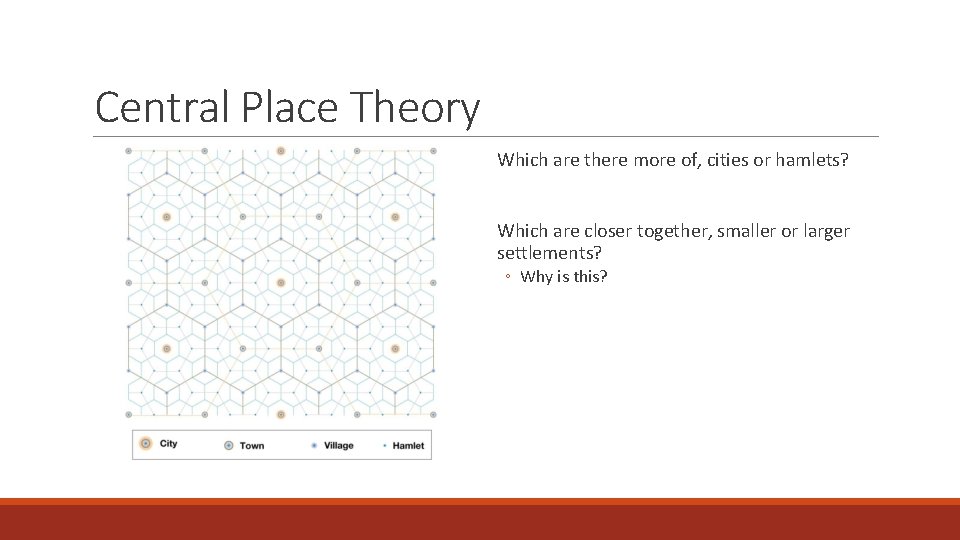
Central Place Theory Which are there more of, cities or hamlets? Which are closer together, smaller or larger settlements? ◦ Why is this?
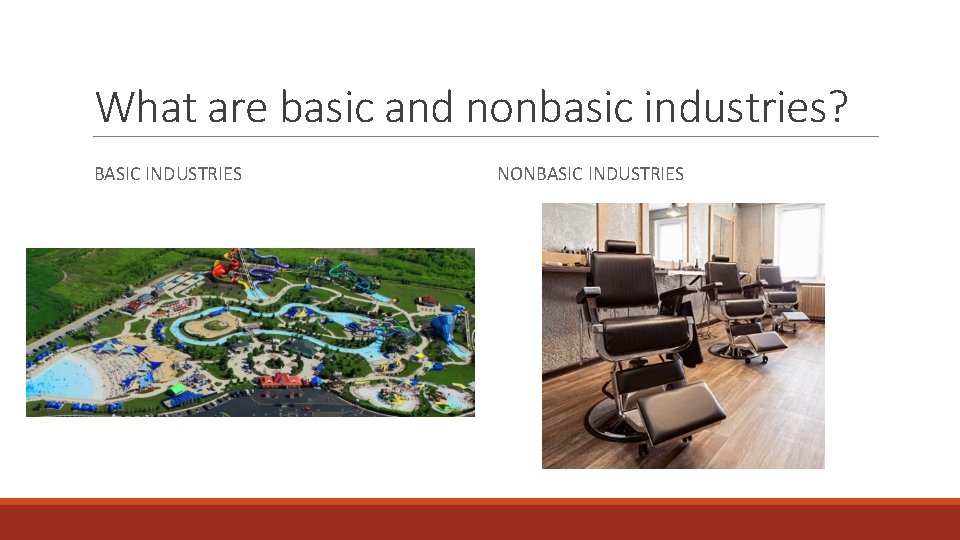
What are basic and nonbasic industries? BASIC INDUSTRIES NONBASIC INDUSTRIES
Chapter 13 CITIES AND URBAN LAND USE
Central Business District (CBD) It is usually centrally located in models Sports centers are usually in CBD’s to boost the service industry economies in the area ◦ Restaurants, bars, hotels, etc. Limited land space in CBD’s does what to the value of the land? With many skyscrapers in CBD’s, what type of economic activity is usually on the street-level? Why don’t you see many industrial business directly in a CBD in North America? When comparing and contrasting European CBD’s and North American CBD’s, they both have retail and offices; Europe has extensive residential use while North America has many skyscrapers
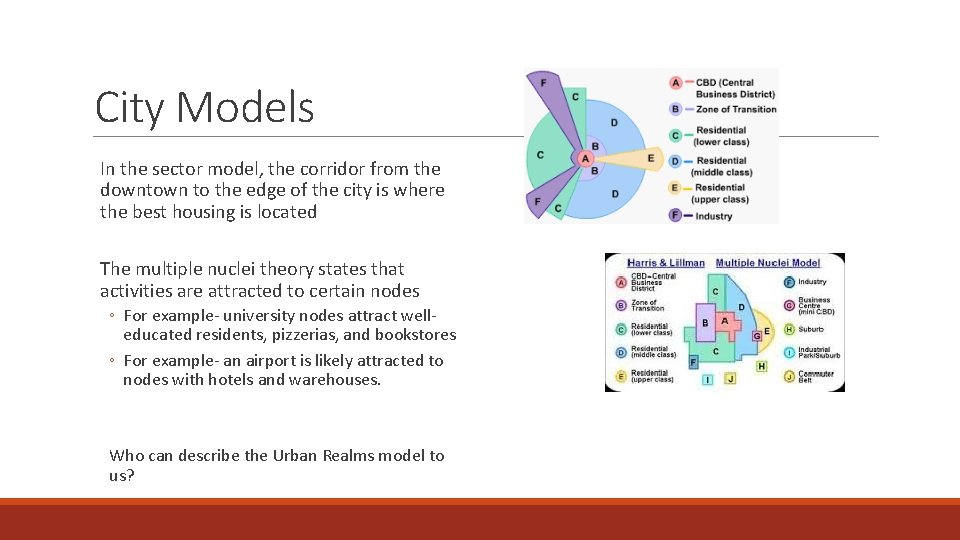
City Models In the sector model, the corridor from the downtown to the edge of the city is where the best housing is located The multiple nuclei theory states that activities are attracted to certain nodes ◦ For example- university nodes attract welleducated residents, pizzerias, and bookstores ◦ For example- an airport is likely attracted to nodes with hotels and warehouses. Who can describe the Urban Realms model to us?
City Models Continued Chicago was a good location to develop a city model because of what? ◦ Differing terrain throughout? ◦ Peaks and valleys? ◦ Mostly flat land?

Urban Areas Basic definition- city plus its surrounding built-up suburbs Hierarchy of size of Urban Areas ◦ ◦ Metropolitan Statistical Area (biggest urban area) Urbanized area Central City CBD (smallest urban area)
Urban Areas outside the U. S. LDC periphery areas of cities (squatter settlements) are known as: ◦ Favelas bidonvilles, bastes, kampongs, or barriadas When comparing and contrasting North American city models to Latin American city models, a noticeable difference is where the rich vs. poor live Suburbs ◦ In the U. S. - most people live here ◦ In Europe- most poor live here
Transportation and Cities PUBLIC TRANSIT CARS Trains Highway system encourages car use European governments subsidize public transit (what does this mean? ) Main use in the U. S. More energy efficiency
Changing Urban Social Geography In U. S. cities, the underclass is largely clustered in inner-city neighborhoods The #1 contribution to the homeless rate is that people cannot afford or maintain a home due to lack of income, mental illness, or family problems The circle of the inner-city is that low-income families are concentrated there, thereby not pouring money into the basic or non-basic industries, keeping it low-income

Don’t forget your vocab! Filtering Gentrification Public housing Megalopolis
Compare/contrast models VON THUNEN BURGESS’ MODEL Agriculture Urban land use Assumes ◦ flat or the same surface throughout ◦ Isolated state ◦ Importance of centrality to the CBD or market Situation (aka relative location) ◦ Grains and grazing are at the periphery because it is low rent and low transportation costs ◦ Perishable items near market because of frequent transportation to the local market ◦ flat or the same surface throughout ◦ Isolated state ◦ Importance of centrality to the CBD or market Situation (aka relative location) ◦ Population density decreases the farther away from the CBD; people move farther away if they can afford transportation
Megacities outside of the U. S. Squatter settlements (favelas, slums, barridos, etc. ) are located at the edge of a city ◦ Undesirable land- steep hills, floodplains, dumps, close to industries, etc. How and why do these form? ◦ Large-scale rural to urban migration ◦ Lack of affordable housing closer to the CBD What problems are prevalent there? ◦ ◦ ◦ Unhealthy living conditions leading to illness and death increases Increase in crime Increase in water pollution due to unsanitary facilities and no trash collection Availability of cheap labor Increased chance for mudslides when on a steep hill
Mexico City Primate City- more than two times the next largest city AND has some sort of social, political, or economic dominance ◦ Mexico City is a Primate City because it is disproportionally larger than the other cities and dominates the country socially, politically, and economically Rank-size rule- Nth largest city is 1/nth smaller than the largest city; results in more smaller cities and fewer larger cities ◦ Mexico city does not follow the rank-size rule because there is no other urban hierarchy in terms of city in Mexico Positives of Primate City ◦ Can take advantage of agglomeration ◦ More services offered because of a higher threshold ◦ Local and large market for goods and services ◦ Global trade opportunities- attract foreign investment Negatives of Primate Cities ◦ ◦ Unequal economic development Unequal distribution of power and wealth Brain drain may occur More people equals less of a chance for political cohesion
Railways and Highways RAILWAYS HIGHWAYS Size of cities: Affect on cities ◦ Stimulated economic growth ◦ People migrated to cities to work on the railways ◦ Railways increased the capacity of corridors Form of cities ◦ Real estate by train stops became more valuable ◦ Formation of CBD around train transportation hubs ◦ Relocation of factories from cities to near highways meant more land cheaper land ◦ Suburbanization happened ◦ Increased air, water, and noise pollution
- Slides: 19