
ServiceLearning This training was developed by the Project
Service-Learning This training was developed by the Project 10: Transition Education Network, a special project funded by the Florida Department of Education, Division of Public Schools, Bureau of Exceptional Education and Student Services, through federal assistance under the Individuals with Disabilities Education Act (IDEA), Part B.
Objectives After this presentation, participants will be able to: 1. Describe what servicelearning is and is not 2. Describe the types of service-learning projects 3. Explore phases and steps for developing a servicelearning program 4. List and provide examples of the K-12 servicelearning standards 5. Summarize the research findings of servicelearning impact upon students 6. Identify service-learning resources and tools
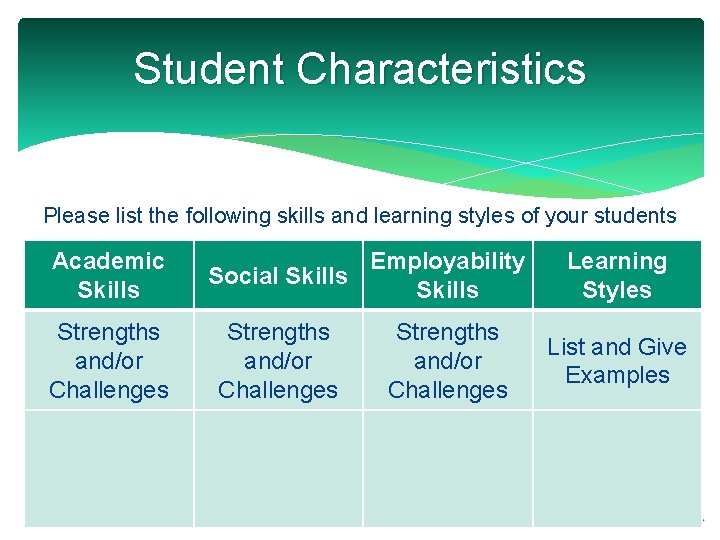
Student Characteristics Please list the following skills and learning styles of your students Academic Skills Social Skills Employability Skills Learning Styles Strengths and/or Challenges List and Give Examples
“Everybody Can be Great, because Everybody can Serve” http: //www. youtube. com/watch? v=Wk. Rdj 9 L 3 wy. E Dr. Martin Luther King Jr. , Ebenezer Baptist Church, 2/4/1968 “To Serve” (Vivanco, 2007)
Service-Learning Defined Service-Learning is a teaching and learning strategy that integrates meaningful community service with instruction and reflection to: § Enrich the learning experience § Teach civic responsibility § Strengthen communities (National Service-Learning Clearinghouse, 2013)
Service-Learning Defined Service-learning is a method of instruction in which classroom learning is enriched and applied through service to others. (Florida Learn and Serve, 2009)
Governor’s Commission on Jobs for Floridians with Disabilities: 2013 Report Recommendation 3 § Increase Work Experiences for Students Receiving a Special Diploma
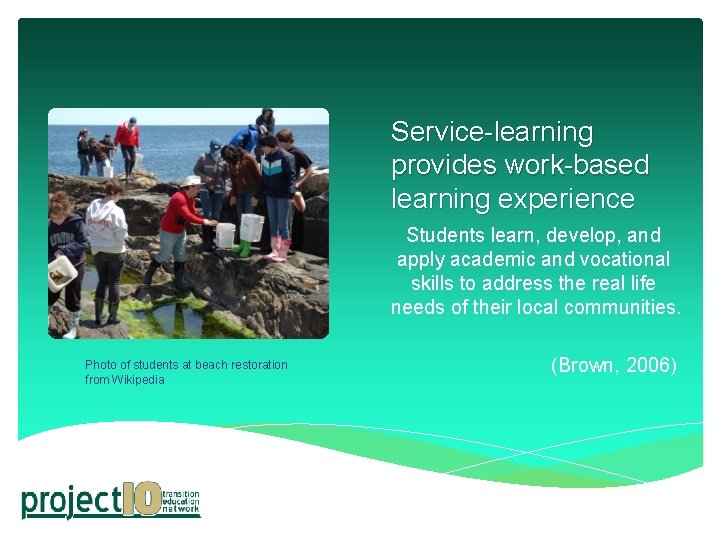
Service-learning provides work-based learning experience Students learn, develop, and apply academic and vocational skills to address the real life needs of their local communities. Photo of students at beach restoration from Wikipedia (Brown, 2006)
Educational Benefits of Service-Learning Research suggests that students in well designed servicelearning projects out-perform their non-serving peers and have positive academic, social, civic, and skill-acquisition impacts. (Florida Learn and Serve, 2009)
Educational Benefits of Service-Learning § Positive, meaningful, and real to the participants § Cooperative rather than competitive experiences § Engages in community-based work experience and problem -solving § Promotes deeper learning because the results are immediate and uncontrived § Supports social, emotional, and cognitive learning and development (Reese, 2010)
Service-Learning is Not: § § § An episodic volunteer program Add-on to existing curriculum Logging of hours to graduate Compensatory or punishment One-sided, benefiting only student or community
Service-Learning is Not an End in Itself It is a strategy/tool/vehicle/method for teachers to more effectively achieve existing instructional goals for students. (Florida Learn and Serve, 2009)
Service-Learning Process § The link to specific curriculum objectives distinguishes service-learning from community service and volunteerism § The service-learning process explicitly involves: • Preparation • Action • Reflection • Celebration (Learn and Serve America, 2013)
Service-Learning Answers the Age-old Student Question Q “Why do I have to learn this stuff. . ? ” A Because it puts coursework into context (Reese, 2010)
Florida Service-Learning Projects Since 1991, Florida has provided funding, training and technical assistance for over 3, 000 service-learning projects (Florida Learn and Serve, 2009)
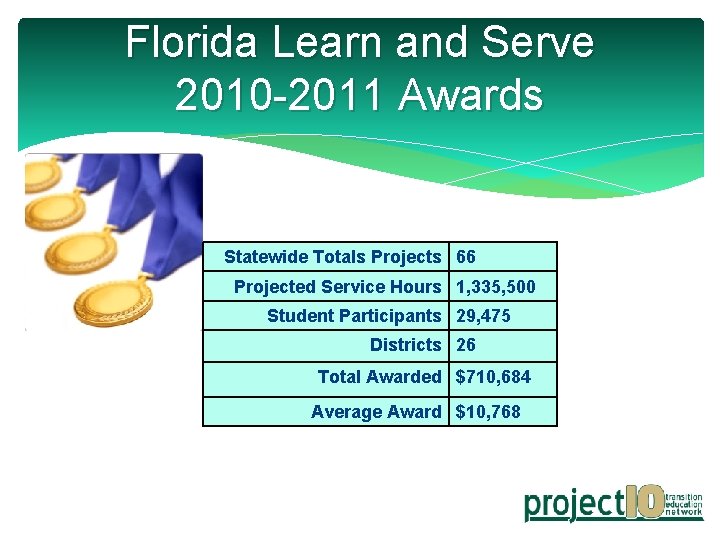
Florida Learn and Serve 2010 -2011 Awards Statewide Totals Projects 66 Projected Service Hours 1, 335, 500 Student Participants 29, 475 Districts 26 Total Awarded $710, 684 Average Award $10, 768
Promoting Inclusive Education Through Service-Learning § It meets the needs of all students § Enables students with disabilities to receive communitybased instruction with their peers without disabilities § Develops a sense of community among students (Gent & Gurecka, 1998)
The Benefit of Service-Learning to Schools Examples: § Planting flowers to beautify the grounds of home school § High school students tutoring elementary students in reading or math (Dymond, Renzaglia, & Chun, 2007)
Bringing Learning to Life http: //www. youtube. com/watch? v=o 2 -eo. Ei 6 FCo (Service Resources, 2009 a)
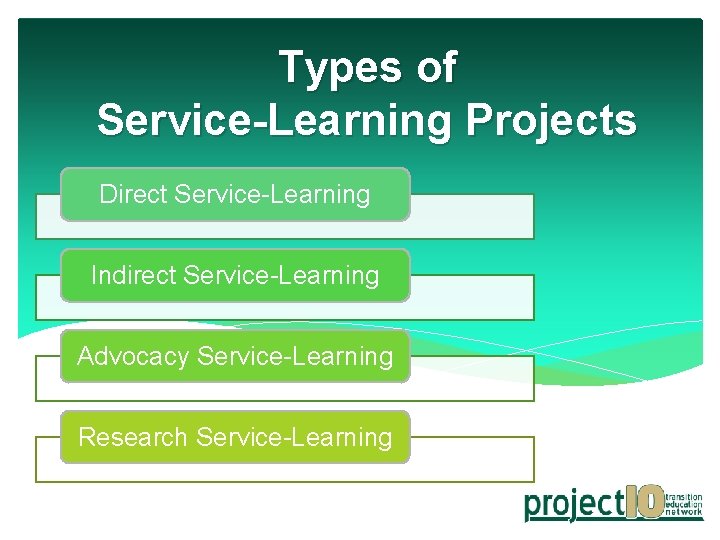
Types of Service-Learning Projects Direct Service-Learning Indirect Service-Learning Advocacy Service-Learning Research Service-Learning
Direct Service-Learning Service that impacts individuals who receive direct help from students, e. g. , person to person, face-to-face § Examples: tutoring, work with elderly, oral histories, peer mediation § Impact Upon Students • Caring for others, dependability, patience, personal responsibility, getting along with others who are different, people skills (Florida Learn and Serve, 2009)
Indirect Service-Learning Projects that benefit community as opposed to individuals § Examples: environmental, construction, restoration, town histories, food and clothing drives § Impact on students • Develops cooperation and teamwork • Big picture learning • Organization and prioritizing skill development (Florida Learn and Serve 2009)
Advocacy Service-Learning Projects that create awareness of issues of public interest § Examples: promoting reading, safety, care for environment, local history, violence and drug prevention, disaster preparedness § Impact Upon Students • Perseverance, engaged citizenship, working with adults and elected officials, understanding rules, compromise (Florida Learn and Serve 2009)
Research Service-Learning Projects that involved gathering and reporting of information on topics of public interest § Examples: Water testing, energy audits of homes or public buildings, flora and fauna studies, surveys § Impact Upon Students • Learn methods of inquiry/problem solving, find information, form and test hypotheses, organize, assess, measure, predict, and evaluate (Florida Learn and Serve 2009)
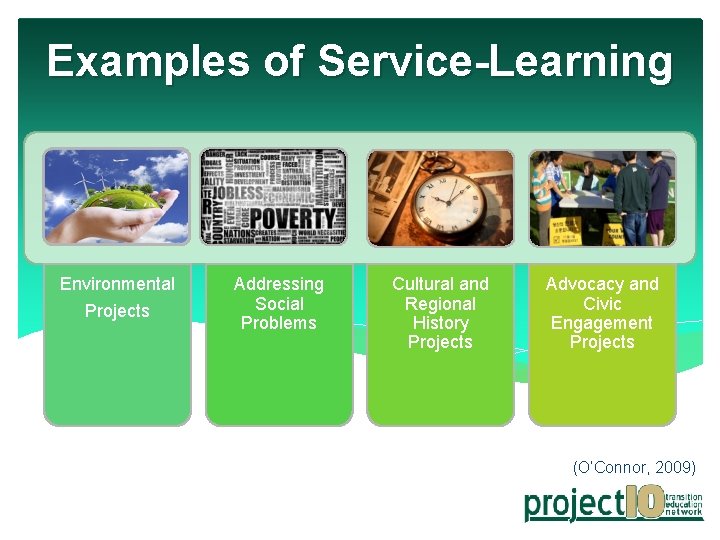
Examples of Service-Learning Environmental Projects Addressing Social Problems Cultural and Regional History Projects Advocacy and Civic Engagement Projects (O’Connor, 2009)
Environmental Projects § Students engage in research involving natural areas such as streams, wetlands, and forests § Students gather and analyze scientific data (testing water quality) with the assistance of environmental professionals and report findings (O’Connor, 2009)
Addressing Social Problems § Students address local social issues such as: § homelessness § hunger § literacy § Action § food or clothing drive § tutoring younger students or adults in literacy Tying these activities into student research and writing regarding the identified social issues (O’Connor, 2009)
Cultural and Historical Projects § Students research and compile historical and/or cultural information relevant to their local communities or regions § May interview adults in the community, record important cultural information passed down from previous generations § Disseminate the information through writing, paintings, film or internet sites (O’Connor, 2009)
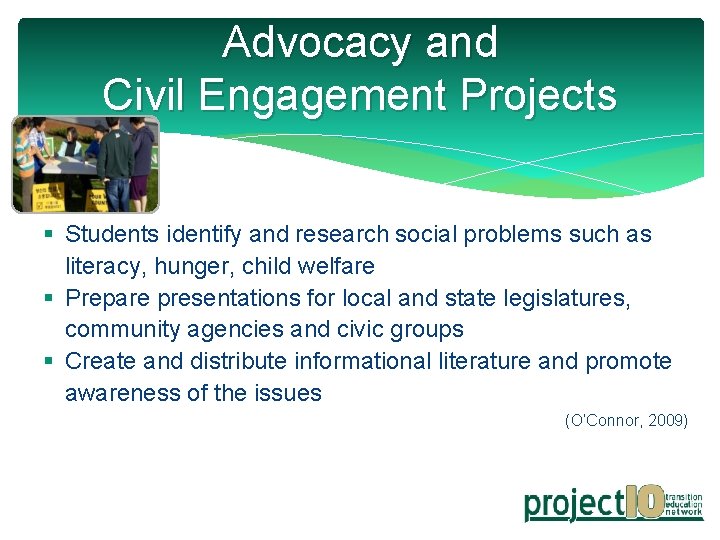
Advocacy and Civil Engagement Projects § Students identify and research social problems such as literacy, hunger, child welfare § Prepare presentations for local and state legislatures, community agencies and civic groups § Create and distribute informational literature and promote awareness of the issues (O’Connor, 2009)
School-Based Service-Learning Benefit the Community Example: High school students in a construction class repaired beds for a homeless shelter because the school-setting allowed controlled access to dangerous equipment. (Dymond, Renzaglia, & Chun, 2007)
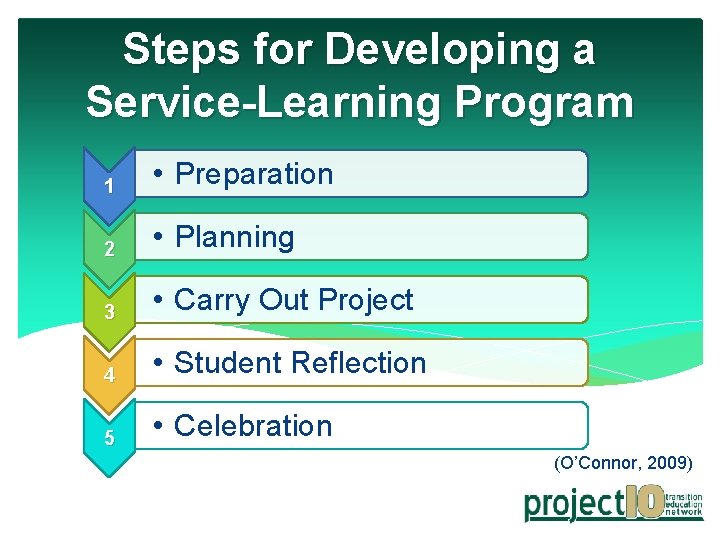
Steps for Developing a Service-Learning Program 1 • Preparation 2 • Planning 3 • Carry Out Project 4 • Student Reflection 5 • Celebration (O’Connor, 2009)
Step Preparation 1 Hold brainstorming sessions with students to identify and discuss the following: § Community problems that might be addressed in a project § Possible solutions § Learning objectives and standards that will be addressed in the project § Goal of the selected project (O’Connor, 2009)
Step Planning 2 § Have students organize the project; develop an action plan § Define student roles and responsibilities within the project § Integrate instruction (how learning standards and objectives will be addressed in the project) § Identify community and school partners needed for project (O’Connor, 2009)
Step Carry Out Project 3 Provide structured opportunities for students to: § Document the project, give feedback, and discuss possible problems and solutions § Discuss the meaning of the project in class § Receive teacher feedback on their work and collaborative skills (O’Connor, 2009)
Step Student Reflection 4 Provide structured opportunities to reflect on the significance of the project after completion: § Analyze the significance to the community, academic significance, their own personal roles and emotional reaction to the experience § Reflections may be written, or a presentation to class or other methods depending on the student’s ability (O’Connor, 2009)
Step Celebration 5 Set aside time after service-learning activity for celebration: § Occurs with all participants (school and community) § Participants celebrate each other § May involve a final product that’s given to the community at the time of the celebration § Can be informal or formal § Should occur immediately after a project (Dymond, Renzaglia, & Chun, 2007)
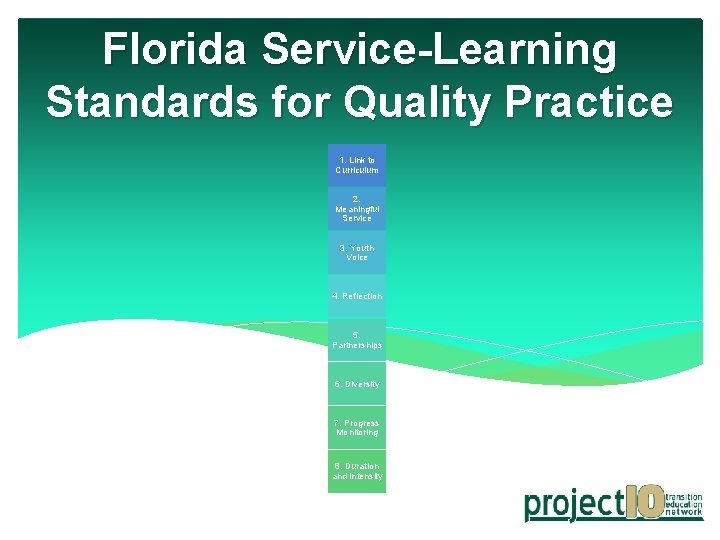
Florida Service-Learning Standards for Quality Practice 1. Link to Curriculum 2. Meaningful Service 3. Youth Voice 4. Reflection 5. Partnerships 6. Diversity 7. Progress Monitoring 8. Duration and Intensity
1 Link to Curriculum Indicators Service-Learning: § Has clearly articulated learning goals § Is aligned with the academic and/or programmatic curriculum § Helps students learn how to transfer knowledge and skills from one setting to another § Is formally recognized in school district policies and student records (Florida Learn and Serve, 2009)
2 Meaningful Service Indicators Service-Learning: § Experiences are appropriate to students ages and developmental abilities § Addresses issues that are personally relevant to participants § Provides interesting and engaging service activities § Leads to attainable and visible outcomes that are valued by those being served (Florida Learn and Serve, 2009)
3 Youth Voice Indicators Service-Learning: § Leads to attainable and visible outcomes that are valued by those being served § Engages youth in generating ideas during the planning, implementation, and evaluation process § Involves youth in the decision-making process throughout the experience § Promotes leadership and decision making skills (Florida Learn and Serve, 2009)
4 Reflection Indicators Service-Learning: § Includes a variety of verbal, written, artistic, and nonverbal activities to demonstrate understanding and change in participants knowledge, skills, and/or attitudes § Provides opportunities for reflection before, during, and after the service experience (Florida Learn and Serve, 2009)
5 Partnerships Indicators Service-Learning: § Involves a variety of partners, including youth, educators, families, community members, community-based organizations, and/or businesses § Partners collaboratively develop and implement action plans to meet specific goals (Florida Learn and Serve, 2009)
6 Diversity Indicators Service-Learning: § Promotes development of interpersonal skills in conflict resolution and group decision-making § Supports identification and analyses of different points of view to gain understanding of multiple perspectives (Florida Learn and Serve, 2009)
7 Progress Monitoring Indicators Service-Learning: § Supports the collection of evidence of progress toward meeting specific service goals and learning outcomes from multiple sources throughout the service-learning experience § Uses evidence to improve service-learning experiences (Florida Learn and Serve, 2009)
8 Duration and Intensity Indicators Service-Learning: § Includes the processes of investigating community needs, preparing for service, action, reflection, demonstration of learning and impacts, and celebration § Is conducted during concentrated blocks of time across a period of several weeks or months (Florida Learn and Serve, 2009)
Service-Learning Research Findings
Service-Learning Research Findings Service-Learning participation improved students’: § Attendance and grade point § Career awareness and average options § Ability to work with well with § Acceptance of cultural others diversity § Leadership and § Pre-employment skills and communications skills job readiness and workforce preparation § Personal and social responsibility (Dymond, Renzagalia, & Chun, 2007; Brown, 2006)
Service-Learning Research Findings Service-Learning participation improved students’: § Pre-employment skills and job readiness and workforce preparation § Engagement with schools and attendance § Attitudes towards schools § Behavior and decreased discipline actions (Brown, 2006; Mc. Pherson, 1997)
Students’ Top Ten Reasons to Participate in Service-Learning 1. Lets you know you have 4. made a positive difference in the community 2. Promotes diversity 5. 3. Allows you to see the results and impacts of your work in the community Provides the chance to explore careers and get job experience Boosts self-confidence and brings personal gratification (Florida Learn and Serve, 2009)
Students’ Top Ten Reasons to Participate in Service-Learning 6. Challenges you, your attitudes, and your abilities 7. Helps you make new friends, contacts, and networks 8. Makes learning fun and real 9. Broadens horizons and perspectives 10. Teaches practical skills and gives career exploration (Florida Learn and Serve, 2009)
Service-Learning: Turning Ideas Into Action http: //www. youtube. com/watch? v=4 JE_zm. CUDtg (Service Resources, 2009 b)
References/Resources Brown, B. L. (2006). Service-learning: More than community service. ERIC. Retrieved from http: //www. education. com/print/Ref_Service_Learning / Dymond, S. K. , Renzaglia, A. , and Chun, E. (2007). Elements of effective school servicelearning programs that include students with and without disabilities. Remedial and Special Education, 28(4), 227 -243. Retrieved from http: //eric. ed. gov/? id=EJ 772683 Dymond, S. K. , Renzaglia, A. , and Chun, E. (2008). Inclusive high school service-learning programs: Methods for and barriers to including students with disabilities. Education and Training in Developmental Disabilities. 43 (1), 20 -35. Florida Department of Education, Bureau of Family and Community Outreach. (2009). Standards for service-learning in Florida: A guide for creating and sustaining quality practice. Tallahassee, FL. Retrieved from http: //www. fsu. edu/~flserve/resources/SL%20 Standards%20 for%20 SL%20 in%20 FL. pdf Follman, Joseph. (1998). Florida learn and serve 1997 -98 outcomes and correlations with 1994 -95, 1995 -96 and 1996 -97. Tallahassee, FL: Florida State University, Center for Civic Education and Service. Retrieved from http: //www. fsu. edu/~flserve/resources/outcome. pdf Gent, P. J. , and Gurecka, L. E. (1998). Service-learning: A creative strategy for inclusive classrooms. The Journal of the Association for Persons with Severe Handicaps, 23, 261271. Retrieved from http: //eric. ed. gov/? id=EJ 599155
References/Resources Governor’s Commission on Jobs for Floridians with Disabilities. (2013). 2013 Report. Retrieved from http: //www. flgov. com/gcjfd/ League Michigan, The. (2010). What is service learning? Retrieved from http: //www. youtube. com/watch? v=q. DAQDg 56 VDsandlist=PLCAF 3 C 40 FDB 8 FA 58 E Mc. Pherson, K. (1997). Service-learning: Making a difference in the community. Schools in the Middle, 6, (3), 9 -15. National Youth Leadership Council (2010). Growing to greatness 2010: The state of service -learning. Retrieved from http: //www. nylc. org/sites/nylc. org/files/G 2 G 2010_0. pdf National Youth Leadership Council. (2014). National service-learning clearinghouse. Retrieved from http: //gsn. nylc. org/clearinghouse New York State Education Department, K-16 Initiatives and Access Programs. (2014). Learn and serve America: K-12 school-based program (LSA). Retrieved from http: //www. highered. nysed. gov/kiap/LEARNANDSERVE/ O’Connor, M. P. (2009). Service works! Promoting success for students with disabilities through participation in service-learning. Teaching Exceptional Children, 41 (6), 13 -17. Olnes, L. (2008). Special projects for special people: Students with disabilities serve others through Service-Learning projects. Teaching Exceptional Children Plus, 5(2), 1 -13.
References/Resources Reese, S. (2010). Learning and serving through CTE. Career and Technical Education Online, 16 -20. Retrieved from https: //www. acteonline. org/uploaded. Files/Assets_and_Documents/Global/files/Publicatio ns/Techniques/2010/tech_apr 10_Learning_and_Service_Through_CTE. pdf Service Resources. (2009 a). Bringing learning to life. Retrieved from http: //www. youtube. com/watch? v=o 2 -eo. Ei 6 FCo&feature=youtu. be Service Resources. (2009 b). Service-learning: Turning ideas into action. Retrieved from http: //www. youtube. com/watch? v=4 JE_zm. CUDtgandlist=PLCAF 3 C 40 FDB 8 FA 58 Eandin dex=2 Vivanco, A. (2007, Jan 15). Dr. Martin Luther King Jr. (To serve). Retrieved from http: //www. youtube. com/watch? v=Wk. Rdj 9 L 3 wy. E
Questions and Thank You! Questions, concerns, or recommendations? Thank you for your attendance and input today!
Presenter Contact Information (RTR Name) Project 10: Transition Education Network Region ( ) Transition Representative Email: Office: www. Project 10. info Updated June 2014
- Slides: 56