
Service teaching statistics to nonstatisticians opportunities and challenges
- Slides: 20
Service teaching statistics to non-statisticians: opportunities and challenges Gillian Lancaster Svetlana Tishkovskaya Ruth Allen Postgraduate Statistics Centre Lancaster University Centre for Excellence in Teaching and Learning
Overview • Lancaster Postgraduate Statistics Centre • Service teaching for biological sciences: an evaluation • Service teaching: case studies, opportunities and challenges • Recommendations and conclusions Centre for Excellence in Teaching and Learning
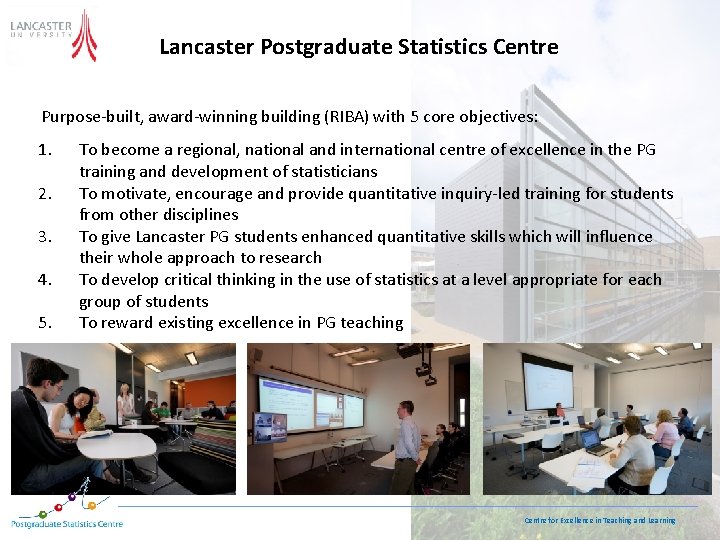
Lancaster Postgraduate Statistics Centre Purpose-built, award-winning building (RIBA) with 5 core objectives: 1. 2. 3. 4. 5. To become a regional, national and international centre of excellence in the PG training and development of statisticians To motivate, encourage and provide quantitative inquiry-led training for students from other disciplines To give Lancaster PG students enhanced quantitative skills which will influence their whole approach to research To develop critical thinking in the use of statistics at a level appropriate for each group of students To reward existing excellence in PG teaching Centre for Excellence in Teaching and Learning
Ten Action Points: 1. Extend and enhance existing opportunities for PG statistics students e. g. MSc pathways 2. To expand our innovative style of inquiry-led statistics teaching into other disciplines 3. To develop innovative biomedical courses within the new medical school 4. To develop collaborations with other institutions to provide specialist training 5. To provide motivational and focussed PG training workshops in a range of disciplines 6. To instigate a Master Class programme in emerging substantive areas with visiting experts 7. To develop a visiting fellow scheme 8. To expand the use of web-based teaching, video material and on-line datasets 9. To develop teaching excellence in our new statistics lecturers 10. To further enhance and reward the teaching excellence of all staff Centre for Excellence in Teaching and Learning
Postgraduates in last 5 years § Service taught 690 students across all faculties § 95 Master’s students within the department § 780 external/internal participants on Short Course programme
Service teaching for biological sciences: an evaluation Ruth Allen, Andy Folkard, Bev Abram, Gill Lancaster
Postgraduate students from other disciplines: challenges § Misconception of statistics – relating to worth of statistical data. § Intrinsic or learned fear of the subject e. g. from school – shy away § ‘Foreign’, complicated sounding concepts to learn § Self-perceived lack of numeracy (Garfield, 1995) Resultant ‘statistics anxiety’ is exacerbated by waning emphasis on statistical thinking and reasoning and tendency to focus on theoretical concepts (Verhoeven, 2006) May carry the mistrust and misunderstanding of statistics and how to best use and understand them, as in the wider population – despite reaching PG level they may have received as little exposure to stats as an UG or school student! Little published data on service teaching especially in the biological sciences (Garfield, 2002). At Tertiary level education challenges include: Pressures of decreasing time slots for stats, insufficient training of instructors, communication between departments and competition for student time.
Evaluation of service teaching for the biological sciences § prompted by the creation of PSC to enhance existing work of the dept § to try and access an understudied group – what are their particular strengths and weaknesses – getting to know the service taught student § to enhance best practice by acting on weaknesses and promoting strengths Interviews and questionnaires to the PG students AND key staff from the biological Science centre – integrated, rounded approach. Only time today for ‘student perspective’ – see forthcoming paper for staff perspective 63 students completed the online questionnaire – 78% of total registered students in 2007/2008
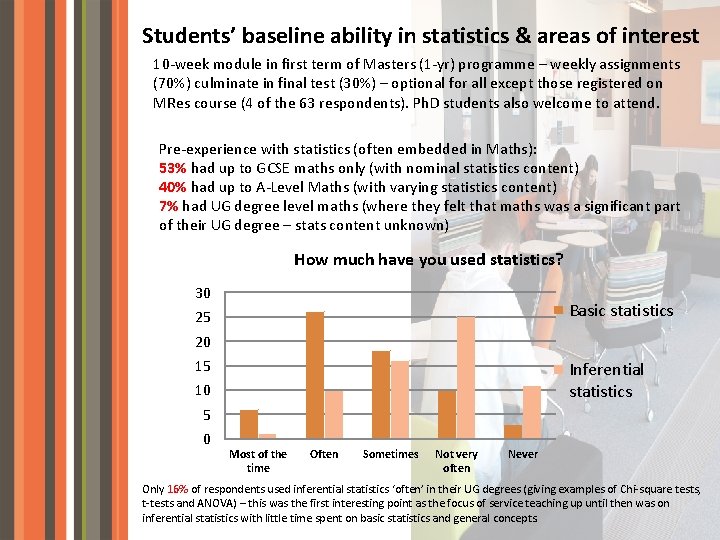
Students’ baseline ability in statistics & areas of interest 10 -week module in first term of Masters (1 -yr) programme – weekly assignments (70%) culminate in final test (30%) – optional for all except those registered on MRes course (4 of the 63 respondents). Ph. D students also welcome to attend. Pre-experience with statistics (often embedded in Maths): 53% had up to GCSE maths only (with nominal statistics content) 40% had up to A-Level Maths (with varying statistics content) 7% had UG degree level maths (where they felt that maths was a significant part of their UG degree – stats content unknown) How much have you used statistics? 30 Basic statistics 25 20 15 Inferential statistics 10 5 0 Most of the time Often Sometimes Not very often Never Only 16% of respondents used inferential statistics ‘often’ in their UG degrees (giving examples of Chi-square tests, t-tests and ANOVA) – this was the first interesting point as the focus of service teaching up until then was on inferential statistics with little time spent on basic statistics and general concepts.
Topics covered § § Perception of statistical ability Current provision and resources Problems and problem solving Future directions and improvements
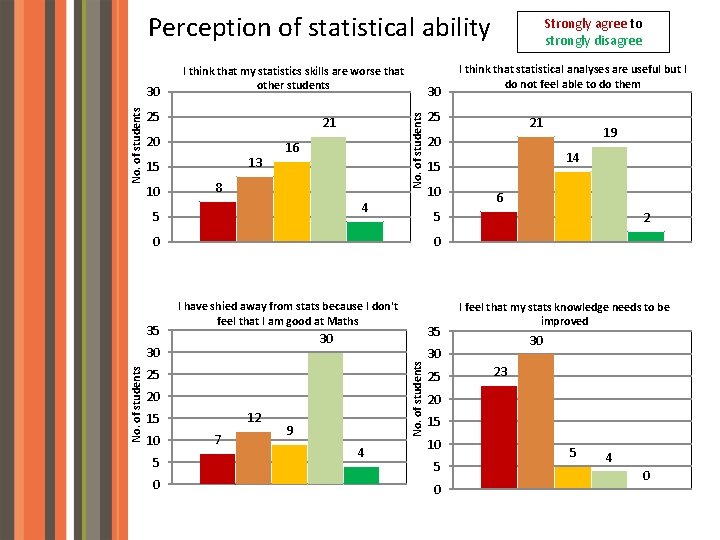
Perception of statistical ability 25 21 20 13 15 10 30 No. of students 30 I think that my statistics skills are worse that other students 16 8 4 5 I have shied away from stats because I don't feel that I am good at Maths No. of students 20 12 15 0 21 20 10 19 14 15 35 30 25 5 25 6 2 0 30 10 I think that statistical analyses are useful but I do not feel able to do them 5 0 35 Strongly agree to strongly disagree 7 9 4 I feel that my stats knowledge needs to be improved 30 30 25 23 20 15 10 5 4 0
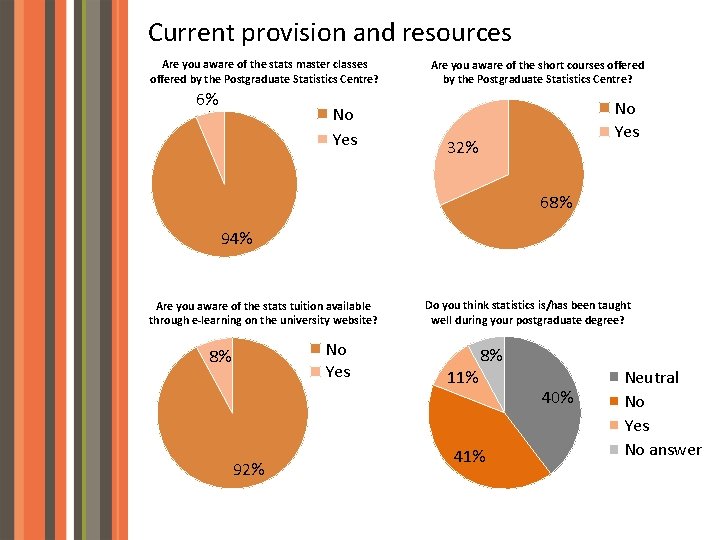
Current provision and resources Are you aware of the stats master classes offered by the Postgraduate Statistics Centre? 6% No Yes Are you aware of the short courses offered by the Postgraduate Statistics Centre? No Yes 32% 68% 94% Are you aware of the stats tuition available through e-learning on the university website? No Yes 8% 92% Do you think statistics is/has been taught well during your postgraduate degree? 8% 11% 40% Neutral No Yes No answer
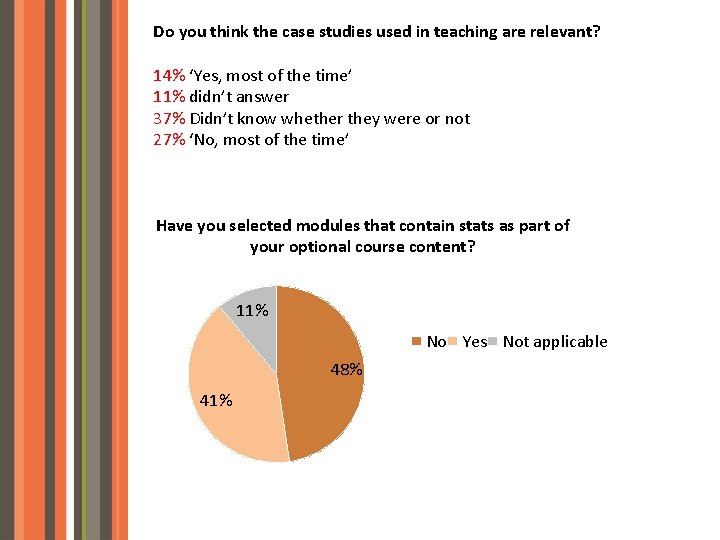
Do you think the case studies used in teaching are relevant? 14% ‘Yes, most of the time’ 11% didn’t answer 37% Didn’t know whether they were or not 27% ‘No, most of the time’ Have you selected modules that contain stats as part of your optional course content? 11% No Yes Not applicable 48% 41%
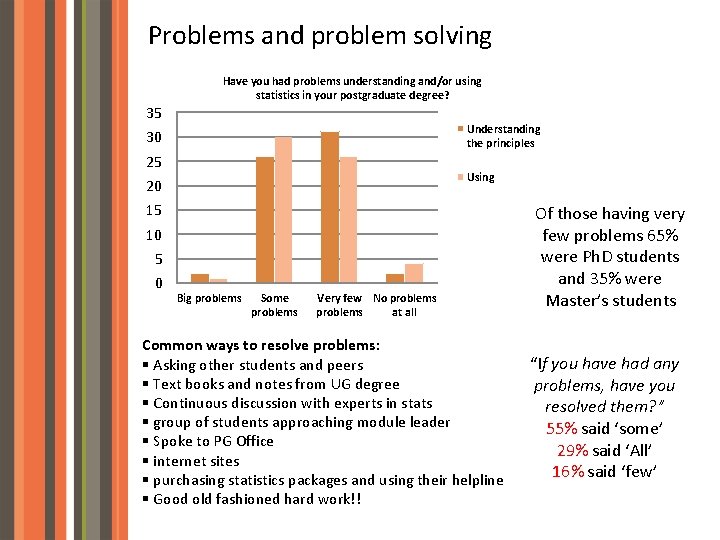
Problems and problem solving Have you had problems understanding and/or using statistics in your postgraduate degree? 35 Understanding the principles 30 25 Using 20 15 10 5 0 Big problems Some problems Very few No problems at all Common ways to resolve problems: § Asking other students and peers § Text books and notes from UG degree § Continuous discussion with experts in stats § group of students approaching module leader § Spoke to PG Office § internet sites § purchasing statistics packages and using their helpline § Good old fashioned hard work!! Of those having very few problems 65% were Ph. D students and 35% were Master’s students “If you have had any problems, have you resolved them? ” 55% said ‘some’ 29% said ‘All’ 16% said ‘few’
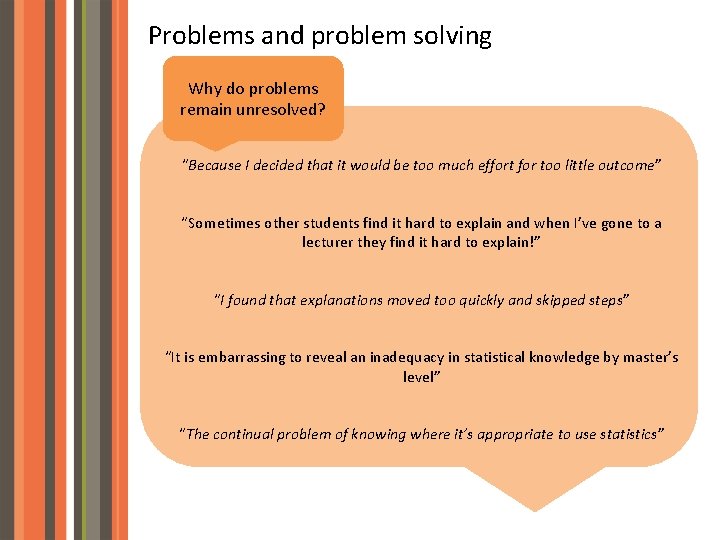
Problems and problem solving Why do problems remain unresolved? “Because I decided that it would be too much effort for too little outcome” “Sometimes other students find it hard to explain and when I’ve gone to a lecturer they find it hard to explain!” “I found that explanations moved too quickly and skipped steps” “It is embarrassing to reveal an inadequacy in statistical knowledge by master’s level” “The continual problem of knowing where it’s appropriate to use statistics”
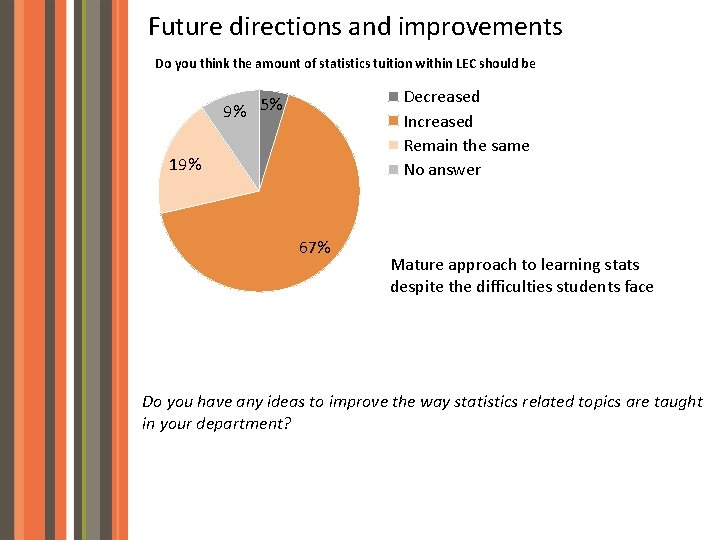
Future directions and improvements Do you think the amount of statistics tuition within LEC should be Decreased Increased Remain the same No answer 9% 5% 19% 67% Mature approach to learning stats despite the difficulties students face Do you have any ideas to improve the way statistics related topics are taught in your department?
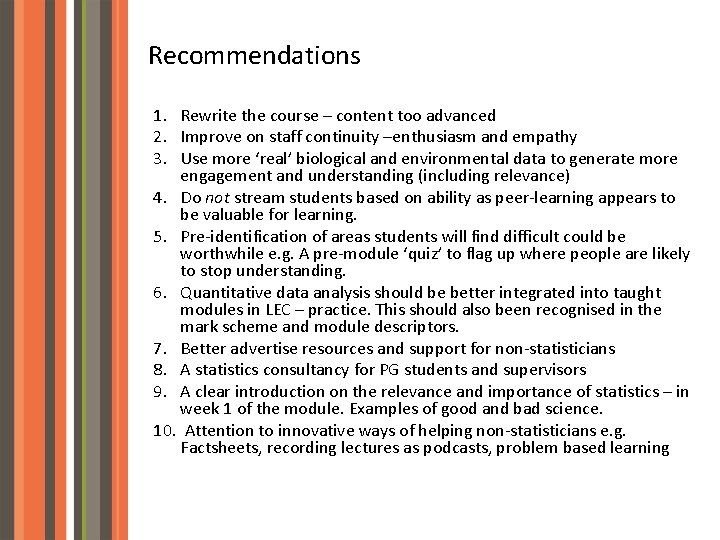
Recommendations 1. Rewrite the course – content too advanced 2. Improve on staff continuity –enthusiasm and empathy 3. Use more ‘real’ biological and environmental data to generate more engagement and understanding (including relevance) 4. Do not stream students based on ability as peer-learning appears to be valuable for learning. 5. Pre-identification of areas students will find difficult could be worthwhile e. g. A pre-module ‘quiz’ to flag up where people are likely to stop understanding. 6. Quantitative data analysis should be better integrated into taught modules in LEC – practice. This should also been recognised in the mark scheme and module descriptors. 7. Better advertise resources and support for non-statisticians 8. A statistics consultancy for PG students and supervisors 9. A clear introduction on the relevance and importance of statistics – in week 1 of the module. Examples of good and bad science. 10. Attention to innovative ways of helping non-statisticians e. g. Factsheets, recording lectures as podcasts, problem based learning
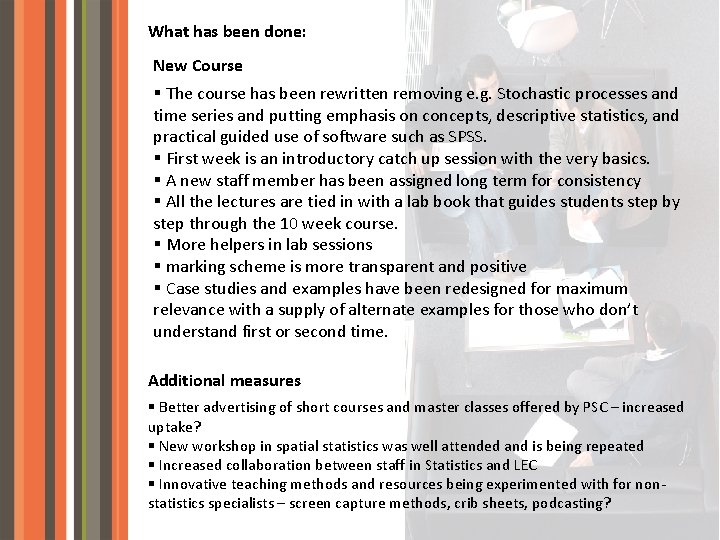
What has been done: New Course § The course has been rewritten removing e. g. Stochastic processes and time series and putting emphasis on concepts, descriptive statistics, and practical guided use of software such as SPSS. § First week is an introductory catch up session with the very basics. § A new staff member has been assigned long term for consistency § All the lectures are tied in with a lab book that guides students step by step through the 10 week course. § More helpers in lab sessions § marking scheme is more transparent and positive § Case studies and examples have been redesigned for maximum relevance with a supply of alternate examples for those who don’t understand first or second time. Additional measures § Better advertising of short courses and master classes offered by PSC – increased uptake? § New workshop in spatial statistics was well attended and is being repeated § Increased collaboration between staff in Statistics and LEC § Innovative teaching methods and resources being experimented with for nonstatistics specialists – screen capture methods, crib sheets, podcasting?
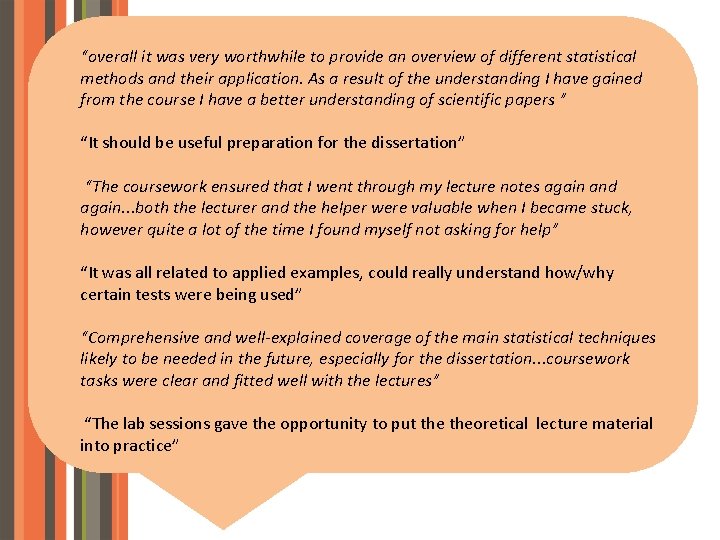
2008/09 Module Feedback “overall it was very worthwhile to provide an overview of different statistical methods and their application. As a result of the understanding I have gained from the course I have a better understanding of scientific papers ” “It should be useful preparation for the dissertation” “The coursework ensured that I went through my lecture notes again and again. . . both the lecturer and the helper were valuable when I became stuck, however quite a lot of the time I found myself not asking for help” “It was all related to applied examples, could really understand how/why certain tests were being used” “Comprehensive and well-explained coverage of the main statistical techniques likely to be needed in the future, especially for the dissertation. . . coursework tasks were clear and fitted well with the lectures” “The lab sessions gave the opportunity to put theoretical lecture material into practice”
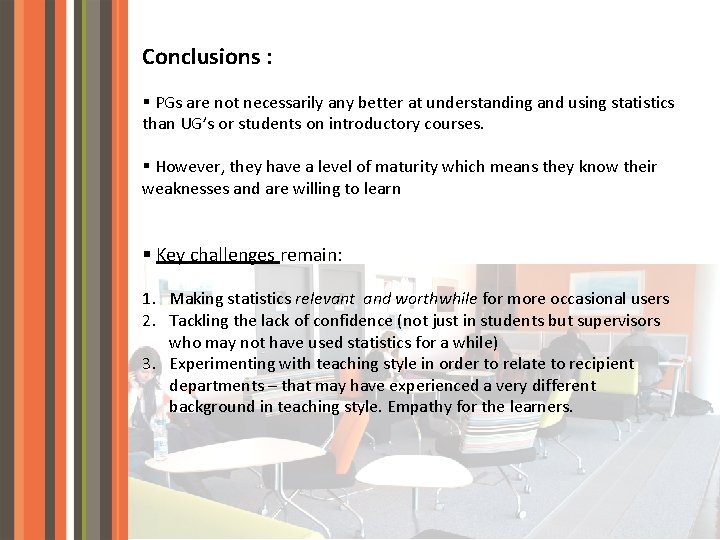
Conclusions : § PGs are not necessarily any better at understanding and using statistics than UG’s or students on introductory courses. § However, they have a level of maturity which means they know their weaknesses and are willing to learn § Key challenges remain: 1. Making statistics relevant and worthwhile for more occasional users 2. Tackling the lack of confidence (not just in students but supervisors who may not have used statistics for a while) 3. Experimenting with teaching style in order to relate to recipient departments – that may have experienced a very different background in teaching style. Empathy for the learners.