
SERVICE STRATEGY Chapter 2 Mc GrawHillIrwin Copyright 2014
- Slides: 48
SERVICE STRATEGY Chapter 2 Mc. Graw-Hill/Irwin Copyright © 2014 by The Mc. Graw-Hill Companies, Inc. All rights reserved.
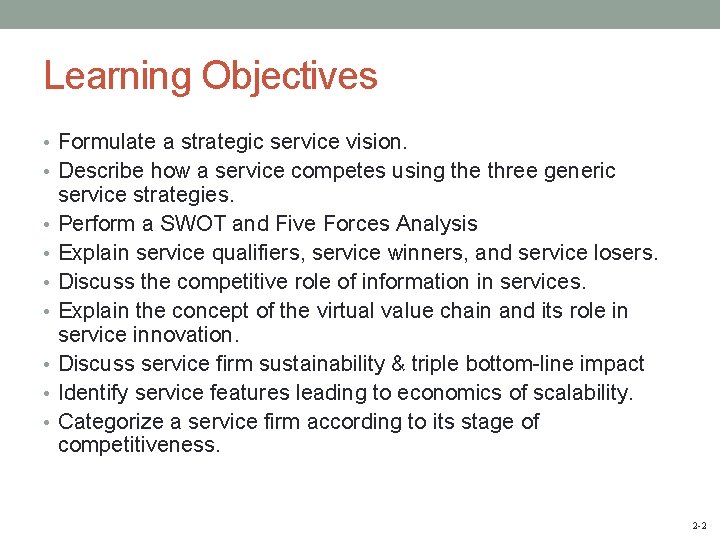
Learning Objectives • Formulate a strategic service vision. • Describe how a service competes using the three generic • • service strategies. Perform a SWOT and Five Forces Analysis Explain service qualifiers, service winners, and service losers. Discuss the competitive role of information in services. Explain the concept of the virtual value chain and its role in service innovation. Discuss service firm sustainability & triple bottom-line impact Identify service features leading to economics of scalability. Categorize a service firm according to its stage of competitiveness. 2 -2
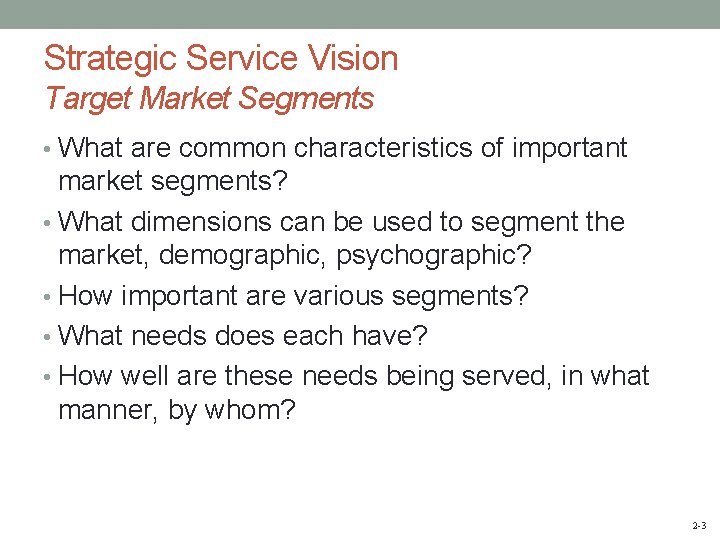
Strategic Service Vision Target Market Segments • What are common characteristics of important market segments? • What dimensions can be used to segment the market, demographic, psychographic? • How important are various segments? • What needs does each have? • How well are these needs being served, in what manner, by whom? 2 -3
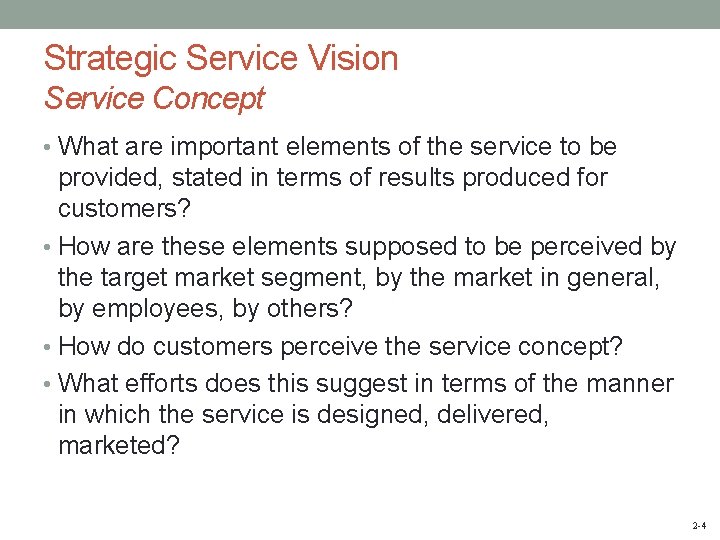
Strategic Service Vision Service Concept • What are important elements of the service to be provided, stated in terms of results produced for customers? • How are these elements supposed to be perceived by the target market segment, by the market in general, by employees, by others? • How do customers perceive the service concept? • What efforts does this suggest in terms of the manner in which the service is designed, delivered, marketed? 2 -4
Strategic Service Vision Operating Strategy • What are important elements of the strategy: operations, financing, marketing, organization, human resources, control? • On which will the most effort be concentrated? • Where will investments be made? • How will quality and cost be controlled: measures, incentives, rewards? • What results will be expected versus competition in terms of, quality of service, cost profile, productivity, morale/loyalty of servers? 2 -5
Strategic Service Vision Service Delivery System • What are important features of the service delivery system including: role of people, technology, equipment, layout, procedures? • What capacity does it provide, normally, at peak levels? • To what extent does it help to ensure quality standards, differentiate the service from competition, provide barriers to entry by competitors? 2 -6
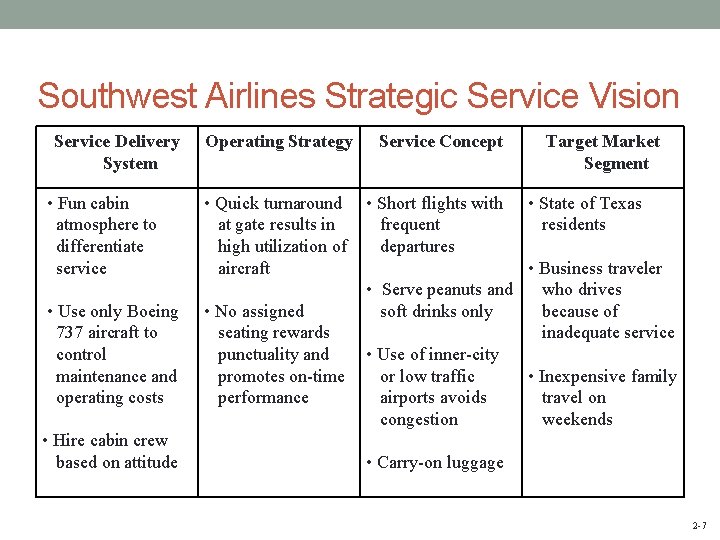
Southwest Airlines Strategic Service Vision Service Delivery System Operating Strategy • Fun cabin atmosphere to differentiate service • Quick turnaround at gate results in high utilization of aircraft • Use only Boeing 737 aircraft to control maintenance and operating costs • No assigned seating rewards punctuality and promotes on-time performance • Hire cabin crew based on attitude Service Concept • Short flights with frequent departures Target Market Segment • State of Texas residents • Business traveler • Serve peanuts and who drives soft drinks only because of inadequate service • Use of inner-city or low traffic • Inexpensive family airports avoids travel on congestion weekends • Carry-on luggage 2 -7
Competitive Environment of Services • Relatively Low Overall Entry Barriers • Economies of Scale Limited • High Transportation Costs • Erratic Sales Fluctuations • No Power Dealing with Buyers or Suppliers • Product Substitutions for Service • High Customer Loyalty • Strong Exit Barriers 2 -8
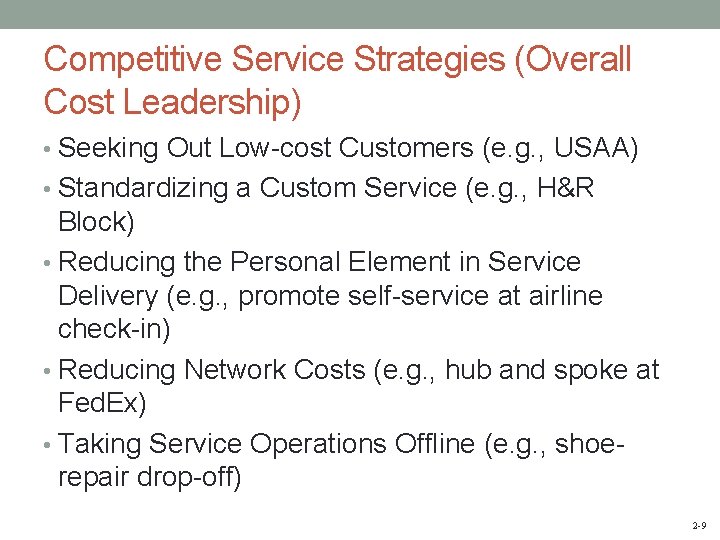
Competitive Service Strategies (Overall Cost Leadership) • Seeking Out Low-cost Customers (e. g. , USAA) • Standardizing a Custom Service (e. g. , H&R Block) • Reducing the Personal Element in Service Delivery (e. g. , promote self-service at airline check-in) • Reducing Network Costs (e. g. , hub and spoke at Fed. Ex) • Taking Service Operations Offline (e. g. , shoerepair drop-off) 2 -9
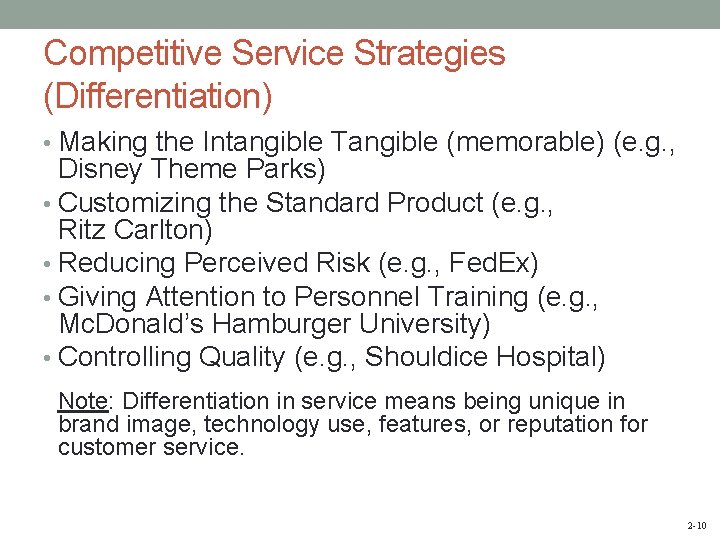
Competitive Service Strategies (Differentiation) • Making the Intangible Tangible (memorable) (e. g. , Disney Theme Parks) • Customizing the Standard Product (e. g. , Ritz Carlton) • Reducing Perceived Risk (e. g. , Fed. Ex) • Giving Attention to Personnel Training (e. g. , Mc. Donald’s Hamburger University) • Controlling Quality (e. g. , Shouldice Hospital) Note: Differentiation in service means being unique in brand image, technology use, features, or reputation for customer service. 2 -10
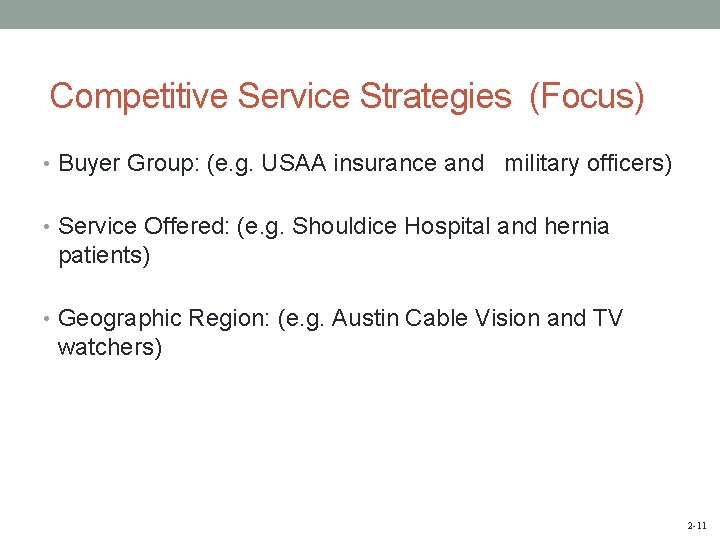
Competitive Service Strategies (Focus) • Buyer Group: (e. g. USAA insurance and military officers) • Service Offered: (e. g. Shouldice Hospital and hernia patients) • Geographic Region: (e. g. Austin Cable Vision and TV watchers) 2 -11
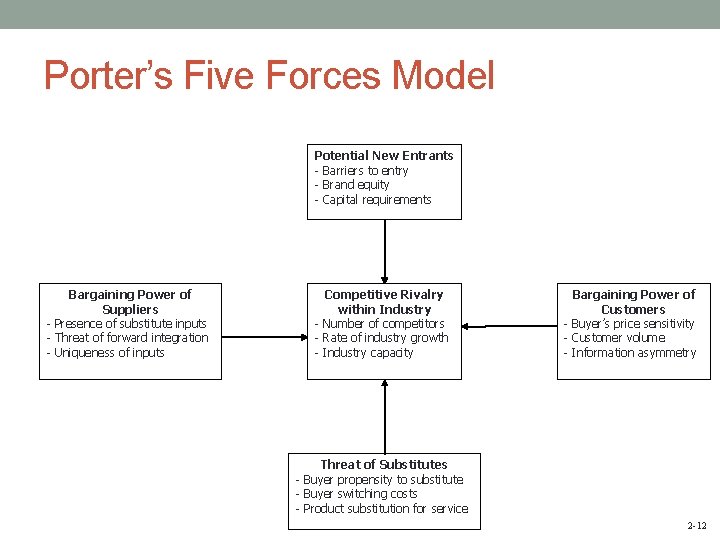
Porter’s Five Forces Model Potential New Entrants - Barriers to entry - Brand equity - Capital requirements Bargaining Power of Suppliers - Presence of substitute inputs - Threat of forward integration - Uniqueness of inputs Competitive Rivalry within Industry - Number of competitors - Rate of industry growth - Industry capacity Bargaining Power of Customers - Buyer’s price sensitivity - Customer volume - Information asymmetry Threat of Substitutes - Buyer propensity to substitute - Buyer switching costs - Product substitution for service 2 -12
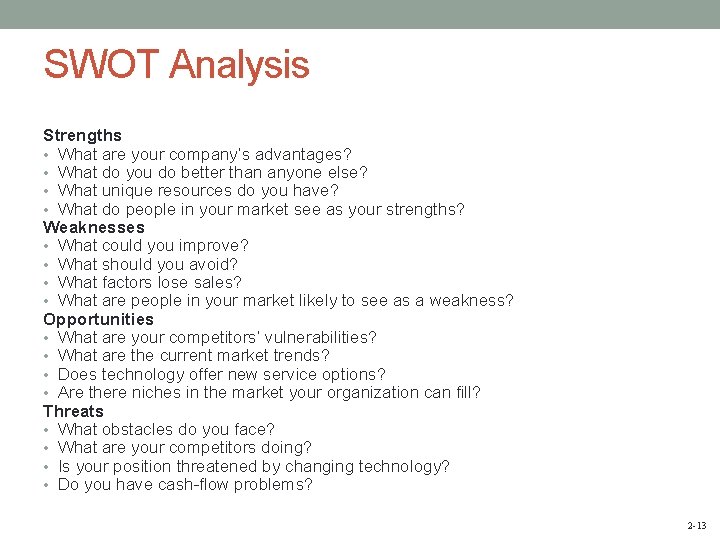
SWOT Analysis Strengths • What are your company’s advantages? • What do you do better than anyone else? • What unique resources do you have? • What do people in your market see as your strengths? Weaknesses • What could you improve? • What should you avoid? • What factors lose sales? • What are people in your market likely to see as a weakness? Opportunities • What are your competitors’ vulnerabilities? • What are the current market trends? • Does technology offer new service options? • Are there niches in the market your organization can fill? Threats • What obstacles do you face? • What are your competitors doing? • Is your position threatened by changing technology? • Do you have cash-flow problems? 2 -13
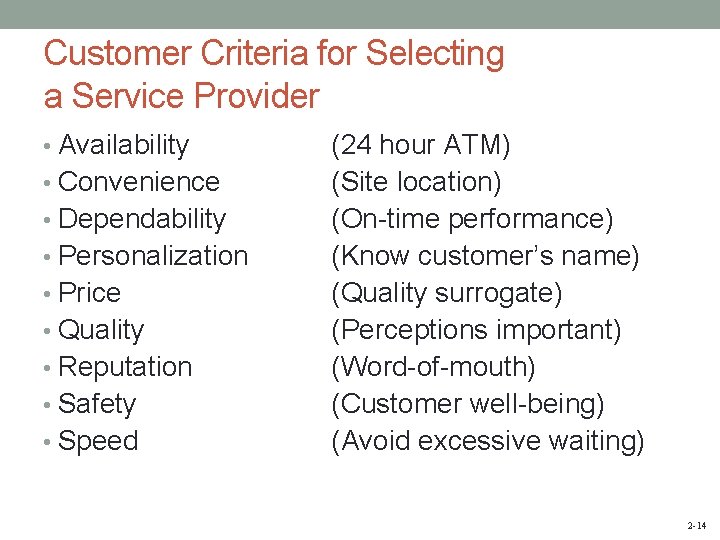
Customer Criteria for Selecting a Service Provider • Availability • Convenience • Dependability • Personalization • Price • Quality • Reputation • Safety • Speed (24 hour ATM) (Site location) (On-time performance) (Know customer’s name) (Quality surrogate) (Perceptions important) (Word-of-mouth) (Customer well-being) (Avoid excessive waiting) 2 -14
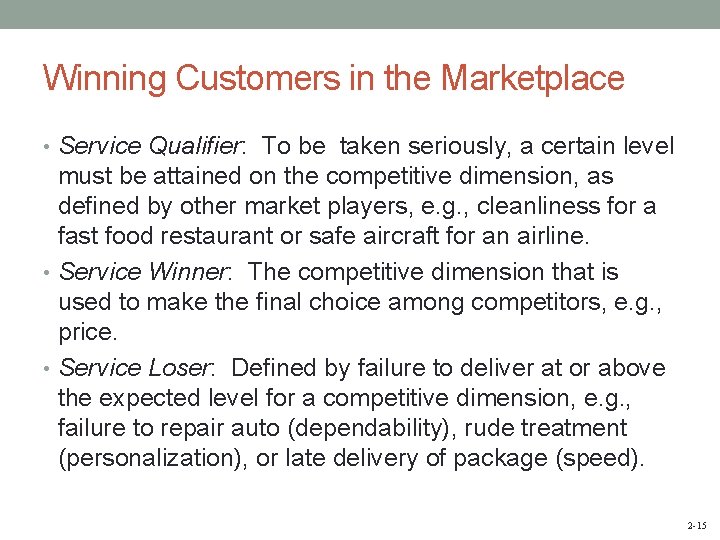
Winning Customers in the Marketplace • Service Qualifier: To be taken seriously, a certain level must be attained on the competitive dimension, as defined by other market players, e. g. , cleanliness for a fast food restaurant or safe aircraft for an airline. • Service Winner: The competitive dimension that is used to make the final choice among competitors, e. g. , price. • Service Loser: Defined by failure to deliver at or above the expected level for a competitive dimension, e. g. , failure to repair auto (dependability), rude treatment (personalization), or late delivery of package (speed). 2 -15
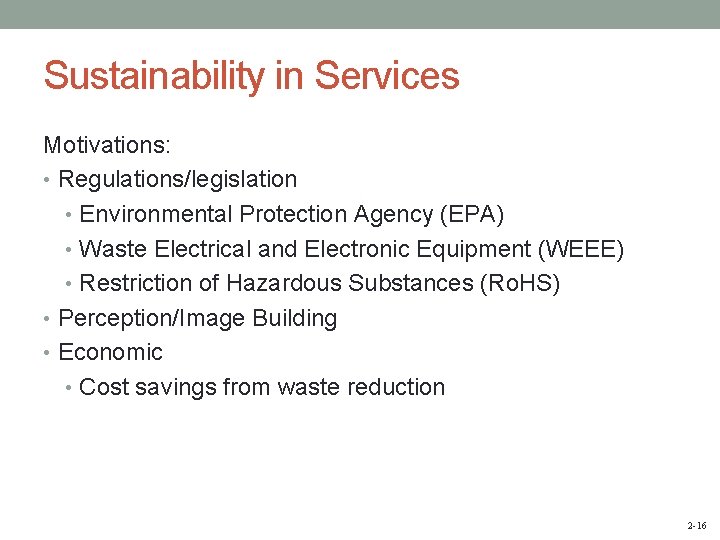
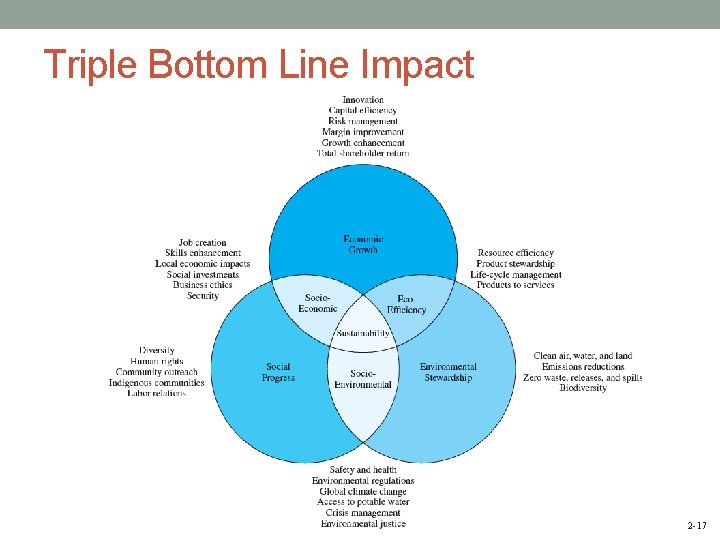
Sustainability in Services Motivations: • Regulations/legislation • Environmental Protection Agency (EPA) • Waste Electrical and Electronic Equipment (WEEE) • Restriction of Hazardous Substances (Ro. HS) • Perception/Image Building • Economic • Cost savings from waste reduction 2 -16
Triple Bottom Line Impact 2 -17
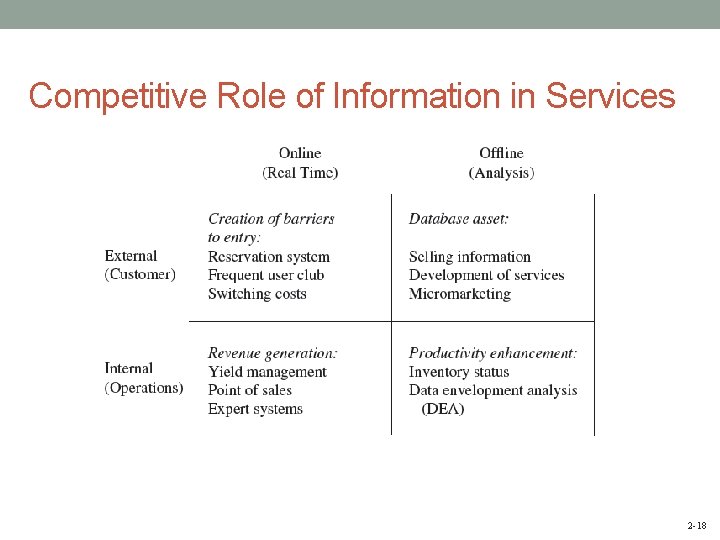
Competitive Role of Information in Services 2 -18
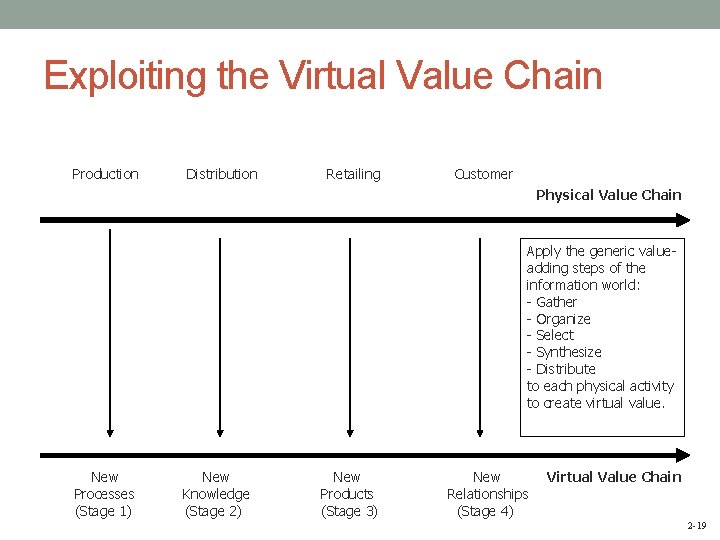
Exploiting the Virtual Value Chain Production Distribution Retailing Customer Physical Value Chain Apply the generic valueadding steps of the information world: - Gather - Organize - Select - Synthesize - Distribute to each physical activity to create virtual value. New Processes (Stage 1) New Knowledge (Stage 2) New Products (Stage 3) New Relationships (Stage 4) Virtual Value Chain 2 -19
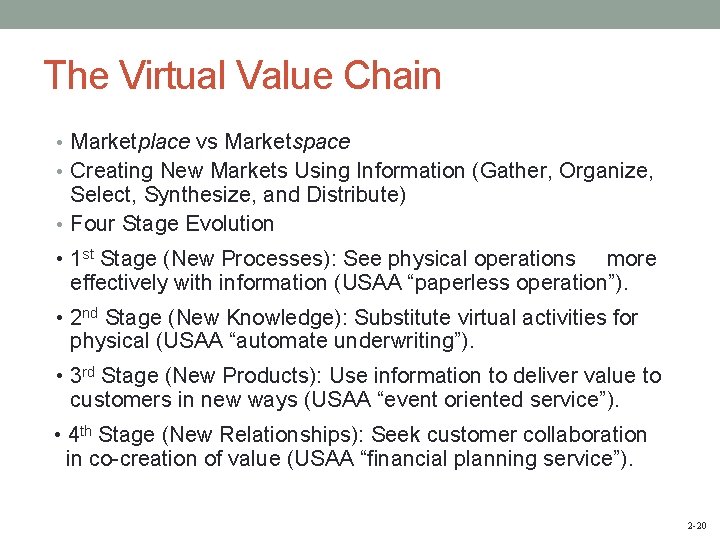
The Virtual Value Chain • Marketplace vs Marketspace • Creating New Markets Using Information (Gather, Organize, Select, Synthesize, and Distribute) • Four Stage Evolution • 1 st Stage (New Processes): See physical operations more effectively with information (USAA “paperless operation”). • 2 nd Stage (New Knowledge): Substitute virtual activities for physical (USAA “automate underwriting”). • 3 rd Stage (New Products): Use information to deliver value to customers in new ways (USAA “event oriented service”). • 4 th Stage (New Relationships): Seek customer collaboration in co-creation of value (USAA “financial planning service”). 2 -20
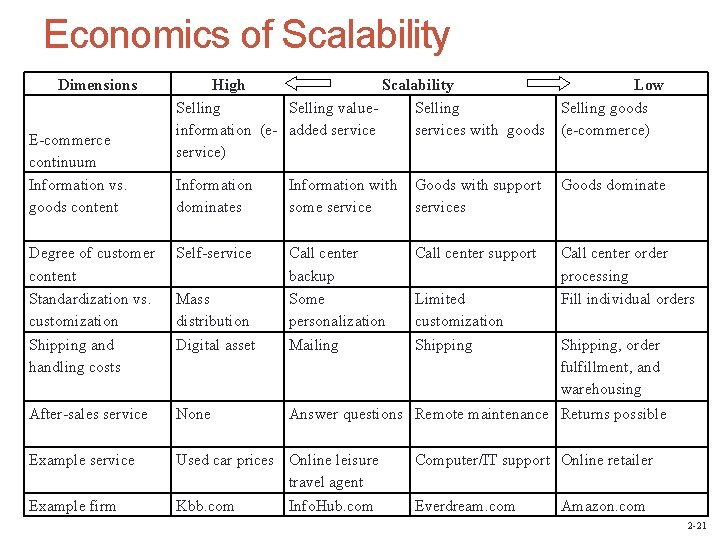
Economics of Scalability Dimensions E-commerce continuum Information vs. goods content High Scalability Low Selling value. Selling goods information (e- added services with goods (e-commerce) service) Information dominates Information with some service Goods with support services Goods dominate Degree of customer content Standardization vs. customization Shipping and handling costs Self-service Call center support Mass distribution Digital asset Call center backup Some personalization Mailing Call center order processing Fill individual orders After-sales service None Answer questions Remote maintenance Returns possible Example service Used car prices Online leisure travel agent Kbb. com Info. Hub. com Example firm Limited customization Shipping, order fulfillment, and warehousing Computer/IT support Online retailer Everdream. com Amazon. com 2 -21
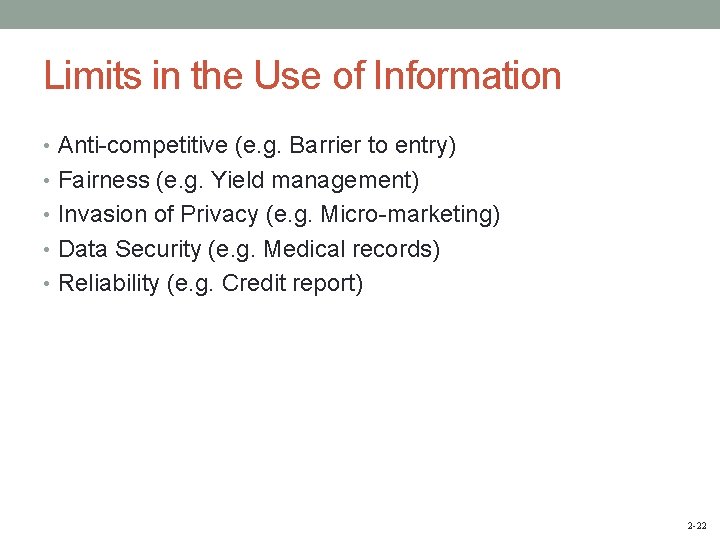
Limits in the Use of Information • Anti-competitive (e. g. Barrier to entry) • Fairness (e. g. Yield management) • Invasion of Privacy (e. g. Micro-marketing) • Data Security (e. g. Medical records) • Reliability (e. g. Credit report) 2 -22
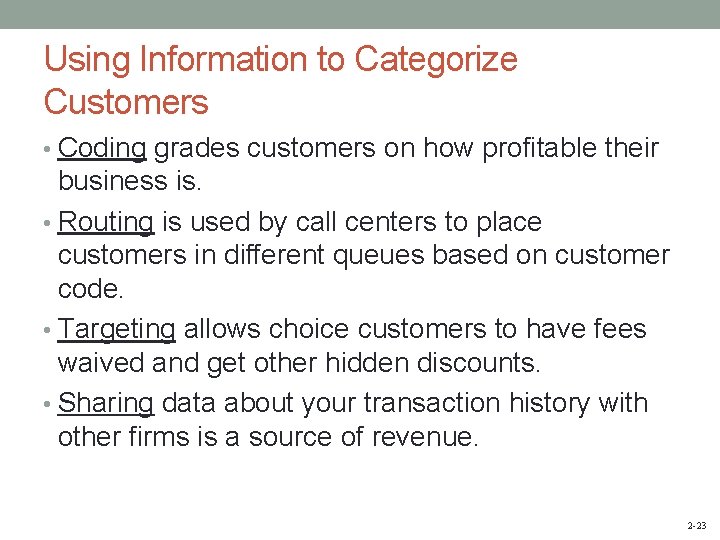
Using Information to Categorize Customers • Coding grades customers on how profitable their business is. • Routing is used by call centers to place customers in different queues based on customer code. • Targeting allows choice customers to have fees waived and get other hidden discounts. • Sharing data about your transaction history with other firms is a source of revenue. 2 -23
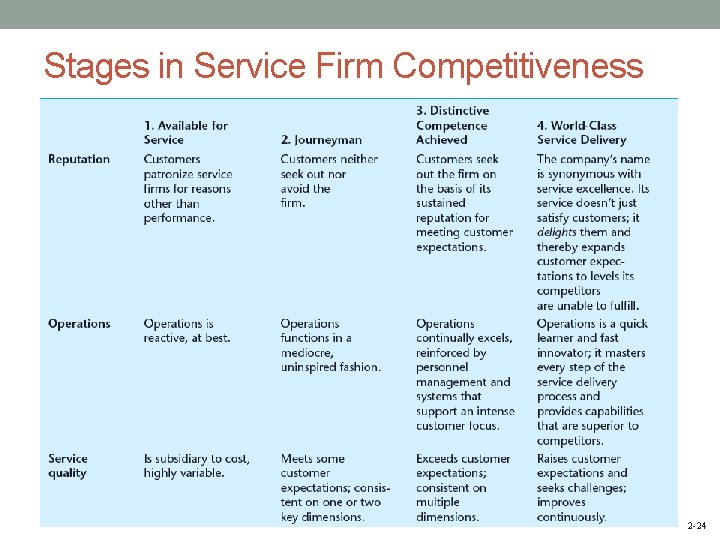
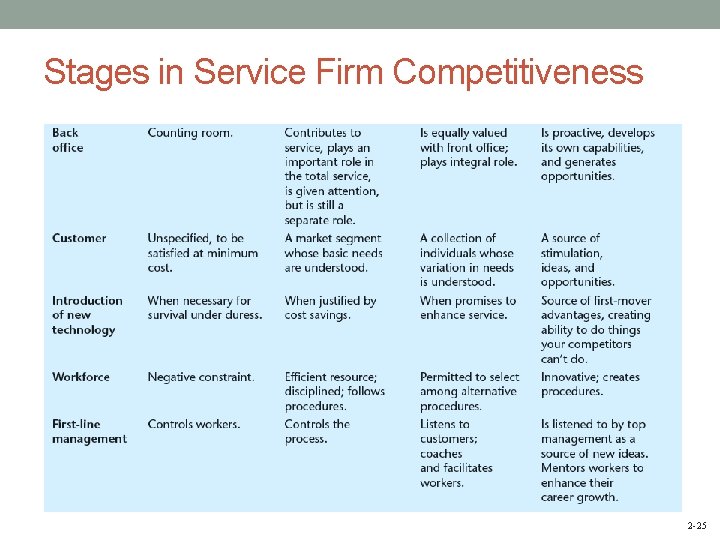
Stages in Service Firm Competitiveness 2 -24
Stages in Service Firm Competitiveness 2 -25
United Commercial Bank and El Banco Banks for Targeted Ethnic Communities 2 -26
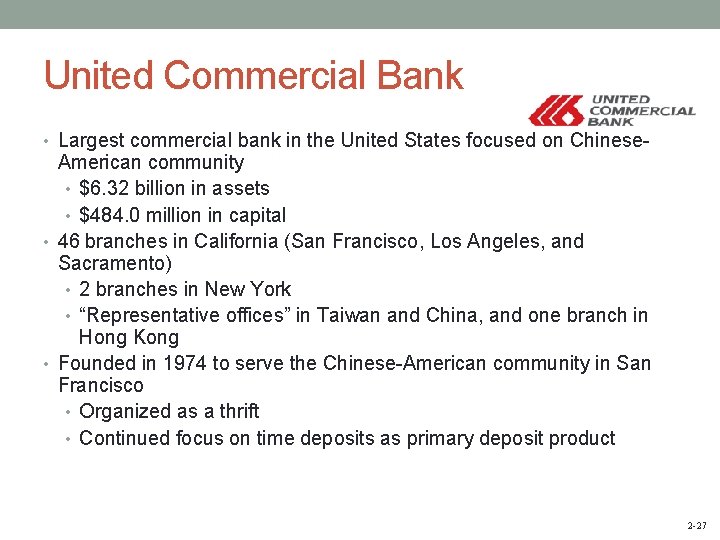
United Commercial Bank • Largest commercial bank in the United States focused on Chinese- American community • $6. 32 billion in assets • $484. 0 million in capital • 46 branches in California (San Francisco, Los Angeles, and Sacramento) • 2 branches in New York • “Representative offices” in Taiwan and China, and one branch in Hong Kong • Founded in 1974 to serve the Chinese-American community in San Francisco • Organized as a thrift • Continued focus on time deposits as primary deposit product 2 -27
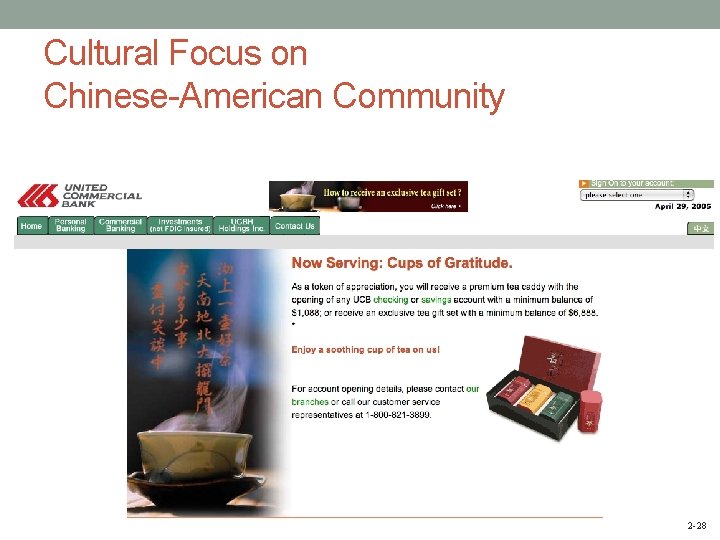
Cultural Focus on Chinese-American Community 2 -28
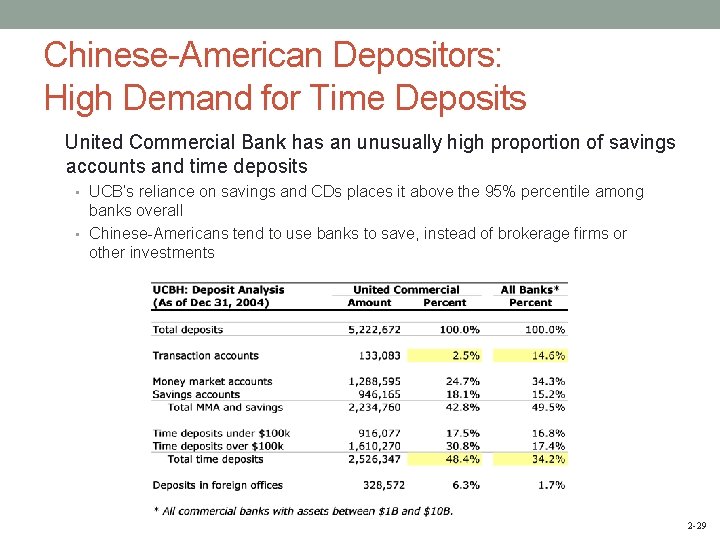
Chinese-American Depositors: High Demand for Time Deposits United Commercial Bank has an unusually high proportion of savings accounts and time deposits • UCB’s reliance on savings and CDs places it above the 95% percentile among banks overall • Chinese-Americans tend to use banks to save, instead of brokerage firms or other investments 2 -29
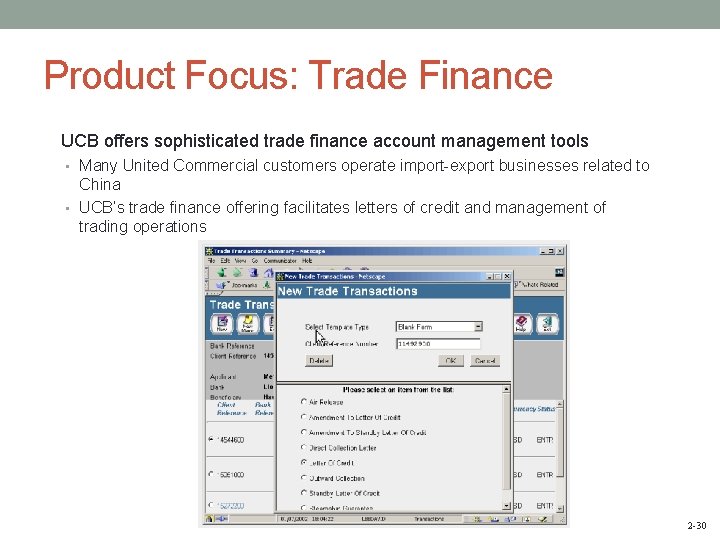
Product Focus: Trade Finance UCB offers sophisticated trade finance account management tools • Many United Commercial customers operate import-export businesses related to China • UCB’s trade finance offering facilitates letters of credit and management of trading operations 2 -30
Asian-American Banks: Superior Valuation Publicly-traded banks focused on the Asian-American communities enjoy premium stock market valuations • Lending to the Chinese and Korean communities has resulted in lower loan losses and fewer charge-offs • Asian-American banks are far more efficient and more profitable than community banks as a whole 2 -31
El Banco: Banking for Latinos in Atlanta • Hispanic retail banking concept based in Atlanta, Georgia • “Franchised” bank offering designed by individuals from check-cashing business • Originally part of smaller local bank in Atlanta; now a subsidiary of Suntrust • Products include deposit accounts, fee-based check cashing, mortgages, and international funds transfers (i. e. to Mexico) • 6 branches in Atlanta • Rapid growth from first branch in January 2002: • Jan. 2002 Deal signed by El Banco and Flag Bank • Jun. 2002 1 Branch • Dec. 2002 2 Branches, 1 st Branch cash flow positive • Jun. 2003 2 nd Branch cash flow positive, NCB buys El Banco • Dec. 2003 4 Branches, 50 employees, Sun. Trust buys NCB • Jun. 2004 6 Branches, 125 employees • Atlanta is 6. 5% Hispanic (268, 851 according to 2000 census) 2 -32
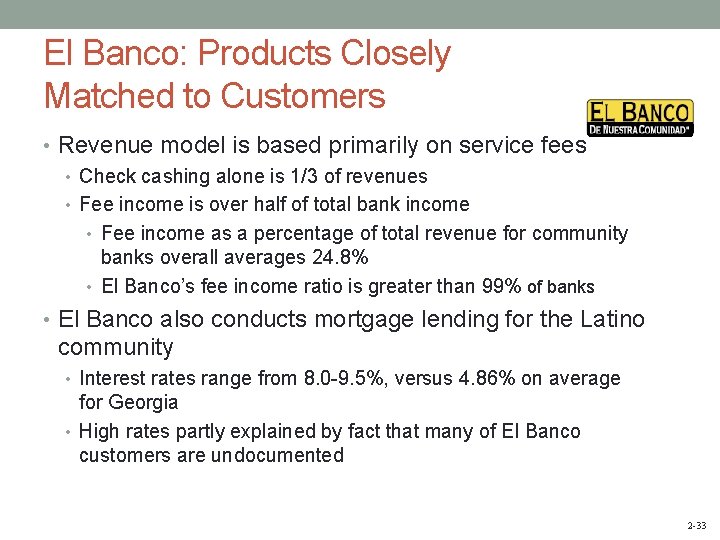
El Banco: Products Closely Matched to Customers • Revenue model is based primarily on service fees • Check cashing alone is 1/3 of revenues • Fee income is over half of total bank income • Fee income as a percentage of total revenue for community banks overall averages 24. 8% • El Banco’s fee income ratio is greater than 99% of banks • El Banco also conducts mortgage lending for the Latino community • Interest rates range from 8. 0 -9. 5%, versus 4. 86% on average for Georgia • High rates partly explained by fact that many of El Banco customers are undocumented 2 -33
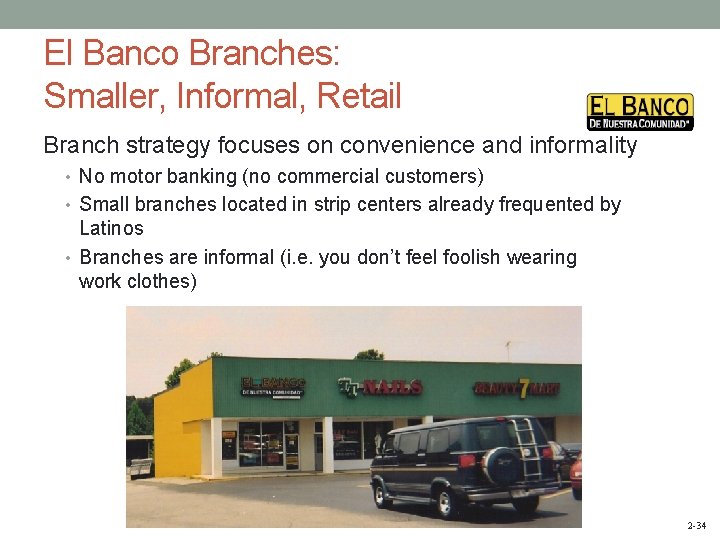
El Banco Branches: Smaller, Informal, Retail Branch strategy focuses on convenience and informality • No motor banking (no commercial customers) • Small branches located in strip centers already frequented by Latinos • Branches are informal (i. e. you don’t feel foolish wearing work clothes) 2 -34
El Banco: Marketing Mimicry El Banco has sought to associate itself with Western Union • Western Union is one of the most recognized names in financial services for Latinos • Many Hispanics send money to relatives with Western Union 2 -35
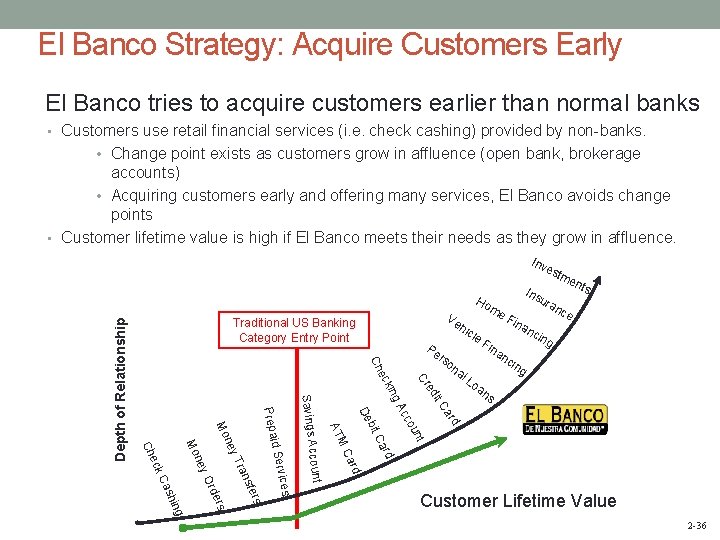
El Banco Strategy: Acquire Customers Early El Banco tries to acquire customers earlier than normal banks • Customers use retail financial services (i. e. check cashing) provided by non-banks. • Change point exists as customers grow in affluence (open bank, brokerage accounts) • Acquiring customers early and offering many services, El Banco avoids change points • Customer lifetime value is high if El Banco meets their needs as they grow in affluence. Inv hic Pe on al ed me F ura le Fin a me ina nts nc e nc ing nc Lo an ing s d cco ar it C g. A t Ca un bit De rd ard MC AT vices rs sfe ers Ord ng shi Ca n Tra ney id Ser Prepa ney Mo Mo eck ccount Savings A kin Cr ec Ch rs Ins Ho Ve Traditional US Banking Category Entry Point Ch Depth of Relationship est Customer Lifetime Value 2 -36
Questions 1. Compare and contrast the strategic service vision of El Banco and United Commercial Bank. 2. Identify the service winners, qualifiers, and service losers for El Banco and United Commercial Bank. 3. What are the differentiating features of banks that target ethnic communities? 2 -37
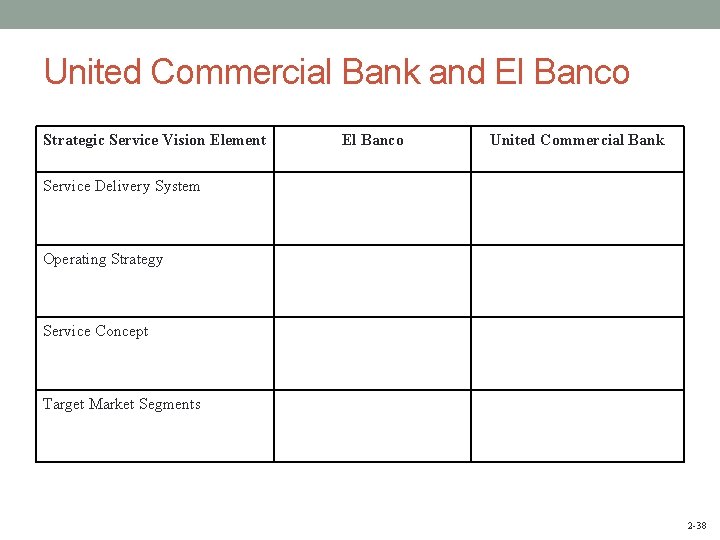
United Commercial Bank and El Banco Strategic Service Vision Element El Banco United Commercial Bank Service Delivery System Operating Strategy Service Concept Target Market Segments 2 -38
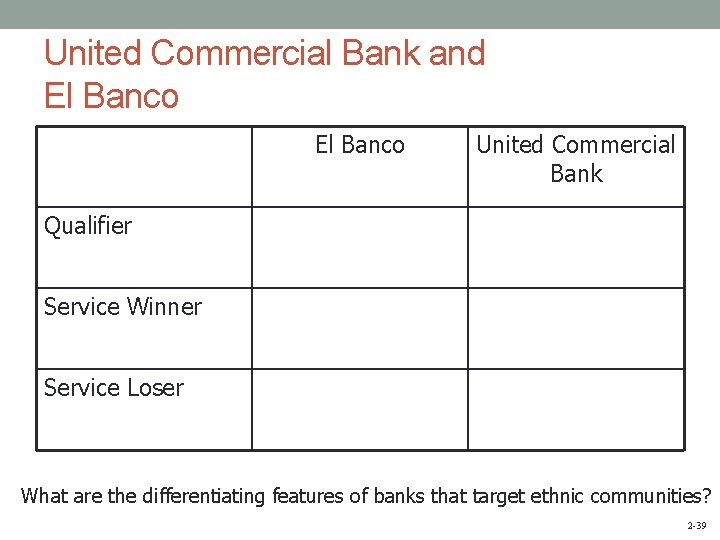
United Commercial Bank and El Banco United Commercial Bank Qualifier Service Winner Service Loser What are the differentiating features of banks that target ethnic communities? 2 -39
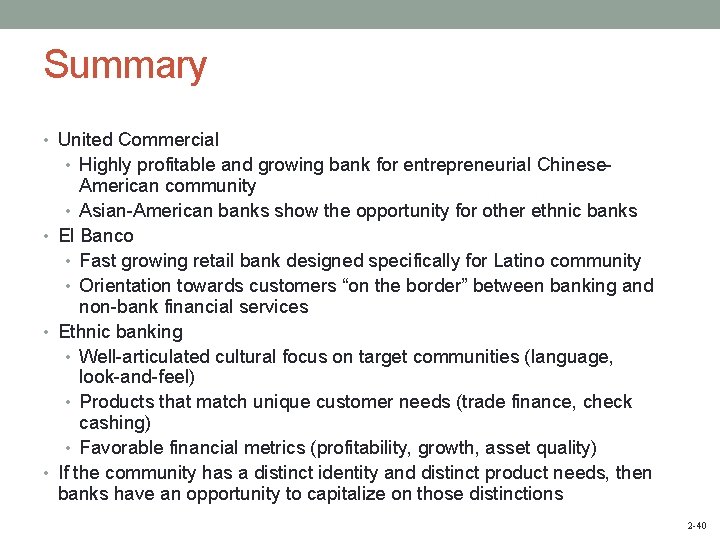
Summary • United Commercial • Highly profitable and growing bank for entrepreneurial Chinese- American community • Asian-American banks show the opportunity for other ethnic banks • El Banco • Fast growing retail bank designed specifically for Latino community • Orientation towards customers “on the border” between banking and non-bank financial services • Ethnic banking • Well-articulated cultural focus on target communities (language, look-and-feel) • Products that match unique customer needs (trade finance, check cashing) • Favorable financial metrics (profitability, growth, asset quality) • If the community has a distinct identity and distinct product needs, then banks have an opportunity to capitalize on those distinctions 2 -40
Status in 2012 • El Banco de Nuestra Comunidad Survives as an entity under the umbrella of Community and Southern Bank, Georgia. • United Commercial Bank Was merged with East West Bank of Pasadena, California, in 2009 after two officers were indicted for financial misdeeds by the FDIC and accused of violations by the SEC. 2 -41
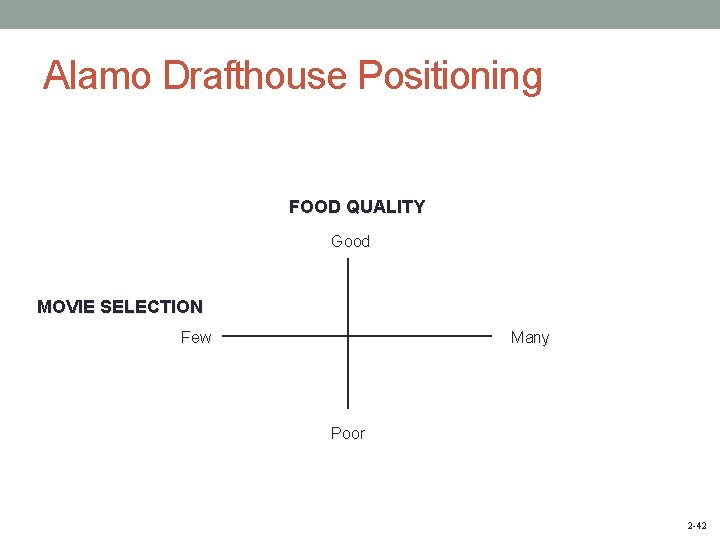
Alamo Drafthouse Positioning FOOD QUALITY Good MOVIE SELECTION Few Many Poor 2 -42
Alamo Drafthouse Strategic Service Vision • Target market segments • Service concept • Operating strategy • Service delivery system 2 -43
Alamo Drafthouse Winning Customers • Qualifiers • Service winners • Service losers Make recommendations for Tim and Carrie that would increase profitability. 2 -44
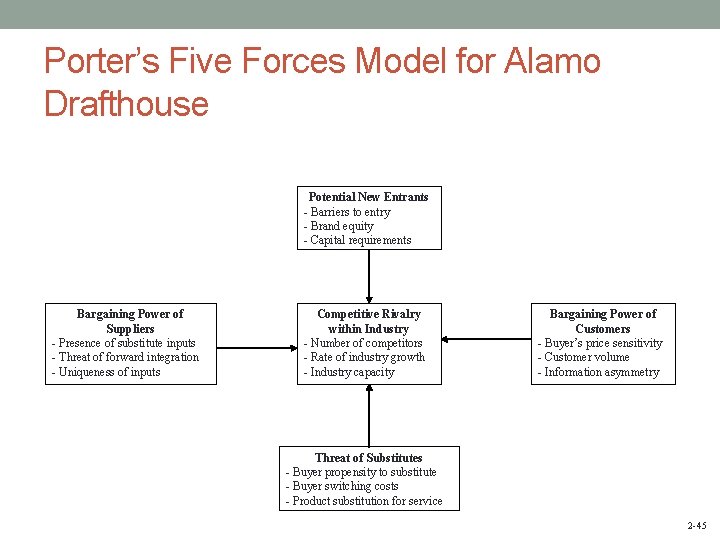
Porter’s Five Forces Model for Alamo Drafthouse Potential New Entrants - Barriers to entry - Brand equity - Capital requirements Bargaining Power of Suppliers - Presence of substitute inputs - Threat of forward integration - Uniqueness of inputs Competitive Rivalry within Industry - Number of competitors - Rate of industry growth - Industry capacity Bargaining Power of Customers - Buyer’s price sensitivity - Customer volume - Information asymmetry Threat of Substitutes - Buyer propensity to substitute - Buyer switching costs - Product substitution for service 2 -45
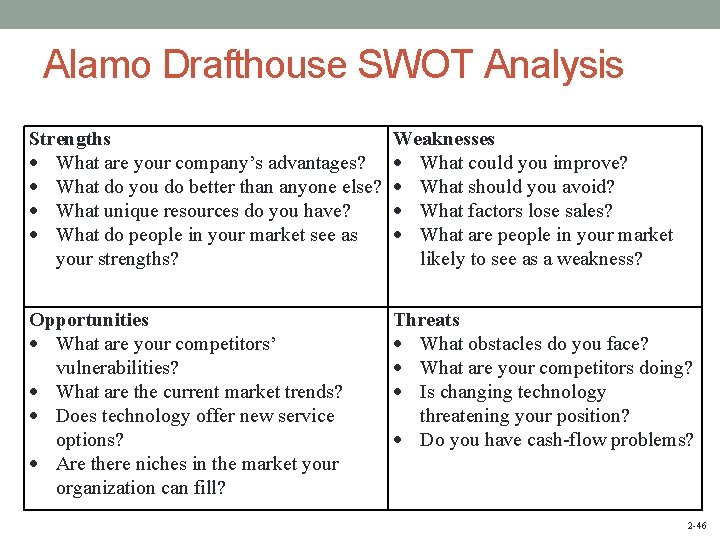
Alamo Drafthouse SWOT Analysis Strengths What are your company’s advantages? What do you do better than anyone else? What unique resources do you have? What do people in your market see as your strengths? Weaknesses What could you improve? What should you avoid? What factors lose sales? What are people in your market likely to see as a weakness? Opportunities What are your competitors’ vulnerabilities? What are the current market trends? Does technology offer new service options? Are there niches in the market your organization can fill? Threats What obstacles do you face? What are your competitors doing? Is changing technology threatening your position? Do you have cash-flow problems? 2 -46
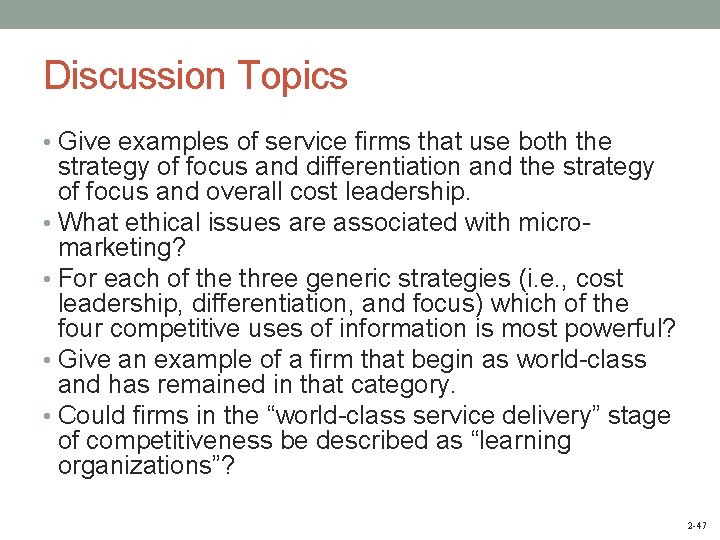
Discussion Topics • Give examples of service firms that use both the strategy of focus and differentiation and the strategy of focus and overall cost leadership. • What ethical issues are associated with micromarketing? • For each of the three generic strategies (i. e. , cost leadership, differentiation, and focus) which of the four competitive uses of information is most powerful? • Give an example of a firm that begin as world-class and has remained in that category. • Could firms in the “world-class service delivery” stage of competitiveness be described as “learning organizations”? 2 -47
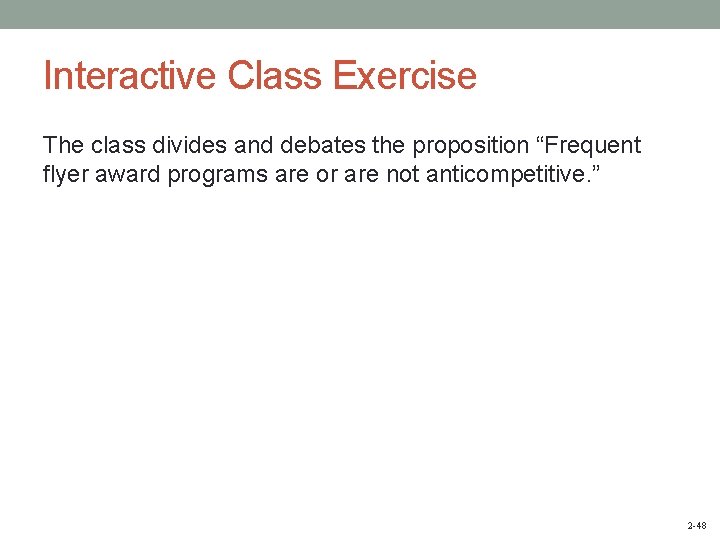
Interactive Class Exercise The class divides and debates the proposition “Frequent flyer award programs are or are not anticompetitive. ” 2 -48