
Service Provider WiFi Bill Mc Farland VP Technology
Service Provider Wi-Fi Bill Mc. Farland, VP Technology, Qualcomm Atheros PAGE 1
Outline § System capacity discussion § 802. 11 u § Wi-Fi Hotspot 2. 0 § Hybrid LTE/Wi-Fi small cells PAGE 2
1000 x Capacity Increase: Needed Exponential growth in mobile data utilization 5 B cumulative smartphone sales estimated for 2012 - 2016 Average traffic per smartphone nearly tripled in 2011 - 150 MB/Mo, versus 55 MB/Mo in 2010 Over the past five years, AT&T’s wireless data traffic has grown 200 X PAGE 3 3
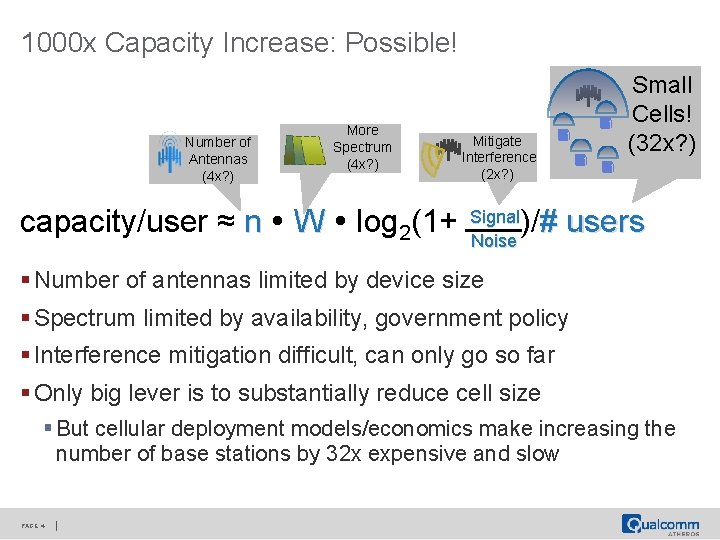
1000 x Capacity Increase: Possible! Number of Antennas (4 x? ) More Spectrum (4 x? ) capacity/user ≈ n W log 2(1+ Mitigate Interference (2 x? ) Small Cells! (32 x? ) )/# users Signal Noise § Number of antennas limited by device size § Spectrum limited by availability, government policy § Interference mitigation difficult, can only go so far § Only big lever is to substantially reduce cell size § But cellular deployment models/economics make increasing the number of base stations by 32 x expensive and slow PAGE 4
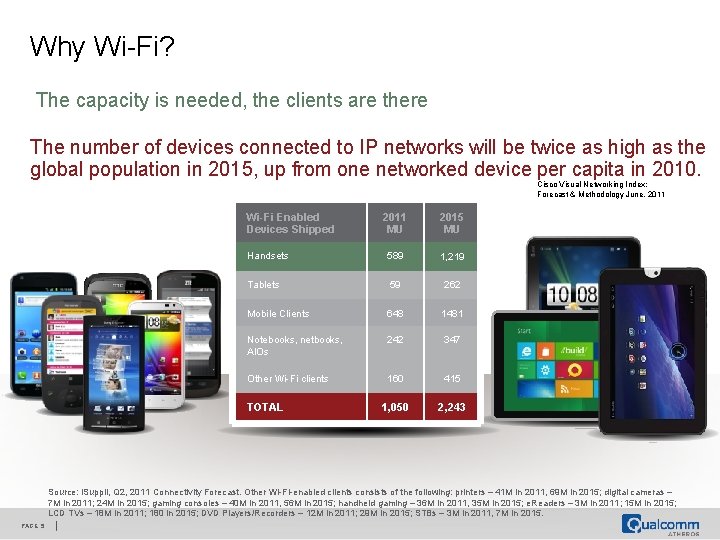
Why Wi-Fi? The capacity is needed, the clients are there The number of devices connected to IP networks will be twice as high as the global population in 2015, up from one networked device per capita in 2010. Cisco Visual Networking Index: Forecast & Methodology June, 2011 Wi-Fi Enabled Devices Shipped 2011 MU 2015 MU Handsets 589 1, 219 Tablets 59 262 Mobile Clients 648 1481 Notebooks, netbooks, AIOs 242 347 Other Wi-Fi clients 160 415 1, 050 2, 243 TOTAL Source: i. Suppli, Q 2, 2011 Connectivity Forecast. Other Wi-Fi-enabled clients consists of the following: printers – 41 M in 2011, 69 M in 2015; digital cameras – 7 M in 2011; 24 M in 2015; gaming consoles – 40 M in 2011, 56 M in 2015; handheld gaming – 36 M in 2011, 35 M in 2015; e. Readers – 3 M in 2011; 15 M in 2015; LCD TVs – 18 M in 2011; 180 in 2015; DVD Players/Recorders – 12 M in 2011; 29 M in 2015; STBs – 3 M in 2011, 7 M in 2015. PAGE 5
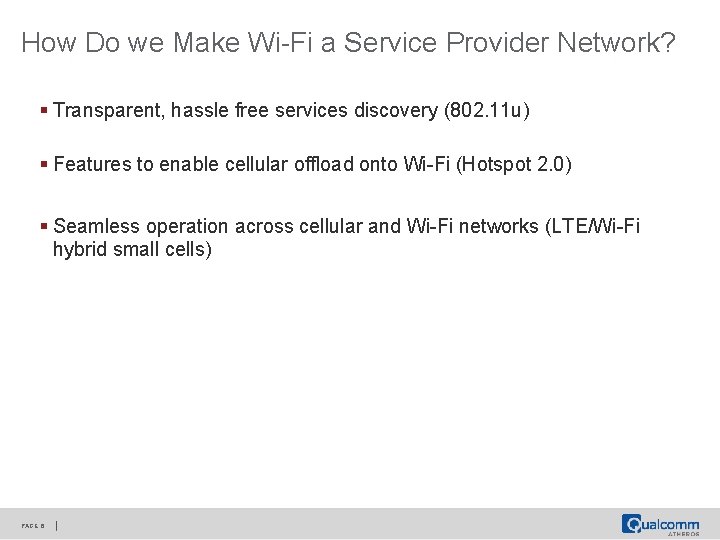
How Do we Make Wi-Fi a Service Provider Network? § Transparent, hassle free services discovery (802. 11 u) § Features to enable cellular offload onto Wi-Fi (Hotspot 2. 0) § Seamless operation across cellular and Wi-Fi networks (LTE/Wi-Fi hybrid small cells) PAGE 6
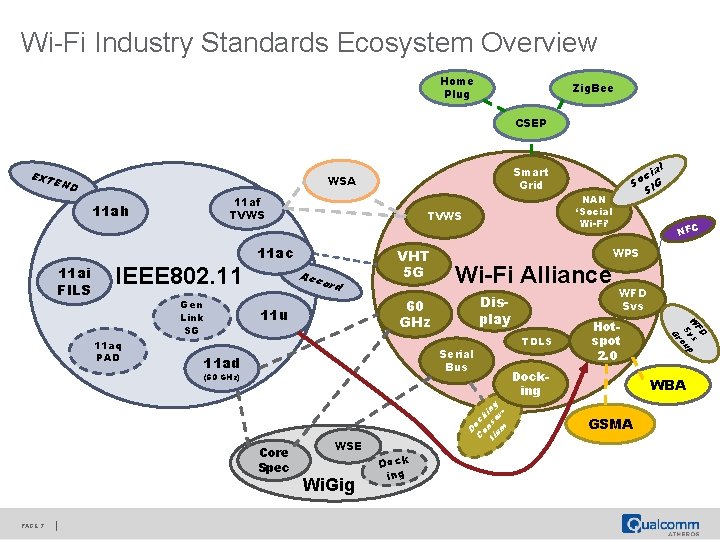
Wi-Fi Industry Standards Ecosystem Overview Home Plug Zig. Bee CSEP EXT WSA END 11 af TVWS 11 ah TVWS 11 ac 11 ai FILS Smart Grid IEEE 802. 11 11 aq PAD 11 ad Core Spec PAGE 7 Wi-Fi Alliance Display Serial Bus (60 GHz) WSE Wi. Gig g in rk o oc s D on um C ti Dock ing NFC WPS 60 GHz 11 u NAN ‘Social Wi-Fi’ TDLS WFD Svs Hotspot 2. 0 Docking FD W s Sv oup r G Gen Link SG Acc ord VHT 5 G ial c So IG S WBA GSMA
802. 11 u PAGE 8
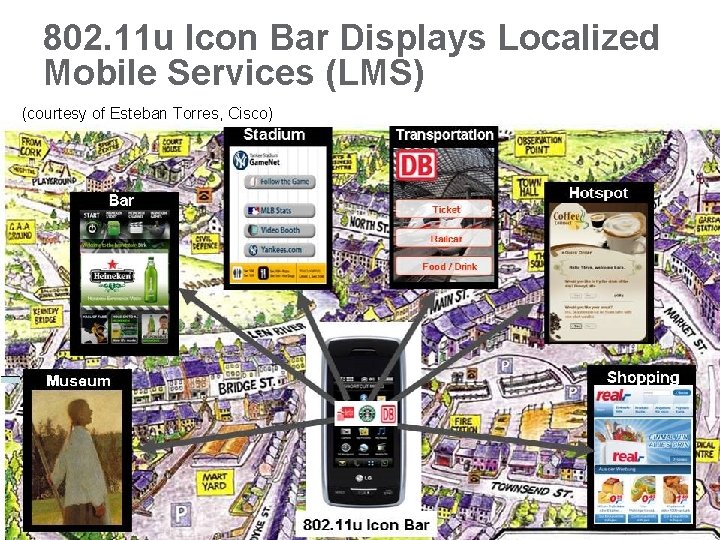
802. 11 u Icon Bar Displays Localized Mobile Services (LMS) (courtesy of Esteban Torres, Cisco) PAGE 9
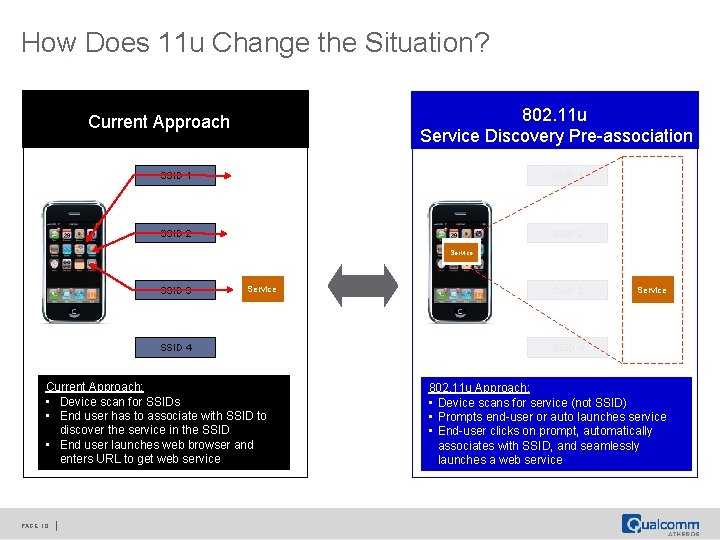
How Does 11 u Change the Situation? 802. 11 u Service Discovery Pre-association Current Approach SSID 1 SSID 2 Service SSID 3 Service SSID 4 Current Approach: • Device scan for SSIDs • End user has to associate with SSID to discover the service in the SSID • End user launches web browser and enters URL to get web service PAGE 10 SSID 3 Service SSID 4 802. 11 u Approach: • Device scans for service (not SSID) • Prompts end-user or auto launches service • End-user clicks on prompt, automatically associates with SSID, and seamlessly launches a web service
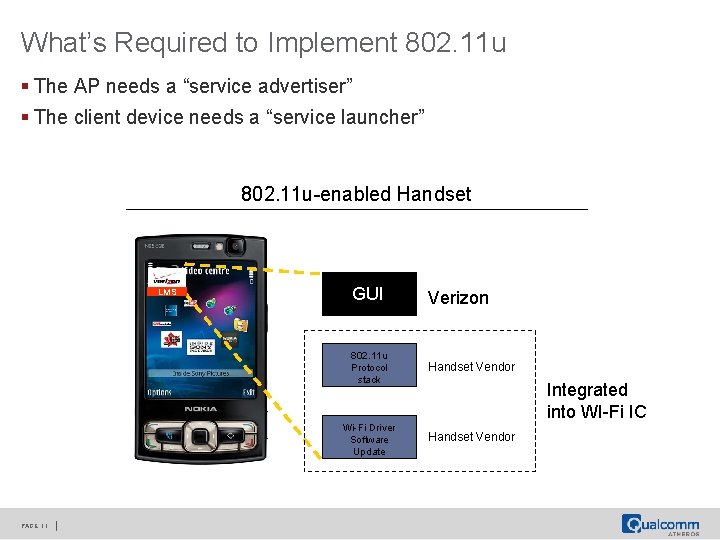
What’s Required to Implement 802. 11 u § The AP needs a “service advertiser” § The client device needs a “service launcher” 802. 11 u-enabled Handset LMS PAGE 11 GUI Verizon 802. 11 u Protocol stack Handset Vendor Wi-Fi Driver Software Update Handset Vendor Integrated into WI-Fi IC
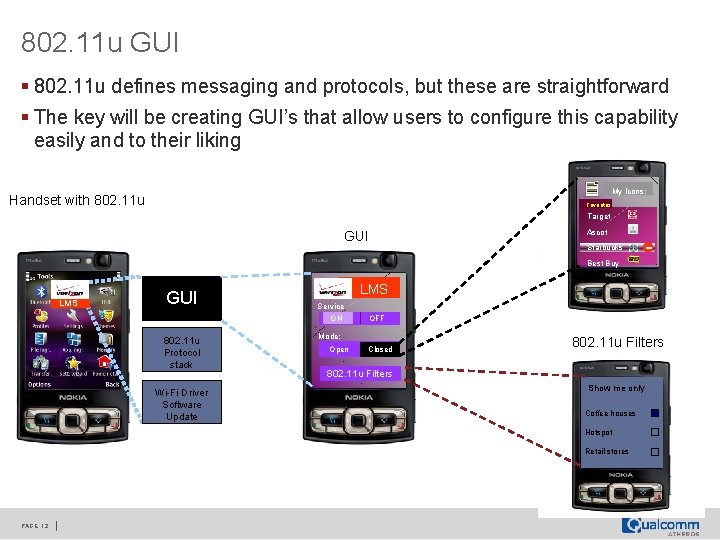
802. 11 u GUI § 802. 11 u defines messaging and protocols, but these are straightforward § The key will be creating GUI’s that allow users to configure this capability easily and to their liking My Icons: Handset with 802. 11 u Favorites Target Ascot GUI Starbucks - Best Buy LMS GUI 802. 11 u Protocol stack Wi-Fi Driver Software Update LMS Service ON OFF Mode: Open Closed 802. 11 u Filters Show me only Coffee houses Hotspot Retail stores PAGE 12
Hotspot 2. 0 (Passpoint) PAGE 13
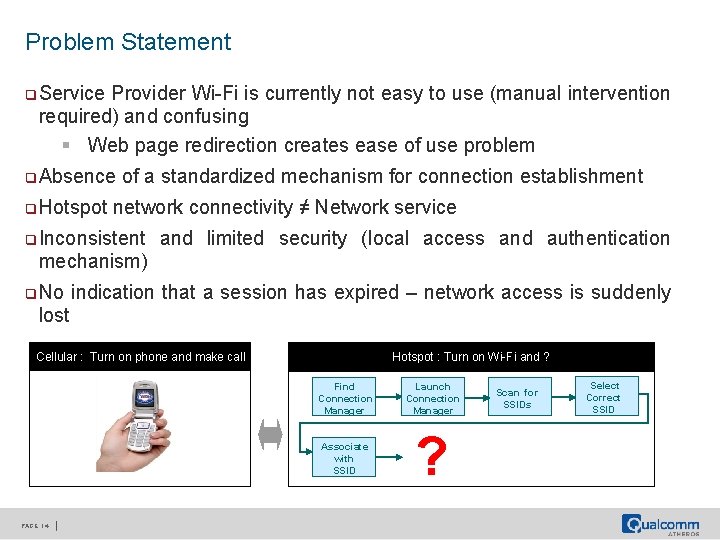
Problem Statement q Service Provider Wi-Fi is currently not easy to use (manual intervention required) and confusing § Web page redirection creates ease of use problem q Absence q Hotspot of a standardized mechanism for connection establishment network connectivity ≠ Network service q Inconsistent and limited security (local access and authentication mechanism) q No indication that a session has expired – network access is suddenly lost Cellular : Turn on phone and make call PAGE 14 Hotspot : Turn on Wi-Fi and ? Find Connection Manager Launch Connection Manager Associate with SSID ? Scan for SSIDs Select Correct SSID
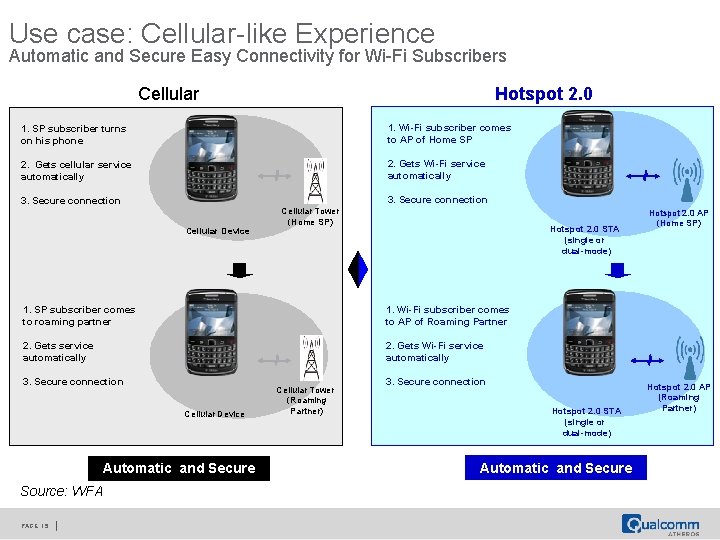
Use case: Cellular-like Experience Automatic and Secure Easy Connectivity for Wi-Fi Subscribers Cellular Hotspot 2. 0 1. SP subscriber turns on his phone 1. Wi-Fi subscriber comes to AP of Home SP 2. Gets cellular service automatically 2. Gets Wi-Fi service automatically 3. Secure connection Cellular Device Cellular Tower (Home SP) Hotspot 2. 0 STA (single or dual-mode) 1. SP subscriber comes to roaming partner 1. Wi-Fi subscriber comes to AP of Roaming Partner 2. Gets service automatically 2. Gets Wi-Fi service automatically 3. Secure connection Cellular Device Automatic and Secure Source: WFA PAGE 15 Cellular Tower (Roaming Partner) 3. Secure connection Hotspot 2. 0 STA (single or dual-mode) Automatic and Secure Hotspot 2. 0 AP (Home SP) Hotspot 2. 0 AP (Roaming Partner)
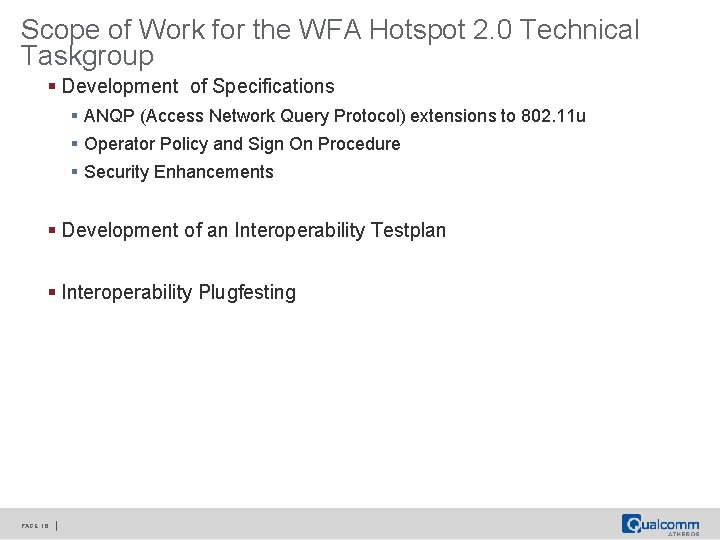
Scope of Work for the WFA Hotspot 2. 0 Technical Taskgroup § Development of Specifications § ANQP (Access Network Query Protocol) extensions to 802. 11 u § Operator Policy and Sign On Procedure § Security Enhancements § Development of an Interoperability Testplan § Interoperability Plugfesting PAGE 16
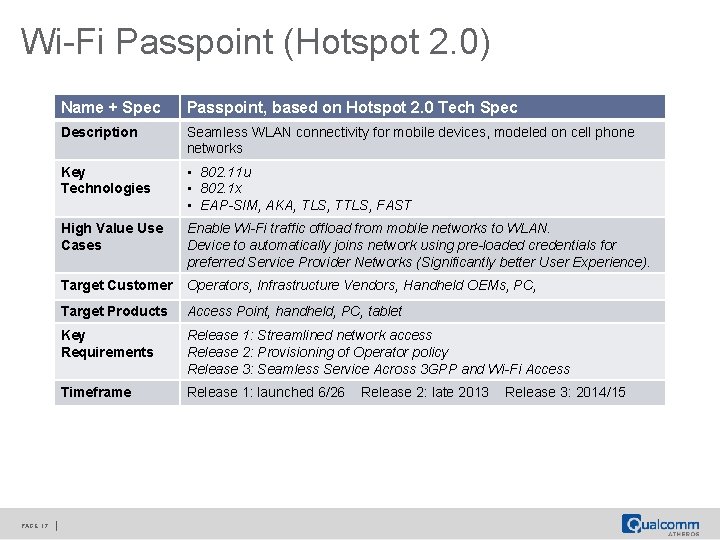
Wi-Fi Passpoint (Hotspot 2. 0) PAGE 17 Name + Spec Passpoint, based on Hotspot 2. 0 Tech Spec Description Seamless WLAN connectivity for mobile devices, modeled on cell phone networks Key Technologies • 802. 11 u • 802. 1 x • EAP-SIM, AKA, TLS, TTLS, FAST High Value Use Cases Enable Wi-Fi traffic offload from mobile networks to WLAN. Device to automatically joins network using pre-loaded credentials for preferred Service Provider Networks (Significantly better User Experience). Target Customer Operators, Infrastructure Vendors, Handheld OEMs, PC, Target Products Access Point, handheld, PC, tablet Key Requirements Release 1: Streamlined network access Release 2: Provisioning of Operator policy Release 3: Seamless Service Across 3 GPP and Wi-Fi Access Timeframe Release 1: launched 6/26 Release 2: late 2013 Release 3: 2014/15
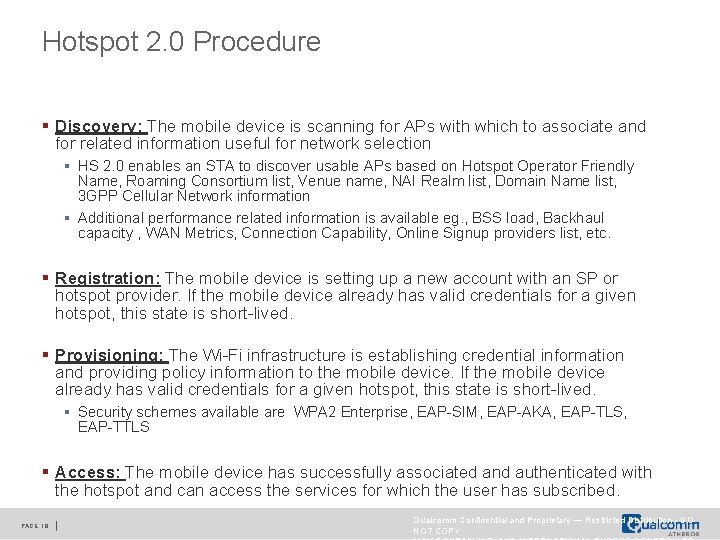
Hotspot 2. 0 Procedure § Discovery: The mobile device is scanning for APs with which to associate and for related information useful for network selection § HS 2. 0 enables an STA to discover usable APs based on Hotspot Operator Friendly Name, Roaming Consortium list, Venue name, NAI Realm list, Domain Name list, 3 GPP Cellular Network information § Additional performance related information is available eg. , BSS load, Backhaul capacity , WAN Metrics, Connection Capability, Online Signup providers list, etc. § Registration: The mobile device is setting up a new account with an SP or hotspot provider. If the mobile device already has valid credentials for a given hotspot, this state is short-lived. § Provisioning: The Wi-Fi infrastructure is establishing credential information and providing policy information to the mobile device. If the mobile device already has valid credentials for a given hotspot, this state is short-lived. § Security schemes available are WPA 2 Enterprise, EAP-SIM, EAP-AKA, EAP-TLS, EAP-TTLS § Access: The mobile device has successfully associated and authenticated with the hotspot and can access the services for which the user has subscribed. PAGE 18 Qualcomm Confidential and Proprietary — Restricted Distribution - DO NOT COPY
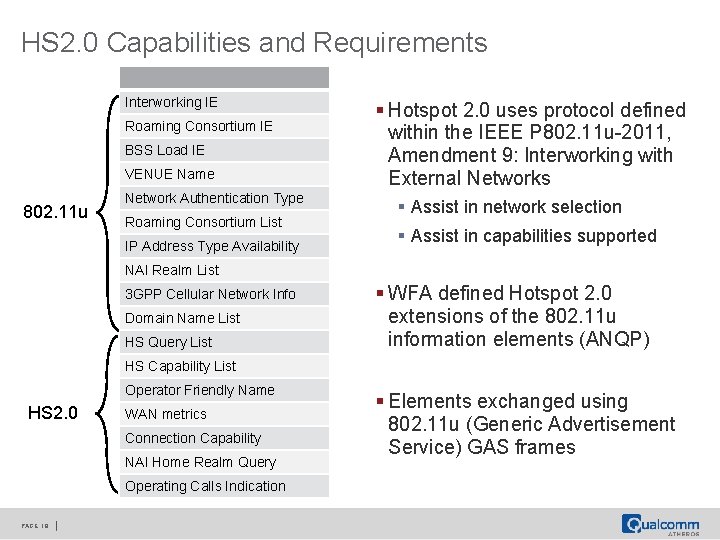
HS 2. 0 Capabilities and Requirements Interworking IE Roaming Consortium IE BSS Load IE VENUE Name 802. 11 u Network Authentication Type Roaming Consortium List IP Address Type Availability § Hotspot 2. 0 uses protocol defined within the IEEE P 802. 11 u-2011, Amendment 9: Interworking with External Networks § Assist in network selection § Assist in capabilities supported NAI Realm List 3 GPP Cellular Network Info Domain Name List HS Query List § WFA defined Hotspot 2. 0 extensions of the 802. 11 u information elements (ANQP) HS Capability List Operator Friendly Name HS 2. 0 WAN metrics Connection Capability NAI Home Realm Query Operating Calls Indication PAGE 19 § Elements exchanged using 802. 11 u (Generic Advertisement Service) GAS frames
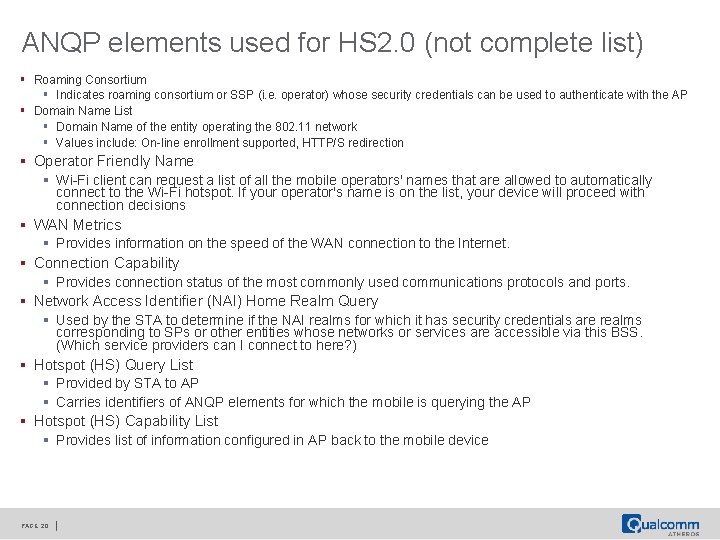
ANQP elements used for HS 2. 0 (not complete list) § Roaming Consortium § Indicates roaming consortium or SSP (i. e. operator) whose security credentials can be used to authenticate with the AP § Domain Name List § Domain Name of the entity operating the 802. 11 network § Values include: On-line enrollment supported, HTTP/S redirection § Operator Friendly Name § § § Wi-Fi client can request a list of all the mobile operators' names that are allowed to automatically connect to the Wi-Fi hotspot. If your operator's name is on the list, your device will proceed with connection decisions WAN Metrics § Provides information on the speed of the WAN connection to the Internet. Connection Capability § Provides connection status of the most commonly used communications protocols and ports. Network Access Identifier (NAI) Home Realm Query § Used by the STA to determine if the NAI realms for which it has security credentials are realms corresponding to SPs or other entities whose networks or services are accessible via this BSS. (Which service providers can I connect to here? ) Hotspot (HS) Query List § Provided by STA to AP § Carries identifiers of ANQP elements for which the mobile is querying the AP Hotspot (HS) Capability List § Provides list of information configured in AP back to the mobile device PAGE 20
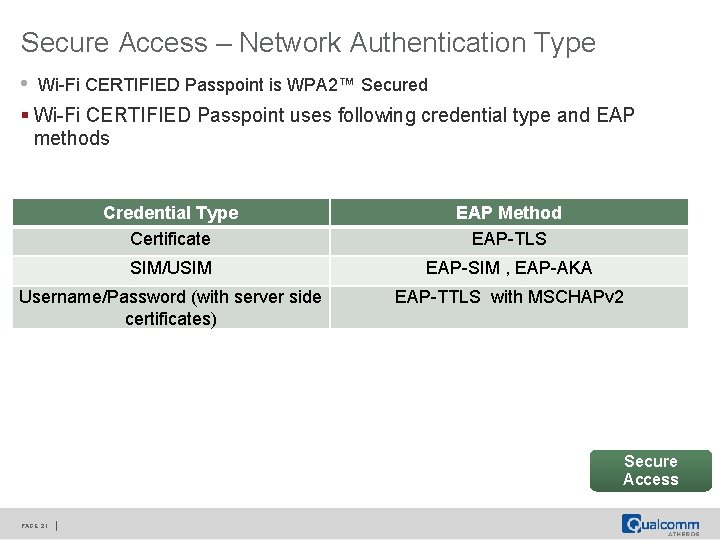
Secure Access – Network Authentication Type • Wi-Fi CERTIFIED Passpoint is WPA 2™ Secured § Wi-Fi CERTIFIED Passpoint uses following credential type and EAP methods Credential Type Certificate EAP Method EAP-TLS SIM/USIM EAP-SIM , EAP-AKA Username/Password (with server side certificates) EAP-TTLS with MSCHAPv 2 Secure Access PAGE 21
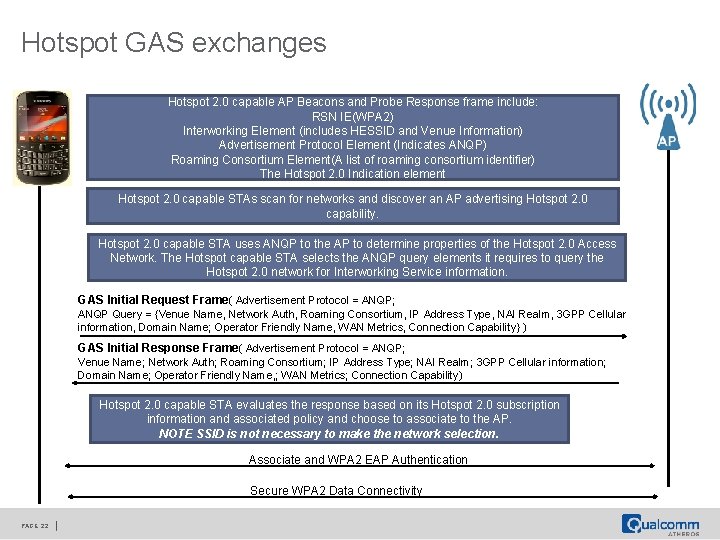
Hotspot GAS exchanges Hotspot 2. 0 capable AP Beacons and Probe Response frame include: RSN IE(WPA 2) Interworking Element (includes HESSID and Venue Information) Advertisement Protocol Element (Indicates ANQP) Roaming Consortium Element(A list of roaming consortium identifier) The Hotspot 2. 0 Indication element Hotspot 2. 0 capable STAs scan for networks and discover an AP advertising Hotspot 2. 0 capability. Hotspot 2. 0 capable STA uses ANQP to the AP to determine properties of the Hotspot 2. 0 Access Network. The Hotspot capable STA selects the ANQP query elements it requires to query the Hotspot 2. 0 network for Interworking Service information. GAS Initial Request Frame( Advertisement Protocol = ANQP; ANQP Query = {Venue Name, Network Auth, Roaming Consortium, IP Address Type, NAI Realm, 3 GPP Cellular information, Domain Name; Operator Friendly Name, WAN Metrics, Connection Capability} ) GAS Initial Response Frame( Advertisement Protocol = ANQP; Venue Name; Network Auth; Roaming Consortium; IP Address Type; NAI Realm; 3 GPP Cellular information; Domain Name; Operator Friendly Name, ; WAN Metrics; Connection Capability) Hotspot 2. 0 capable STA evaluates the response based on its Hotspot 2. 0 subscription information and associated policy and choose to associate to the AP. NOTE SSID is not necessary to make the network selection. Associate and WPA 2 EAP Authentication Secure WPA 2 Data Connectivity PAGE 22
Hybrid LTE/Wi-Fi Small Cells PAGE 23
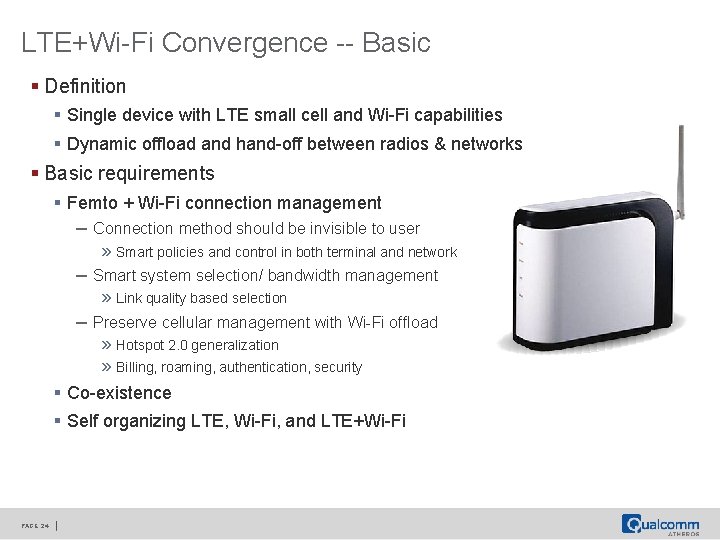
LTE+Wi-Fi Convergence -- Basic § Definition § Single device with LTE small cell and Wi-Fi capabilities § Dynamic offload and hand-off between radios & networks § Basic requirements § Femto + Wi-Fi connection management – Connection method should be invisible to user » Smart policies and control in both terminal and network – Smart system selection/ bandwidth management » Link quality based selection – Preserve cellular management with Wi-Fi offload » Hotspot 2. 0 generalization » Billing, roaming, authentication, security § Co-existence § Self organizing LTE, Wi-Fi, and LTE+Wi-Fi PAGE 24
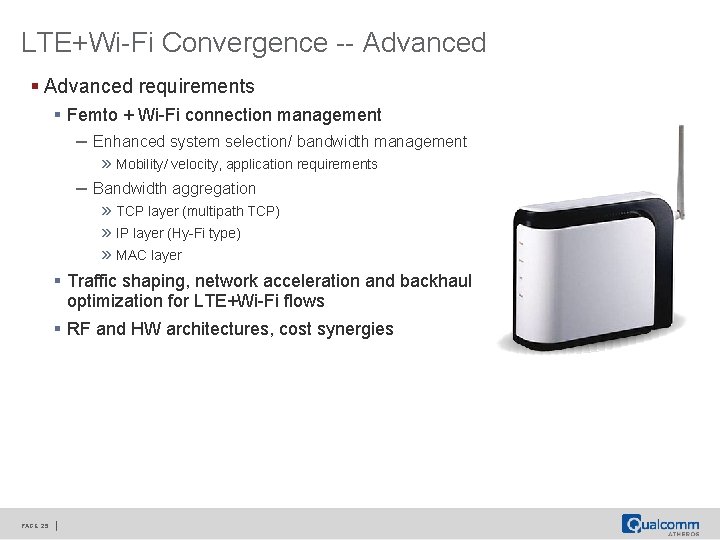
LTE+Wi-Fi Convergence -- Advanced § Advanced requirements § Femto + Wi-Fi connection management – Enhanced system selection/ bandwidth management » Mobility/ velocity, application requirements – Bandwidth aggregation » TCP layer (multipath TCP) » IP layer (Hy-Fi type) » MAC layer § Traffic shaping, network acceleration and backhaul optimization for LTE+Wi-Fi flows § RF and HW architectures, cost synergies PAGE 25
Thank you! PAGE 26
- Slides: 26