
Service Now Configuration Management Deep Dive Training Learning

- Slides: 30
Service. Now Configuration Management Deep Dive Training
Learning Objectives § Define Configuration Management § Identify the scope of the Configuration Management processes and its key activities § Explain the benefits of Configuration Management § Explain key terms and concepts § Understand process roles and responsibilities § Walk through the Service. Now Configuration Management Application
Configuration Management DEFINITIONS AND CONCEPTS
Configuration Management Overview § Configuration Management is the process of establishing and maintaining reliable information on managed IT services, applications and infrastructure components throughout their lifecycle § The Configuration Management (CM) process focuses on the creation, maintenance, and use of Configuration Items (CIs), their Attributes, and Relationships
Configuration Management Overview § Configuration Management process is focused on establishing a complete Configuration Management Database (CMDB) and process integration with other ITIL processes to help realize Configuration Management objectives § It is important to note that Configuration Management is not Asset Management § This will enable the CMDB to capture end-to-end information about Configuration Items (CIs) and their relationships, however the amount and quality of information maintained within it is expected to continue to evolve over time
CMDB Relationships With Other ITSM Processes ITIL Incident Management Configuration Management assists Incident Management by: providing the Service Desk with immediate information on the CIs affected, and more timely resolution of faults by understanding what CIs have been affected and changed. ITIL Service Catalog Management With Service Portfolio Management, Business Services in the CMDB can also be managed by the Service Catalog team, and exposed to end-users who can then request items from them. ITIL Problem Management (Later Phase) Configuration Management assists Problem Management by: linking the CIs affected by problems to the incident / problem / change management processes, and ensuring the CI status is properly maintained. ITIL Change Management (Later Phase) Configuration Management assists Change Management by: recording which CIs have been changed and controlling the status of CIs throughout the entire CI lifecycle. Configuration Management ensures any changes made to CIs are recorded and kept accurate.
Key Definitions CI A Configuration Item (CI) is a service asset that needs to be managed in order to deliver a service. The scope of what constitutes a CI varies by organizations and environments but should be aligned with business requirements. CMDB The Configuration Management Database (CMDB) is the key component of the Configuration Management process. It is a database where the configuration information of managed assets (Configuration Items) is stored. The CMDB supports the delivery of services by maintaining accurate and reliable information on IT assets.
Key Definitions BASELINE A Baseline is a point-in-time configuration of one or more CIs that has been formally reviewed and agreed. Changes from the configuration baseline should only be implemented through formal change procedures. Operational Data means information about the currentstate environment that is captured e. g. by discovery and OPERATIONAL other data sources. The CMDB should only contain configuration information that has been validated and is DATA subject to change control, and should not be used as a monitoring tool or a repository for operational data not relevant for ITSM.
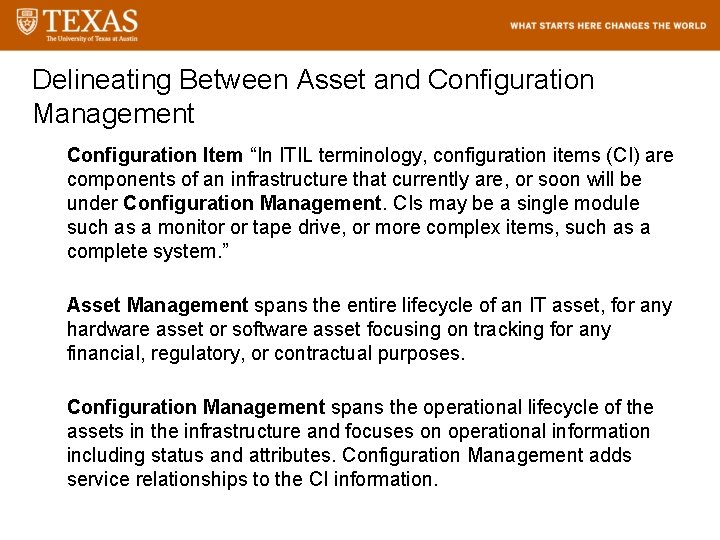
Delineating Between Asset and Configuration Management Configuration Item “In ITIL terminology, configuration items (CI) are components of an infrastructure that currently are, or soon will be under Configuration Management. CIs may be a single module such as a monitor or tape drive, or more complex items, such as a complete system. ” Asset Management spans the entire lifecycle of an IT asset, for any hardware asset or software asset focusing on tracking for any financial, regulatory, or contractual purposes. Configuration Management spans the operational lifecycle of the assets in the infrastructure and focuses on operational information including status and attributes. Configuration Management adds service relationships to the CI information.
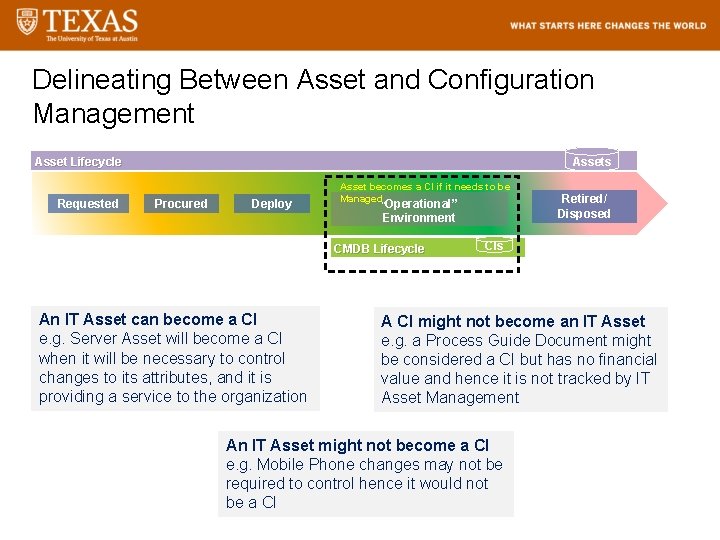
Delineating Between Asset and Configuration Management Assets Asset Lifecycle Requested Procured Deploy Asset becomes a CI if it needs to be Managed “Operational” Environment CMDB Lifecycle An IT Asset can become a CI e. g. Server Asset will become a CI when it will be necessary to control changes to its attributes, and it is providing a service to the organization Retired/ Disposed CIs A CI might not become an IT Asset e. g. a Process Guide Document might be considered a CI but has no financial value and hence it is not tracked by IT Asset Management An IT Asset might not become a CI e. g. Mobile Phone changes may not be required to control hence it would not be a CI
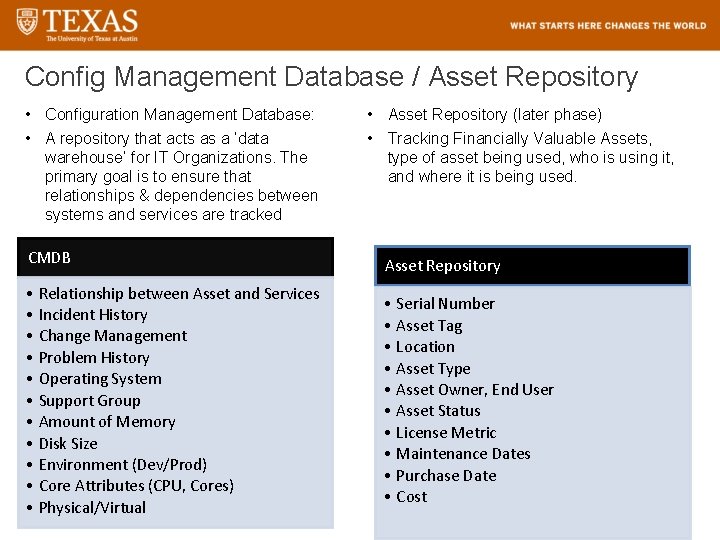
Config Management Database / Asset Repository • Configuration Management Database: • A repository that acts as a ‘data warehouse’ for IT Organizations. The primary goal is to ensure that relationships & dependencies between systems and services are tracked • Asset Repository (later phase) • Tracking Financially Valuable Assets, type of asset being used, who is using it, and where it is being used. CMDB Asset Repository • Relationship between Asset and Services • Incident History • Change Management • Problem History • Operating System • Support Group • Amount of Memory • Disk Size • Environment (Dev/Prod) • Core Attributes (CPU, Cores) • Physical/Virtual • Serial Number • Asset Tag • Location • Asset Type • Asset Owner, End User • Asset Status • License Metric • Maintenance Dates • Purchase Date • Cost
Configuration Management CMDB
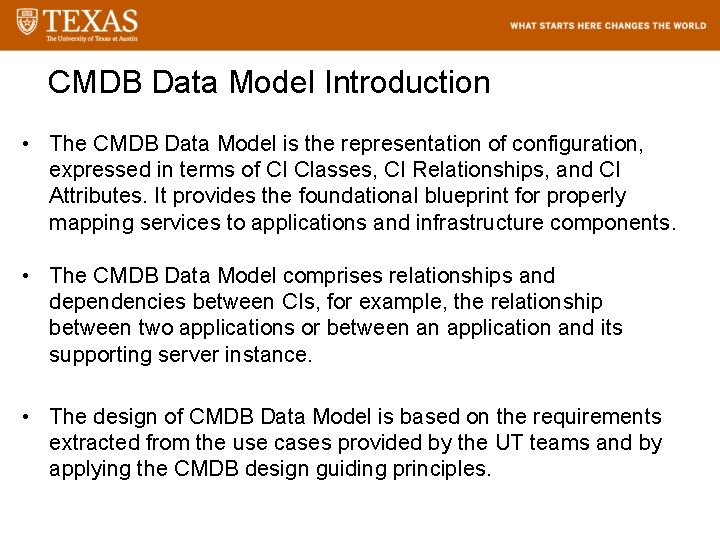
CMDB Data Model Introduction • The CMDB Data Model is the representation of configuration, expressed in terms of CI Classes, CI Relationships, and CI Attributes. It provides the foundational blueprint for properly mapping services to applications and infrastructure components. • The CMDB Data Model comprises relationships and dependencies between CIs, for example, the relationship between two applications or between an application and its supporting server instance. • The design of CMDB Data Model is based on the requirements extracted from the use cases provided by the UT teams and by applying the CMDB design guiding principles.
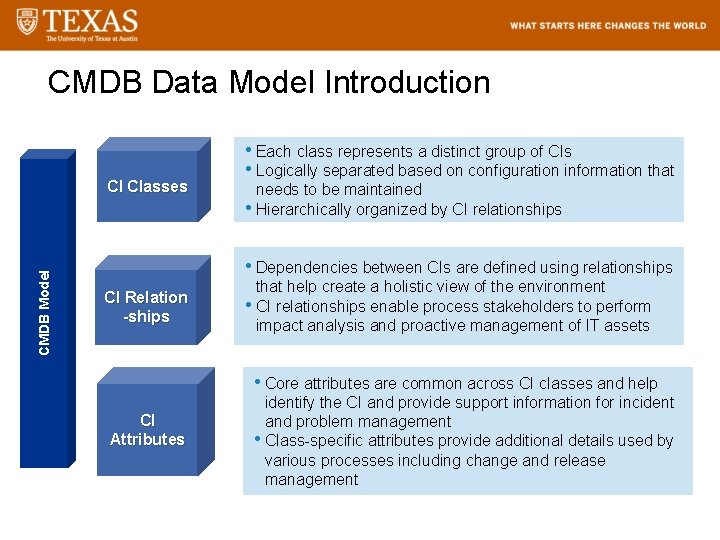
CMDB Data Model Introduction CMDB Model CI Classes • Each class represents a distinct group of CIs • Logically separated based on configuration information that needs to be maintained • Hierarchically organized by CI relationships • Dependencies between CIs are defined using relationships CI Relation -ships that help create a holistic view of the environment • CI relationships enable process stakeholders to perform impact analysis and proactive management of IT assets • Core attributes are common across CI classes and help CI Attributes identify the CI and provide support information for incident and problem management • Class-specific attributes provide additional details used by various processes including change and release management
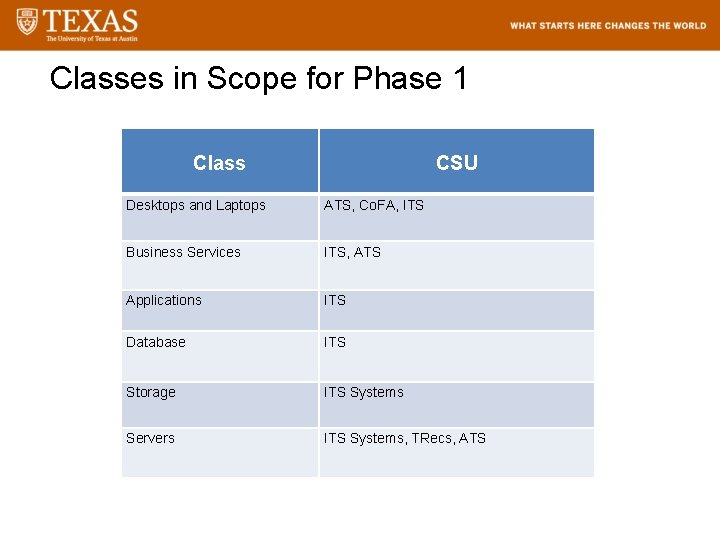
Classes in Scope for Phase 1 Class CSU Desktops and Laptops ATS, Co. FA, ITS Business Services ITS, ATS Applications ITS Database ITS Storage ITS Systems Servers ITS Systems, TRecs, ATS
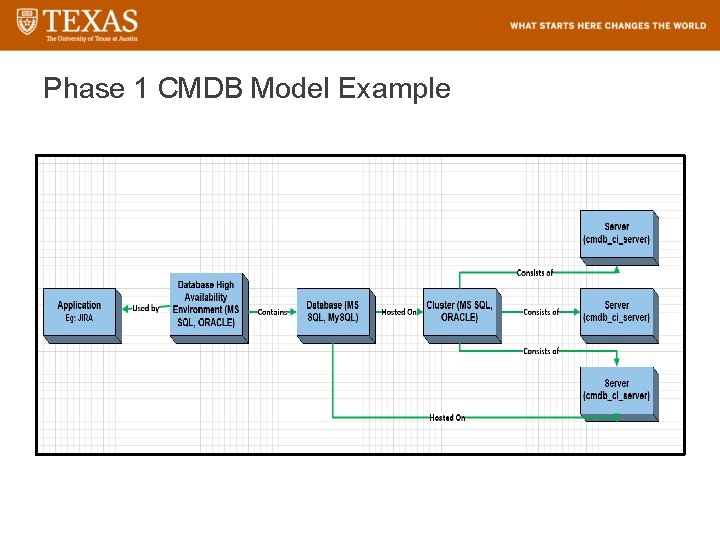
Phase 1 CMDB Model Example
Configuration Management PROCESS ROLES AND RESPONSIBILITIES
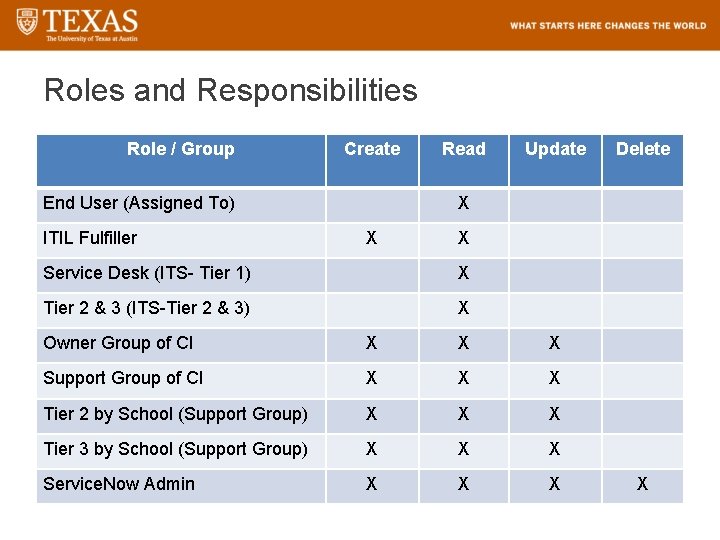
Roles and Responsibilities Role / Group Create End User (Assigned To) ITIL Fulfiller Read Update Delete X X X Service Desk (ITS- Tier 1) X Tier 2 & 3 (ITS-Tier 2 & 3) X Owner Group of CI X X X Support Group of CI X X X Tier 2 by School (Support Group) X X X Tier 3 by School (Support Group) X X X Service. Now Admin X X
Configuration Management PROCESS AND ACTIVITIES
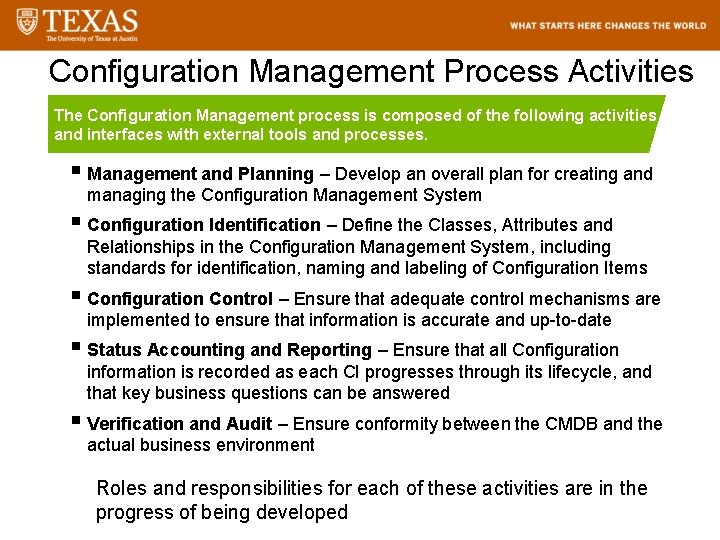
Configuration Management Process Activities The Configuration Management process is composed of the following activities and interfaces with external tools and processes. § Management and Planning – Develop an overall plan for creating and managing the Configuration Management System § Configuration Identification – Define the Classes, Attributes and Relationships in the Configuration Management System, including standards for identification, naming and labeling of Configuration Items § Configuration Control – Ensure that adequate control mechanisms are implemented to ensure that information is accurate and up-to-date § Status Accounting and Reporting – Ensure that all Configuration information is recorded as each CI progresses through its lifecycle, and that key business questions can be answered § Verification and Audit – Ensure conformity between the CMDB and the actual business environment Roles and responsibilities for each of these activities are in the progress of being developed
High Level Process Diagram
Service. Now CONFIGURATION MANAGEMENT APPLICATION AND MODULES
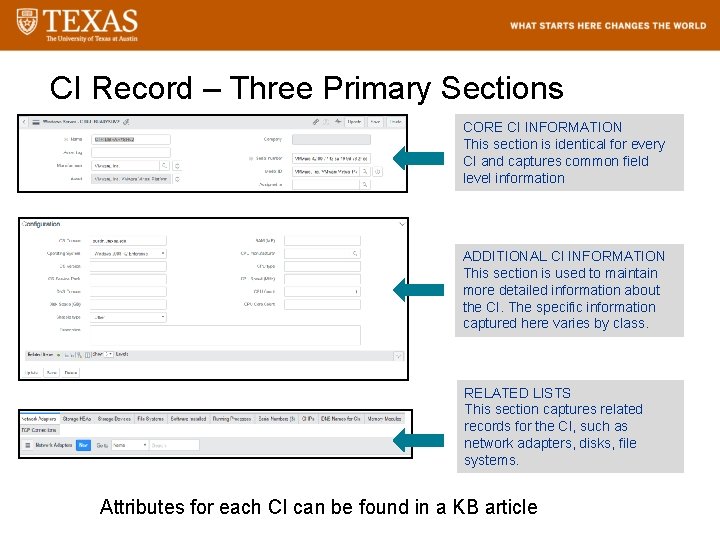
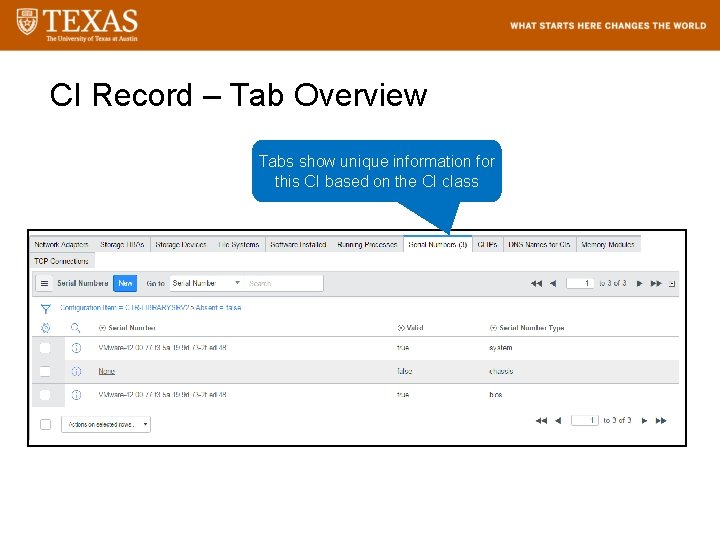
CI Record – Three Primary Sections CORE CI INFORMATION This section is identical for every CI and captures common field level information ADDITIONAL CI INFORMATION This section is used to maintain more detailed information about the CI. The specific information captured here varies by class. RELATED LISTS This section captures related records for the CI, such as network adapters, disks, file systems. Attributes for each CI can be found in a KB article
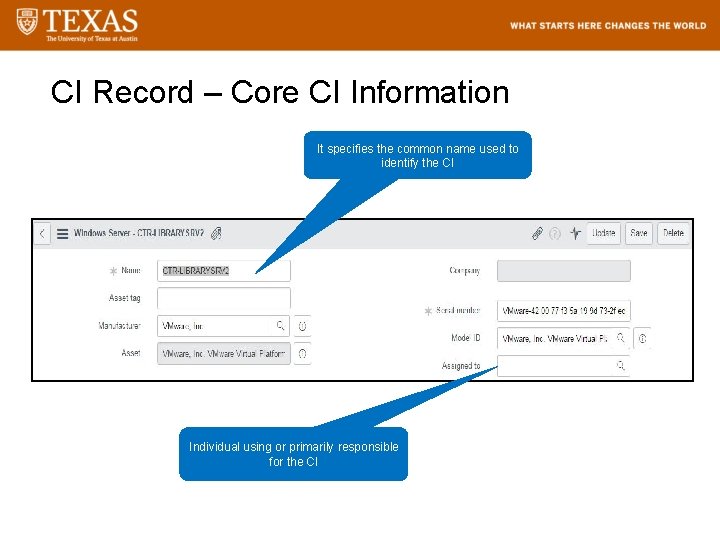
CI Record – Core CI Information It specifies the common name used to identify the CI Individual using or primarily responsible for the CI
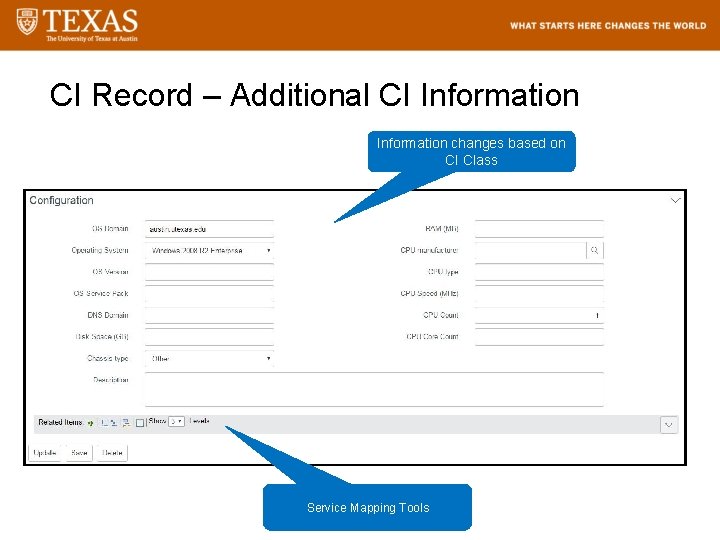
CI Record – Additional CI Information changes based on CI Class Service Mapping Tools
CI Record – Tab Overview Tabs show unique information for this CI based on the CI class
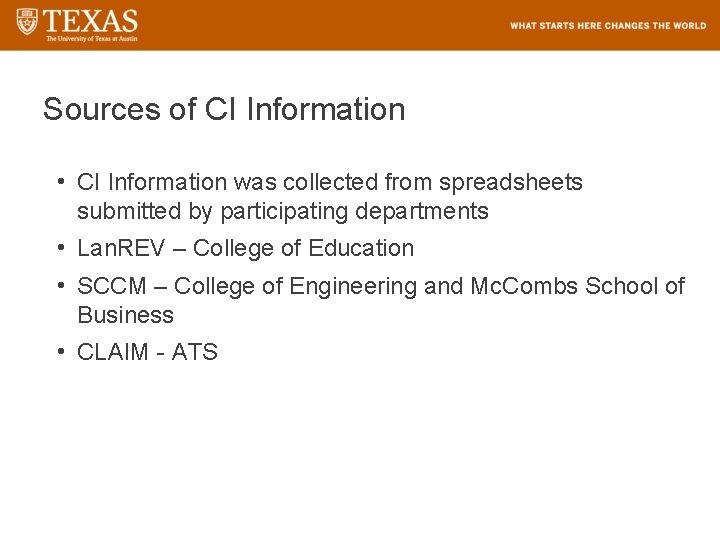
Sources of CI Information • CI Information was collected from spreadsheets submitted by participating departments • Lan. REV – College of Education • SCCM – College of Engineering and Mc. Combs School of Business • CLAIM - ATS
Tool Demo CONFIGURATION MANAGEMENT
Summary §Define Configuration Management §Identify the scope of the Configuration Management processes and its key activities §Explain the benefits of Configuration Management §Explain key terms and concepts §Understand process roles and responsibilities §Walked through the Service. Now application
Questions about Configuration Management