
Service Learning Even a OneDay Project Can Have
- Slides: 2
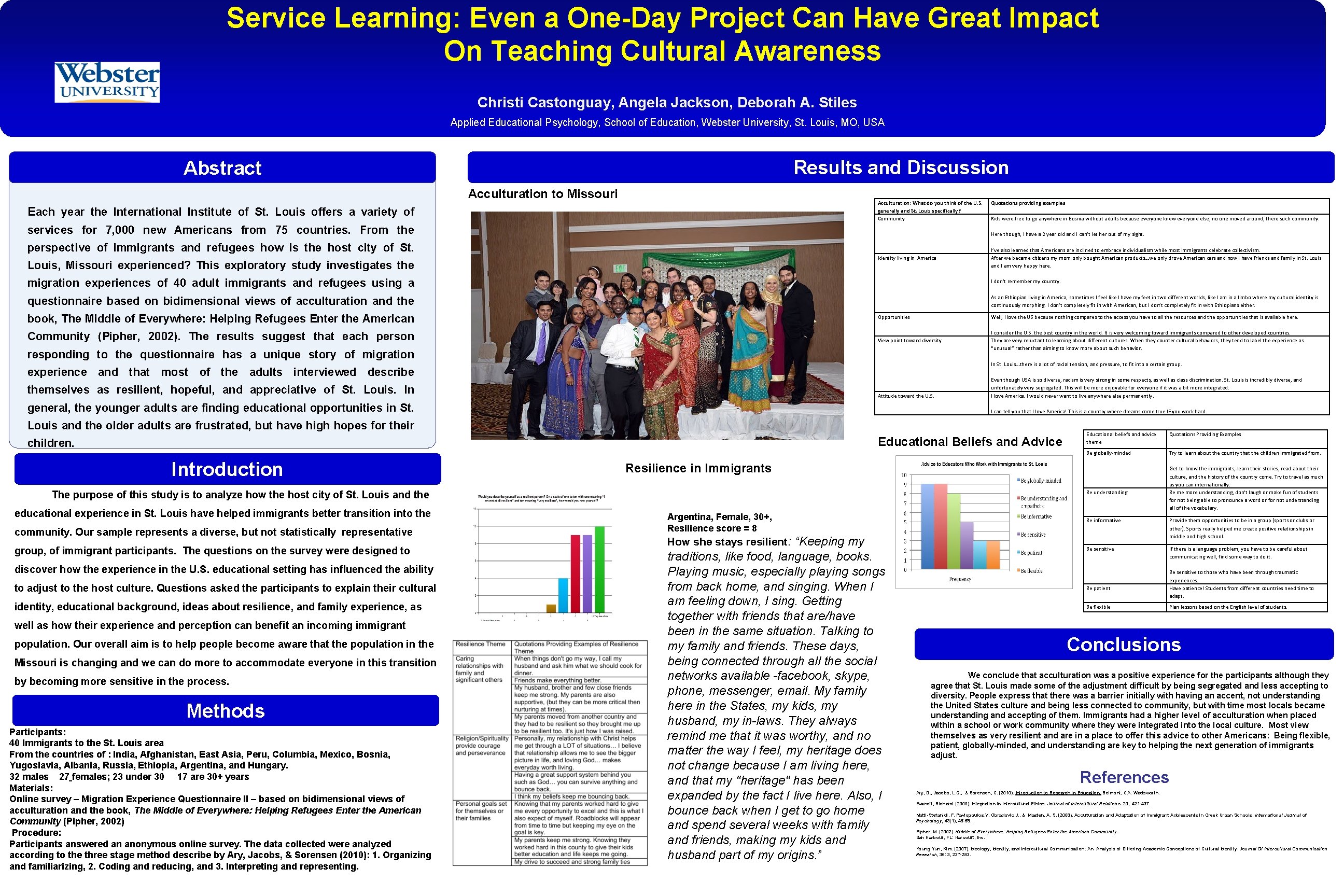
Service Learning: Even a One-Day Project Can Have Great Impact On Teaching Cultural Awareness Christi Castonguay, Angela Jackson, Deborah A. Stiles Applied Educational Psychology, School of Education, Webster University, St. Louis, MO, USA Results and Discussion Abstract Acculturation to Missouri Acculturation: What do you think of the U. S. generally and St. Louis specifically? Community Each year the International Institute of St. Louis offers a variety of services for 7, 000 new Americans from 75 countries. From the Quotations providing examples Kids were free to go anywhere in Bosnia without adults because everyone knew everyone else, no one moved around, there such community. Here though, I have a 2 year old and I can’t let her out of my sight. perspective of immigrants and refugees how is the host city of St. Identity living in America Louis, Missouri experienced? This exploratory study investigates the I’ve also learned that Americans are inclined to embrace individualism while most immigrants celebrate collectivism. After we became citizens my mom only bought American products…we only drove American cars and now I have friends and family in St. Louis and I am very happy here. migration experiences of 40 adult immigrants and refugees using a I don’t remember my country. questionnaire based on bidimensional views of acculturation and the As an Ethiopian living in America, sometimes I feel like I have my feet in two different worlds, like I am in a limbo where my cultural identity is continuously morphing. I don’t completely fit in with American, but I don’t completely fit in with Ethiopians either. book, The Middle of Everywhere: Helping Refugees Enter the American Community (Pipher, 2002). The results suggest that each person Opportunities Well, I love the US because nothing compares to the access you have to all the resources and the opportunities that is available here. View point toward diversity I consider the U. S. the best country in the world. It is very welcoming toward immigrants compared to other developed countries. They are very reluctant to learning about different cultures. When they counter cultural behaviors, they tend to label the experience as “unusual” rather than aiming to know more about such behavior. responding to the questionnaire has a unique story of migration In St. Louis…there is a lot of racial tension, and pressure, to fit into a certain group. experience and that most of the adults interviewed describe themselves as resilient, hopeful, and appreciative of St. Louis. In Attitude toward the U. S. general, the younger adults are finding educational opportunities in St. Even though USA is so diverse, racism is very strong in some respects, as well as class discrimination. St. Louis is incredibly diverse, and unfortunately very segregated. This will be more enjoyable for everyone if it was a bit more integrated. I love America. I would never want to live anywhere else permanently. I can tell you that I love America! This is a country where dreams come true IF you work hard. Louis and the older adults are frustrated, but have high hopes for their Educational Beliefs and Advice children. Introduction community. Our sample represents a diverse, but not statistically representative group, of immigrant participants. The questions on the survey were designed to discover how the experience in the U. S. educational setting has influenced the ability to adjust to the host culture. Questions asked the participants to explain their cultural identity, educational background, ideas about resilience, and family experience, as well as how their experience and perception can benefit an incoming immigrant population. Our overall aim is to help people become aware that the population in the Missouri is changing and we can do more to accommodate everyone in this transition by becoming more sensitive in the process. Methods Participants: 40 Immigrants to the St. Louis area From the countries of : India, Afghanistan, East Asia, Peru, Columbia, Mexico, Bosnia, Yugoslavia, Albania, Russia, Ethiopia, Argentina, and Hungary. 32 males 27 females; 23 under 30 17 are 30+ years Materials: Online survey – Migration Experience Questionnaire II – based on bidimensional views of acculturation and the book, The Middle of Everywhere: Helping Refugees Enter the American Community (Pipher, 2002) Procedure: Participants answered an anonymous online survey. The data collected were analyzed according to the three stage method describe by Ary, Jacobs, & Sorensen (2010): 1. Organizing and familiarizing, 2. Coding and reducing, and 3. Interpreting and representing. Quotations Providing Examples Be globally-minded Try to learn about the country that the children immigrated from. Resilience in Immigrants Be understanding The purpose of this study is to analyze how the host city of St. Louis and the educational experience in St. Louis have helped immigrants better transition into the Educational beliefs and advice theme Argentina, Female, 30+, Resilience score = 8 How she stays resilient: “Keeping my traditions, like food, language, books. Playing music, especially playing songs from back home, and singing. When I am feeling down, I sing. Getting together with friends that are/have been in the same situation. Talking to my family and friends. These days, being connected through all the social networks available -facebook, skype, phone, messenger, email. My family here in the States, my kids, my husband, my in-laws. They always remind me that it was worthy, and no matter the way I feel, my heritage does not change because I am living here, and that my "heritage" has been expanded by the fact I live here. Also, I bounce back when I get to go home and spend several weeks with family and friends, making my kids and husband part of my origins. ” Get to know the immigrants, learn their stories, read about their culture, and the history of the country come. Try to travel as much as you can internationally. Be me more understanding, don’t laugh or make fun of students for not being able to pronounce a word or for not understanding all of the vocabulary. Be informative Provide them opportunities to be in a group (sports or clubs or other). Sports really helped me create positive relationships in middle and high school. Be sensitive If there is a language problem, you have to be careful about communicating well, find some way to do it. Be patient Be flexible Be sensitive to those who have been through traumatic experiences. Have patience! Students from different countries need time to adapt. Plan lessons based on the English level of students. Conclusions We conclude that acculturation was a positive experience for the participants although they agree that St. Louis made some of the adjustment difficult by being segregated and less accepting to diversity. People express that there was a barrier initially with having an accent, not understanding the United States culture and being less connected to community, but with time most locals became understanding and accepting of them. Immigrants had a higher level of acculturation when placed within a school or work community where they were integrated into the local culture. Most view themselves as very resilient and are in a place to offer this advice to other Americans: Being flexible, patient, globally-minded, and understanding are key to helping the next generation of immigrants adjust. References Ary, D. , Jacobs, L. C. , & Sorensen, C. (2010). Introduction to Research in Education. Belmont, CA: Wadsworth. Evanoff, Richard. (2006). Integration in Intercultural Ethics. Journal of Intercultural Relations. 20, 421 -437. Motti-Stefanidi, F. Pavlopoulos, V. Obradovic, J. , & Masten, A. S. (2008). Acculturation and Adaptation of Immigrant Adolescents in Greek Urban Schools. International Journal of Psychology, 43(1), 45 -58. Pipher, M. (2002). Middle of Everywhere: Helping Refugees Enter the American Community. San Harbour, FL: Harcourt, Inc. Young Yun, Kim. (2007). Ideology, Identity, and Intercultural Communication: An Analysis of Differing Academic Conceptions of Cultural Identity. Journal Of Intercultural Communication Research, 36: 3, 237 -253.
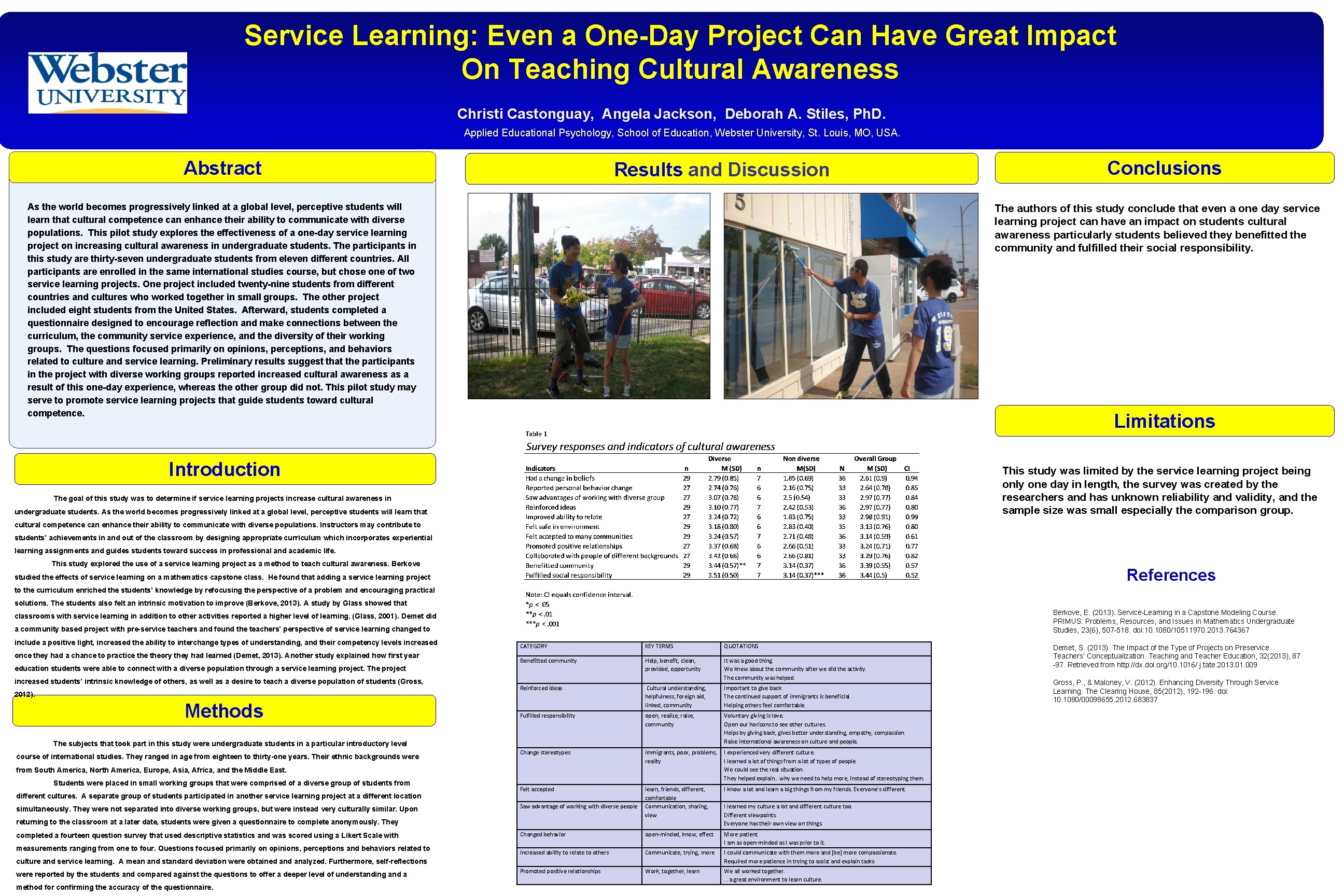
Service Learning: Even a One-Day Project Can Have Great Impact On Teaching Cultural Awareness Christi Castonguay, Angela Jackson, Deborah A. Stiles, Ph. D. Applied Educational Psychology, School of Education, Webster University, St. Louis, MO, USA. Abstract Results and Discussion As the world becomes progressively linked at a global level, perceptive students will learn that cultural competence can enhance their ability to communicate with diverse populations. This pilot study explores the effectiveness of a one-day service learning project on increasing cultural awareness in undergraduate students. The participants in this study are thirty-seven undergraduate students from eleven different countries. All participants are enrolled in the same international studies course, but chose one of two service learning projects. One project included twenty-nine students from different countries and cultures who worked together in small groups. The other project included eight students from the United States. Afterward, students completed a questionnaire designed to encourage reflection and make connections between the curriculum, the community service experience, and the diversity of their working groups. The questions focused primarily on opinions, perceptions, and behaviors related to culture and service learning. Preliminary results suggest that the participants in the project with diverse working groups reported increased cultural awareness as a result of this one-day experience, whereas the other group did not. This pilot study may serve to promote service learning projects that guide students toward cultural competence. Conclusions The authors of this study conclude that even a one day service learning project can have an impact on students cultural awareness particularly students believed they benefitted the community and fulfilled their social responsibility. Limitations Introduction This study was limited by the service learning project being only one day in length, the survey was created by the researchers and has unknown reliability and validity, and the sample size was small especially the comparison group. The goal of this study was to determine if service learning projects increase cultural awareness in undergraduate students. As the world becomes progressively linked at a global level, perceptive students will learn that cultural competence can enhance their ability to communicate with diverse populations. Instructors may contribute to students’ achievements in and out of the classroom by designing appropriate curriculum which incorporates experiential learning assignments and guides students toward success in professional and academic life. This study explored the use of a service learning project as a method to teach cultural awareness. Berkove References studied the effects of service learning on a mathematics capstone class. He found that adding a service learning project to the curriculum enriched the students’ knowledge by refocusing the perspective of a problem and encouraging practical solutions. The students also felt an intrinsic motivation to improve (Berkove, 2013). A study by Glass showed that Berkove, E. (2013). Service-Learning in a Capstone Modeling Course. PRIMUS: Problems, Resources, and Issues in Mathematics Undergraduate Studies, 23(6), 507 -518. doi: 10. 1080/10511970. 2013. 764367 classrooms with service learning in addition to other activities reported a higher level of learning. (Glass, 2001). Demet did a community based project with pre-service teachers and found the teachers’ perspective of service learning changed to include a positive light, increased the ability to interchange types of understanding, and their competency levels increased once they had a chance to practice theory they had learned (Demet, 2013). Another study explained how first year CATEGORY KEY TERMS QUOTATIONS Benefitted community Help, benefit, clean, provided, opportunity It was a good thing. We knew about the community after we did the activity. The community was helped. Reinforced ideas Cultural understanding, helpfulness, foreign aid, linked, community Important to give back. The continued support of immigrants is beneficial. Helping others feel comfortable. Fulfilled responsibility open, realize, raise, community Voluntary giving is love. Open our horizons to see other cultures. Helps by giving back, gives better understanding, empathy, compassion. Raise international awareness on culture and people. Change stereotypes immigrants, poor, problems, reality I experienced very different culture. I learned a lot of things from a lot of types of people. We could see the real situation. They helped explain. . . why we need to help more, instead of stereotyping them. Felt accepted learn, friends, different, comfortable Communication, sharing, view I know a lot and learn a big things from my friends. Everyone’s different. Changed behavior open-minded, know, effect More patient. I am as open-minded as I was prior to it. Increased ability to relate to others Communicate, trying, more I could communicate with them more and [be] more compassionate. Required more patience in trying to assist and explain tasks. Promoted positive relationships Work, together, learn We all worked together. . a great environment to learn culture. education students were able to connect with a diverse population through a service learning project. The project increased students’ intrinsic knowledge of others, as well as a desire to teach a diverse population of students (Gross, 2012). Methods The subjects that took part in this study were undergraduate students in a particular introductory level course of international studies. They ranged in age from eighteen to thirty-one years. Their ethnic backgrounds were from South America, North America, Europe, Asia, Africa, and the Middle East. Students were placed in small working groups that were comprised of a diverse group of students from different cultures. A separate group of students participated in another service learning project at a different location simultaneously. They were not separated into diverse working groups, but were instead very culturally similar. Upon Saw advantage of working with diverse people returning to the classroom at a later date, students were given a questionnaire to complete anonymously. They completed a fourteen question survey that used descriptive statistics and was scored using a Likert Scale with measurements ranging from one to four. Questions focused primarily on opinions, perceptions and behaviors related to culture and service learning. A mean and standard deviation were obtained analyzed. Furthermore, self-reflections were reported by the students and compared against the questions to offer a deeper level of understanding and a method for confirming the accuracy of the questionnaire. I learned my culture a lot and different culture too. Different viewpoints. Everyone has their own view on things. Demet, S. (2013). The Impact of the Type of Projects on Preservice Teachers’ Conceptualization. Teaching and Teacher Education, 32(2013), 87 -97. Retrieved from http: //dx. doi. org/10. 1016/ j. tate. 2013. 01. 009 Gross, P. , & Maloney, V. (2012). Enhancing Diversity Through Service Learning. The Clearing House, 85(2012), 192 -196. doi: 10. 1080/00098655. 2012. 683837