
SERVICE LEARNING AT THE ELEMENTARY LEVEL Rebecca Brigham
SERVICE LEARNING AT THE ELEMENTARY LEVEL Rebecca Brigham EDU 510 Fall 2017
“ Everybody can be great. Because anybody can serve. You don’t have to have a college degree to serve. You don’t have to make your subject and verb agree to serve. . You only need a heart full of grace. -Martin Luther King, Jr. A soul generated by love. ”
WHAT IS SERVICE LEARNING? ➤ In 1990, Congress passed the National and Community Service Act, which defined and supported the method of service-learning in education. Within the document, it states: ➤ “. . Engages students in meeting community needs with demonstrable results, while enhancing students’ academic and civic learning. ” ➤ In other words, service-learning is a strategy that involves a service to the community while connecting to student learning that is tied to academic curriculum and social issues.
SERVICE-LEARNING AT THE ELEMENTARY LEVEL ➤ When presenting servicelearning to the students (1 -6), I would use a definition that the students will be able to understand process. ➤ Service-Learning: Someone who helps another, and who is in turn, enriched by what he or she has learned from that act.

ELEMENTS OF SERVICE-LEARNING ➤ There are four key components to integrating service-learning within your teaching. All components work together to create a strong program that correlates to academic curriculum, while challenging students to hold citizenship within their community. 1. Preparation 2. Action 3. Reflection 4. Assessment
PREPAR ATION To start integrating service-learning, as an educator, you need to prepare your students for what the service is, and why they will be completing it. This is where you state the objective for the activity, and students will learn what the outcome will be. Here are some examples of preparation that can be used at the elementary level: ➤ Discussion: What is service-learning? Why are we doing it? ➤ Small-group discussions ➤ Journal writing ➤ Readings ➤ Classroom Presentation by Agency or Staff Member of Service ➤ On-site visit or observation ➤ Video of service ➤ Presentation by students from the previous class year ➤ Research/Internet Browsing on social issue
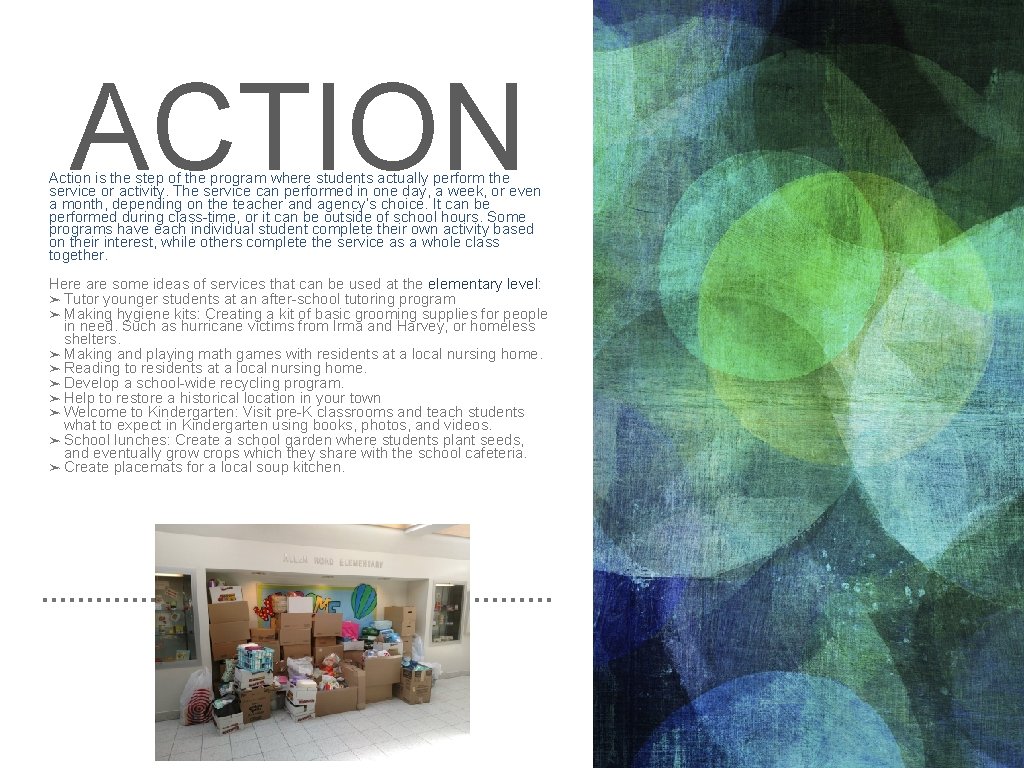
ACTION Action is the step of the program where students actually perform the service or activity. The service can performed in one day, a week, or even a month, depending on the teacher and agency’s choice. It can be performed during class-time, or it can be outside of school hours. Some programs have each individual student complete their own activity based on their interest, while others complete the service as a whole class together. Here are some ideas of services that can be used at the elementary level: ➤ Tutor younger students at an after-school tutoring program ➤ Making hygiene kits: Creating a kit of basic grooming supplies for people in need. Such as hurricane victims from Irma and Harvey, or homeless shelters. ➤ Making and playing math games with residents at a local nursing home. ➤ Reading to residents at a local nursing home. ➤ Develop a school-wide recycling program. ➤ Help to restore a historical location in your town ➤ Welcome to Kindergarten: Visit pre-K classrooms and teach students what to expect in Kindergarten using books, photos, and videos. ➤ School lunches: Create a school garden where students plant seeds, and eventually grow crops which they share with the school cafeteria. ➤ Create placemats for a local soup kitchen.

REFLEC TION The difference between having students volunteer and having students partake in service-learning is that service-learning has the reflective component. The students must reflect and critically analyze their experience. As the teacher, you can direct their reflection, so that they are critically thinking about their experience and attitudes. You also need to tie in the academic curriculum and social issues into the reflection as well. The product in which they show their reflection is the choice of the teacher, but there are guiding questions that can be asked to help this process become reflective. Here are some questions you can pose during the reflection to students at the elementary level : ➤ What are you feeling? ➤ How do you see yourself differently? ➤ What questions do you have? ➤ Whom did you serve during this service? ➤ What new impressions do you have? And how can that serve to similar situations? ➤ What social issue were you dealing with? ➤ How should our world be different? ➤ What is one step you can take to reach that vision you have of our world?
ASSESS MENT Assessment is important for service-learning because we need to gather the information to make an evaluation of the student’s service. We need to determine if the student was successful with their preparation, action, and reflection. It’s important to develop an assessment instrument that guides the students service and reflective work. Many teachers develop a self-assessment for the students to gain the information on each student’s evaluation. You can present questions to the student, so that they can analyze the context of their activities and learning that made up the program. How you want the student to present the information is the choice of the teacher, but the students should be the one assessing themselves as the learner, while you assess their self-assessment. Here are some questions you can incorporate in your selfassessment at the elementary level : ➤ Did you and the agency meet the goals for the project? ➤ Did you learn what you set out to learn? ➤ Did your attitude, beliefs, or values shift in any way?
LET’S CHECK OUR UNDERSTANDING… To make sure that you are understanding the concept of service-learning, answer the questions below. 1. An environment where one can learn and develop by actively participating in organized service experiences within one's community is called _______. 2. Service learning is a kind of _______ learning strategy. a. Community-based b. Active and experiential c. Kinetic d. Volunteer 3. Which one of these is NOT a key component of service-learning? a. Action b. Reflection c. Preparation d. Communication
LET’S CHECK OUR UNDERSTANDING… To make sure that you are understanding the concept of service-learning, answer the questions below. 1. An environment where one can learn and develop by actively participating in organized service experiences within one's community is called service-learning. 2. Service learning is a kind of _______ learning strategy. a. Community-based b. Active and experiential c. Kinetic d. Volunteer 3. Which one of these is NOT a key component of service-learning? a. Action b. Reflection c. Preparation d. Communication
PROS TO SERVICE-LEARNING Pros ➤ Almost any academic standard can be turned into a service-learning activity. ➤ Provides real world experiences to help students understand multiple perspectives in our society. ➤ Encourages students to take ownership of their education. ➤ Provides development for civic engagement, personal, and social skills. ➤ Deepen understanding of academic standards. ➤ Students feel connected to their community.
CONS TO SERVICE-LEARNING Cons ➤ Service-learning ➤ Takes is time consuming (for the students and teacher). time away from educational curriculum and instructional time. ➤ We can face emotional and intellectual unknowns. (May not know the outcome of the lesson. ) ➤ It may be hard to measure the outcome of student learning.
TO GAIN A BETTER UNDERSTANDING… ➤ Here is a video of Woodbury Middle School in Las Vegas, Nevada, completing different service-learning projects throughout the year. ➤ https: //www. youtube. com/watch? v=Vkrfa. L 7 Jg. ZU
YOUR FINAL THOUGHTS… ➤ What do you like about service -learning? ➤ What do you dislike? ➤ Are you for or against servicelearning in the classroom? And why?
REFERENCES ➤ Kronick, R. F. , Cunningham, R. B. , & Gourley, M. (2011). Experiencing Service. Learning. Retrieved from https: //ebookcentral. proquest. com ➤ Sigler, T. S. , & Tyran, K. L. (2017). Enhancing Learning, Changing the World: How Service-Learning Influences the Brain. Journal Of Community Engagement & Higher Education, 9(2), p. 16 -29 ➤ Waterman, A. S. (Ed. ). (2003). Studying Service-Learning : Innovations in Education Research Methodology. Retrieved from https: //ebookcentral. proquest. com
- Slides: 16