
Service Learning 101 What Why How Brenda Marsteller
Service Learning 101: What, Why & How? Brenda Marsteller Kowalewski, Ph. D. Community-Based & Experiential Learning
Objectives • Define Service-Learning • Show the impact of Service-Learning on: – Students – Faculty – Community • Provide a service-learning example and best practices • Provide you with an opportunity to get started • Provide you with resources to help you teach a service-learning course 2
Service Learning: What Is It? • National Commission on Service-Learning “…a teaching and learning approach that integrates community service with academic study to enrich learning, teach civic responsibility, and strengthen communities. ” 3
Corporation for National and Community Service • Promotes learning through active participation • Provides structured time for students to reflect • Provides a opportunities to use skills and knowledge in real-life situations • Extends learning beyond the classroom • Fosters a sense of caring for others Adapted from the National and Community Service Act of 1990 4
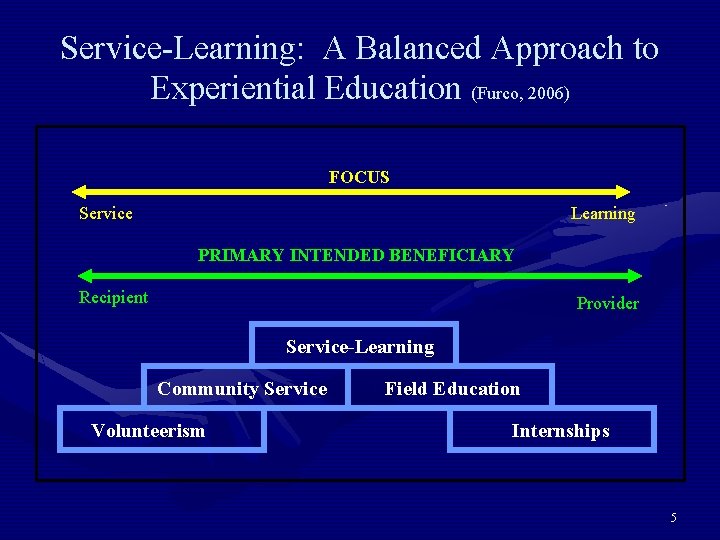
Service-Learning: A Balanced Approach to Experiential Education (Furco, 2006) FOCUS Service Learning PRIMARY INTENDED BENEFICIARY Recipient Provider Service-Learning Community Service Volunteerism Field Education Internships 5
Community service example If students remove trash from a streambed: they are providing a service to the community as volunteers. 6
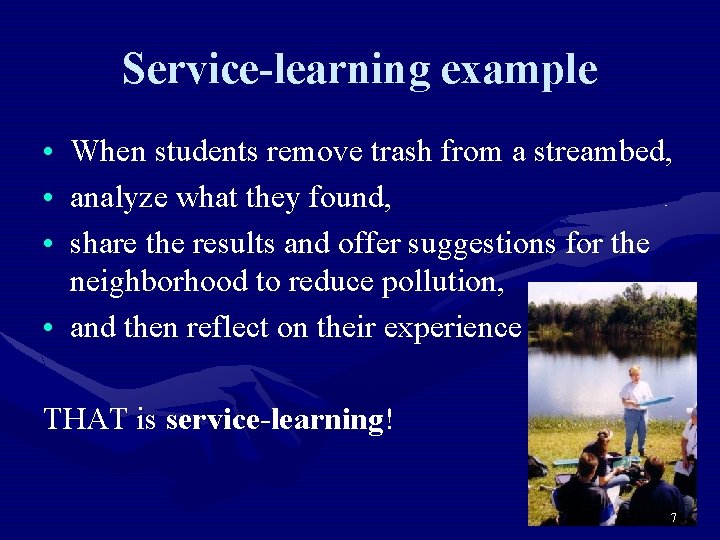
Service-learning example • When students remove trash from a streambed, • analyze what they found, • share the results and offer suggestions for the neighborhood to reduce pollution, • and then reflect on their experience THAT is service-learning! 7
Many roads to service-learning Different All seek § Interpretations § Objectives – Combination of service objectives with intentional learning objectives § Contexts – Changes in both the recipient and the provider of the service 8
Reflection: A Key Component The intentional consideration of an experience in light of particular learning objectives (Hatcher & Bringle, 1997). • • Connected Continuous Challenging Contextualized
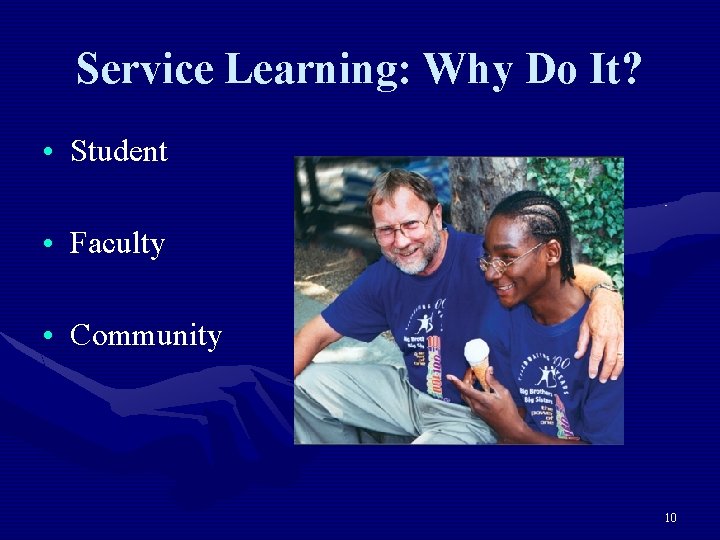
Service Learning: Why Do It? • Student • Faculty • Community 10
Students Benefit Personally • positively affects student personal development – such as: sense of personal efficacy, personal identity, spiritual growth, and moral development • positively affects interpersonal development – the ability to work well with others, leadership, and communication skills 11
Raises Student Awareness • positive effect on reducing stereotypes and facilitating cultural & racial understanding • positive effect on sense of social responsibility and citizenship skills • positive effect on commitment to service 12
Students’ Academic Learning Increases • Students' ability to apply what they have learned to “the real world” • Complexity of understanding, problem analysis, critical thinking, and cognitive development • Service-learning contributes to career development 13
Students have a Positive Relationship with the Institution • Students engaged in service-learning report stronger faculty relationships than those who are not involved in service-learning. • Service-learning improves student satisfaction with college. • Service-learning positively affects student retention. • Students engaged in service-learning are more likely to graduate. 14
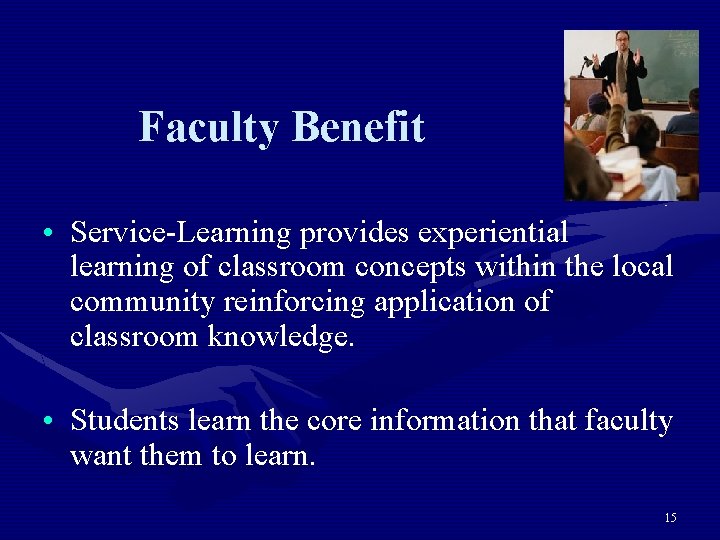
Faculty Benefit • Service-Learning provides experiential learning of classroom concepts within the local community reinforcing application of classroom knowledge. • Students learn the core information that faculty want them to learn. 15
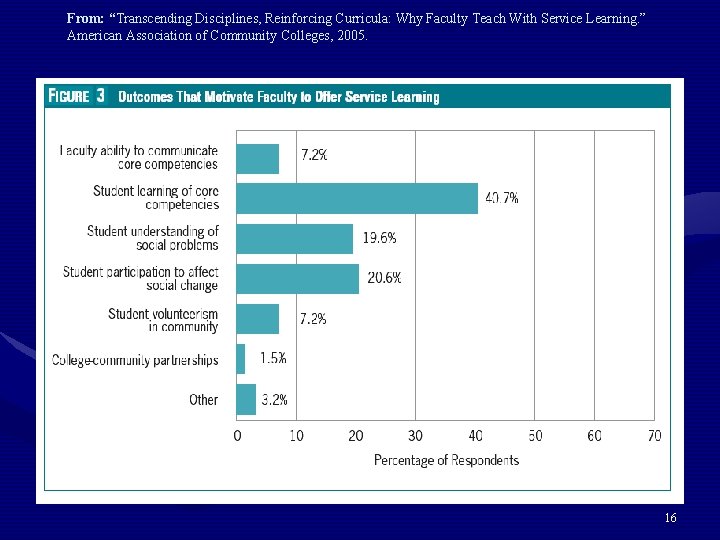
From: “Transcending Disciplines, Reinforcing Curricula: Why Faculty Teach With Service Learning. ” “ American Association of Community Colleges, 2005. 16
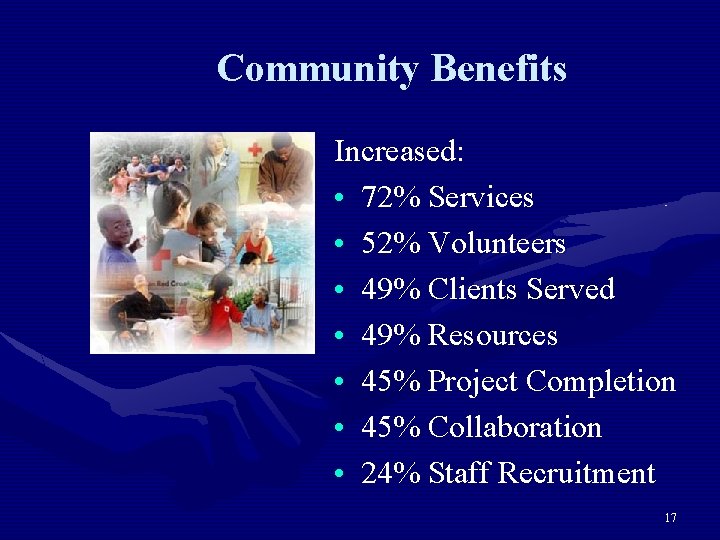
Community Benefits Increased: • 72% Services • 52% Volunteers • 49% Clients Served • 49% Resources • 45% Project Completion • 45% Collaboration • 24% Staff Recruitment 17
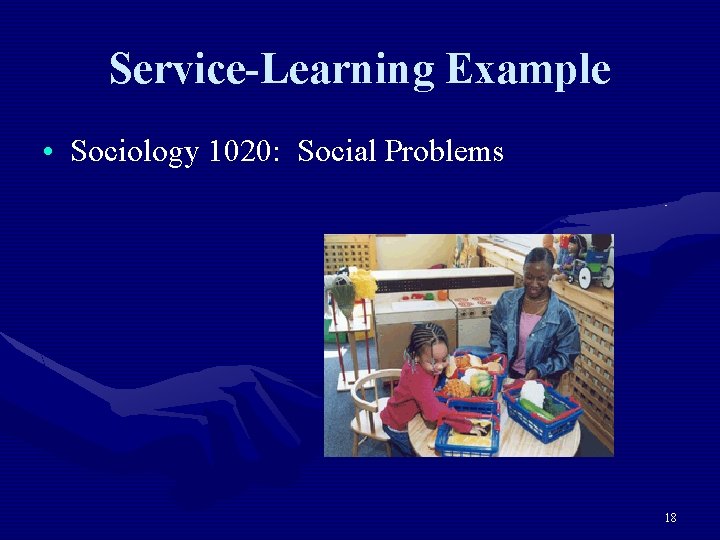
Service-Learning Example • Sociology 1020: Social Problems 18
Best Practices • Academic Credit is for Learning, Not for Service • Do Not Compromise Academic Rigor • Establish Learning Objectives • Establish Criteria for the Selection of Service. Placements 19
Best Practices (cont’d) • Provide Educationally-Sound Learning Strategies to Harvest Community Learning and Realize Course Learning Objectives • Prepare Students for Learning from the Community • Minimize the Distinction Between the Students’ Community Learning Role and Classroom Learning Role 20
Best Practices (cont’d) • Rethink the Faculty Instructional Role • Be Prepared for Variation in, and Some Loss of Control with, Student Learning Outcomes • Maximize the Community Responsibility Orientation of the Course 21
Getting Started: S-L and Your Course • Which course is the best candidate for incorporating a service-learning component? • Course Development Worksheet – List course objectives. – Brain storm potential projects and partners that could help you teach at least one course objective. – Logistics • Assignments and Evaluating them. 22
Resources • CBEL office - Brenda Kowalewski, Director • Library Suite 57 – 626 -7737 • Sociology SS 126 – 626 -7893 • bkowalewski@weber. edu • Bibliography of Library resources (handout) 23
Online Resources • Community-Based & Experiential Learning – http: //programs. weber. edu/CBEL (under construction) • Thayne Center - SLCC – http: //active. slcc. edu/thaynecenter/ • National Service-Learning Clearinghouse – www. servicelearning. org • Campus Compact – www. campuscompact. org • Utah Campus Compact – www. utahcampuscompact. org 24
- Slides: 24