
Service Function Chaining SFC Subscriber and Host Identification
Service Function Chaining (SFC): Subscriber and Host Identification Considerations draft-sarikaya-sfc-hostid-serviceheader Behcet Sarikaya(sarikaya@ieee. org) Dirk von Hugo(Dirk. von-Hugo@telekom. de) Mohamed Boucadair (mohamed. boucadair@orange. com) IETF#94, Yokohama, November 2015 1
On (Per-subscriber) Policies l Some service deployments require enforcing policies based on the internal IP address/prefix, a subscriber identifier, or a combination thereof. l l Typically denoted as: Per-subscriber policies These policies may be enforced by one or multiple Service Functions These Service Functions may be located anywhere within an SFC-enabled domain The exact set of policies to be enforced are deployment-specific. 2
The Problem l A Service Function that needs to enforce persubscriber or per-host policies may not have access to the internal IP address/prefix or subscriber Identifier (MAC@, Line ID, etc. ) l l Because of the presence of NATs Difficult to access to a Layer 2 information when the SF is located upstream How to pass that information to upstream SFs for the sake of policy enforcement? Explicit authentication is out of scope 3
Sample Use Case Policy Control Host 1 Host 2 RG with NAT … Edge Router (BNG) Internet IPv 4/IPv 6 Host i Host n l Scenario: multiple devices with different policies (usage profiles/patterns) owned by same subscriber are behind NAT (e. g. residential home gateway, RG) l l l Smart home sensors Home network (devices) configuration tool Parents and kids personal devices 4
The Solution l Pass the “identification” data to be consumed by upstream SFs in a dedicated NEW context object l l l Two context headers are specified: l l l As part of the NSH header Compliant with Section 4. 9 of RFC 7665 ( « Sharing metadata » ) Host Identifier Subscriber Identifier Defined as Optional Variable Length Metadata 5
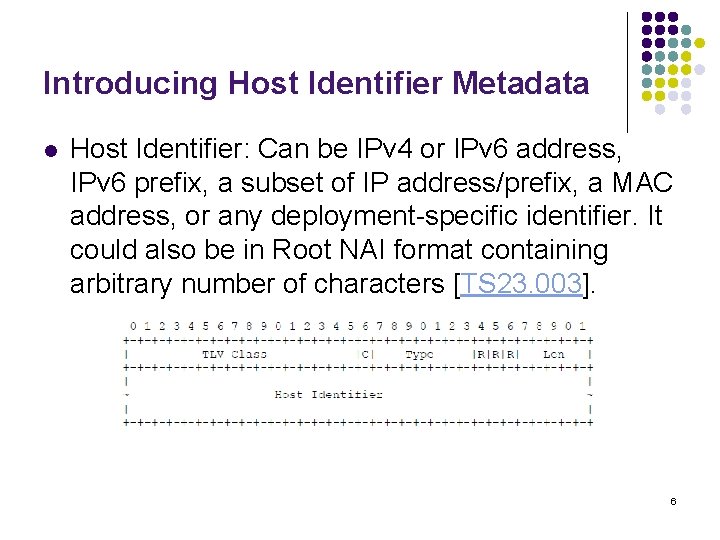
Introducing Host Identifier Metadata l Host Identifier: Can be IPv 4 or IPv 6 address, IPv 6 prefix, a subset of IP address/prefix, a MAC address, or any deployment-specific identifier. It could also be in Root NAI format containing arbitrary number of characters [TS 23. 003]. 6
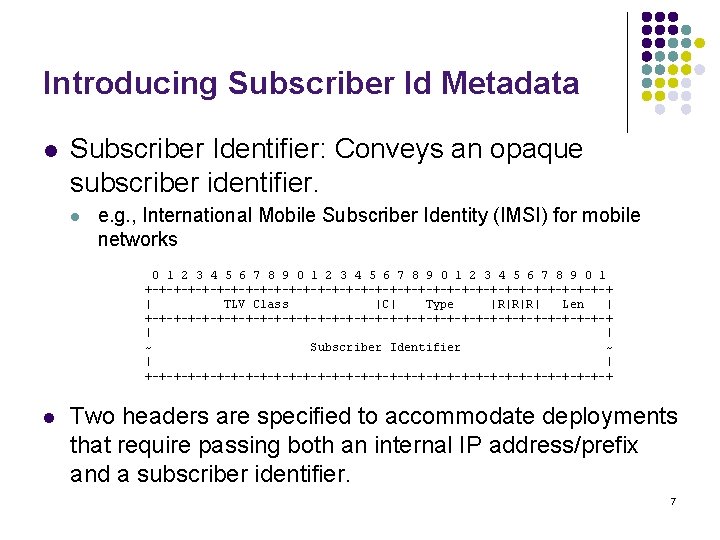
Introducing Subscriber Id Metadata l Subscriber Identifier: Conveys an opaque subscriber identifier. l e. g. , International Mobile Subscriber Identity (IMSI) for mobile networks 0 1 2 3 4 5 6 7 8 9 0 1 +-+-+-+-+-+-+-+-+-+-+-+-+-+-+-+-+ | TLV Class |C| Type |R|R|R| Len | +-+-+-+-+-+-+-+-+-+-+-+-+-+-+-+-+ | | ~ Subscriber Identifier ~ | | +-+-+-+-+-+-+-+-+-+-+-+-+-+-+-+-+ l Two headers are specified to accommodate deployments that require passing both an internal IP address/prefix and a subscriber identifier. 7
Privacy Considerations l Privacy-related consideration for passing personalized and thus sensitive information have been addressed in the draft, e. g. , l Misconfiguring SFC egress nodes is a threat that may have negative impacts on privacy (e. g. , some operational networks leak the MSISDN outside). l l MUST NOT be exposed outside the operator's domain No visible mapping between host ID and subscriber ID CPE MUST NOT leak non-authorized information to the service provider by means of an SFC header. Also tackled by draft-ietf-sfc-control-plane and RFC 8 6967, RFC 7665
Next steps l l l Comments and contributions are welcome Any interest from the WG to document such considerations? What are the next steps for this effort? l l Consider adoption as a standalone document? Merge with an existing draft? 9
- Slides: 9