
Service Desk Service Desk Basic Concepts Terminology Incident
Service Desk

Service Desk Basic Concepts - Terminology Incident Service Desk Types Service Desk Organizational Structures Service Request For Change Access Rights

Service Desk Basic Concepts Support group Service Desk call support Support group Customer & solution End User Support group organization 1 st line 2 nd line 3 rd line

Service Desk Roles, Responsibilities, and Skills technical skills business understanding communication skills

Service Desk Types Skill level First line resolution Service Desk 100% Helpdesk Call Center 0% Costs

Service Desk Organization: Local Service Desk user user Service Desk location A Service Desk location C Service Desk location B user

Service Desk Organization: Centralized Service Desk User Group Service Desk 2 nd Line Support Technic al Mgmt Applicatio n Mgmt IT Ops Mgmt 3 rd Party Support Request Fulfilment
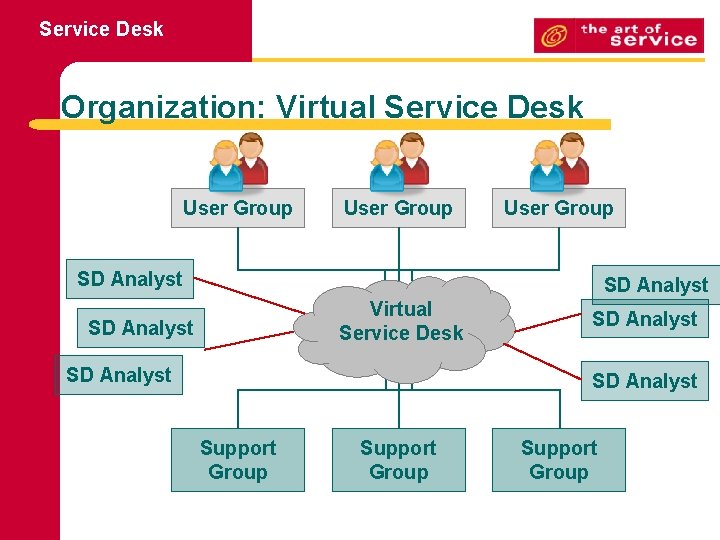
Service Desk Organization: Virtual Service Desk User Group SD Analyst Virtual Service Desk SD Analyst Support Group
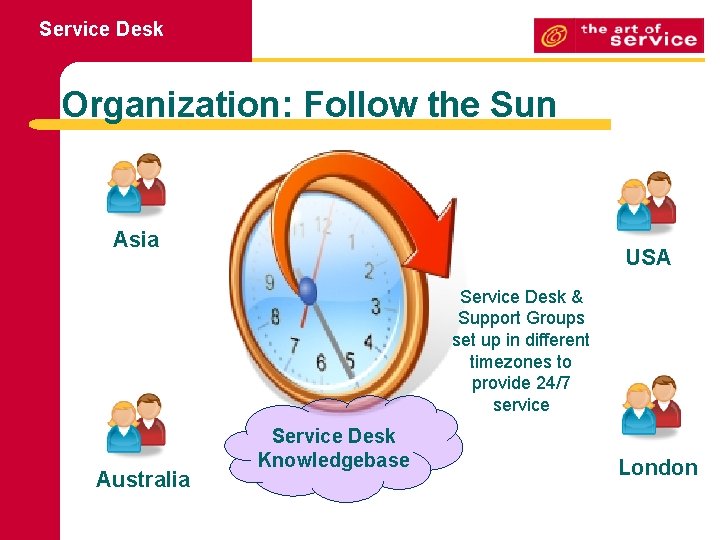
Service Desk Organization: Follow the Sun Asia USA Service Desk & Support Groups set up in different timezones to provide 24/7 service Australia Service Desk Knowledgebase London
Service Desk Tools § Computerized service desk § Voice services (adv. menu systems, voicemail, SMS) § Web and email (access, notification, updates) § Self help for customers § Contain linkages to SLAs, CMDB § Access to availability monitoring tools
Service Desk Outsourcing Decisions to outsource are a strategic issue for senior managers. Many of the guidelines are not unique to the Service Desk and can be applied to any function, support area or service being outsourced (or out-tasked).
Service Desk Outsourcing Safeguards • Tools are consistent with those used in the customer organization. • Customer requirements are adequately scoped and specified. • Tools not only support the outsourced Service Desk, but also the customers organization’s processes and business requirements.

Service Desk Process Flows The outsourced desk should use the same tools and processes (or, as a minimum, interfacing tools and processes) to allow smooth process flow between the Service Desk and second- and third-line support groups. In addition, the outsourced Service Desk should have access to: • • All Incident and Problem records and information; Service Requests records and information; Known Error Data; Change Schedule; Sources of internal knowledge; SKMS, CMS; and Alerts for monitoring tools.
Service Desk SLA Targets The SLA Targets for overall incident handling and resolution times need to be agreed with the customers and among all team and departments – and OLA/UC targets need to be coordinated and agreed with individual support groups so that they underpin and support the SLA targets.
Service Desk Good Communications The lines of communication between the outsourced Service Desk and the other support groups need to work very effectively. This can be assisted by: • • • Close physical co-location; Regular liaison/review meetings; Cross-training tutorials between teams and departments; Partnership arrangements when staff from both; organizations are used jointly to staff the desk; and Communication Plans and performance targets are documented in a consistent manner in OLAs and UCs.
Service Desk Off-shore Service Desk Outsourcing companies who offer off-shore Service Desk solutions should take the following into account: • • Training programs; Language skills; Regular visits by representatives; and Training in the use of the customer organization tools and methods of work.

Service Desk Ownership of data Clear ownership of the data collected by the outsourced Service Desk must be established. Ownership of all data relative to users, customers, affected CIs, services, Incidents, Service Requests, Changes etc. must remain with the organization that is outsourcing the activity – but both organizations will require access to it
- Slides: 17