
Service Delivery Operations Tier 0 Tier 1 and
- Slides: 17
Service Delivery & Operations ~~~ Tier 0, Tier 1 and Tier 2 experiences from Operations, Site and Experiment viewpoints Jamie. Shiers@cern. ch ~~~ LCG-LHCC Referees Meeting, th 16 February 2010
Structure • Recap of situation at the end of STEP’ 09 • Referees meeting of July 6 th 2009 + workshop • Status at the time of EGEE’ 09 / September review • Issues from first data taking: experiment reports at January 2010 GDB • Priorities and targets for the next 6 months • Documents & pointers attached to agenda – see also experiment reports this afternoon 2
The Bottom Line… • From ATLAS’ presentation to January GDB Ø “The Grid worked… BUT” • There a number of large “BUTs” and several / many smaller ones… • Focus on the large ones here: smaller ones followed up on via WLCG Daily Operations meetings etc. q The first part of the message is important! 3
CCRC'08 MB Update 4
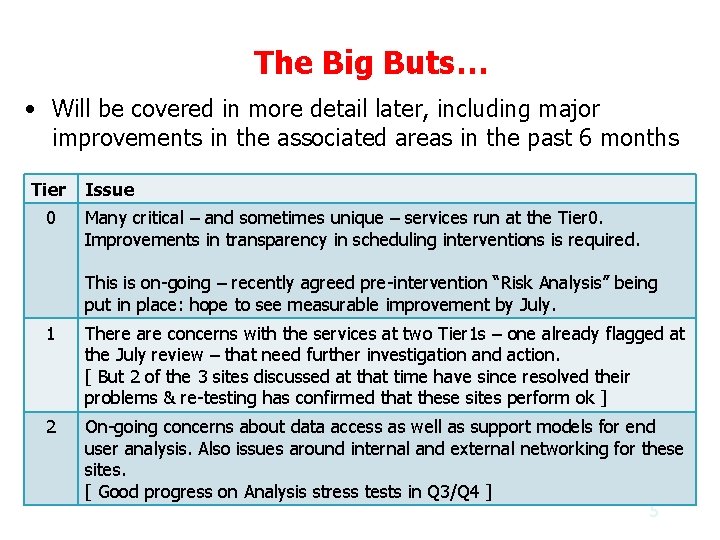
The Big Buts… • Will be covered in more detail later, including major improvements in the associated areas in the past 6 months Tier 0 Issue Many critical – and sometimes unique – services run at the Tier 0. Improvements in transparency in scheduling interventions is required. This is on-going – recently agreed pre-intervention “Risk Analysis” being put in place: hope to see measurable improvement by July. 1 There are concerns with the services at two Tier 1 s – one already flagged at the July review – that need further investigation and action. [ But 2 of the 3 sites discussed at that time have since resolved their problems & re-testing has confirmed that these sites perform ok ] 2 On-going concerns about data access as well as support models for end user analysis. Also issues around internal and external networking for these sites. [ Good progress on Analysis stress tests in Q 3/Q 4 ] 5
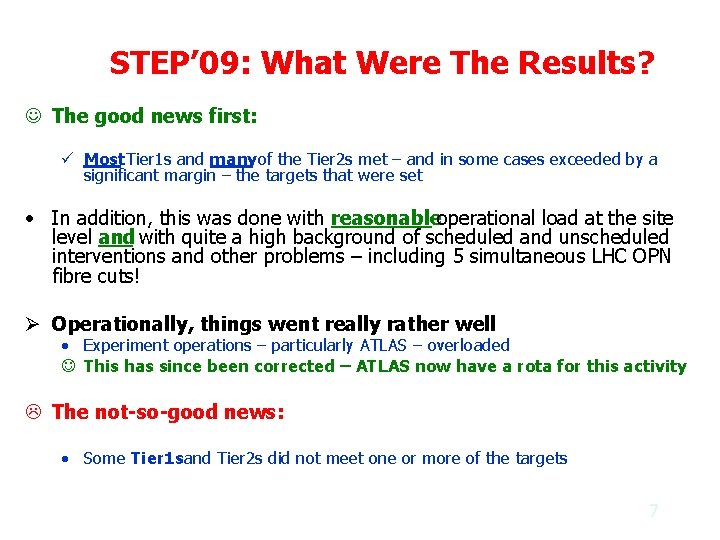
STEP’ 09: What Were The Results? J The good news first: ü Most Tier 1 s and many of the Tier 2 s met – and in some cases exceeded by a significant margin – the targets that were set • In addition, this was done with reasonableoperational load at the site level and with quite a high background of scheduled and unscheduled interventions and other problems – including 5 simultaneous LHC OPN fibre cuts! Ø Operationally, things went really rather well • Experiment operations – particularly ATLAS – overloaded J This has since been corrected – ATLAS now have a rota for this activity L The not-so-good news: • Some Tier 1 s and Tier 2 s did not meet one or more of the targets 7
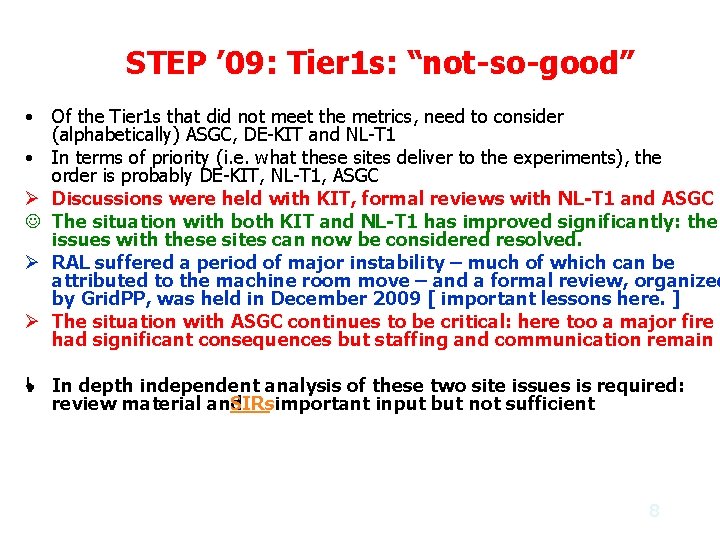
STEP ’ 09: Tier 1 s: “not-so-good” • Of the Tier 1 s that did not meet the metrics, need to consider (alphabetically) ASGC, DE-KIT and NL-T 1 • In terms of priority (i. e. what these sites deliver to the experiments), the order is probably DE-KIT, NL-T 1, ASGC Ø Discussions were held with KIT, formal reviews with NL-T 1 and ASGC J The situation with both KIT and NL-T 1 has improved significantly: the issues with these sites can now be considered resolved. Ø RAL suffered a period of major instability – much of which can be attributed to the machine room move – and a formal review, organized by Grid. PP, was held in December 2009 [ important lessons here. ] Ø The situation with ASGC continues to be critical: here too a major fire had significant consequences but staffing and communication remain L In depth independent analysis of these two site issues is required: review material and SIRsimportant input but not sufficient 8
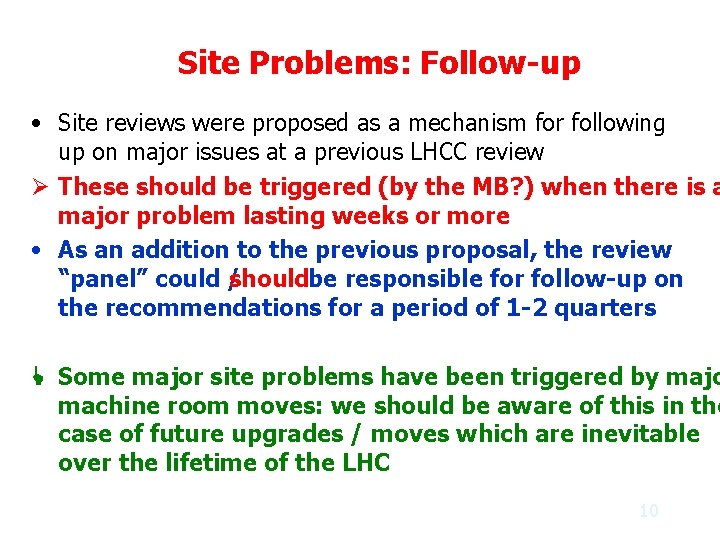
Site Problems: Follow-up • Site reviews were proposed as a mechanism for following up on major issues at a previous LHCC review Ø These should be triggered (by the MB? ) when there is a major problem lasting weeks or more • As an addition to the previous proposal, the review “panel” could /shouldbe responsible for follow-up on the recommendations for a period of 1 -2 quarters L Some major site problems have been triggered by majo machine room moves: we should be aware of this in the case of future upgrades / moves which are inevitable over the lifetime of the LHC 10
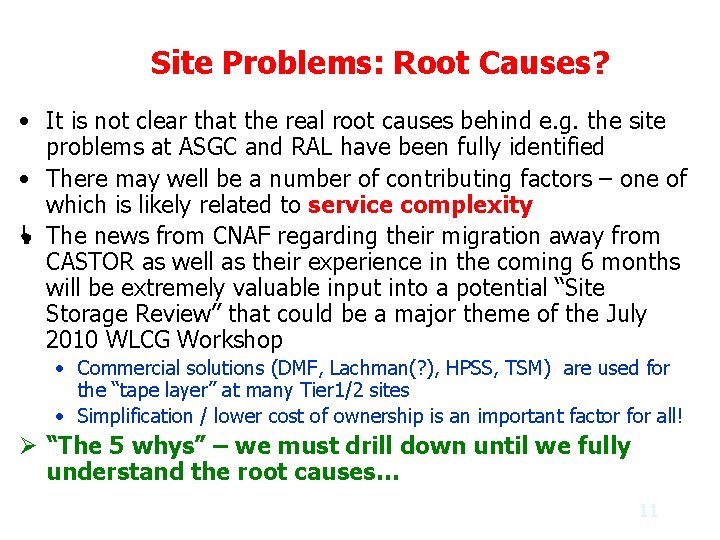
Site Problems: Root Causes? • It is not clear that the real root causes behind e. g. the site problems at ASGC and RAL have been fully identified • There may well be a number of contributing factors – one of which is likely related to service complexity L The news from CNAF regarding their migration away from CASTOR as well as their experience in the coming 6 months will be extremely valuable input into a potential “Site Storage Review” that could be a major theme of the July 2010 WLCG Workshop • Commercial solutions (DMF, Lachman(? ), HPSS, TSM) are used for the “tape layer” at many Tier 1/2 sites • Simplification / lower cost of ownership is an important factor for all! Ø “The 5 whys” – we must drill down until we fully understand the root causes… 11
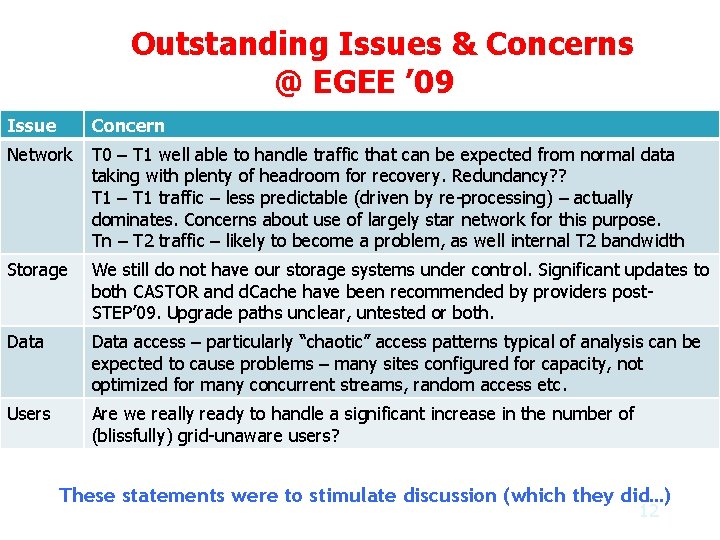
Outstanding Issues & Concerns @ EGEE ’ 09 Issue Concern Network T 0 – T 1 well able to handle traffic that can be expected from normal data taking with plenty of headroom for recovery. Redundancy? ? T 1 – T 1 traffic – less predictable (driven by re-processing) – actually dominates. Concerns about use of largely star network for this purpose. Tn – T 2 traffic – likely to become a problem, as well internal T 2 bandwidth Storage We still do not have our storage systems under control. Significant updates to both CASTOR and d. Cache have been recommended by providers post. STEP’ 09. Upgrade paths unclear, untested or both. Data access – particularly “chaotic” access patterns typical of analysis can be expected to cause problems – many sites configured for capacity, not optimized for many concurrent streams, random access etc. Users Are we really ready to handle a significant increase in the number of (blissfully) grid-unaware users? These statements were to stimulate discussion (which they did…) 12
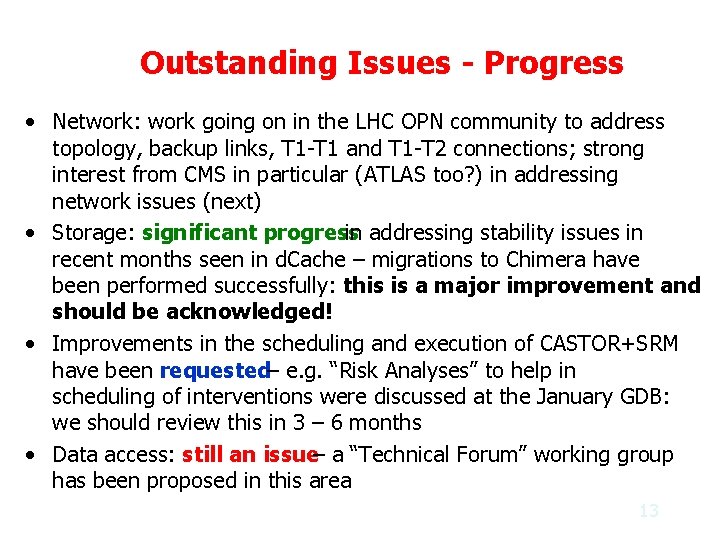
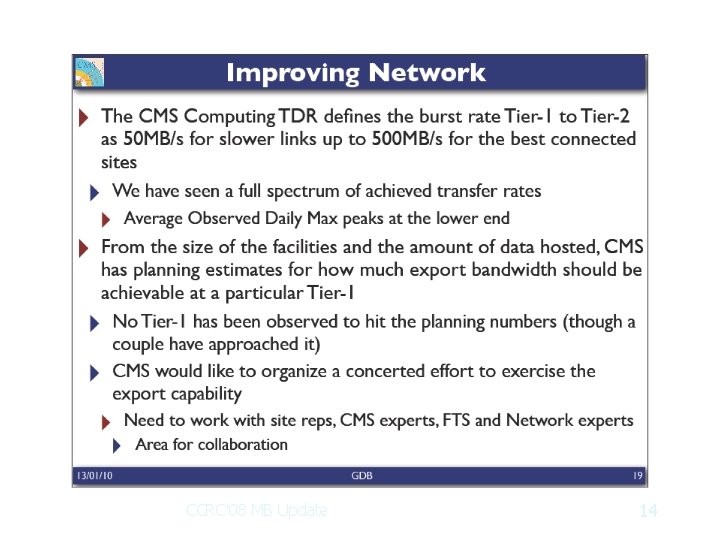
Outstanding Issues - Progress • Network: work going on in the LHC OPN community to address topology, backup links, T 1 -T 1 and T 1 -T 2 connections; strong interest from CMS in particular (ATLAS too? ) in addressing network issues (next) • Storage: significant progress in addressing stability issues in recent months seen in d. Cache – migrations to Chimera have been performed successfully: this is a major improvement and should be acknowledged! • Improvements in the scheduling and execution of CASTOR+SRM have been requested– e. g. “Risk Analyses” to help in scheduling of interventions were discussed at the January GDB: we should review this in 3 – 6 months • Data access: still an issue– a “Technical Forum” working group has been proposed in this area 13
CCRC'08 MB Update 14
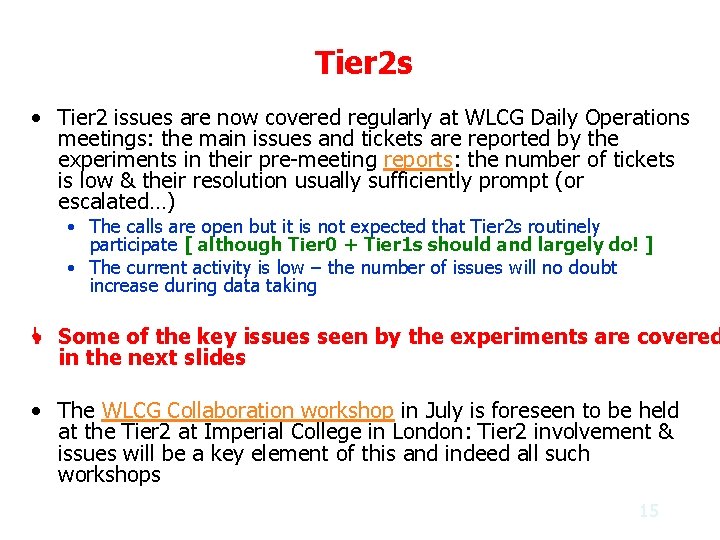
Tier 2 s • Tier 2 issues are now covered regularly at WLCG Daily Operations meetings: the main issues and tickets are reported by the experiments in their pre-meeting reports: the number of tickets is low & their resolution usually sufficiently prompt (or escalated…) • The calls are open but it is not expected that Tier 2 s routinely participate [ although Tier 0 + Tier 1 s should and largely do! ] • The current activity is low – the number of issues will no doubt increase during data taking L Some of the key issues seen by the experiments are covered in the next slides • The WLCG Collaboration workshop in July is foreseen to be held at the Tier 2 at Imperial College in London: Tier 2 involvement & issues will be a key element of this and indeed all such workshops 15
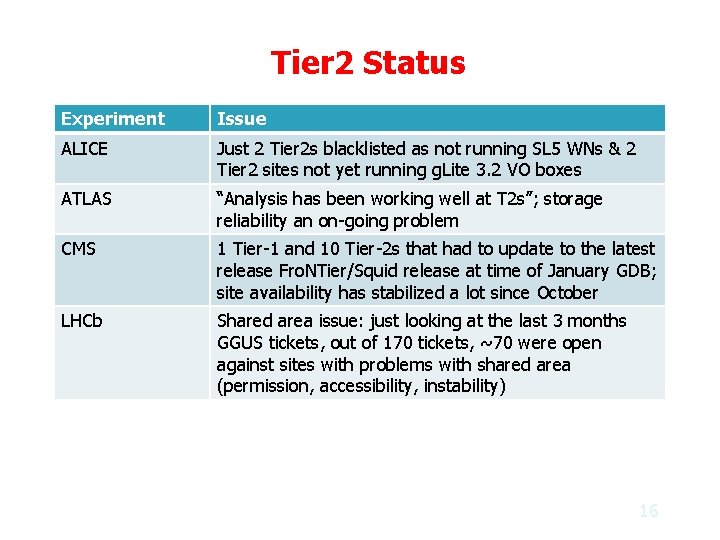
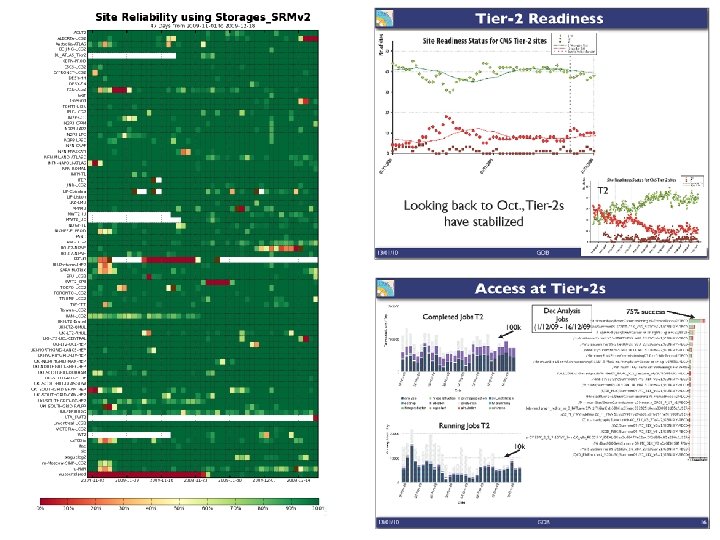
Tier 2 Status Experiment Issue ALICE Just 2 Tier 2 s blacklisted as not running SL 5 WNs & 2 Tier 2 sites not yet running g. Lite 3. 2 VO boxes ATLAS “Analysis has been working well at T 2 s”; storage reliability an on-going problem CMS 1 Tier-1 and 10 Tier-2 s that had to update to the latest release Fro. NTier/Squid release at time of January GDB; site availability has stabilized a lot since October LHCb Shared area issue: just looking at the last 3 months GGUS tickets, out of 170 tickets, ~70 were open against sites with problems with shared area (permission, accessibility, instability) 16
CCRC'08 MB Update 17
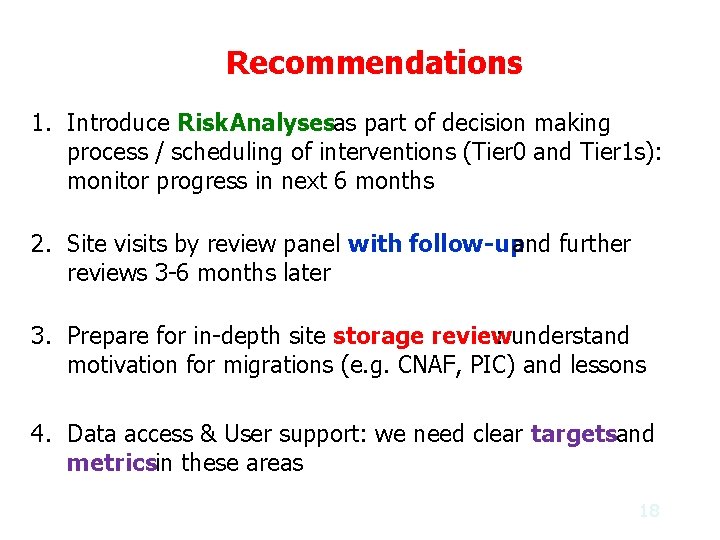
Recommendations 1. Introduce Risk Analysesas part of decision making process / scheduling of interventions (Tier 0 and Tier 1 s): monitor progress in next 6 months 2. Site visits by review panel with follow-up and further reviews 3 -6 months later 3. Prepare for in-depth site storage review : understand motivation for migrations (e. g. CNAF, PIC) and lessons 4. Data access & User support: we need clear targetsand metricsin these areas 18
Overall Conclusions • The main issues outstanding at the end of STEP ’ 09 hav been successfully addressed • Some site problems still exist: need to fully understand root causes and address at WLCG level • Quarterly experiment operations reports to the GDB are a good way of setting targets and priorities for the coming 3 – 6 months • “The Grid worked” AND we have a clear list of prioritized actions for addressing outstanding concerns 19