
Service Costing Characteristics of services Intangibility They do

Service Costing

Characteristics of services • Intangibility: They do not have a physical substance unlike goods. They cannot be held or seen. • Inseparability: Consumption and creation of a service cannot be separated. Services are consumed as they are created. A service does not exist until it is consumed by the person being served. • Variability: Services face the problem of maintaining consistency in the standard of output. Goods can usually be supplied to a standard specification. This is more difficult to achieve for services. • Perishability: Services cannot be stored. • Lack of ownership: Services do not result in the transfer of property in anything. The purchase of a service only confers on the customer a temporary benefit.
Difference between service costing from manufacturing industries • There is no production system; therefore there are no production overheads. • Direct materials costs are often a fairly small proportion of total costs (for example, the direct materials costs to a telecommunications company of providing telephone services are very small). • In some service industries, direct labour costs are high (for example, in the film-making industry, accountancy and investment banking). • General overhead costs can be a very high proportion of total costs. • Inventory is usually very small; therefore absorption costing is usually of little or no value for management information purposes.
Cost units in service costing: composite cost units • The cost per room per day. This is a useful unit cost in the hotel services industry. • The cost per passenger mile or the cost per passenger kilometre (= the average cost of transporting a passenger for one mile or one kilometre). This unit measure of cost is used by transport companies that provide bus or train services. • The cost per tonne mile delivered (= the average cost of transporting one tonne of goods for one mile). This unit cost is commonly used for costing freight services and delivery operations. • The cost per patient/day (= the average cost of treating one patient for one day) or the cost per hospital bed/day (= the cost of maintaining one hospital bed in a hospital for one day). These costs are used by health service providers. • The cost per man day. This unit cost is widely used in professional services, such as auditing, legal services and consultancy services
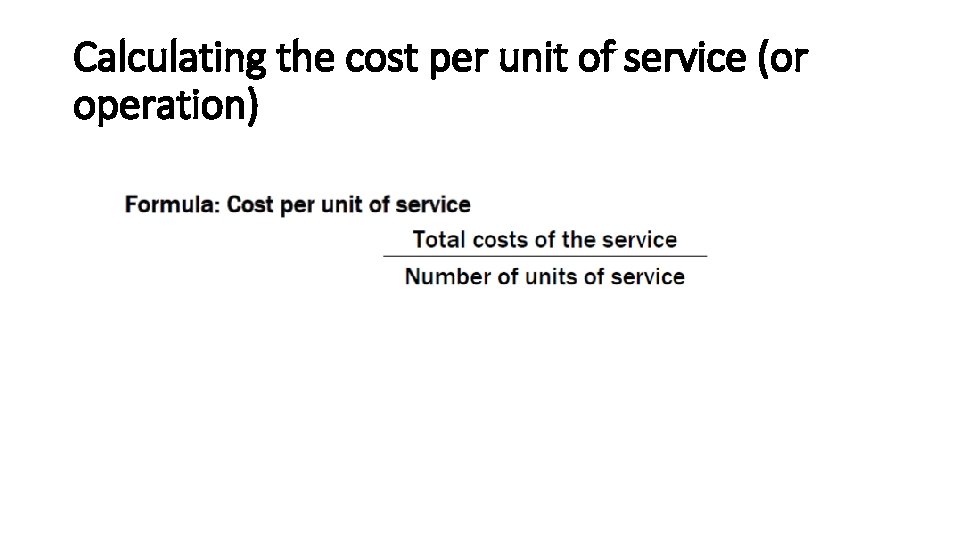
Calculating the cost per unit of service (or operation)
Q 1. • • • A restaurant is currently operating a buffet system Cost of a restaurant £ 4 million Number of tables 50 Chairs per table 4 Operating hours 6 hours per day One shift of buffet is of two hours Average occupancy ratio 75% The restaurant operates 7 days per week and 50 weeks per year. Required: Calculate cost person ($25. 39 person)
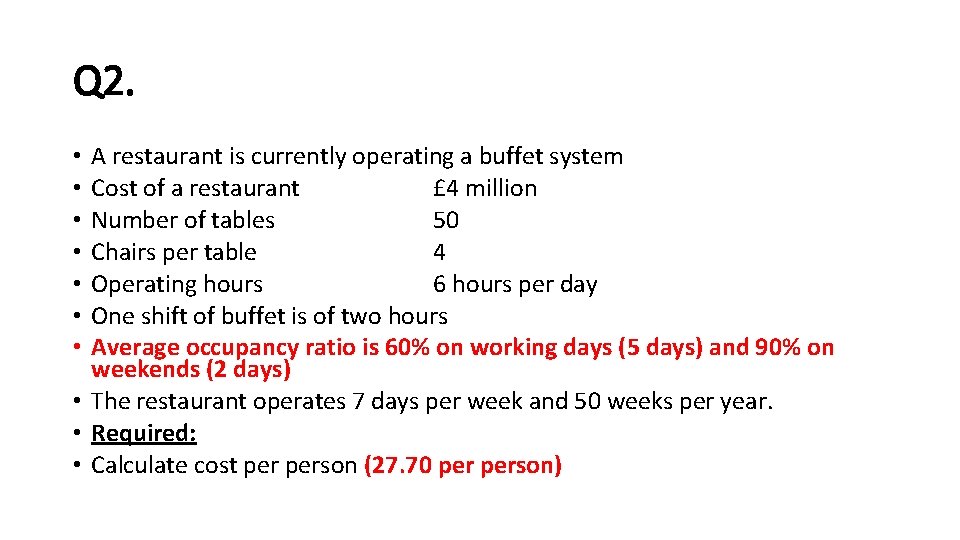
Q 2. A restaurant is currently operating a buffet system Cost of a restaurant £ 4 million Number of tables 50 Chairs per table 4 Operating hours 6 hours per day One shift of buffet is of two hours Average occupancy ratio is 60% on working days (5 days) and 90% on weekends (2 days) • The restaurant operates 7 days per week and 50 weeks per year. • Required: • Calculate cost person (27. 70 person) • •
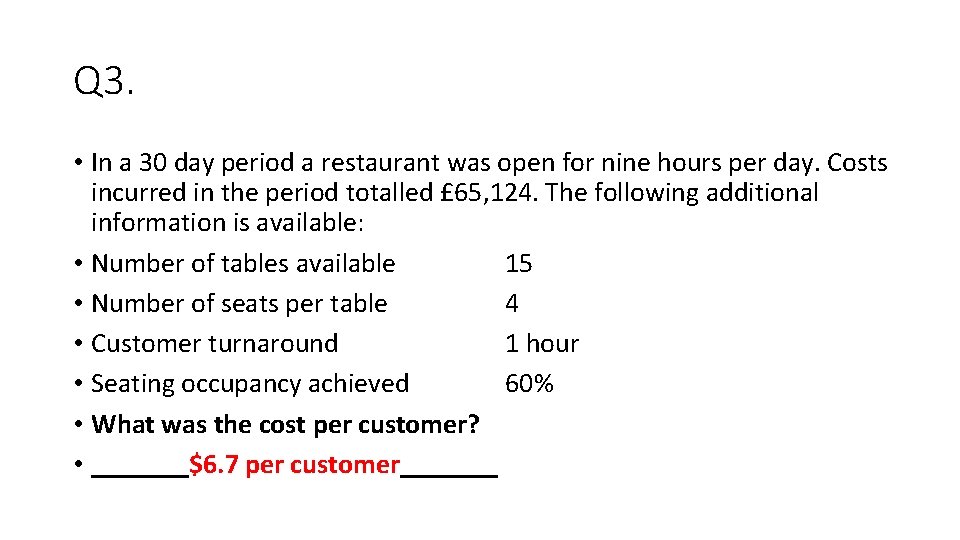
Q 3. • In a 30 day period a restaurant was open for nine hours per day. Costs incurred in the period totalled £ 65, 124. The following additional information is available: • Number of tables available 15 • Number of seats per table 4 • Customer turnaround 1 hour • Seating occupancy achieved 60% • What was the cost per customer? • _______$6. 7 per customer_______
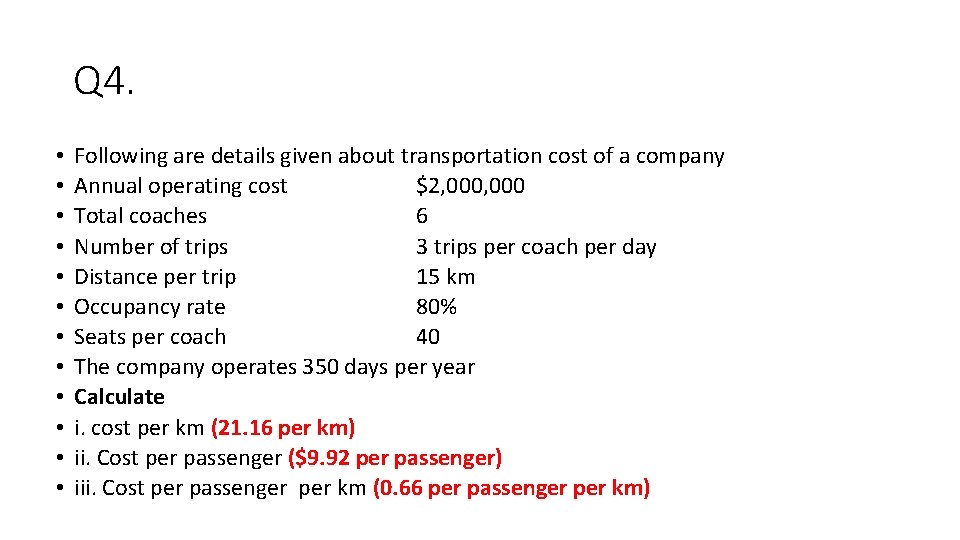
Q 4. • • • Following are details given about transportation cost of a company Annual operating cost $2, 000 Total coaches 6 Number of trips 3 trips per coach per day Distance per trip 15 km Occupancy rate 80% Seats per coach 40 The company operates 350 days per year Calculate i. cost per km (21. 16 per km) ii. Cost per passenger ($9. 92 per passenger) iii. Cost per passenger per km (0. 66 per passenger per km)
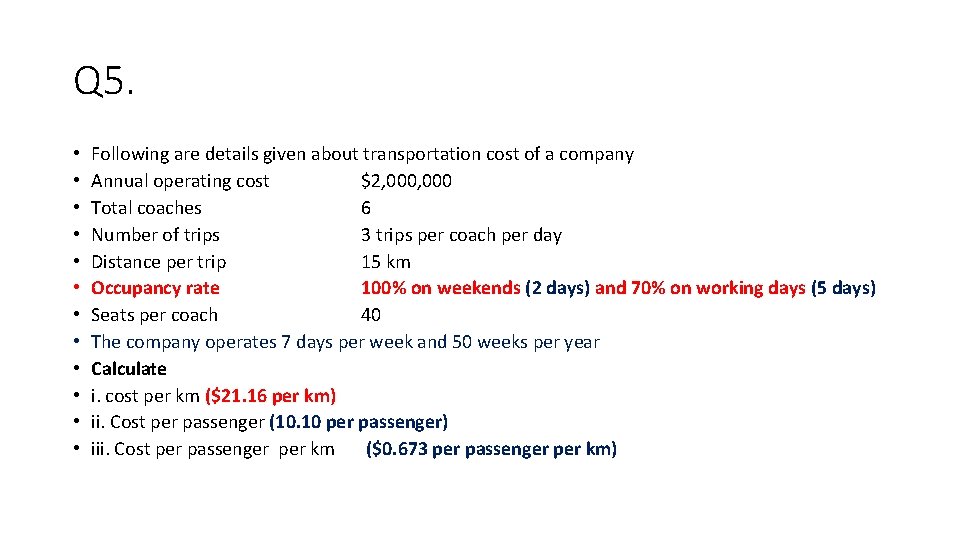
Q 5. • • • Following are details given about transportation cost of a company Annual operating cost $2, 000 Total coaches 6 Number of trips 3 trips per coach per day Distance per trip 15 km Occupancy rate 100% on weekends (2 days) and 70% on working days (5 days) Seats per coach 40 The company operates 7 days per week and 50 weeks per year Calculate i. cost per km ($21. 16 per km) ii. Cost per passenger (10. 10 per passenger) iii. Cost per passenger per km ($0. 673 per passenger per km)
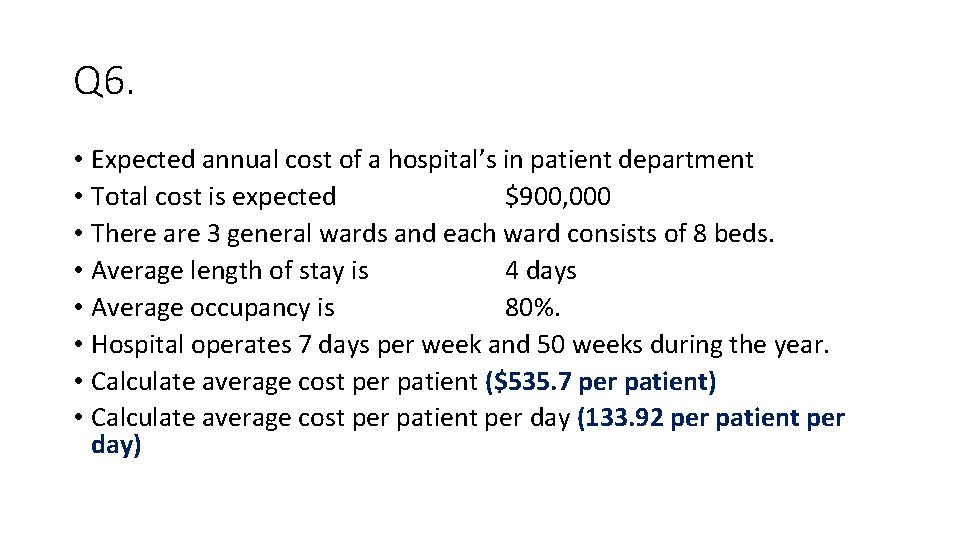
Q 6. • Expected annual cost of a hospital’s in patient department • Total cost is expected $900, 000 • There are 3 general wards and each ward consists of 8 beds. • Average length of stay is 4 days • Average occupancy is 80%. • Hospital operates 7 days per week and 50 weeks during the year. • Calculate average cost per patient ($535. 7 per patient) • Calculate average cost per patient per day (133. 92 per patient per day)
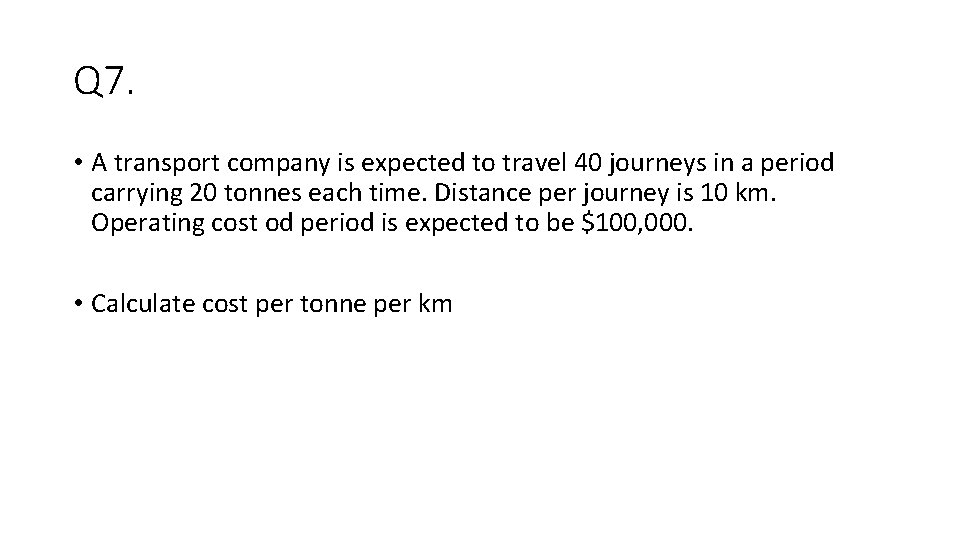
Q 7. • A transport company is expected to travel 40 journeys in a period carrying 20 tonnes each time. Distance per journey is 10 km. Operating cost od period is expected to be $100, 000. • Calculate cost per tonne per km
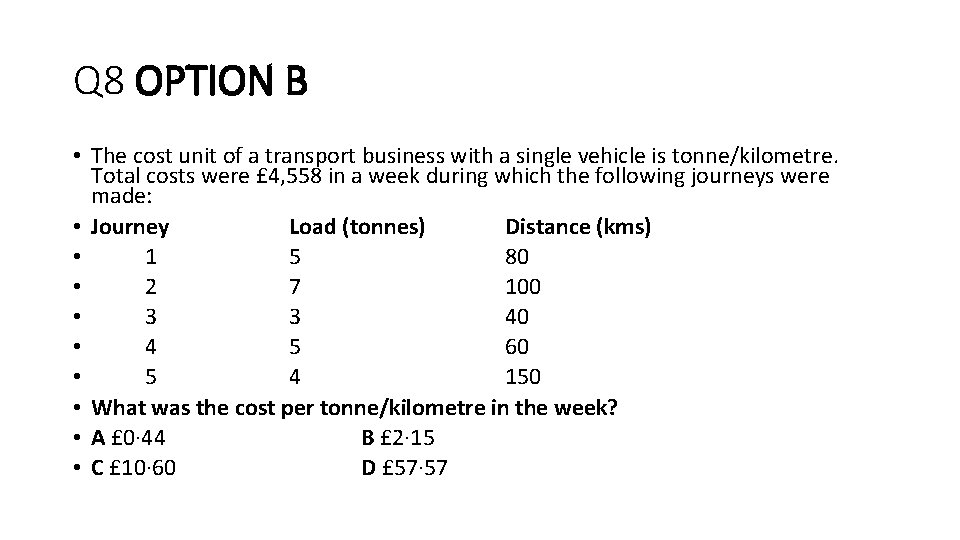
Q 8 OPTION B • The cost unit of a transport business with a single vehicle is tonne/kilometre. Total costs were £ 4, 558 in a week during which the following journeys were made: • Journey Load (tonnes) Distance (kms) • 1 5 80 • 2 7 100 • 3 3 40 • 4 5 60 • 5 4 150 • What was the cost per tonne/kilometre in the week? • A £ 0· 44 B £ 2· 15 • C £ 10· 60 D £ 57· 57
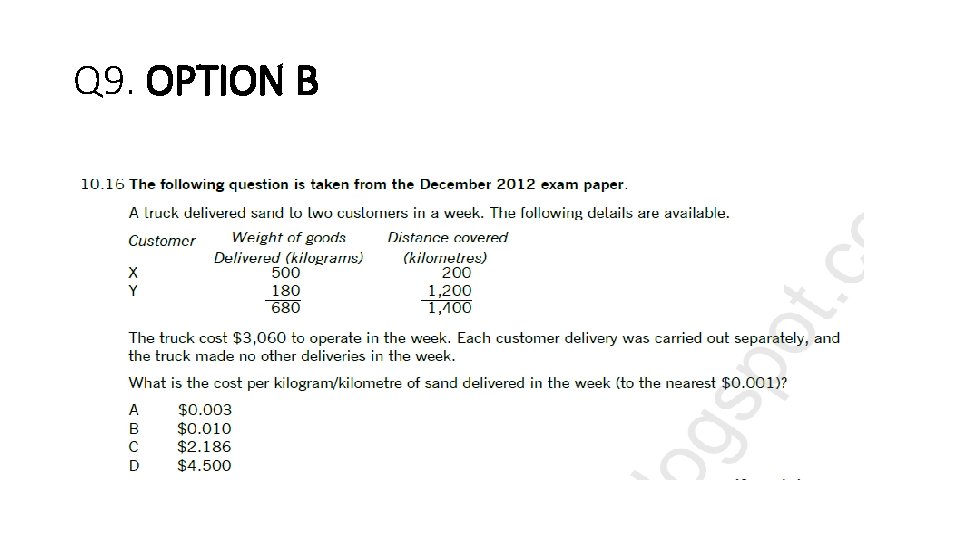
Q 9. OPTION B
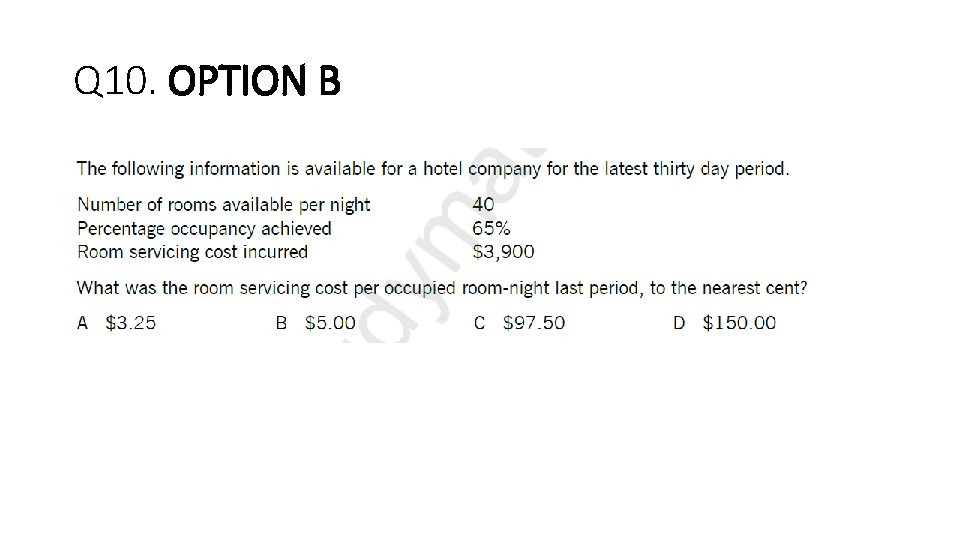
Q 10. OPTION B
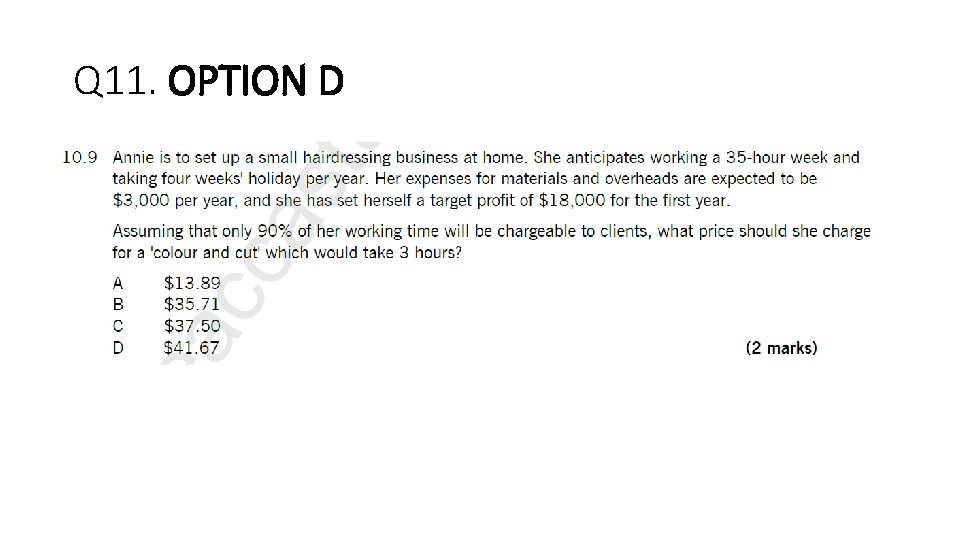
Q 11. OPTION D

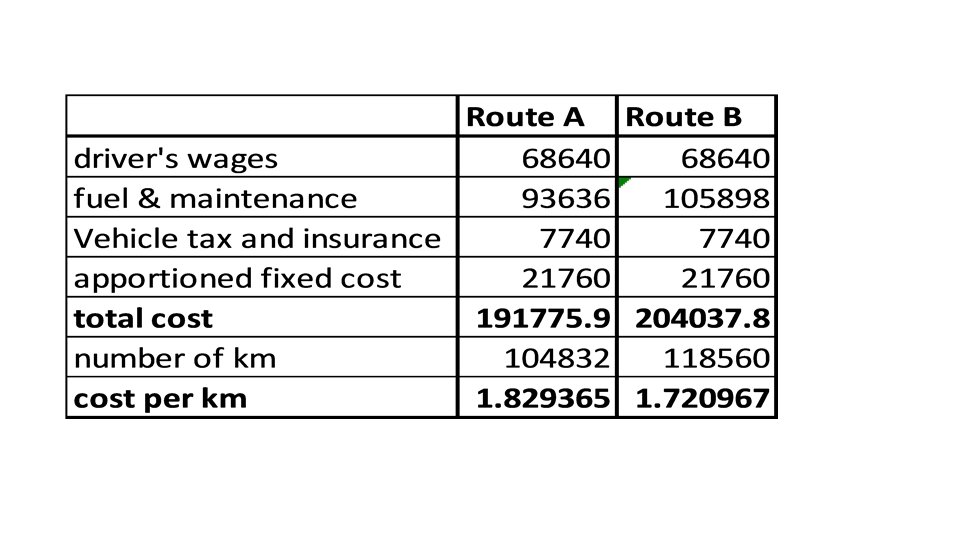
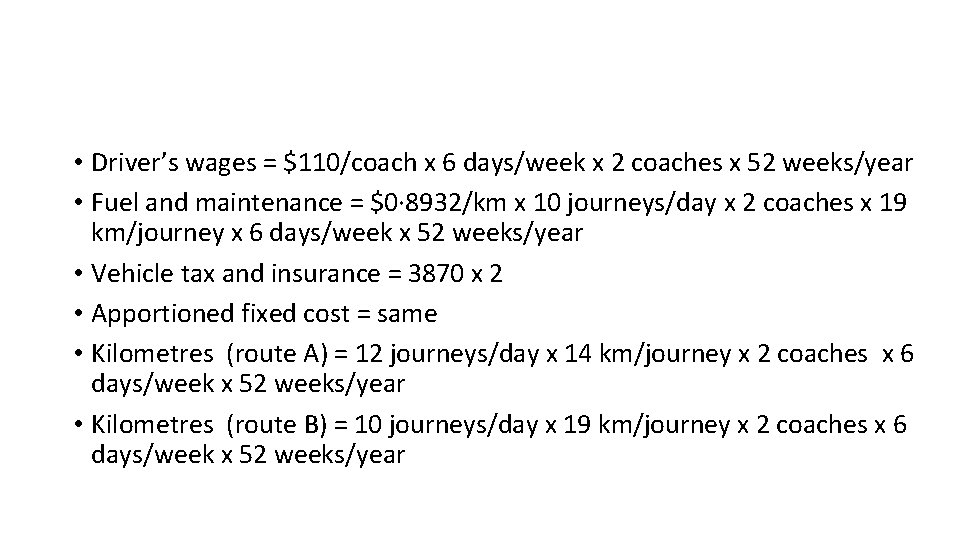
• Driver’s wages = $110/coach x 6 days/week x 2 coaches x 52 weeks/year • Fuel and maintenance = $0· 8932/km x 10 journeys/day x 2 coaches x 19 km/journey x 6 days/week x 52 weeks/year • Vehicle tax and insurance = 3870 x 2 • Apportioned fixed cost = same • Kilometres (route A) = 12 journeys/day x 14 km/journey x 2 coaches x 6 days/week x 52 weeks/year • Kilometres (route B) = 10 journeys/day x 19 km/journey x 2 coaches x 6 days/week x 52 weeks/year
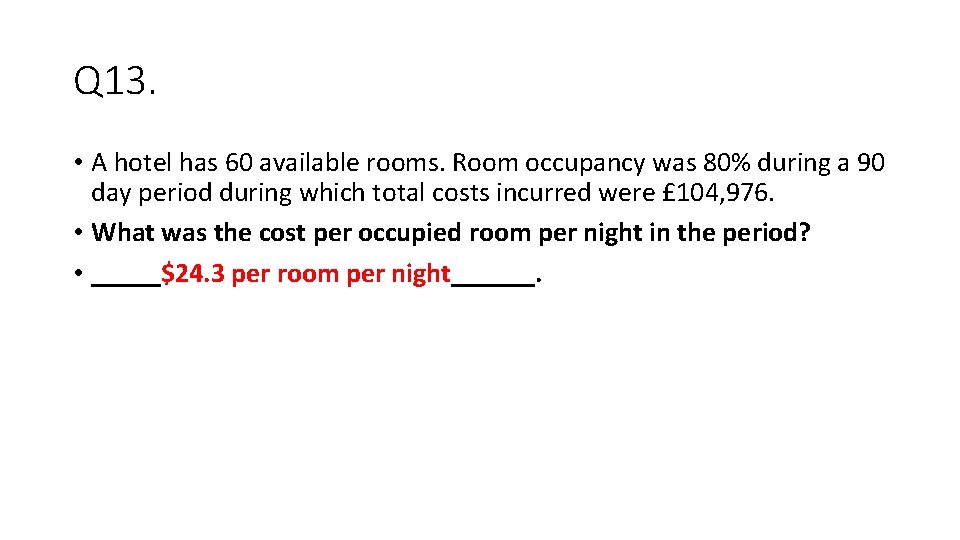
Q 13. • A hotel has 60 available rooms. Room occupancy was 80% during a 90 day period during which total costs incurred were £ 104, 976. • What was the cost per occupied room per night in the period? • _____$24. 3 per room per night______.
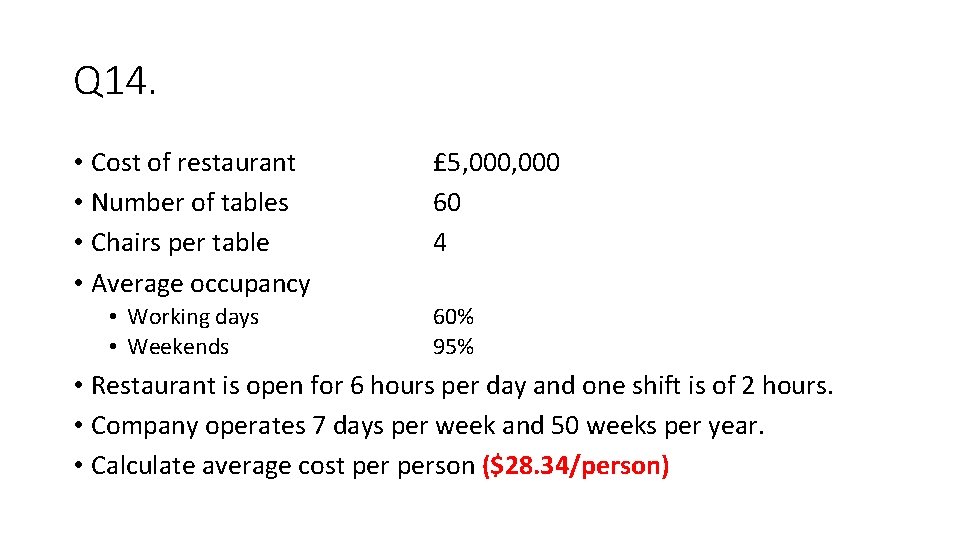
Q 14. • Cost of restaurant • Number of tables • Chairs per table • Average occupancy • Working days • Weekends £ 5, 000 60 4 60% 95% • Restaurant is open for 6 hours per day and one shift is of 2 hours. • Company operates 7 days per week and 50 weeks per year. • Calculate average cost person ($28. 34/person)
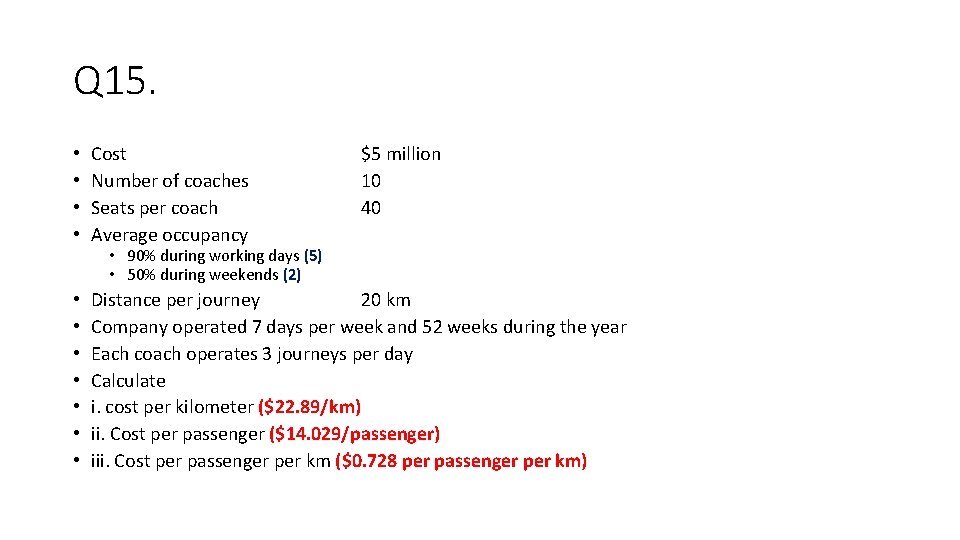
Q 15. • • Cost Number of coaches Seats per coach Average occupancy $5 million 10 40 • • Distance per journey 20 km Company operated 7 days per week and 52 weeks during the year Each coach operates 3 journeys per day Calculate i. cost per kilometer ($22. 89/km) ii. Cost per passenger ($14. 029/passenger) iii. Cost per passenger per km ($0. 728 per passenger per km) • 90% during working days (5) • 50% during weekends (2)
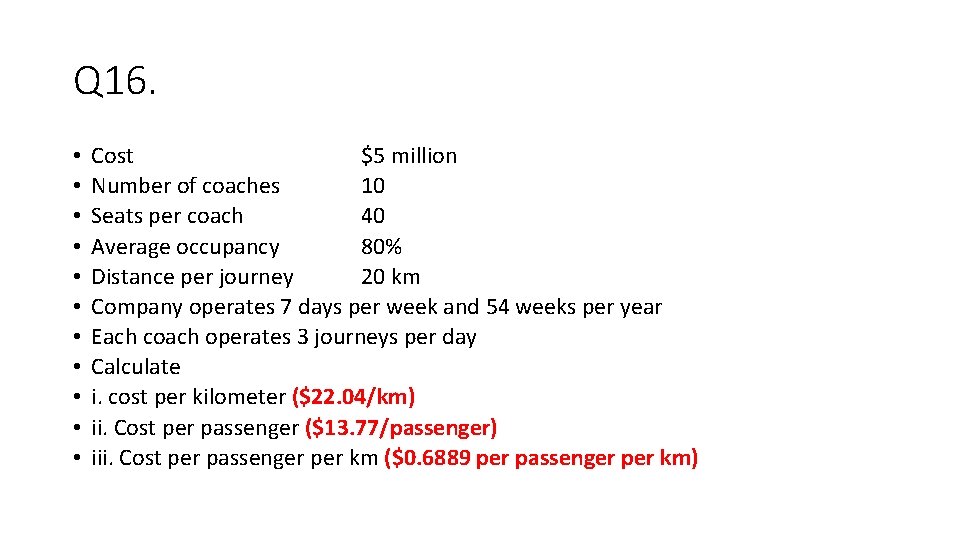
Q 16. • • • Cost $5 million Number of coaches 10 Seats per coach 40 Average occupancy 80% Distance per journey 20 km Company operates 7 days per week and 54 weeks per year Each coach operates 3 journeys per day Calculate i. cost per kilometer ($22. 04/km) ii. Cost per passenger ($13. 77/passenger) iii. Cost per passenger per km ($0. 6889 per passenger per km)
- Slides: 23