
ServerSide Web Applications CSE 591 Security and Vulnerability
Server-Side Web Applications CSE 591 – Security and Vulnerability Analysis Spring 2015 Adam Doupé Arizona State University http: //adamdoupe. com Content of some slides provided by Giovanni Vigna of UCSB, with approval
Overview • So far, we've examined the three main protocols underpinning the web – URI/URL – HTTP – HTML • What we've studied has been a distributed document retrieval system – This is the historical basis for the web Adam Doupé, Security and Vulnerability Analysis
Web Applications • It was quickly realized that the way the web was structured allowed for returning dynamic responses • Early web was intentionally designed this way, to allow organizations to offer access to a database via the web • Basis of GET and POST also confirm this – GET "SHOULD NOT have the significance of taking an action other than retrieval" • Safe and idempotent – POST • Annotation of existing resources; posting a message to a bulletin board, newsgroup, mailing list, or similar group of articles, providing a block of data, such as the result of submitting a form, to a data-handling process; and extending a database through an append operation Adam Doupé, Security and Vulnerability Analysis
Web Applications • Server-side code to dynamically create an HTML response • How does this differ from a web site? • In the HTTP protocol we've looked at so far, each request is distinct – Server has client IP address and User-Agent Adam Doupé, Security and Vulnerability Analysis
Maintaining State • HTTP is a stateless protocol • However, to write a web application we would like maintain state and link requests together • The goal is to create a "session" so that the web application can link requests to the same user – Allows authentication – Rich, full applications • Three ways this can be achieved – Embedding information in URLs – Using hidden fields in forms – Using cookies Adam Doupé, Security and Vulnerability Analysis
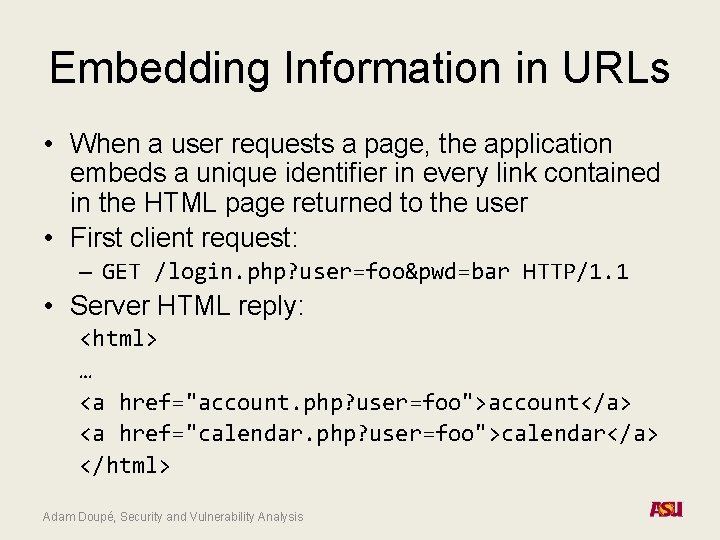
Embedding Information in URLs • When a user requests a page, the application embeds a unique identifier in every link contained in the HTML page returned to the user • First client request: – GET /login. php? user=foo&pwd=bar HTTP/1. 1 • Server HTML reply: <html> … <a href="account. php? user=foo">account</a> <a href="calendar. php? user=foo">calendar</a> </html> Adam Doupé, Security and Vulnerability Analysis
Embedding Information in URLs • What happens when user sends a link to someone else? • Is the session secure? • What does the session security depend on? • Is this in use today? Adam Doupé, Security and Vulnerability Analysis
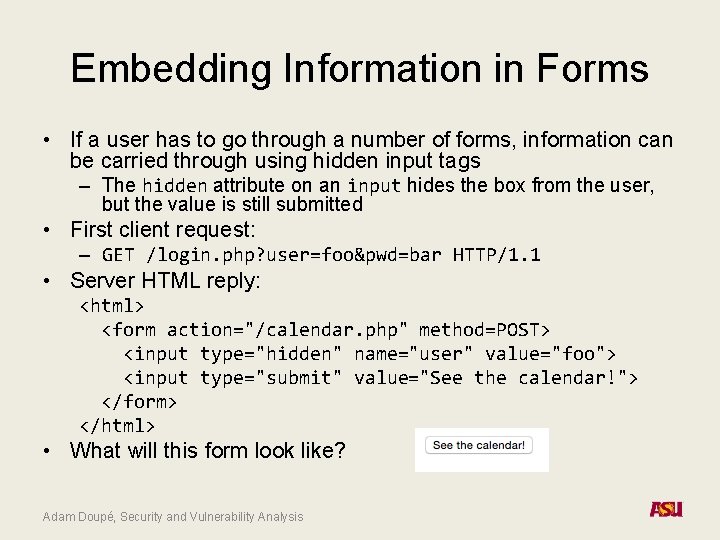
Embedding Information in Forms • If a user has to go through a number of forms, information can be carried through using hidden input tags – The hidden attribute on an input hides the box from the user, but the value is still submitted • First client request: – GET /login. php? user=foo&pwd=bar HTTP/1. 1 • Server HTML reply: <html> <form action="/calendar. php" method=POST> <input type="hidden" name="user" value="foo"> <input type="submit" value="See the calendar!"> </form> </html> • What will this form look like? Adam Doupé, Security and Vulnerability Analysis
Embedding Information in Forms • How does this compare with embedding information in URLs? • Is the session secure? • What does the security of the session depend on? • Is this in use today? Adam Doupé, Security and Vulnerability Analysis
Embedding Information in Cookies • Cookies are state information that is passed between a web server and a user agent – Server initiates the start of a session by asking the user agent to store a cookie – Server or user agent can terminate the session • Cookies first defined by Netscape while attempting to create an ecommerce application • RFC 2109 (February 1997) describes first standardization attempt for cookies • RFC 2965 (October 2000) tried to standardize cookies 2. 0 • RFC 6265 (April 2011) describes the actual use of cookies in the modern web and is the best reference Adam Doupé, Security and Vulnerability Analysis
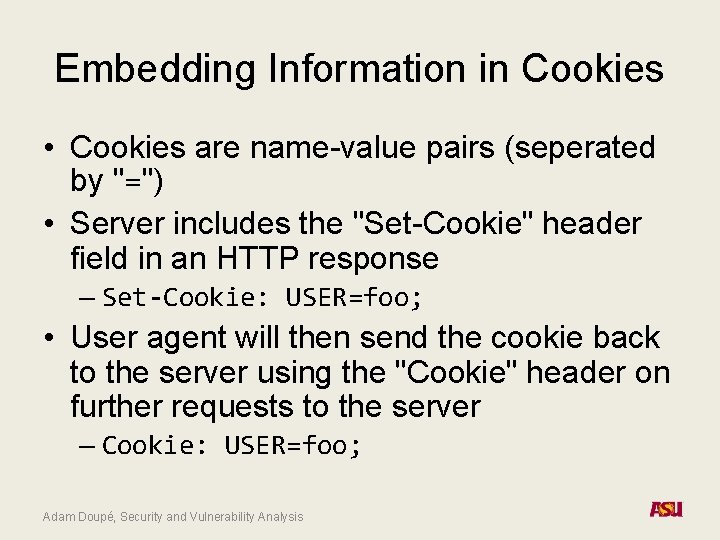
Embedding Information in Cookies • Cookies are name-value pairs (seperated by "=") • Server includes the "Set-Cookie" header field in an HTTP response – Set-Cookie: USER=foo; • User agent will then send the cookie back to the server using the "Cookie" header on further requests to the server – Cookie: USER=foo; Adam Doupé, Security and Vulnerability Analysis
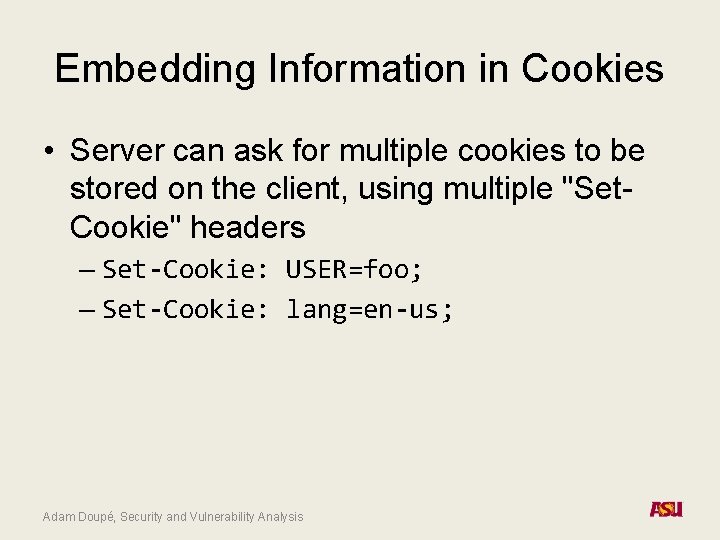
Embedding Information in Cookies • Server can ask for multiple cookies to be stored on the client, using multiple "Set. Cookie" headers – Set-Cookie: USER=foo; – Set-Cookie: lang=en-us; Adam Doupé, Security and Vulnerability Analysis
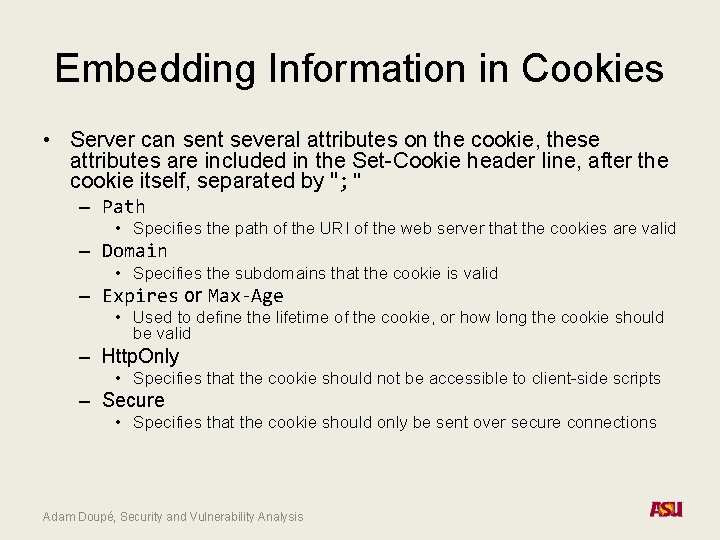
Embedding Information in Cookies • Server can sent several attributes on the cookie, these attributes are included in the Set-Cookie header line, after the cookie itself, separated by "; " – Path • Specifies the path of the URI of the web server that the cookies are valid – Domain • Specifies the subdomains that the cookie is valid – Expires or Max-Age • Used to define the lifetime of the cookie, or how long the cookie should be valid – Http. Only • Specifies that the cookie should not be accessible to client-side scripts – Secure • Specifies that the cookie should only be sent over secure connections Adam Doupé, Security and Vulnerability Analysis
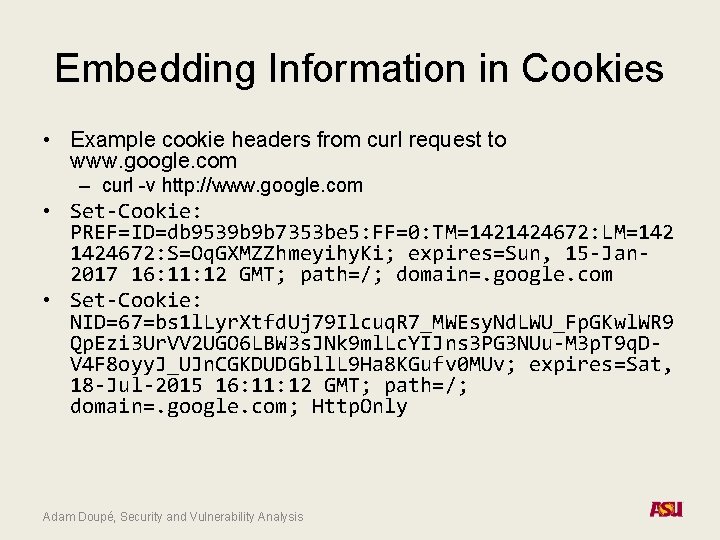
Embedding Information in Cookies • Example cookie headers from curl request to www. google. com – curl -v http: //www. google. com • Set-Cookie: PREF=ID=db 9539 b 9 b 7353 be 5: FF=0: TM=1421424672: LM=142 1424672: S=Oq. GXMZZhmeyihy. Ki; expires=Sun, 15 -Jan 2017 16: 11: 12 GMT; path=/; domain=. google. com • Set-Cookie: NID=67=bs 1 l. Lyr. Xtfd. Uj 79 Ilcuq. R 7_MWEsy. Nd. LWU_Fp. GKwl. WR 9 Qp. Ezi 3 Ur. VV 2 UGO 6 LBW 3 s. JNk 9 ml. Lc. YIJns 3 PG 3 NUu-M 3 p. T 9 q. DV 4 F 8 oyy. J_UJn. CGKDUDGbll. L 9 Ha 8 KGufv 0 MUv; expires=Sat, 18 -Jul-2015 16: 11: 12 GMT; path=/; domain=. google. com; Http. Only Adam Doupé, Security and Vulnerability Analysis
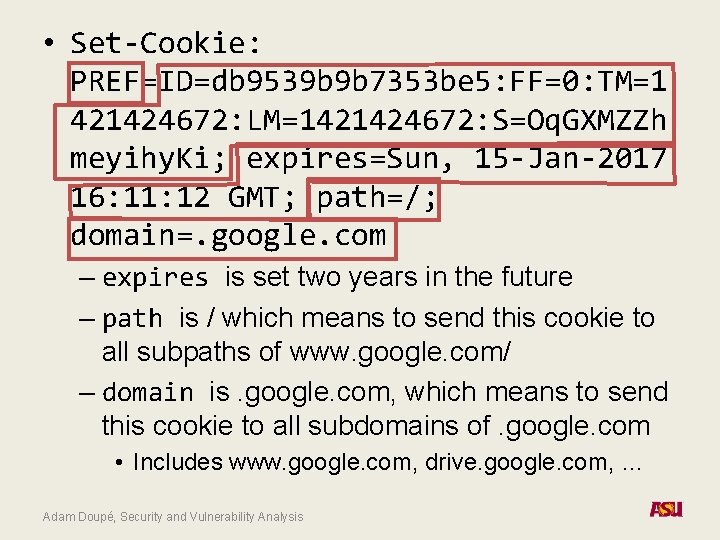
• Set-Cookie: PREF=ID=db 9539 b 9 b 7353 be 5: FF=0: TM=1 421424672: LM=1421424672: S=Oq. GXMZZh meyihy. Ki; expires=Sun, 15 -Jan-2017 16: 11: 12 GMT; path=/; domain=. google. com – expires is set two years in the future – path is / which means to send this cookie to all subpaths of www. google. com/ – domain is. google. com, which means to send this cookie to all subdomains of. google. com • Includes www. google. com, drive. google. com, … Adam Doupé, Security and Vulnerability Analysis
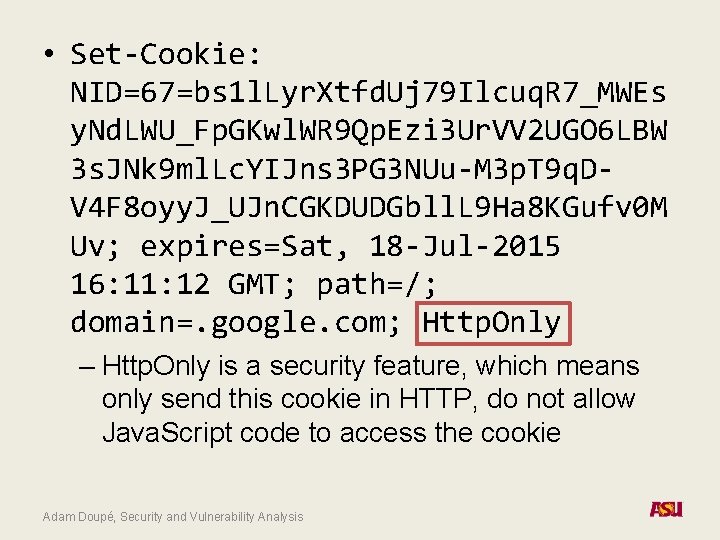
• Set-Cookie: NID=67=bs 1 l. Lyr. Xtfd. Uj 79 Ilcuq. R 7_MWEs y. Nd. LWU_Fp. GKwl. WR 9 Qp. Ezi 3 Ur. VV 2 UGO 6 LBW 3 s. JNk 9 ml. Lc. YIJns 3 PG 3 NUu-M 3 p. T 9 q. DV 4 F 8 oyy. J_UJn. CGKDUDGbll. L 9 Ha 8 KGufv 0 M Uv; expires=Sat, 18 -Jul-2015 16: 11: 12 GMT; path=/; domain=. google. com; Http. Only – Http. Only is a security feature, which means only send this cookie in HTTP, do not allow Java. Script code to access the cookie Adam Doupé, Security and Vulnerability Analysis
Embedding Information in Cookies • The server can request the deletion of cookies by setting the "expires" cookie attribute to a date in the past • User agent should then delete cookie with that name • Set-Cookie: USER=foo; expires=Thu, 1 -Jan 2015 16: 11: 12 GMT; • User agent will then delete the cookie with name "USER" that is associated with this domain – Proxies are not supposed to cache cookie headers • Why? Adam Doupé, Security and Vulnerability Analysis
Embedding Information in Cookies • User agent is responsible for following the server's policies – Expiring cookies – Restricting cookies to the proper domains and paths • However, user agent is free to delete cookies at any time – Space/storage restrictions – User decides to clear the cookies Adam Doupé, Security and Vulnerability Analysis
Modern Sessions • Sessions are used to represent a time-limited interaction of a user with a web server • There is no concept of a "session" at the HTTP level, and therefore it has to be implemented at the web application level – Using cookies – Using URL parameters – Using hidden form fields • In the most common use of sessions, the server generates a unique (random and unguessable) session ID and sends it to the user agent as a cookie • On subsequent requests, user agent sends the session ID to the server, and the server uses the session ID to index the server's session information Adam Doupé, Security and Vulnerability Analysis
Designing Web Applications • In the early days of the web, one would write a "web application" by writing a custom web server that received HTTP requests, ran custom code based on the URL path and query data, and returned a dynamically created HTML page – The drawback here is that one would have to keep the web server up-to-date with the latest HTTP changes (HTTP/1. 1 spec is 175 pages) • Generally decided that it was a good idea to separate the concerns into a web server, which accepted HTTP request and forwarded relevant requests to a web application – Could develop a web application without worrying about HTTP Adam Doupé, Security and Vulnerability Analysis
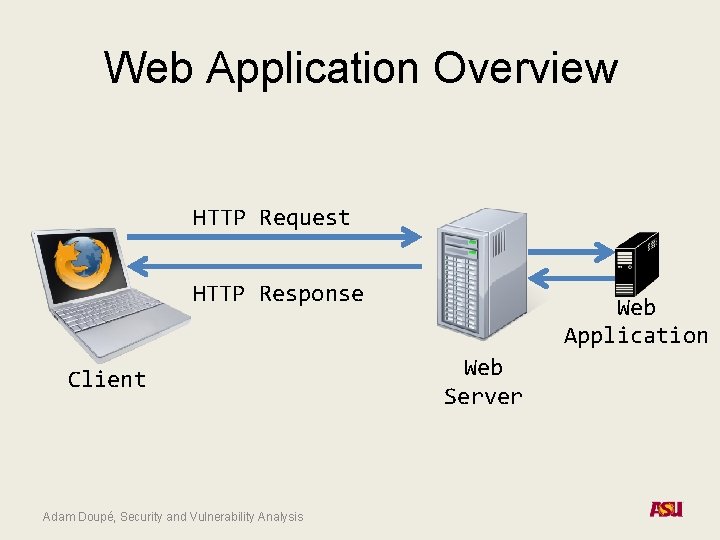
Web Application Overview HTTP Request HTTP Response Client Adam Doupé, Security and Vulnerability Analysis Web Application Web Server
The Common Gateway Interface • Defines an interface between the web server and a program on the web server that should receive the request • The program's output is returned to the client • CGI developed by NCSA (National Center for Supercomputing Applications at University of Illinois, Urbana-Champaign) around 1993 – NCSA created the Mosaic web browser, which eventually turned into the Netscape browser – NCSA also created the server component NCSA HTTPd, which eventually became the Apache HTTP server • CGI 1. 1 defined in RFC 3875 (October 2004) Adam Doupé, Security and Vulnerability Analysis
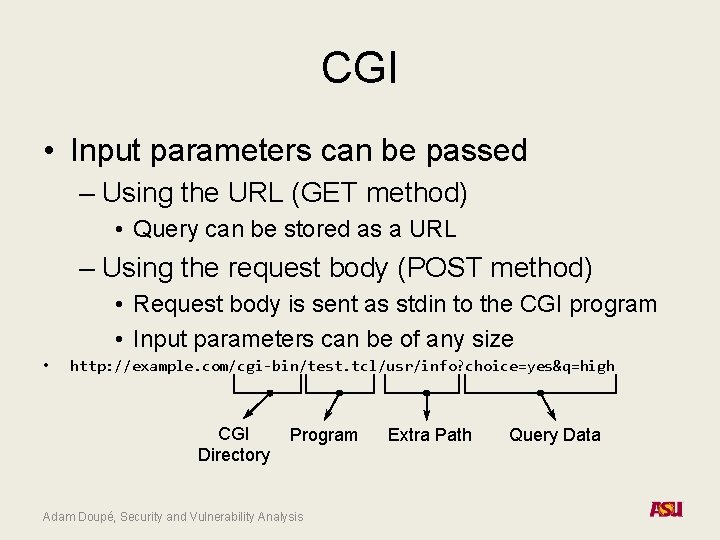
CGI • Input parameters can be passed – Using the URL (GET method) • Query can be stored as a URL – Using the request body (POST method) • Request body is sent as stdin to the CGI program • Input parameters can be of any size • http: //example. com/cgi-bin/test. tcl/usr/info? choice=yes&q=high CGI Directory Program Adam Doupé, Security and Vulnerability Analysis Extra Path Query Data
CGI Programs • Can be written in any language – As long as the server can execute the program (permissions are correct, etc. ) • Input to the program (the HTTP request body) is piped to the process' stdin • Other request metadata are passed by setting standard environment variables – REQUEST_METHOD: GET, POST, HEAD, … – PATH_INFO: path in the URL that follows the program name and precedes "? " – QUERY_STRING: information that follows "? " • Encoded using previously discussed application/x-www-form-urlencoded • name=value pairs separated by "&", name and value are percent encoded – CONTENT_TYPE: MIME type of the data for a POST request – CONTENT_LENGTH: size of the data for the POST request – HTTP_<field>: value of the corresponding HTTP request header Adam Doupé, Security and Vulnerability Analysis
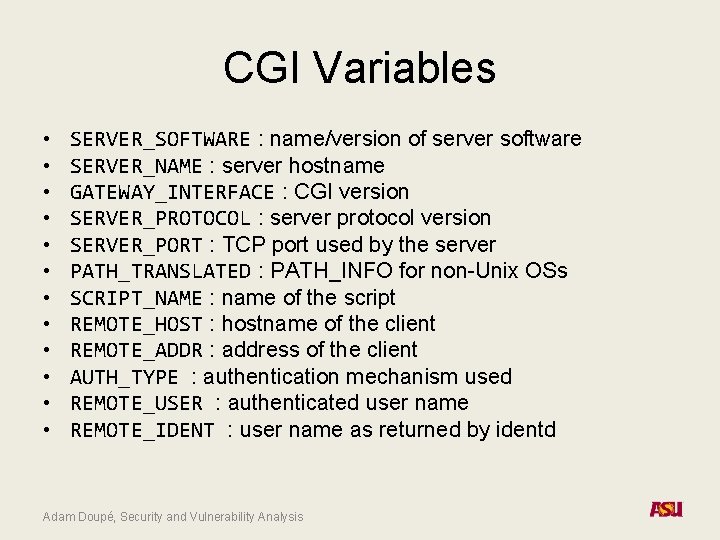
CGI Variables • • • SERVER_SOFTWARE : name/version of server software SERVER_NAME : server hostname GATEWAY_INTERFACE : CGI version SERVER_PROTOCOL : server protocol version SERVER_PORT : TCP port used by the server PATH_TRANSLATED : PATH_INFO for non-Unix OSs SCRIPT_NAME : name of the script REMOTE_HOST : hostname of the client REMOTE_ADDR : address of the client AUTH_TYPE : authentication mechanism used REMOTE_USER : authenticated user name REMOTE_IDENT : user name as returned by identd Adam Doupé, Security and Vulnerability Analysis
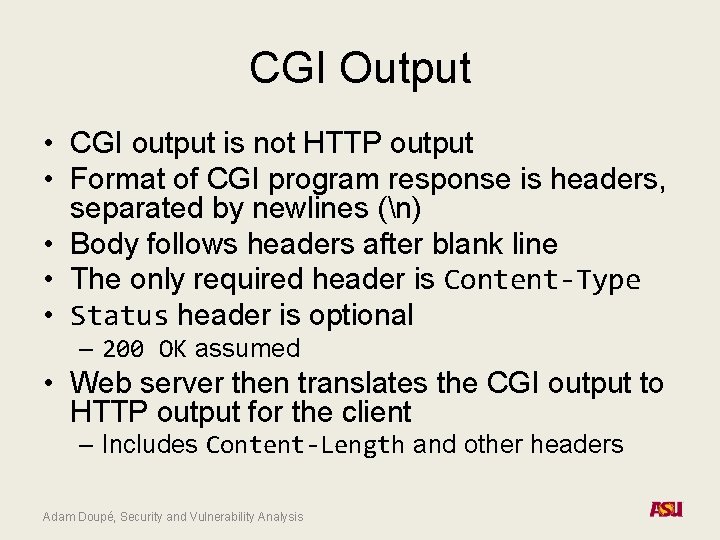
CGI Output • CGI output is not HTTP output • Format of CGI program response is headers, separated by newlines (n) • Body follows headers after blank line • The only required header is Content-Type • Status header is optional – 200 OK assumed • Web server then translates the CGI output to HTTP output for the client – Includes Content-Length and other headers Adam Doupé, Security and Vulnerability Analysis
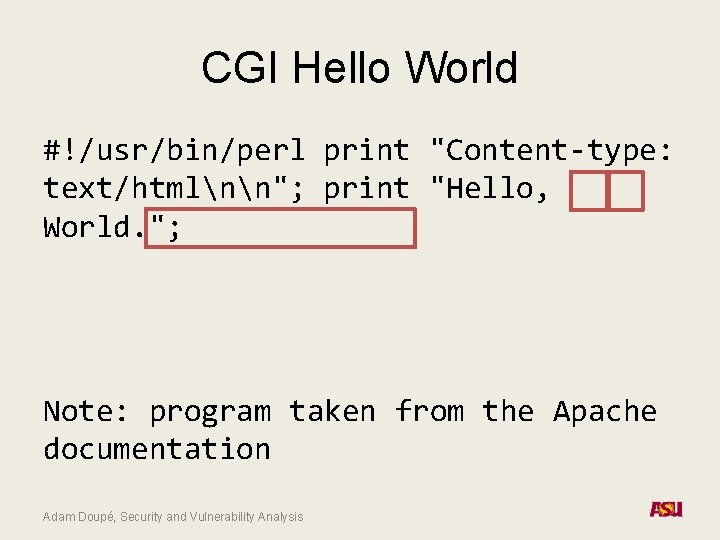
CGI Hello World #!/usr/bin/perl print "Content-type: text/htmlnn"; print "Hello, World. "; Note: program taken from the Apache documentation Adam Doupé, Security and Vulnerability Analysis
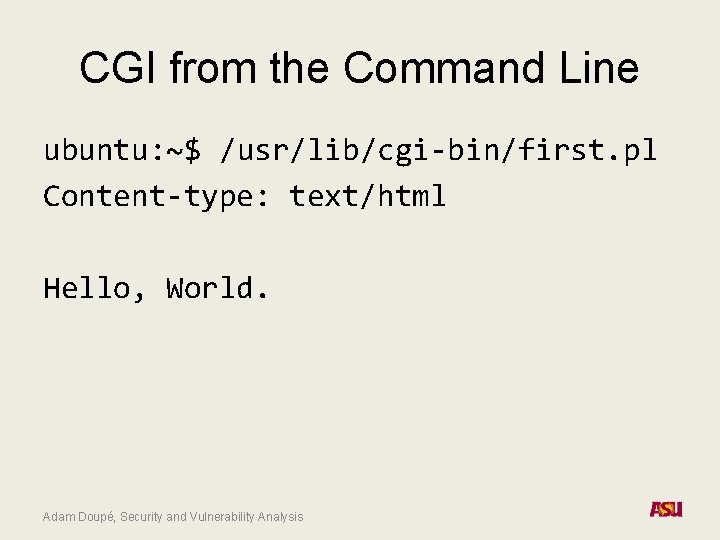
CGI from the Command Line ubuntu: ~$ /usr/lib/cgi-bin/first. pl Content-type: text/html Hello, World. Adam Doupé, Security and Vulnerability Analysis
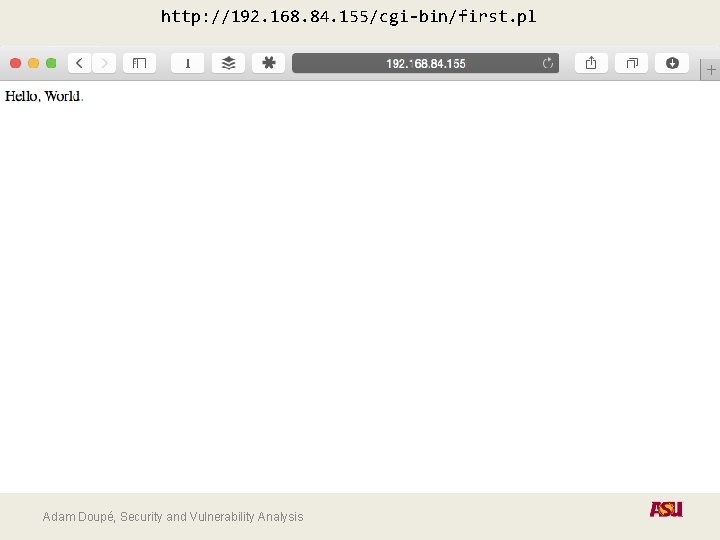
http: //192. 168. 84. 155/cgi-bin/first. pl Adam Doupé, Security and Vulnerability Analysis
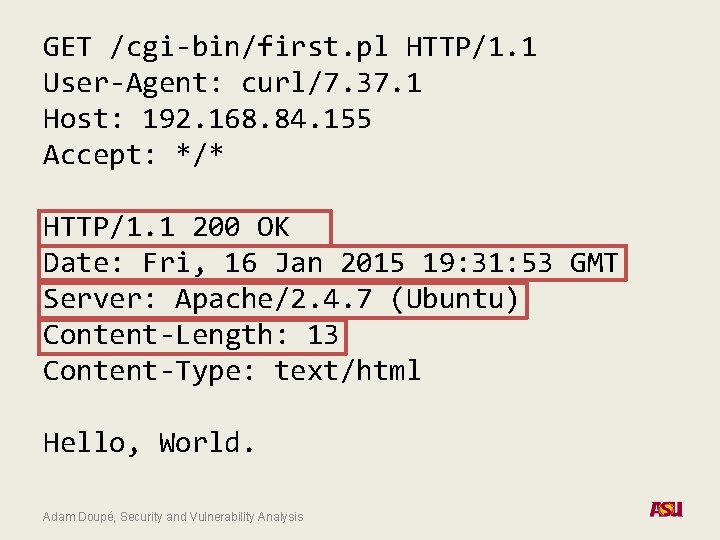
GET /cgi-bin/first. pl HTTP/1. 1 User-Agent: curl/7. 37. 1 Host: 192. 168. 84. 155 Accept: */* HTTP/1. 1 200 OK Date: Fri, 16 Jan 2015 19: 31: 53 GMT Server: Apache/2. 4. 7 (Ubuntu) Content-Length: 13 Content-Type: text/html Hello, World. Adam Doupé, Security and Vulnerability Analysis
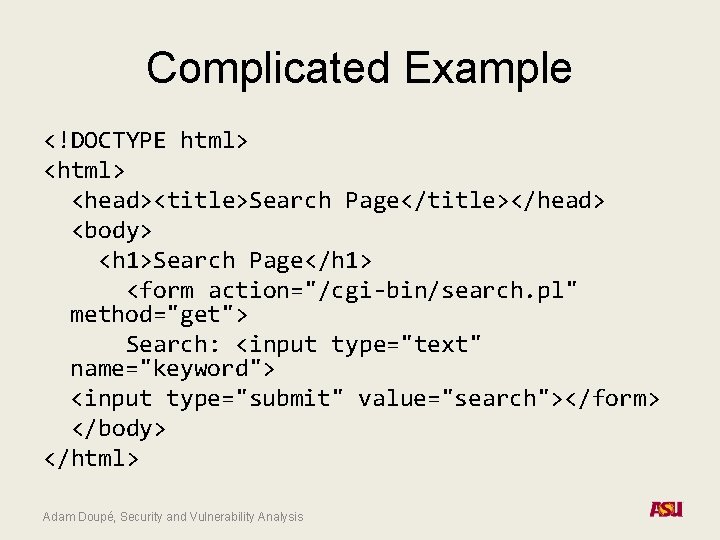
Complicated Example <!DOCTYPE html> <head><title>Search Page</title></head> <body> <h 1>Search Page</h 1> <form action="/cgi-bin/search. pl" method="get"> Search: <input type="text" name="keyword"> <input type="submit" value="search"></form> </body> </html> Adam Doupé, Security and Vulnerability Analysis
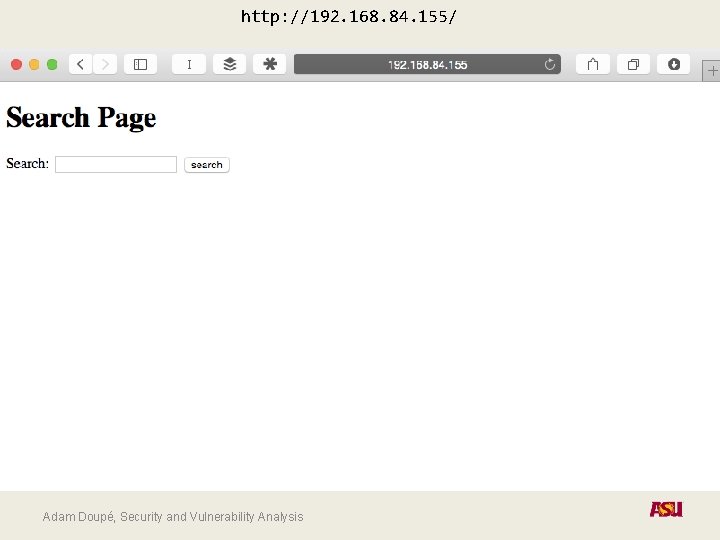
http: //192. 168. 84. 155/ Adam Doupé, Security and Vulnerability Analysis
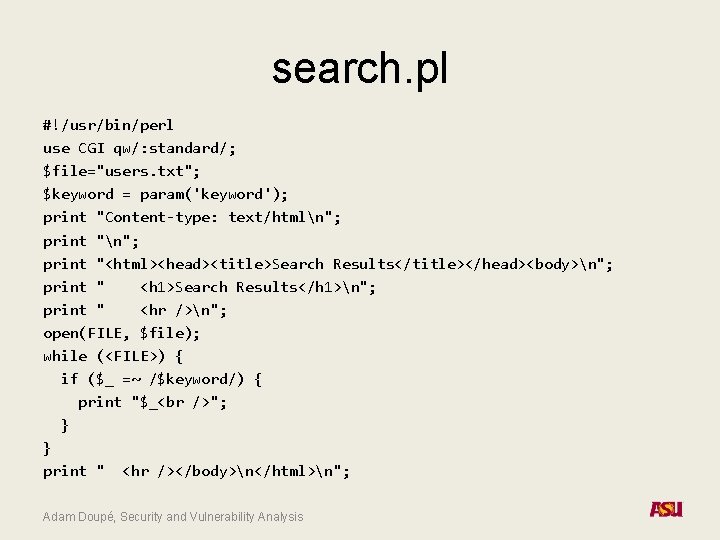
search. pl #!/usr/bin/perl use CGI qw/: standard/; $file="users. txt"; $keyword = param('keyword'); print "Content-type: text/htmln"; print "<html><head><title>Search Results</title></head><body>n"; print " <h 1>Search Results</h 1>n"; print " <hr />n"; open(FILE, $file); while (<FILE>) { if ($_ =~ /$keyword/) { print "$_ "; } } print " <hr /></body>n</html>n"; Adam Doupé, Security and Vulnerability Analysis
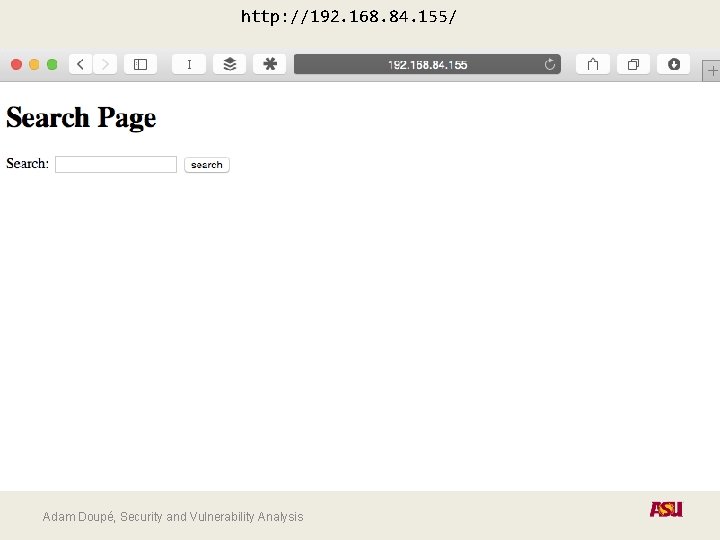
http: //192. 168. 84. 155/ Adam Doupé, Security and Vulnerability Analysis
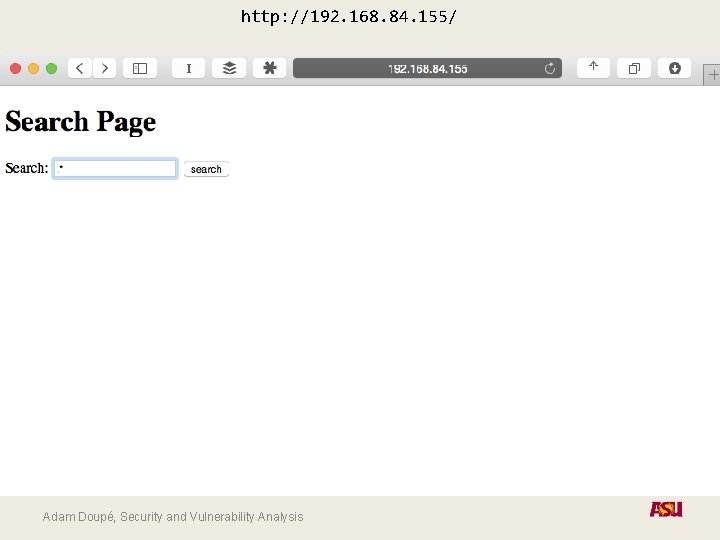
http: //192. 168. 84. 155/ Adam Doupé, Security and Vulnerability Analysis
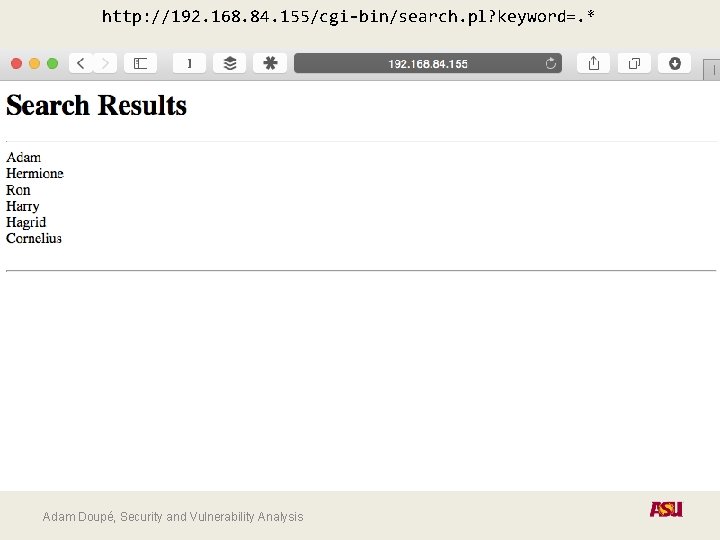
http: //192. 168. 84. 155/cgi-bin/search. pl? keyword=. * Adam Doupé, Security and Vulnerability Analysis
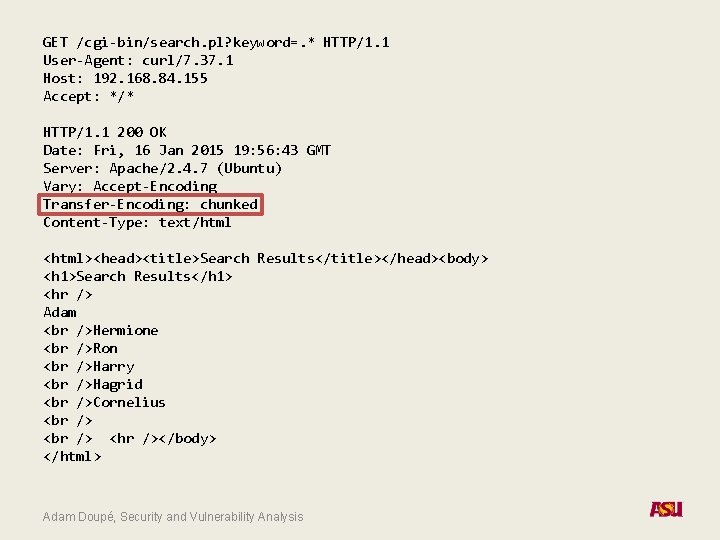
GET /cgi-bin/search. pl? keyword=. * HTTP/1. 1 User-Agent: curl/7. 37. 1 Host: 192. 168. 84. 155 Accept: */* HTTP/1. 1 200 OK Date: Fri, 16 Jan 2015 19: 56: 43 GMT Server: Apache/2. 4. 7 (Ubuntu) Vary: Accept-Encoding Transfer-Encoding: chunked Content-Type: text/html <html><head><title>Search Results</title></head><body> <h 1>Search Results</h 1> <hr /> Adam Hermione Ron Harry Hagrid Cornelius <hr /></body> </html> Adam Doupé, Security and Vulnerability Analysis
Recap • Embedding information in URLs • Embedding information in forms • Chunked encoding Adam Doupé, Security and Vulnerability Analysis
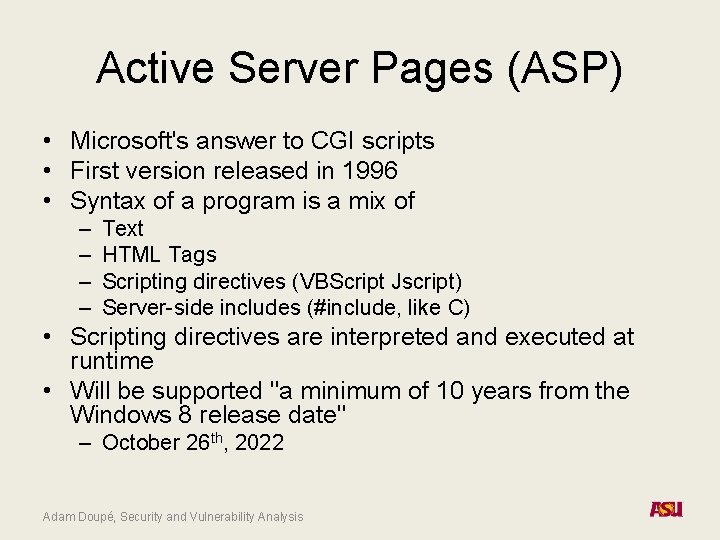
Active Server Pages (ASP) • Microsoft's answer to CGI scripts • First version released in 1996 • Syntax of a program is a mix of – – Text HTML Tags Scripting directives (VBScript Jscript) Server-side includes (#include, like C) • Scripting directives are interpreted and executed at runtime • Will be supported "a minimum of 10 years from the Windows 8 release date" – October 26 th, 2022 Adam Doupé, Security and Vulnerability Analysis
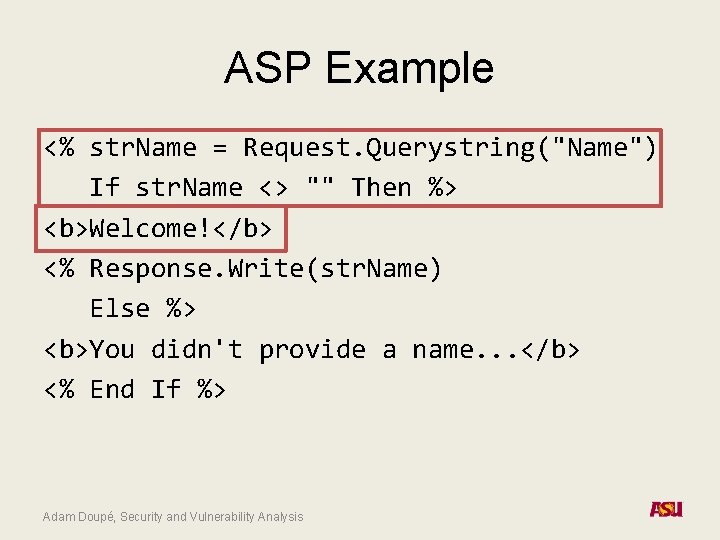
ASP Example <% str. Name = Request. Querystring("Name") If str. Name <> "" Then %> <b>Welcome!</b> <% Response. Write(str. Name) Else %> <b>You didn't provide a name. . . </b> <% End If %> Adam Doupé, Security and Vulnerability Analysis
Web Application Frameworks • As the previous Request. Querystring example shows, frameworks were quickly created to assist web developers in making web applications • Frameworks can help – Ease extracting input to the web application (query parameters, form parameters) – Setting/reading cookies – Sessions – Security – Database Adam Doupé, Security and Vulnerability Analysis
Web Application Frameworks • Important to study web application frameworks to understand the (security) pros and cons of each • Some vulnerability classes are only present in certain frameworks Adam Doupé, Security and Vulnerability Analysis
Java Servlets • Sun's improvement over CGI scripts – You can write a Java program as a CGI script – Java interpreter started with every request – Whole Java interpreter and program copied into memory on every request • First servlet 1. 0 released in June 1997 – In typical Java fashion, the "servlet" concept is abstract way to extend a server to respond to a request – Most typical way it's used is "HTTP Servlet, " which is also referred to as a servlet Adam Doupé, Security and Vulnerability Analysis
Java Servlets • Servlet specification defines an interface that a class must implement to respond to requests • Servlet "lives" inside a hosting server • Each request is handled by a separate thread – Thus reducing the overhead of each request • Can also share state between requests, by sharing data between threads Adam Doupé, Security and Vulnerability Analysis
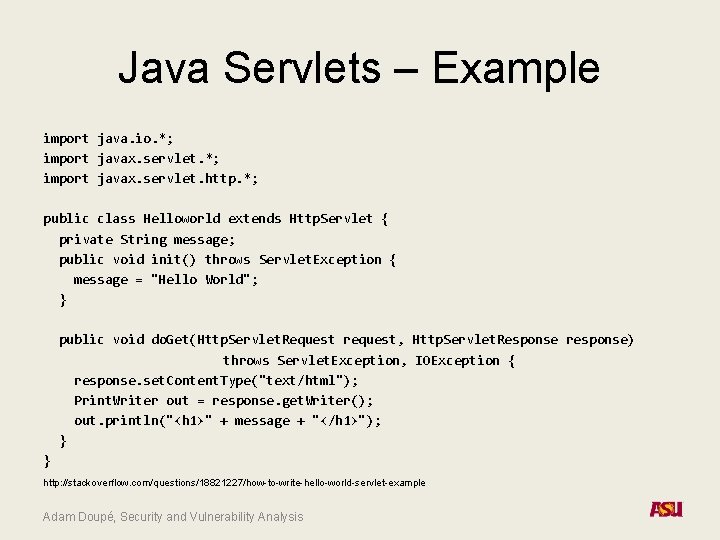
Java Servlets – Example import java. io. *; import javax. servlet. http. *; public class Helloworld extends Http. Servlet { private String message; public void init() throws Servlet. Exception { message = "Hello World"; } public void do. Get(Http. Servlet. Request request, Http. Servlet. Response response) throws Servlet. Exception, IOException { response. set. Content. Type("text/html"); Print. Writer out = response. get. Writer(); out. println("<h 1>" + message + "</h 1>"); } } http: //stackoverflow. com/questions/18821227/how-to-write-hello-world-servlet-example Adam Doupé, Security and Vulnerability Analysis
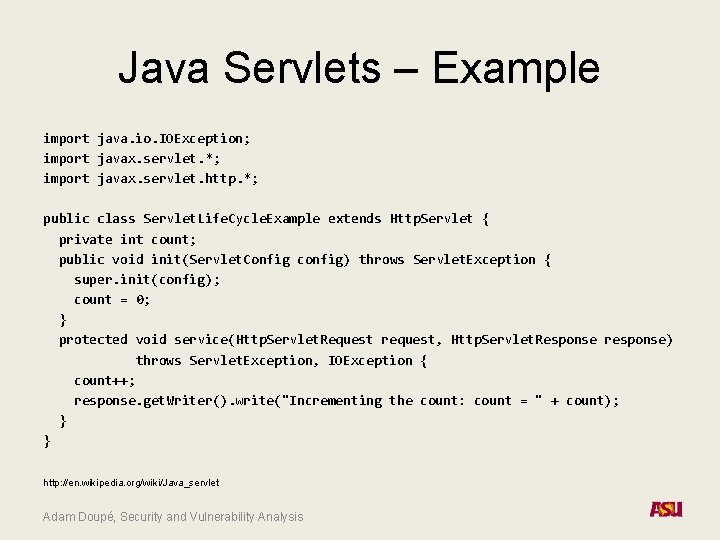
Java Servlets – Example import java. io. IOException; import javax. servlet. *; import javax. servlet. http. *; public class Servlet. Life. Cycle. Example extends Http. Servlet { private int count; public void init(Servlet. Config config) throws Servlet. Exception { super. init(config); count = 0; } protected void service(Http. Servlet. Request request, Http. Servlet. Response response) throws Servlet. Exception, IOException { count++; response. get. Writer(). write("Incrementing the count: count = " + count); } } http: //en. wikipedia. org/wiki/Java_servlet Adam Doupé, Security and Vulnerability Analysis
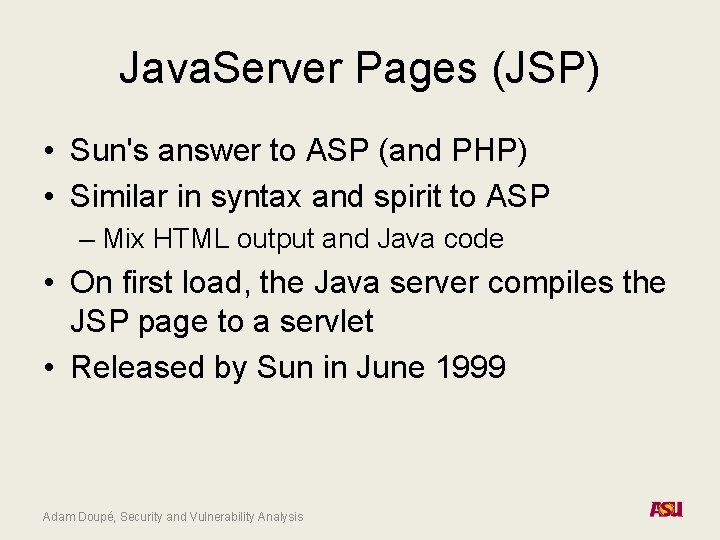
Java. Server Pages (JSP) • Sun's answer to ASP (and PHP) • Similar in syntax and spirit to ASP – Mix HTML output and Java code • On first load, the Java server compiles the JSP page to a servlet • Released by Sun in June 1999 Adam Doupé, Security and Vulnerability Analysis
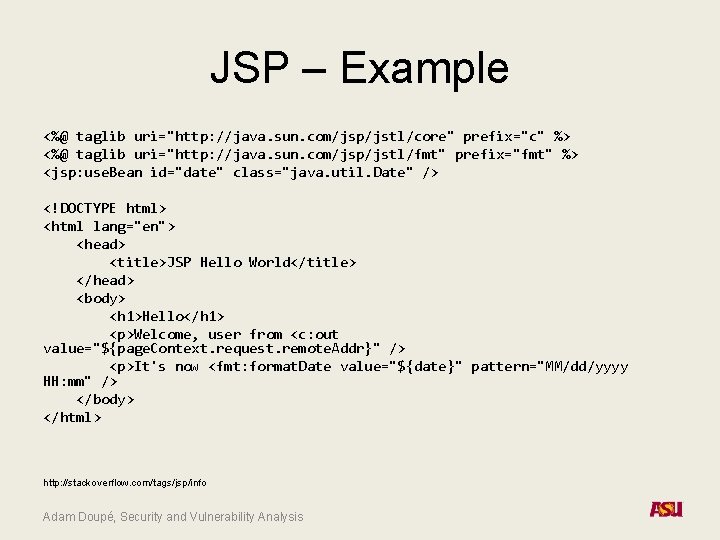
JSP – Example <%@ taglib uri="http: //java. sun. com/jsp/jstl/core" prefix="c" %> <%@ taglib uri="http: //java. sun. com/jsp/jstl/fmt" prefix="fmt" %> <jsp: use. Bean id="date" class="java. util. Date" /> <!DOCTYPE html> <html lang="en"> <head> <title>JSP Hello World</title> </head> <body> <h 1>Hello</h 1> <p>Welcome, user from <c: out value="${page. Context. request. remote. Addr}" /> <p>It's now <fmt: format. Date value="${date}" pattern="MM/dd/yyyy HH: mm" /> </body> </html> http: //stackoverflow. com/tags/jsp/info Adam Doupé, Security and Vulnerability Analysis
PHP: Hypertext Preprocessor • Scripting language that can be embedded in HTML pages to generate dynamic content – Basic idea is similar to JSP and ASP • Originally released in 1995 as a series of CGI scripts as C binaries • PHP 3. 0 released June 1998 is the closest to current PHP – "At its peak, PHP 3. 0 was installed on approximately 10% of the web servers on the Internet" http: //php. net/manual/en/history. php • PHP 4. 0 released May 2000 • PHP 5. 0 released July 2004 – Added support for objects • PHP 5. 6 released August 2014 is the latest version Adam Doupé, Security and Vulnerability Analysis
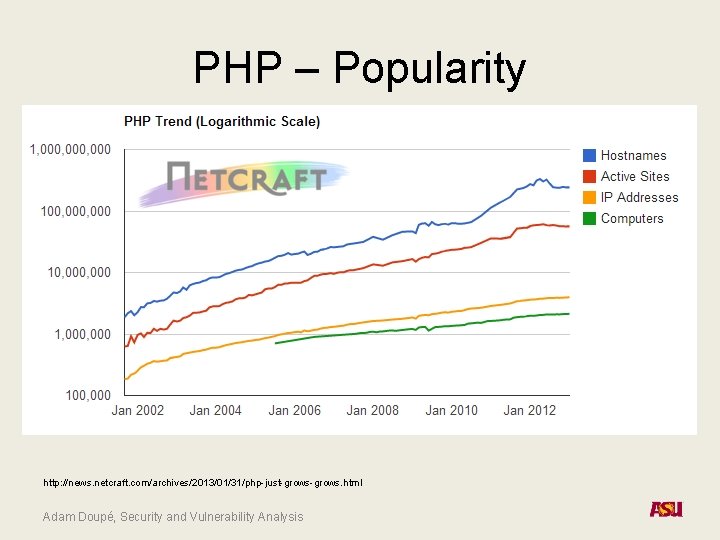
PHP – Popularity http: //news. netcraft. com/archives/2013/01/31/php-just-grows. html Adam Doupé, Security and Vulnerability Analysis
PHP • The page is parsed and interpreted on each page request – Can be run as CGI, so that a new copy of the PHP interpreter is run on each request – Or the PHP interpreter can be embedded into the web server • mod_php for apache • Completely new language – C-like in syntax – Custom designed to build web applications – Language grew organically over time Adam Doupé, Security and Vulnerability Analysis
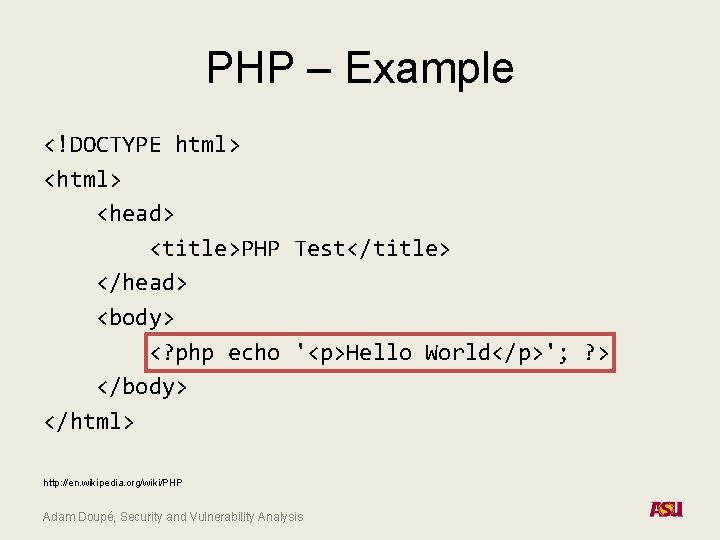
PHP – Example <!DOCTYPE html> <head> <title>PHP Test</title> </head> <body> <? php echo '<p>Hello World</p>'; ? > </body> </html> http: //en. wikipedia. org/wiki/PHP Adam Doupé, Security and Vulnerability Analysis
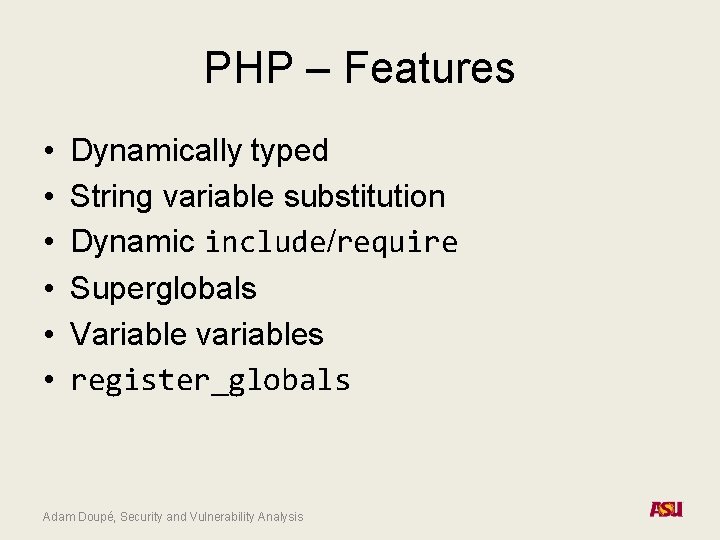
PHP – Features • • • Dynamically typed String variable substitution Dynamic include/require Superglobals Variable variables register_globals Adam Doupé, Security and Vulnerability Analysis
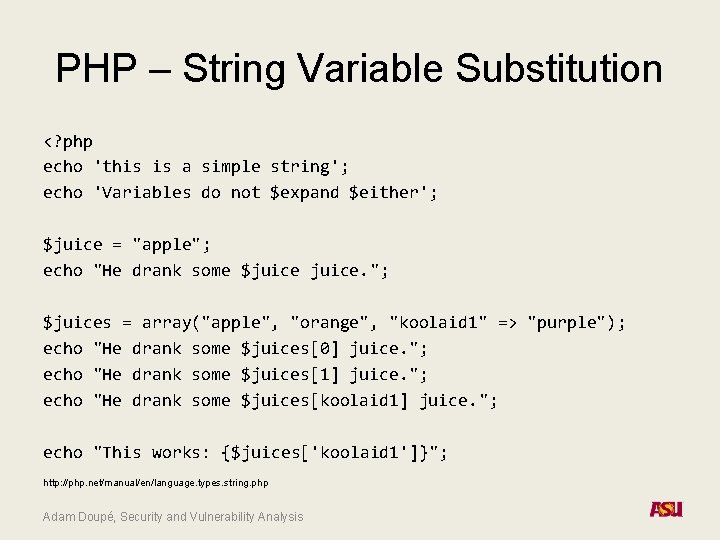
PHP – String Variable Substitution <? php echo 'this is a simple string'; echo 'Variables do not $expand $either'; $juice = "apple"; echo "He drank some $juice. "; $juices = array("apple", "orange", "koolaid 1" => "purple"); echo "He drank some $juices[0] juice. "; echo "He drank some $juices[1] juice. "; echo "He drank some $juices[koolaid 1] juice. "; echo "This works: {$juices['koolaid 1']}"; http: //php. net/manual/en/language. types. string. php Adam Doupé, Security and Vulnerability Analysis
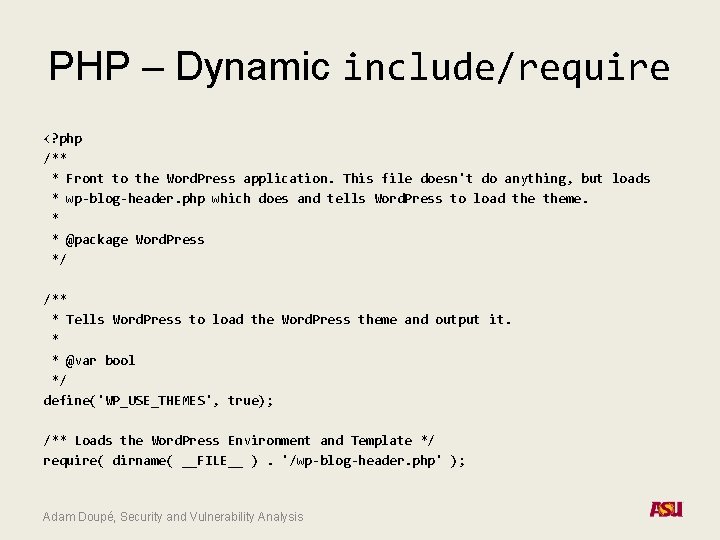
PHP – Dynamic include/require <? php /** * Front to the Word. Press application. This file doesn't do anything, but loads * wp-blog-header. php which does and tells Word. Press to load theme. * * @package Word. Press */ /** * Tells Word. Press to load the Word. Press theme and output it. * * @var bool */ define('WP_USE_THEMES', true); /** Loads the Word. Press Environment and Template */ require( dirname( __FILE__ ). '/wp-blog-header. php' ); Adam Doupé, Security and Vulnerability Analysis
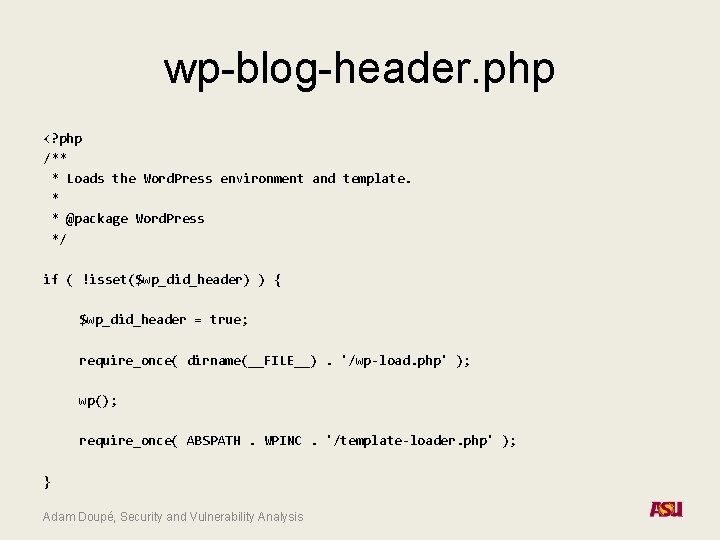
wp-blog-header. php <? php /** * Loads the Word. Press environment and template. * * @package Word. Press */ if ( !isset($wp_did_header) ) { $wp_did_header = true; require_once( dirname(__FILE__). '/wp-load. php' ); wp(); require_once( ABSPATH. WPINC. '/template-loader. php' ); } Adam Doupé, Security and Vulnerability Analysis
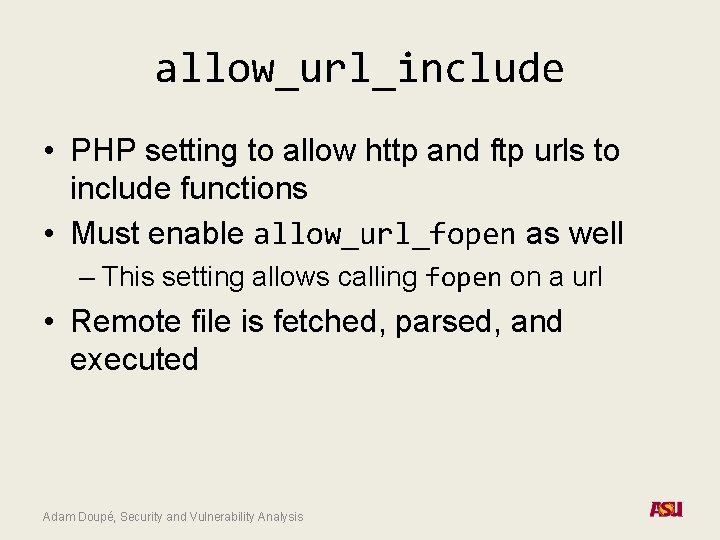
allow_url_include • PHP setting to allow http and ftp urls to include functions • Must enable allow_url_fopen as well – This setting allows calling fopen on a url • Remote file is fetched, parsed, and executed Adam Doupé, Security and Vulnerability Analysis
![PHP - Superglobals <? php if ( 'POST' != $_SERVER['REQUEST_METHOD'] ) { header('Allow: POST');](http://slidetodoc.com/presentation_image_h2/eee90d391aa42a9b97d45c192404ba3e/image-58.jpg "PHP - Superglobals <? php if ( 'POST' != $_SERVER['REQUEST_METHOD'] ) { header('Allow: POST');")
PHP - Superglobals <? php if ( 'POST' != $_SERVER['REQUEST_METHOD'] ) { header('Allow: POST'); header('HTTP/1. 1 405 Method Not Allowed'); header('Content-Type: text/plain'); exit; } $comment_post_ID = isset($_POST['comment_post_ID']) ? (int) $_POST['comment_post_ID'] : 0; $post = get_post($comment_post_ID); if ( empty( $post->comment_status ) ) { /** * Fires when a comment is attempted on a post that does not exist. * @since 1. 5. 0 * @param int $comment_post_ID Post ID. */ do_action( 'comment_id_not_found', $comment_post_ID ); exit; } // get_post_status() will get the parent status for attachments. $status = get_post_status($post); $status_obj = get_post_status_object($status); Wordpress – wp-comments-post. php Adam Doupé, Security and Vulnerability Analysis
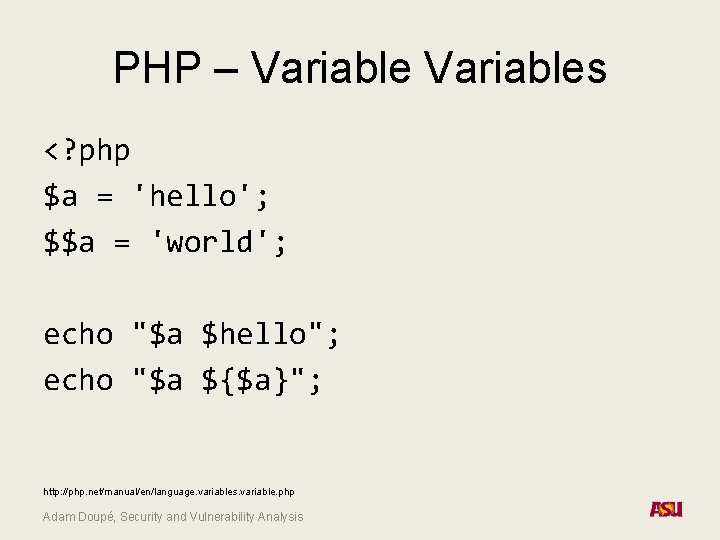
PHP – Variables <? php $a = 'hello'; $$a = 'world'; echo "$a $hello"; echo "$a ${$a}"; http: //php. net/manual/en/language. variables. variable. php Adam Doupé, Security and Vulnerability Analysis
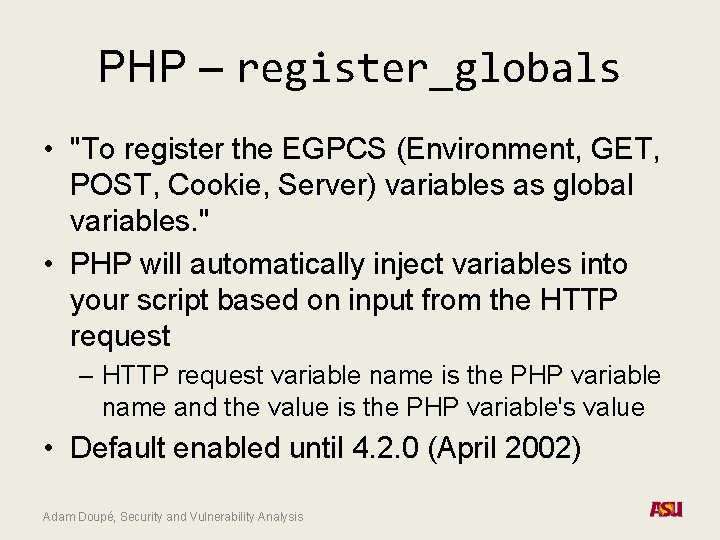
PHP – register_globals • "To register the EGPCS (Environment, GET, POST, Cookie, Server) variables as global variables. " • PHP will automatically inject variables into your script based on input from the HTTP request – HTTP request variable name is the PHP variable name and the value is the PHP variable's value • Default enabled until 4. 2. 0 (April 2002) Adam Doupé, Security and Vulnerability Analysis
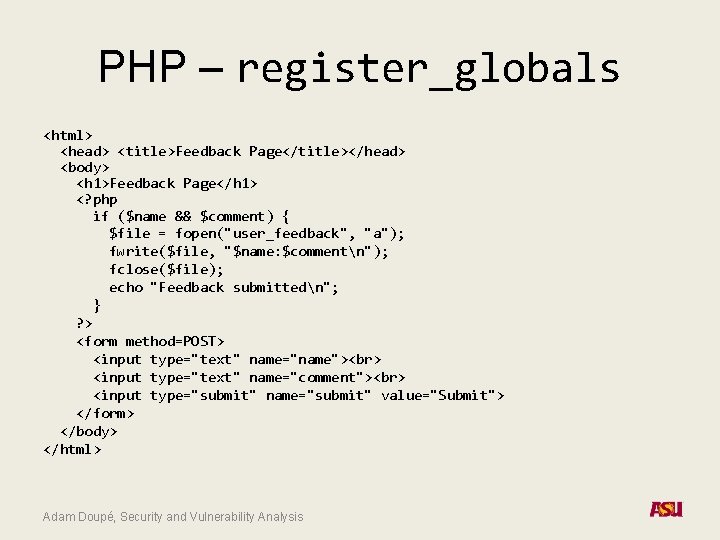
PHP – register_globals <html> <head> <title>Feedback Page</title></head> <body> <h 1>Feedback Page</h 1> <? php if ($name && $comment) { $file = fopen("user_feedback", "a"); fwrite($file, "$name: $commentn"); fclose($file); echo "Feedback submittedn"; } ? > <form method=POST> <input type="text" name="name"> <input type="text" name="comment"> <input type="submit" name="submit" value="Submit"> </form> </body> </html> Adam Doupé, Security and Vulnerability Analysis
Storing State • Web applications would like to store persistent state – Otherwise it's hard to make a real application, as cookies can only store small amounts of information • Where to store the state? – Memory • Previous JSP example – Filesystem • Flat • XML file – Database • Most common for modern web applications Adam Doupé, Security and Vulnerability Analysis
Web Applications and the Database • Pros – ACID compliance – Concurrency – Separation of concerns • Can run database on another server • Can have multiple web application processes connecting to the same database • Cons – More complicated to build and deploy – Adding another language to web technology (SQL) Adam Doupé, Security and Vulnerability Analysis
LAMP Stack • Classic web application model – Linux – Apache – My. SQL – PHP • Nice way to think of web applications, as each component can be mixed and swapped – Underlying OS – Web server – Database – Web application language/framework Adam Doupé, Security and Vulnerability Analysis
My. SQL • Currently second-most used open-source relational database – What is the first? • First release on May 23 rd 1995 – Same day that Sun released first version of Java • Sun eventually purchased My. SQL (the company) for $1 billion in January 2008 Adam Doupé, Security and Vulnerability Analysis
Adam Doupé, Security and Vulnerability Analysis
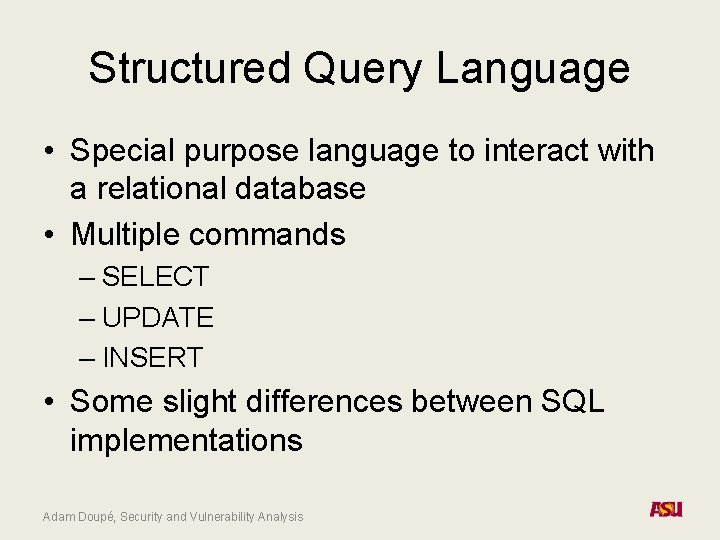
Structured Query Language • Special purpose language to interact with a relational database • Multiple commands – SELECT – UPDATE – INSERT • Some slight differences between SQL implementations Adam Doupé, Security and Vulnerability Analysis
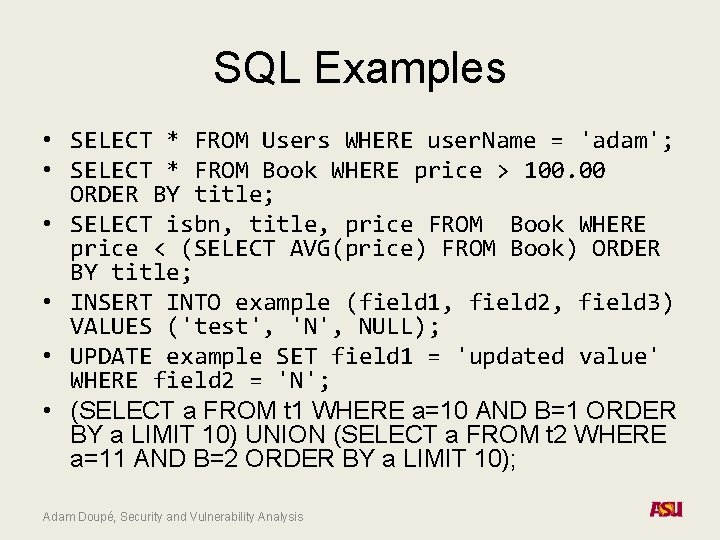
SQL Examples • SELECT * FROM Users WHERE user. Name = 'adam'; • SELECT * FROM Book WHERE price > 100. 00 ORDER BY title; • SELECT isbn, title, price FROM Book WHERE price < (SELECT AVG(price) FROM Book) ORDER BY title; • INSERT INTO example (field 1, field 2, field 3) VALUES ('test', 'N', NULL); • UPDATE example SET field 1 = 'updated value' WHERE field 2 = 'N'; • (SELECT a FROM t 1 WHERE a=10 AND B=1 ORDER BY a LIMIT 10) UNION (SELECT a FROM t 2 WHERE a=11 AND B=2 ORDER BY a LIMIT 10); Adam Doupé, Security and Vulnerability Analysis
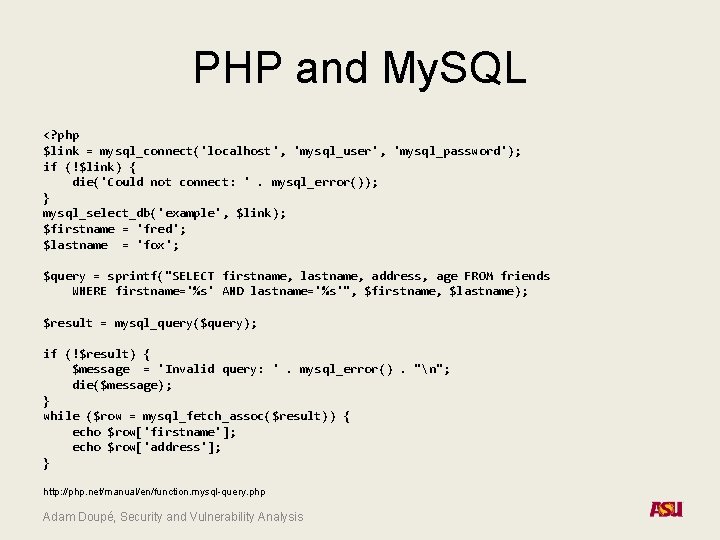
PHP and My. SQL <? php $link = mysql_connect('localhost', 'mysql_user', 'mysql_password'); if (!$link) { die('Could not connect: '. mysql_error()); } mysql_select_db('example', $link); $firstname = 'fred'; $lastname = 'fox'; $query = sprintf("SELECT firstname, lastname, address, age FROM friends WHERE firstname='%s' AND lastname='%s'", $firstname, $lastname); $result = mysql_query($query); if (!$result) { $message = 'Invalid query: '. mysql_error(). "n"; die($message); } while ($row = mysql_fetch_assoc($result)) { echo $row['firstname']; echo $row['address']; } http: //php. net/manual/en/function. mysql-query. php Adam Doupé, Security and Vulnerability Analysis
Server-Side Web Application Technologies • • Cookies CGI ASP Servlets JSP PHP SQL Adam Doupé, Security and Vulnerability Analysis
Technologies • • • • URI Percent Encoding HTTP Request HTTP Response HTTP Authentication HTML Character References Form Urlencoding Cookies CGI ASP Servlets JSP PHP SQL Adam Doupé, Security and Vulnerability Analysis
- Slides: 71