
Servant Leadership Chapter 10 Northouse Leadership 8 e

- Slides: 22
Servant Leadership Chapter 10 Northouse, Leadership 8 e. © SAGE Publications, 2019. 2
Overview ÷ Servant Leadership Description ÷ Servant Leadership Defined ÷ Historical Basis of Servant Leadership ÷ Ten Characteristics of Servant Leadership ÷ Building a Theory About Servant Leadership Northouse, Leadership 8 e. © SAGE Publications, 2019. 3
Overview ÷ Building a Model of Servant Leadership ÷ How Does Servant Leadership Work? ÷ Strengths and Criticisms ÷ Application Northouse, Leadership 8 e. © SAGE Publications, 2019. 4
Servant Leadership Description ÷ Servant Leadership--is a paradox: both service and influence ÷ Interest in Servant Leadership ® Most scholarship has been prescriptive, until recently ® Past 10 years have clarified the concept and its assumptions ® Focuses on leadership from the point of view of the leader and his/her behaviors ® Servant leaders put followers first Northouse, Leadership 8 e. © SAGE Publications, 2019. 5
Servant Leadership Defined ÷ Greenleaf Definition: “Servant leadership begins with the natural feeling that one wants to serve, to serve first. Then conscious choice brings one to aspire to lead. . The difference manifests itself in the care taken by the servant--first to make sure that other people’s highest priority needs are being served. The best test. . . is: do those served grow as persons; do they, while being served, become healthier, wiser, freer, more autonomous, more likely themselves to become a servant? And, what is the effect on the least privileged in society; will they benefit, or, at least, will they not be further deprived? ” Sometimes treated as a trait, but viewed as a behavior in this chapter Northouse, Leadership 8 e. © SAGE Publications, 2019. 6
Historical Basis of Servant Leadership ÷ Greenleaf Center for Servant Leadership ® Advocating for building consensus in groups rather than using coercive leadership ® Inspired by Hesse’s novel, Journey to the East, where the travelers discovered the true leader of their group was the servant ® Leaders have a social responsibility for the “have-nots” ® Leaders shift authority to those who are being led Northouse, Leadership 8 e. © SAGE Publications, 2019. 7
10 Characteristics of a Servant Leader (Spears, 2002) 1. Listening--acknowledging the viewpoint of followers and validating these perspectives. 2. Empathy--“standing in the shoes” of another person and attempting to see the world from that person’s point of view. 3. Healing--in helping followers become whole, servant leaders are themselves healed. 4. Awareness--understanding oneself and the impact one has on others. Northouse, Leadership 8 e. © SAGE Publications, 2019. 8
10 Characteristics of a Servant Leader (Spears, 2002) 5. Persuasion--creates change through gentle, nonjudgmental argument. 6. Conceptualization--the ability to be a visionary for an organization. 7. Foresight--the ability to predict what is coming based on what is occurring in the present and what has happened in the past. Northouse, Leadership 8 e. © SAGE Publications, 2019. 9
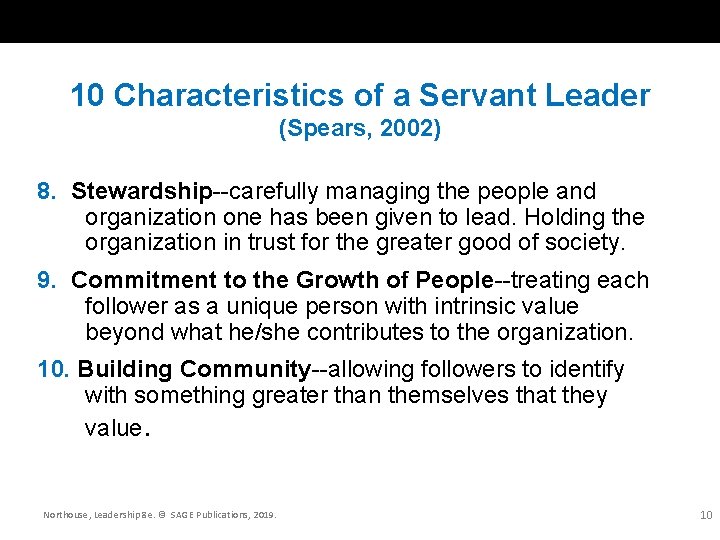
10 Characteristics of a Servant Leader (Spears, 2002) 8. Stewardship--carefully managing the people and organization one has been given to lead. Holding the organization in trust for the greater good of society. 9. Commitment to the Growth of People--treating each follower as a unique person with intrinsic value beyond what he/she contributes to the organization. 10. Building Community--allowing followers to identify with something greater than themselves that they value. Northouse, Leadership 8 e. © SAGE Publications, 2019. 10
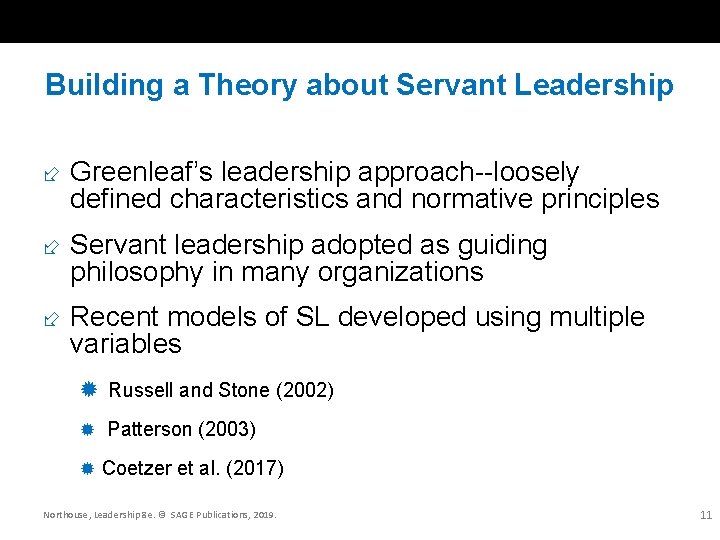
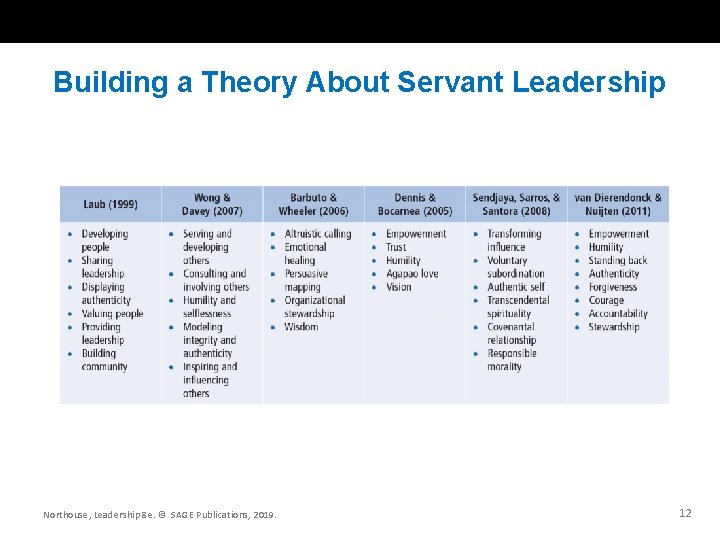
Building a Theory about Servant Leadership ÷ Greenleaf’s leadership approach--loosely defined characteristics and normative principles ÷ Servant leadership adopted as guiding philosophy in many organizations ÷ Recent models of SL developed using multiple variables ® Russell and Stone (2002) ® Patterson (2003) ® Coetzer et al. (2017) Northouse, Leadership 8 e. © SAGE Publications, 2019. 11
Building a Theory About Servant Leadership Northouse, Leadership 8 e. © SAGE Publications, 2019. 12
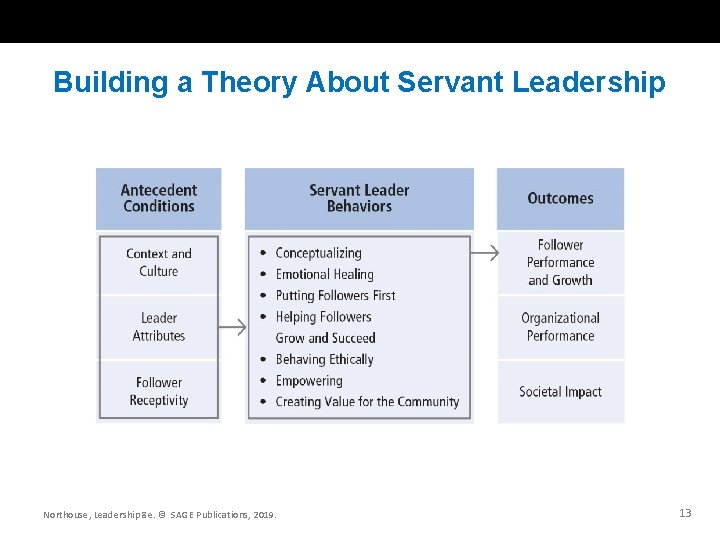
Building a Theory About Servant Leadership Northouse, Leadership 8 e. © SAGE Publications, 2019. 13
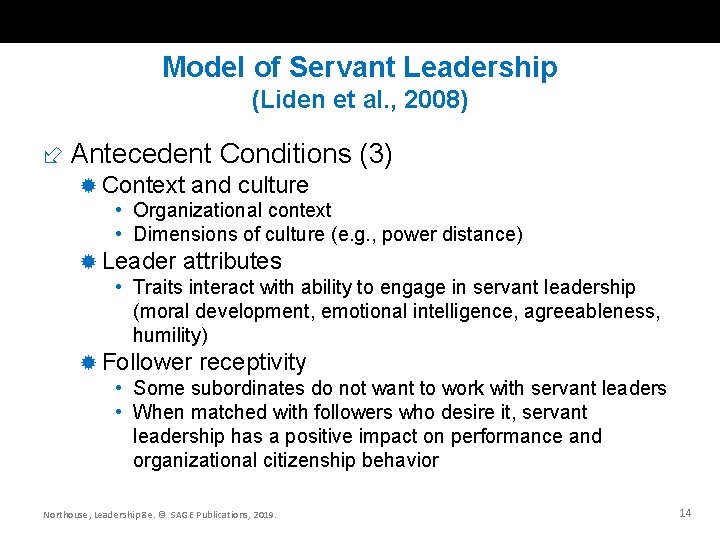
Model of Servant Leadership (Liden et al. , 2008) ÷ Antecedent Conditions (3) ® Context and culture • Organizational context • Dimensions of culture (e. g. , power distance) ® Leader attributes • Traits interact with ability to engage in servant leadership (moral development, emotional intelligence, agreeableness, humility) ® Follower receptivity • Some subordinates do not want to work with servant leaders • When matched with followers who desire it, servant leadership has a positive impact on performance and organizational citizenship behavior Northouse, Leadership 8 e. © SAGE Publications, 2019. 14
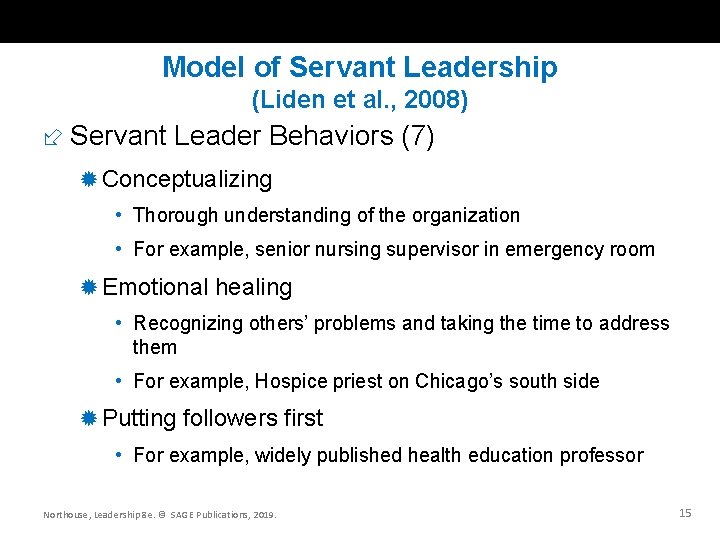
Model of Servant Leadership (Liden et al. , 2008) ÷ Servant Leader Behaviors (7) ® Conceptualizing • Thorough understanding of the organization • For example, senior nursing supervisor in emergency room ® Emotional healing • Recognizing others’ problems and taking the time to address them • For example, Hospice priest on Chicago’s south side ® Putting followers first • For example, widely published health education professor Northouse, Leadership 8 e. © SAGE Publications, 2019. 15
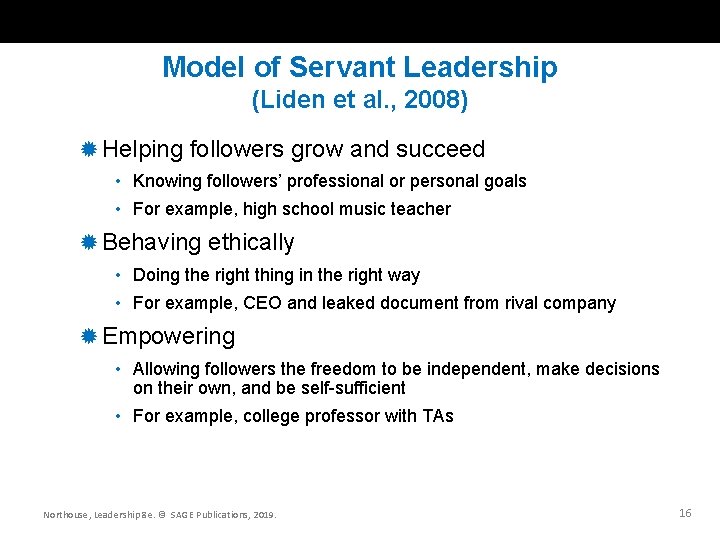
Model of Servant Leadership (Liden et al. , 2008) ® Helping followers grow and succeed • Knowing followers’ professional or personal goals • For example, high school music teacher ® Behaving ethically • Doing the right thing in the right way • For example, CEO and leaked document from rival company ® Empowering • Allowing followers the freedom to be independent, make decisions on their own, and be self-sufficient • For example, college professor with TAs Northouse, Leadership 8 e. © SAGE Publications, 2019. 16
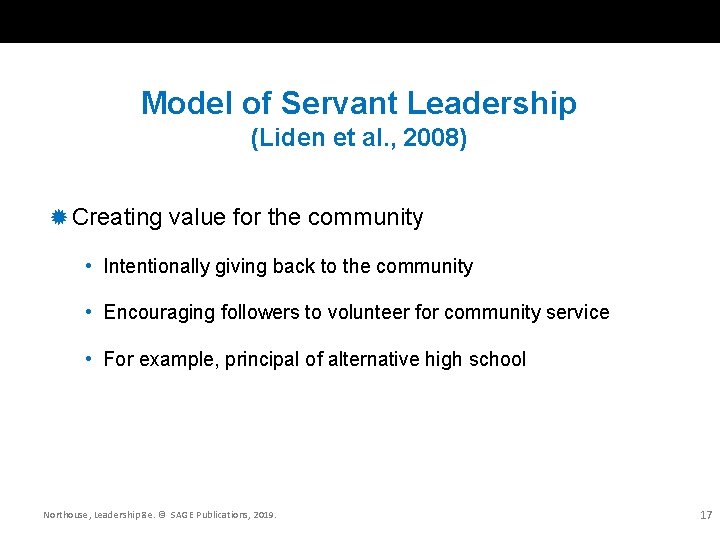
Model of Servant Leadership (Liden et al. , 2008) ® Creating value for the community • Intentionally giving back to the community • Encouraging followers to volunteer for community service • For example, principal of alternative high school Northouse, Leadership 8 e. © SAGE Publications, 2019. 17
Model of Servant Leadership (Liden et al. , 2008) ÷ Outcomes (3) - Follower performance and growth • Recognizing followers’ contributions and helping them realize their human potential • Favorable impact on subordinate in-role performance (identification with organization, adaptability, proactivity, service climate, reduced turnover, organizational citizenship) • Followers themselves may become servant leaders - Organizational performance • Positive relationship between servant leadership and OCB • Team effectiveness enhanced by increasing members’ shared confidence that they could be effective - Societal impact • For example, Mother Teresa and Sisters of Charity • For example, Southwest Airlines Northouse, Leadership 8 e. © SAGE Publications, 2019. 18
How Does SL Work? ÷ SL is different from many other leadership theories. ÷ It is concerned with putting followers first and the outcomes that are likely to emerge. ÷ SL works best when leaders are altruistic and have a strong motivation to help others. ÷ It is important for followers to be receptive to this style of leadership. ÷ SL results in community and societal change. Northouse, Leadership 8 e. © SAGE Publications, 2019. 19
Strengths ÷ Makes altruism the central component of the leadership process. ÷ Provides a counterintuitive approach to the use of influence. Leaders should share control. ÷ SL is not a panacea. It may not be effective when subordinates are not open to being guided, supported, and empowered. ÷ Research has resulted in a sound measure of SL--the SLQ. Northouse, Leadership 8 e. © SAGE Publications, 2019. 20
Criticisms ÷ Because the name appears contradictory, SL may be seen as whimsical, or not really “leadership. ” ÷ Researchers are unable to reach consensus on a common definition or theoretical framework for SL. ÷ The prescriptive overtone suggests that good leaders “put others first, ” which conflicts with other principles of leadership such as directing, concern for production, and so on. It can also sound moralistic, which may deter some researchers. ÷ Conceptualizing is not unique to servant leaders. It is unclear why it is included in this model. Northouse, Leadership 8 e. © SAGE Publications, 2019. 21
Application ÷ SL can be applied at all levels of management and in all types of organizations. ÷ SL has been used extensively in a variety of organizations for more than 30 years. ÷ Organizations should be careful to select employees who (a) are interested in building long-term relationships with followers and (b) have strong ethics. ÷ SL is taught at many colleges and universities and is used by numerous independent coaches, trainers, and consultants. Northouse, Leadership 8 e. © SAGE Publications, 2019. 22