
Series Circuits In this presentation you will n
- Slides: 19
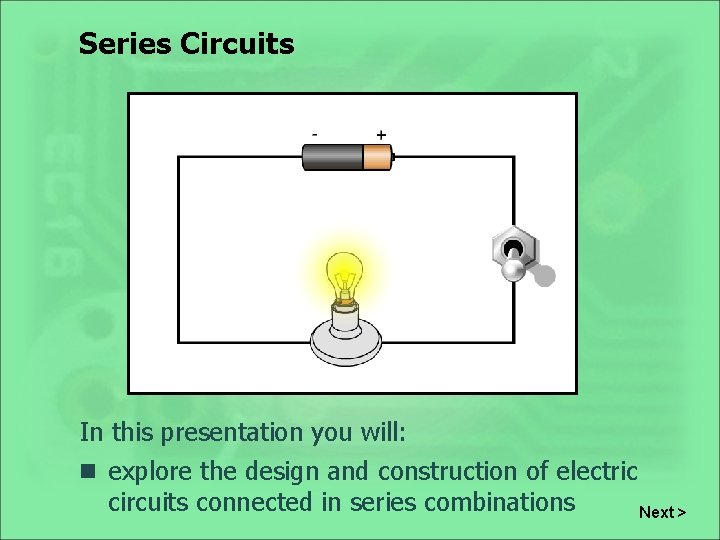
Series Circuits In this presentation you will: n explore the design and construction of electric circuits connected in series combinations Next >
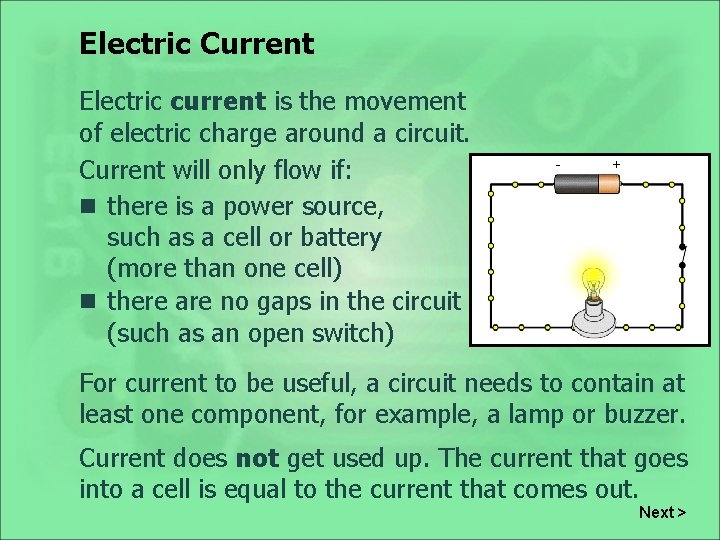
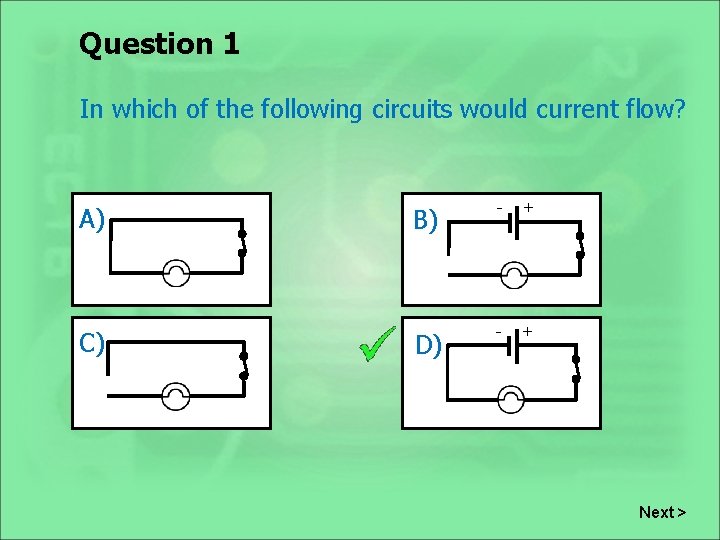
Electric Current Electric current is the movement of electric charge around a circuit. Current will only flow if: n there is a power source, such as a cell or battery (more than one cell) n there are no gaps in the circuit (such as an open switch) - + For current to be useful, a circuit needs to contain at least one component, for example, a lamp or buzzer. Current does not get used up. The current that goes into a cell is equal to the current that comes out. Next >
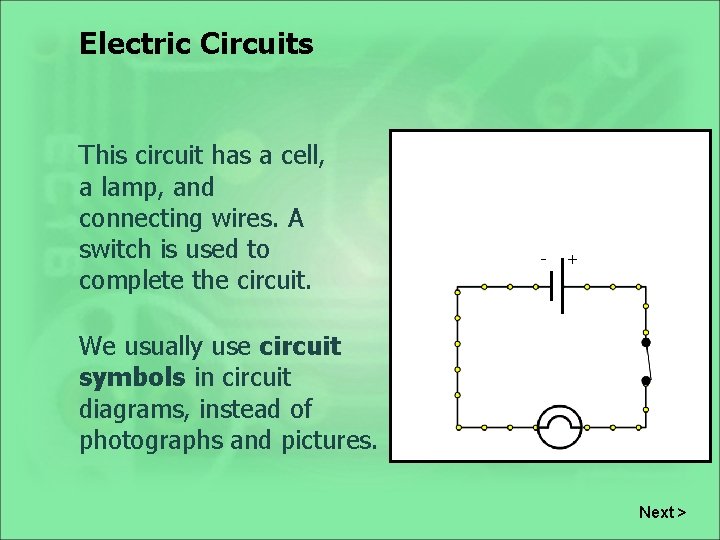
Electric Circuits This circuit has a cell, a lamp, and connecting wires. A switch is used to complete the circuit. + - - + We usually use circuit symbols in circuit diagrams, instead of photographs and pictures. Next >
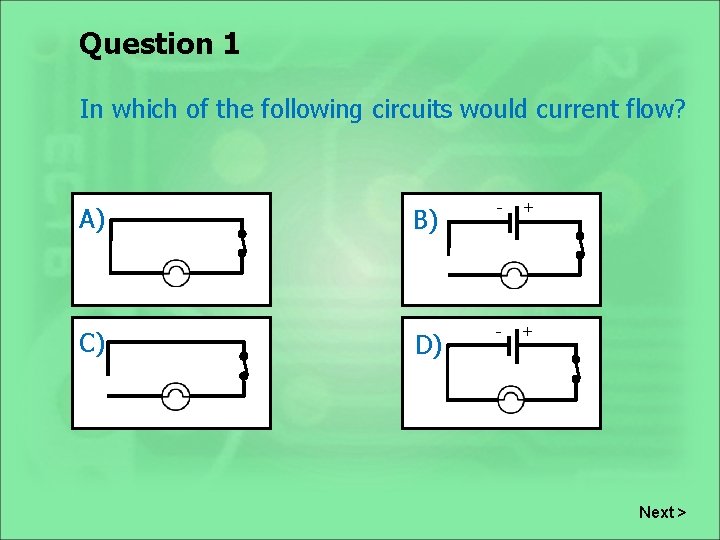
Question 1 In which of the following circuits would current flow? A) C) B) - + D) - + Next >
Question 1 In which of the following circuits would current flow? A) C) B) - + D) - + Next >
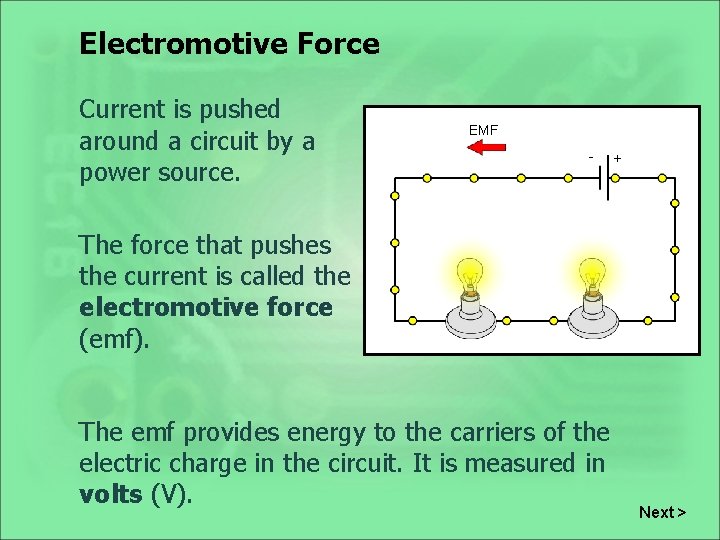
Electromotive Force Current is pushed around a circuit by a power source. EMF - + The force that pushes the current is called the electromotive force (emf). The emf provides energy to the carriers of the electric charge in the circuit. It is measured in volts (V). Next >
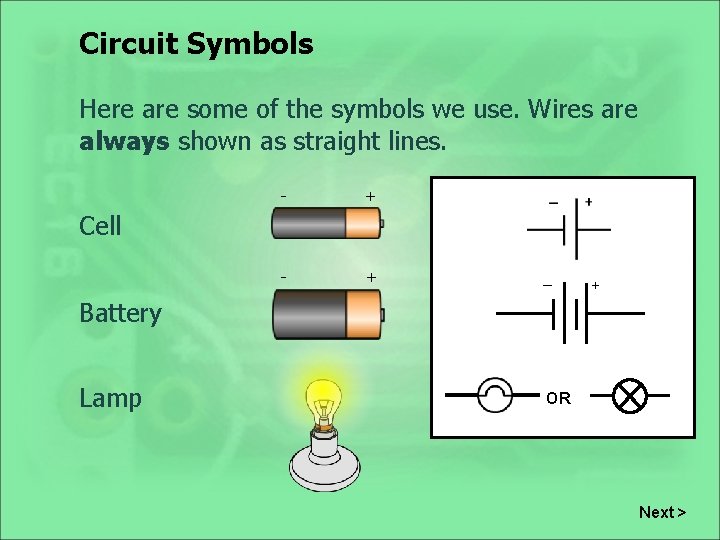
Circuit Symbols Here are some of the symbols we use. Wires are always shown as straight lines. - + Cell _ + Battery Lamp OR Next >
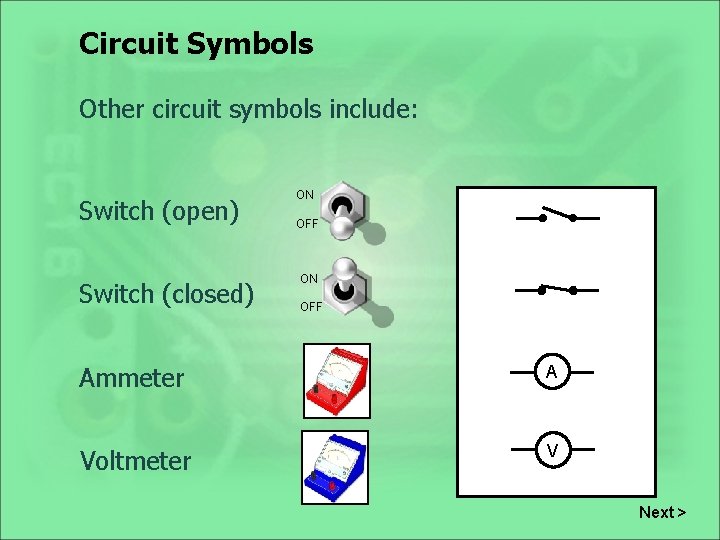
Circuit Symbols Other circuit symbols include: Switch (open) Switch (closed) ON OFF Ammeter A Voltmeter V Next >
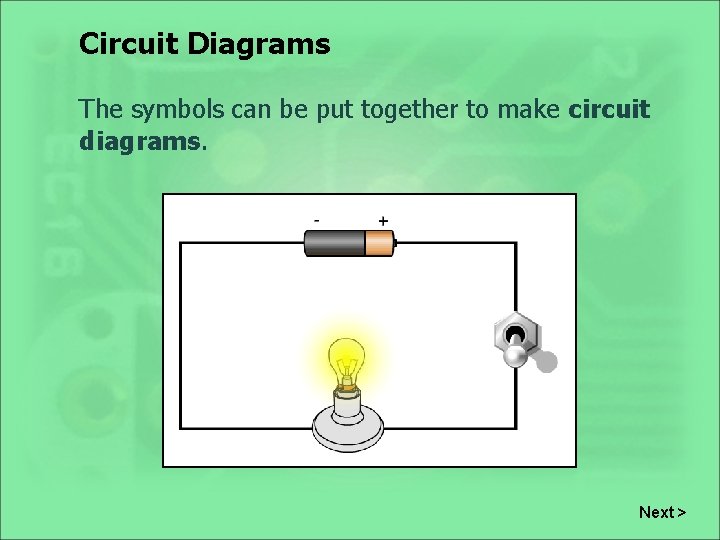
Circuit Diagrams The symbols can be put together to make circuit diagrams. Next >
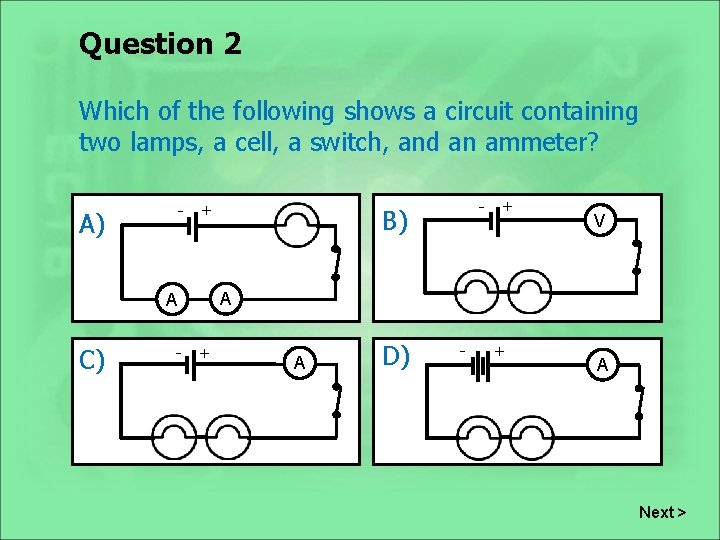
Question 2 Which of the following shows a circuit containing two lamps, a cell, a switch, and an ammeter? A) - + - B) + V A A C) - + A D) - + A Next >
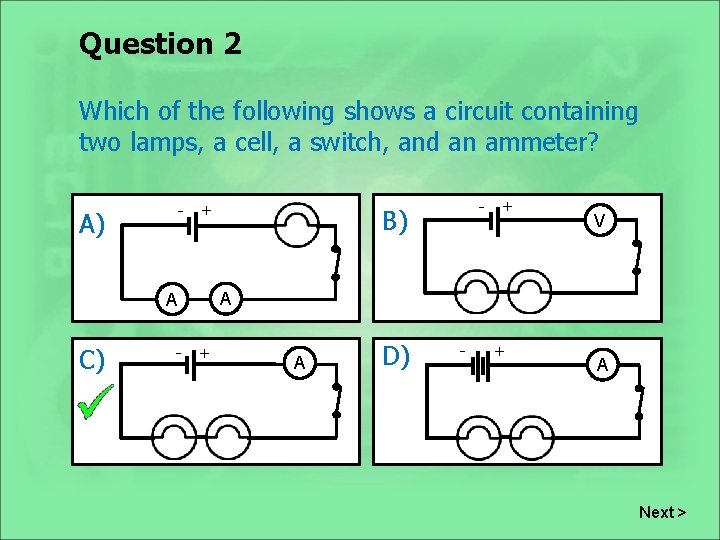
Question 2 Which of the following shows a circuit containing two lamps, a cell, a switch, and an ammeter? A) - + - B) + V A A C) - + A D) - + A Next >
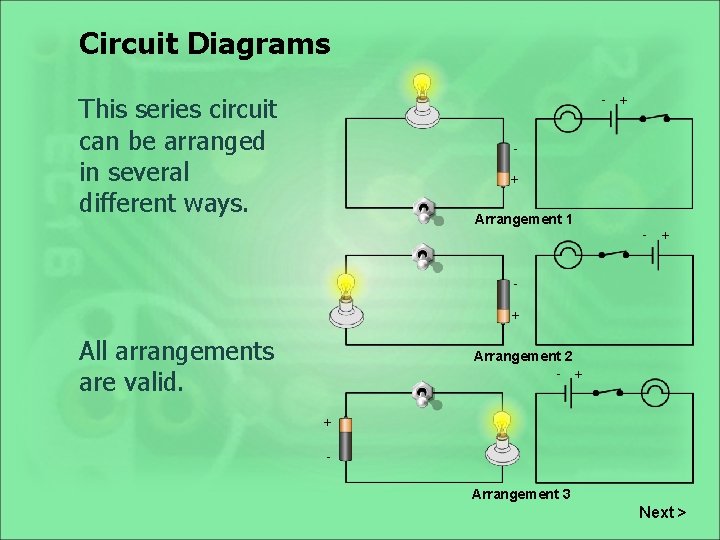
Circuit Diagrams This series circuit can be arranged in several different ways. - + + Arrangement 1 - + + All arrangements are valid. Arrangement 2 - + + - Arrangement 3 Next >
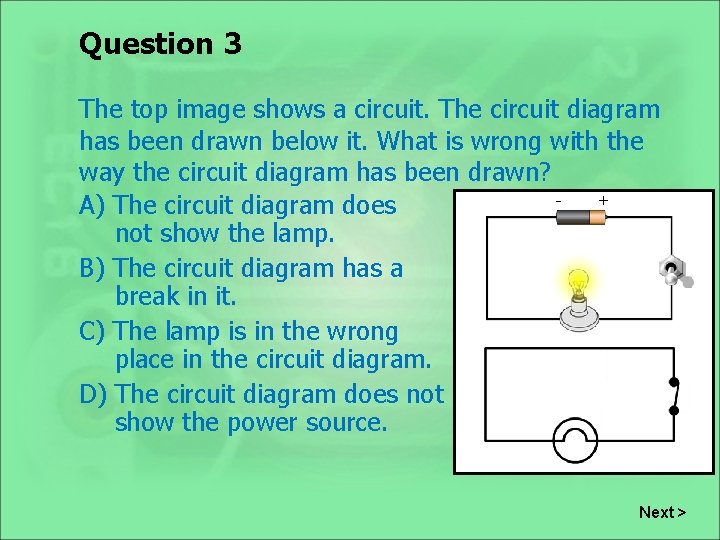
Question 3 The top image shows a circuit. The circuit diagram has been drawn below it. What is wrong with the way the circuit diagram has been drawn? + A) The circuit diagram does not show the lamp. B) The circuit diagram has a break in it. C) The lamp is in the wrong place in the circuit diagram. D) The circuit diagram does not show the power source. Next >
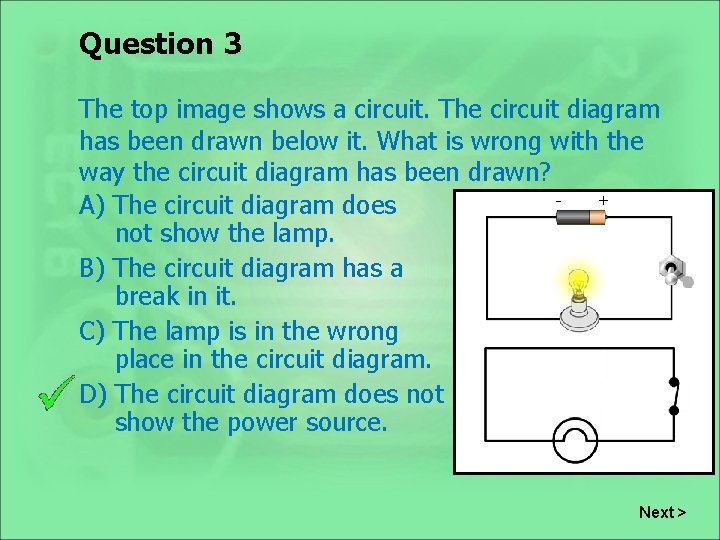
Question 3 The top image shows a circuit. The circuit diagram has been drawn below it. What is wrong with the way the circuit diagram has been drawn? + A) The circuit diagram does not show the lamp. B) The circuit diagram has a break in it. C) The lamp is in the wrong place in the circuit diagram. D) The circuit diagram does not show the power source. Next >
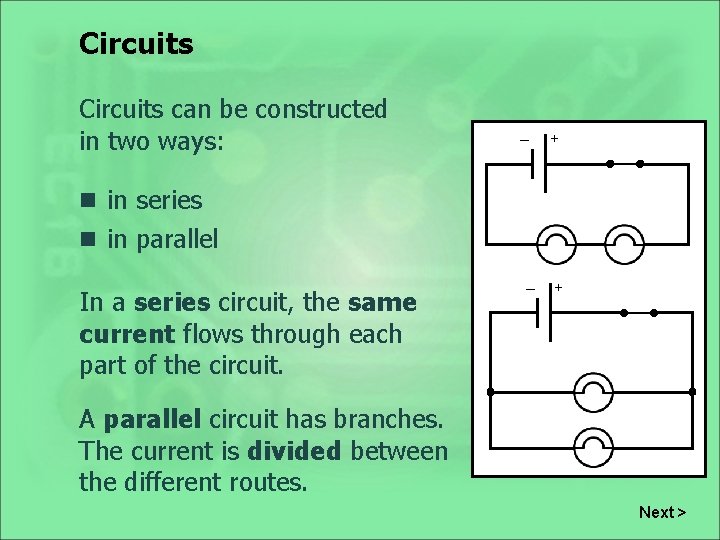
Circuits can be constructed in two ways: _ + n in series n in parallel In a series circuit, the same current flows through each part of the circuit. _ + A parallel circuit has branches. The current is divided between the different routes. Next >
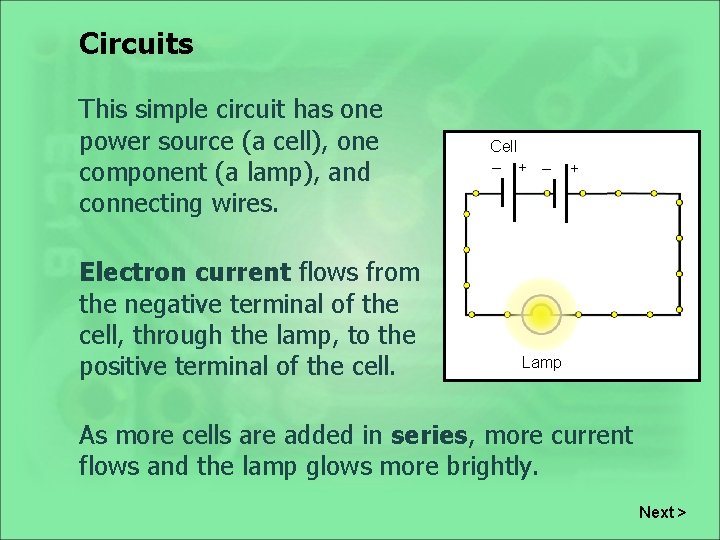
Circuits This simple circuit has one power source (a cell), one component (a lamp), and connecting wires. Electron current flows from the negative terminal of the cell, through the lamp, to the positive terminal of the cell. Cell _ + Lamp As more cells are added in series, more current flows and the lamp glows more brightly. Next >
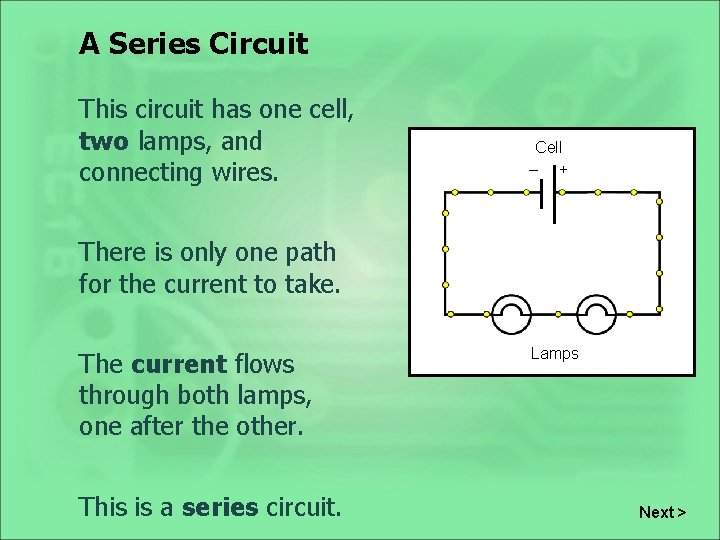
A Series Circuit This circuit has one cell, two lamps, and connecting wires. Cell _ + There is only one path for the current to take. The current flows through both lamps, one after the other. This is a series circuit. Lamps Next >
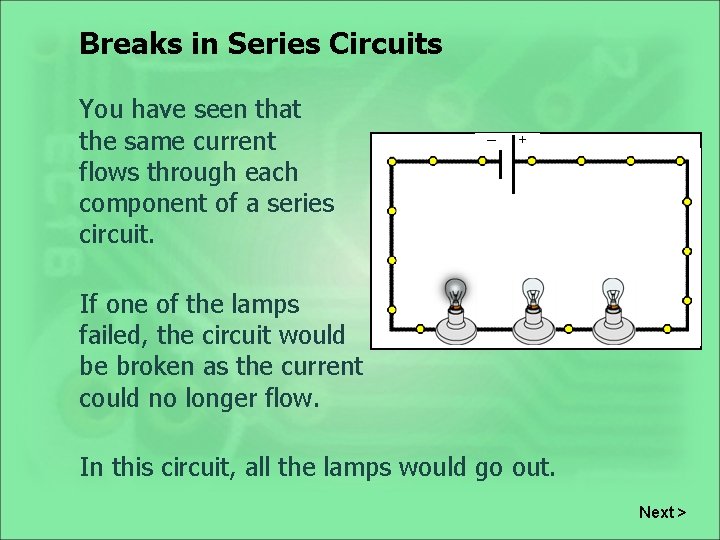
Breaks in Series Circuits You have seen that the same current flows through each component of a series circuit. _ + If one of the lamps failed, the circuit would be broken as the current could no longer flow. In this circuit, all the lamps would go out. Next >
Summary In this presentation you have seen: n the concept of electric current and electromotive force n circuit symbols and diagrams n circuits connected in series combinations End >