
SERIES AND PARALLEL CIRCUITS Physics Mrs Coyle PART
- Slides: 23
SERIES AND PARALLEL CIRCUITS Physics Mrs. Coyle
PART I Kirchhoff’s Rules Series Circuits Equivalent Resistance Voltage Drop Across Resistors Brightness of Bulbs in a Series Circuit
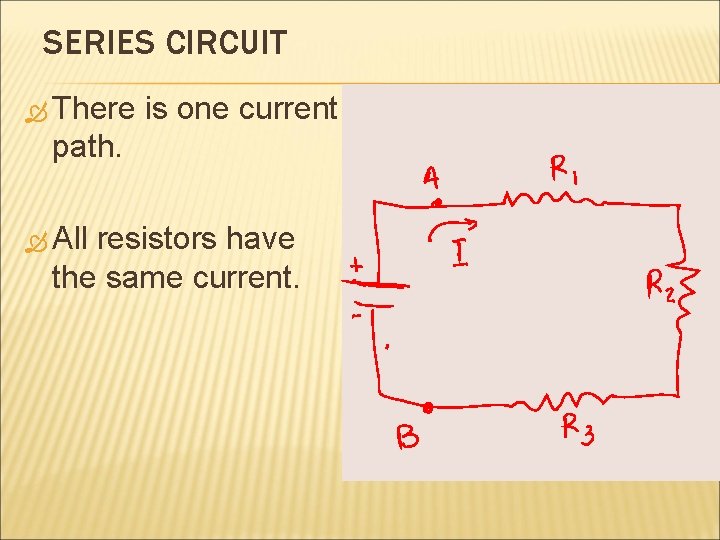
SERIES CIRCUIT There is one current path. All resistors have the same current.
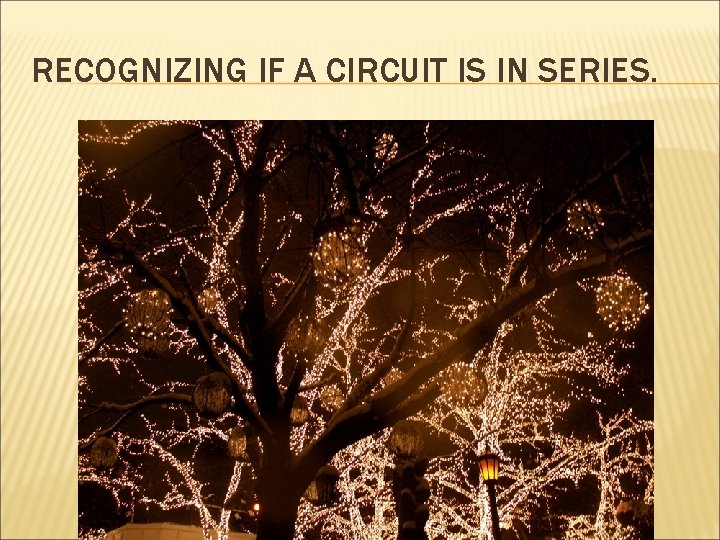
RECOGNIZING IF A CIRCUIT IS IN SERIES.
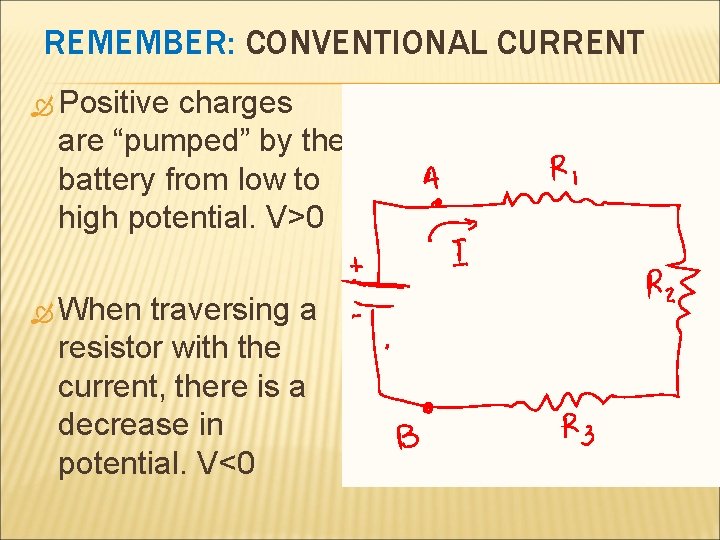
REMEMBER: CONVENTIONAL CURRENT Positive charges are “pumped” by the battery from low to high potential. V>0 When traversing a resistor with the current, there is a decrease in potential. V<0
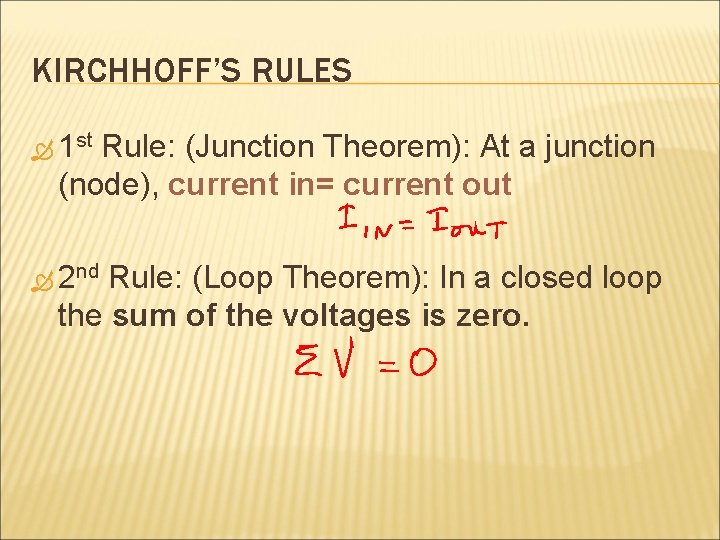
KIRCHHOFF’S RULES 1 st Rule: (Junction Theorem): At a junction (node), current in= current out 2 nd Rule: (Loop Theorem): In a closed loop the sum of the voltages is zero.
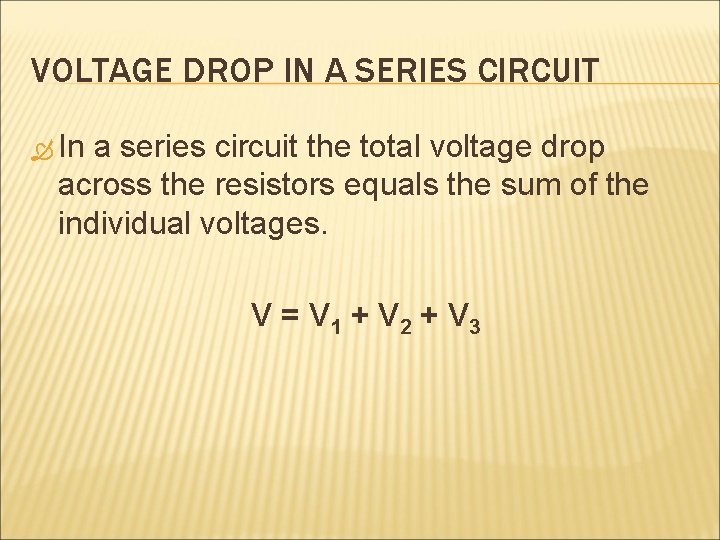
VOLTAGE DROP IN A SERIES CIRCUIT In a series circuit the total voltage drop across the resistors equals the sum of the individual voltages. V = V 1 + V 2 + V 3
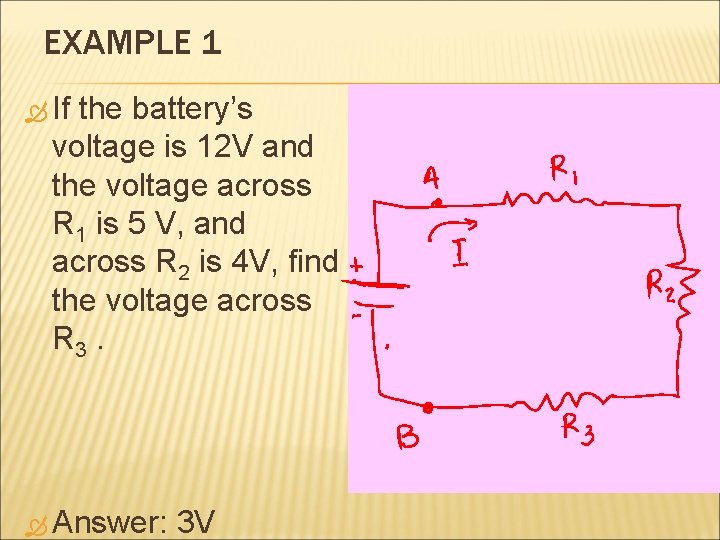
EXAMPLE 1 If the battery’s voltage is 12 V and the voltage across R 1 is 5 V, and across R 2 is 4 V, find the voltage across R 3. Answer: 3 V
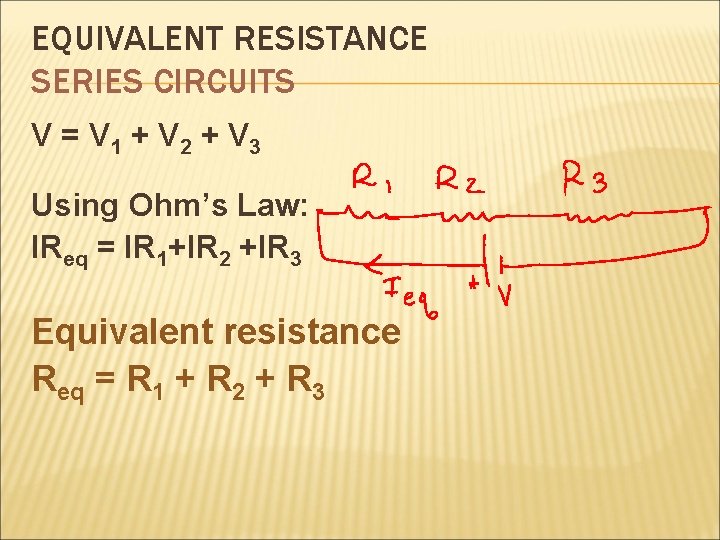
EQUIVALENT RESISTANCE SERIES CIRCUITS V = V 1 + V 2 + V 3 Using Ohm’s Law: IReq = IR 1+IR 2 +IR 3 Equivalent resistance Req = R 1 + R 2 + R 3
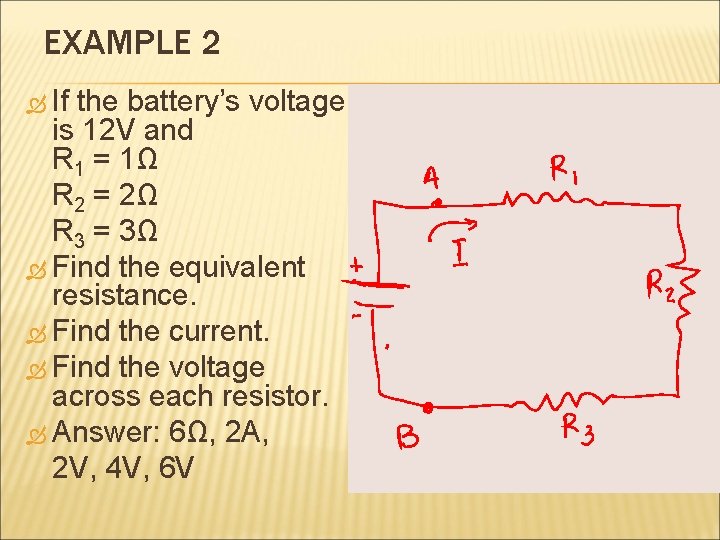
EXAMPLE 2 If the battery’s voltage is 12 V and R 1 = 1Ω R 2 = 2Ω R 3 = 3Ω Find the equivalent resistance. Find the current. Find the voltage across each resistor. Answer: 6Ω, 2 A, 2 V, 4 V, 6 V
REMEMBER: BRIGHTNESS OF A LIGHT BULB AND POWER The greater the power actually used by a light bulb, the greater the brightness. Note: the power rating of a light bulb is indicated for a given voltage, at room temperature and the bulb may be in a circuit that does not have that voltage.
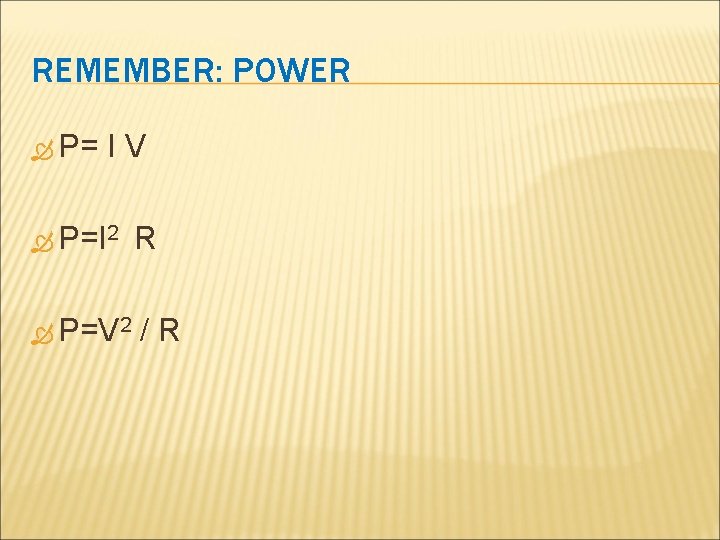
REMEMBER: POWER P= IV P=I 2 R P=V 2 /R
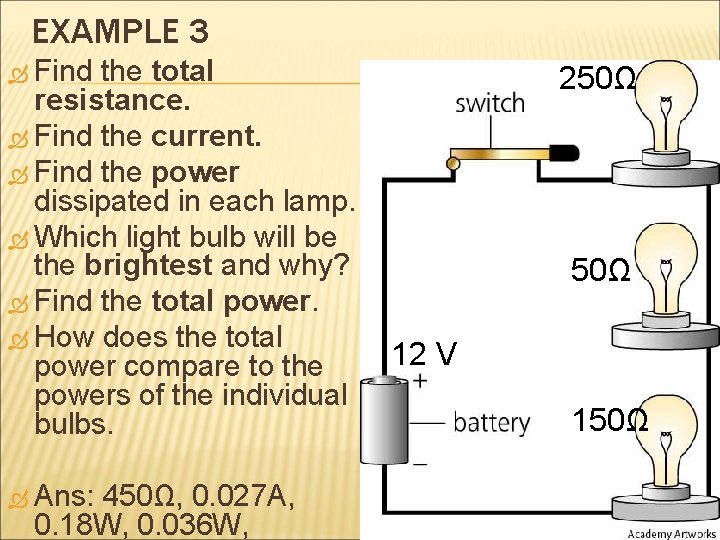
EXAMPLE 3 Find the total resistance. Find the current. Find the power dissipated in each lamp. Which light bulb will be the brightest and why? Find the total power. How does the total power compare to the powers of the individual bulbs. Ans: 450Ω, 0. 027 A, 0. 18 W, 0. 036 W, 250Ω 12 V 150Ω
PART II Parallel Circuits Equivalent Resistance Brightness of Light Bulb Combination Circuits
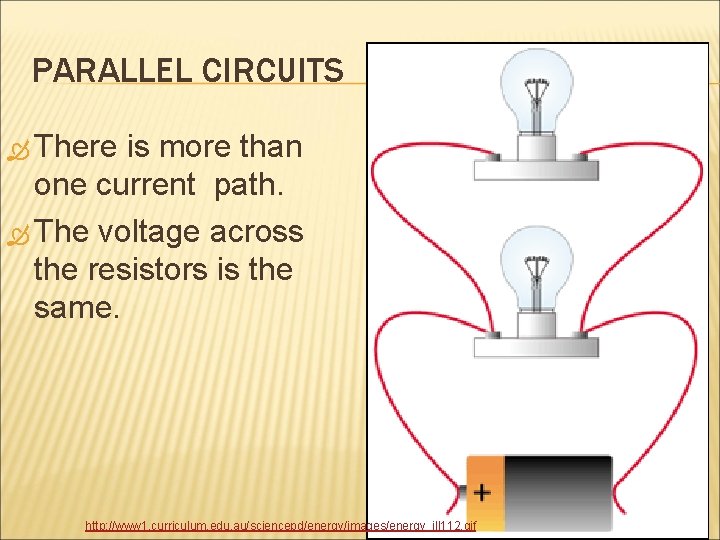
PARALLEL CIRCUITS There is more than one current path. The voltage across the resistors is the same. http: //www 1. curriculum. edu. au/sciencepd/energy/images/energy_ill 112. gif
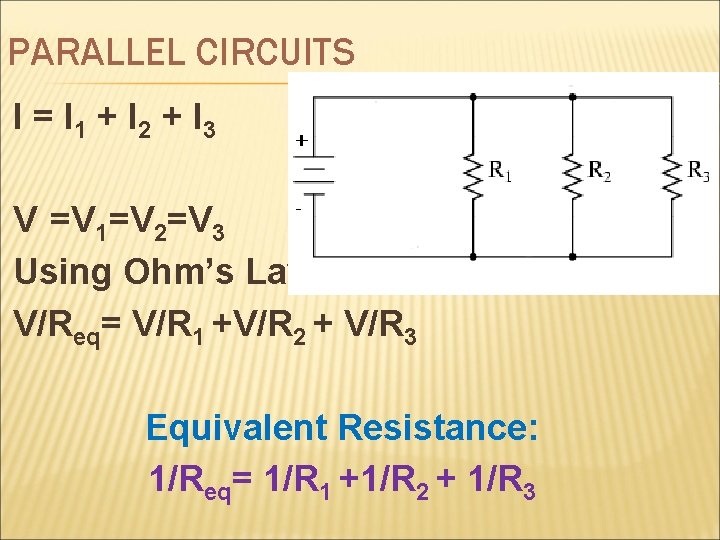
PARALLEL CIRCUITS I = I 1 + I 2 + I 3 V =V 1=V 2=V 3 Using Ohm’s Law: V/Req= V/R 1 +V/R 2 + V/R 3 Equivalent Resistance: 1/Req= 1/R 1 +1/R 2 + 1/R 3
WHEN ARE PARALLEL CIRCUITS USED?
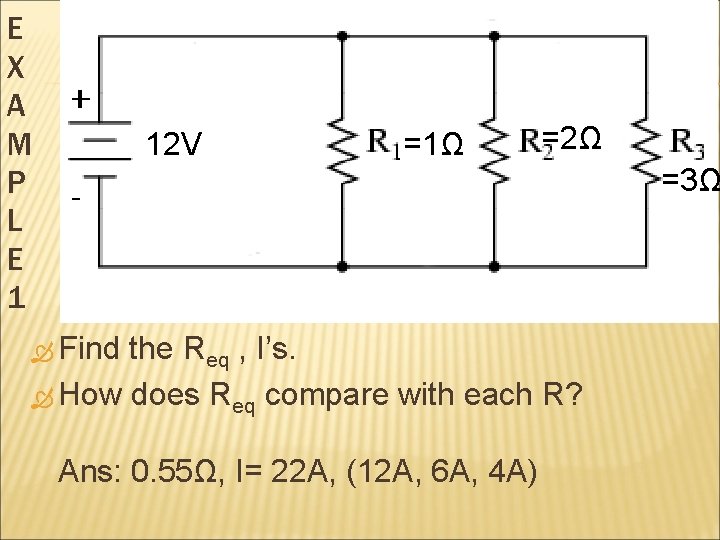
E X A M P L E 1 12 V =1Ω =2Ω =3Ω Find the Req , I’s. How does Req compare with each R? Ans: 0. 55Ω, I= 22 A, (12 A, 6 A, 4 A)
QUESTION Why should you not plug in too many appliances in the same outlet in a home?
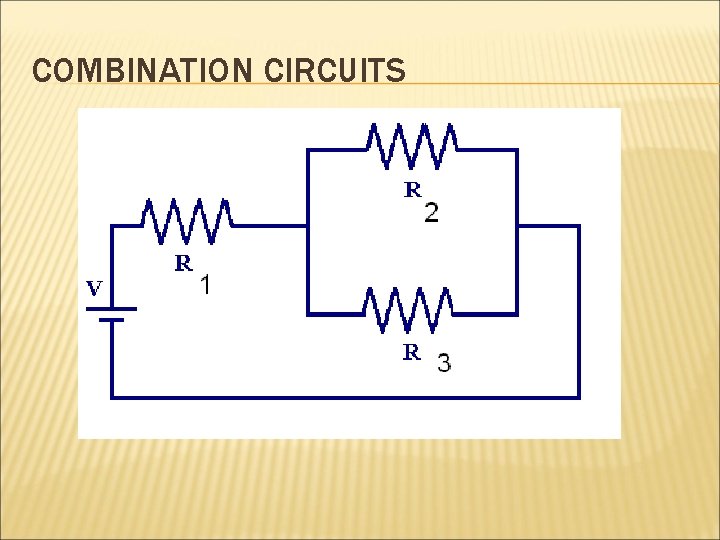
COMBINATION CIRCUITS
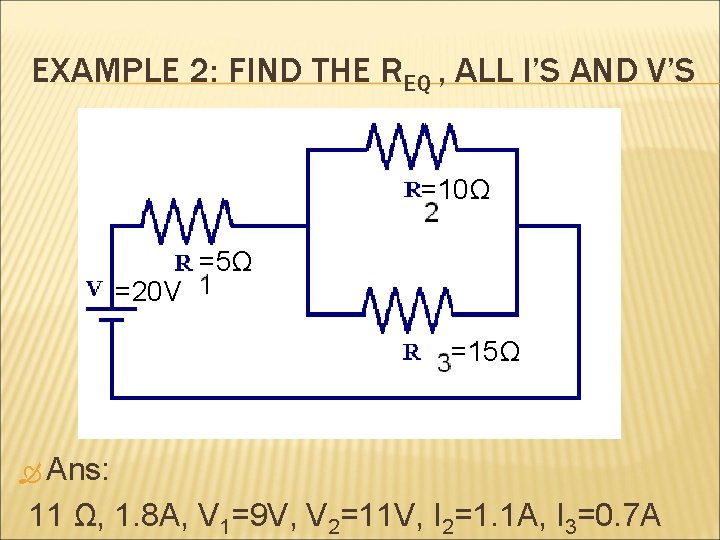
EXAMPLE 2: FIND THE REQ , ALL I’S AND V’S =10Ω =20 V =5Ω =15Ω Ans: 11 Ω, 1. 8 A, V 1=9 V, V 2=11 V, I 2=1. 1 A, I 3=0. 7 A
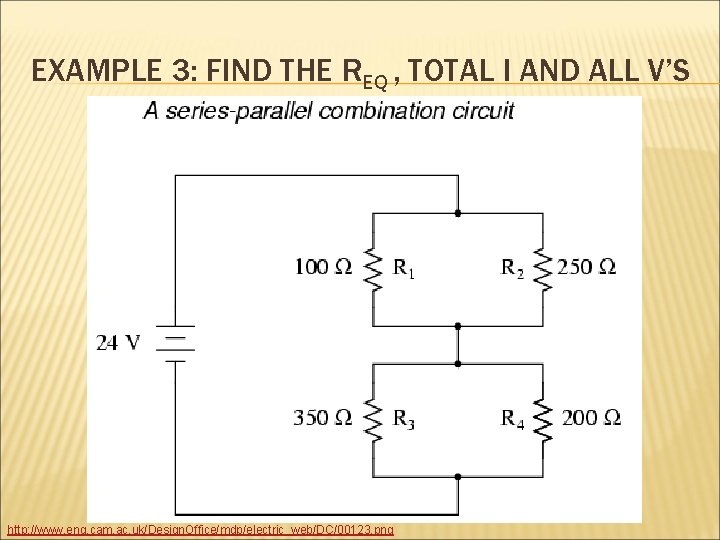
EXAMPLE 3: FIND THE REQ , TOTAL I AND ALL V’S http: //www. eng. cam. ac. uk/Design. Office/mdp/electric_web/DC/00123. png
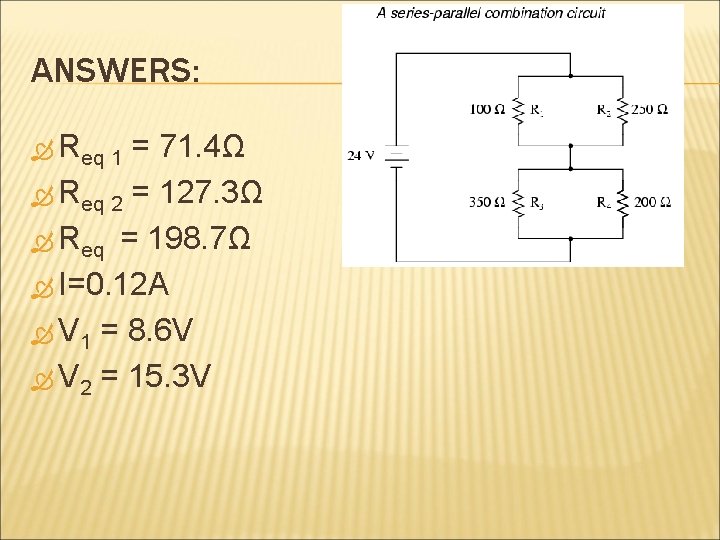
ANSWERS: Req 1 = 71. 4Ω Req 2 = 127. 3Ω Req = 198. 7Ω I=0. 12 A V 1 = 8. 6 V V 2 = 15. 3 V