
SERC Science Education Resource Center Overview and Update




- Slides: 44
SERC: Science Education Resource Center Overview and Update Cathy Manduca, Carleton College January 12, 2018
Using the power of community action and the web to improve • Learning about the Earth • Higher Education
What SERC Does • Professional development workshops – unique in our approach to community sharing and use of web • Web site development and hosting services – Serckit • Evaluate programs and materials • Support networks and communities of transformation- robust technical platform and tested practices for management, meetings and information sharing • Community leadership and organizational support
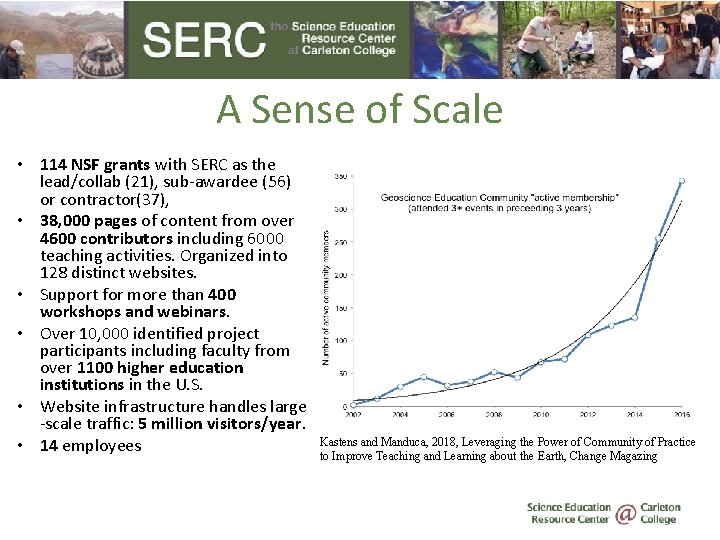
A Sense of Scale • 114 NSF grants with SERC as the lead/collab (21), sub-awardee (56) or contractor(37), • 38, 000 pages of content from over 4600 contributors including 6000 teaching activities. Organized into 128 distinct websites. • Support for more than 400 workshops and webinars. • Over 10, 000 identified project participants including faculty from over 1100 higher education institutions in the U. S. • Website infrastructure handles large -scale traffic: 5 million visitors/year. • 14 employees Kastens and Manduca, 2018, Leveraging the Power of Community of Practice to Improve Teaching and Learning about the Earth, Change Magazing
Current Foci • Integrating learning about geoscience and Societal Issues • Fostering inclusive teaching and student success • Supporting networks/communities of transformation/practice • Research and evaluation – community change, effective practices, broadening participation • Sustaining quality programs and resources
Current Foci • Integrating learning about geoscience and Societal Issues • Fostering inclusive teaching and student success • Supporting networks/communities of transformation/practice • Research and evaluation – community change, effective practices, broadening participation • Sustaining quality programs and resources
Integrating learning about geoscience and Societal Issues Why is this a priority? - Broadening participation in geoscience - Developing a workforce for wicked problems - Creating the capacity to use geoscience for societal good - Developing scientifically literate communities
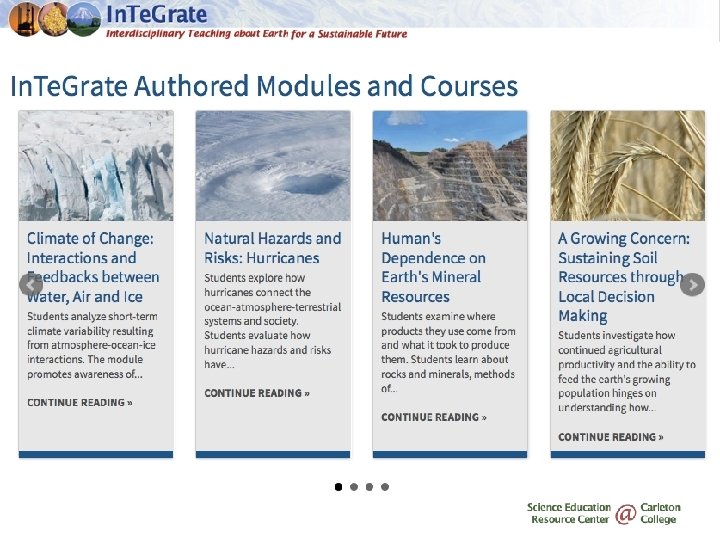
In. Te. Grate supports integrated interdisciplinary learning about resource and environmental issues across the undergraduate curriculum to create a sustainable and just civilization. A five-year community effort to improve Earth literacy and build a workforce prepared to tackle environmental and resource issues An NSF STEP Center
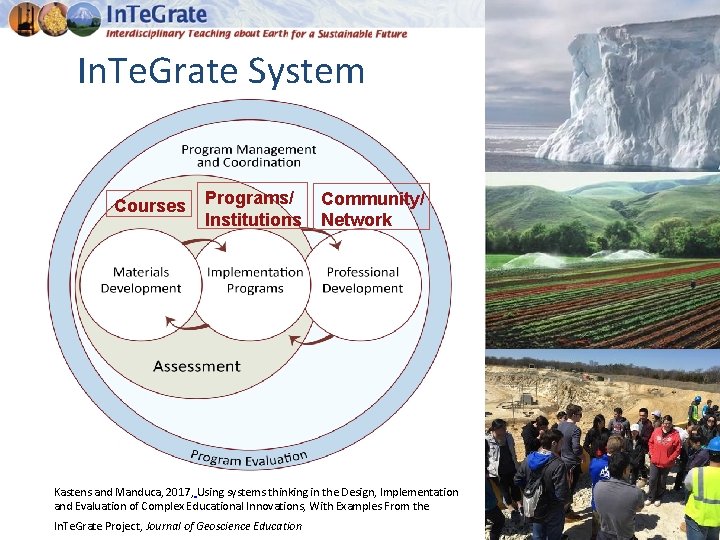
In. Te. Grate System Courses Programs/ Institutions Community/ Network Kastens and Manduca, 2017, Using systems thinking in the Design, Implementation and Evaluation of Complex Educational Innovations, With Examples From the In. Te. Grate Project, Journal of Geoscience Education
Materials development: • Modules or full courses • Developed by 3 -4 person faculty teams • Each team member must be from a different institution • Each team member must commit to testing the material • Chosen from proposal writers • Receive stipend
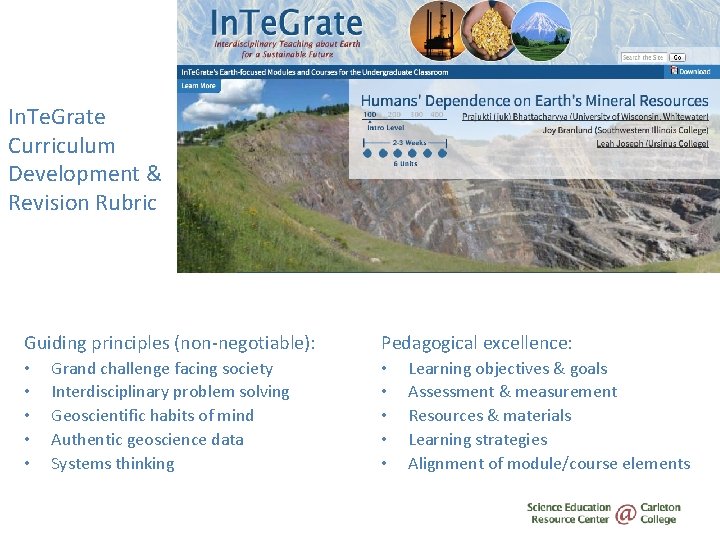
In. Te. Grate Curriculum Development & Revision Rubric Guiding principles (non-negotiable): • • • Grand challenge facing society Interdisciplinary problem solving Geoscientific habits of mind Authentic geoscience data Systems thinking Pedagogical excellence: • • • Learning objectives & goals Assessment & measurement Resources & materials Learning strategies Alignment of module/course elements
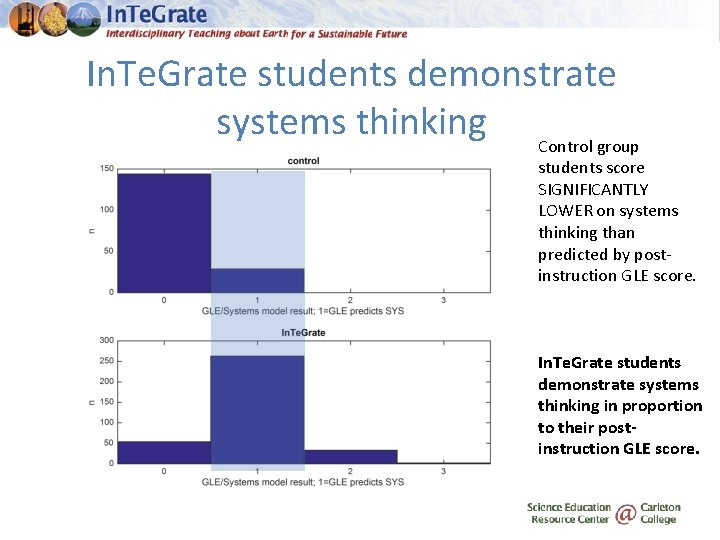
In. Te. Grate students demonstrate systems thinking Control group students score SIGNIFICANTLY LOWER on systems thinking than predicted by postinstruction GLE score. In. Te. Grate students demonstrate systems thinking in proportion to their postinstruction GLE score.
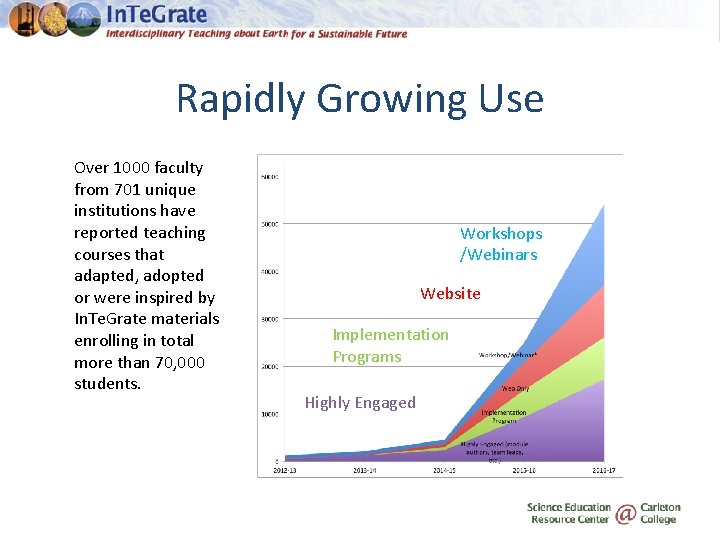
Rapidly Growing Use Over 1000 faculty from 701 unique institutions have reported teaching courses that adapted, adopted or were inspired by In. Te. Grate materials enrolling in total more than 70, 000 students. Workshops /Webinars Website Implementation Programs Highly Engaged
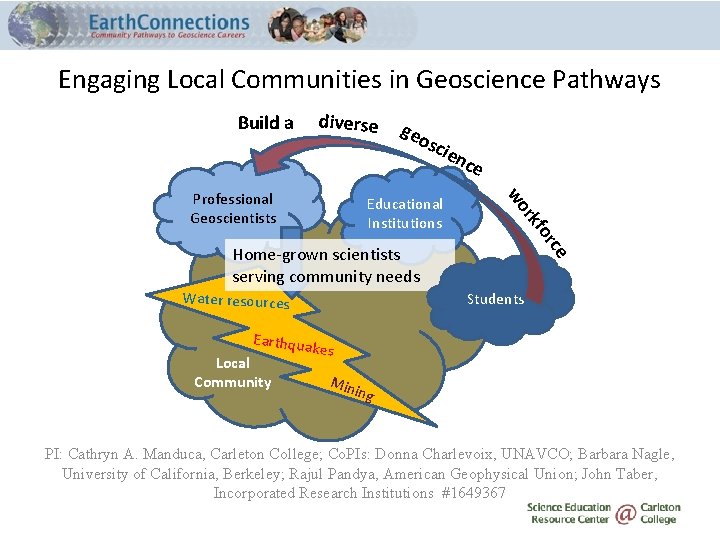
Engaging Local Communities in Geoscience Pathways diverse Build a cie r fo rk Educational Institutions nce wo Professional Geoscientists geo s Water resources ce Home-grown scientists serving community needs Students Earthqua Local Community kes Min ing PI: Cathryn A. Manduca, Carleton College; Co. PIs: Donna Charlevoix, UNAVCO; Barbara Nagle, University of California, Berkeley; Rajul Pandya, American Geophysical Union; John Taber, Incorporated Research Institutions #1649367
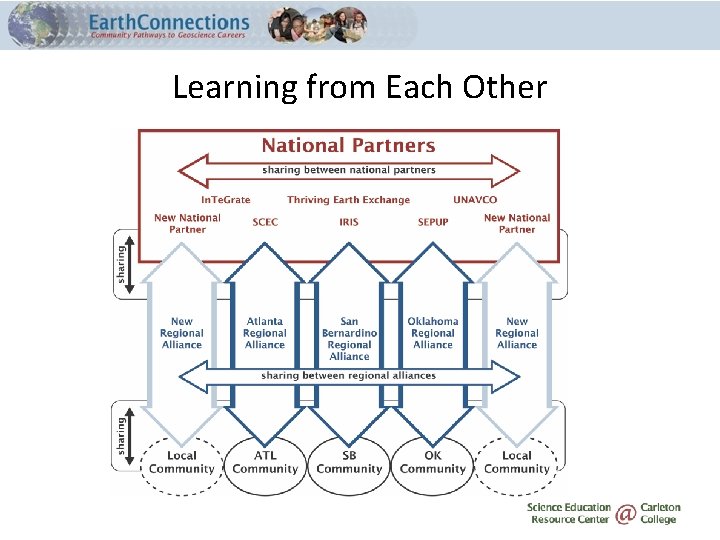
Learning from Each Other
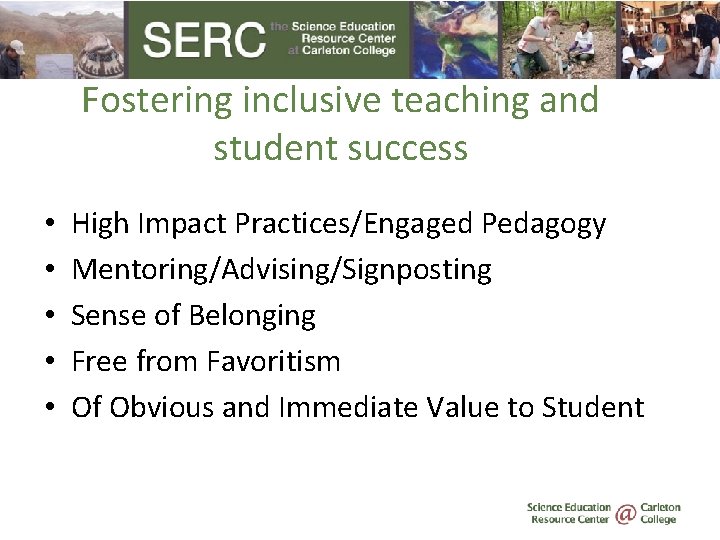
Fostering inclusive teaching and student success • • • High Impact Practices/Engaged Pedagogy Mentoring/Advising/Signposting Sense of Belonging Free from Favoritism Of Obvious and Immediate Value to Student
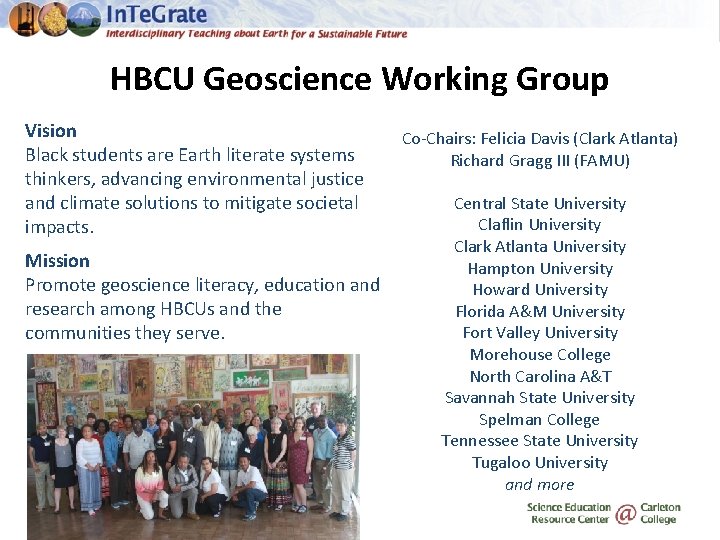
HBCU Geoscience Working Group Vision Black students are Earth literate systems thinkers, advancing environmental justice and climate solutions to mitigate societal impacts. Mission Promote geoscience literacy, education and research among HBCUs and the communities they serve. Co-Chairs: Felicia Davis (Clark Atlanta) Richard Gragg III (FAMU) Central State University Claflin University Clark Atlanta University Hampton University Howard University Florida A&M University Fort Valley University Morehouse College North Carolina A&T Savannah State University Spelman College Tennessee State University Tugaloo University and more
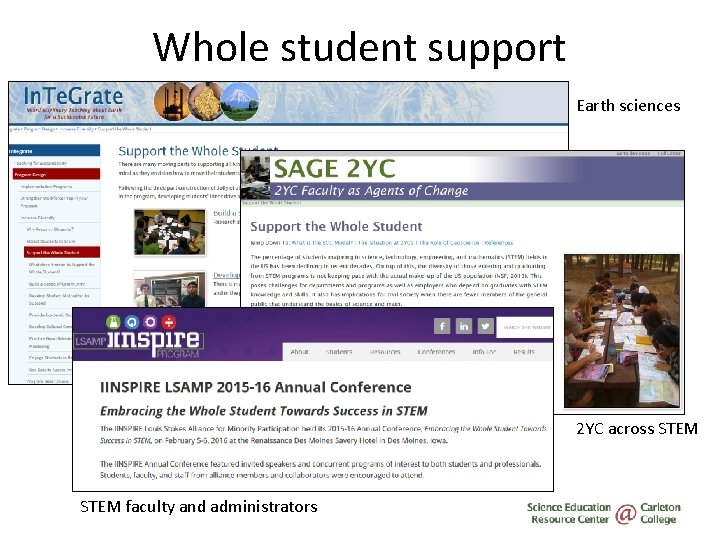
Whole student support Earth sciences 2 YC across STEM faculty and administrators
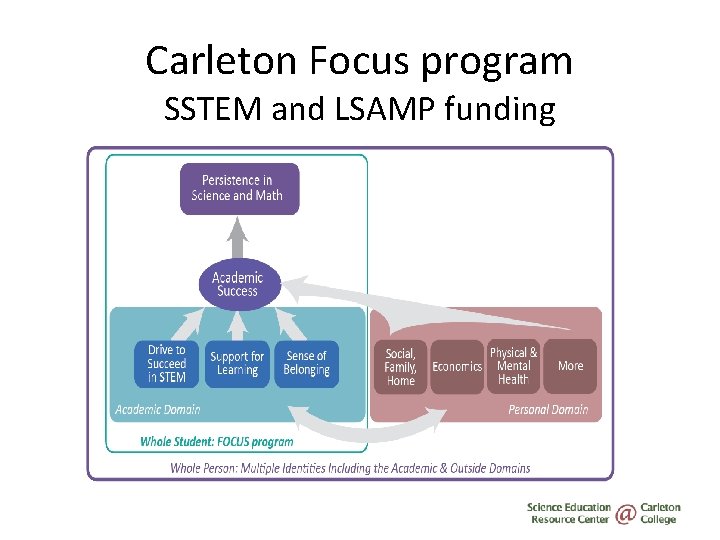
Carleton Focus program SSTEM and LSAMP funding
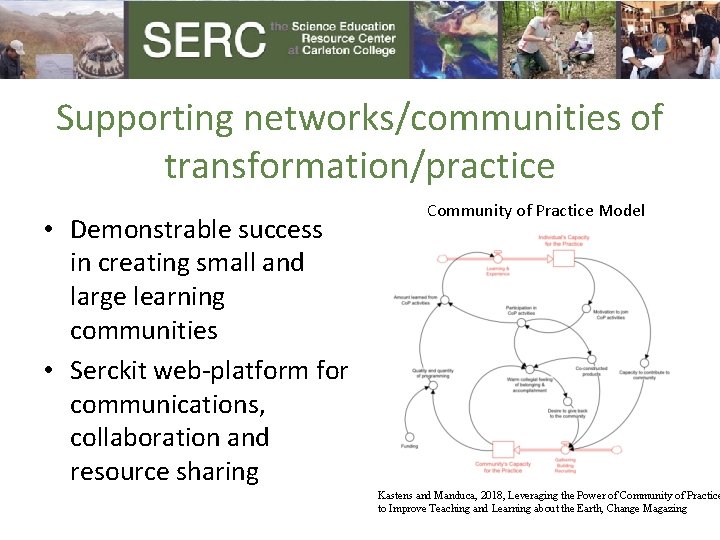
Supporting networks/communities of transformation/practice • Demonstrable success in creating small and large learning communities • Serckit web-platform for communications, collaboration and resource sharing Community of Practice Model Kastens and Manduca, 2018, Leveraging the Power of Community of Practice to Improve Teaching and Learning about the Earth, Change Magazing
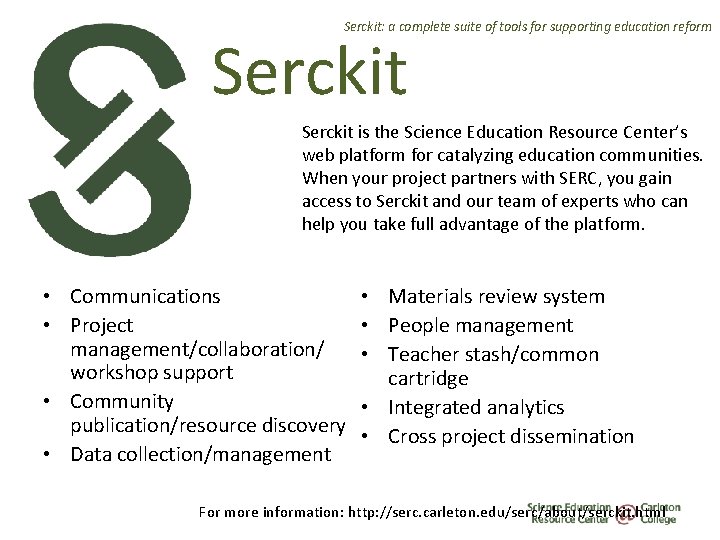
Serckit: a complete suite of tools for supporting education reform Serckit is the Science Education Resource Center’s web platform for catalyzing education communities. When your project partners with SERC, you gain access to Serckit and our team of experts who can help you take full advantage of the platform. • Communications • Project management/collaboration/ workshop support • Community publication/resource discovery • Data collection/management • Materials review system • People management • Teacher stash/common cartridge • Integrated analytics • Cross project dissemination For more information: http: //serc. carleton. edu/serc/about/serckit. html
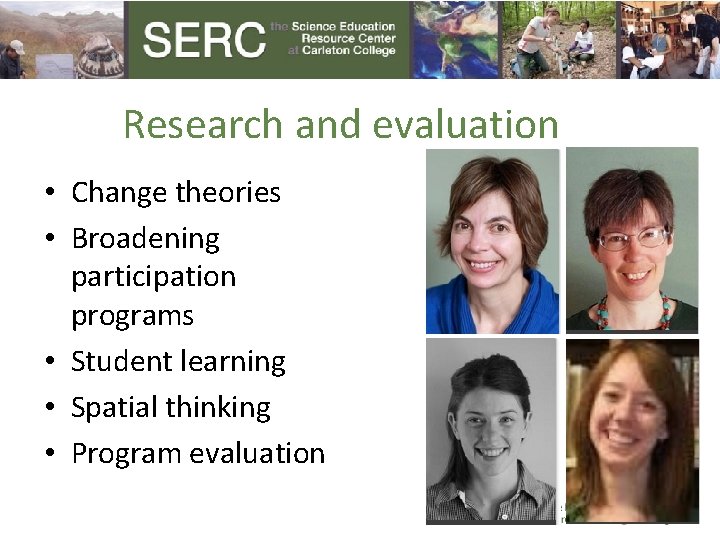
Research and evaluation • Change theories • Broadening participation programs • Student learning • Spatial thinking • Program evaluation
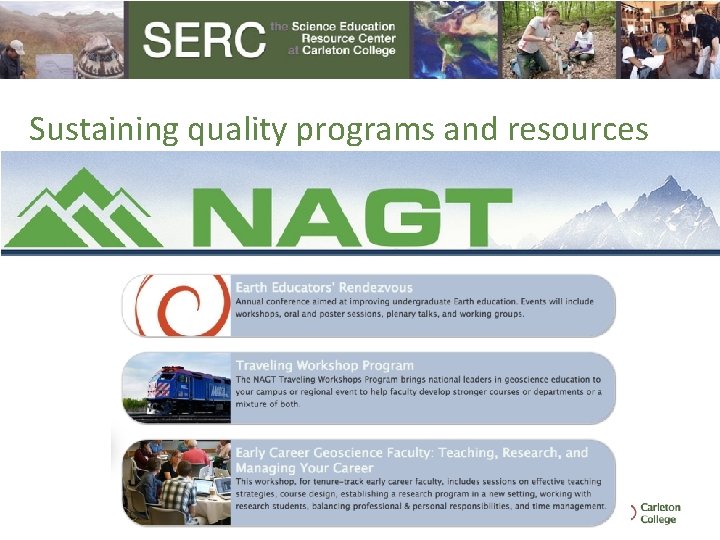
Sustaining quality programs and resources
Current Foci • Integrating learning about geoscience and Societal Issues • Fostering inclusive teaching and student success • Supporting networks/communities of transformation/practice • Research and evaluation – community change, effective practices, broadening participation • Sustaining quality programs and resources
Extra slides beyond this point
$ 3 000 SERC NSF funding 2002 -2017 $ 2 500 000 $ 2 000 $ 1 500 000 $ 1 000 $ 500 000 $- 2002 2003 2004 2005 2006 2007 2008 2009 2010 2011 2012 2013 2014 2015 2016 2017
Across Disciplines In. Te. Grate's reach extends beyond the geosciences, making it a valuable resource to build understanding and buy in across departments and majors and providing the interdisciplinary perspective needed to tackle sustainability-related issues.
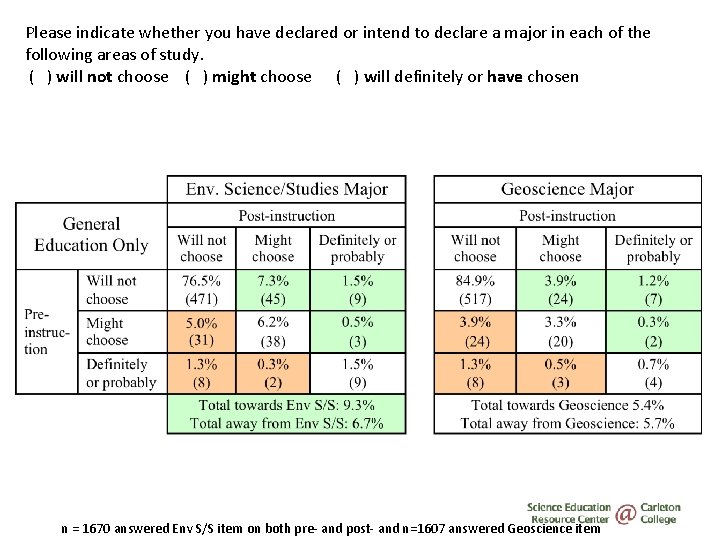
Please indicate whether you have declared or intend to declare a major in each of the following areas of study. ( ) will not choose ( ) might choose ( ) will definitely or have chosen n = 1670 answered Env S/S item on both pre- and post- and n=1607 answered Geoscience item
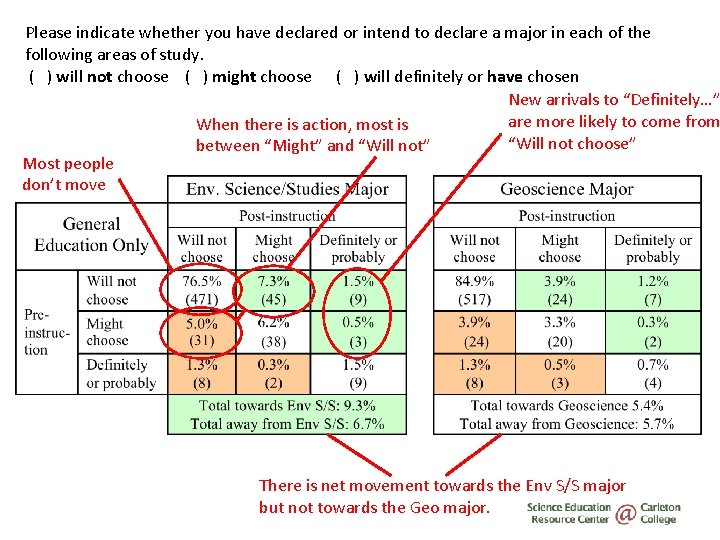
Please indicate whether you have declared or intend to declare a major in each of the following areas of study. ( ) will not choose ( ) might choose ( ) will definitely or have chosen New arrivals to “Definitely…” are more likely to come from When there is action, most is “Will not choose” between “Might” and “Will not” Most people don’t move There is net movement towards the Env S/S major but not towards the Geo major.
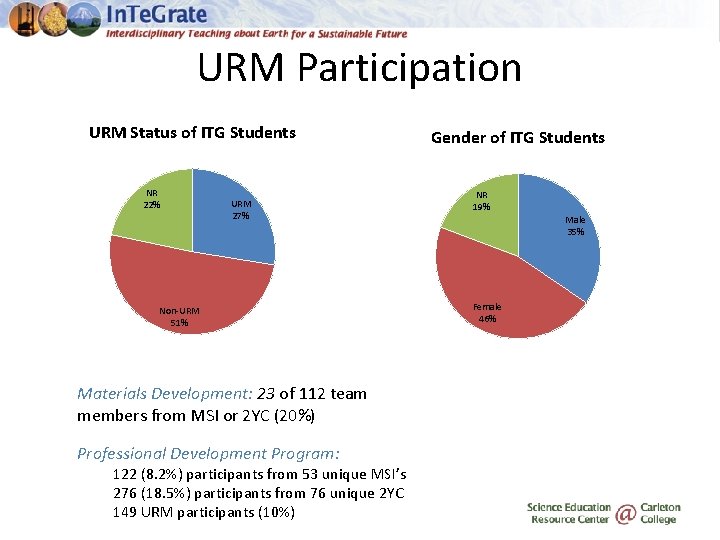
URM Participation URM Status of ITG Students NR 22% URM 27% Non-URM 51% Materials Development: 23 of 112 team members from MSI or 2 YC (20%) Professional Development Program: 122 (8. 2%) participants from 53 unique MSI’s 276 (18. 5%) participants from 76 unique 2 YC 149 URM participants (10%) Gender of ITG Students NR 19% Male 35% Female 46%
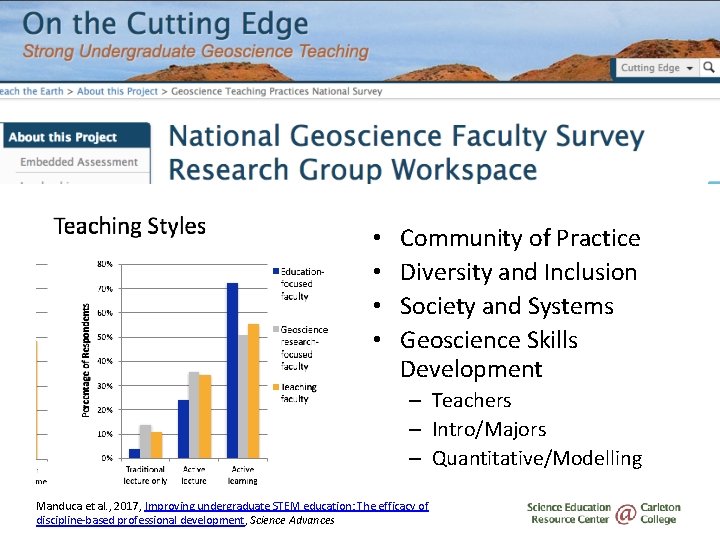
• • Community of Practice Diversity and Inclusion Society and Systems Geoscience Skills Development – Teachers – Intro/Majors – Quantitative/Modelling Manduca et al. , 2017, Improving undergraduate STEM education: The efficacy of discipline-based professional development, Science Advances
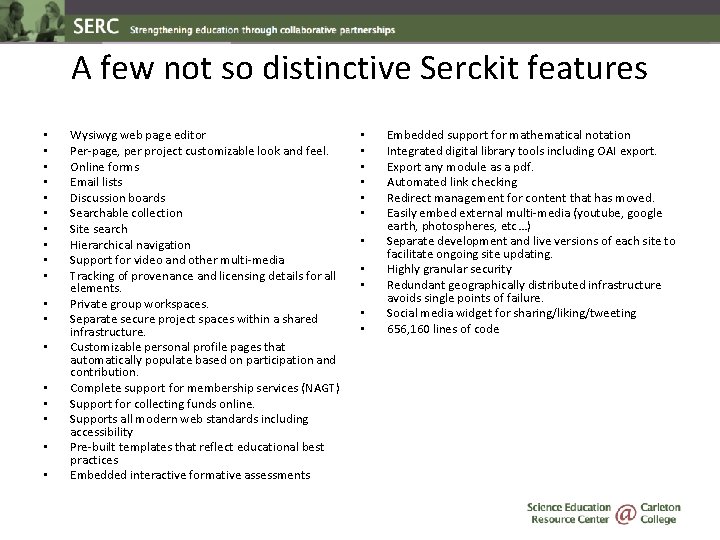
A few not so distinctive Serckit features • • • • • Wysiwyg web page editor Per-page, per project customizable look and feel. Online forms Email lists Discussion boards Searchable collection Site search Hierarchical navigation Support for video and other multi-media Tracking of provenance and licensing details for all elements. Private group workspaces. Separate secure project spaces within a shared infrastructure. Customizable personal profile pages that automatically populate based on participation and contribution. Complete support for membership services (NAGT) Support for collecting funds online. Supports all modern web standards including accessibility Pre-built templates that reflect educational best practices Embedded interactive formative assessments • • • Embedded support for mathematical notation Integrated digital library tools including OAI export. Export any module as a pdf. Automated link checking Redirect management for content that has moved. Easily embed external multi-media (youtube, google earth, photospheres, etc…) Separate development and live versions of each site to facilitate ongoing site updating. Highly granular security Redundant geographically distributed infrastructure avoids single points of failure. Social media widget for sharing/liking/tweeting 656, 160 lines of code
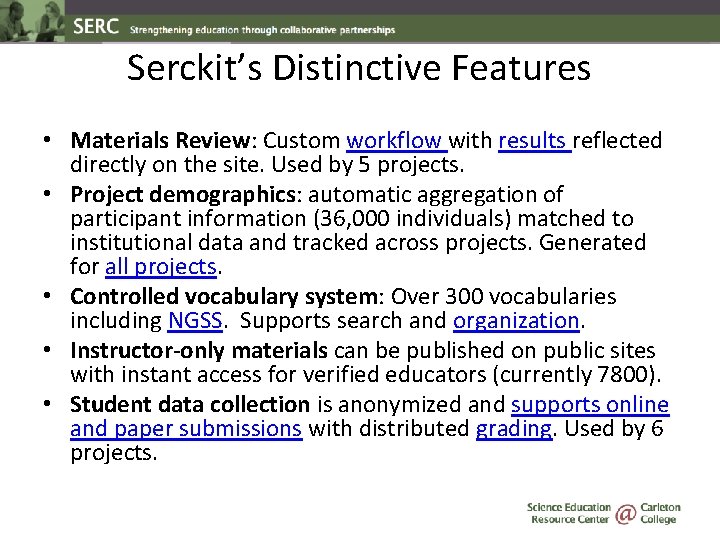
Serckit’s Distinctive Features • Materials Review: Custom workflow with results reflected directly on the site. Used by 5 projects. • Project demographics: automatic aggregation of participant information (36, 000 individuals) matched to institutional data and tracked across projects. Generated for all projects. • Controlled vocabulary system: Over 300 vocabularies including NGSS. Supports search and organization. • Instructor-only materials can be published on public sites with instant access for verified educators (currently 7800). • Student data collection is anonymized and supports online and paper submissions with distributed grading. Used by 6 projects.
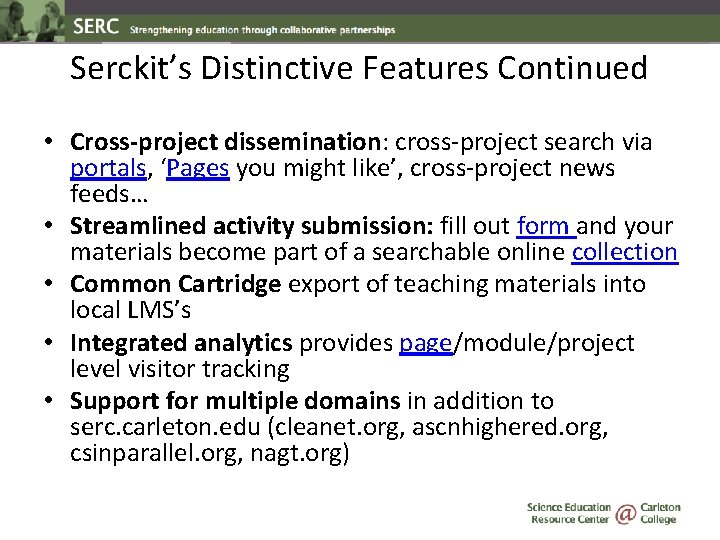
Serckit’s Distinctive Features Continued • Cross-project dissemination: cross-project search via portals, ‘Pages you might like’, cross-project news feeds… • Streamlined activity submission: fill out form and your materials become part of a searchable online collection • Common Cartridge export of teaching materials into local LMS’s • Integrated analytics provides page/module/project level visitor tracking • Support for multiple domains in addition to serc. carleton. edu (cleanet. org, ascnhighered. org, csinparallel. org, nagt. org)
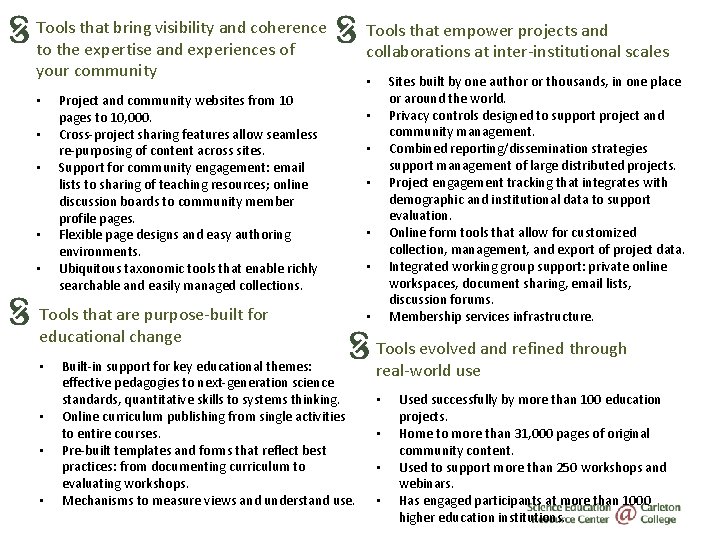
Tools that bring visibility and coherence to the expertise and experiences of your community • • • Project and community websites from 10 pages to 10, 000. Cross-project sharing features allow seamless re-purposing of content across sites. Support for community engagement: email lists to sharing of teaching resources; online discussion boards to community member profile pages. Flexible page designs and easy authoring environments. Ubiquitous taxonomic tools that enable richly searchable and easily managed collections. Tools that are purpose-built for educational change • • Built-in support for key educational themes: effective pedagogies to next-generation science standards, quantitative skills to systems thinking. Online curriculum publishing from single activities to entire courses. Pre-built templates and forms that reflect best practices: from documenting curriculum to evaluating workshops. Mechanisms to measure views and understand use. Tools that empower projects and collaborations at inter-institutional scales Sites built by one author or thousands, in one place or around the world. Privacy controls designed to support project and community management. Combined reporting/dissemination strategies support management of large distributed projects. Project engagement tracking that integrates with demographic and institutional data to support evaluation. Online form tools that allow for customized collection, management, and export of project data. Integrated working group support: private online workspaces, document sharing, email lists, discussion forums. Membership services infrastructure. • • Tools evolved and refined through real-world use • • Used successfully by more than 100 education projects. Home to more than 31, 000 pages of original community content. Used to support more than 250 workshops and webinars. Has engaged participants at more than 1000 higher education institutions.
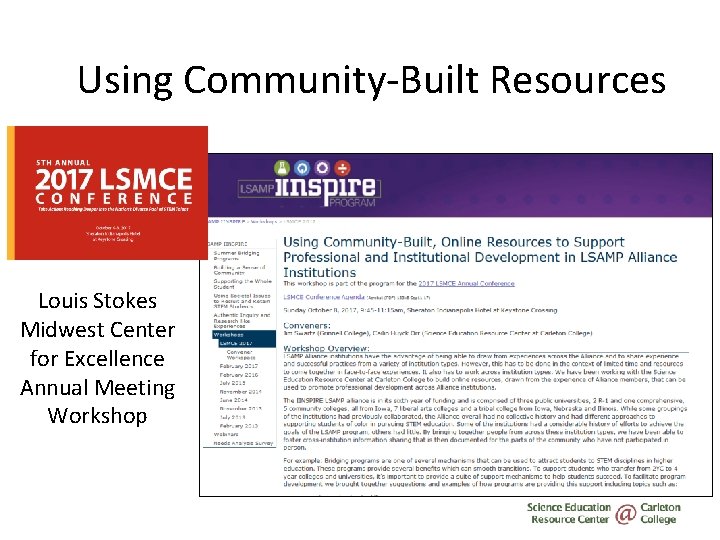
Using Community-Built Resources Louis Stokes Midwest Center for Excellence Annual Meeting Workshop
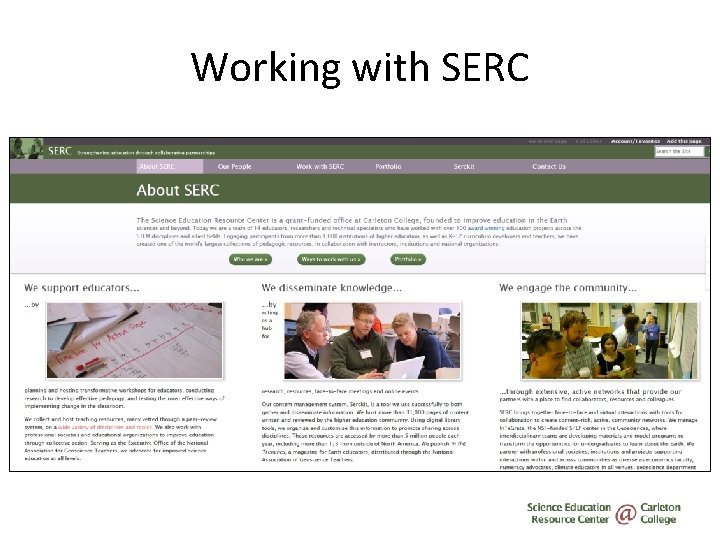
Working with SERC
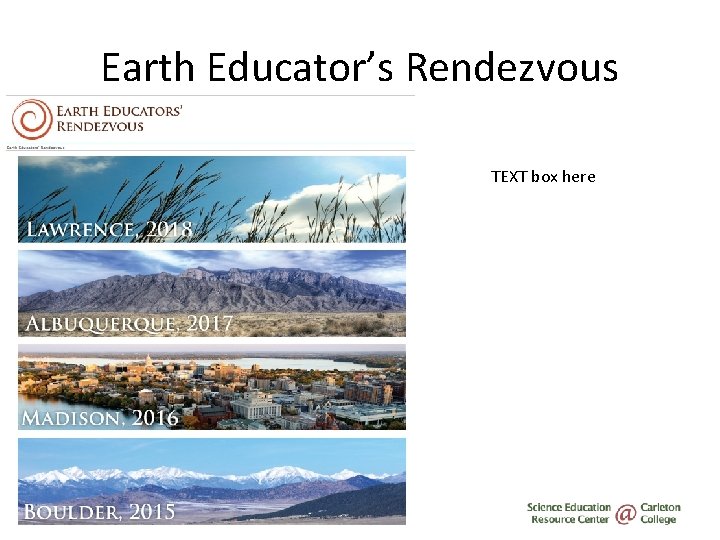
Earth Educator’s Rendezvous TEXT box here