
Sequential Logic Design CT 101 Computing Systems Organization
- Slides: 28
Sequential Logic Design CT 101 – Computing Systems Organization
Contents • Basic Sequential Components – Flip. Flop, Latches, Counters • Programmable Logic Devices – PLD, PLA, CPLDs & FPGAs • Finite State Machine Model – Generic Model – Synchronous Model – Mealy & More FSMs
Overview • The most fundamental sequential components are the latch and flip-flop • They store one bit of data and make it available to other components • The main difference between a latch and a flip-flop is that the first are level triggered and the latter are edge triggered • Flip-flops and latches have a clock input
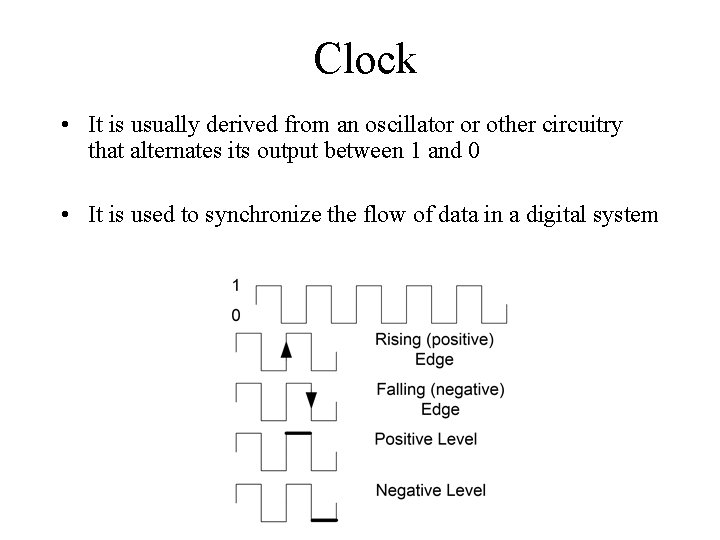
Clock • It is usually derived from an oscillator or other circuitry that alternates its output between 1 and 0 • It is used to synchronize the flow of data in a digital system
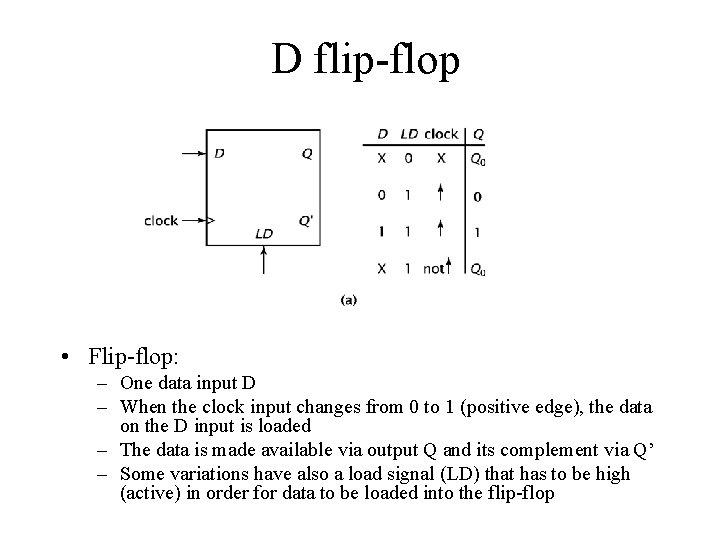
D flip-flop • Flip-flop: – One data input D – When the clock input changes from 0 to 1 (positive edge), the data on the D input is loaded – The data is made available via output Q and its complement via Q’ – Some variations have also a load signal (LD) that has to be high (active) in order for data to be loaded into the flip-flop
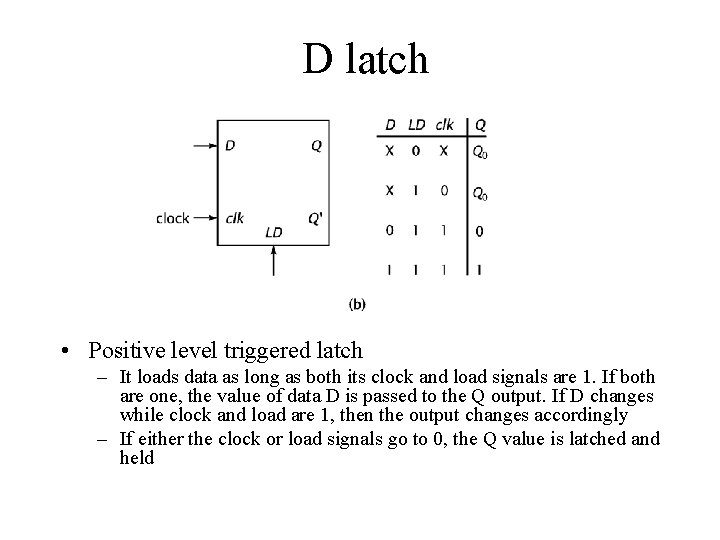
D latch • Positive level triggered latch – It loads data as long as both its clock and load signals are 1. If both are one, the value of data D is passed to the Q output. If D changes while clock and load are 1, then the output changes accordingly – If either the clock or load signals go to 0, the Q value is latched and held
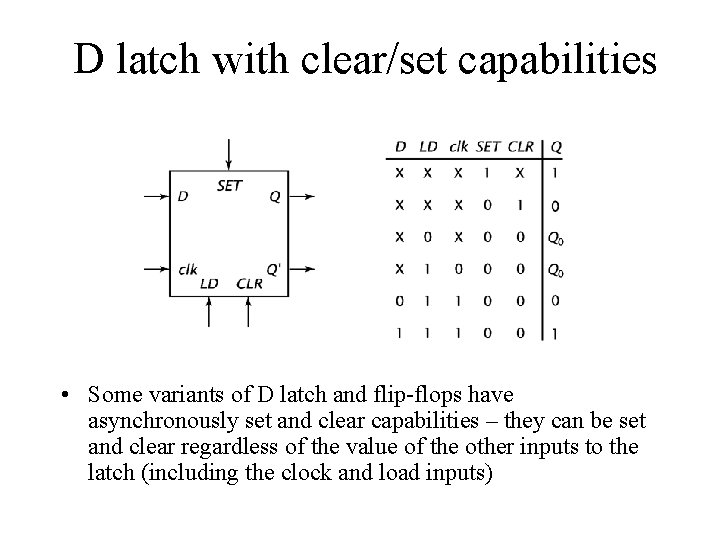
D latch with clear/set capabilities • Some variants of D latch and flip-flops have asynchronously set and clear capabilities – they can be set and clear regardless of the value of the other inputs to the latch (including the clock and load inputs)
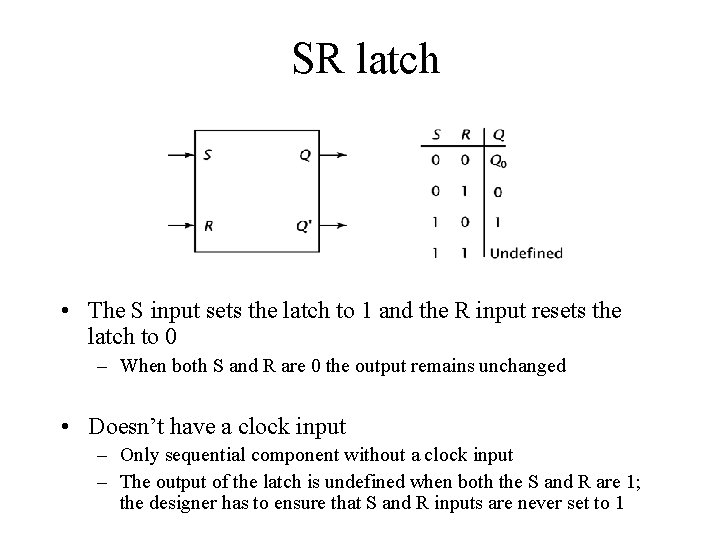
SR latch • The S input sets the latch to 1 and the R input resets the latch to 0 – When both S and R are 0 the output remains unchanged • Doesn’t have a clock input – Only sequential component without a clock input – The output of the latch is undefined when both the S and R are 1; the designer has to ensure that S and R inputs are never set to 1
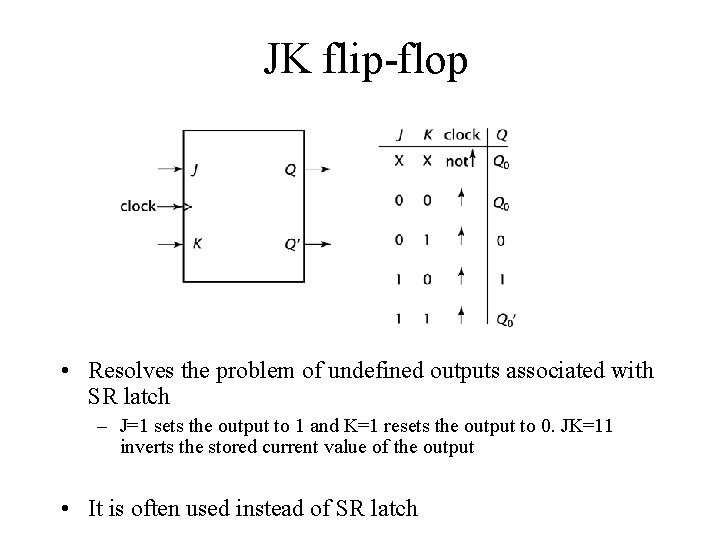
JK flip-flop • Resolves the problem of undefined outputs associated with SR latch – J=1 sets the output to 1 and K=1 resets the output to 0. JK=11 inverts the stored current value of the output • It is often used instead of SR latch
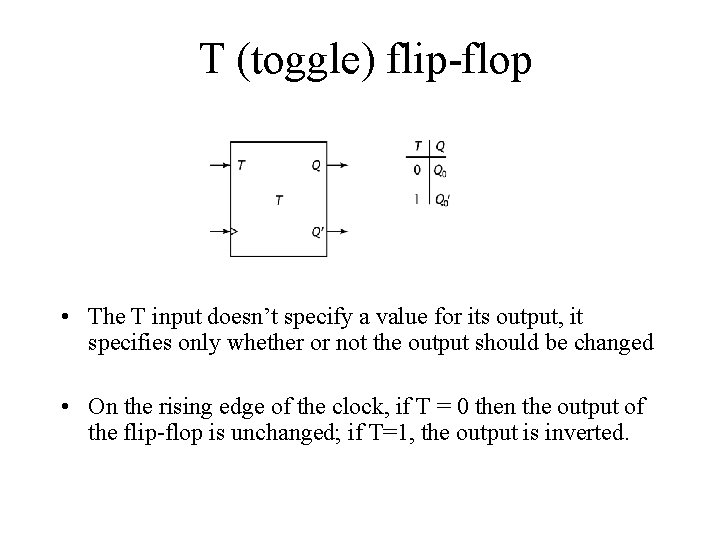
T (toggle) flip-flop • The T input doesn’t specify a value for its output, it specifies only whether or not the output should be changed • On the rising edge of the clock, if T = 0 then the output of the flip-flop is unchanged; if T=1, the output is inverted.
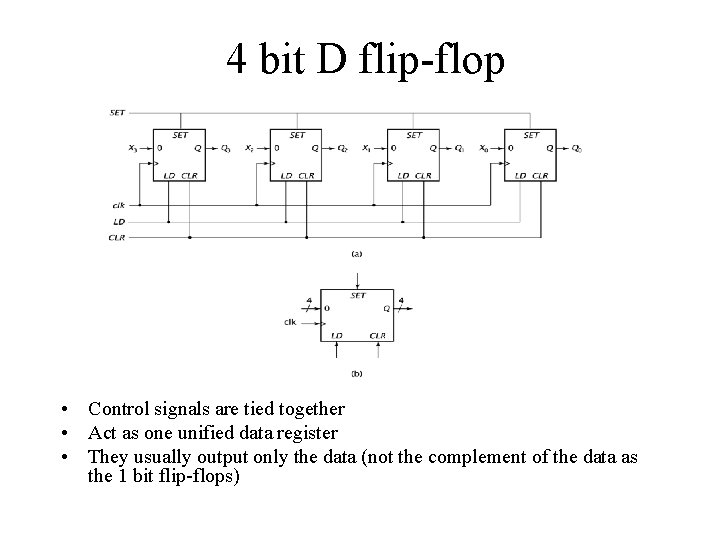
Observations • All of the flip-flops and latches shown so far are positive edge triggered or positive level triggered. They also have active high load, set and clear inputs. • It is possible for those components to be negative edge triggered or negative level triggered and have active low control signals as well. • Flips-flops and latches can be combined in parallel to store data with more than one bit
4 bit D flip-flop • Control signals are tied together • Act as one unified data register • They usually output only the data (not the complement of the data as the 1 bit flip-flops)
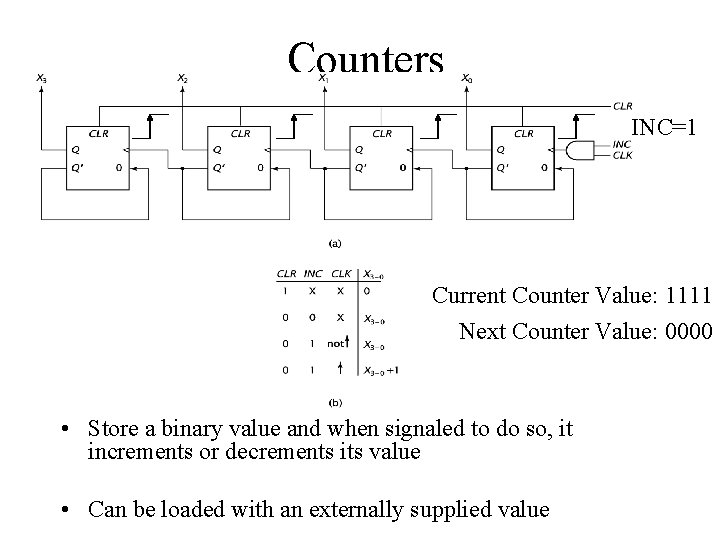
Counters INC=1 Current Counter Value: 1111 Next Counter Value: 0000 • Store a binary value and when signaled to do so, it increments or decrements its value • Can be loaded with an externally supplied value
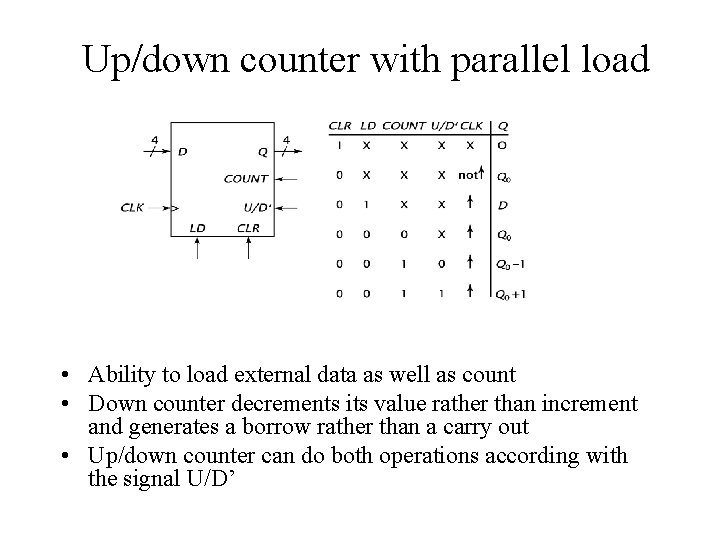
Up/down counter with parallel load • Ability to load external data as well as count • Down counter decrements its value rather than increment and generates a borrow rather than a carry out • Up/down counter can do both operations according with the signal U/D’
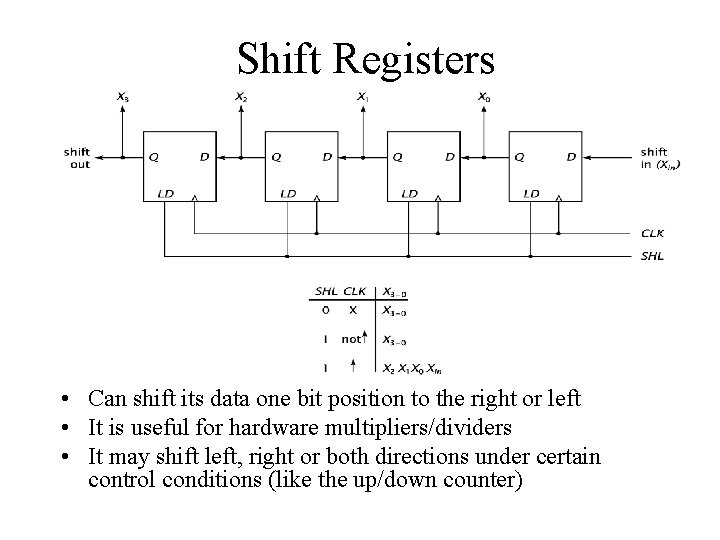
Shift Registers • Can shift its data one bit position to the right or left • It is useful for hardware multipliers/dividers • It may shift left, right or both directions under certain control conditions (like the up/down counter)
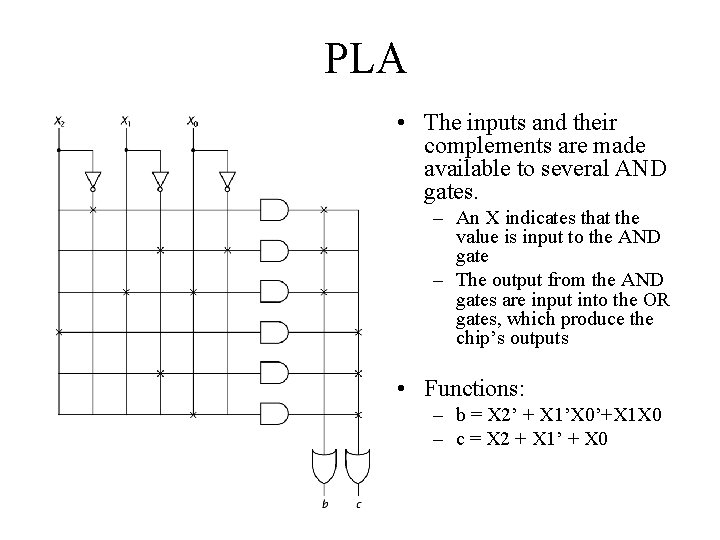
Programmable Logic Devices • Most of the circuits presented so far are available on a TTL IC chip. Circuits can be constructed using these chips and wiring them together • An alternative to this method would be to program all the components into a single chip, saving wiring, space and power • One type of such device is PLA (Programmable Logic Array) that contains one or more and/or arrays.
PLA • The inputs and their complements are made available to several AND gates. – An X indicates that the value is input to the AND gate – The output from the AND gates are input into the OR gates, which produce the chip’s outputs • Functions: – b = X 2’ + X 1’X 0’+X 1 X 0 – c = X 2 + X 1’ + X 0
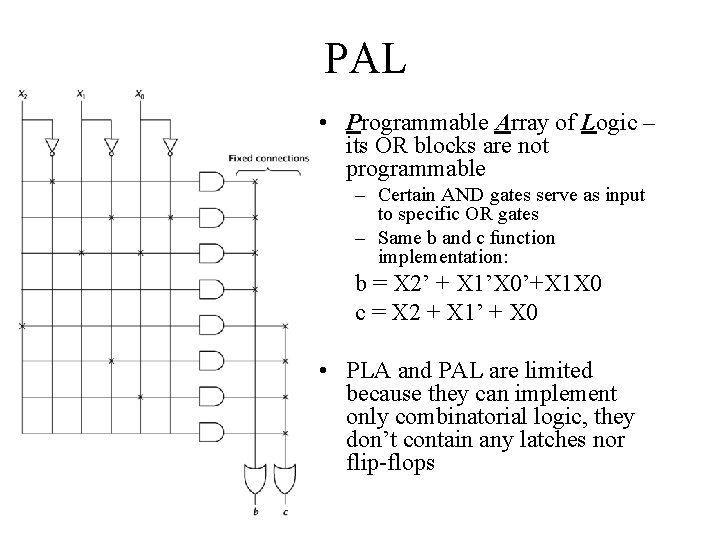
PAL • Programmable Array of Logic – its OR blocks are not programmable – Certain AND gates serve as input to specific OR gates – Same b and c function implementation: b = X 2’ + X 1’X 0’+X 1 X 0 c = X 2 + X 1’ + X 0 • PLA and PAL are limited because they can implement only combinatorial logic, they don’t contain any latches nor flip-flops
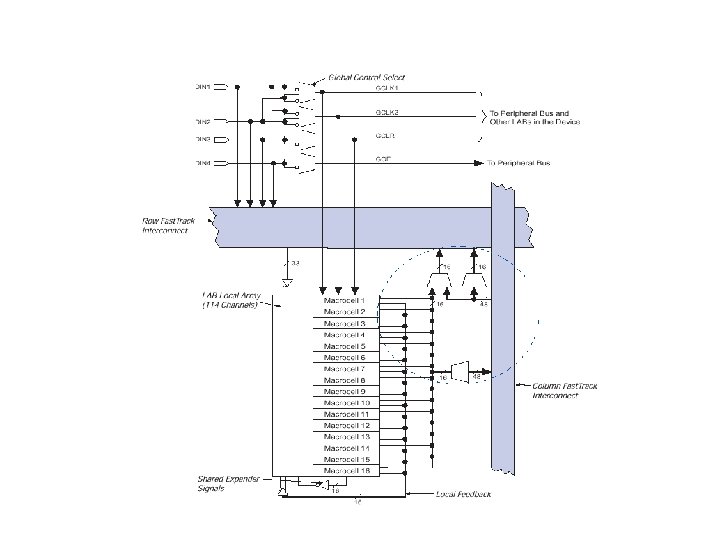
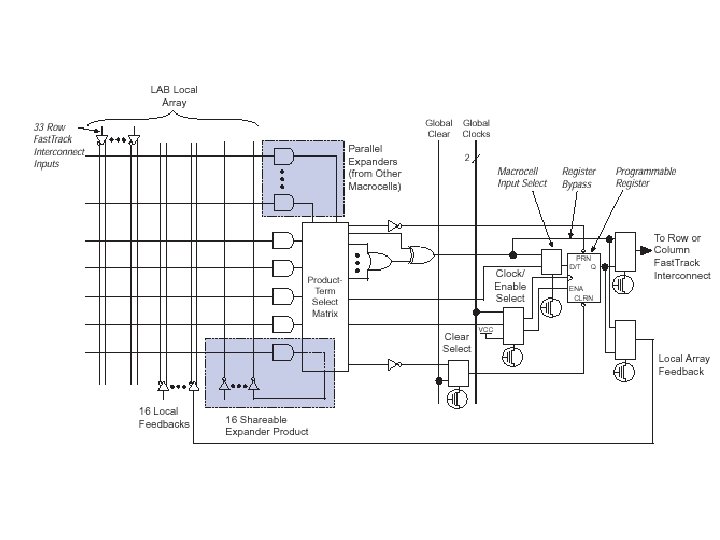
PLD • Programmable Logic Device is a more complex component that is needed to realize sequential circuits • It is usually made up of logic blocks with the possibility to interconnect them. • Each logic bloc is made out of macro cells, that may be equivalent to a PAL with an output flip-flop • The input/output pins of an PLD can be configured to the desired function (unlike for PLA or PAL, where they are fixed) • Used in more complex design than the PAL or PLA
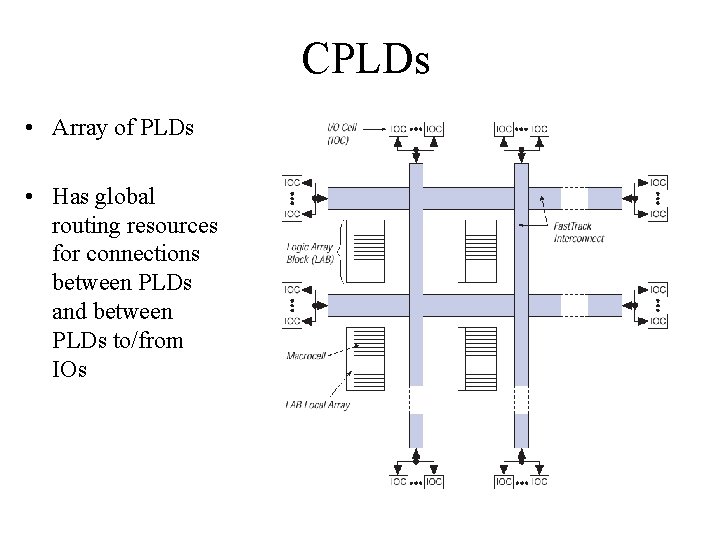
CPLDs • Array of PLDs • Has global routing resources for connections between PLDs and between PLDs to/from IOs
FPGAs • Field Programmable Gate Array is one of the most powerful and complex programmable circuit available • Contain an array of cells, each of which can be programmed to realize a function • There are programmable interconnects between the cells, allowing connect to each other • Includes flip-flops allowing the design and implementation of complex sequential circuit on a chip (of a complexity of a processor) • Often contains the equivalent of 100 k to a few million simple logic gates on a single chip
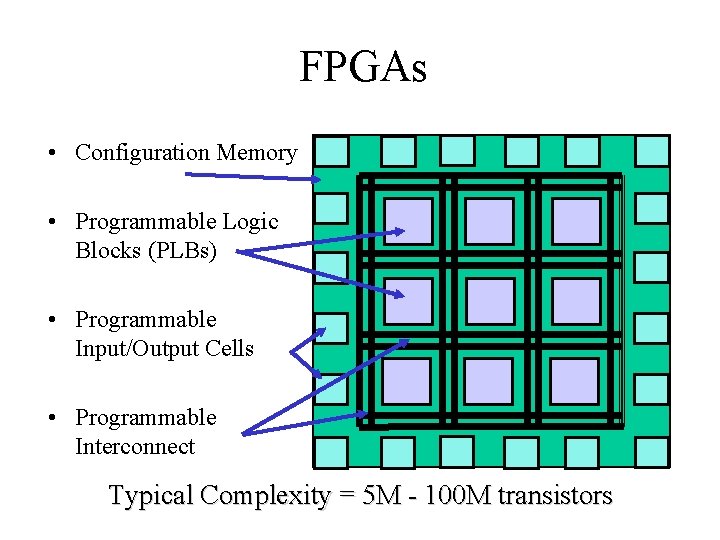
FPGAs • Configuration Memory • Programmable Logic Blocks (PLBs) • Programmable Input/Output Cells • Programmable Interconnect Typical Complexity = 5 M - 100 M transistors
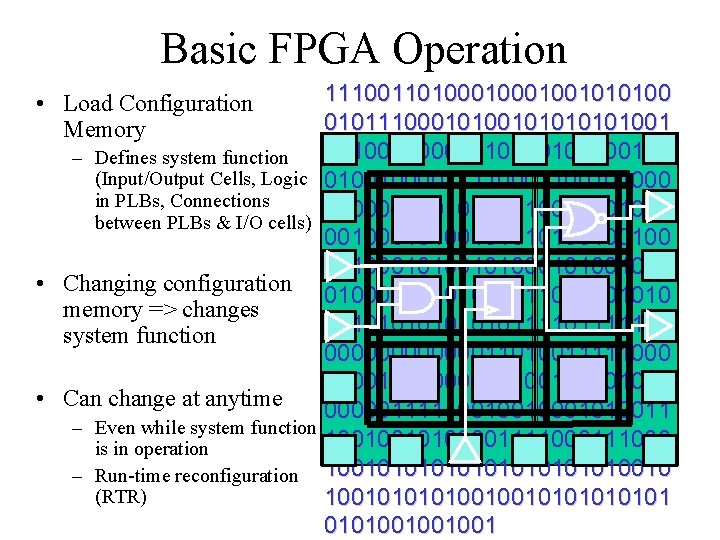
Basic FPGA Operation 1110011010001001010100 010111000101010101001 0010001010100100100110 – Defines system function (Input/Output Cells, Logic 01001000011110001100101000 in PLBs, Connections 1000011001010001001001 between PLBs & I/O cells) 001010010100100100 101000101001010 • Changing configuration 010010101011101010 memory => changes 101010101111100 system function 00000011010011111000 01001110000011100100101000 • Can change at anytime 0000011111001001010011 – Even while system function 10010010100001111000 is in operation – Run-time reconfiguration 1001010101010010 (RTR) 1001010010010101001001001 • Load Configuration Memory
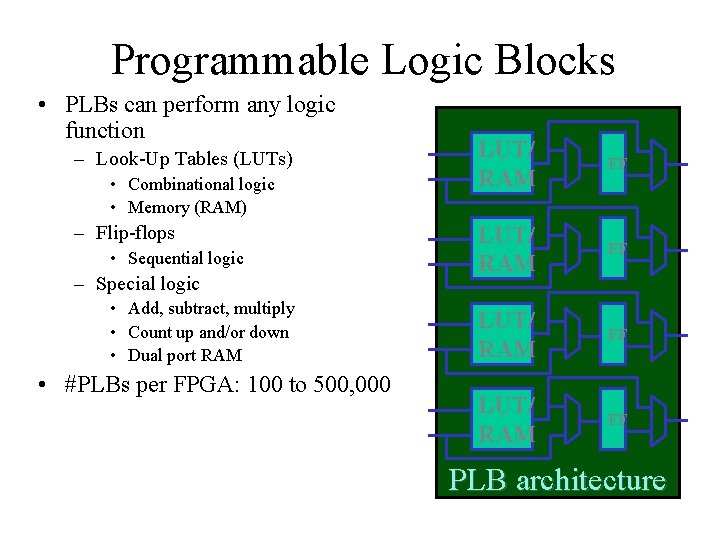
Programmable Logic Blocks • PLBs can perform any logic function – Look-Up Tables (LUTs) • Combinational logic • Memory (RAM) – Flip-flops • Sequential logic – Special logic • Add, subtract, multiply • Count up and/or down • Dual port RAM • #PLBs per FPGA: 100 to 500, 000 LUT/ RAM FF PLB architecture
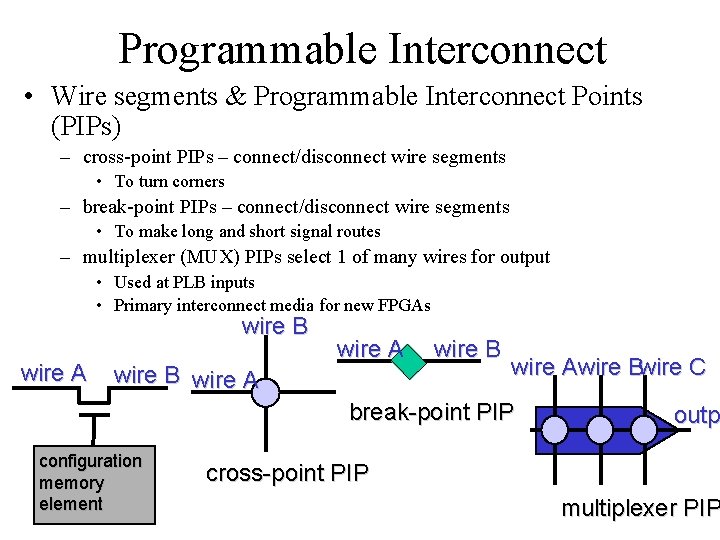
Programmable Interconnect • Wire segments & Programmable Interconnect Points (PIPs) – cross-point PIPs – connect/disconnect wire segments • To turn corners – break-point PIPs – connect/disconnect wire segments • To make long and short signal routes – multiplexer (MUX) PIPs select 1 of many wires for output • Used at PLB inputs • Primary interconnect media for new FPGAs wire B wire A wire B wire Awire Bwire C break-point PIP configuration memory element outp cross-point PIP multiplexer PIP
References • “Computer Systems Organization & Architecture”, John D. Carpinelli, ISBN: 0 -201 -61253 -4