
Sequential Circuit Design for Space borne and Critical
"Sequential Circuit Design for Space -borne and Critical Electronics" Dr. Rod L. Barto Spacecraft Digital Electronics Richard B. Katz NASA Goddard Space Flight Center Barto 1 A 4
Two Most Common Finite State Machine (FSM) Types • Binary: Smallest m (flip-flop count) with 2 m n (state count), highest encoding efficiency. – Or Gray Coded, a re-mapping of a binary FSM • One Hot: m = n, i. e. , one flip-flop per state, lowest encoding efficiency. – Or Modified One Hot: m = n-1 (one state represented by 0 vector). Issue: How To Protect FSMs Against Transient Errors (SEUs and MEUs): • Illegal State Detection • Adding Error Detection and Correction (EDAC) Circuitry Barto 2 A 4

Encoding Efficiency: Binary vs. One Hot Barto 3 A 4
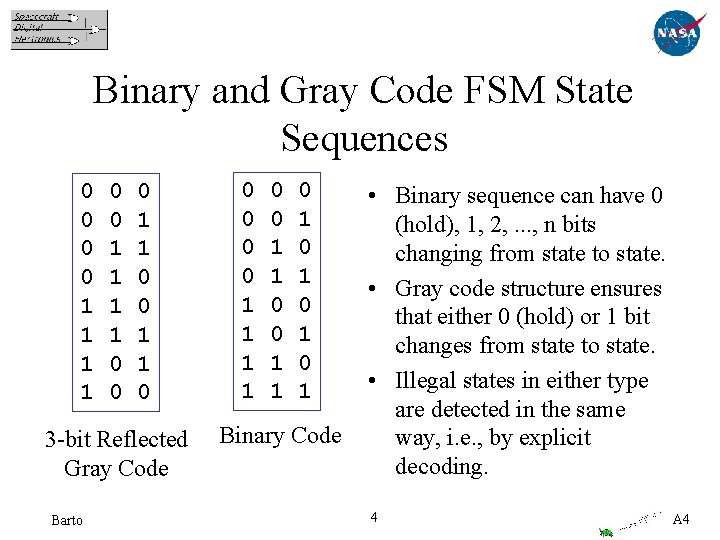
Binary and Gray Code FSM State Sequences 0 0 1 1 1 1 0 0 0 1 1 0 3 -bit Reflected Gray Code Barto 0 0 1 1 0 1 0 1 Binary Code • Binary sequence can have 0 (hold), 1, 2, . . . , n bits changing from state to state. • Gray code structure ensures that either 0 (hold) or 1 bit changes from state to state. • Illegal states in either type are detected in the same way, i. e. , by explicit decoding. 4 A 4
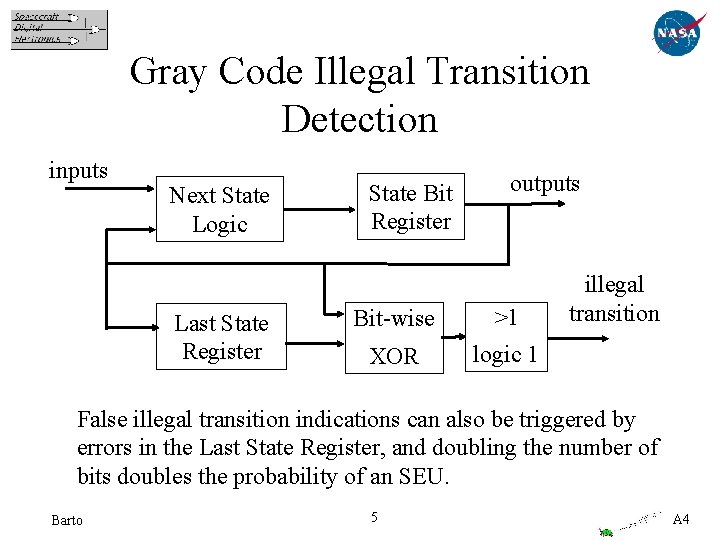
Gray Code Illegal Transition Detection inputs Next State Logic Last State Register State Bit Register outputs Bit-wise >1 XOR logic 1 illegal transition False illegal transition indications can also be triggered by errors in the Last State Register, and doubling the number of bits doubles the probability of an SEU. Barto 5 A 4
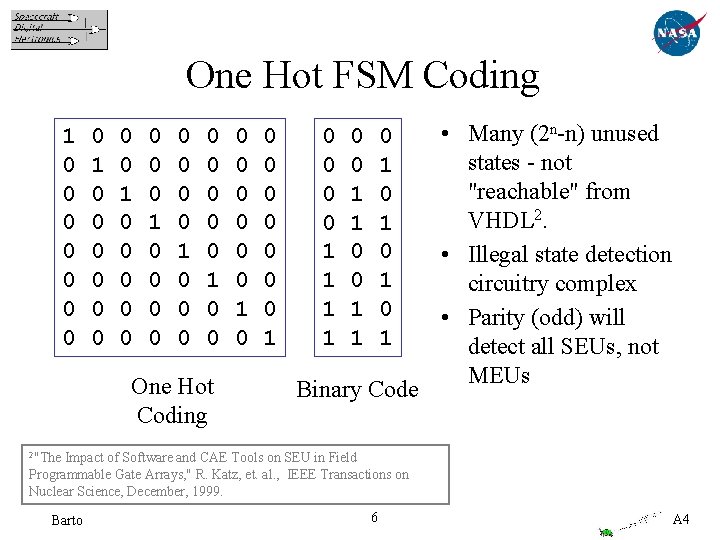
One Hot FSM Coding 1 0 0 0 0 0 0 0 0 1 0 0 0 0 1 0 0 One Hot Coding 0 0 0 1 0 0 0 0 1 1 0 1 0 1 Binary Code • Many (2 n-n) unused states - not "reachable" from VHDL 2. • Illegal state detection circuitry complex • Parity (odd) will detect all SEUs, not MEUs 2"The Impact of Software and CAE Tools on SEU in Field Programmable Gate Arrays, " R. Katz, et. al. , IEEE Transactions on Nuclear Science, December, 1999. Barto 6 A 4
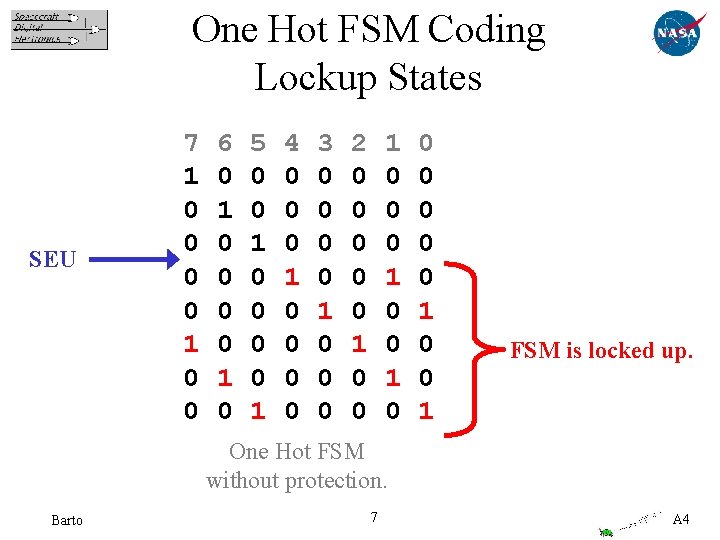
One Hot FSM Coding Lockup States SEU 7 1 0 0 6 0 1 0 5 0 0 1 4 0 0 0 1 0 0 3 0 0 1 0 0 0 2 0 0 0 1 0 0 0 0 1 FSM is locked up. One Hot FSM without protection. Barto 7 A 4
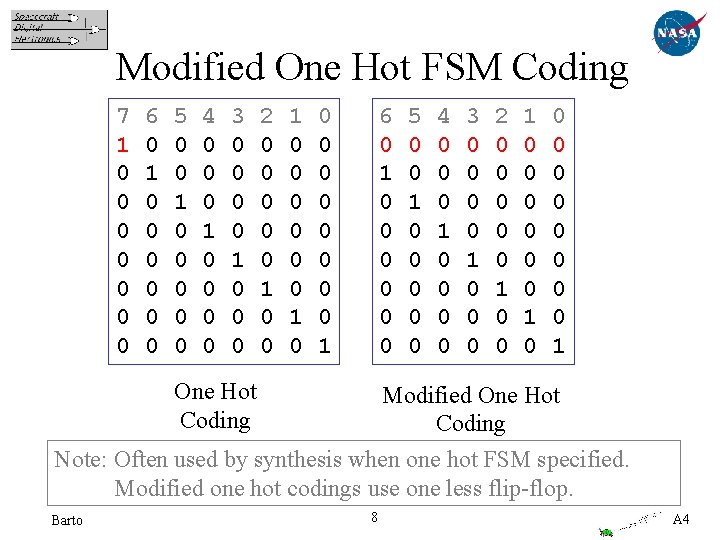
Modified One Hot FSM Coding 7 1 0 0 0 0 6 0 1 0 0 0 5 0 0 1 0 0 0 0 0 4 0 0 0 1 0 0 0 0 3 0 0 0 0 1 0 0 0 2 0 0 0 0 0 1 0 0 0 1 0 0 0 0 0 1 One Hot Coding Modified One Hot Coding Note: Often used by synthesis when one hot FSM specified. Modified one hot codings use one less flip-flop. Barto 8 A 4
Modified One Hot FSM Illegal State Detection • Error detection more difficult than for one hot – 1 0 upsets result in a legal state. – Parity will not detect all SEUs. – If an SEU occurs, most likely the upset will be detectable • Recovery from lockup sequence simple - If all 0's (NOR of state bits), then generate a 1 to first stage. – If multiple 1's (more difficult to detect), then will wait until all 1's are "shifted out. " Barto 9 A 4
Is There a Best FSM Type, and Is It Best Protected Against Transient Errors By Circuit-Level or System. Level EDAC? • Circuit-level EDAC – Expensive in power and mass if used to protect all circuits – Can be defeated by multiple-bit transient errors • System-level EDAC – Required for hard-failure handling – Relies on inherent redundancy in system, high-level error checking, and some EDAC hardware Barto 10 A 4
System-Level Error Checking Mechanisms • Natural error checking mechanisms – e. g. , fire a thruster, check for spacecraft attitude change • Checking mechanisms arising from multiple subsystems – e. g. , command a module to power on, check its current draw and temperature • Explicitly added checking mechanisms – Watchdog timers – Handshake protocols for command acknowledgement – Monitors, e. g. , thruster on-time monitor Barto 11 A 4
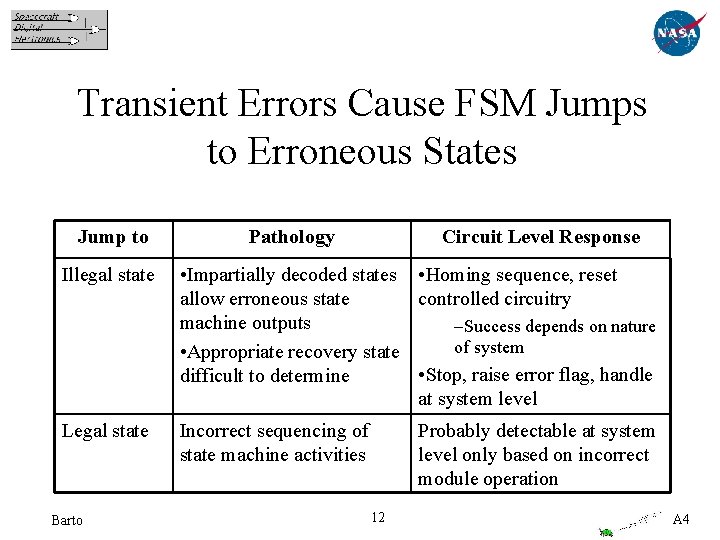
Transient Errors Cause FSM Jumps to Erroneous States Jump to Pathology Circuit Level Response Illegal state • Impartially decoded states • Homing sequence, reset allow erroneous state controlled circuitry machine outputs –Success depends on nature of system • Appropriate recovery state • Stop, raise error flag, handle difficult to determine at system level Legal state Incorrect sequencing of state machine activities Barto Probably detectable at system level only based on incorrect module operation 12 A 4
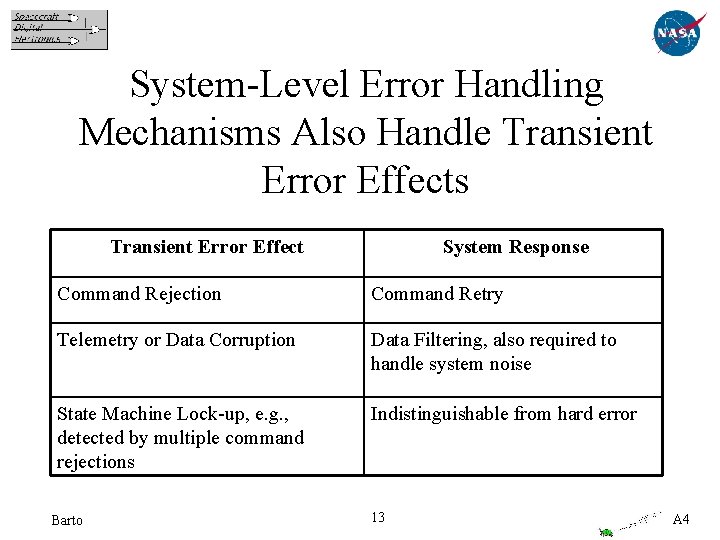
System-Level Error Handling Mechanisms Also Handle Transient Error Effects Transient Error Effect System Response Command Rejection Command Retry Telemetry or Data Corruption Data Filtering, also required to handle system noise State Machine Lock-up, e. g. , detected by multiple command rejections Indistinguishable from hard error Barto 13 A 4
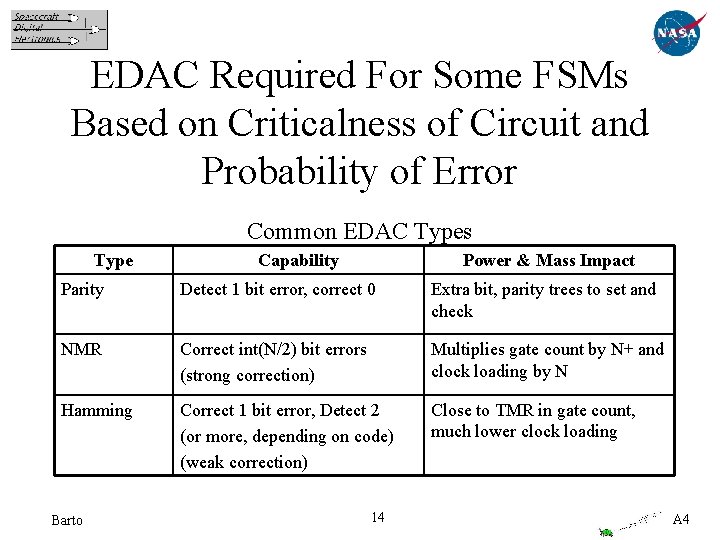
EDAC Required For Some FSMs Based on Criticalness of Circuit and Probability of Error Common EDAC Types Type Capability Power & Mass Impact Parity Detect 1 bit error, correct 0 Extra bit, parity trees to set and check NMR Correct int(N/2) bit errors (strong correction) Multiplies gate count by N+ and clock loading by N Hamming Correct 1 bit error, Detect 2 (or more, depending on code) (weak correction) Close to TMR in gate count, much lower clock loading Barto 14 A 4
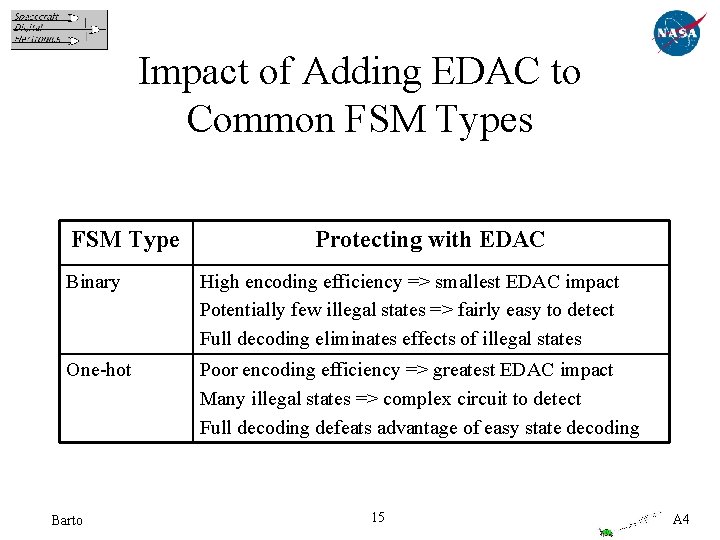
Impact of Adding EDAC to Common FSM Types FSM Type Protecting with EDAC Binary High encoding efficiency => smallest EDAC impact Potentially few illegal states => fairly easy to detect Full decoding eliminates effects of illegal states One-hot Poor encoding efficiency => greatest EDAC impact Many illegal states => complex circuit to detect Full decoding defeats advantage of easy state decoding Barto 15 A 4
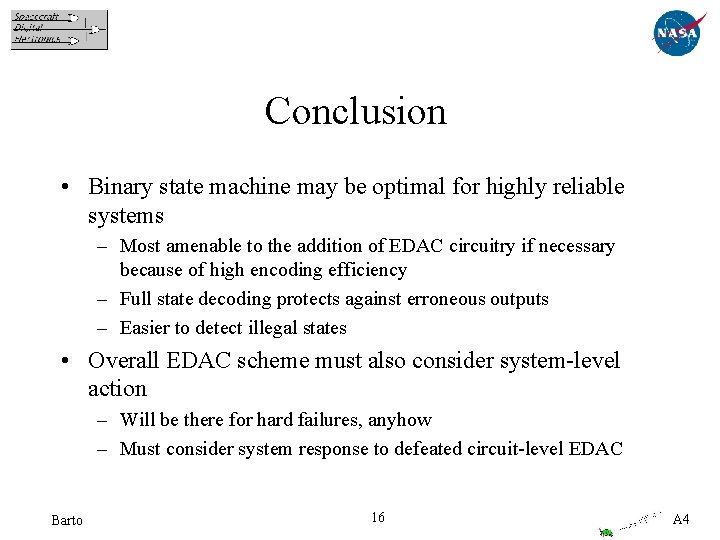
Conclusion • Binary state machine may be optimal for highly reliable systems – Most amenable to the addition of EDAC circuitry if necessary because of high encoding efficiency – Full state decoding protects against erroneous outputs – Easier to detect illegal states • Overall EDAC scheme must also consider system-level action – Will be there for hard failures, anyhow – Must consider system response to defeated circuit-level EDAC Barto 16 A 4
- Slides: 16