
Sequential Circuit Analysis Design Dr Aiman H ElMaleh


- Slides: 46
Sequential Circuit Analysis & Design Dr. Aiman H. El-Maleh Computer Engineering Department King Fahd University of Petroleum & Minerals
Outline n Sequential Circuit Model n Timing of Sequential Circuits n Latches and Flip flops n Sequential Circuit Timing Constraints n Sequential Circuit Analysis n Sequential Circuit Design Procedure n Sequential Circuit Design Examples 1 -2
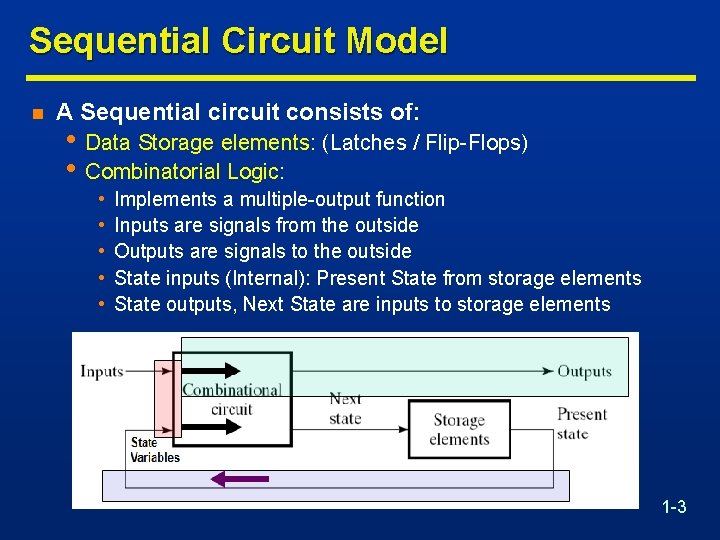
Sequential Circuit Model n A Sequential circuit consists of: • Data Storage elements: (Latches / Flip-Flops) • Combinatorial Logic: • • • Implements a multiple-output function Inputs are signals from the outside Outputs are signals to the outside State inputs (Internal): Present State from storage elements State outputs, Next State are inputs to storage elements 1 -3
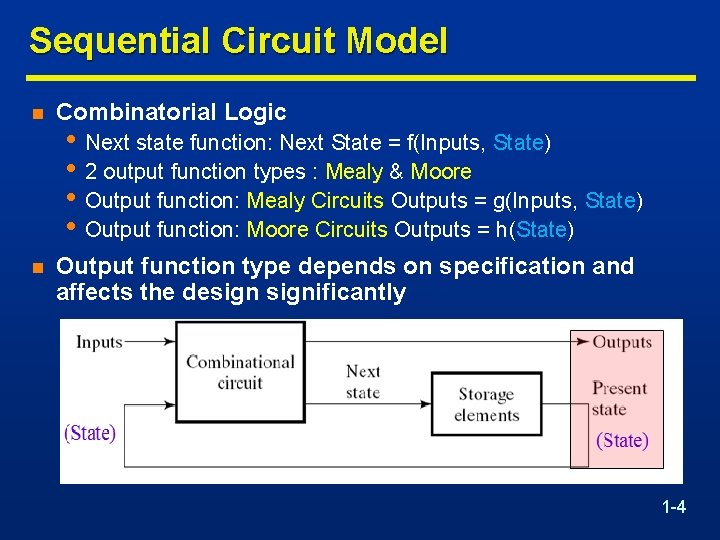
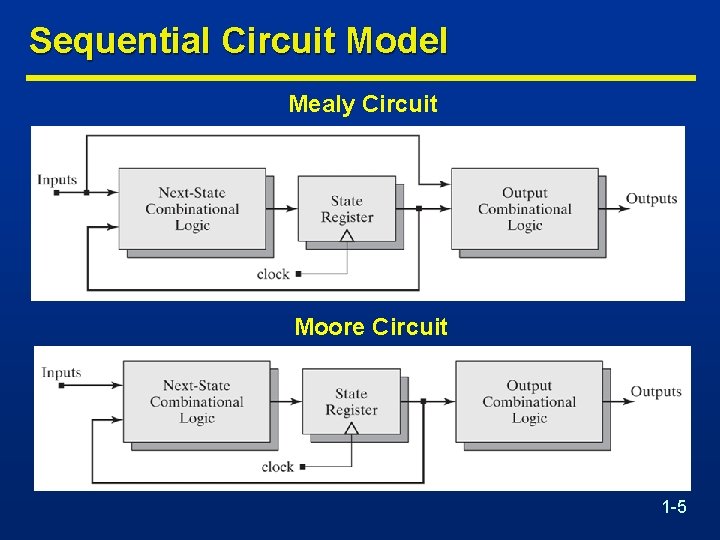
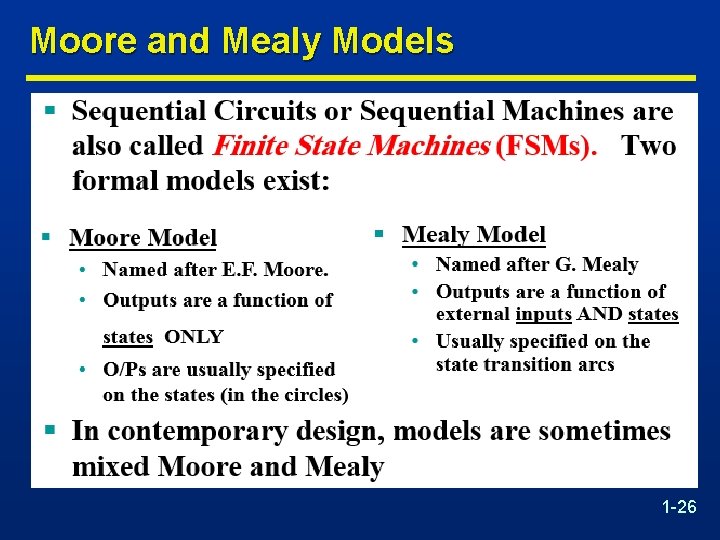
Sequential Circuit Model n Combinatorial Logic n Output function type depends on specification and affects the designificantly • Next state function: Next State = f(Inputs, State) • 2 output function types : Mealy & Moore • Output function: Mealy Circuits Outputs = g(Inputs, State) • Output function: Moore Circuits Outputs = h(State) 1 -4
Sequential Circuit Model Mealy Circuit Moore Circuit 1 -5
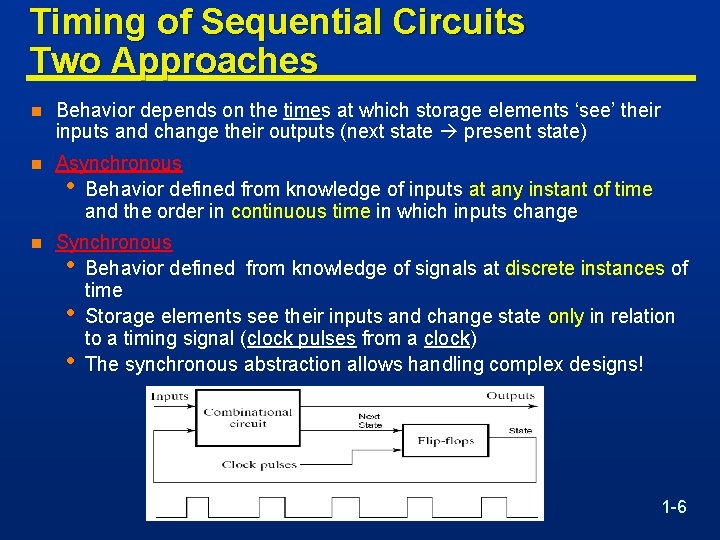
Timing of Sequential Circuits Two Approaches n Behavior depends on the times at which storage elements ‘see’ their inputs and change their outputs (next state present state) n Asynchronous • Behavior defined from knowledge of inputs at any instant of time and the order in continuous time in which inputs change n Synchronous • Behavior defined from knowledge of signals at discrete instances of time • Storage elements see their inputs and change state only in relation to a timing signal (clock pulses from a clock) • The synchronous abstraction allows handling complex designs! 1 -6
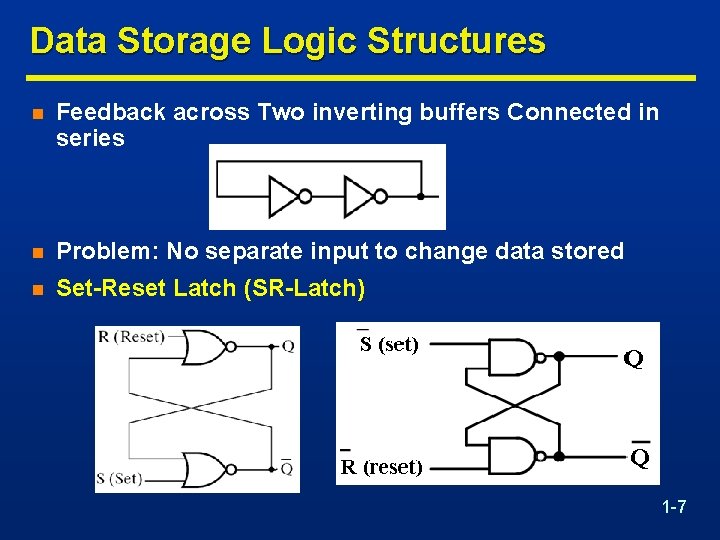
Data Storage Logic Structures n Feedback across Two inverting buffers Connected in series n Problem: No separate input to change data stored n Set-Reset Latch (SR-Latch) 1 -7
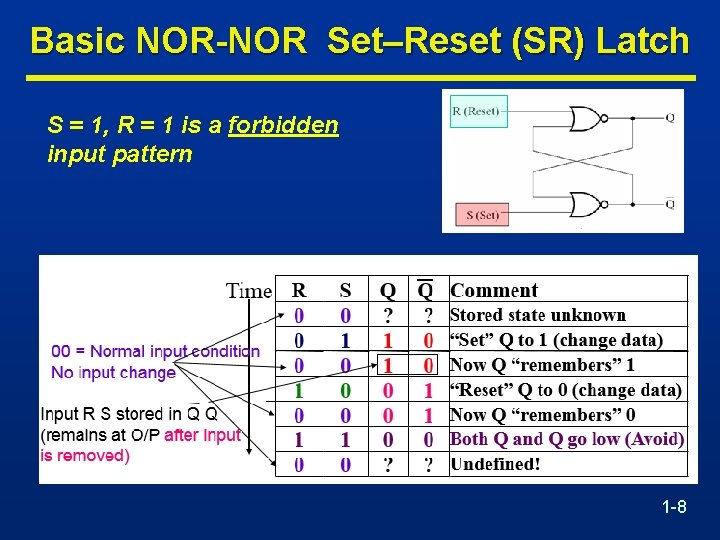
Basic NOR-NOR Set–Reset (SR) Latch S = 1, R = 1 is a forbidden input pattern 1 -8
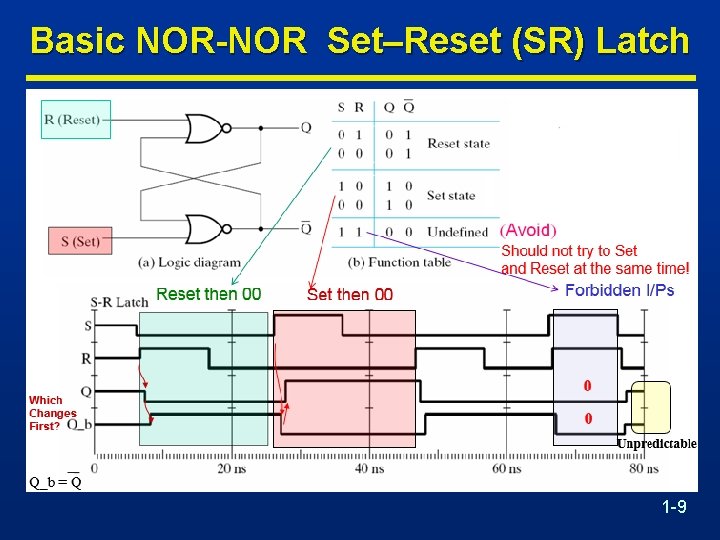
Basic NOR-NOR Set–Reset (SR) Latch 1 -9
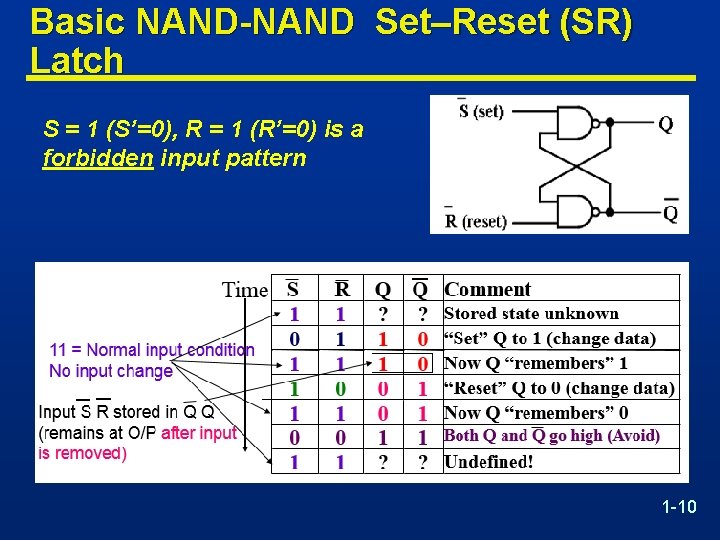
Basic NAND-NAND Set–Reset (SR) Latch S = 1 (S’=0), R = 1 (R’=0) is a forbidden input pattern 1 -10
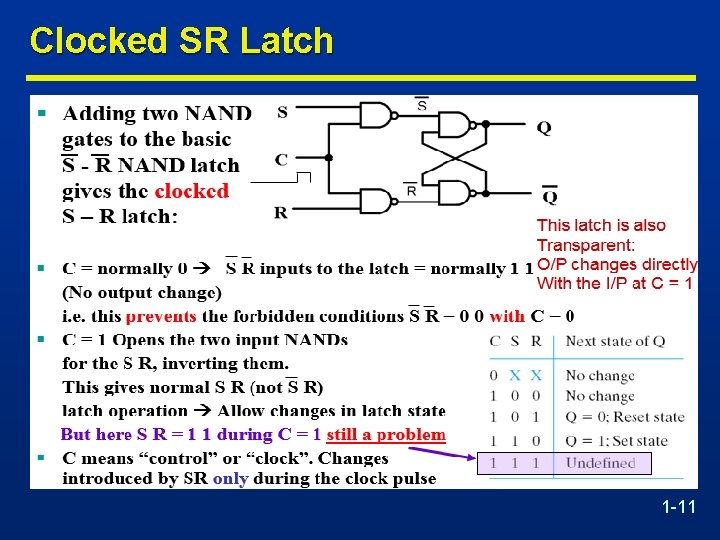
Clocked SR Latch 1 -11
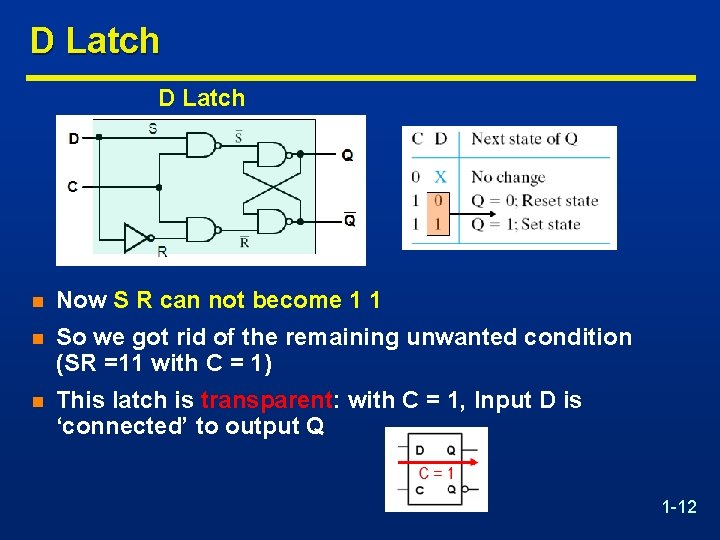
D Latch n Now S R can not become 1 1 n So we got rid of the remaining unwanted condition (SR =11 with C = 1) n This latch is transparent: with C = 1, Input D is ‘connected’ to output Q 1 -12
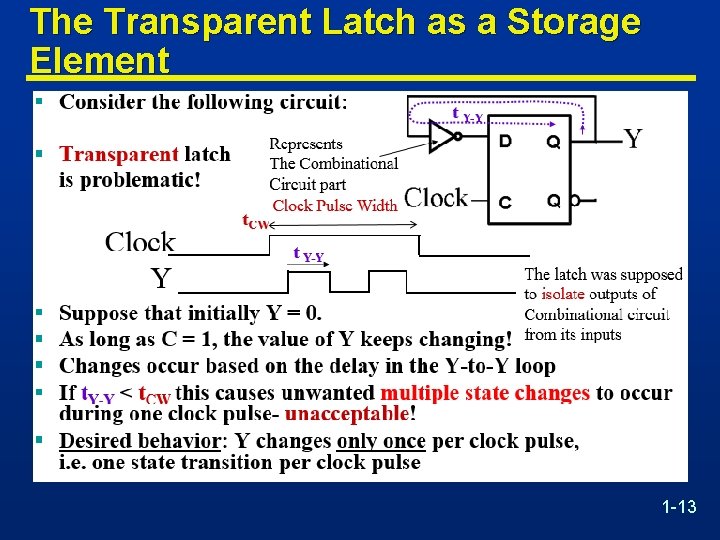
The Transparent Latch as a Storage Element 1 -13
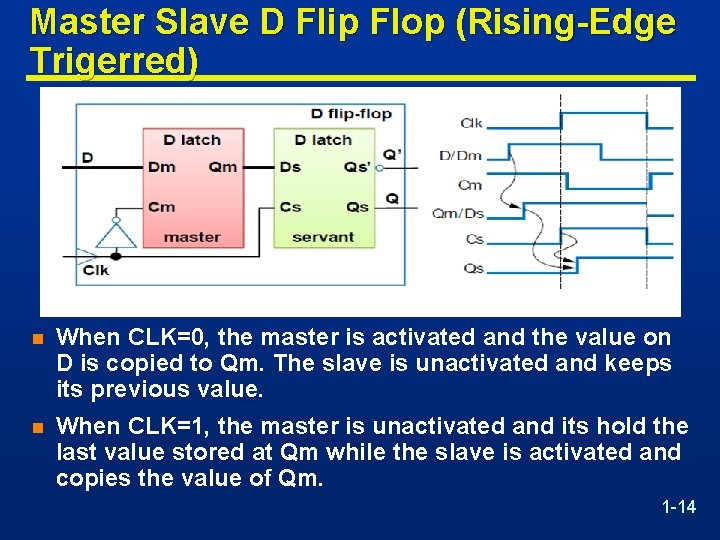
Master Slave D Flip Flop (Rising-Edge Trigerred) n When CLK=0, the master is activated and the value on D is copied to Qm. The slave is unactivated and keeps its previous value. n When CLK=1, the master is unactivated and its hold the last value stored at Qm while the slave is activated and copies the value of Qm. 1 -14
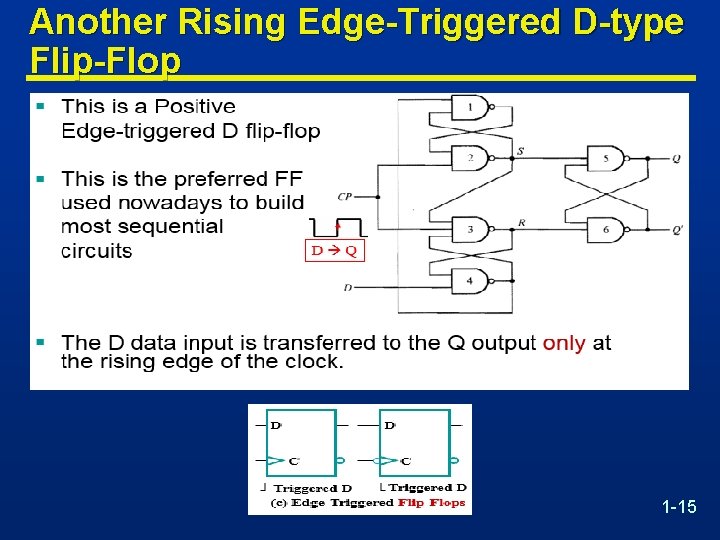
Another Rising Edge-Triggered D-type Flip-Flop 1 -15
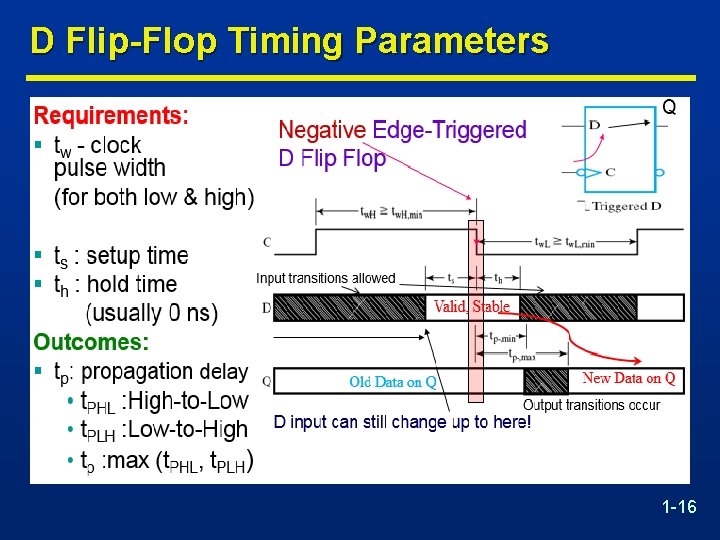
D Flip-Flop Timing Parameters 1 -16
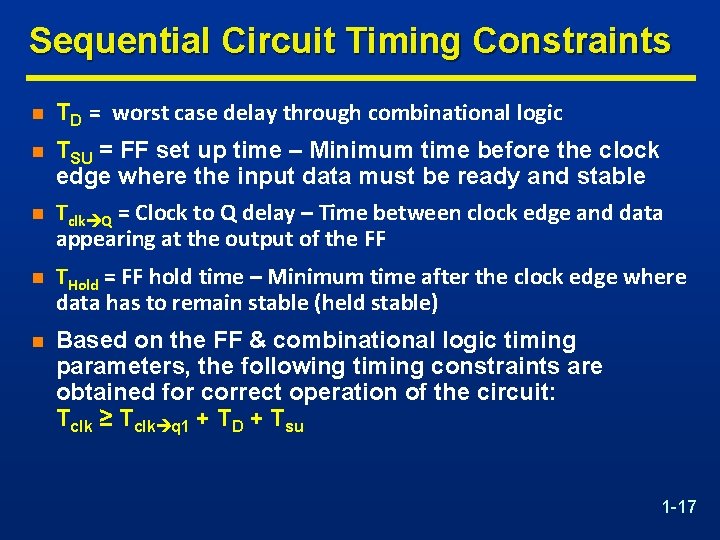
Sequential Circuit Timing Constraints n TD = worst case delay through combinational logic n TSU = FF set up time – Minimum time before the clock edge where the input data must be ready and stable n Tclk Q = Clock to Q delay – Time between clock edge and data appearing at the output of the FF n THold = FF hold time – Minimum time after the clock edge where data has to remain stable (held stable) n Based on the FF & combinational logic timing parameters, the following timing constraints are obtained for correct operation of the circuit: Tclk ≥ Tclk q 1 + TD + Tsu 1 -17
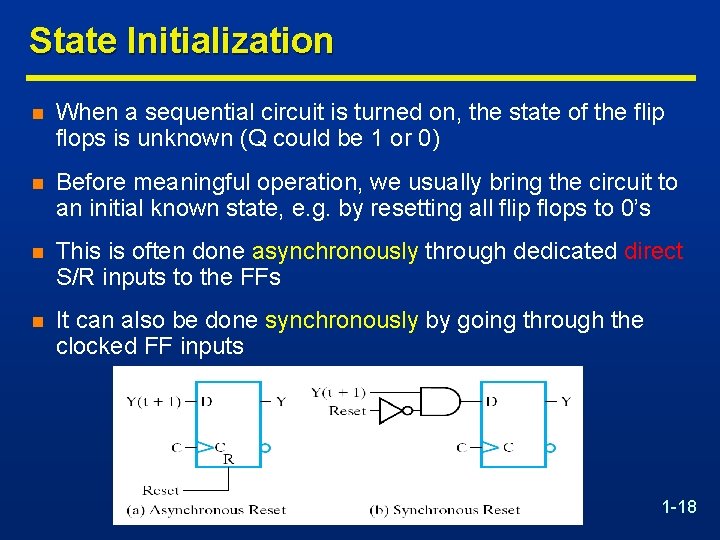
State Initialization n When a sequential circuit is turned on, the state of the flip flops is unknown (Q could be 1 or 0) n Before meaningful operation, we usually bring the circuit to an initial known state, e. g. by resetting all flip flops to 0’s n This is often done asynchronously through dedicated direct S/R inputs to the FFs n It can also be done synchronously by going through the clocked FF inputs 1 -18
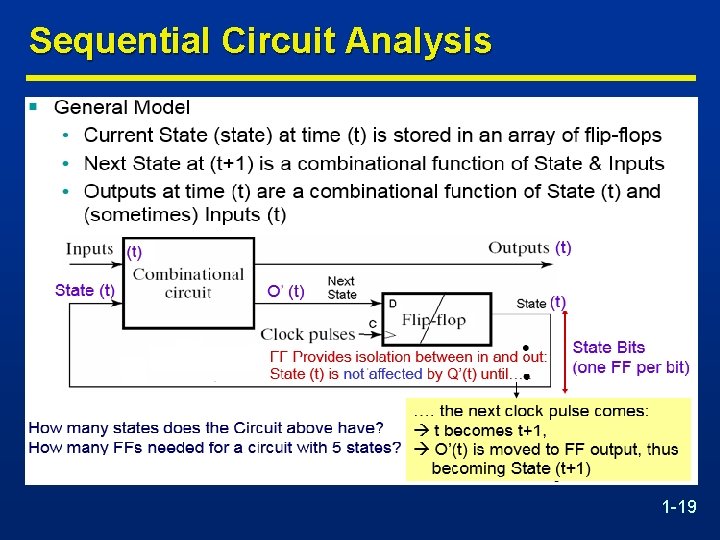
Sequential Circuit Analysis 1 -19
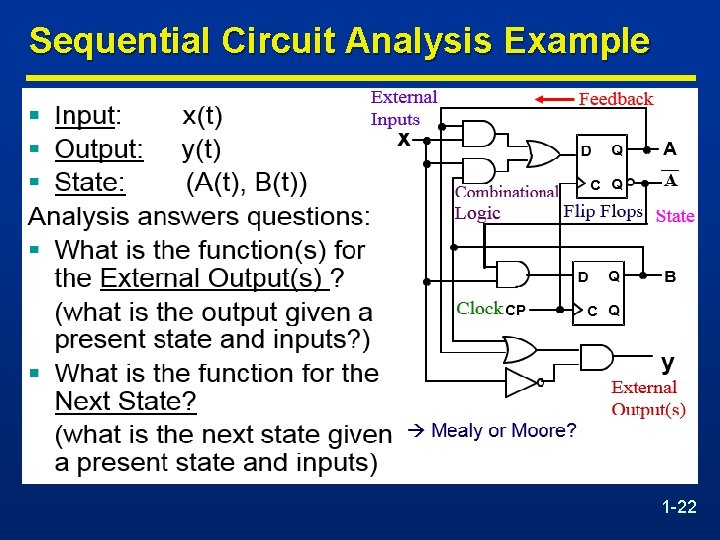
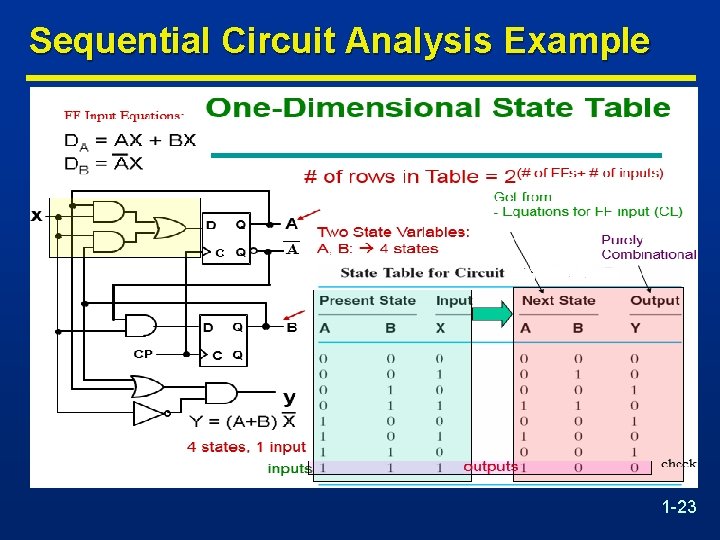
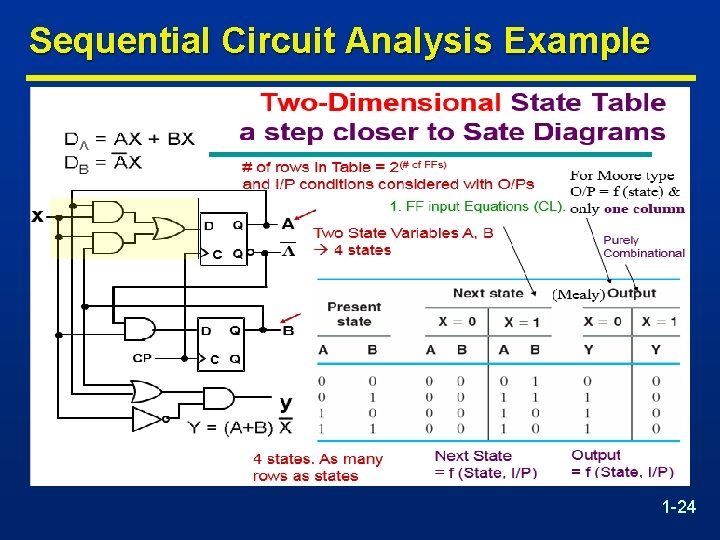
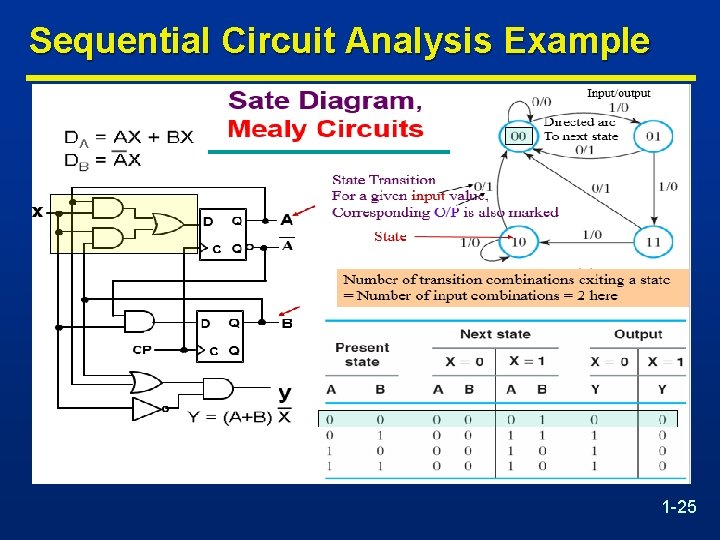
Sequential Circuit Analysis n Given a sequential Circuit n Objective: Derive outputs & state behavior (outputs and next state) from (present states and inputs) n Two equivalent approaches to represent the results: • State table: A truth table-like approach • State diagram: A graphical, more intuitive way of representing the state table and expressing the sequential circuit operation 1 -20
State Table Characteristics n State table – a multiple variable table with the following four sections: CL Inputs: • Present State – the values of the state variables for each allowed state (FF outputs) • External Inputs CL Outputs: • Next-state – the value of the state (FF outputs) at time (t+1) based on the present state and the inputs. Determined by FF inputs • Outputs – the value of the outputs as a function of the present state and (sometimes- Mealy) the inputs. 1 -21
Sequential Circuit Analysis Example 1 -22
Sequential Circuit Analysis Example 1 -23
Sequential Circuit Analysis Example 1 -24
Sequential Circuit Analysis Example 1 -25
Moore and Mealy Models 1 -26
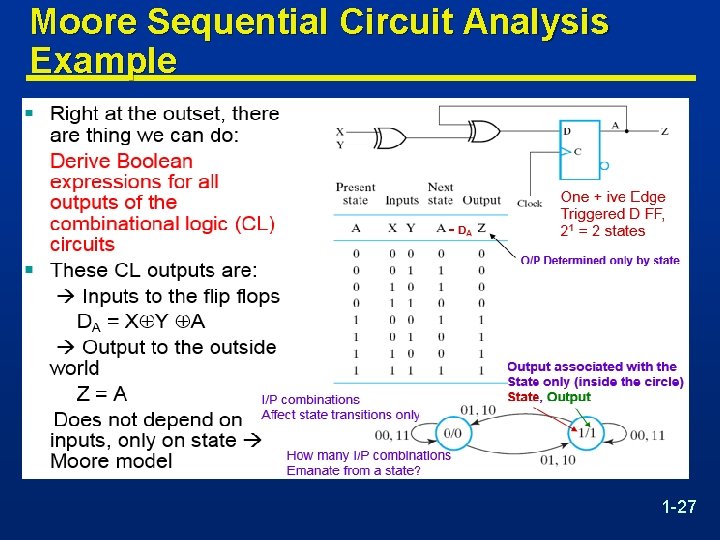
Moore Sequential Circuit Analysis Example 1 -27
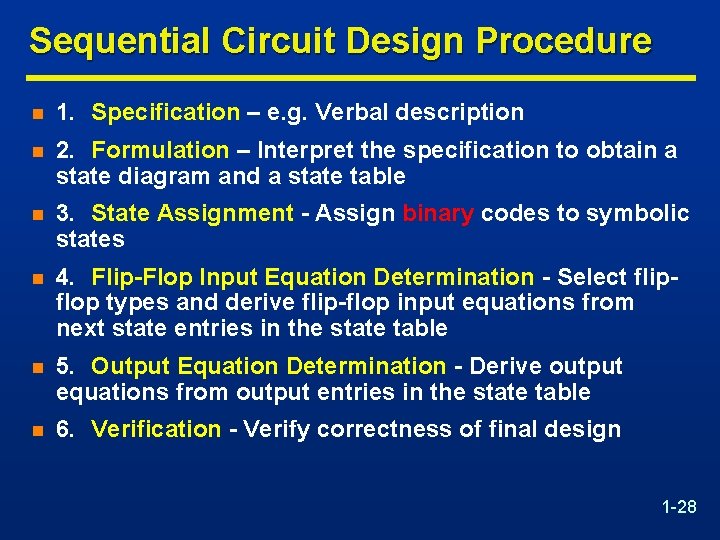
Sequential Circuit Design Procedure n 1. Specification – e. g. Verbal description n 2. Formulation – Interpret the specification to obtain a state diagram and a state table n 3. State Assignment - Assign binary codes to symbolic states n 4. Flip-Flop Input Equation Determination - Select flipflop types and derive flip-flop input equations from next state entries in the state table n 5. Output Equation Determination - Derive output equations from output entries in the state table n 6. Verification - Verify correctness of final design 1 -28
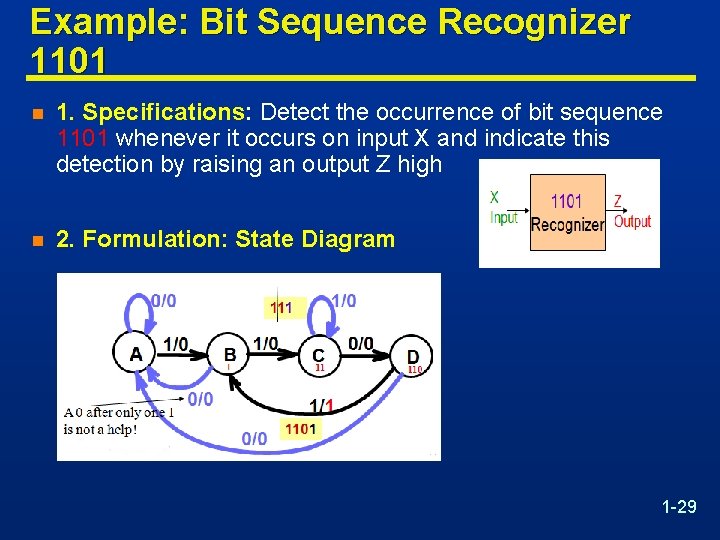
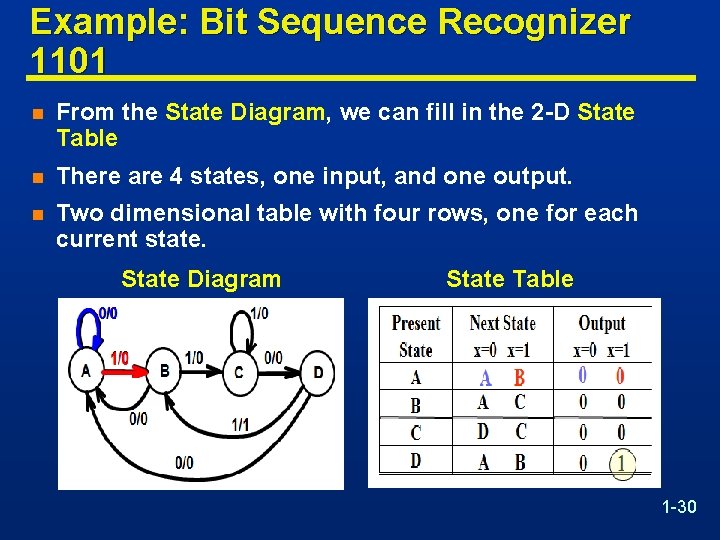
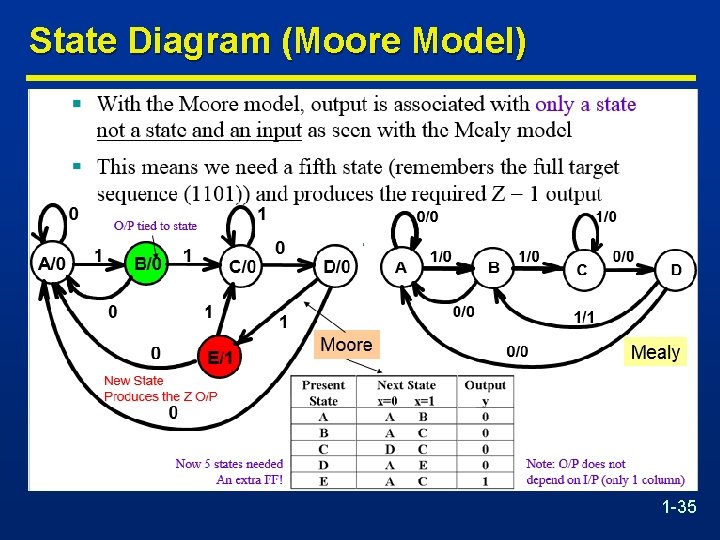
Example: Bit Sequence Recognizer 1101 n 1. Specifications: Detect the occurrence of bit sequence 1101 whenever it occurs on input X and indicate this detection by raising an output Z high n 2. Formulation: State Diagram 1 -29
Example: Bit Sequence Recognizer 1101 n From the State Diagram, we can fill in the 2 -D State Table n There are 4 states, one input, and one output. n Two dimensional table with four rows, one for each current state. State Diagram State Table 1 -30
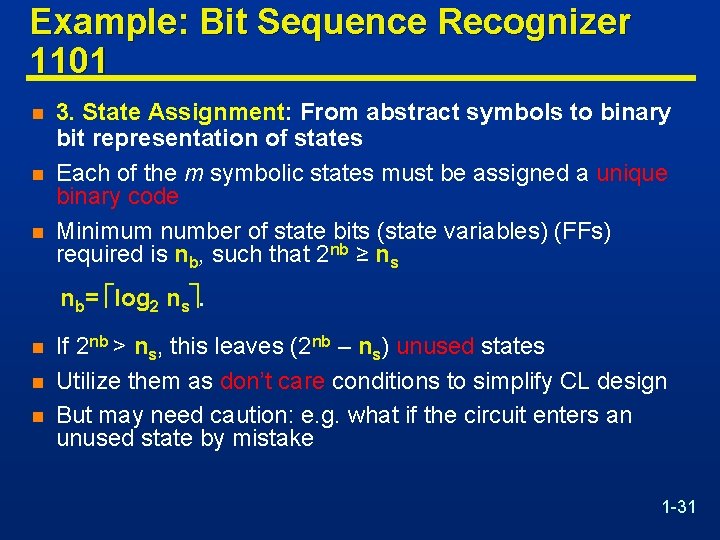
Example: Bit Sequence Recognizer 1101 n n n 3. State Assignment: From abstract symbols to binary bit representation of states Each of the m symbolic states must be assigned a unique binary code Minimum number of state bits (state variables) (FFs) required is nb, such that 2 nb ≥ ns nb= log 2 ns. n n n If 2 nb > ns, this leaves (2 nb – ns) unused states Utilize them as don’t care conditions to simplify CL design But may need caution: e. g. what if the circuit enters an unused state by mistake 1 -31
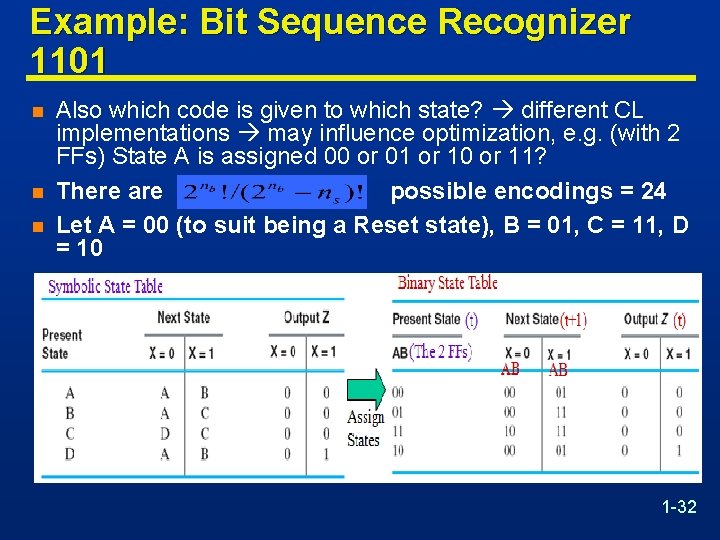
Example: Bit Sequence Recognizer 1101 n n n Also which code is given to which state? different CL implementations may influence optimization, e. g. (with 2 FFs) State A is assigned 00 or 01 or 10 or 11? There are possible encodings = 24 Let A = 00 (to suit being a Reset state), B = 01, C = 11, D = 10 1 -32
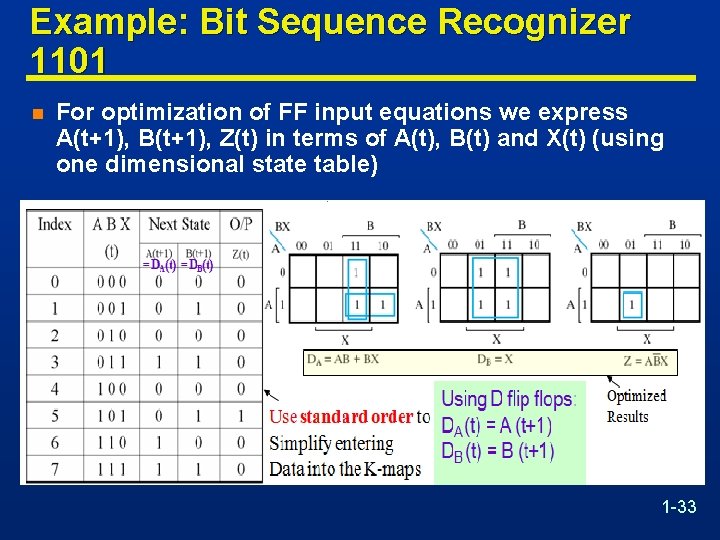
Example: Bit Sequence Recognizer 1101 n For optimization of FF input equations we express A(t+1), B(t+1), Z(t) in terms of A(t), B(t) and X(t) (using one dimensional state table) 1 -33
Example: Bit Sequence Recognizer 1101 1 -34
State Diagram (Moore Model) 1 -35
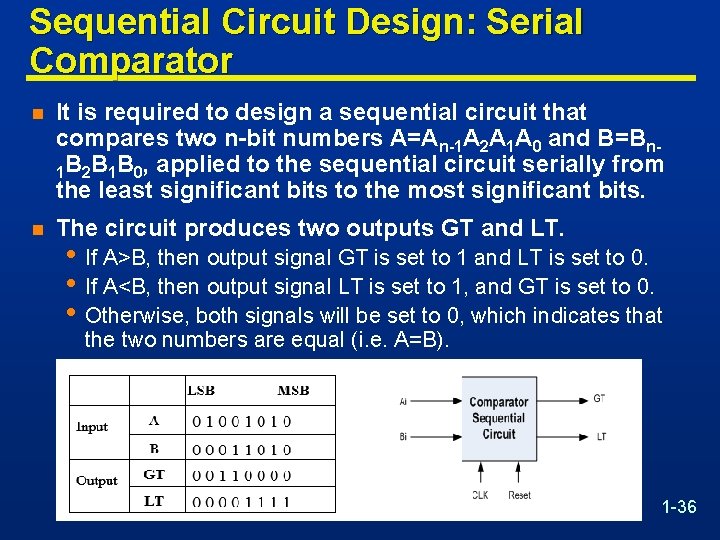
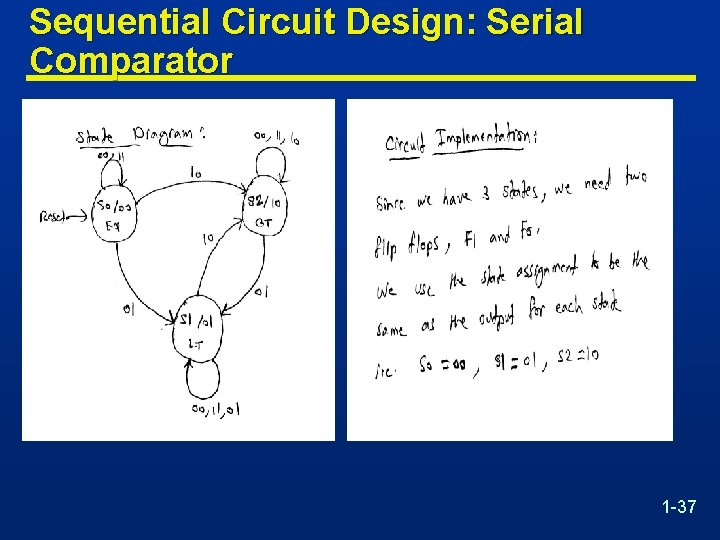
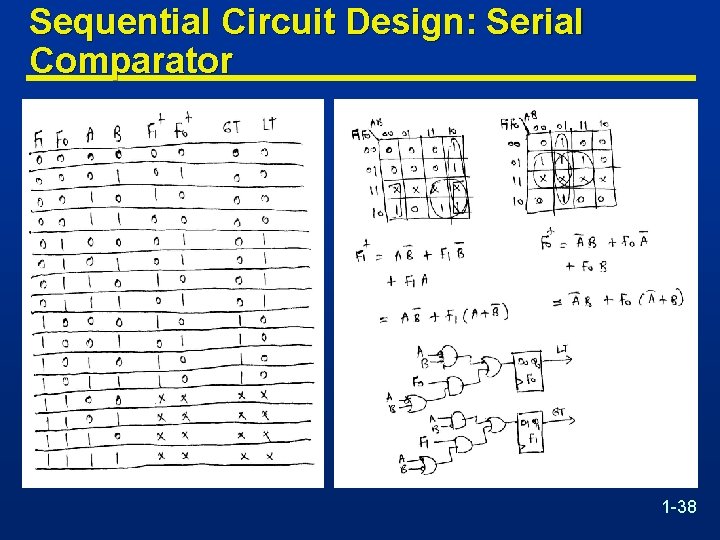
Sequential Circuit Design: Serial Comparator n It is required to design a sequential circuit that compares two n-bit numbers A=An-1 A 2 A 1 A 0 and B=Bn 1 B 2 B 1 B 0, applied to the sequential circuit serially from the least significant bits to the most significant bits. n The circuit produces two outputs GT and LT. • If A>B, then output signal GT is set to 1 and LT is set to 0. • If A<B, then output signal LT is set to 1, and GT is set to 0. • Otherwise, both signals will be set to 0, which indicates that the two numbers are equal (i. e. A=B). 1 -36
Sequential Circuit Design: Serial Comparator 1 -37
Sequential Circuit Design: Serial Comparator 1 -38
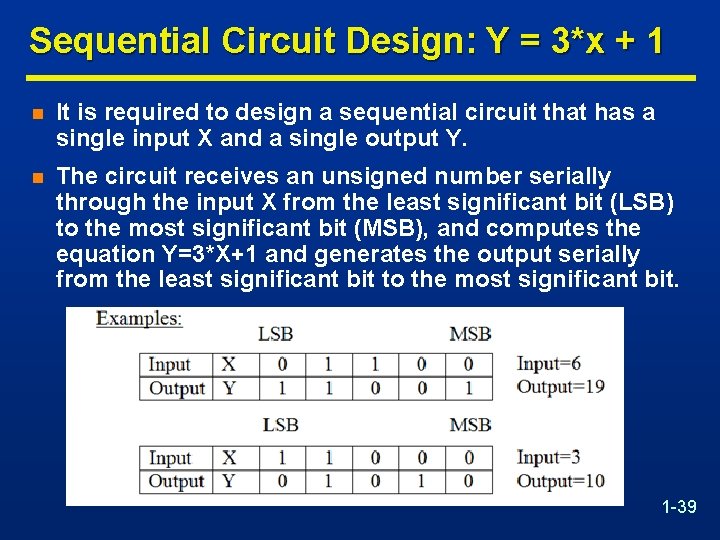
Sequential Circuit Design: Y = 3*x + 1 n It is required to design a sequential circuit that has a single input X and a single output Y. n The circuit receives an unsigned number serially through the input X from the least significant bit (LSB) to the most significant bit (MSB), and computes the equation Y=3*X+1 and generates the output serially from the least significant bit to the most significant bit. 1 -39
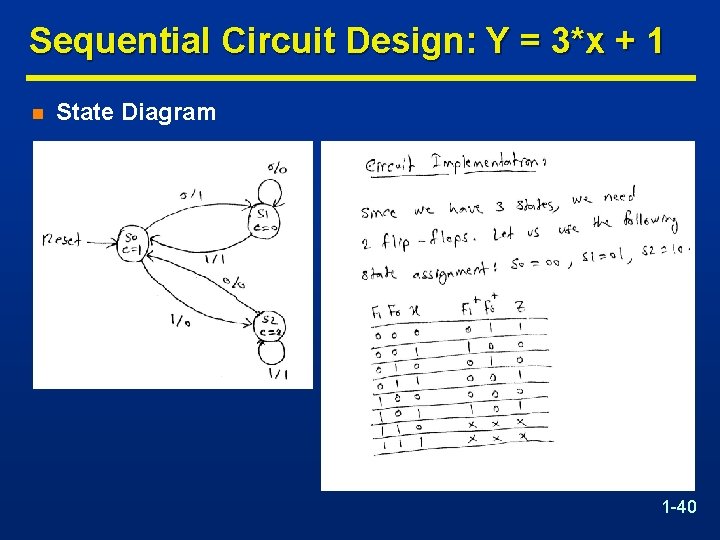
Sequential Circuit Design: Y = 3*x + 1 n State Diagram 1 -40
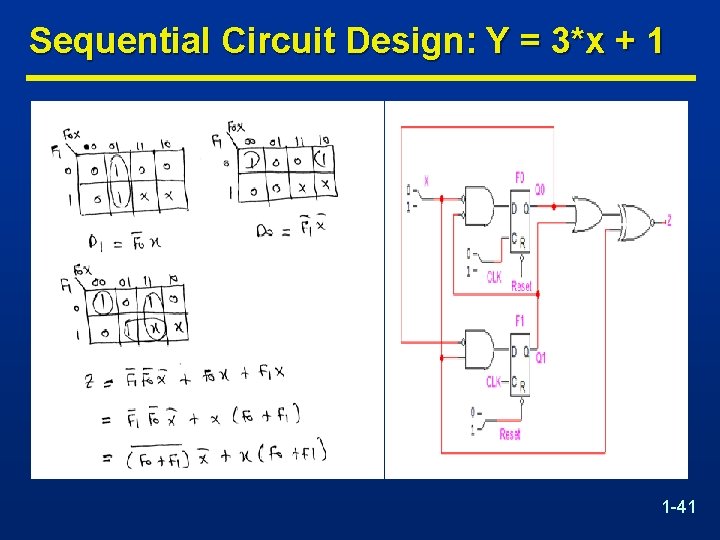
Sequential Circuit Design: Y = 3*x + 1 1 -41
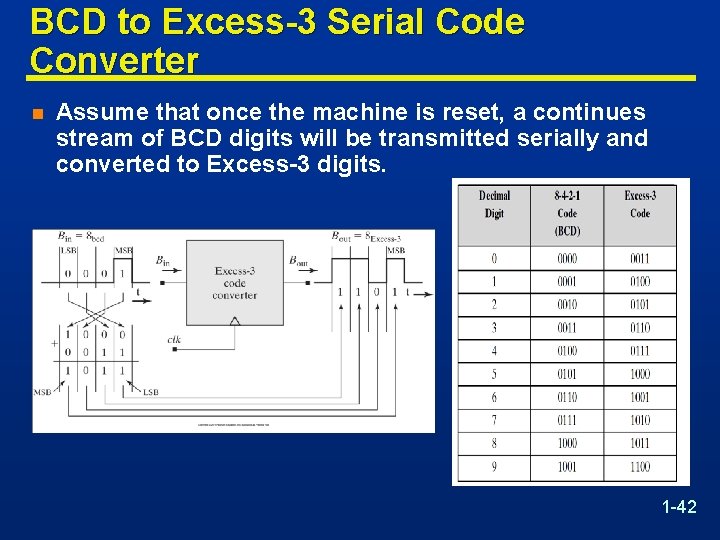
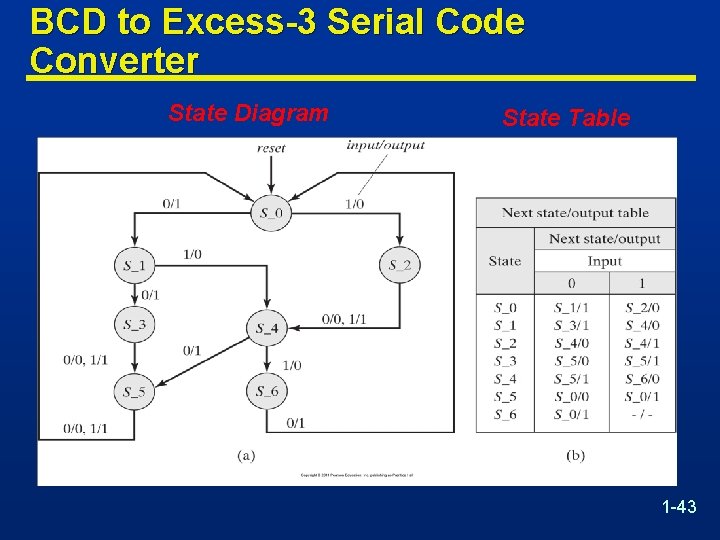
BCD to Excess-3 Serial Code Converter n Assume that once the machine is reset, a continues stream of BCD digits will be transmitted serially and converted to Excess-3 digits. 1 -42
BCD to Excess-3 Serial Code Converter State Diagram State Table 1 -43
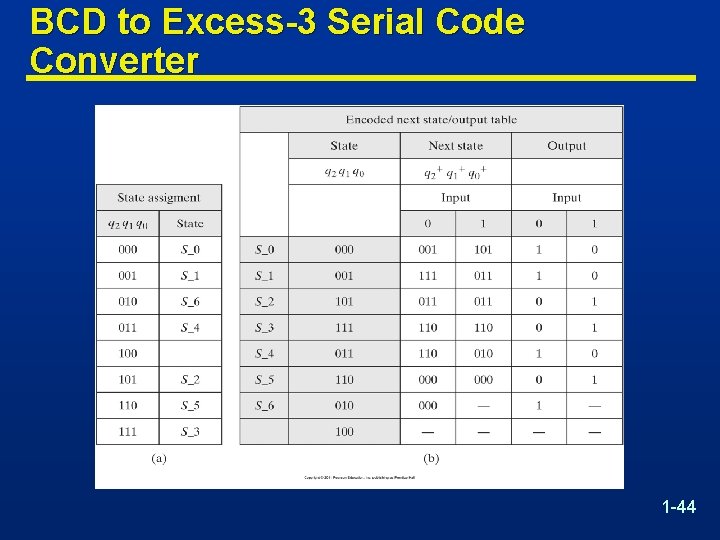
BCD to Excess-3 Serial Code Converter 1 -44
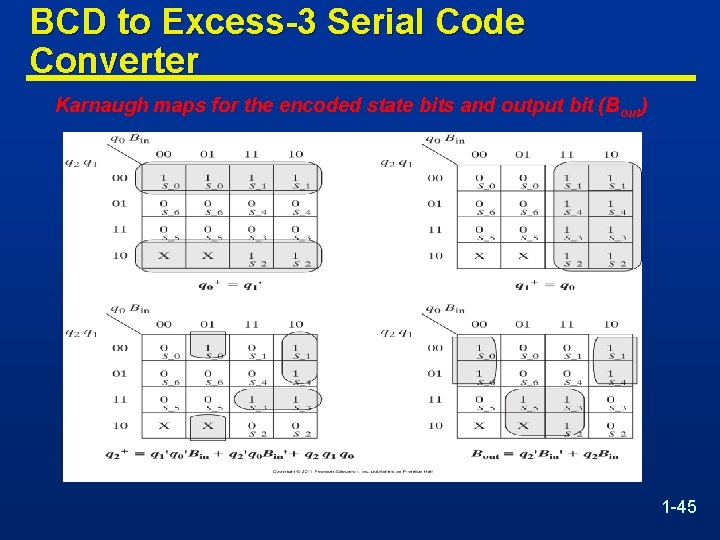
BCD to Excess-3 Serial Code Converter Karnaugh maps for the encoded state bits and output bit (Bout) 1 -45
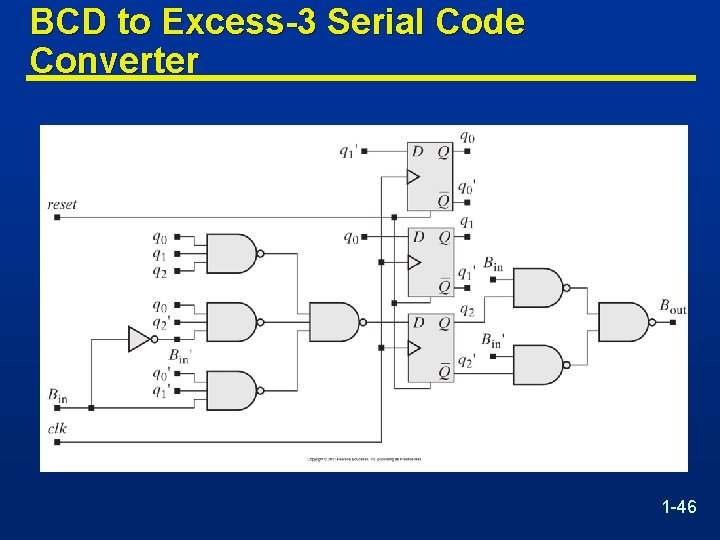
BCD to Excess-3 Serial Code Converter 1 -46