
Sequencing is the ordering of information Kinds of
- Slides: 21
Sequencing is the ordering of information.
Kinds of Sequencing /When you read you have to identify how the author has organized the information in a story. /The writer may use a sequence that is spatial, chronological, emphatic, or logical.
Transition and Signal Words As you read, • identify words that are transitions and signals that help you understand if the author • has ordered the information spatially, chronologically, emphatically, or logically.
Time Order Signal Words Write down the time order signal words and phrases that are on the next two pages:
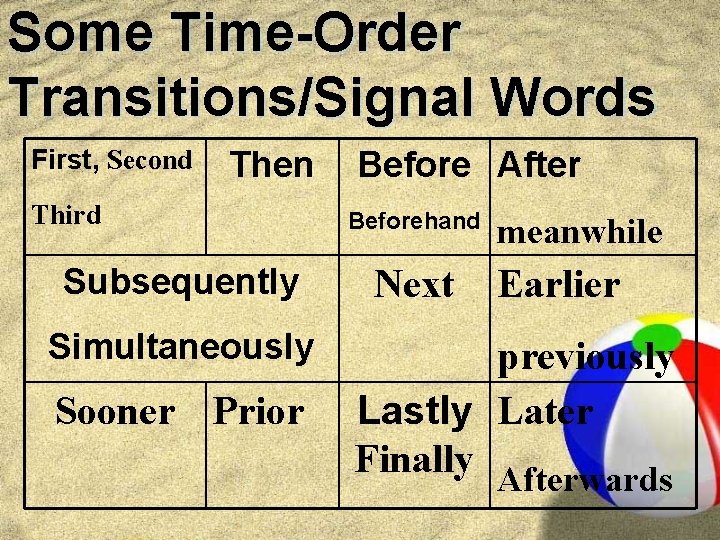
Some Time-Order Transitions/Signal Words First, Second Then Third Subsequently Simultaneously Sooner Prior Before After Beforehand Next meanwhile Earlier previously Lastly Later Finally Afterwards
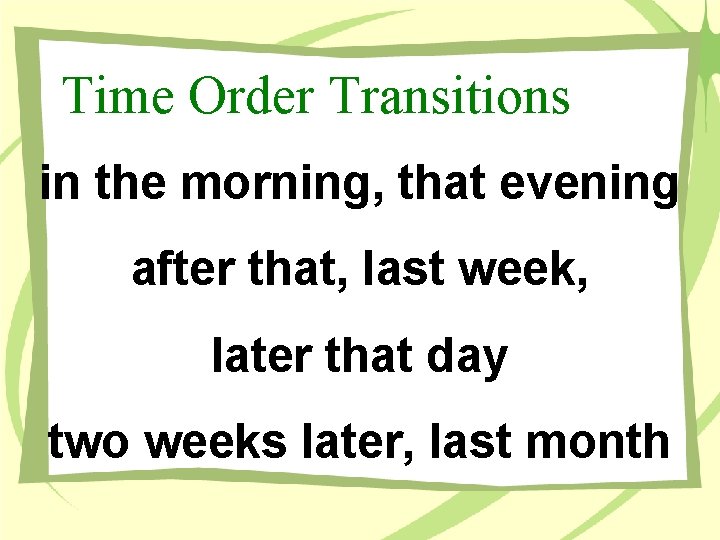
Time Order Transitions in the morning, that evening after that, last week, later that day two weeks later, last month
Be a Sequence Detective See if you can spot the signal words in the following story and identify the chronology.
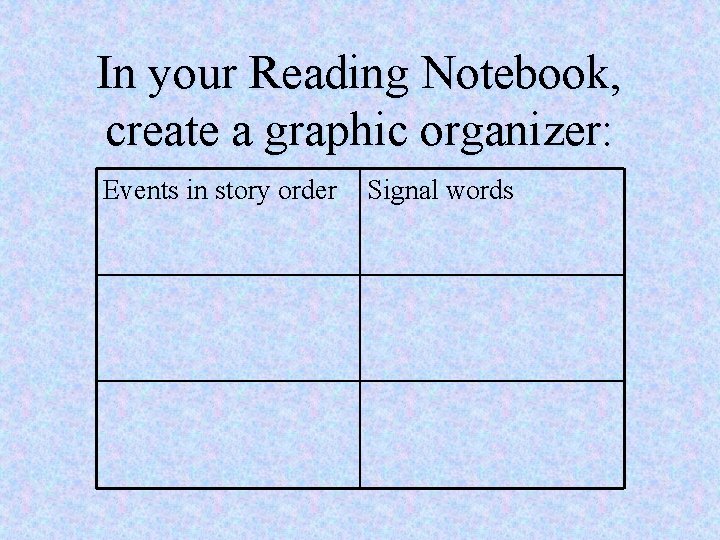
In your Reading Notebook, create a graphic organizer: Events in story order Signal words
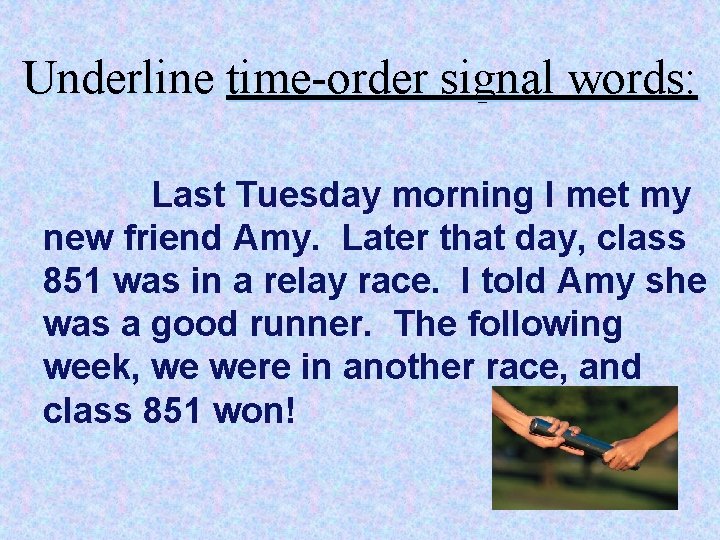
Underline time-order signal words: Last Tuesday morning I met my new friend Amy. Later that day, class 851 was in a relay race. I told Amy she was a good runner. The following week, we were in another race, and class 851 won!
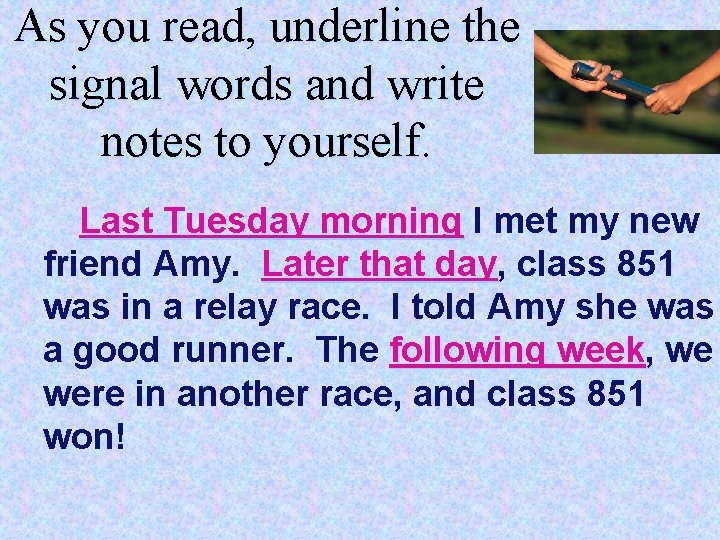
As you read, underline the signal words and write notes to yourself. Last Tuesday morning I met my new friend Amy. Later that day, day class 851 was in a relay race. I told Amy she was a good runner. The following week, week we were in another race, and class 851 won!
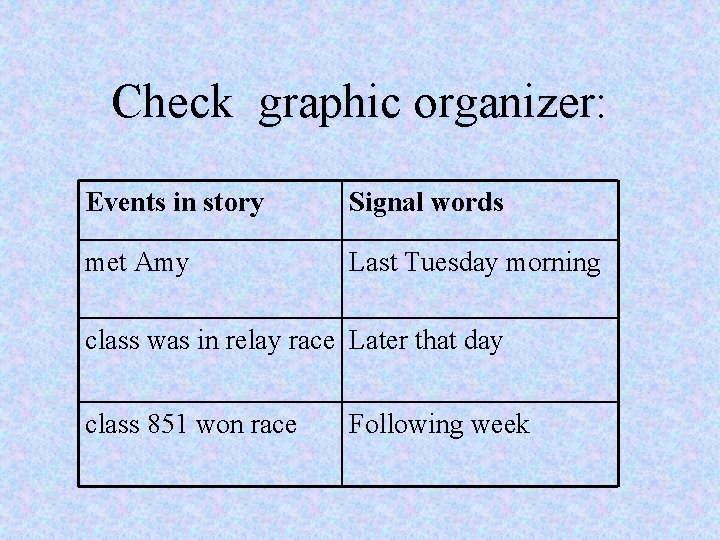
Check graphic organizer: Events in story Signal words met Amy Last Tuesday morning class was in relay race Later that day class 851 won race Following week
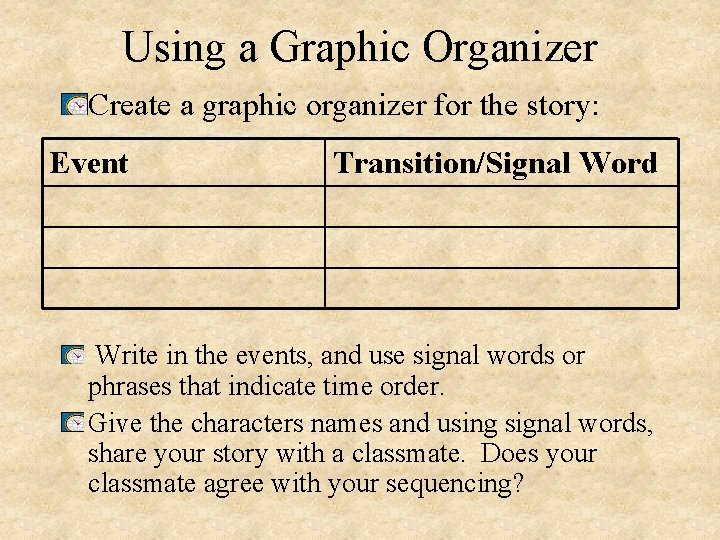
Using a Graphic Organizer Create a graphic organizer for the story: Event Transition/Signal Word Write in the events, and use signal words or phrases that indicate time order. Give the characters names and using signal words, share your story with a classmate. Does your classmate agree with your sequencing?
Reflection Why would an author tell a story out of its proper chronological sequence? Could an author combine different types of sequencing in the same story?
Author’s Sequence vs Story’s Chronology Authors often tell a story out of the story’s actual chronological sequence for dramatic effect. For example, the author might begin with a startling current event and then go back in the past to relate the event’s history. As you read this kind of story, underline dates, make notes for yourself, and create a graphic organizer.
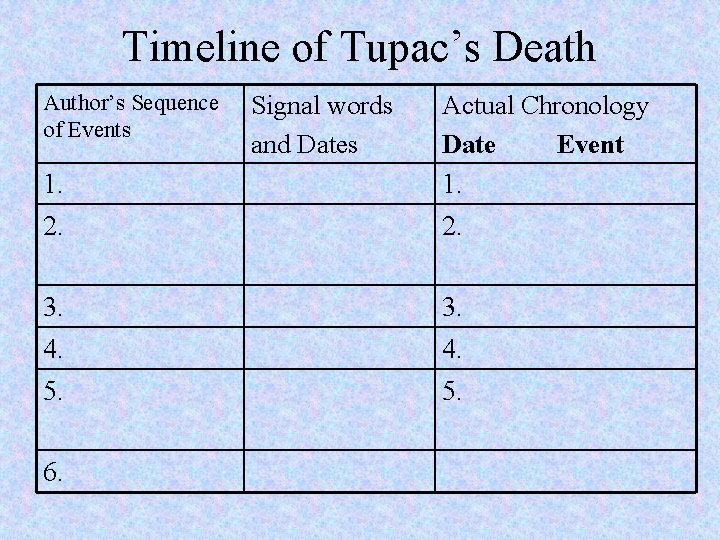
Timeline of Tupac’s Death Author’s Sequence of Events Signal words and Dates Actual Chronology Date Event 1. 2. 3. 4. 5. 6.
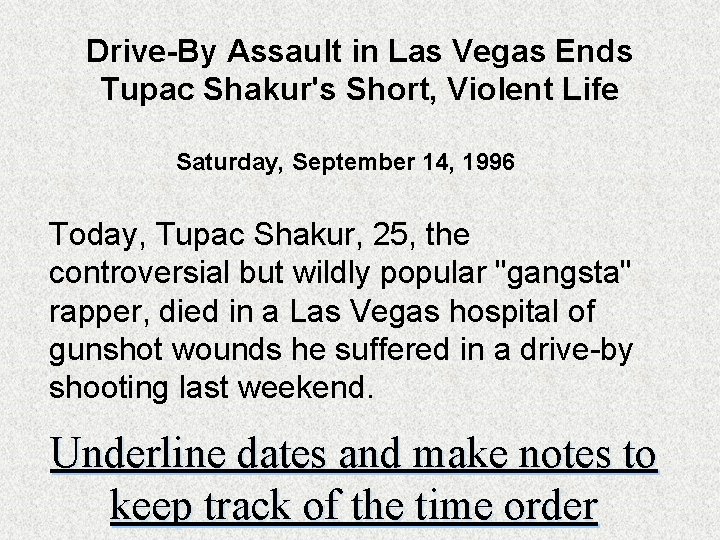
Drive-By Assault in Las Vegas Ends Tupac Shakur's Short, Violent Life Saturday, September 14, 1996 Today, Tupac Shakur, 25, the controversial but wildly popular "gangsta" rapper, died in a Las Vegas hospital of gunshot wounds he suffered in a drive-by shooting last weekend. Underline dates and make notes to keep track of the time order
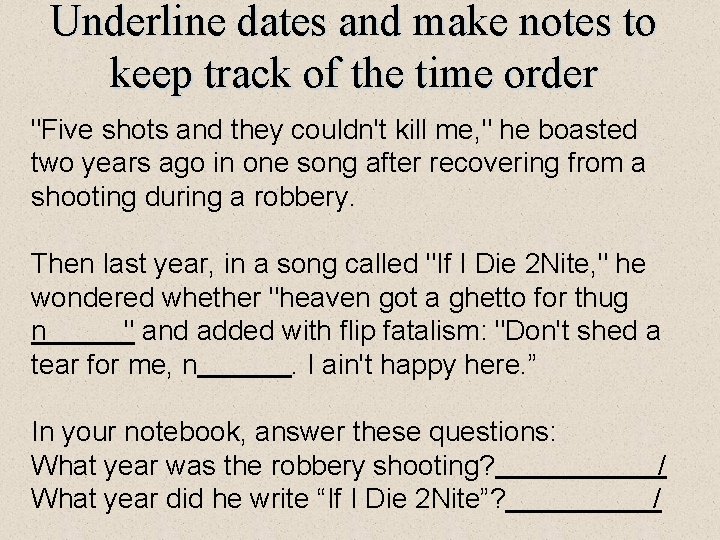
Underline dates and make notes to keep track of the time order "Five shots and they couldn't kill me, " he boasted two years ago in one song after recovering from a shooting during a robbery. Then last year, in a song called "If I Die 2 Nite, " he wondered whether "heaven got a ghetto for thug n " and added with flip fatalism: "Don't shed a tear for me, n. I ain't happy here. ” In your notebook, answer these questions: What year was the robbery shooting? What year did he write “If I Die 2 Nite”? / /
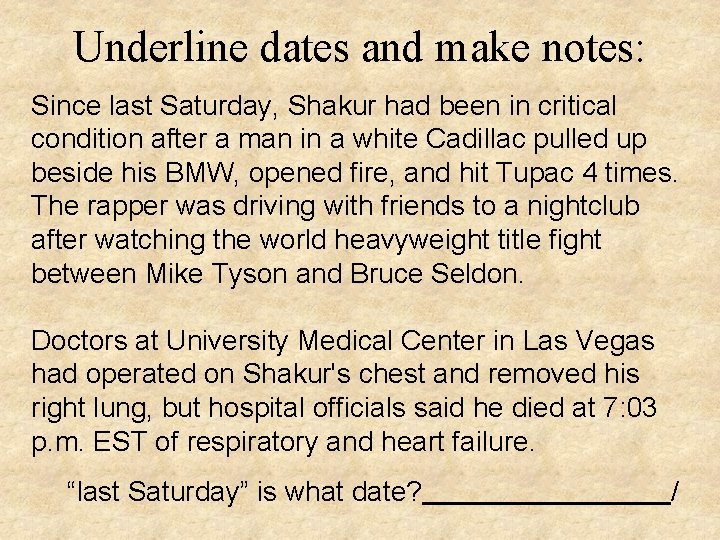
Underline dates and make notes: Since last Saturday, Shakur had been in critical condition after a man in a white Cadillac pulled up beside his BMW, opened fire, and hit Tupac 4 times. The rapper was driving with friends to a nightclub after watching the world heavyweight title fight between Mike Tyson and Bruce Seldon. Doctors at University Medical Center in Las Vegas had operated on Shakur's chest and removed his right lung, but hospital officials said he died at 7: 03 p. m. EST of respiratory and heart failure. “last Saturday” is what date? /
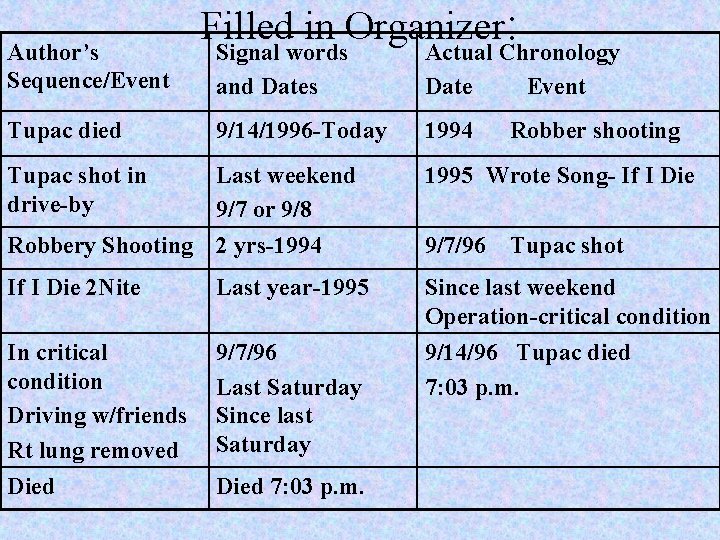
Author’s Sequence/Event Tupac died Filled in Organizer: Signal words Actual Chronology and Dates Date 9/14/1996 -Today 1994 Event Robber shooting Last weekend 9/7 or 9/8 Robbery Shooting 2 yrs-1994 1995 Wrote Song- If I Die 2 Nite Last year-1995 In critical condition Driving w/friends Rt lung removed Died 9/7/96 Last Saturday Since last weekend Operation-critical condition 9/14/96 Tupac died 7: 03 p. m. Tupac shot in drive-by Died 7: 03 p. m. 9/7/96 Tupac shot
Summary of Time-Order Sequencing Stories have a chronological sequence, but authors often tell the story out of sequence. As you read, notice, underline, and write notes in the margins. Underline signal words: dates, times, words, and phrases such as: before, later, meanwhile, previously, the following year To help yourself, create a graphic organizer, such as a chart or time line.