
Sequencetosequence models with attention Many slides adapted from
![Sequence-to-sequence with RNNs estamos comiendo we are eating bread [START] pan estamos comiendo [STOP]](https://slidetodoc.com/presentation_image_h2/430699f9a5366956a7f7ae799d7c1809/image-3.jpg "Sequence-to-sequence with RNNs estamos comiendo we are eating bread [START] pan estamos comiendo [STOP]")

![Sequence-to-sequence with RNNs and attention ✖ � ✖ � + estamos comiendo pan [STOP]](https://slidetodoc.com/presentation_image_h2/430699f9a5366956a7f7ae799d7c1809/image-11.jpg "Sequence-to-sequence with RNNs and attention ✖ � ✖ � + estamos comiendo pan [STOP]")
![Sequence-to-sequence with RNNs and attention ✖ � ✖ � + estamos comiendo pan [STOP]](https://slidetodoc.com/presentation_image_h2/430699f9a5366956a7f7ae799d7c1809/image-12.jpg "Sequence-to-sequence with RNNs and attention ✖ � ✖ � + estamos comiendo pan [STOP]")
![Generalizing attention ✖ � ✖ � + estamos comiendo pan [STOP] softmax we are](https://slidetodoc.com/presentation_image_h2/430699f9a5366956a7f7ae799d7c1809/image-20.jpg "Generalizing attention ✖ � ✖ � + estamos comiendo pan [STOP] softmax we are")
![Image captioning with RNNs and attention Alignment scores Attention weights softmax cat CNN [START]](https://slidetodoc.com/presentation_image_h2/430699f9a5366956a7f7ae799d7c1809/image-23.jpg "Image captioning with RNNs and attention Alignment scores Attention weights softmax cat CNN [START]")
![Image captioning with RNNs and attention Alignment scores Attention weights softmax cat sitting [START]](https://slidetodoc.com/presentation_image_h2/430699f9a5366956a7f7ae799d7c1809/image-24.jpg "Image captioning with RNNs and attention Alignment scores Attention weights softmax cat sitting [START]")
- Slides: 38
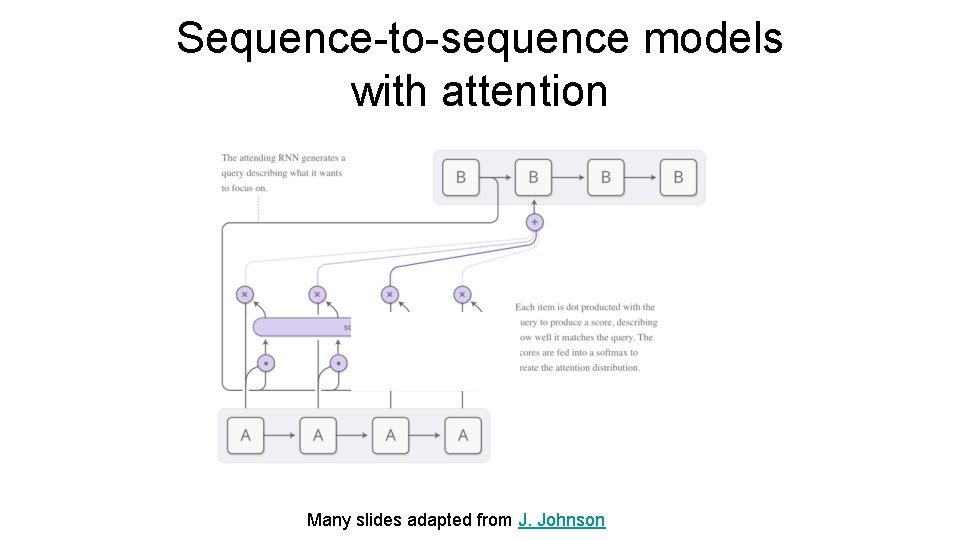
Sequence-to-sequence models with attention Many slides adapted from J. Johnson
Outline • • Vanilla seq 2 seq with RNNs Seq 2 seq with RNNs and attention Image captioning with attention Convolutional seq 2 seq with attention
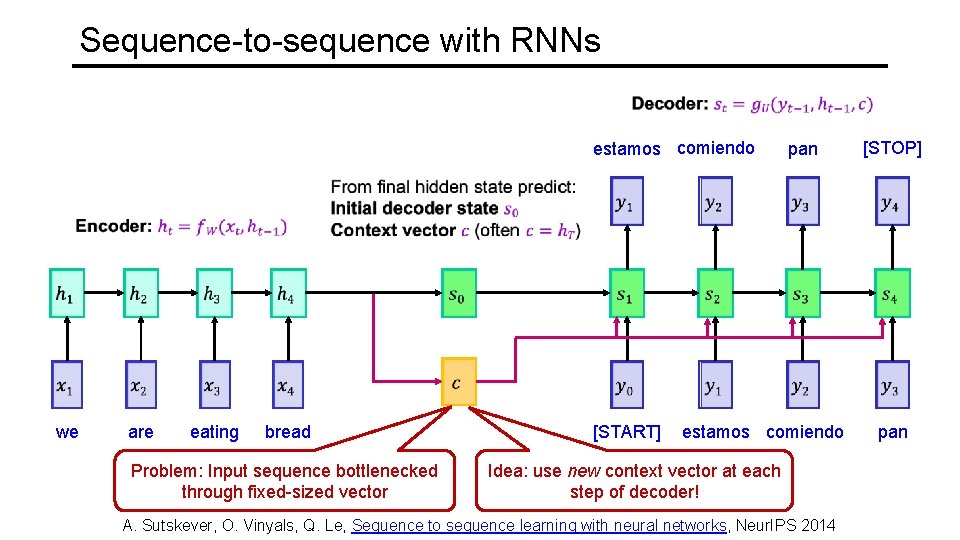
Sequence-to-sequence with RNNs estamos comiendo we are eating bread [START] pan estamos comiendo [STOP] pan
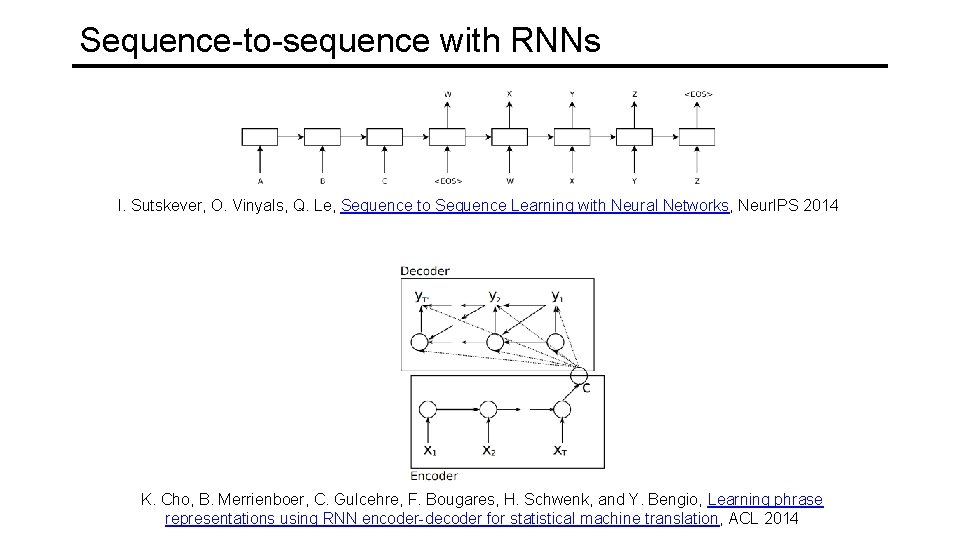
Sequence-to-sequence with RNNs I. Sutskever, O. Vinyals, Q. Le, Sequence to Sequence Learning with Neural Networks, Neur. IPS 2014 K. Cho, B. Merrienboer, C. Gulcehre, F. Bougares, H. Schwenk, and Y. Bengio, Learning phrase representations using RNN encoder-decoder for statistical machine translation, ACL 2014
Sequence-to-sequence with RNNs estamos comiendo we are eating bread Problem: Input sequence bottlenecked through fixed-sized vector [START] pan estamos comiendo Idea: use new context vector at each step of decoder! A. Sutskever, O. Vinyals, Q. Le, Sequence to sequence learning with neural networks, Neur. IPS 2014 [STOP] pan
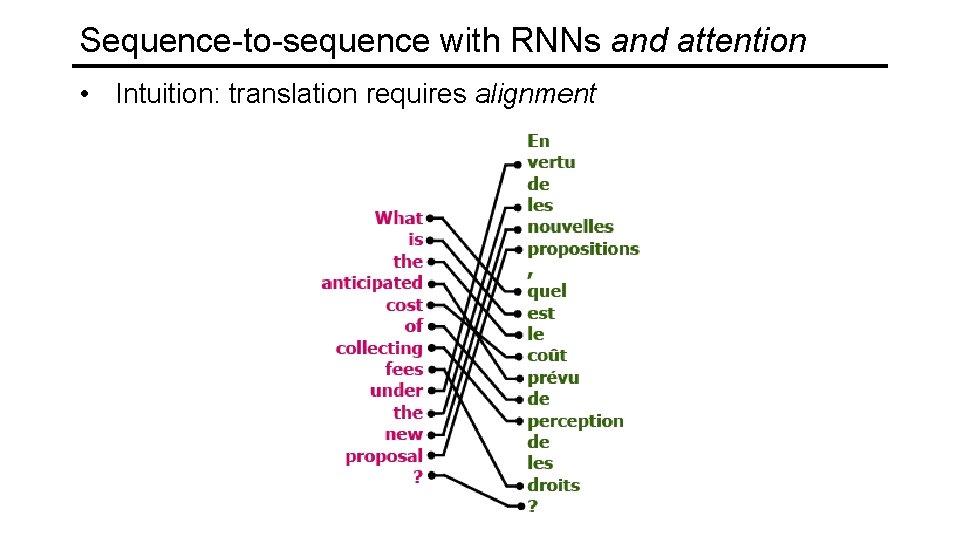
Sequence-to-sequence with RNNs and attention • Intuition: translation requires alignment
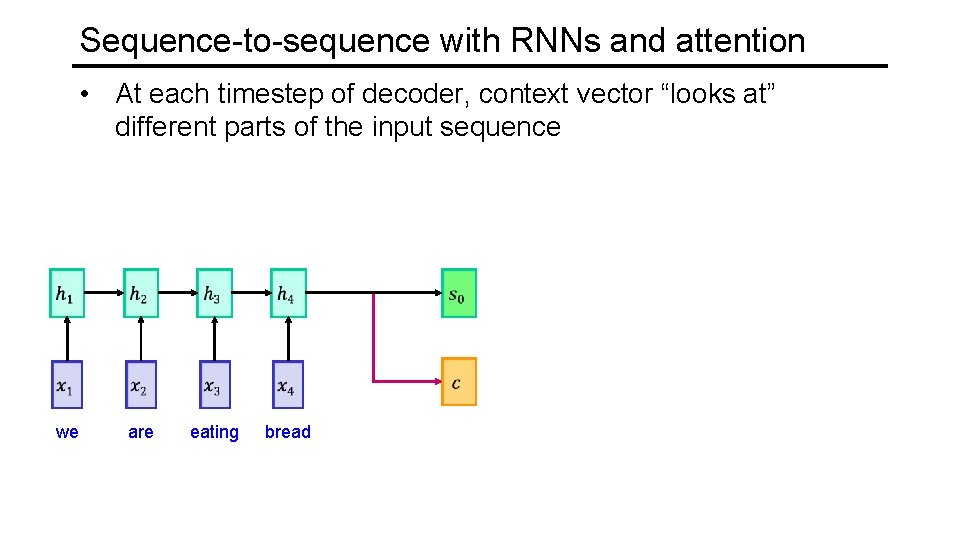
Sequence-to-sequence with RNNs and attention • At each timestep of decoder, context vector “looks at” different parts of the input sequence we are eating bread
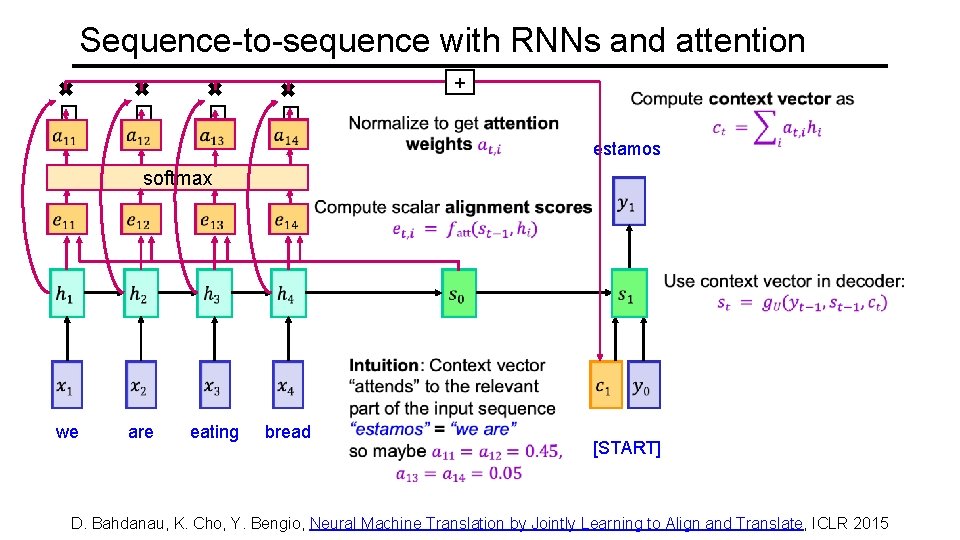
Sequence-to-sequence with RNNs and attention ✖ � ✖ � + estamos softmax we are eating bread [START] D. Bahdanau, K. Cho, Y. Bengio, Neural Machine Translation by Jointly Learning to Align and Translate, ICLR 2015
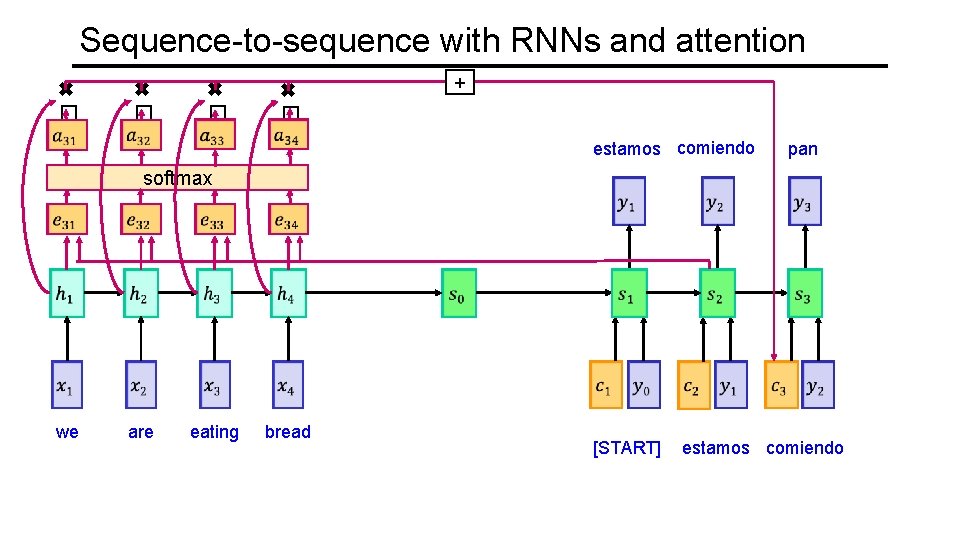
Sequence-to-sequence with RNNs and attention ✖ � ✖ � + estamos comiendo softmax we are eating bread [START] estamos
Sequence-to-sequence with RNNs and attention ✖ � ✖ � + estamos comiendo pan softmax we are eating bread [START] estamos comiendo
Sequence-to-sequence with RNNs and attention ✖ � ✖ � + estamos comiendo pan [STOP] softmax we are eating bread [START] estamos comiendo pan
Sequence-to-sequence with RNNs and attention ✖ � ✖ � + estamos comiendo pan [STOP] softmax we are eating bread [START] estamos comiendo pan
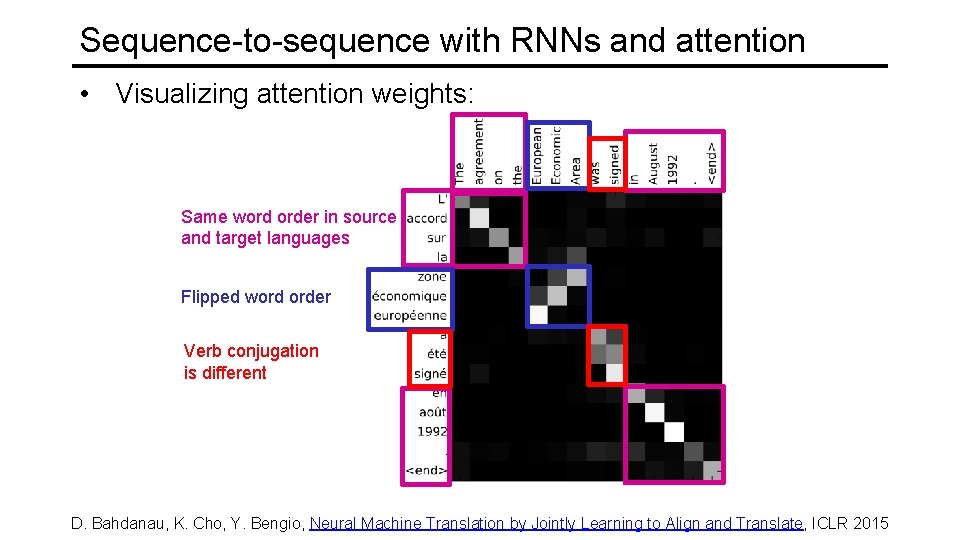
Sequence-to-sequence with RNNs and attention • Visualizing attention weights: Same word order in source and target languages Flipped word order Verb conjugation is different D. Bahdanau, K. Cho, Y. Bengio, Neural Machine Translation by Jointly Learning to Align and Translate, ICLR 2015
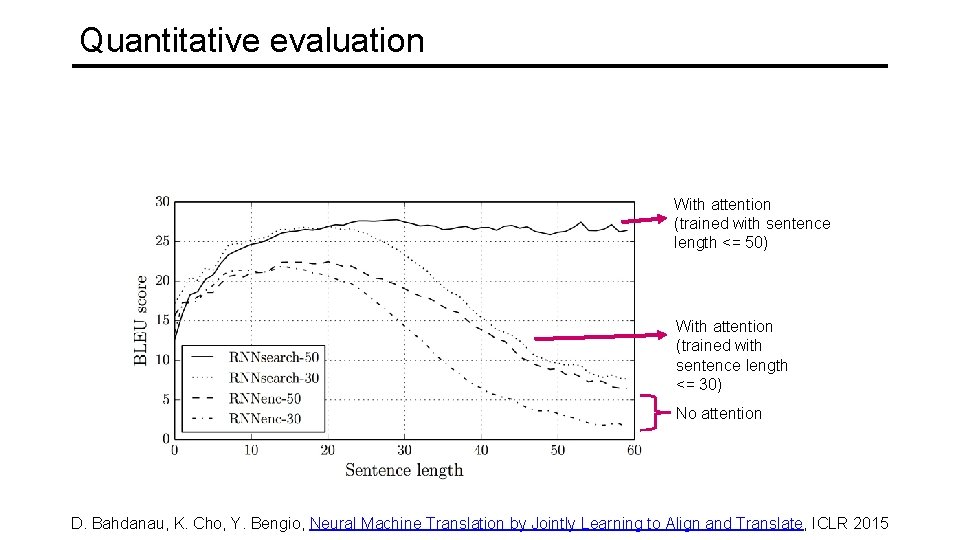
Quantitative evaluation With attention (trained with sentence length <= 50) With attention (trained with sentence length <= 30) No attention D. Bahdanau, K. Cho, Y. Bengio, Neural Machine Translation by Jointly Learning to Align and Translate, ICLR 2015
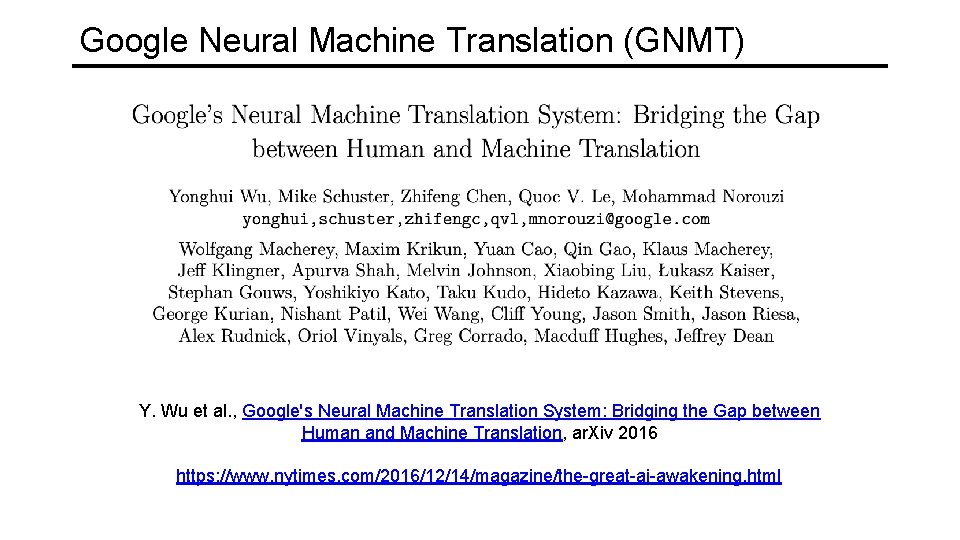
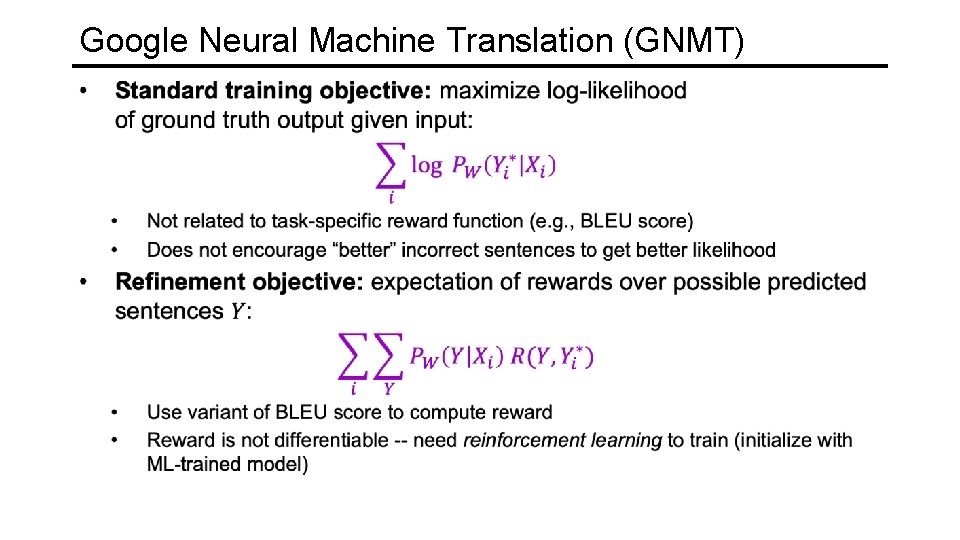
Google Neural Machine Translation (GNMT) Y. Wu et al. , Google's Neural Machine Translation System: Bridging the Gap between Human and Machine Translation, ar. Xiv 2016 https: //www. nytimes. com/2016/12/14/magazine/the-great-ai-awakening. html
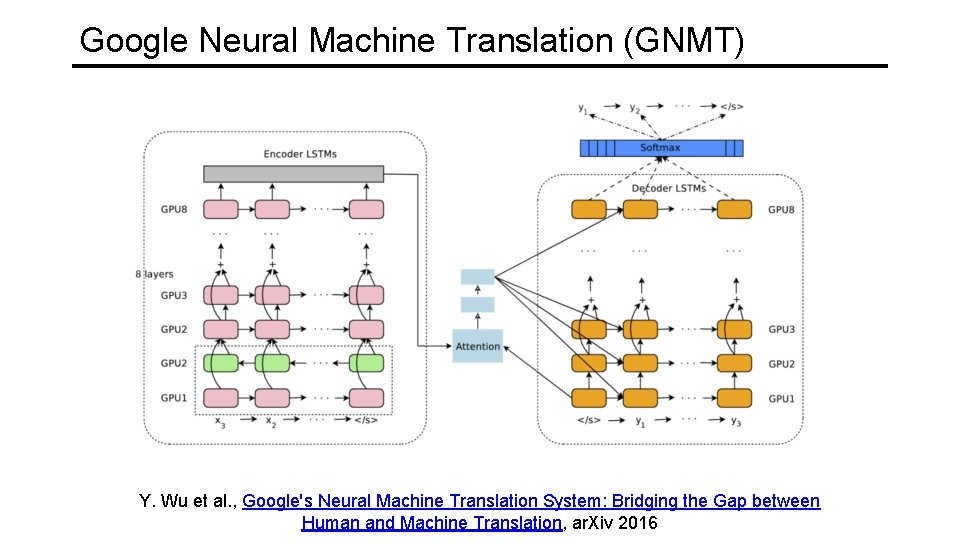
Google Neural Machine Translation (GNMT) Y. Wu et al. , Google's Neural Machine Translation System: Bridging the Gap between Human and Machine Translation, ar. Xiv 2016
Google Neural Machine Translation (GNMT)
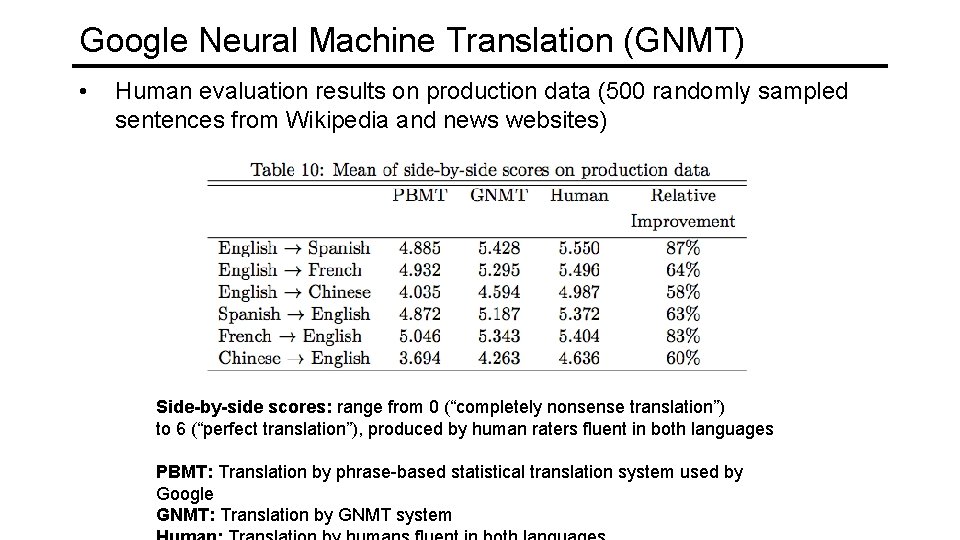
Google Neural Machine Translation (GNMT) • Human evaluation results on production data (500 randomly sampled sentences from Wikipedia and news websites) Side-by-side scores: range from 0 (“completely nonsense translation”) to 6 (“perfect translation”), produced by human raters fluent in both languages PBMT: Translation by phrase-based statistical translation system used by Google GNMT: Translation by GNMT system
Outline • Vanilla seq 2 seq with RNNs • Seq 2 seq with RNNs and attention • Image captioning with attention
Generalizing attention ✖ � ✖ � + estamos comiendo pan [STOP] softmax we are eating bread [START] estamos comiendo pan
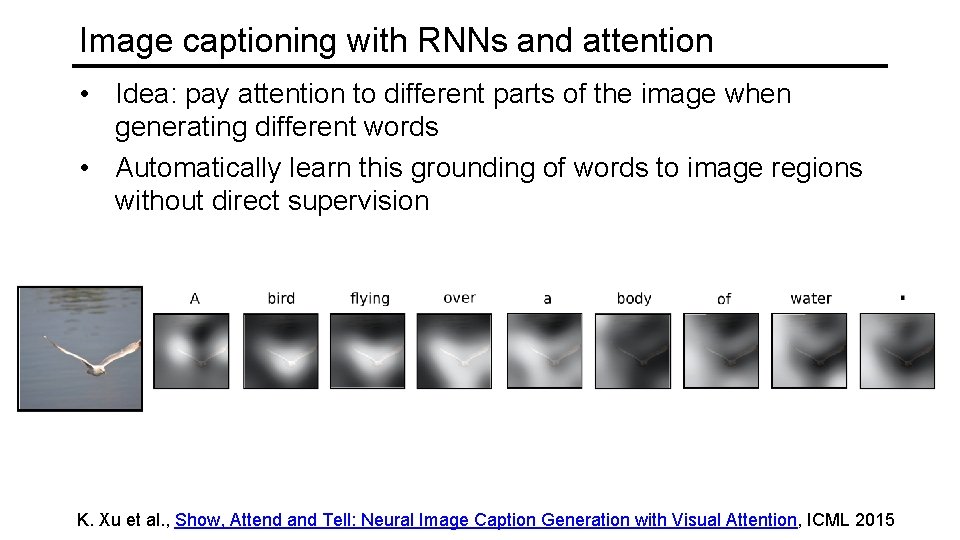
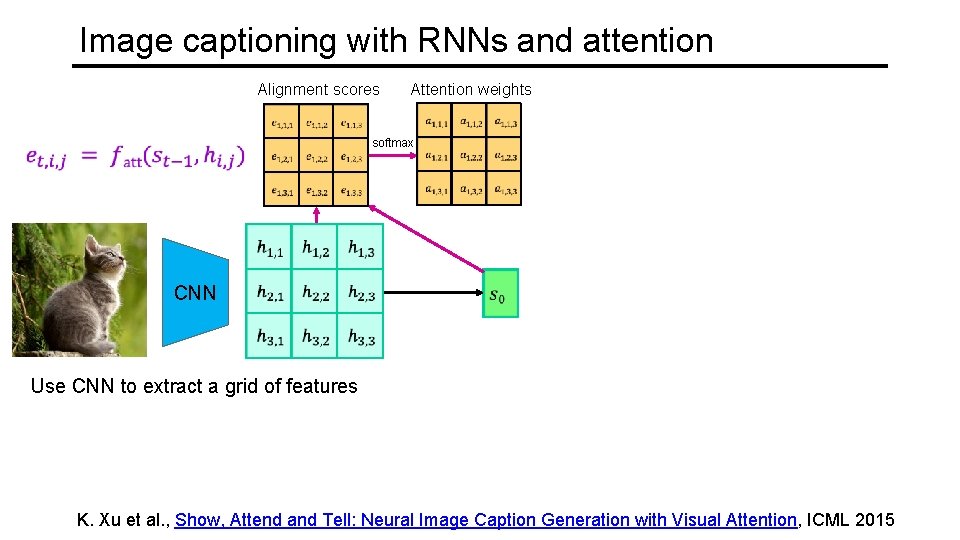
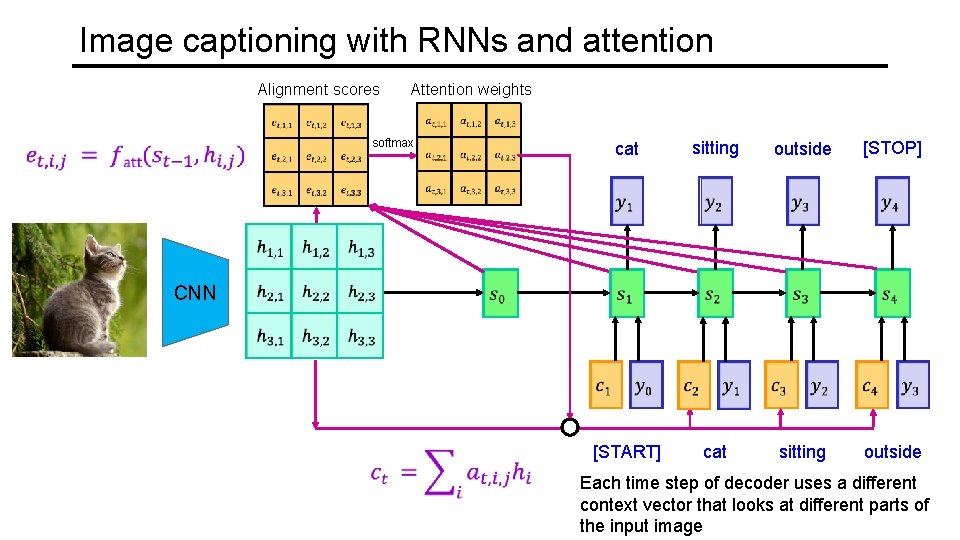
Image captioning with RNNs and attention • Idea: pay attention to different parts of the image when generating different words • Automatically learn this grounding of words to image regions without direct supervision K. Xu et al. , Show, Attend and Tell: Neural Image Caption Generation with Visual Attention, ICML 2015
Image captioning with RNNs and attention Alignment scores Attention weights softmax CNN Use CNN to extract a grid of features K. Xu et al. , Show, Attend and Tell: Neural Image Caption Generation with Visual Attention, ICML 2015
Image captioning with RNNs and attention Alignment scores Attention weights softmax cat CNN [START]
Image captioning with RNNs and attention Alignment scores Attention weights softmax cat sitting [START] cat CNN Use a CNN to compute a grid of features for an image
Image captioning with RNNs and attention Alignment scores Attention weights softmax cat sitting outside [STOP] [START] cat sitting outside CNN Each time step of decoder uses a different context vector that looks at different parts of the input image
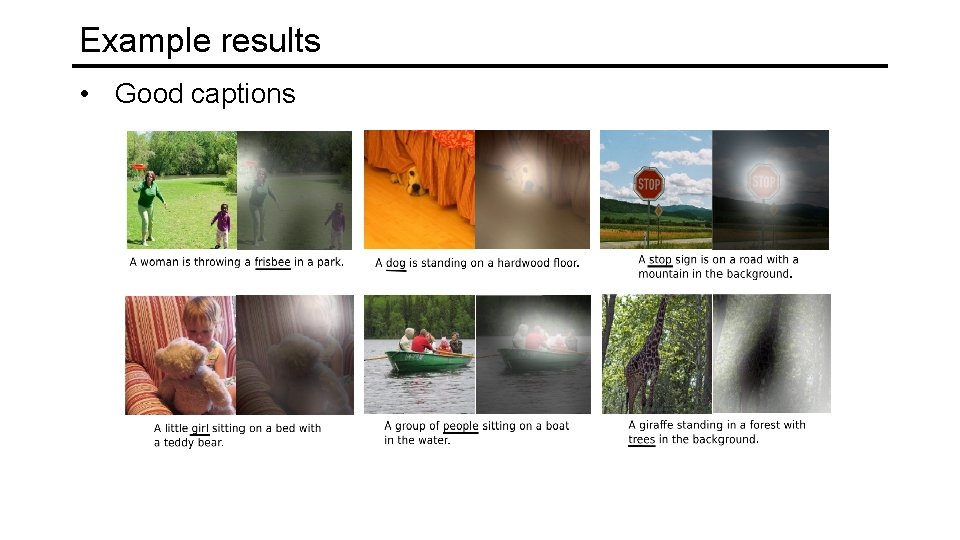
Example results • Good captions
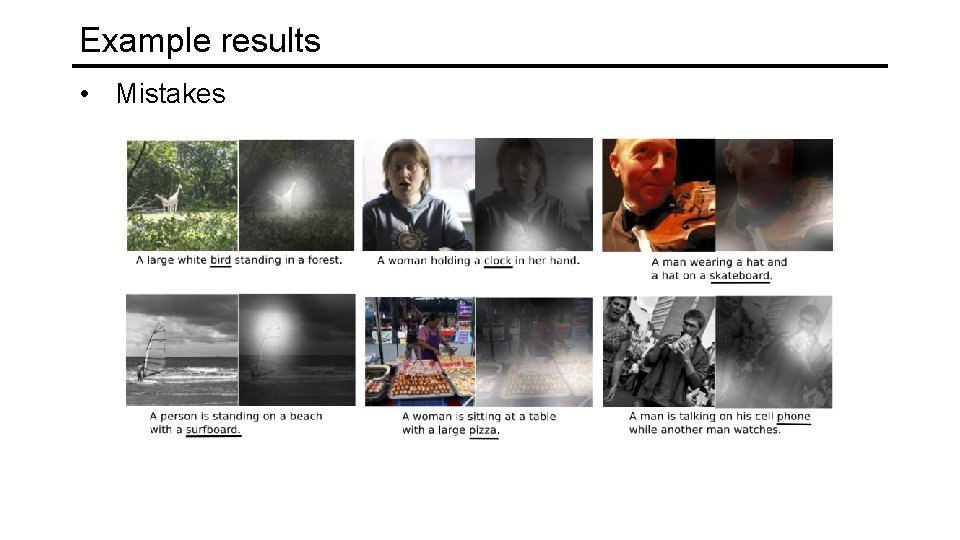
Example results • Mistakes
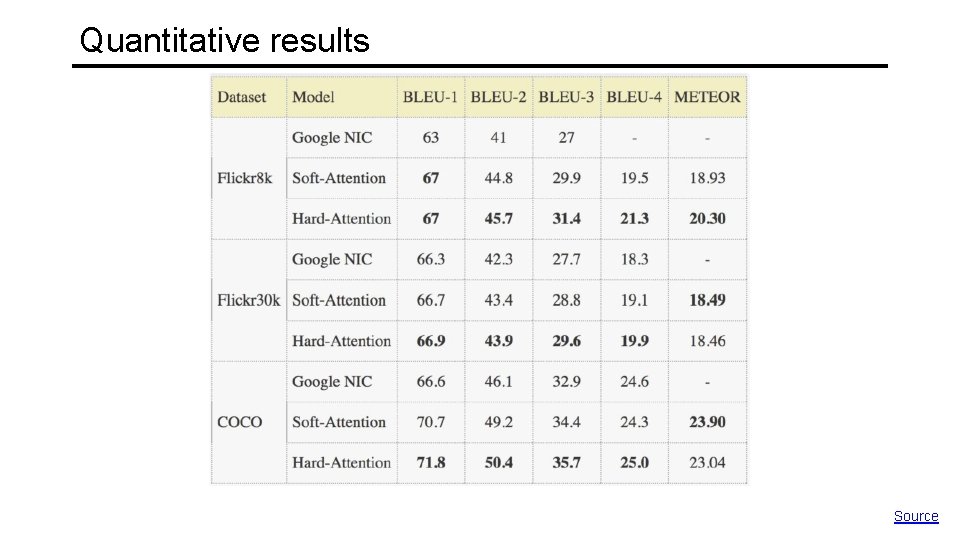
Quantitative results Source
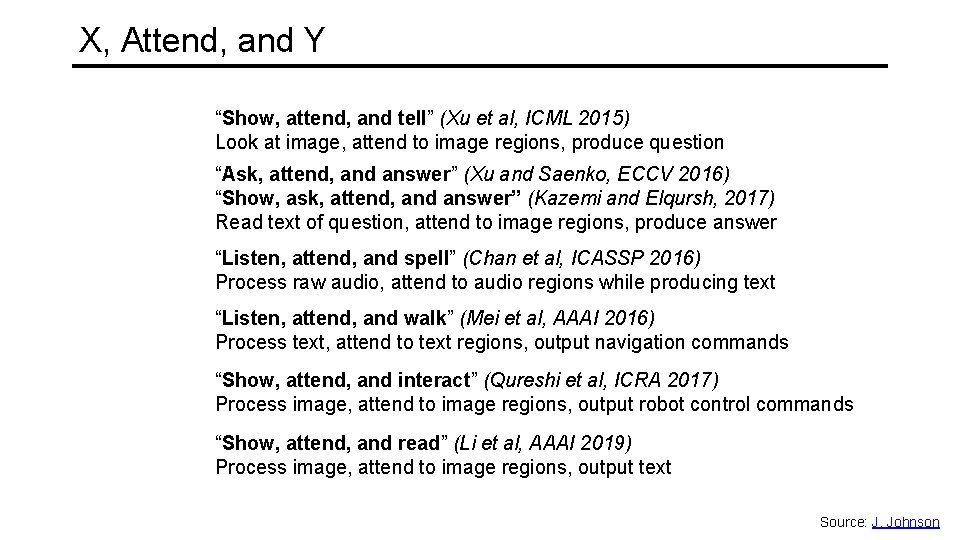
X, Attend, and Y “Show, attend, and tell” (Xu et al, ICML 2015) Look at image, attend to image regions, produce question “Ask, attend, and answer” (Xu and Saenko, ECCV 2016) “Show, ask, attend, and answer” (Kazemi and Elqursh, 2017) Read text of question, attend to image regions, produce answer “Listen, attend, and spell” (Chan et al, ICASSP 2016) Process raw audio, attend to audio regions while producing text “Listen, attend, and walk” (Mei et al, AAAI 2016) Process text, attend to text regions, output navigation commands “Show, attend, and interact” (Qureshi et al, ICRA 2017) Process image, attend to image regions, output robot control commands “Show, attend, and read” (Li et al, AAAI 2019) Process image, attend to image regions, output text Source: J. Johnson
Outline • • Vanilla seq 2 seq with RNNs Seq 2 seq with RNNs and attention Image captioning with attention Convolutional seq 2 seq with attention
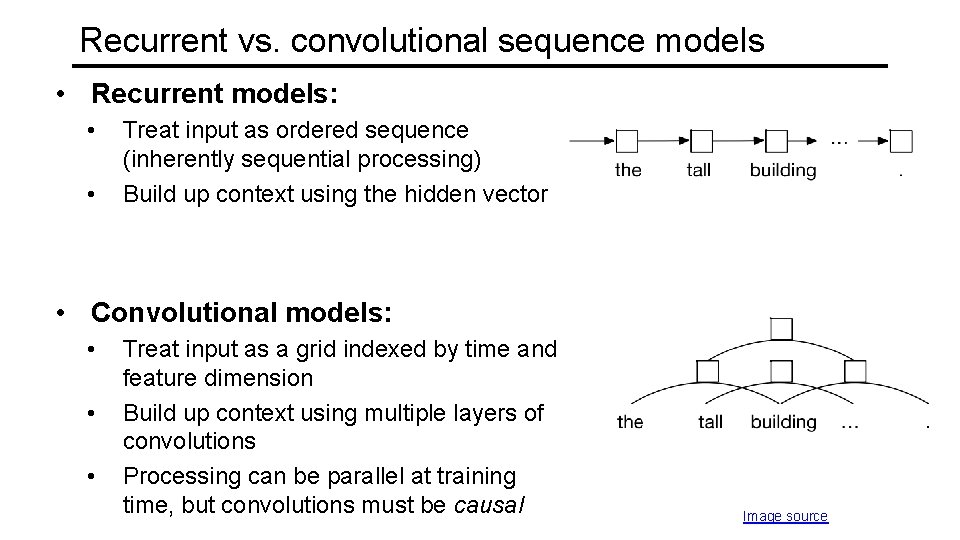
Recurrent vs. convolutional sequence models • Recurrent models: • • Treat input as ordered sequence (inherently sequential processing) Build up context using the hidden vector • Convolutional models: • • • Treat input as a grid indexed by time and feature dimension Build up context using multiple layers of convolutions Processing can be parallel at training time, but convolutions must be causal Image source
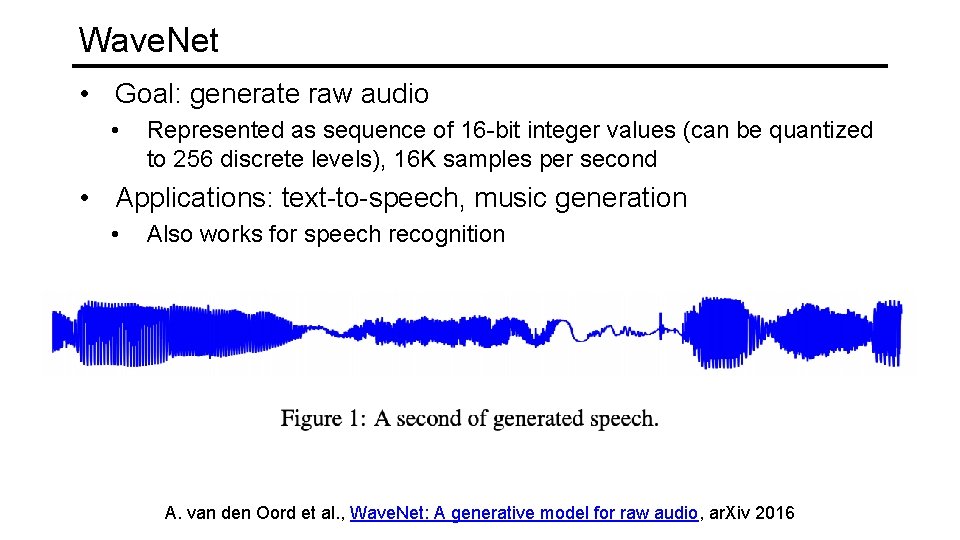
Wave. Net • Goal: generate raw audio • Represented as sequence of 16 -bit integer values (can be quantized to 256 discrete levels), 16 K samples per second • Applications: text-to-speech, music generation • Also works for speech recognition A. van den Oord et al. , Wave. Net: A generative model for raw audio, ar. Xiv 2016
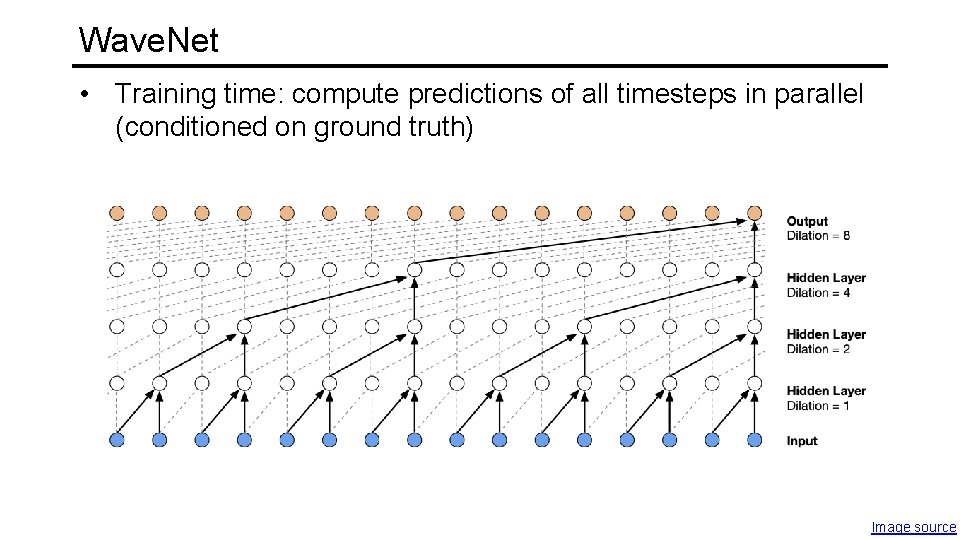
Wave. Net • Training time: compute predictions of all timesteps in parallel (conditioned on ground truth) Image source
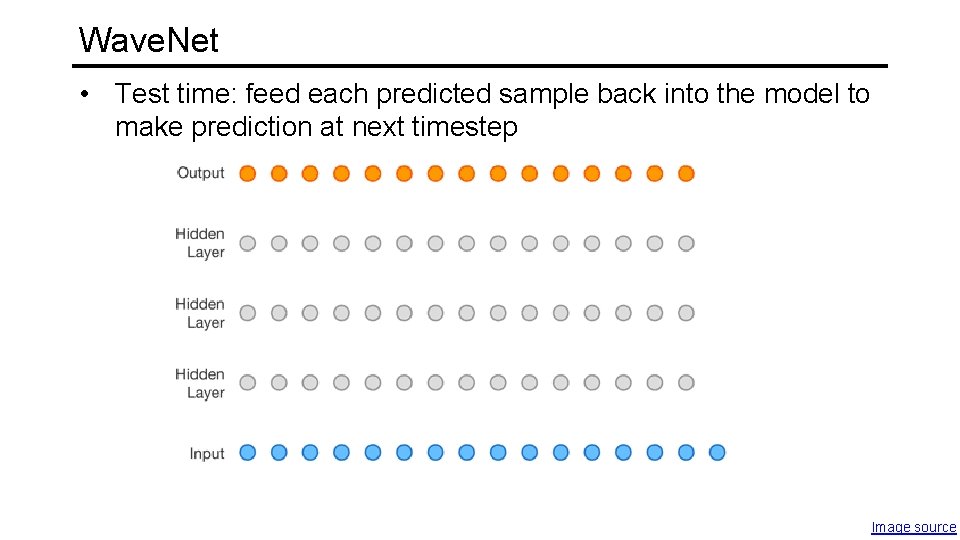
Wave. Net • Test time: feed each predicted sample back into the model to make prediction at next timestep Image source
Wave. Net: Results • Text-to-speech with different speaker identities: • Generated sample of classical piano music: https: //deepmind. com/blog/article/wavenet-generative-model-raw-audio
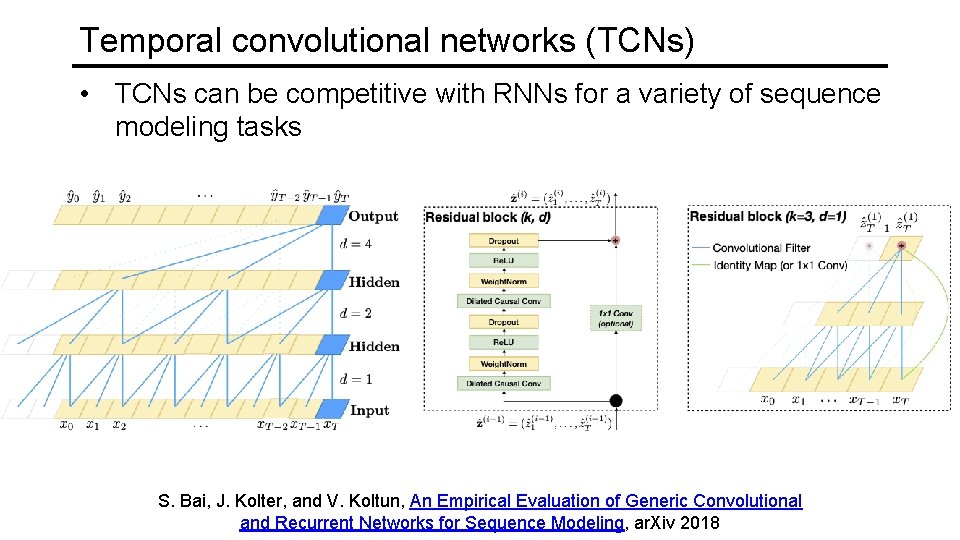
Temporal convolutional networks (TCNs) • TCNs can be competitive with RNNs for a variety of sequence modeling tasks S. Bai, J. Kolter, and V. Koltun, An Empirical Evaluation of Generic Convolutional and Recurrent Networks for Sequence Modeling, ar. Xiv 2018
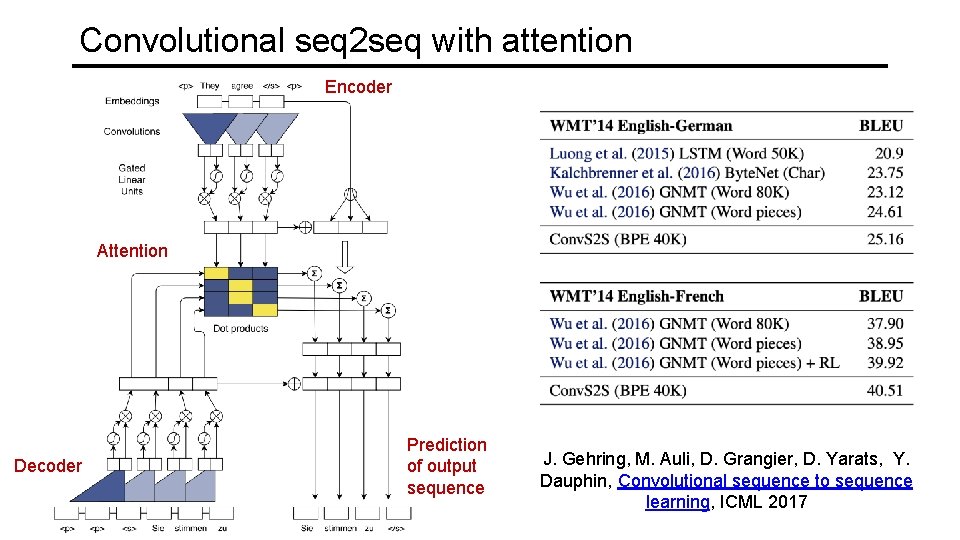
Convolutional seq 2 seq with attention Encoder Attention Decoder Prediction of output sequence J. Gehring, M. Auli, D. Grangier, D. Yarats, Y. Dauphin, Convolutional sequence to sequence learning, ICML 2017
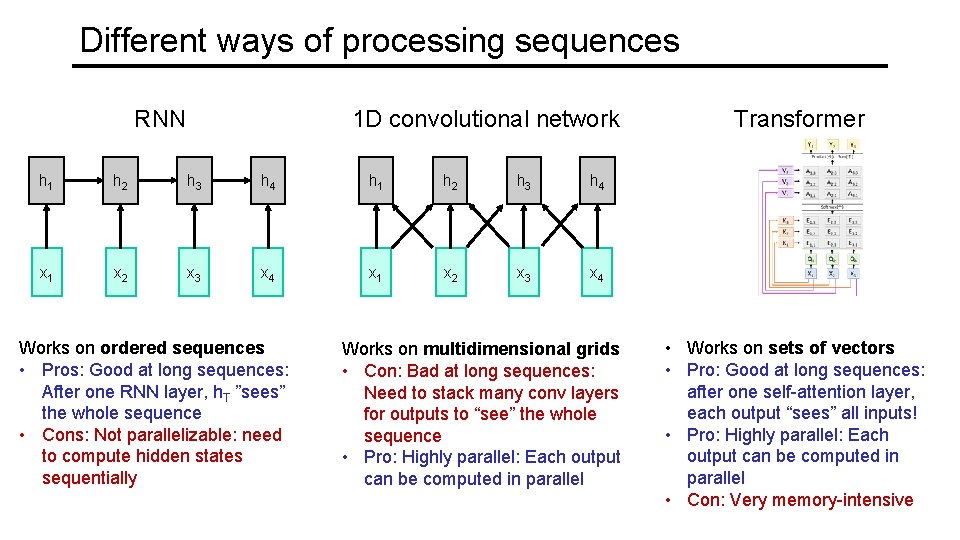
Different ways of processing sequences 1 D convolutional network RNN h 1 h 2 h 3 h 4 x 1 x 2 x 3 x 4 Works on ordered sequences • Pros: Good at long sequences: After one RNN layer, h. T ”sees” the whole sequence • Cons: Not parallelizable: need to compute hidden states sequentially Works on multidimensional grids • Con: Bad at long sequences: Need to stack many conv layers for outputs to “see” the whole sequence • Pro: Highly parallel: Each output can be computed in parallel Transformer • Works on sets of vectors • Pro: Good at long sequences: after one self-attention layer, each output “sees” all inputs! • Pro: Highly parallel: Each output can be computed in parallel • Con: Very memory-intensive