
Sequences Jordi Cortadella Department of Computer Science Maximum
- Slides: 18
Sequences Jordi Cortadella Department of Computer Science
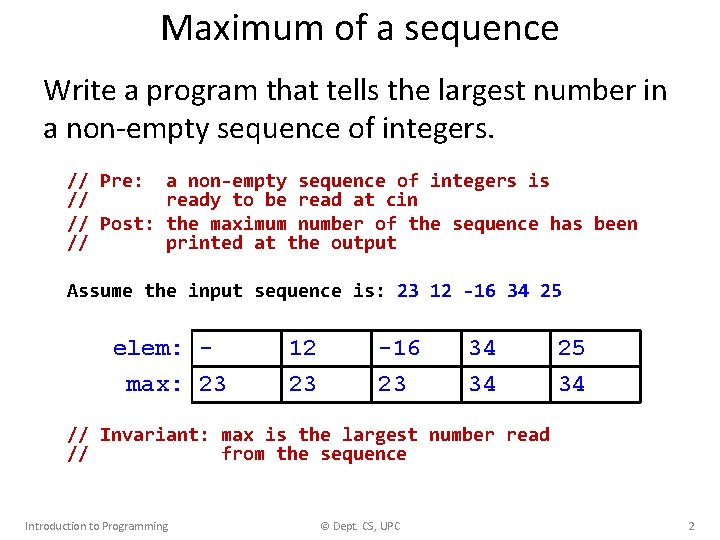
Maximum of a sequence Write a program that tells the largest number in a non-empty sequence of integers. // Pre: // // Post: // a non-empty sequence of integers is ready to be read at cin the maximum number of the sequence has been printed at the output Assume the input sequence is: 23 12 -16 34 25 elem: max: 23 12 23 -16 23 34 34 25 34 // Invariant: max is the largest number read // from the sequence Introduction to Programming © Dept. CS, UPC 2
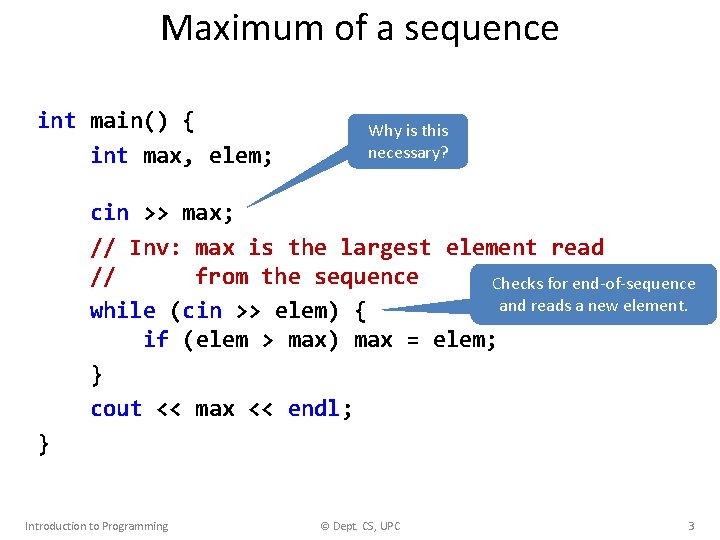
Maximum of a sequence int main() { int max, elem; Why is this necessary? cin >> max; // Inv: max is the largest element read // from the sequence Checks for end-of-sequence and reads a new element. while (cin >> elem) { if (elem > max) max = elem; } cout << max << endl; } Introduction to Programming © Dept. CS, UPC 3
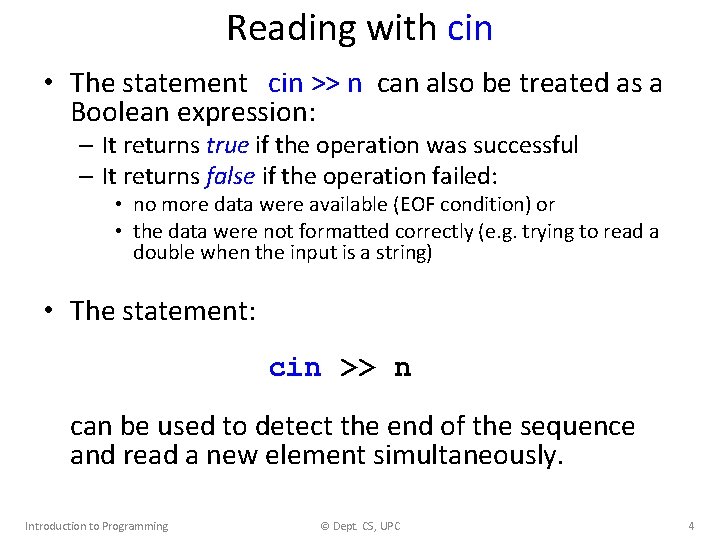
Reading with cin • The statement cin >> n can also be treated as a Boolean expression: – It returns true if the operation was successful – It returns false if the operation failed: • no more data were available (EOF condition) or • the data were not formatted correctly (e. g. trying to read a double when the input is a string) • The statement: cin >> n can be used to detect the end of the sequence and read a new element simultaneously. Introduction to Programming © Dept. CS, UPC 4
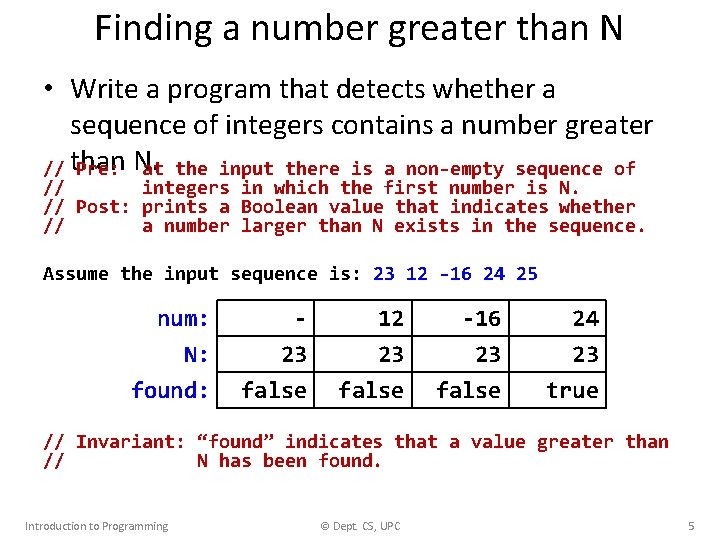
Finding a number greater than N • Write a program that detects whether a sequence of integers contains a number greater // than Pre: N. at the input there is a non-empty sequence of // integers in which the first number is N. // Post: prints a Boolean value that indicates whether // a number larger than N exists in the sequence. Assume the input sequence is: 23 12 -16 24 25 num: N: 23 12 23 -16 23 24 23 found: false true // Invariant: “found” indicates that a value greater than // N has been found. Introduction to Programming © Dept. CS, UPC 5
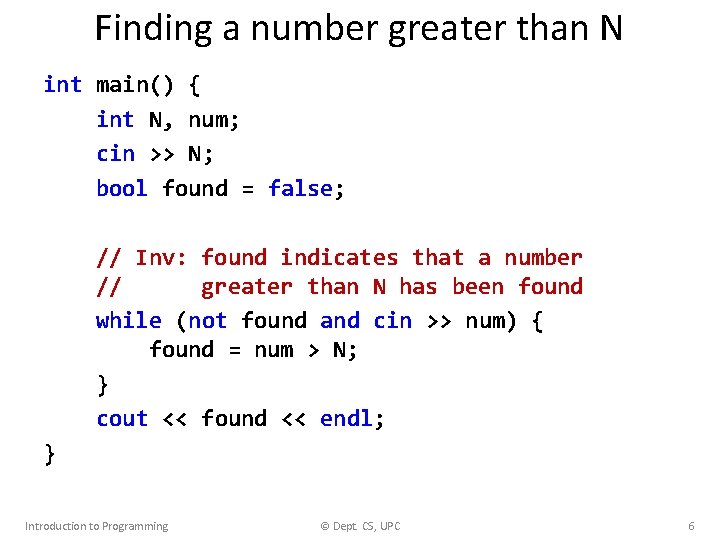
Finding a number greater than N int main() { int N, num; cin >> N; bool found = false; // Inv: found indicates that a number // greater than N has been found while (not found and cin >> num) { found = num > N; } cout << found << endl; } Introduction to Programming © Dept. CS, UPC 6
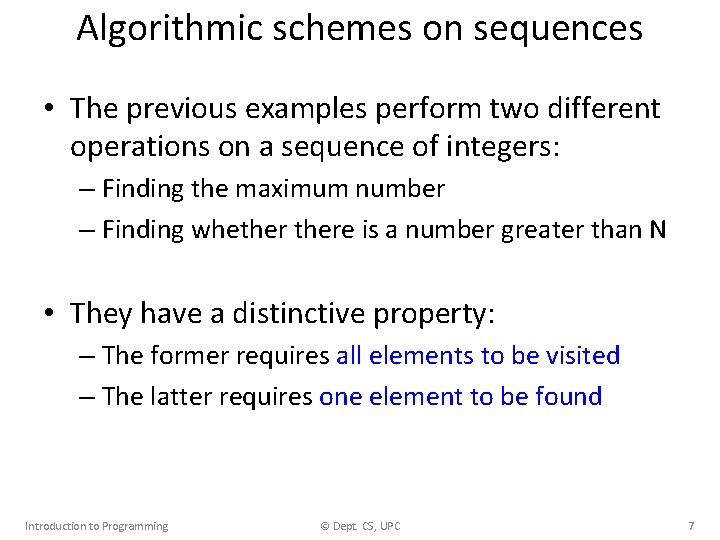
Algorithmic schemes on sequences • The previous examples perform two different operations on a sequence of integers: – Finding the maximum number – Finding whethere is a number greater than N • They have a distinctive property: – The former requires all elements to be visited – The latter requires one element to be found Introduction to Programming © Dept. CS, UPC 7
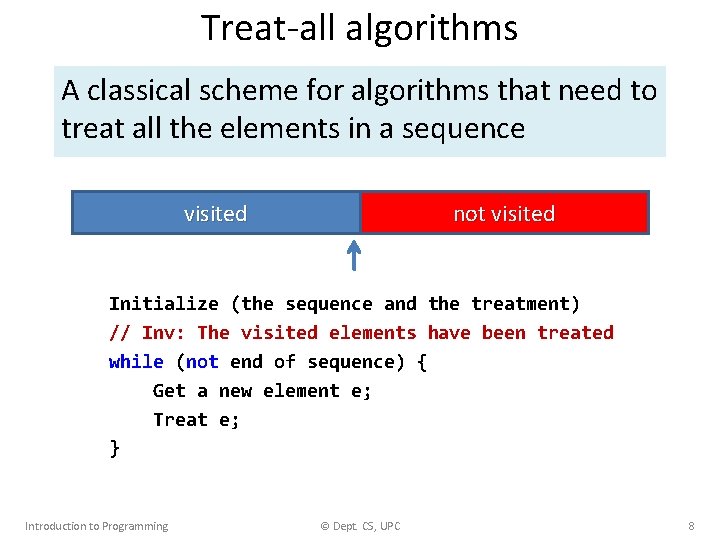
Treat-all algorithms A classical scheme for algorithms that need to treat all the elements in a sequence visited not visited Initialize (the sequence and the treatment) // Inv: The visited elements have been treated while (not end of sequence) { Get a new element e; Treat e; } Introduction to Programming © Dept. CS, UPC 8
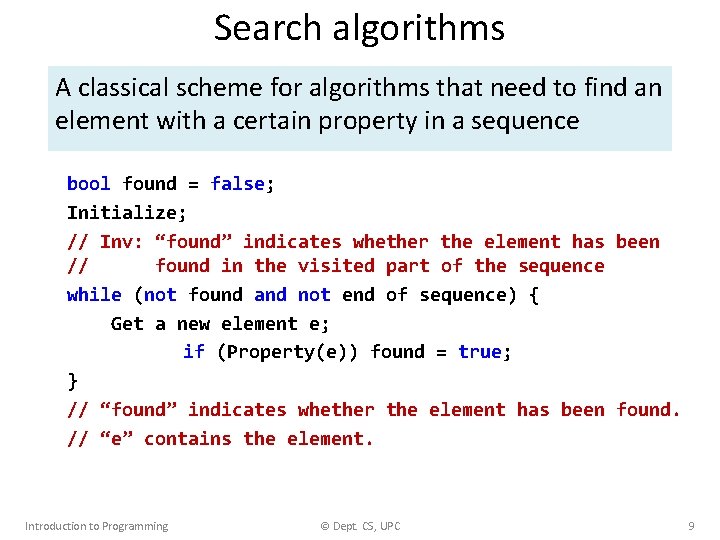
Search algorithms A classical scheme for algorithms that need to find an element with a certain property in a sequence bool found = false; Initialize; // Inv: “found” indicates whether the element has been // found in the visited part of the sequence while (not found and not end of sequence) { Get a new element e; if (Property(e)) found = true; } // “found” indicates whether the element has been found. // “e” contains the element. Introduction to Programming © Dept. CS, UPC 9
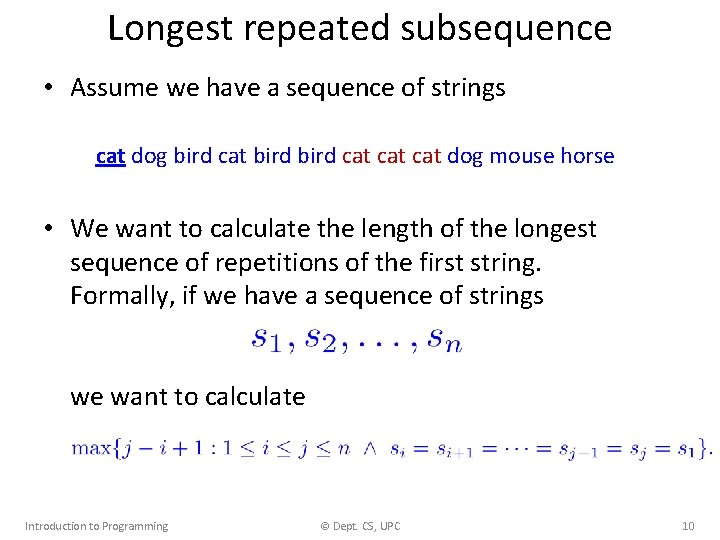
Longest repeated subsequence • Assume we have a sequence of strings cat dog bird cat cat dog mouse horse • We want to calculate the length of the longest sequence of repetitions of the first string. Formally, if we have a sequence of strings we want to calculate Introduction to Programming © Dept. CS, UPC 10
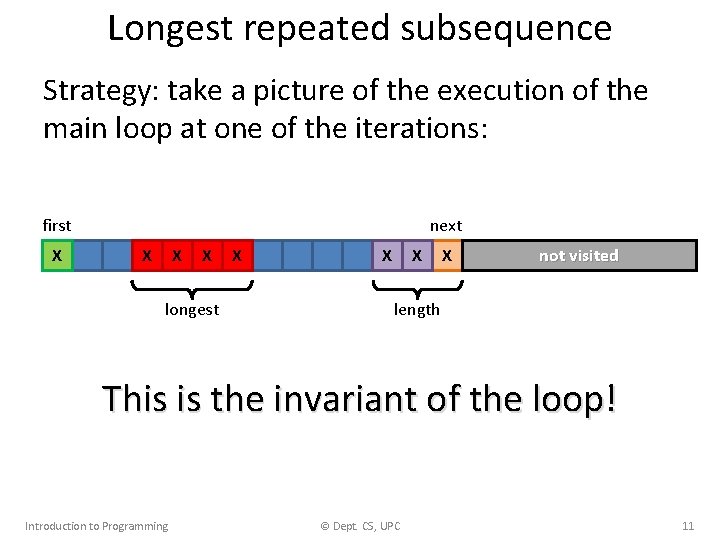
Longest repeated subsequence Strategy: take a picture of the execution of the main loop at one of the iterations: first X next X X X longest X X not visited length This is the invariant of the loop! Introduction to Programming © Dept. CS, UPC 11
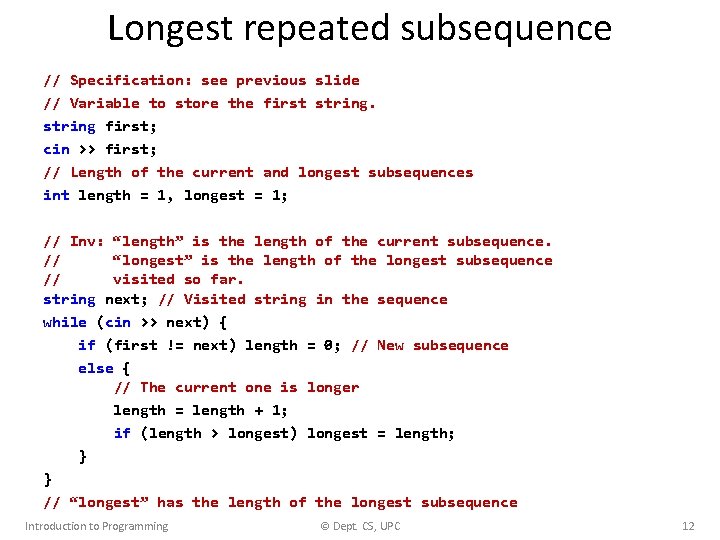
Longest repeated subsequence // Specification: see previous slide // Variable to store the first string first; cin >> first; // Length of the current and longest subsequences int length = 1, longest = 1; // Inv: “length” is the length of the current subsequence. // “longest” is the length of the longest subsequence // visited so far. string next; // Visited string in the sequence while (cin >> next) { if (first != next) length = 0; // New subsequence else { // The current one is longer length = length + 1; if (length > longest) longest = length; } } // “longest” has the length of the longest subsequence Introduction to Programming © Dept. CS, UPC 12
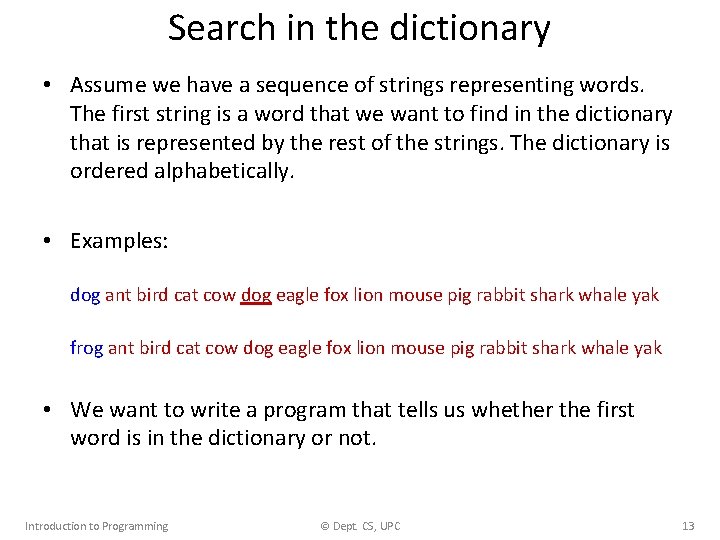
Search in the dictionary • Assume we have a sequence of strings representing words. The first string is a word that we want to find in the dictionary that is represented by the rest of the strings. The dictionary is ordered alphabetically. • Examples: dog ant bird cat cow dog eagle fox lion mouse pig rabbit shark whale yak frog ant bird cat cow dog eagle fox lion mouse pig rabbit shark whale yak • We want to write a program that tells us whether the first word is in the dictionary or not. Introduction to Programming © Dept. CS, UPC 13
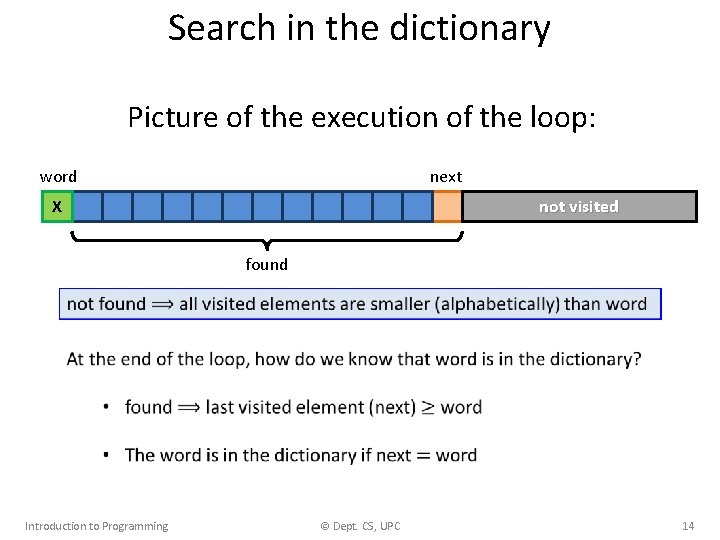
Search in the dictionary Picture of the execution of the loop: word next X not visited found Introduction to Programming © Dept. CS, UPC 14
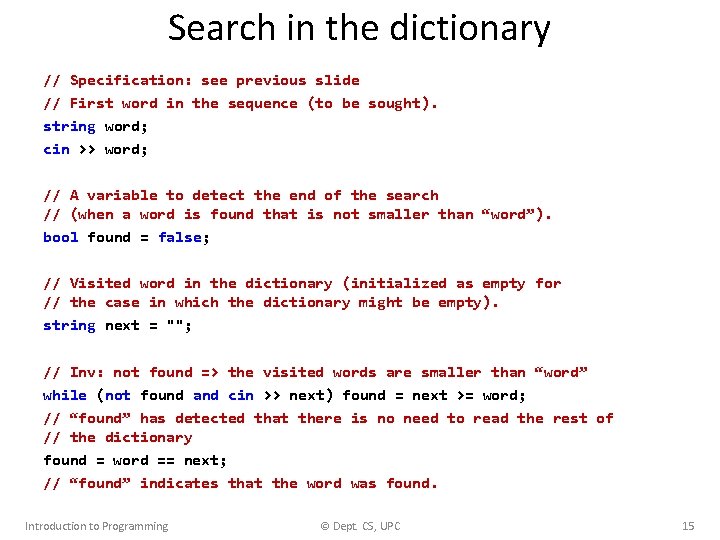
Search in the dictionary // Specification: see previous slide // First word in the sequence (to be sought). string word; cin >> word; // A variable to detect the end of the search // (when a word is found that is not smaller than “word”). bool found = false; // Visited word in the dictionary (initialized as empty for // the case in which the dictionary might be empty). string next = ""; // Inv: not found => the visited words are smaller than “word” while (not found and cin >> next) found = next >= word; // “found” has detected that there is no need to read the rest of // the dictionary found = word == next; // “found” indicates that the word was found. Introduction to Programming © Dept. CS, UPC 15
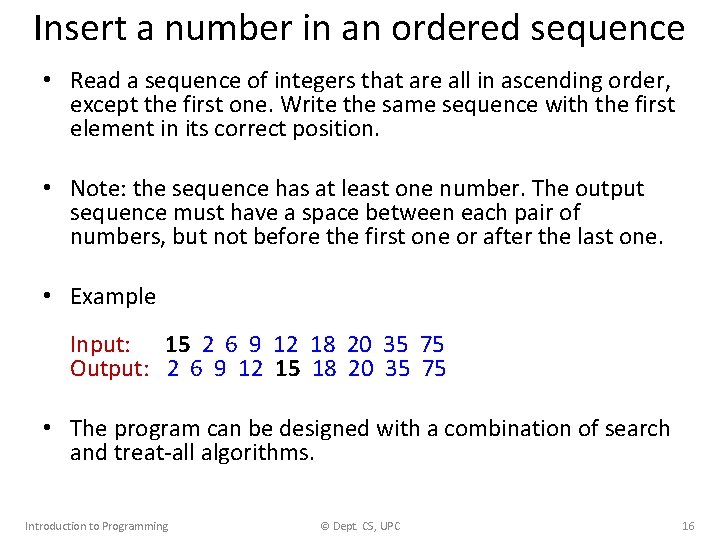
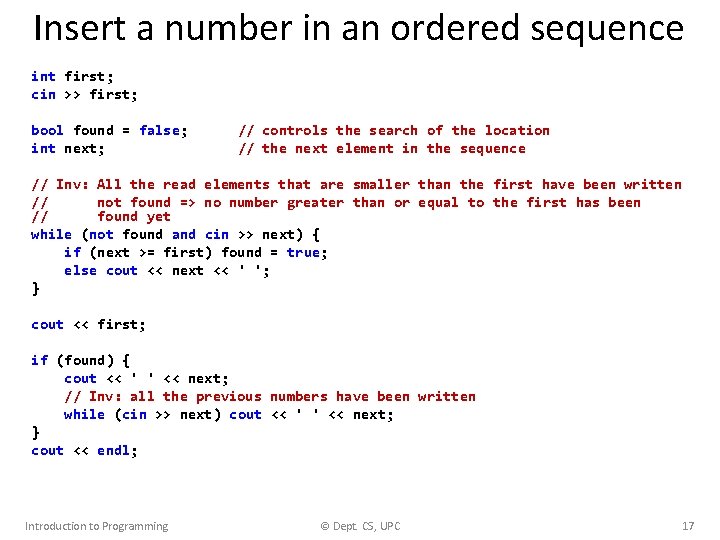
Insert a number in an ordered sequence • Read a sequence of integers that are all in ascending order, except the first one. Write the same sequence with the first element in its correct position. • Note: the sequence has at least one number. The output sequence must have a space between each pair of numbers, but not before the first one or after the last one. • Example Input: 15 2 6 9 12 18 20 35 75 Output: 2 6 9 12 15 18 20 35 75 • The program can be designed with a combination of search and treat-all algorithms. Introduction to Programming © Dept. CS, UPC 16
Insert a number in an ordered sequence int first; cin >> first; bool found = false; int next; // controls the search of the location // the next element in the sequence // Inv: All the read elements that are smaller than the first have been written // not found => no number greater than or equal to the first has been // found yet while (not found and cin >> next) { if (next >= first) found = true; else cout << next << ' '; } cout << first; if (found) { cout << ' ' << next; // Inv: all the previous numbers have been written while (cin >> next) cout << ' ' << next; } cout << endl; Introduction to Programming © Dept. CS, UPC 17
Summary • Algorithms on sequences can only have sequential access to the elements. • Two fundamental schemes: – Treat-all algorithms (all elements visited) – Search algorithms (one element must be found) • Recommendation: do not use treat-all algorithms when only a search is needed. Introduction to Programming © Dept. CS, UPC 18