
Sequences and Sigma Notation Section 1 1 Looking
- Slides: 7
Sequences and Sigma Notation Section 1. 1
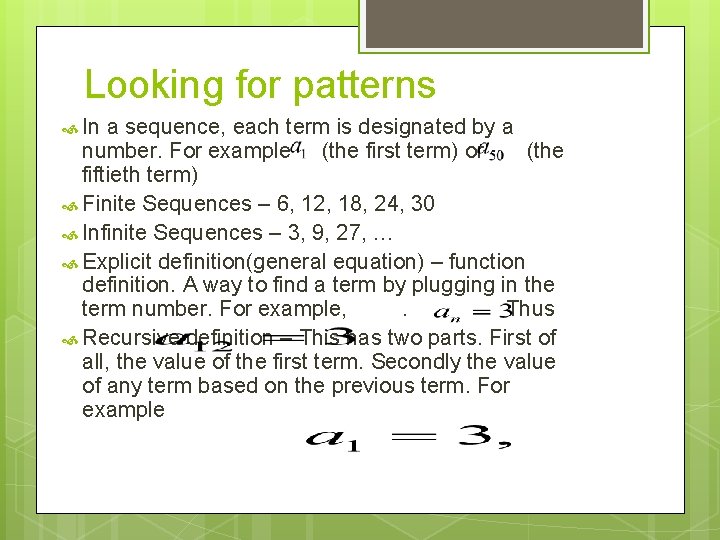
Looking for patterns In a sequence, each term is designated by a number. For example (the first term) or (the fiftieth term) Finite Sequences – 6, 12, 18, 24, 30 Infinite Sequences – 3, 9, 27, … Explicit definition(general equation) – function definition. A way to find a term by plugging in the term number. For example, . Thus Recursive definition – This has two parts. First of all, the value of the first term. Secondly the value of any term based on the previous term. For example
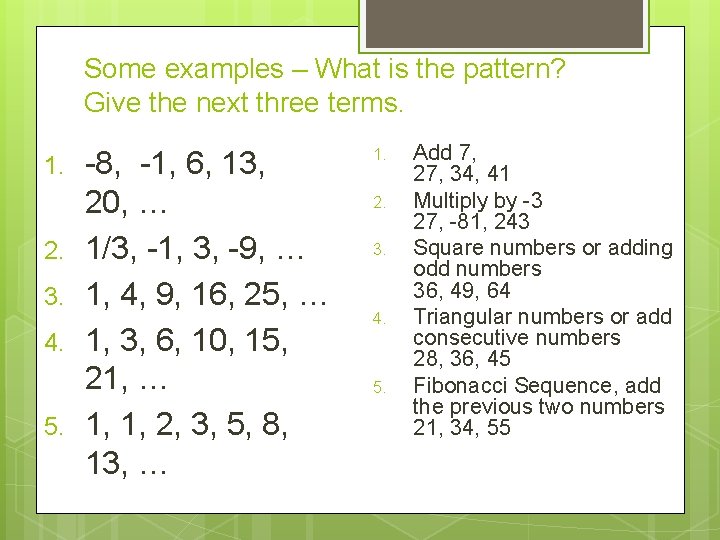
Some examples – What is the pattern? Give the next three terms. 1. 2. 3. 4. 5. -8, -1, 6, 13, 20, … 1/3, -1, 3, -9, … 1, 4, 9, 16, 25, … 1, 3, 6, 10, 15, 21, … 1, 1, 2, 3, 5, 8, 13, … 1. 2. 3. 4. 5. Add 7, 27, 34, 41 Multiply by -3 27, -81, 243 Square numbers or adding odd numbers 36, 49, 64 Triangular numbers or add consecutive numbers 28, 36, 45 Fibonacci Sequence, add the previous two numbers 21, 34, 55
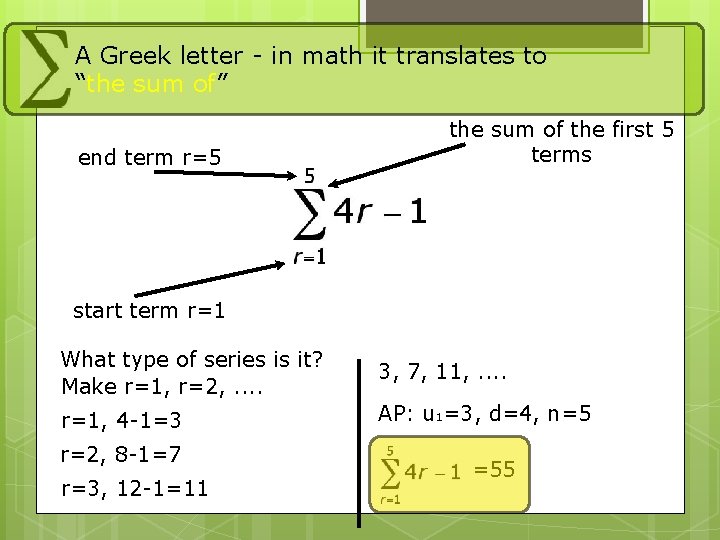
A Greek letter - in math it translates to “the sum of” end term r=5 the sum of the first 5 terms start term r=1 What type of series is it? Make r=1, r=2, . . 3, 7, 11, . . r=1, 4 -1=3 AP: u 1=3, d=4, n=5 r=2, 8 -1=7 r=3, 12 -1=11 =55
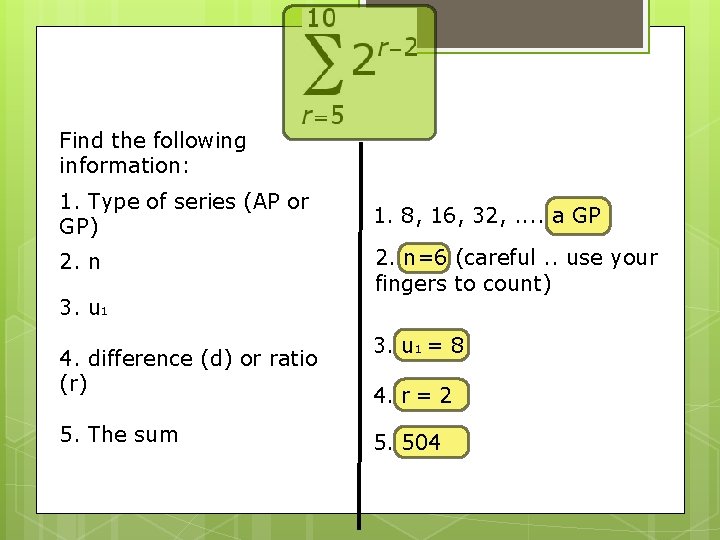
Find the following information: 1. Type of series (AP or GP) 1. 8, 16, 32, . . a GP 2. n=6 (careful. . use your fingers to count) 3. u 1 4. difference (d) or ratio (r) 5. The sum 3. u 1 = 8 4. r = 2 5. 504
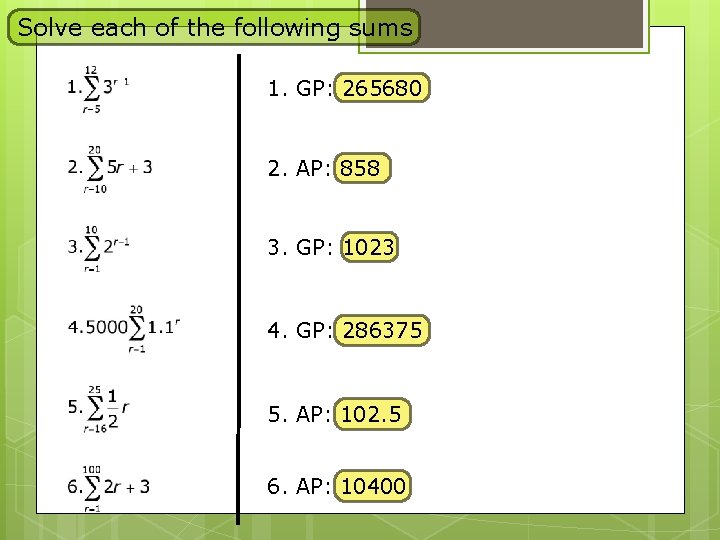
Solve each of the following sums 1. GP: 265680 2. AP: 858 3. GP: 1023 4. GP: 286375 5. AP: 102. 5 6. AP: 10400