
Sequences and Indexing A sequence is a type

- Slides: 5
Sequences and Indexing A sequence is a type of thing that represents a: • Finite, ordered collection of things • Indexed by non-negative integers. For example: • A list: ['red', 'white', 'blue'] • A string: 'Check out Joan Osborne, super musician' • A tuple: (800, 400, 310) There also types in Python for unordered collections, for example, sets and dictionaries.
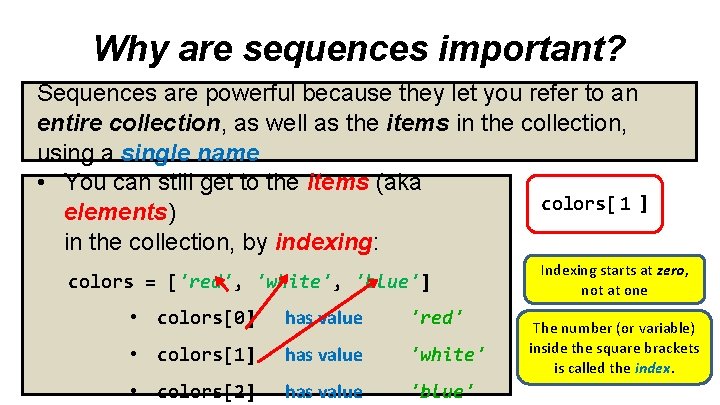
Why are sequences important? Sequences are powerful because they let you refer to an entire collection, as well as the items in the collection, using a single name. • You can still get to the items (aka colors[ 1 ] elements) in the collection, by indexing: colors = ['red', 'white', 'blue'] • colors[0] has value 'red' • colors[1] has value 'white' • colors[2] has value 'blue' Indexing starts at zero, not at one The number (or variable) inside the square brackets is called the index.
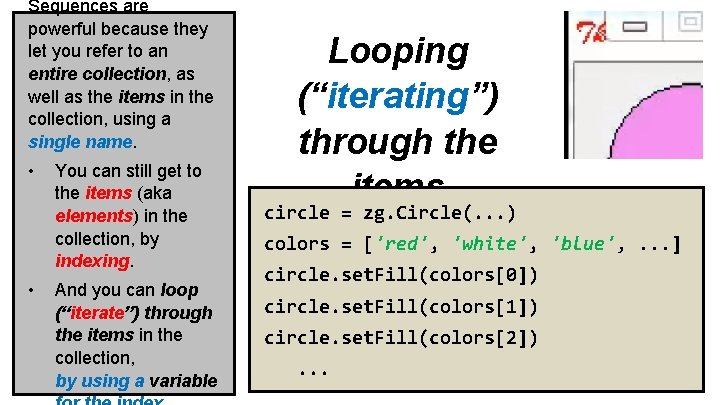
Sequences are powerful because they let you refer to an entire collection, as well as the items in the collection, using a single name. • • You can still get to the items (aka elements) in the collection, by indexing. And you can loop (“iterate”) through the items in the collection, by using a variable Looping (“iterating”) through the items circle = zg. Circle(. . . ) colors = ['red', 'white', 'blue', . . . ] circle. set. Fill(colors[0]) circle. set. Fill(colors[1]) circle. set. Fill(colors[2]). . .
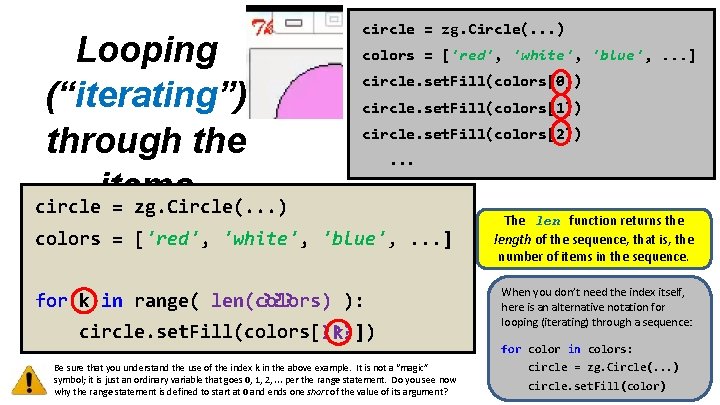
Looping (“iterating”) through the items circle = zg. Circle(. . . ) colors = ['red', 'white', 'blue', . . . ] circle. set. Fill(colors[0]) circle. set. Fill(colors[1]) circle. set. Fill(colors[2]). . . colors = ['red', 'white', 'blue', . . . ] for k in range( len(colors) ): ? ? ? circle. set. Fill(colors[? ? ? k ]) Be sure that you understand the use of the index k in the above example. It is not a “magic” symbol; it is just an ordinary variable that goes 0, 1, 2, . . . per the range statement. Do you see now why the range statement is defined to start at 0 and ends one short of the value of its argument? The len function returns the length of the sequence, that is, the number of items in the sequence. When you don’t need the index itself, here is an alternative notation for looping (iterating) through a sequence: for color in colors: circle = zg. Circle(. . . ) circle. set. Fill(color)
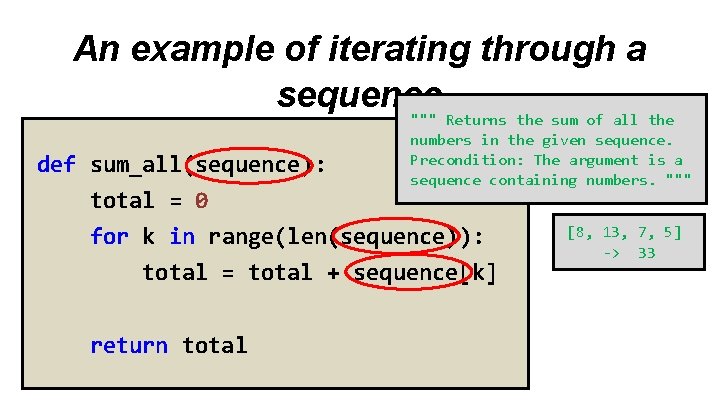
An example of iterating through a sequence """ Returns the sum of all the def sum_all(sequence): total = 0 numbers in the given sequence. Precondition: The argument is a sequence containing numbers. """ for k in range(len(sequence)): total = total + sequence[k] return total [8, 13, 7, 5] -> 33