
Sequence of tenses Direct speech Present Simple I

- Slides: 11
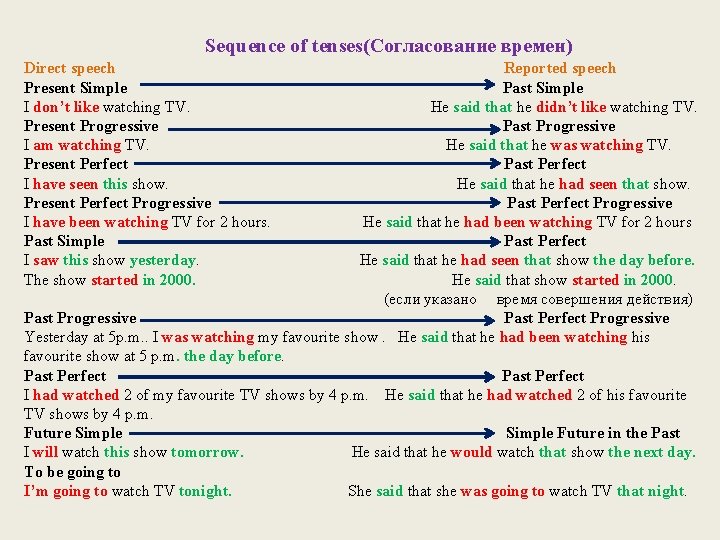
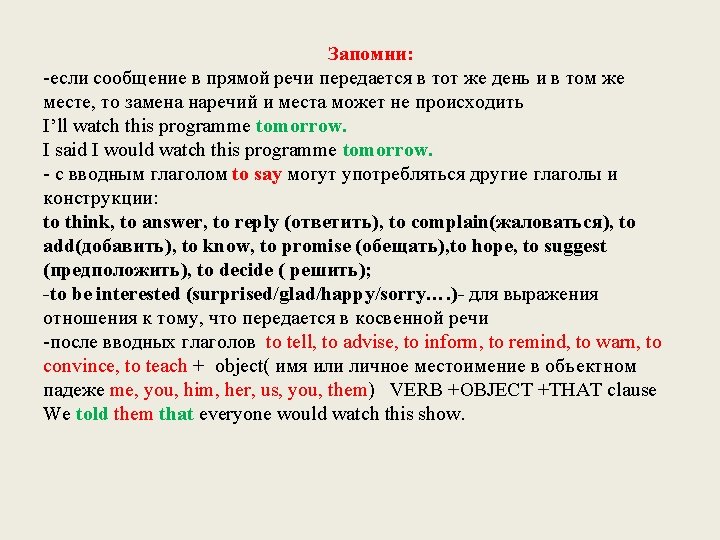
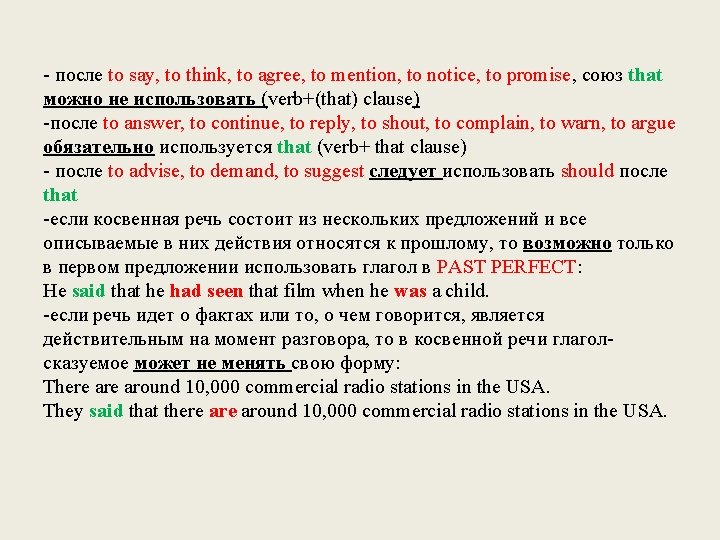
Sequence of tenses(Согласование времен) Direct speech Present Simple I don’t like watching TV. Present Progressive I am watching TV. Present Perfect I have seen this show. Present Perfect Progressive I have been watching TV for 2 hours. Past Simple I saw this show yesterday. The show started in 2000. Reported speech Past Simple He said that he didn’t like watching TV. Past Progressive He said that he was watching TV. Past Perfect He said that he had seen that show. Past Perfect Progressive He said that he had been watching TV for 2 hours Past Perfect He said that he had seen that show the day before. He said that show started in 2000. (если указано время совершения действия) Past Progressive Past Perfect Progressive Yesterday at 5 p. m. . I was watching my favourite show. He said that he had been watching his favourite show at 5 p. m. the day before. Past Perfect I had watched 2 of my favourite TV shows by 4 p. m. He said that he had watched 2 of his favourite TV shows by 4 p. m. Future Simple Future in the Past I will watch this show tomorrow. He said that he would watch that show the next day. To be going to I’m going to watch TV tonight. She said that she was going to watch TV that night.
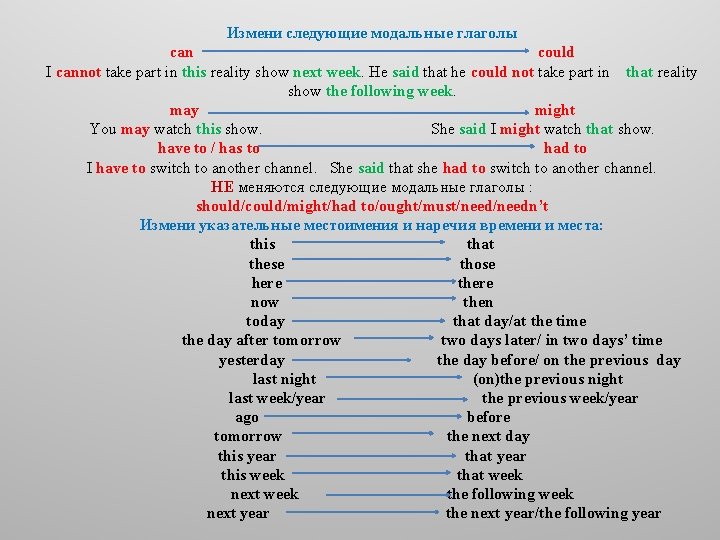
Измени следующие модальные глаголы can could I cannot take part in this reality show next week. He said that he could not take part in that reality show the following week. may might You may watch this show. She said I might watch that show. have to / has to had to I have to switch to another channel. She said that she had to switch to another channel. НЕ меняются следующие модальные глаголы : should/could/might/had to/ought/must/needn’t Измени указательные местоимения и наречия времени и места: this that these those here there now then today that day/at the time the day after tomorrow two days later/ in two days’ time yesterday the day before/ on the previous day last night (on)the previous night last week/year the previous week/year ago before tomorrow the next day this year that year this week that week next week the following week next year the next year/the following year
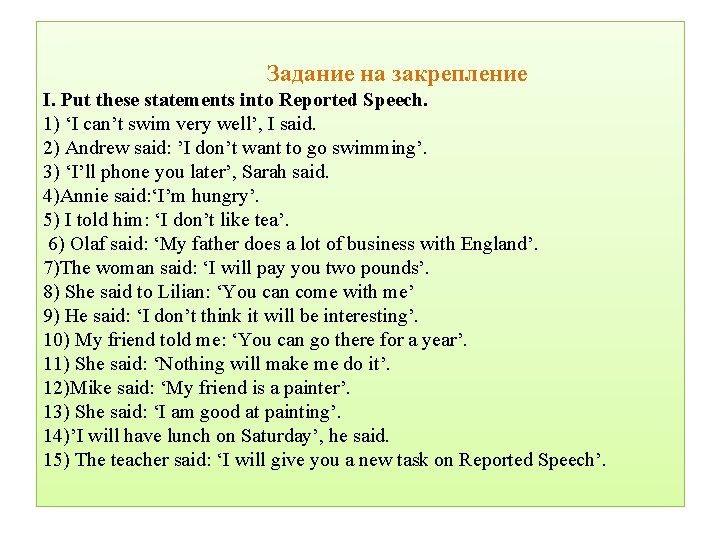
Задание на закрепление I. Put these statements into Reported Speech. 1) ‘I can’t swim very well’, I said. 2) Andrew said: ’I don’t want to go swimming’. 3) ‘I’ll phone you later’, Sarah said. 4)Annie said: ‘I’m hungry’. 5) I told him: ‘I don’t like tea’. 6) Olaf said: ‘My father does a lot of business with England’. 7)The woman said: ‘I will pay you two pounds’. 8) She said to Lilian: ‘You can come with me’ 9) He said: ‘I don’t think it will be interesting’. 10) My friend told me: ‘You can go there for a year’. 11) She said: ‘Nothing will make me do it’. 12)Mike said: ‘My friend is a painter’. 13) She said: ‘I am good at painting’. 14)’I will have lunch on Saturday’, he said. 15) The teacher said: ‘I will give you a new task on Reported Speech’.
II. Turn the following direct commands and requests into indirect ones. 1) Mrs. Wiggins: ‘Don’t make such a fuss, James’. 2) A teacher(to the class): ‘Work harder’. 3) Andrew(to his dog): ‘Don’t go away’. 4) Frieda( to Tom): ‘Pass me the sugar, please’. 5) A teacher (to the pupil): ‘Answer my question, please’. 6) Timothy: ‘Look out, Nick!’ 7) Grandpa: ‘Mr. Wiggins, hold the ladder, please’. 8) Mrs. Wiggins: ’Mother, don’t speak so loudly, please’. 9) Mr. Wiggins: ‘Timothy, don’t take the picture!’ 10) An officer (to his soldiers): ‘Fire at the enemy!’
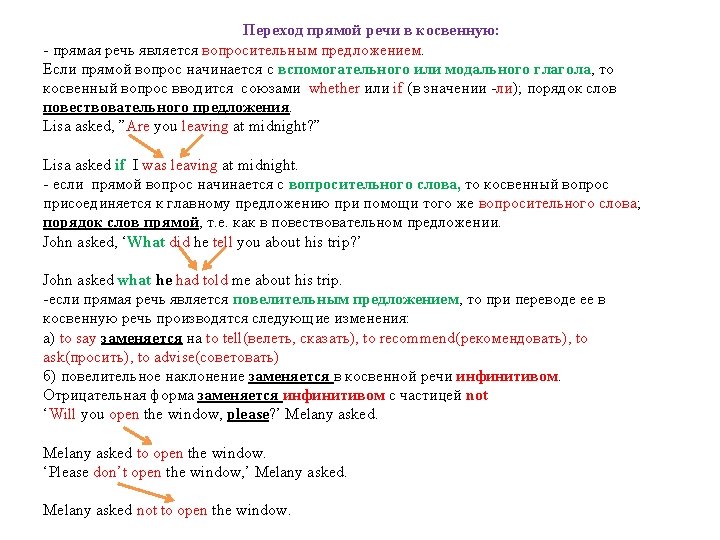
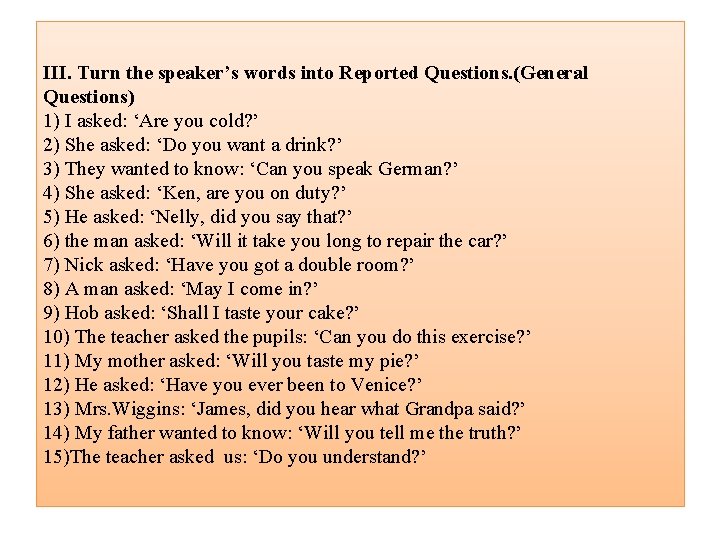
III. Turn the speaker’s words into Reported Questions. (General Questions) 1) I asked: ‘Are you cold? ’ 2) She asked: ‘Do you want a drink? ’ 3) They wanted to know: ‘Can you speak German? ’ 4) She asked: ‘Ken, are you on duty? ’ 5) He asked: ‘Nelly, did you say that? ’ 6) the man asked: ‘Will it take you long to repair the car? ’ 7) Nick asked: ‘Have you got a double room? ’ 8) A man asked: ‘May I come in? ’ 9) Hob asked: ‘Shall I taste your cake? ’ 10) The teacher asked the pupils: ‘Can you do this exercise? ’ 11) My mother asked: ‘Will you taste my pie? ’ 12) He asked: ‘Have you ever been to Venice? ’ 13) Mrs. Wiggins: ‘James, did you hear what Grandpa said? ’ 14) My father wanted to know: ‘Will you tell me the truth? ’ 15)The teacher asked us: ‘Do you understand? ’
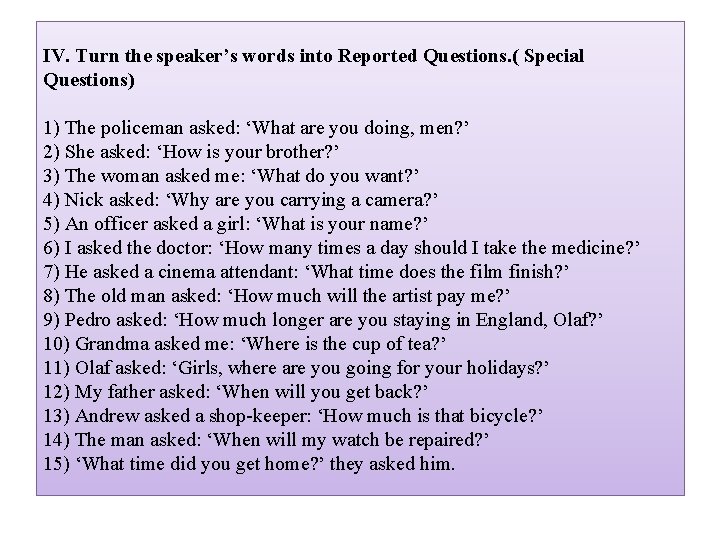
IV. Turn the speaker’s words into Reported Questions. ( Special Questions) 1) The policeman asked: ‘What are you doing, men? ’ 2) She asked: ‘How is your brother? ’ 3) The woman asked me: ‘What do you want? ’ 4) Nick asked: ‘Why are you carrying a camera? ’ 5) An officer asked a girl: ‘What is your name? ’ 6) I asked the doctor: ‘How many times a day should I take the medicine? ’ 7) He asked a cinema attendant: ‘What time does the film finish? ’ 8) The old man asked: ‘How much will the artist pay me? ’ 9) Pedro asked: ‘How much longer are you staying in England, Olaf? ’ 10) Grandma asked me: ‘Where is the cup of tea? ’ 11) Olaf asked: ‘Girls, where are you going for your holidays? ’ 12) My father asked: ‘When will you get back? ’ 13) Andrew asked a shop-keeper: ‘How much is that bicycle? ’ 14) The man asked: ‘When will my watch be repaired? ’ 15) ‘What time did you get home? ’ they asked him.