
Sequence motifs information content and sequence logos Morten

- Slides: 48
Sequence motifs, information content, and sequence logos Morten Nielsen, CBS, Depart of Systems Biology, DTU
Why weight matrices? • The vast majority of biological motifs are characterized by a linear motif – – – – Post translational modifications Signal peptides T cell epitopes Transcription binding sites SH 2/SH 3 domain binding MHC binding …. • Predict impact of sequence variation (SNP) • Used to prediction protein structure and function
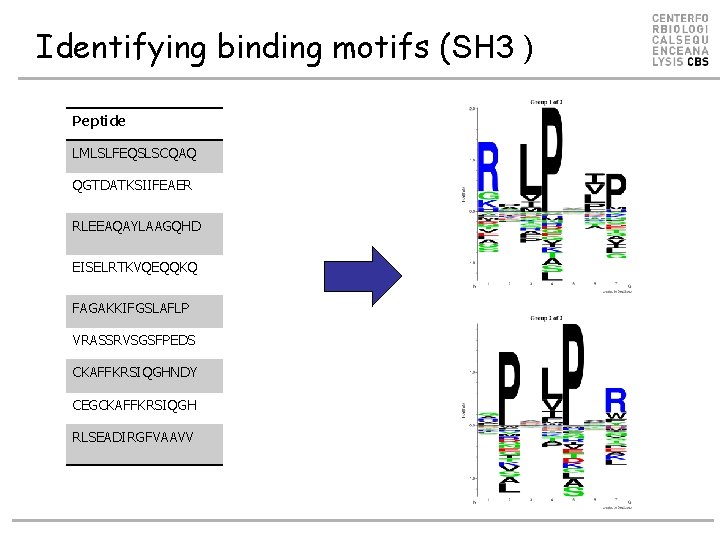
Identifying binding motifs (SH 3 ) Peptide Signal LMLSLFEQSLSCQAQ 9 QGTDATKSIIFEAER -12 RLEEAQAYLAAGQHD 10 EISELRTKVQEQQKQ 44 FAGAKKIFGSLAFLP 70 VRASSRVSGSFPEDS -7 CKAFFKRSIQGHNDY 86 CEGCKAFFKRSIQGH 100 RLSEADIRGFVAAVV -7
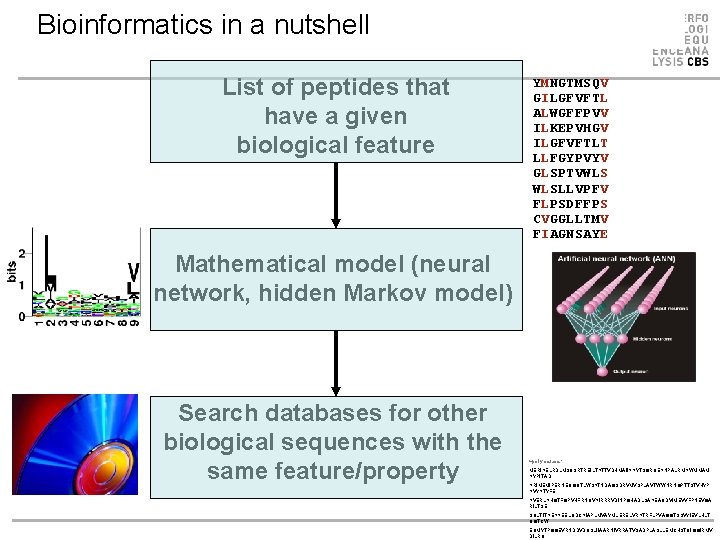
Bioinformatics in a nutshell List of peptides that have a given biological feature YMNGTMSQV GILGFVFTL ALWGFFPVV ILKEPVHGV ILGFVFTLT LLFGYPVYV GLSPTVWLS WLSLLVPFV FLPSDFFPS CVGGLLTMV FIAGNSAYE Mathematical model (neural network, hidden Markov model) Search databases for other biological sequences with the same feature/property >polymerase“ MERIKELRDLMSQSRTREILTKTTVDHMAIIKKYTSGRQEKNPALRMKWMMAM KYPITAD KRIMEMIPERNEQGQTLWSKTNDAGSDRVMVSPLAVTWWNRNGPTTSTVHYP KVYKTYFE KVERLKHGTFGPVHFRNQVKIRRRVDINPGHADLSAKEAQDVIMEVVFPNEVGA RILTSE SQLTITKEKKEELQDCKIAPLMVAYMLERELVRKTRFLPVAGGTSSVYIEVLHLT QGTCW EQMYTPGGEVRNDDVDQSLIIAARNIVRRATVSADPLASLLEMCHSTQIGGIRMV DILRQ
Objectives • Visualization of binding motifs – Construction of sequence logos • Understand the concepts of weight matrix construction – One of the most important methods of bioinformatics • How to deal with data redundancy • How to deal with low counts (few observations) • How to use weight matrices to characterize receptor-ligand interactions • Case story from the MHC-peptide interactions guiding immune system reactions
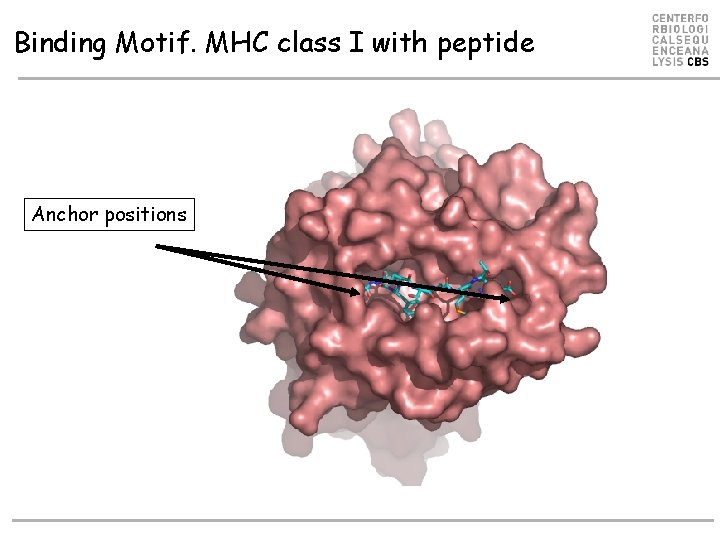
Binding Motif. MHC class I with peptide Anchor positions
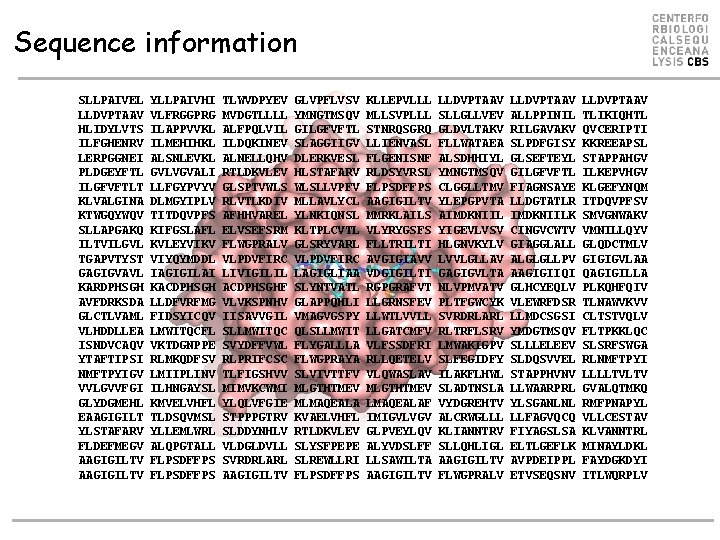
Sequence information SLLPAIVEL LLDVPTAAV HLIDYLVTS ILFGHENRV LERPGGNEI PLDGEYFTL ILGFVFTLT KLVALGINA KTWGQYWQV SLLAPGAKQ ILTVILGVL TGAPVTYST GAGIGVAVL KARDPHSGH AVFDRKSDA GLCTLVAML VLHDDLLEA ISNDVCAQV YTAFTIPSI NMFTPYIGV VVLGVVFGI GLYDGMEHL EAAGIGILT YLSTAFARV FLDEFMEGV AAGIGILTV YLLPAIVHI VLFRGGPRG ILAPPVVKL ILMEHIHKL ALSNLEVKL GVLVGVALI LLFGYPVYV DLMGYIPLV TITDQVPFS KIFGSLAFL KVLEYVIKV VIYQYMDDL IAGIGILAI KACDPHSGH LLDFVRFMG FIDSYICQV LMWITQCFL VKTDGNPPE RLMKQDFSV LMIIPLINV ILHNGAYSL KMVELVHFL TLDSQVMSL YLLEMLWRL ALQPGTALL FLPSDFFPS TLWVDPYEV MVDGTLLLL ALFPQLVIL ILDQKINEV ALNELLQHV RTLDKVLEV GLSPTVWLS RLVTLKDIV AFHHVAREL ELVSEFSRM FLWGPRALV VLPDVFIRC LIVIGILIL ACDPHSGHF VLVKSPNHV IISAVVGIL SLLMWITQC SVYDFFVWL RLPRIFCSC TLFIGSHVV MIMVKCWMI YLQLVFGIE STPPPGTRV SLDDYNHLV VLDGLDVLL SVRDRLARL AAGIGILTV GLVPFLVSV YMNGTMSQV GILGFVFTL SLAGGIIGV DLERKVESL HLSTAFARV WLSLLVPFV MLLAVLYCL YLNKIQNSL KLTPLCVTL GLSRYVARL VLPDVFIRC LAGIGLIAA SLYNTVATL GLAPPQHLI VMAGVGSPY QLSLLMWIT FLYGALLLA FLWGPRAYA SLVIVTTFV MLGTHTMEV MLMAQEALA KVAELVHFL RTLDKVLEV SLYSFPEPE SLREWLLRI FLPSDFFPS KLLEPVLLL MLLSVPLLL STNRQSGRQ LLIENVASL FLGENISNF RLDSYVRSL FLPSDFFPS AAGIGILTV MMRKLAILS VLYRYGSFS FLLTRILTI AVGIGIAVV VDGIGILTI RGPGRAFVT LLGRNSFEV LLWTLVVLL LLGATCMFV VLFSSDFRI RLLQETELV VLQWASLAV MLGTHTMEV LMAQEALAF IMIGVLVGV GLPVEYLQV ALYVDSLFF LLSAWILTA AAGIGILTV LLDVPTAAV SLLGLLVEV GLDVLTAKV FLLWATAEA ALSDHHIYL YMNGTMSQV CLGGLLTMV YLEPGPVTA AIMDKNIIL YIGEVLVSV HLGNVKYLV LVVLGLLAV GAGIGVLTA NLVPMVATV PLTFGWCYK SVRDRLARL RLTRFLSRV LMWAKIGPV SLFEGIDFY ILAKFLHWL SLADTNSLA VYDGREHTV ALCRWGLLL KLIANNTRV SLLQHLIGL AAGIGILTV FLWGPRALV LLDVPTAAV ALLPPINIL RILGAVAKV SLPDFGISY GLSEFTEYL GILGFVFTL FIAGNSAYE LLDGTATLR IMDKNIILK CINGVCWTV GIAGGLALL ALGLGLLPV AAGIGIIQI GLHCYEQLV VLEWRFDSR LLMDCSGSI YMDGTMSQV SLLLELEEV SLDQSVVEL STAPPHVNV LLWAARPRL YLSGANLNL LLFAGVQCQ FIYAGSLSA ELTLGEFLK AVPDEIPPL ETVSEQSNV LLDVPTAAV TLIKIQHTL QVCERIPTI KKREEAPSL STAPPAHGV ILKEPVHGV KLGEFYNQM ITDQVPFSV SMVGNWAKV VMNILLQYV GLQDCTMLV GIGIGVLAA QAGIGILLA PLKQHFQIV TLNAWVKVV CLTSTVQLV FLTPKKLQC SLSRFSWGA RLNMFTPYI LLLLTVLTV GVALQTMKQ RMFPNAPYL VLLCESTAV KLVANNTRL MINAYLDKL FAYDGKDYI ITLWQRPLV
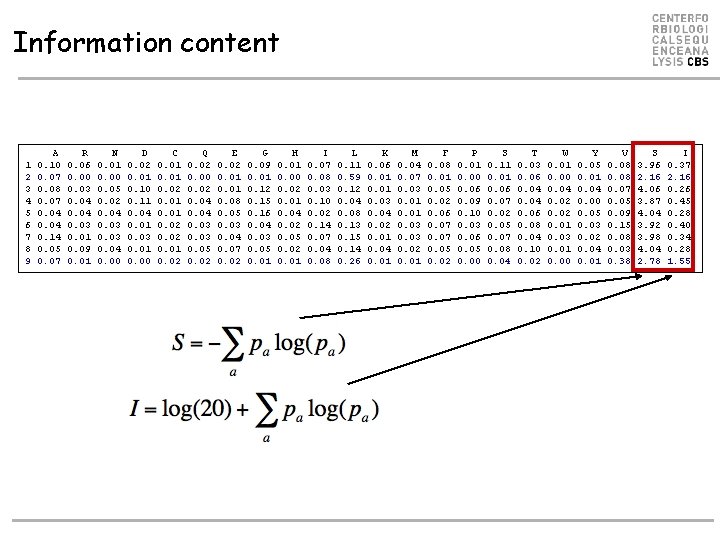
Information content 1 2 3 4 5 6 7 8 9 A 0. 10 0. 07 0. 08 0. 07 0. 04 0. 14 0. 05 0. 07 R 0. 06 0. 00 0. 03 0. 04 0. 03 0. 01 0. 09 0. 01 N 0. 01 0. 00 0. 05 0. 02 0. 04 0. 03 0. 04 0. 00 D 0. 02 0. 01 0. 10 0. 11 0. 04 0. 01 0. 03 0. 01 0. 00 C 0. 01 0. 02 Q 0. 02 0. 00 0. 02 0. 04 0. 03 0. 05 0. 02 E 0. 02 0. 01 0. 08 0. 05 0. 03 0. 04 0. 07 0. 02 G 0. 09 0. 01 0. 12 0. 15 0. 16 0. 04 0. 03 0. 05 0. 01 H 0. 01 0. 00 0. 02 0. 01 0. 04 0. 02 0. 05 0. 02 0. 01 I 0. 07 0. 08 0. 03 0. 10 0. 02 0. 14 0. 07 0. 04 0. 08 L 0. 11 0. 59 0. 12 0. 04 0. 08 0. 13 0. 15 0. 14 0. 26 K 0. 06 0. 01 0. 03 0. 04 0. 02 0. 01 0. 04 0. 01 M 0. 04 0. 07 0. 03 0. 01 0. 03 0. 02 0. 01 F 0. 08 0. 01 0. 05 0. 02 0. 06 0. 07 0. 05 0. 02 P 0. 01 0. 00 0. 06 0. 09 0. 10 0. 03 0. 06 0. 05 0. 00 S 0. 11 0. 06 0. 07 0. 02 0. 05 0. 07 0. 08 0. 04 T 0. 03 0. 06 0. 04 0. 06 0. 08 0. 04 0. 10 0. 02 W 0. 01 0. 00 0. 04 0. 02 0. 01 0. 03 0. 01 0. 00 Y 0. 05 0. 01 0. 04 0. 00 0. 05 0. 03 0. 02 0. 04 0. 01 V 0. 08 0. 07 0. 05 0. 09 0. 15 0. 08 0. 03 0. 38 S 3. 96 2. 16 4. 06 3. 87 4. 04 3. 92 3. 98 4. 04 2. 78 I 0. 37 2. 16 0. 26 0. 45 0. 28 0. 40 0. 34 0. 28 1. 55
Sequence Information • Say that a peptide must have L at P 2 in order to bind, and that A, F, W, and Y are found at P 1. Which position has most information? • How many questions do I need to ask to tell if a peptide binds looking at only P 1 or P 2?
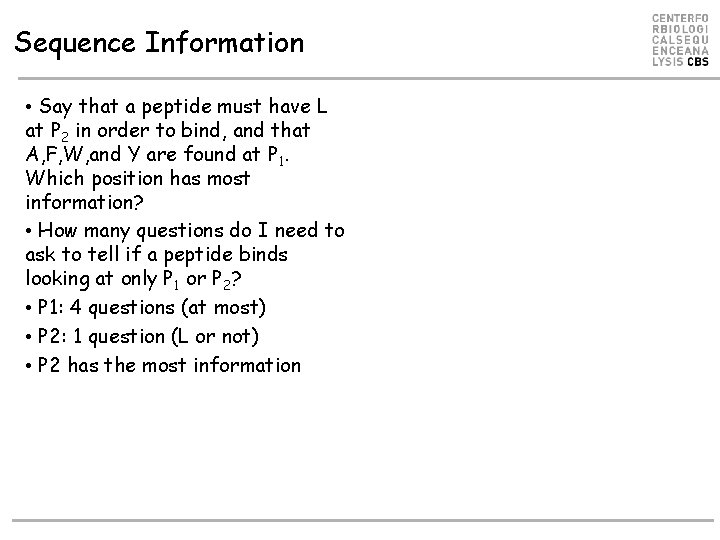
Sequence Information • Say that a peptide must have L at P 2 in order to bind, and that A, F, W, and Y are found at P 1. Which position has most information? • How many questions do I need to ask to tell if a peptide binds looking at only P 1 or P 2? • P 1: 4 questions (at most) • P 2: 1 question (L or not) • P 2 has the most information
Sequence Information • Say that a peptide must have L at P 2 in order to bind, and that A, F, W, and Y are found at P 1. Which position has most information? • How many questions do I need to ask to tell if a peptide binds looking at only P 1 or P 2? • P 1: 4 questions (at most) • P 2: 1 question (L or not) • P 2 has the most information • Calculate pa at each position • Entropy • Information content • Conserved positions – PL=1, P!L=0 => S=0, I=log(20) • Mutable positions – Paa=1/20 => S=log(20), I=0
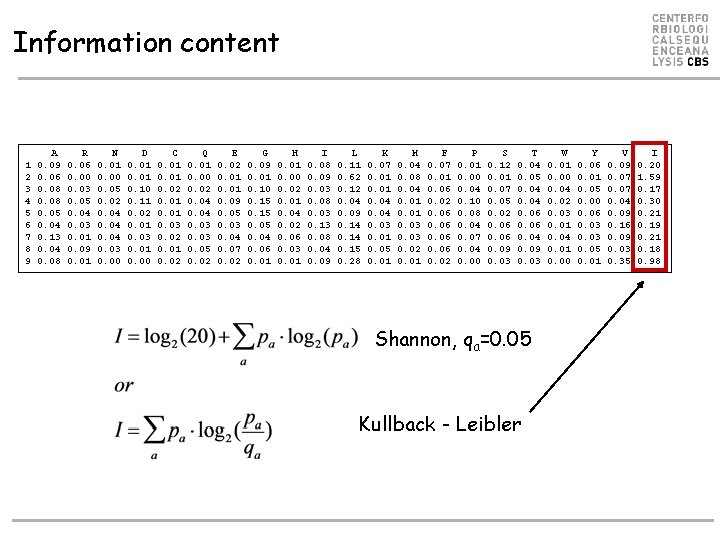
Information content 1 2 3 4 5 6 7 8 9 A 0. 09 0. 06 0. 08 0. 05 0. 04 0. 13 0. 04 0. 08 R 0. 06 0. 00 0. 03 0. 05 0. 04 0. 03 0. 01 0. 09 0. 01 N 0. 01 0. 00 0. 05 0. 02 0. 04 0. 03 0. 00 D 0. 01 0. 10 0. 11 0. 02 0. 01 0. 03 0. 01 0. 00 C 0. 01 0. 02 0. 01 0. 03 0. 02 0. 01 0. 02 Q 0. 01 0. 00 0. 02 0. 04 0. 03 0. 05 0. 02 E 0. 02 0. 01 0. 09 0. 05 0. 03 0. 04 0. 07 0. 02 G 0. 09 0. 01 0. 10 0. 15 0. 05 0. 04 0. 06 0. 01 H 0. 01 0. 00 0. 02 0. 01 0. 04 0. 02 0. 06 0. 03 0. 01 I 0. 08 0. 09 0. 03 0. 08 0. 03 0. 13 0. 08 0. 04 0. 09 L 0. 11 0. 62 0. 12 0. 04 0. 09 0. 14 0. 15 0. 28 K 0. 07 0. 01 0. 04 0. 03 0. 01 0. 05 0. 01 M 0. 04 0. 08 0. 04 0. 01 0. 03 0. 02 0. 01 F 0. 07 0. 01 0. 06 0. 02 P 0. 01 0. 00 0. 04 0. 10 0. 08 0. 04 0. 07 0. 04 0. 00 S 0. 12 0. 01 0. 07 0. 05 0. 02 0. 06 0. 09 0. 03 T 0. 04 0. 05 0. 04 0. 06 0. 04 0. 09 0. 03 Shannon, qa=0. 05 Kullback - Leibler W 0. 01 0. 00 0. 04 0. 02 0. 03 0. 01 0. 04 0. 01 0. 00 Y 0. 06 0. 01 0. 05 0. 00 0. 06 0. 03 0. 05 0. 01 V 0. 09 0. 07 0. 04 0. 09 0. 16 0. 09 0. 03 0. 35 I 0. 20 1. 59 0. 17 0. 30 0. 21 0. 19 0. 21 0. 18 0. 98
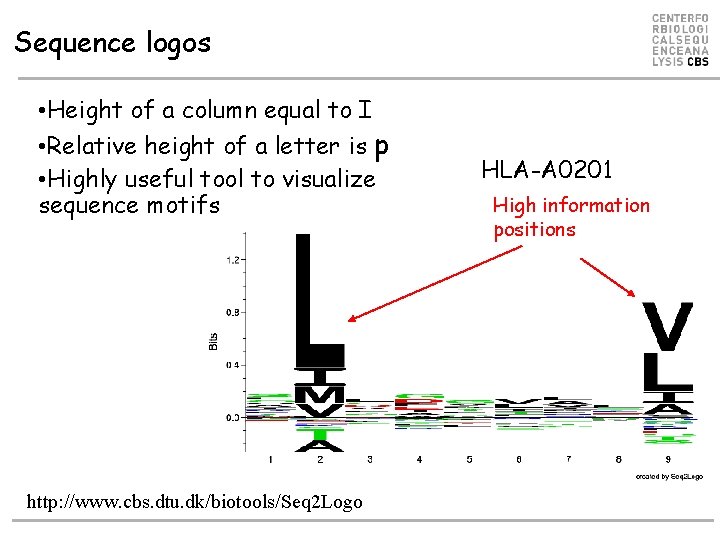
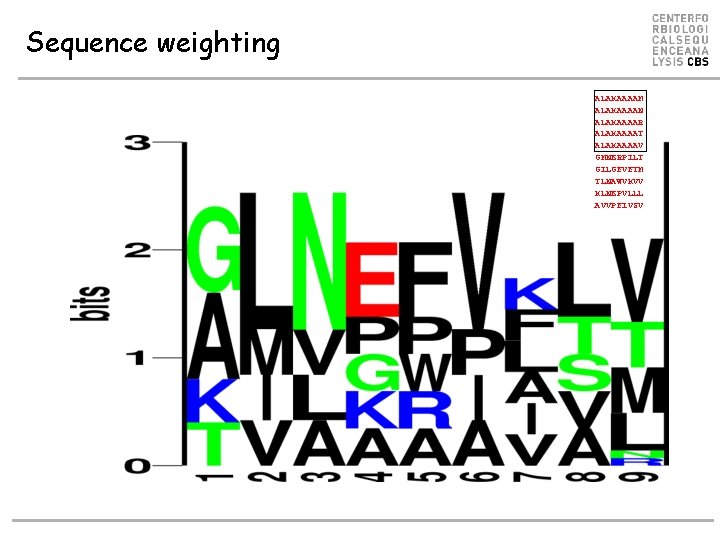
Sequence logos • Height of a column equal to I • Relative height of a letter is p • Highly useful tool to visualize sequence motifs http: //www. cbs. dtu. dk/biotools/Seq 2 Logo HLA-A 0201 High information positions
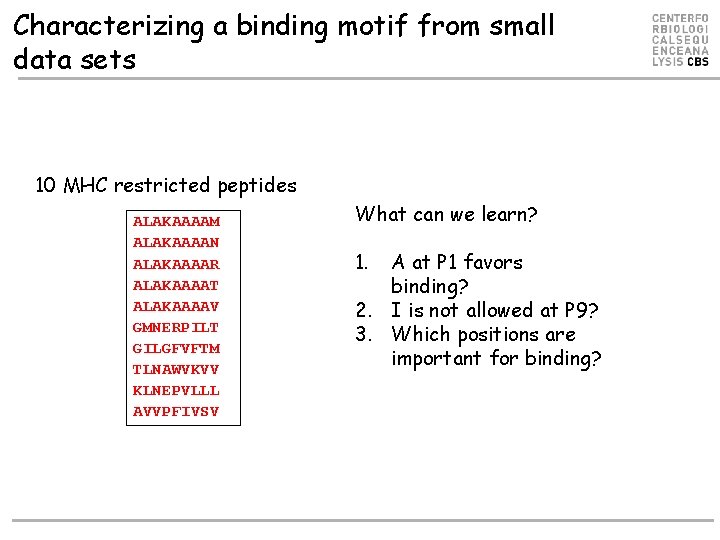
Characterizing a binding motif from small data sets 10 MHC restricted peptides ALAKAAAAM ALAKAAAAN ALAKAAAAR ALAKAAAAT ALAKAAAAV GMNERPILT GILGFVFTM TLNAWVKVV KLNEPVLLL AVVPFIVSV What can we learn? 1. A at P 1 favors binding? 2. I is not allowed at P 9? 3. Which positions are important for binding?
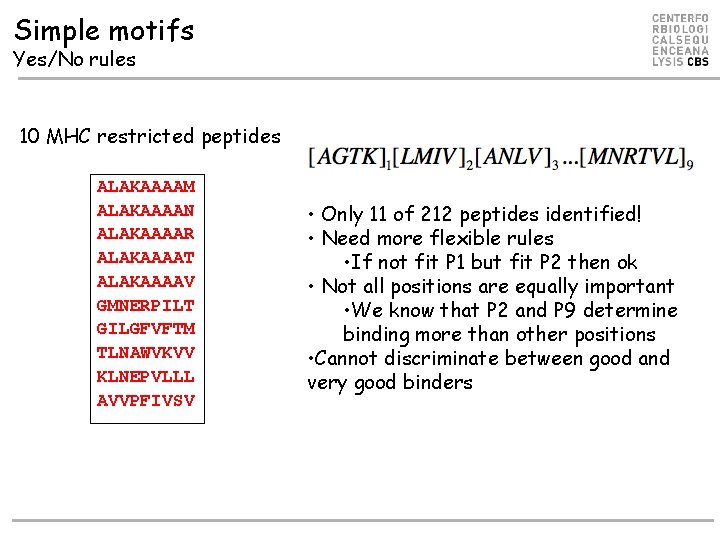
Simple motifs Yes/No rules 10 MHC restricted peptides ALAKAAAAM ALAKAAAAN ALAKAAAAR ALAKAAAAT ALAKAAAAV GMNERPILT GILGFVFTM TLNAWVKVV KLNEPVLLL AVVPFIVSV • Only 11 of 212 peptides identified! • Need more flexible rules • If not fit P 1 but fit P 2 then ok • Not all positions are equally important • We know that P 2 and P 9 determine binding more than other positions • Cannot discriminate between good and very good binders
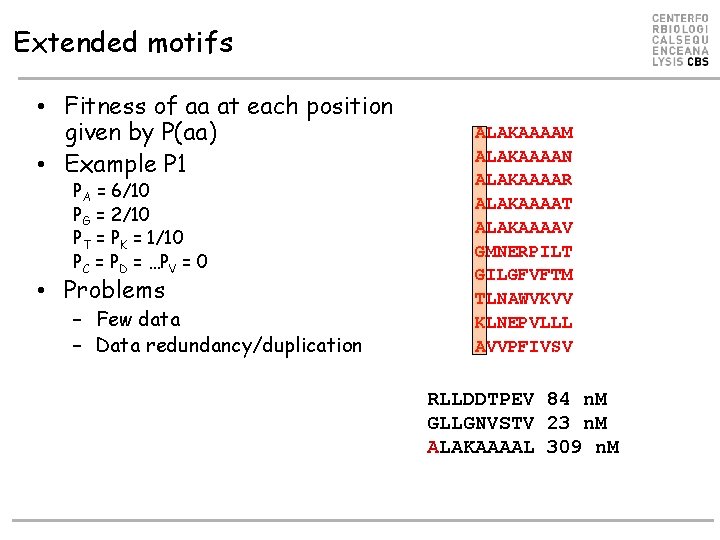
Extended motifs • Fitness of aa at each position given by P(aa) • Example P 1 PA = 6/10 PG = 2/10 PT = PK = 1/10 PC = PD = …PV = 0 • Problems – Few data – Data redundancy/duplication ALAKAAAAM ALAKAAAAN ALAKAAAAR ALAKAAAAT ALAKAAAAV GMNERPILT GILGFVFTM TLNAWVKVV KLNEPVLLL AVVPFIVSV RLLDDTPEV 84 n. M GLLGNVSTV 23 n. M ALAKAAAAL 309 n. M
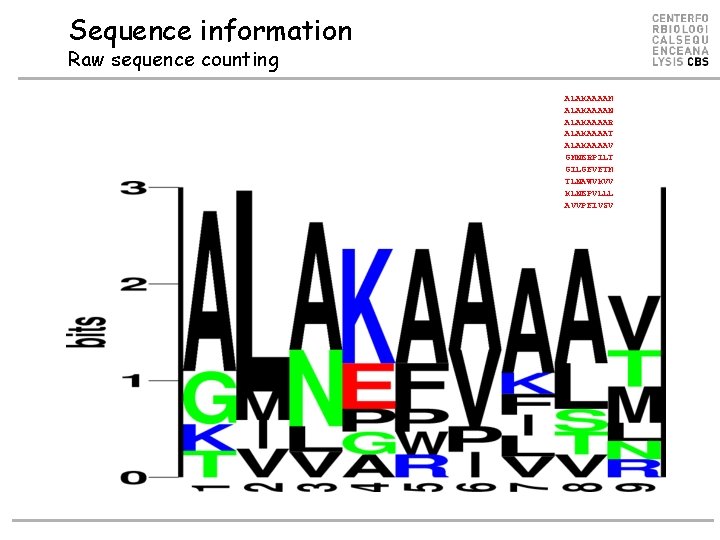
Sequence information Raw sequence counting ALAKAAAAM ALAKAAAAN ALAKAAAAR ALAKAAAAT ALAKAAAAV GMNERPILT GILGFVFTM TLNAWVKVV KLNEPVLLL AVVPFIVSV
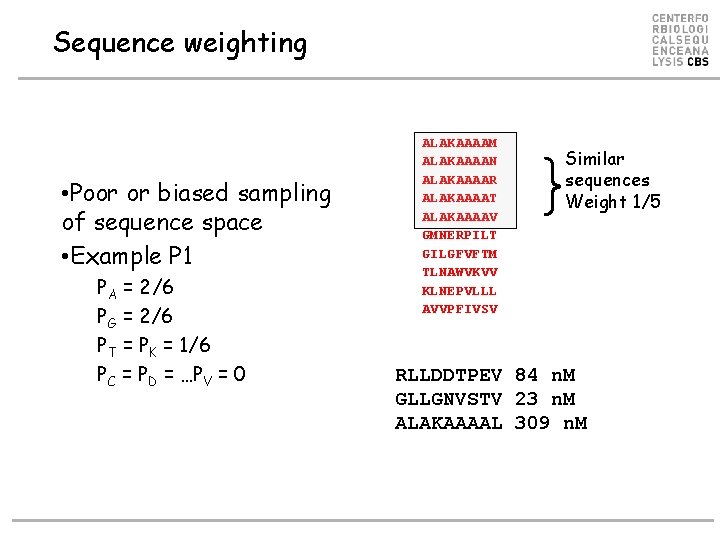
Sequence weighting • Poor or biased sampling of sequence space • Example P 1 PA = 2/6 PG = 2/6 PT = PK = 1/6 PC = PD = …PV = 0 ALAKAAAAM ALAKAAAAN ALAKAAAAR ALAKAAAAT ALAKAAAAV GMNERPILT GILGFVFTM TLNAWVKVV KLNEPVLLL AVVPFIVSV } Similar sequences Weight 1/5 RLLDDTPEV 84 n. M GLLGNVSTV 23 n. M ALAKAAAAL 309 n. M
Sequence weighting • How to define clusters? – Hobohm algorithm • We will work on Hobohm later in the course • Slow when data sets are large – Heuristics • Less accurate • Fast
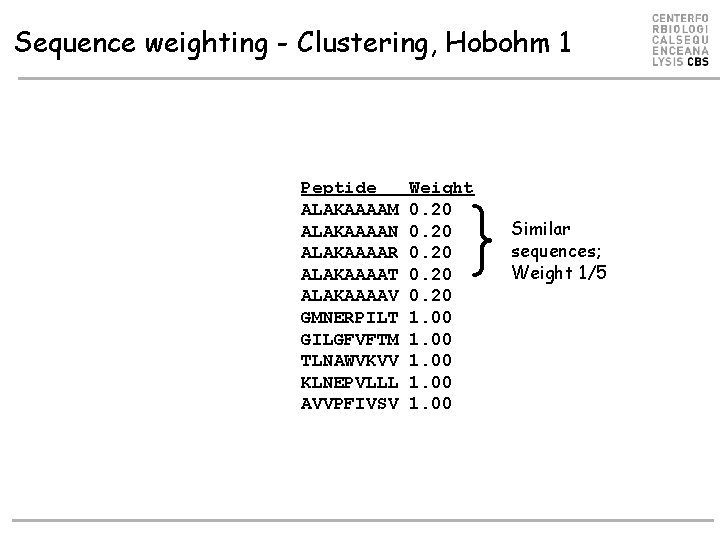
Sequence weighting - Clustering, Hobohm 1 Peptide ALAKAAAAM ALAKAAAAN ALAKAAAAR ALAKAAAAT ALAKAAAAV GMNERPILT GILGFVFTM TLNAWVKVV KLNEPVLLL AVVPFIVSV Weight 0. 20 1. 00 } Similar sequences; Weight 1/5
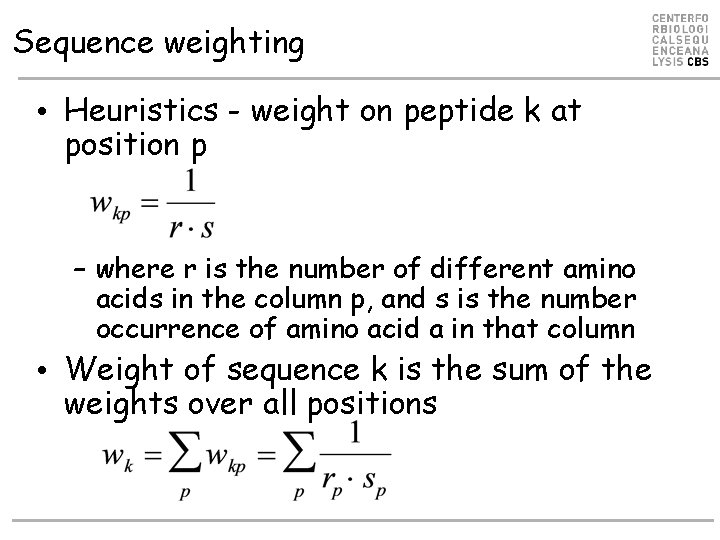
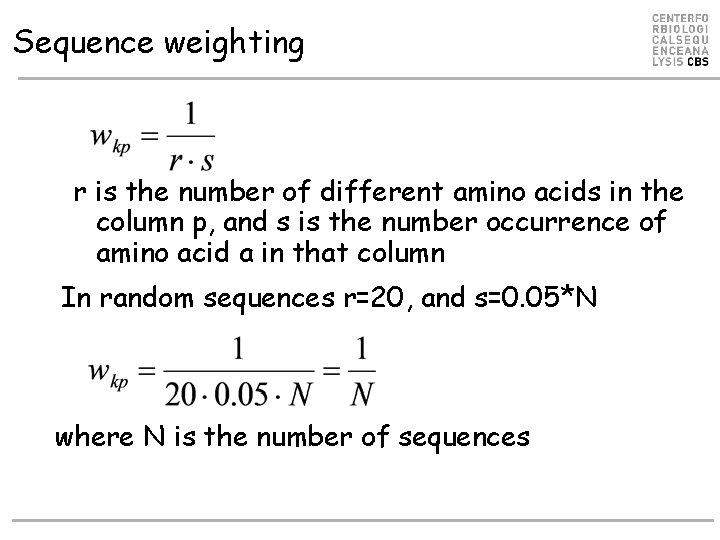
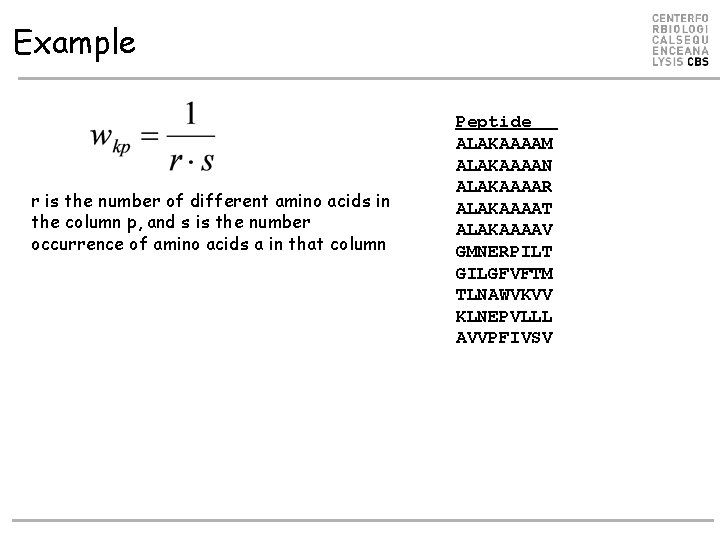
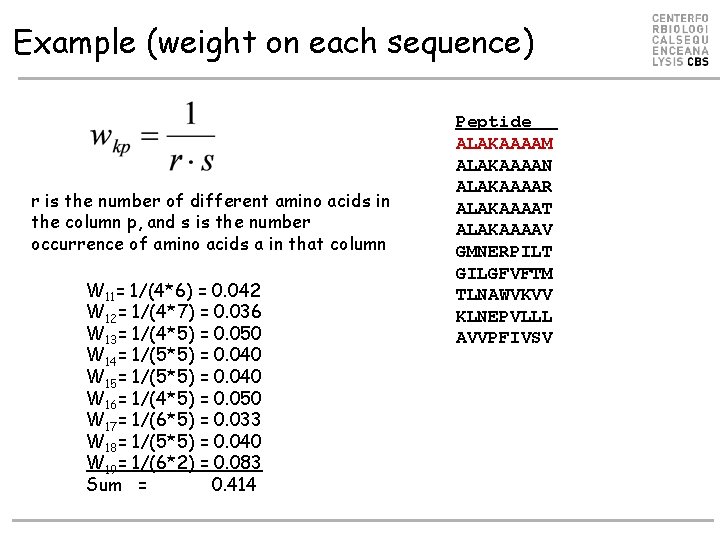
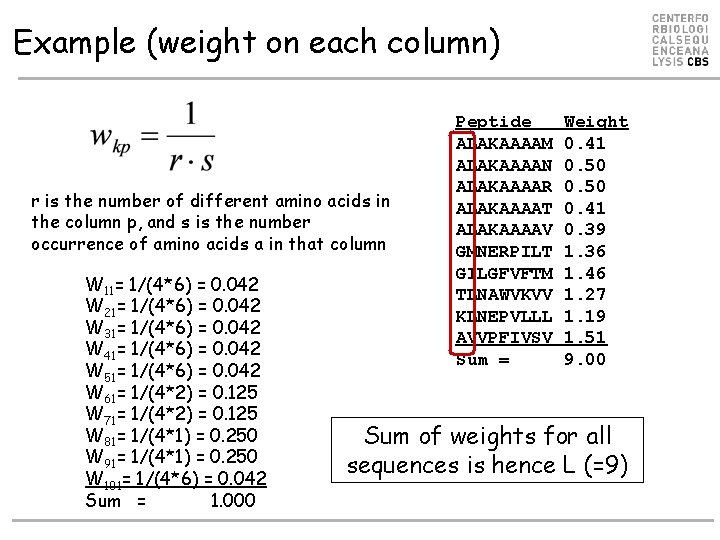
Sequence weighting • Heuristics - weight on peptide k at position p – where r is the number of different amino acids in the column p, and s is the number occurrence of amino acid a in that column • Weight of sequence k is the sum of the weights over all positions
Sequence weighting r is the number of different amino acids in the column p, and s is the number occurrence of amino acid a in that column In random sequences r=20, and s=0. 05*N where N is the number of sequences
Example r is the number of different amino acids in the column p, and s is the number occurrence of amino acids a in that column Peptide ALAKAAAAM ALAKAAAAN ALAKAAAAR ALAKAAAAT ALAKAAAAV GMNERPILT GILGFVFTM TLNAWVKVV KLNEPVLLL AVVPFIVSV Weight 0. 41 0. 50 0. 41 0. 39 1. 36 1. 46 1. 27 1. 19 1. 51
Example (weight on each sequence) r is the number of different amino acids in the column p, and s is the number occurrence of amino acids a in that column W 11= 1/(4*6) = 0. 042 W 12= 1/(4*7) = 0. 036 W 13= 1/(4*5) = 0. 050 W 14= 1/(5*5) = 0. 040 W 15= 1/(5*5) = 0. 040 W 16= 1/(4*5) = 0. 050 W 17= 1/(6*5) = 0. 033 W 18= 1/(5*5) = 0. 040 W 19= 1/(6*2) = 0. 083 Sum = 0. 414 Peptide ALAKAAAAM ALAKAAAAN ALAKAAAAR ALAKAAAAT ALAKAAAAV GMNERPILT GILGFVFTM TLNAWVKVV KLNEPVLLL AVVPFIVSV Weight 0. 41 0. 50 0. 41 0. 39 1. 36 1. 46 1. 27 1. 19 1. 51
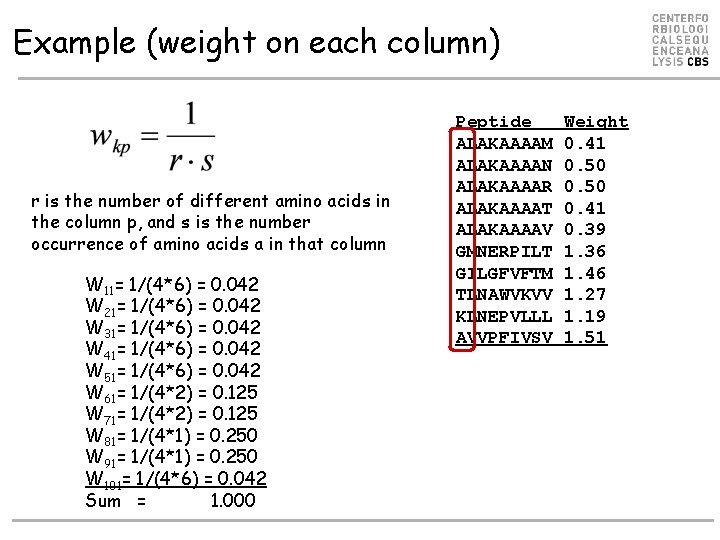
Example (weight on each column) r is the number of different amino acids in the column p, and s is the number occurrence of amino acids a in that column W 11= 1/(4*6) = 0. 042 W 21= 1/(4*6) = 0. 042 W 31= 1/(4*6) = 0. 042 W 41= 1/(4*6) = 0. 042 W 51= 1/(4*6) = 0. 042 W 61= 1/(4*2) = 0. 125 W 71= 1/(4*2) = 0. 125 W 81= 1/(4*1) = 0. 250 W 91= 1/(4*1) = 0. 250 W 101= 1/(4*6) = 0. 042 Sum = 1. 000 Peptide ALAKAAAAM ALAKAAAAN ALAKAAAAR ALAKAAAAT ALAKAAAAV GMNERPILT GILGFVFTM TLNAWVKVV KLNEPVLLL AVVPFIVSV Sum = Weight 0. 41 0. 50 0. 41 0. 39 1. 36 1. 46 1. 27 1. 19 1. 51 9. 00
Example (weight on each column) r is the number of different amino acids in the column p, and s is the number occurrence of amino acids a in that column W 11= 1/(4*6) = 0. 042 W 21= 1/(4*6) = 0. 042 W 31= 1/(4*6) = 0. 042 W 41= 1/(4*6) = 0. 042 W 51= 1/(4*6) = 0. 042 W 61= 1/(4*2) = 0. 125 W 71= 1/(4*2) = 0. 125 W 81= 1/(4*1) = 0. 250 W 91= 1/(4*1) = 0. 250 W 101= 1/(4*6) = 0. 042 Sum = 1. 000 Peptide ALAKAAAAM ALAKAAAAN ALAKAAAAR ALAKAAAAT ALAKAAAAV GMNERPILT GILGFVFTM TLNAWVKVV KLNEPVLLL AVVPFIVSV Sum = Weight 0. 41 0. 50 0. 41 0. 39 1. 36 1. 46 1. 27 1. 19 1. 51 9. 00 Sum of weights for all sequences is hence L (=9)
Sequence weighting ALAKAAAAM ALAKAAAAN ALAKAAAAR ALAKAAAAT ALAKAAAAV GMNERPILT GILGFVFTM TLNAWVKVV KLNEPVLLL AVVPFIVSV
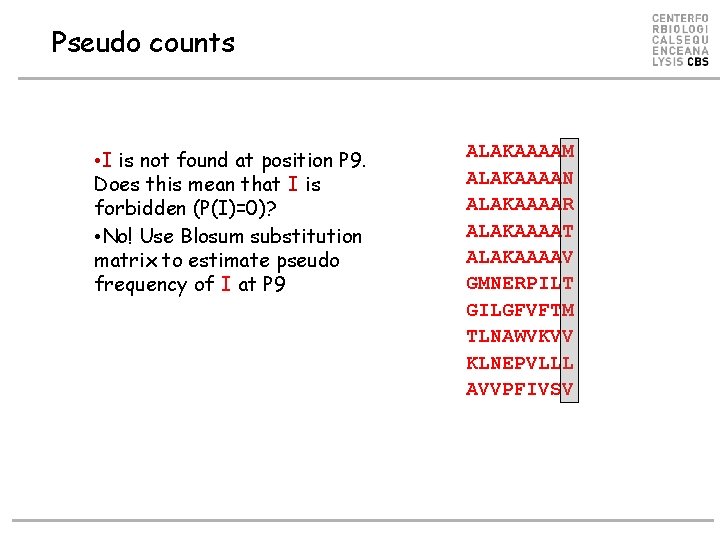
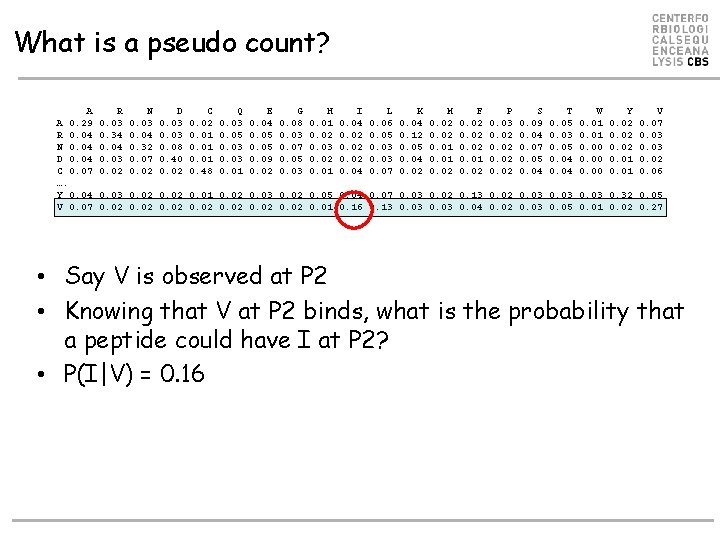
Pseudo counts • I is not found at position P 9. Does this mean that I is forbidden (P(I)=0)? • No! Use Blosum substitution matrix to estimate pseudo frequency of I at P 9 ALAKAAAAM ALAKAAAAN ALAKAAAAR ALAKAAAAT ALAKAAAAV GMNERPILT GILGFVFTM TLNAWVKVV KLNEPVLLL AVVPFIVSV
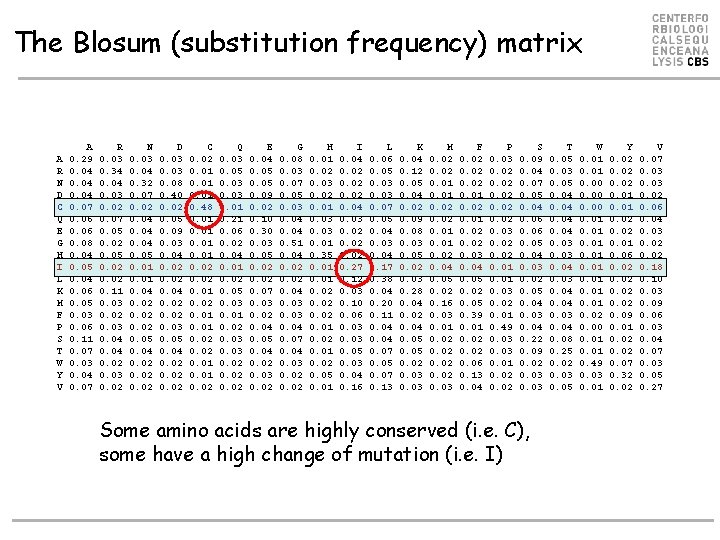
The Blosum (substitution frequency) matrix A R N D C Q E G H I L K M F P S T W Y V A 0. 29 0. 04 0. 07 0. 06 0. 08 0. 04 0. 05 0. 04 0. 06 0. 05 0. 03 0. 06 0. 11 0. 07 0. 03 0. 04 0. 07 R 0. 03 0. 34 0. 03 0. 02 0. 07 0. 05 0. 02 0. 11 0. 03 0. 02 0. 03 0. 04 0. 02 0. 03 0. 02 N 0. 03 0. 04 0. 32 0. 07 0. 02 0. 04 0. 05 0. 01 0. 04 0. 02 0. 05 0. 04 0. 02 D 0. 03 0. 08 0. 40 0. 02 0. 05 0. 09 0. 03 0. 04 0. 02 0. 03 0. 05 0. 04 0. 02 C 0. 02 0. 01 0. 48 0. 01 0. 02 0. 01 0. 02 Q 0. 03 0. 05 0. 03 0. 01 0. 21 0. 06 0. 02 0. 04 0. 01 0. 02 0. 05 0. 03 0. 01 0. 02 0. 03 0. 02 E 0. 04 0. 05 0. 09 0. 02 0. 10 0. 30 0. 03 0. 05 0. 02 0. 07 0. 03 0. 02 0. 04 0. 05 0. 04 0. 02 0. 03 0. 02 G 0. 08 0. 03 0. 07 0. 05 0. 03 0. 04 0. 51 0. 04 0. 02 0. 04 0. 03 0. 04 0. 07 0. 04 0. 03 0. 02 H 0. 01 0. 02 0. 03 0. 02 0. 01 0. 03 0. 01 0. 35 0. 01 0. 02 0. 05 0. 01 I 0. 04 0. 02 0. 04 0. 03 0. 02 0. 27 0. 12 0. 03 0. 10 0. 06 0. 03 0. 05 0. 03 0. 04 0. 16 L 0. 06 0. 05 0. 03 0. 07 0. 05 0. 04 0. 03 0. 04 0. 17 0. 38 0. 04 0. 20 0. 11 0. 04 0. 07 0. 05 0. 07 0. 13 K 0. 04 0. 12 0. 05 0. 04 0. 02 0. 09 0. 08 0. 03 0. 05 0. 02 0. 03 0. 28 0. 04 0. 02 0. 04 0. 05 0. 02 0. 03 M 0. 02 0. 01 0. 02 0. 04 0. 05 0. 02 0. 16 0. 03 0. 01 0. 02 0. 03 F 0. 02 0. 01 0. 02 0. 03 0. 04 0. 05 0. 02 0. 05 0. 39 0. 01 0. 02 0. 06 0. 13 0. 04 P 0. 03 0. 02 0. 01 0. 49 0. 03 0. 01 0. 02 S 0. 09 0. 04 0. 07 0. 05 0. 04 0. 06 0. 05 0. 04 0. 03 0. 02 0. 05 0. 04 0. 03 0. 04 0. 22 0. 09 0. 02 0. 03 Some amino acids are highly conserved (i. e. C), some have a high change of mutation (i. e. I) T 0. 05 0. 03 0. 05 0. 04 0. 03 0. 04 0. 08 0. 25 0. 02 0. 03 0. 05 W 0. 01 0. 00 0. 01 0. 02 0. 00 0. 01 0. 49 0. 03 0. 01 Y 0. 02 0. 01 0. 06 0. 02 0. 09 0. 01 0. 02 0. 07 0. 32 0. 02 V 0. 07 0. 03 0. 02 0. 06 0. 04 0. 03 0. 02 0. 18 0. 10 0. 03 0. 09 0. 06 0. 03 0. 04 0. 07 0. 03 0. 05 0. 27
What is a pseudo count? A A 0. 29 R 0. 04 N 0. 04 D 0. 04 C 0. 07 …. Y 0. 04 V 0. 07 R 0. 03 0. 34 0. 03 0. 02 N 0. 03 0. 04 0. 32 0. 07 0. 02 D 0. 03 0. 08 0. 40 0. 02 C 0. 02 0. 01 0. 48 Q 0. 03 0. 05 0. 03 0. 01 E 0. 04 0. 05 0. 09 0. 02 G 0. 08 0. 03 0. 07 0. 05 0. 03 H 0. 01 0. 02 0. 03 0. 02 0. 01 I 0. 04 0. 02 0. 04 L 0. 06 0. 05 0. 03 0. 07 K 0. 04 0. 12 0. 05 0. 04 0. 02 M 0. 02 0. 01 0. 02 F 0. 02 0. 01 0. 02 P 0. 03 0. 02 S 0. 09 0. 04 0. 07 0. 05 0. 04 T 0. 05 0. 03 0. 05 0. 04 W 0. 01 0. 00 Y 0. 02 0. 01 V 0. 07 0. 03 0. 02 0. 06 0. 03 0. 02 0. 01 0. 02 0. 03 0. 02 0. 05 0. 04 0. 07 0. 03 0. 02 0. 13 0. 02 0. 03 0. 32 0. 05 0. 02 0. 01 0. 16 0. 13 0. 03 0. 04 0. 02 0. 03 0. 05 0. 01 0. 02 0. 27 • Say V is observed at P 2 • Knowing that V at P 2 binds, what is the probability that a peptide could have I at P 2? • P(I|V) = 0. 16
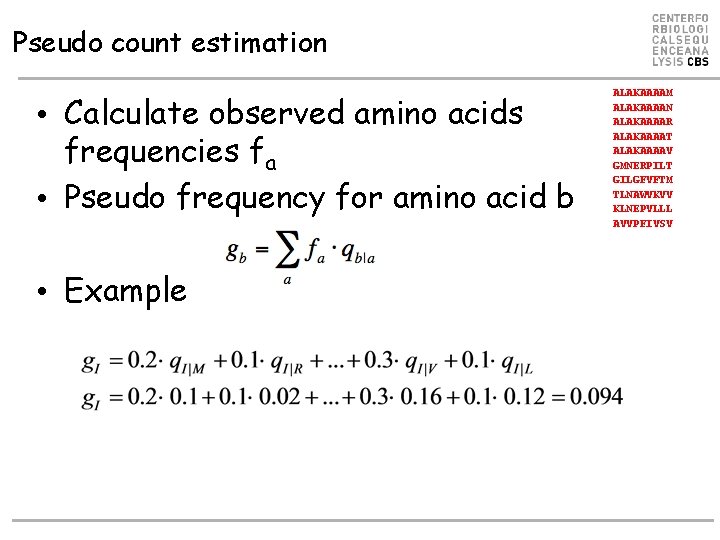
Pseudo count estimation • Calculate observed amino acids frequencies fa • Pseudo frequency for amino acid b • Example ALAKAAAAM ALAKAAAAN ALAKAAAAR ALAKAAAAT ALAKAAAAV GMNERPILT GILGFVFTM TLNAWVKVV KLNEPVLLL AVVPFIVSV
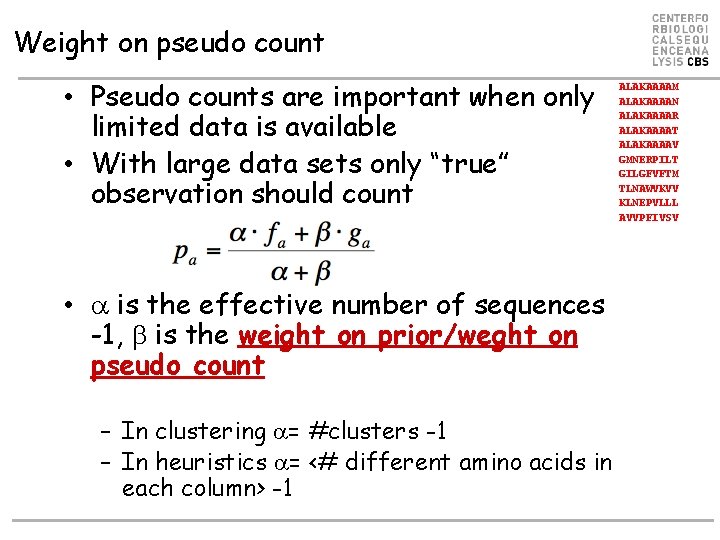
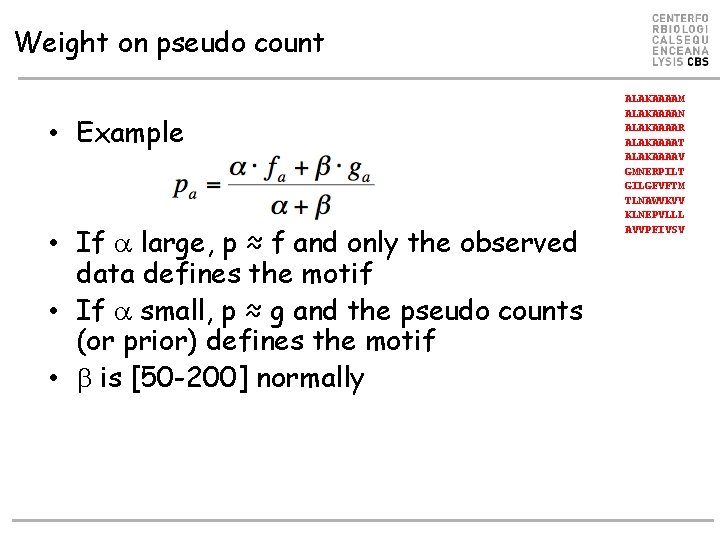
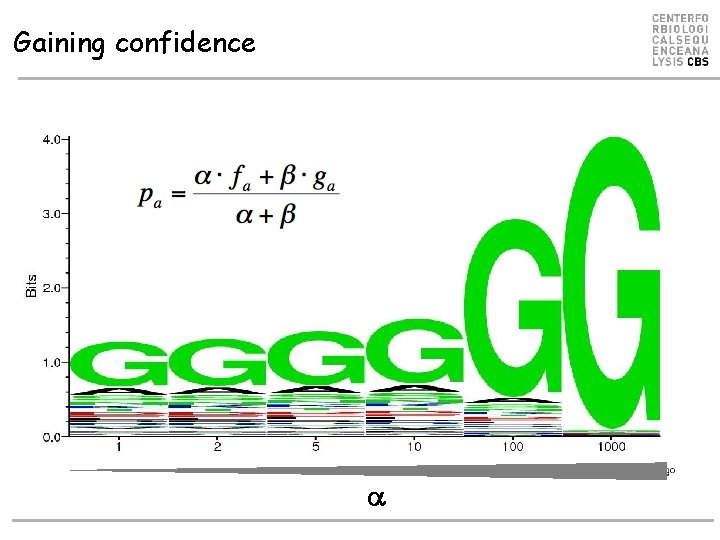
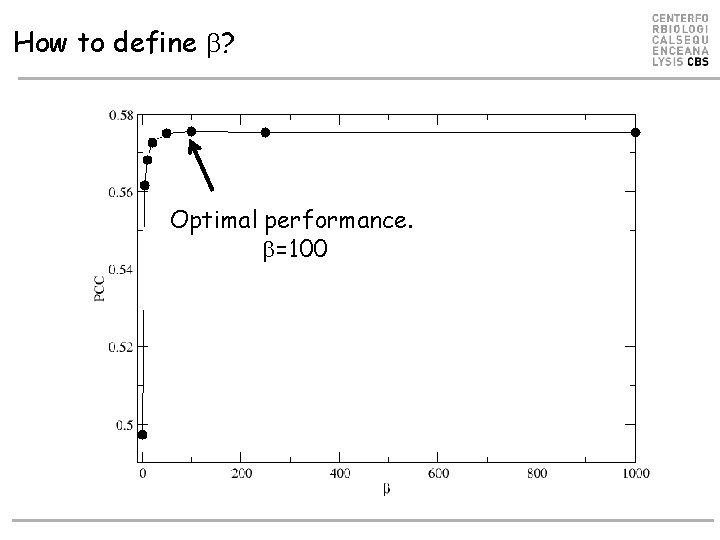
Weight on pseudo count • Pseudo counts are important when only limited data is available • With large data sets only “true” observation should count • is the effective number of sequences -1, is the weight on prior/weght on pseudo count – In clustering = #clusters -1 – In heuristics = <# different amino acids in each column> -1 ALAKAAAAM ALAKAAAAN ALAKAAAAR ALAKAAAAT ALAKAAAAV GMNERPILT GILGFVFTM TLNAWVKVV KLNEPVLLL AVVPFIVSV
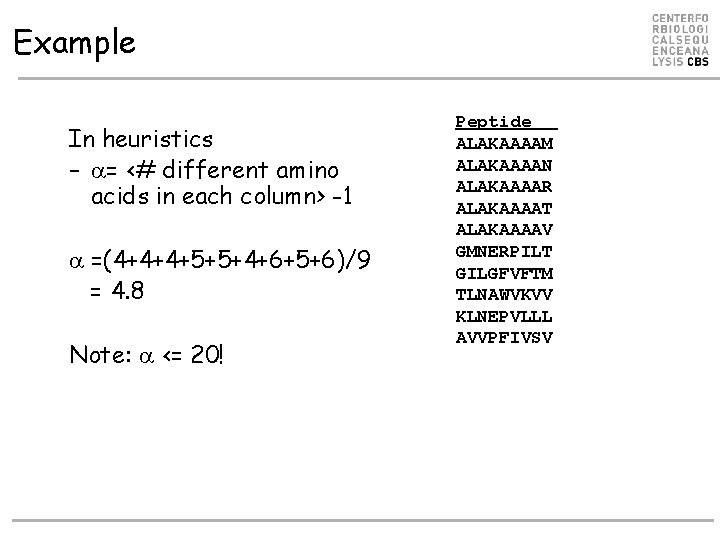
Example In heuristics – = <# different amino acids in each column> -1 =(4+4+4+5+5+4+6+5+6)/9 = 4. 8 Note: <= 20! Peptide ALAKAAAAM ALAKAAAAN ALAKAAAAR ALAKAAAAT ALAKAAAAV GMNERPILT GILGFVFTM TLNAWVKVV KLNEPVLLL AVVPFIVSV Weight 0. 41 0. 50 0. 41 0. 39 1. 36 1. 46 1. 27 1. 19 1. 51
Weight on pseudo count • Example • If large, p ≈ f and only the observed data defines the motif • If small, p ≈ g and the pseudo counts (or prior) defines the motif • is [50 -200] normally ALAKAAAAM ALAKAAAAN ALAKAAAAR ALAKAAAAT ALAKAAAAV GMNERPILT GILGFVFTM TLNAWVKVV KLNEPVLLL AVVPFIVSV
Gaining confidence a
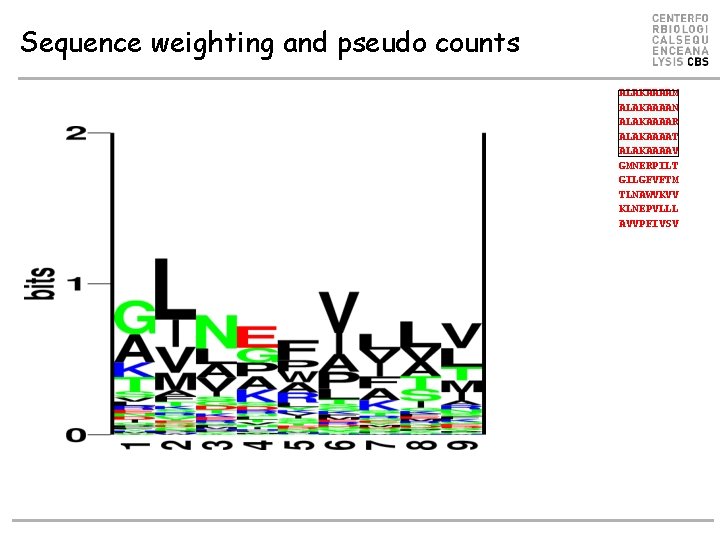
Sequence weighting and pseudo counts ALAKAAAAM ALAKAAAAN ALAKAAAAR ALAKAAAAT ALAKAAAAV GMNERPILT GILGFVFTM TLNAWVKVV KLNEPVLLL AVVPFIVSV
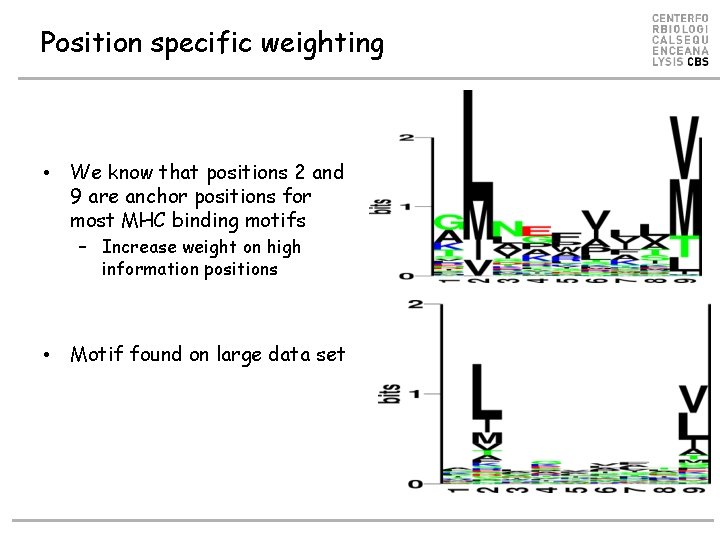
Position specific weighting • We know that positions 2 and 9 are anchor positions for most MHC binding motifs – Increase weight on high information positions • Motif found on large data set
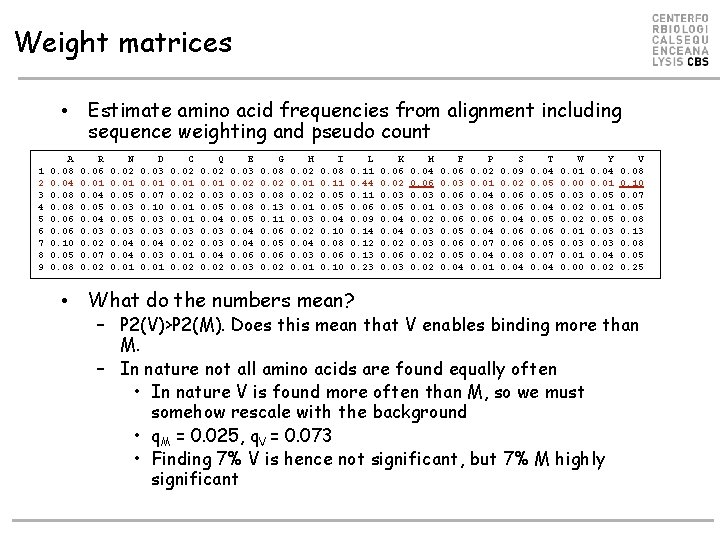
Weight matrices • Estimate amino acid frequencies from alignment including sequence weighting and pseudo count 1 2 3 4 5 6 7 8 9 A 0. 08 0. 04 0. 08 0. 06 0. 10 0. 05 0. 08 R 0. 06 0. 01 0. 04 0. 05 0. 04 0. 03 0. 02 0. 07 0. 02 N 0. 02 0. 01 0. 05 0. 03 0. 04 0. 01 D 0. 03 0. 01 0. 07 0. 10 0. 03 0. 04 0. 03 0. 01 C 0. 02 0. 01 0. 03 0. 02 0. 01 0. 02 Q 0. 02 0. 01 0. 03 0. 05 0. 04 0. 03 0. 04 0. 02 E 0. 03 0. 02 0. 03 0. 08 0. 05 0. 04 0. 06 0. 03 G 0. 08 0. 02 0. 08 0. 13 0. 11 0. 06 0. 05 0. 06 0. 02 H 0. 02 0. 01 0. 03 0. 02 0. 04 0. 03 0. 01 I 0. 08 0. 11 0. 05 0. 04 0. 10 0. 08 0. 06 0. 10 L 0. 11 0. 44 0. 11 0. 06 0. 09 0. 14 0. 12 0. 13 0. 23 • What do the numbers mean? K 0. 06 0. 02 0. 03 0. 05 0. 04 0. 02 0. 06 0. 03 M 0. 04 0. 06 0. 03 0. 01 0. 02 0. 03 0. 02 F 0. 06 0. 03 0. 06 0. 05 0. 04 P 0. 02 0. 01 0. 04 0. 08 0. 06 0. 04 0. 07 0. 04 0. 01 S 0. 09 0. 02 0. 06 0. 04 0. 06 0. 08 0. 04 T 0. 04 0. 05 0. 06 0. 05 0. 07 0. 04 W 0. 01 0. 00 0. 03 0. 02 0. 01 0. 03 0. 01 0. 00 Y 0. 04 0. 01 0. 05 0. 03 0. 04 0. 02 V 0. 08 0. 10 0. 07 0. 05 0. 08 0. 13 0. 08 0. 05 0. 25 – P 2(V)>P 2(M). Does this mean that V enables binding more than M. – In nature not all amino acids are found equally often • In nature V is found more often than M, so we must somehow rescale with the background • q. M = 0. 025, q. V = 0. 073 • Finding 7% V is hence not significant, but 7% M highly significant
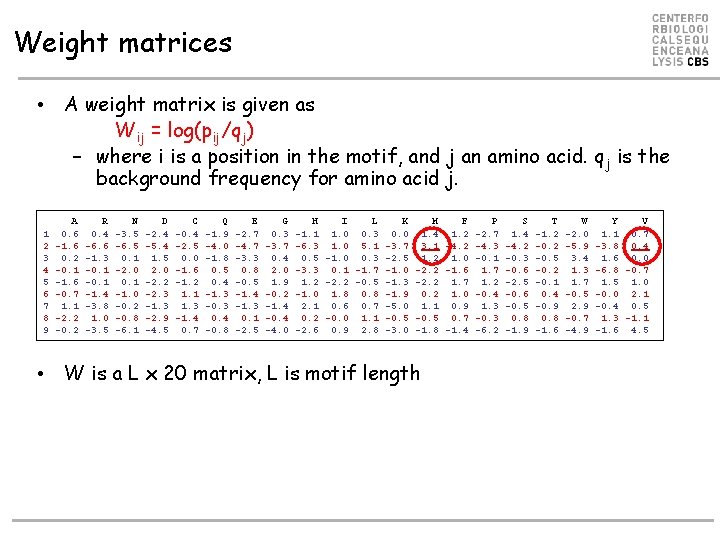
Weight matrices • A weight matrix is given as Wij = log(pij/qj) – where i is a position in the motif, and j an amino acid. q j is the background frequency for amino acid j. 1 2 3 4 5 6 7 8 9 A 0. 6 -1. 6 0. 2 -0. 1 -1. 6 -0. 7 1. 1 -2. 2 -0. 2 R 0. 4 -6. 6 -1. 3 -0. 1 -1. 4 -3. 8 1. 0 -3. 5 N -3. 5 -6. 5 0. 1 -2. 0 0. 1 -1. 0 -0. 2 -0. 8 -6. 1 D -2. 4 -5. 4 1. 5 2. 0 -2. 2 -2. 3 -1. 3 -2. 9 -4. 5 C -0. 4 -2. 5 0. 0 -1. 6 -1. 2 1. 1 1. 3 -1. 4 0. 7 Q -1. 9 -4. 0 -1. 8 0. 5 0. 4 -1. 3 -0. 3 0. 4 -0. 8 E -2. 7 -4. 7 -3. 3 0. 8 -0. 5 -1. 4 -1. 3 0. 1 -2. 5 G 0. 3 -3. 7 0. 4 2. 0 1. 9 -0. 2 -1. 4 -0. 4 -4. 0 H I L K M F -1. 1 1. 0 0. 3 0. 0 1. 4 1. 2 -6. 3 1. 0 5. 1 -3. 7 3. 1 -4. 2 0. 5 -1. 0 0. 3 -2. 5 1. 2 1. 0 -3. 3 0. 1 -1. 7 -1. 0 -2. 2 -1. 6 1. 2 -2. 2 -0. 5 -1. 3 -2. 2 1. 7 -1. 0 1. 8 0. 8 -1. 9 0. 2 1. 0 2. 1 0. 6 0. 7 -5. 0 1. 1 0. 9 0. 2 -0. 0 1. 1 -0. 5 0. 7 -2. 6 0. 9 2. 8 -3. 0 -1. 8 -1. 4 • W is a L x 20 matrix, L is motif length P -2. 7 -4. 3 -0. 1 1. 7 1. 2 -0. 4 1. 3 -0. 3 -6. 2 S 1. 4 -4. 2 -0. 3 -0. 6 -2. 5 -0. 6 -0. 5 0. 8 -1. 9 T -1. 2 -0. 5 -0. 2 -0. 1 0. 4 -0. 9 0. 8 -1. 6 W -2. 0 -5. 9 3. 4 1. 3 1. 7 -0. 5 2. 9 -0. 7 -4. 9 Y V 1. 1 0. 7 -3. 8 0. 4 1. 6 0. 0 -6. 8 -0. 7 1. 5 1. 0 -0. 0 2. 1 -0. 4 0. 5 1. 3 -1. 1 -1. 6 4. 5
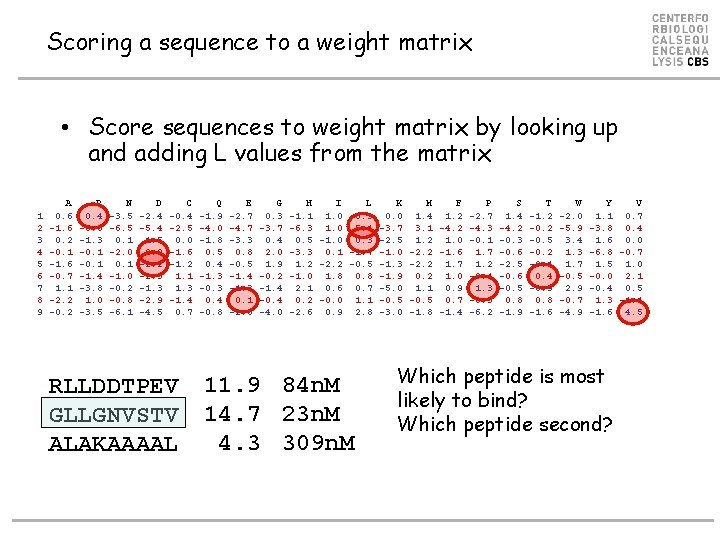
Scoring a sequence to a weight matrix • Score sequences to weight matrix by looking up and adding L values from the matrix 1 2 3 4 5 6 7 8 9 A 0. 6 -1. 6 0. 2 -0. 1 -1. 6 -0. 7 1. 1 -2. 2 -0. 2 R 0. 4 -6. 6 -1. 3 -0. 1 -1. 4 -3. 8 1. 0 -3. 5 N -3. 5 -6. 5 0. 1 -2. 0 0. 1 -1. 0 -0. 2 -0. 8 -6. 1 D -2. 4 -5. 4 1. 5 2. 0 -2. 2 -2. 3 -1. 3 -2. 9 -4. 5 C -0. 4 -2. 5 0. 0 -1. 6 -1. 2 1. 1 1. 3 -1. 4 0. 7 RLLDDTPEV GLLGNVSTV ALAKAAAAL Q -1. 9 -4. 0 -1. 8 0. 5 0. 4 -1. 3 -0. 3 0. 4 -0. 8 E -2. 7 -4. 7 -3. 3 0. 8 -0. 5 -1. 4 -1. 3 0. 1 -2. 5 G 0. 3 -3. 7 0. 4 2. 0 1. 9 -0. 2 -1. 4 -0. 4 -4. 0 H I L K M F -1. 1 1. 0 0. 3 0. 0 1. 4 1. 2 -6. 3 1. 0 5. 1 -3. 7 3. 1 -4. 2 0. 5 -1. 0 0. 3 -2. 5 1. 2 1. 0 -3. 3 0. 1 -1. 7 -1. 0 -2. 2 -1. 6 1. 2 -2. 2 -0. 5 -1. 3 -2. 2 1. 7 -1. 0 1. 8 0. 8 -1. 9 0. 2 1. 0 2. 1 0. 6 0. 7 -5. 0 1. 1 0. 9 0. 2 -0. 0 1. 1 -0. 5 0. 7 -2. 6 0. 9 2. 8 -3. 0 -1. 8 -1. 4 11. 9 84 n. M 14. 7 23 n. M 4. 3 309 n. M P -2. 7 -4. 3 -0. 1 1. 7 1. 2 -0. 4 1. 3 -0. 3 -6. 2 S 1. 4 -4. 2 -0. 3 -0. 6 -2. 5 -0. 6 -0. 5 0. 8 -1. 9 T -1. 2 -0. 5 -0. 2 -0. 1 0. 4 -0. 9 0. 8 -1. 6 W -2. 0 -5. 9 3. 4 1. 3 1. 7 -0. 5 2. 9 -0. 7 -4. 9 Y V 1. 1 0. 7 -3. 8 0. 4 1. 6 0. 0 -6. 8 -0. 7 1. 5 1. 0 -0. 0 2. 1 -0. 4 0. 5 1. 3 -1. 1 -1. 6 4. 5 Which peptide is most likely to bind? Which peptide second?
An example!! (See handout)
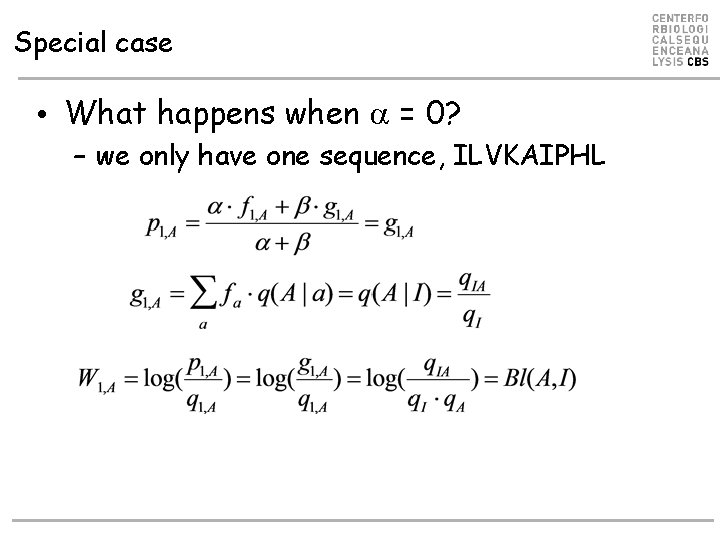
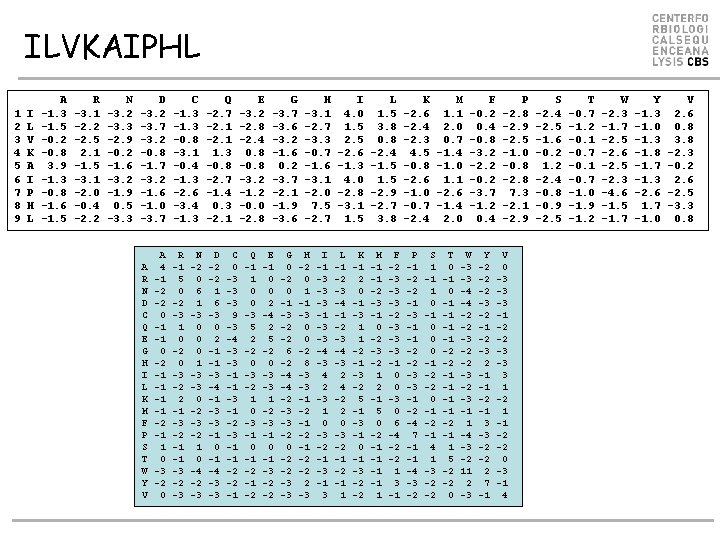
Special case • What happens when = 0? – we only have one sequence, ILVKAIPHL
ILVKAIPHL 1 2 3 4 5 6 7 8 9 I L V K A I P H L A -1. 3 -1. 5 -0. 2 -0. 8 3. 9 -1. 3 -0. 8 -1. 6 -1. 5 R -3. 1 -2. 2 -2. 5 2. 1 -1. 5 -3. 1 -2. 0 -0. 4 -2. 2 N -3. 2 -3. 3 -2. 9 -0. 2 -1. 6 -3. 2 -1. 9 0. 5 -3. 3 D -3. 2 -3. 7 -3. 2 -0. 8 -1. 7 -3. 2 -1. 6 -1. 0 -3. 7 A R N D C Q E G H I L K M F P S T W Y V A 4 -1 -2 -2 0 -1 -1 0 -2 -1 -1 -2 -1 1 0 -3 -2 0 C -1. 3 -0. 8 -3. 1 -0. 4 -1. 3 -2. 6 -3. 4 -1. 3 Q -2. 7 -2. 1 1. 3 -0. 8 -2. 7 -1. 4 0. 3 -2. 1 R -1 5 0 -2 -3 1 0 -2 0 -3 -2 2 -1 -3 -2 -1 -1 -3 -2 -3 D -2 -2 1 6 -3 0 2 -1 -1 -3 -4 -1 -3 -3 -1 0 -1 -4 -3 -3 N -2 0 6 1 -3 0 0 0 1 -3 -3 0 -2 -3 -2 1 0 -4 -2 -3 C 0 -3 -3 -3 9 -3 -4 -3 -3 -1 -1 -3 -1 -2 -3 -1 -1 -2 -2 -1 E -3. 2 -2. 8 -2. 4 0. 8 -3. 2 -1. 2 -0. 0 -2. 8 G -3. 7 -3. 6 -3. 2 -1. 6 0. 2 -3. 7 -2. 1 -1. 9 -3. 6 Q -1 1 0 0 -3 5 2 -2 0 -3 -2 1 0 -3 -1 0 -1 -2 G 0 -2 0 -1 -3 -2 -2 6 -2 -4 -4 -2 -3 -3 -2 0 -2 -2 -3 -3 E -1 0 0 2 -4 2 5 -2 0 -3 -3 1 -2 -3 -1 0 -1 -3 -2 -2 H -3. 1 -2. 7 -3. 3 -0. 7 -1. 6 -3. 1 -2. 0 7. 5 -2. 7 H -2 0 1 -1 -3 0 0 -2 8 -3 -3 -1 -2 -2 2 -3 I -1 -3 -3 -3 -1 -3 -3 -4 -3 4 2 -3 1 0 -3 -2 -1 -3 -1 3 I 4. 0 1. 5 2. 5 -2. 6 -1. 3 4. 0 -2. 8 -3. 1 1. 5 L -1 -2 -3 -4 -3 2 4 -2 2 0 -3 -2 -1 1 K -1 2 0 -1 -3 1 1 -2 -1 -3 -2 5 -1 -3 -1 0 -1 -3 -2 -2 L 1. 5 3. 8 0. 8 -2. 4 -1. 5 -2. 9 -2. 7 3. 8 K -2. 6 -2. 4 -2. 3 4. 5 -0. 8 -2. 6 -1. 0 -0. 7 -2. 4 M -1 -1 -2 -3 -1 0 -2 -3 -2 1 2 -1 5 0 -2 -1 -1 1 P -1 -2 -2 -1 -3 -1 -1 -2 -2 -3 -3 -1 -2 -4 7 -1 -1 -4 -3 -2 F -2 -3 -3 -3 -1 0 0 -3 0 6 -4 -2 -2 1 3 -1 S 1 -1 1 0 -1 0 0 0 -1 -2 -2 0 -1 -2 -1 4 1 -3 -2 -2 M 1. 1 2. 0 0. 7 -1. 4 -1. 0 1. 1 -2. 6 -1. 4 2. 0 F -0. 2 0. 4 -0. 8 -3. 2 -2. 2 -0. 2 -3. 7 -1. 2 0. 4 T 0 -1 -1 -2 -2 -1 -1 -2 -1 1 5 -2 -2 0 Y -2 -2 -2 -3 -2 -1 -2 -3 2 -1 -1 -2 -1 3 -3 -2 -2 2 7 -1 W -3 -3 -4 -4 -2 -2 -3 -1 1 -4 -3 -2 11 2 -3 P -2. 8 -2. 9 -2. 5 -1. 0 -0. 8 -2. 8 7. 3 -2. 1 -2. 9 V 0 -3 -3 -3 -1 -2 -2 -3 -3 3 1 -2 1 -1 -2 -2 0 -3 -1 4 S -2. 4 -2. 5 -1. 6 -0. 2 1. 2 -2. 4 -0. 8 -0. 9 -2. 5 T -0. 7 -1. 2 -0. 1 -0. 7 -1. 0 -1. 9 -1. 2 W -2. 3 -1. 7 -2. 5 -2. 6 -2. 5 -2. 3 -4. 6 -1. 5 -1. 7 Y -1. 3 -1. 0 -1. 3 -1. 8 -1. 7 -1. 3 -2. 6 1. 7 -1. 0 V 2. 6 0. 8 3. 8 -2. 3 -0. 2 2. 6 -2. 5 -3. 3 0. 8
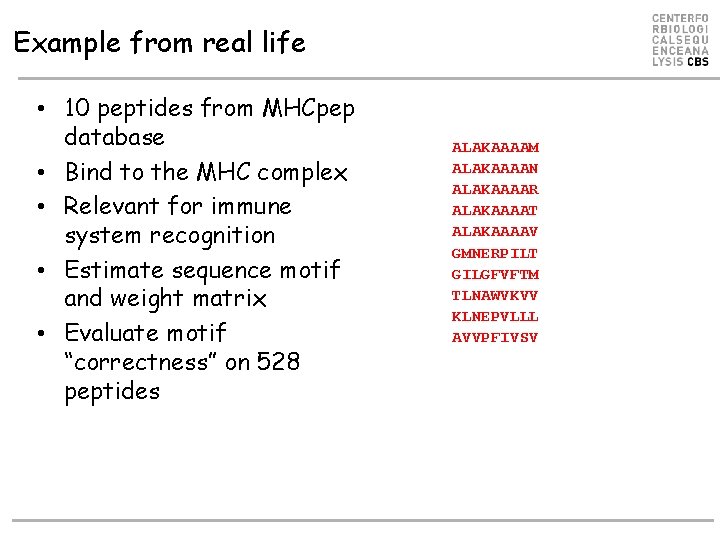
Example from real life • 10 peptides from MHCpep database • Bind to the MHC complex • Relevant for immune system recognition • Estimate sequence motif and weight matrix • Evaluate motif “correctness” on 528 peptides ALAKAAAAM ALAKAAAAN ALAKAAAAR ALAKAAAAT ALAKAAAAV GMNERPILT GILGFVFTM TLNAWVKVV KLNEPVLLL AVVPFIVSV
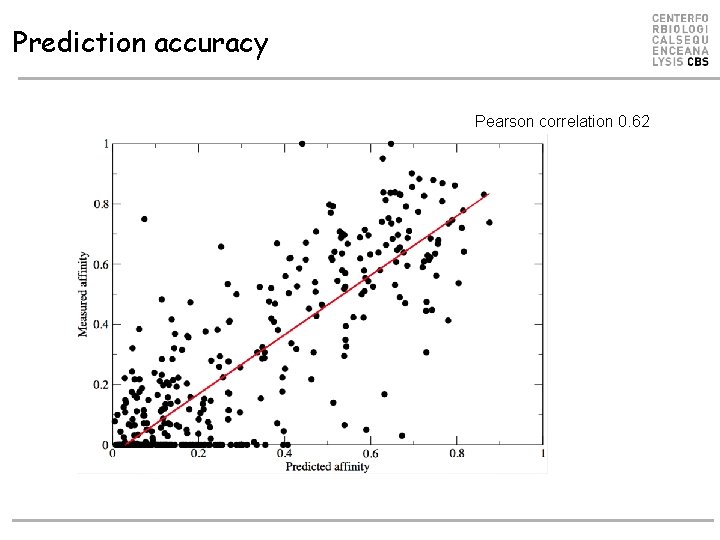
Prediction accuracy Measured affinity Pearson correlation 0. 62 Prediction score
How to define ? Optimal performance. =100
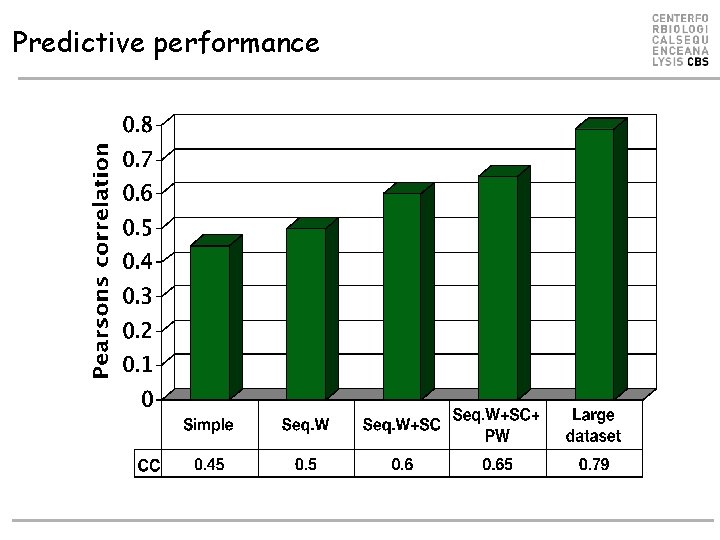
Predictive performance
Summary • Sequence logo is a power tool to visualize (binding) motifs – Information content identifies essential residues for function and/or structural stability • Weight matrices can be derived from very limited number of data using the techniques of – Sequence weighting – Pseudo counts