
SEQR BASICS Beth Lucas Senior Planner Broome County
SEQR BASICS Beth Lucas Senior Planner Broome County Planning and Economic Development
OVERVIEW Who am I? § Senior Planner, Broome County § Specialize in environmental planning § SEQR compliance for County § May offer non-legal advice regarding the SEQR process Who am I NOT? § A lawyer § SEQR isn’t always black and white. If you are uncertain you should consult your municipal attorney. § An enforcer § SEQR is self-enforcing. The County has no authority to enforce any penalties pertaining to SEQR. § SEQR considerations may weigh into our assessment during the 239 process.

OVERVIEW What is SEQR? SEQR Processes and procedures Tools and Resources This presentation is based off of guidance obtained from the NYS Department of Environmental Conservation and the NYS Planning Federation.
WHAT IS SEQR?
WHAT IS SEQR? New York State Environmental Quality Review Act Statute is Article 8 of NYS Environmental Conservation Law, Chapter 43, Consolidated Laws of NYS Regulations are Part 617 of Title 6 of the New York Codes, Rules and Regulations (“ 6 NYCRR”) Posted online at: http: //www. dec. ny. gov/permits/357. html

WHAT IS SEQR? SEQR is: An additional review that enables agencies to evaluate environmental effects of their decisions Activated when an agency must make a discretionary decision. SEQR is NOT: An additional permit or approval Intended to be the sole consideration in decision-making
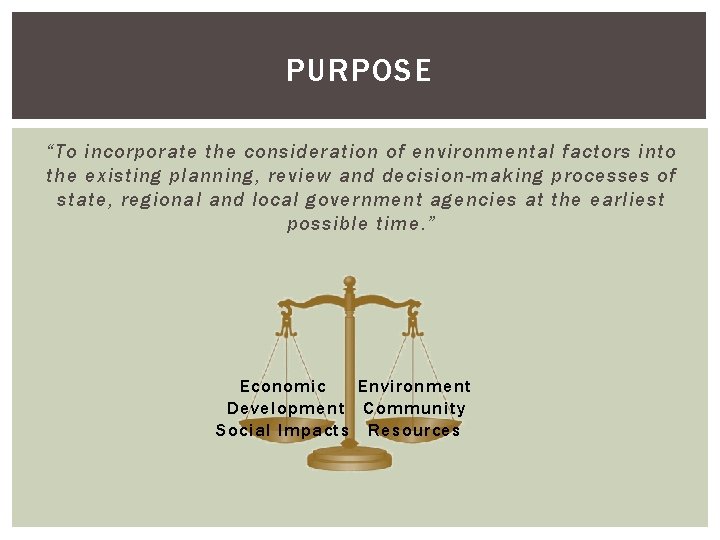
PURPOSE “To incorporate the consideration of environmental factors into the existing planning, review and decision-making processes of state, regional and local government agencies at the earliest possible time. ” Economic Environment Development Community Social Impacts Resources
“ENVIRONMENTAL FACTORS” Resources or characteristics that could be affected by an action, including: § Land, air, water, minerals § Flora, fauna § Noise/Visual Character § Agricultural resources § Historic resources § Archeological resources § Aesthetics § Community Character
WHAT IS AN “AGENCY”? “A public body which has jurisdiction by law to fund, approve or directly undertake an action. ” State Agencies County Legislatures Town or Village Boards City Councils Planning Boards Zoning Boards of Appeal School Boards
WHAT IS AN “ACTION”? When an agency undertakes: § Discretionary decision – agency has the ability to say yes, no, or “only if”. § Direct Actions § Agency sponsors, undertakes or approves projects or physical activities § Planning or policy-making that may commit the agency to a future course of action § Adoption of rules, regulations, or procedures § Combinations of the above
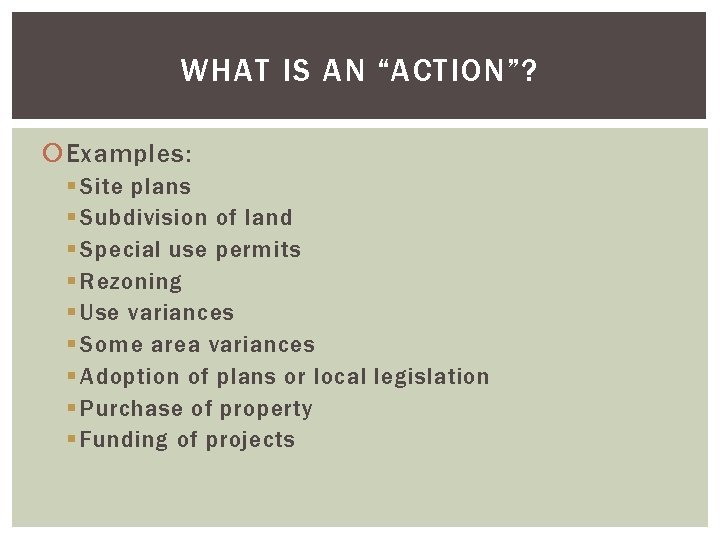
WHAT IS AN “ACTION”? Examples: § Site plans § Subdivision of land § Special use permits § Rezoning § Use variances § Some area variances § Adoption of plans or local legislation § Purchase of property § Funding of projects
WHY SEQR? Because it is required by NYS Law? For a successful project? Because you might get sued? All of the above?
SEQR PROCESSES AND PROCEDURES
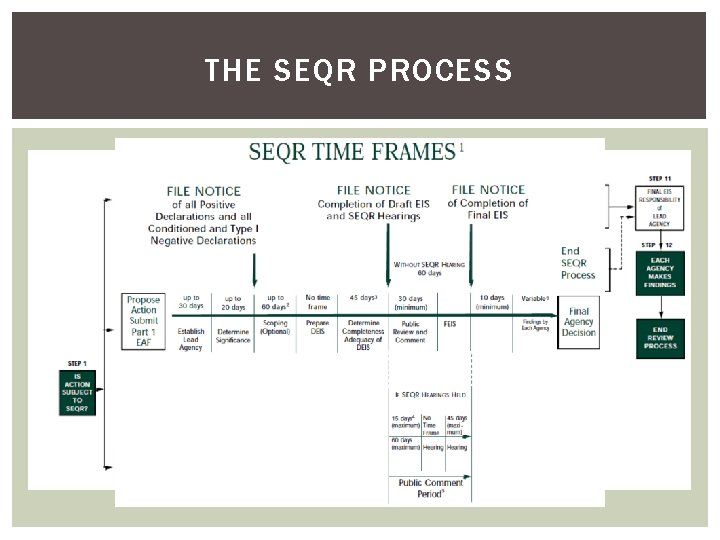
THE SEQR PROCESS
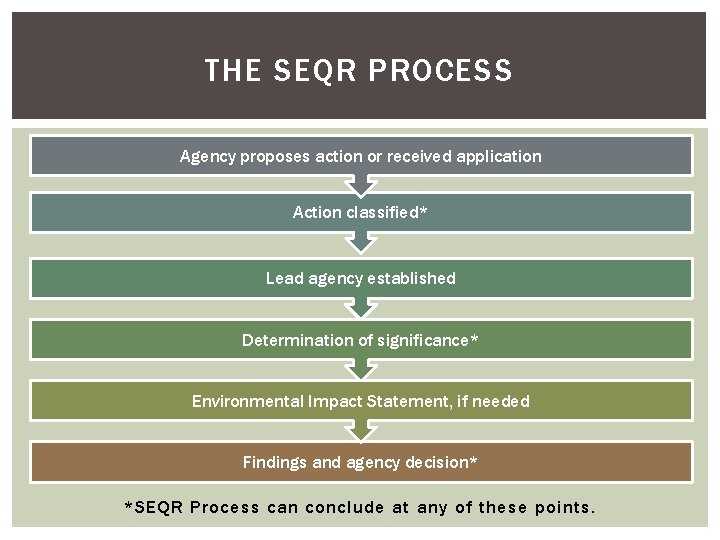
THE SEQR PROCESS Agency proposes action or received application Action classified* Lead agency established Determination of significance* Environmental Impact Statement, if needed Findings and agency decision* *SEQR Process can conclude at any of these points.
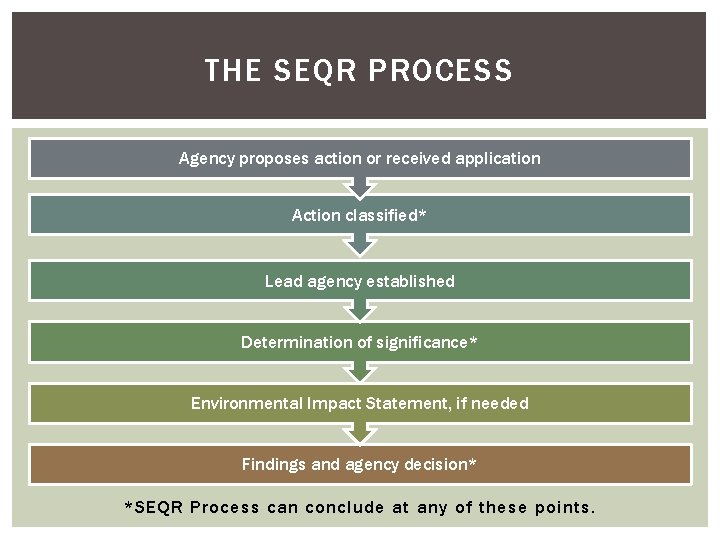
THE SEQR PROCESS Agency proposes action or received application Action classified* Lead agency established Determination of significance* Environmental Impact Statement, if needed Findings and agency decision* *SEQR Process can conclude at any of these points.
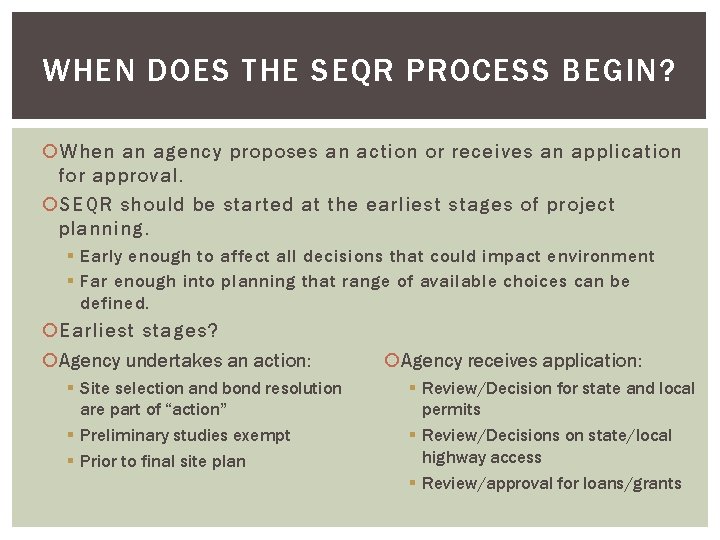
WHEN DOES THE SEQR PROCESS BEGIN? When an agency proposes an action or receives an application for approval. SEQR should be started at the earliest stages of project planning. § Early enough to affect all decisions that could impact environment § Far enough into planning that range of available choices can be defined. Earliest stages? Agency undertakes an action: § Site selection and bond resolution are part of “action” § Preliminary studies exempt § Prior to final site plan Agency receives application: § Review/Decision for state and local permits § Review/Decisions on state/local highway access § Review/approval for loans/grants
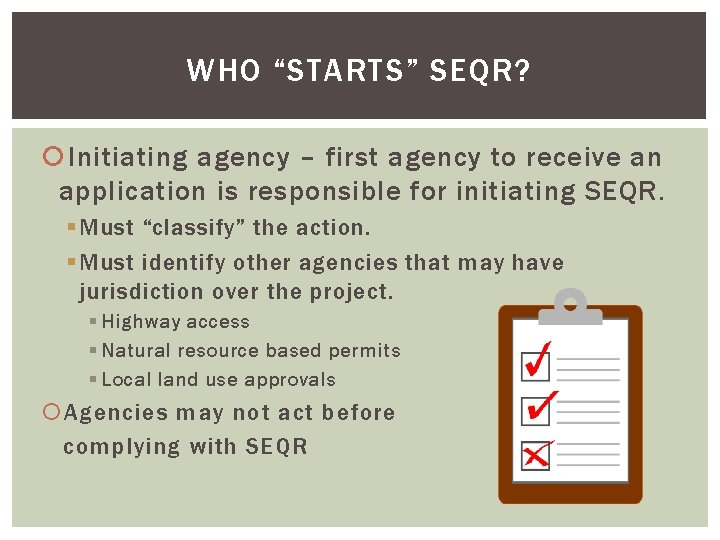
WHO “STARTS” SEQR? Initiating agency – first agency to receive an application is responsible for initiating SEQR. § Must “classify” the action. § Must identify other agencies that may have jurisdiction over the project. § Highway access § Natural resource based permits § Local land use approvals Agencies may not act before complying with SEQR
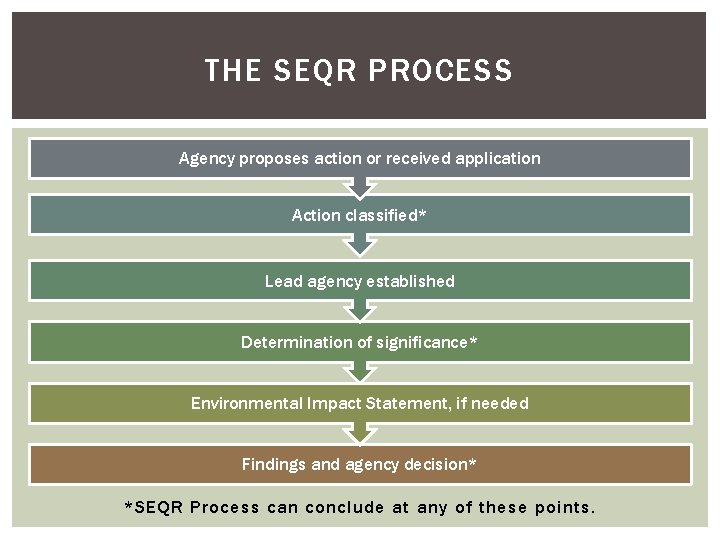
THE SEQR PROCESS Agency proposes action or received application Action classified* Lead agency established Determination of significance* Environmental Impact Statement, if needed Findings and agency decision* *SEQR Process can conclude at any of these points.
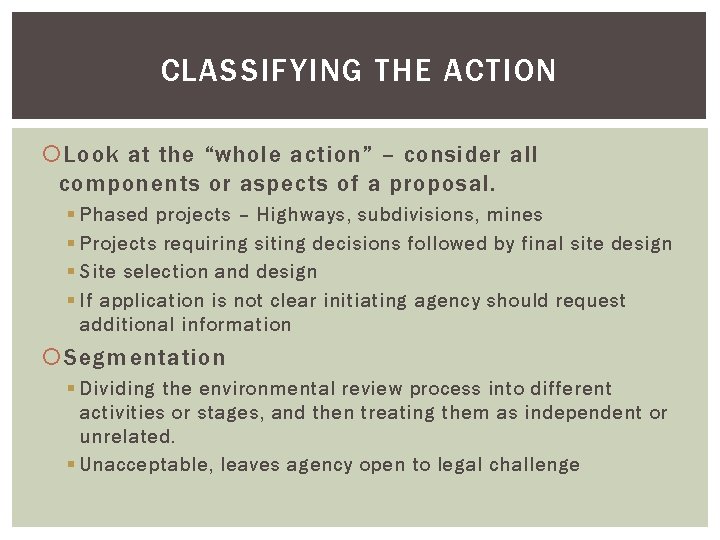
CLASSIFYING THE ACTION Look at the “whole action” – consider all components or aspects of a proposal. § Phased projects – Highways, subdivisions, mines § Projects requiring siting decisions followed by final site design § Site selection and design § If application is not clear initiating agency should request additional information Segmentation § Dividing the environmental review process into different activities or stages, and then treating them as independent or unrelated. § Unacceptable, leaves agency open to legal challenge
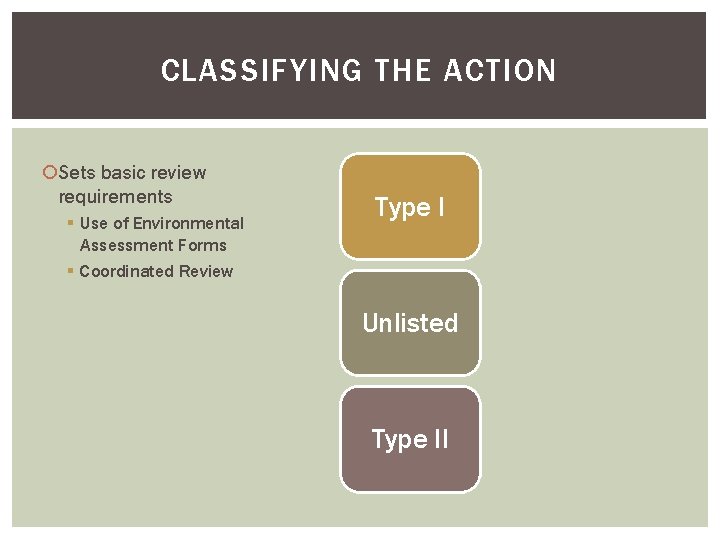
CLASSIFYING THE ACTION Sets basic review requirements § Use of Environmental Assessment Forms § Coordinated Review Type I Unlisted Type II
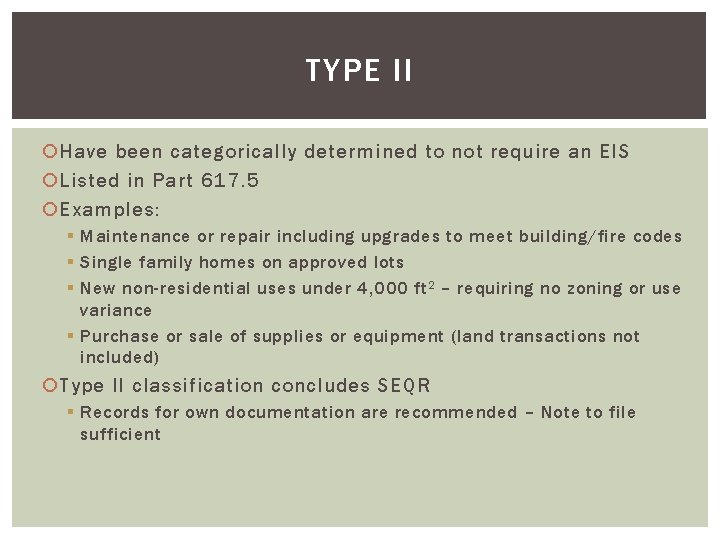
TYPE II Have been categorically determined to not require an EIS Listed in Part 617. 5 Examples: § Maintenance or repair including upgrades to meet building/fire codes § Single family homes on approved lots § New non-residential uses under 4, 000 ft 2 – requiring no zoning or use variance § Purchase or sale of supplies or equipment (land transactions not included) Type II classification concludes SEQR § Records for own documentation are recommended – Note to file sufficient
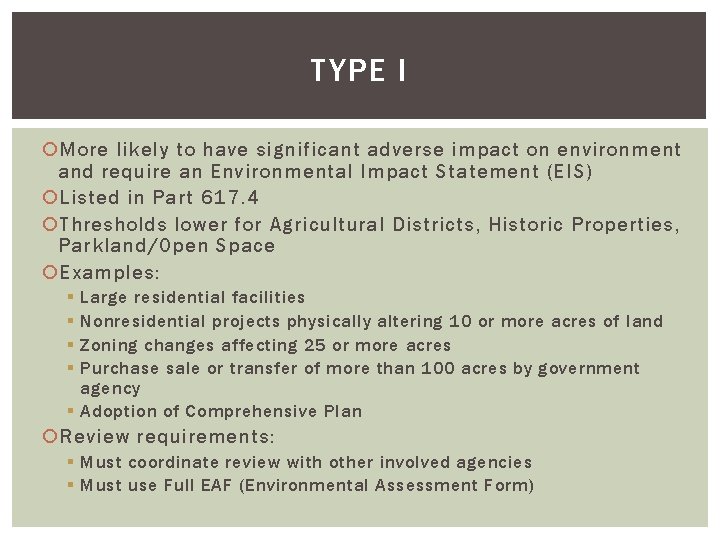
TYPE I More likely to have significant adverse impact on environment and require an Environmental Impact Statement (EIS) Listed in Part 617. 4 Thresholds lower for Agricultural Districts, Historic Properties, Parkland/Open Space Examples: § § Large residential facilities Nonresidential projects physically altering 10 or more acres of land Zoning changes affecting 25 or more acres Purchase sale or transfer of more than 100 acres by government agency § Adoption of Comprehensive Plan Review requirements: § Must coordinate review with other involved agencies § Must use Full EAF (Environmental Assessment Form)
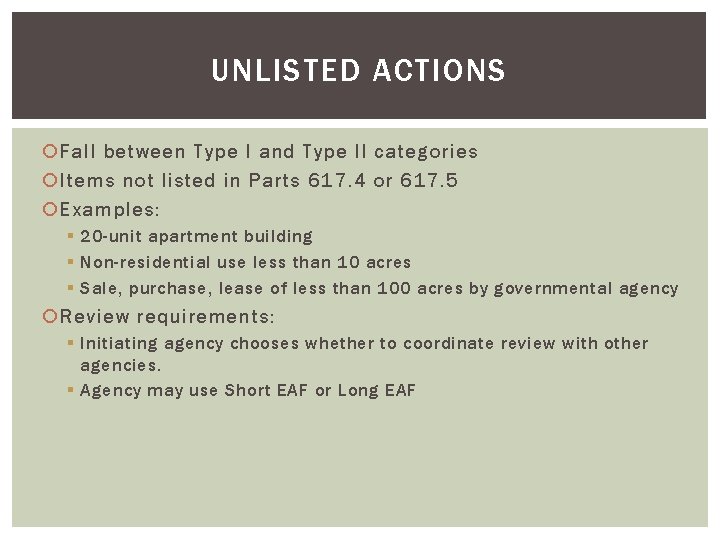
UNLISTED ACTIONS Fall between Type I and Type II categories Items not listed in Parts 617. 4 or 617. 5 Examples: § 20 -unit apartment building § Non-residential use less than 10 acres § Sale, purchase, lease of less than 100 acres by governmental agency Review requirements: § Initiating agency chooses whether to coordinate review with other agencies. § Agency may use Short EAF or Long EAF
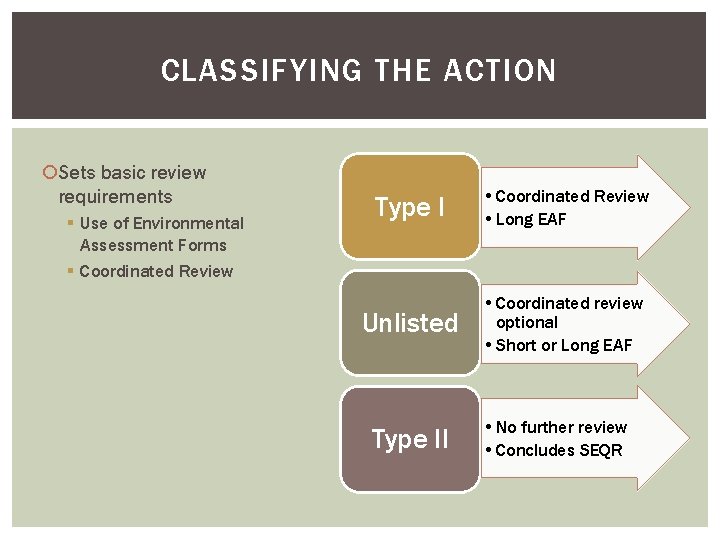
CLASSIFYING THE ACTION Sets basic review requirements § Use of Environmental Assessment Forms § Coordinated Review Type I • Coordinated Review • Long EAF Unlisted • Coordinated review optional • Short or Long EAF Type II • No further review • Concludes SEQR
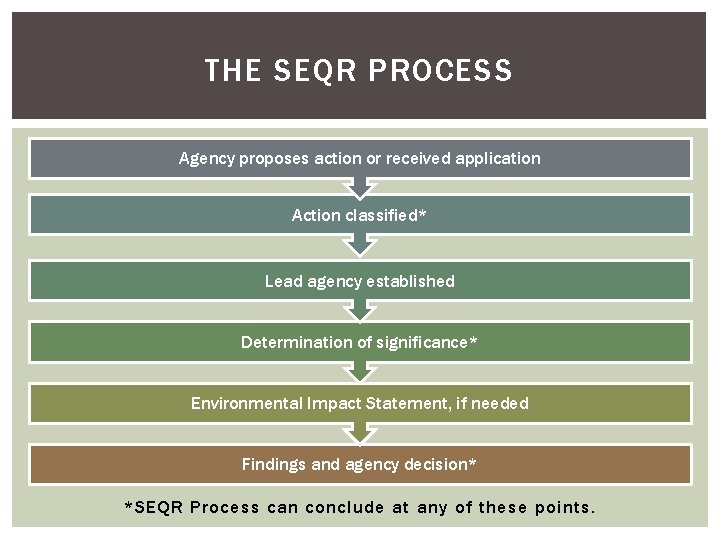
THE SEQR PROCESS Agency proposes action or received application Action classified* Lead agency established Determination of significance* Environmental Impact Statement, if needed Findings and agency decision* *SEQR Process can conclude at any of these points.
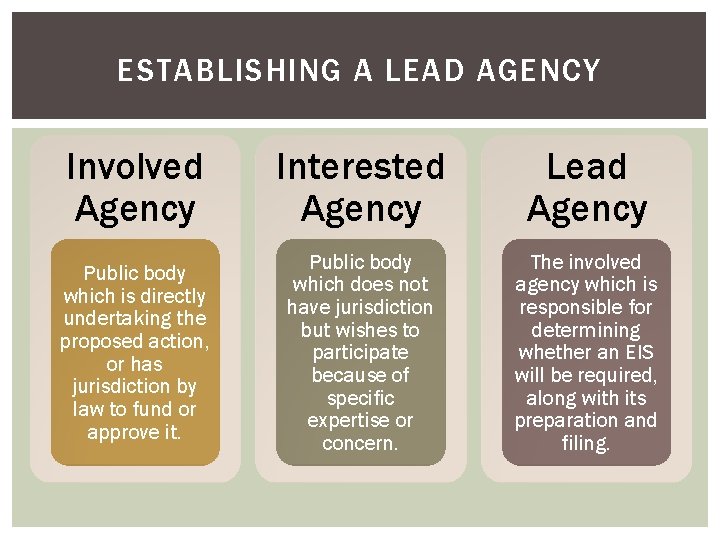
ESTABLISHING A LEAD AGENCY Involved Agency Interested Agency Lead Agency Public body which is directly undertaking the proposed action, or has jurisdiction by law to fund or approve it. Public body which does not have jurisdiction but wishes to participate because of specific expertise or concern. The involved agency which is responsible for determining whether an EIS will be required, along with its preparation and filing.
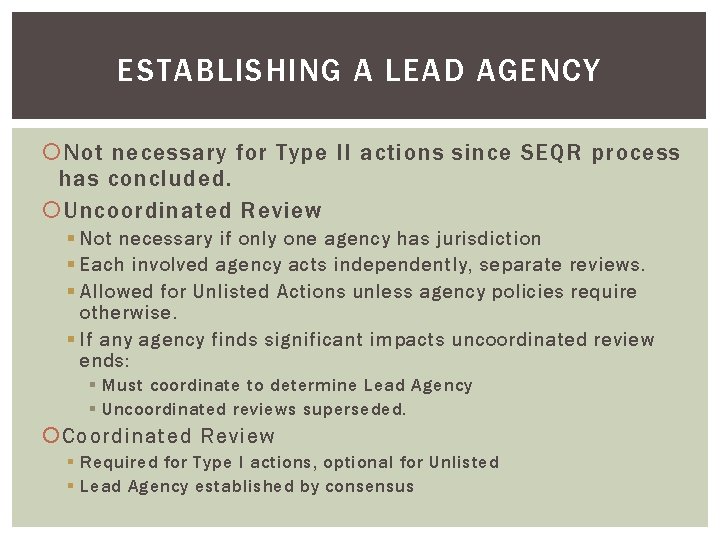
ESTABLISHING A LEAD AGENCY Not necessary for Type II actions since SEQR process has concluded. Uncoordinated Review § Not necessary if only one agency has jurisdiction § Each involved agency acts independently, separate reviews. § Allowed for Unlisted Actions unless agency policies require otherwise. § If any agency finds significant impacts uncoordinated review ends: § Must coordinate to determine Lead Agency § Uncoordinated reviews superseded. Coordinated Review § Required for Type I actions, optional for Unlisted § Lead Agency established by consensus
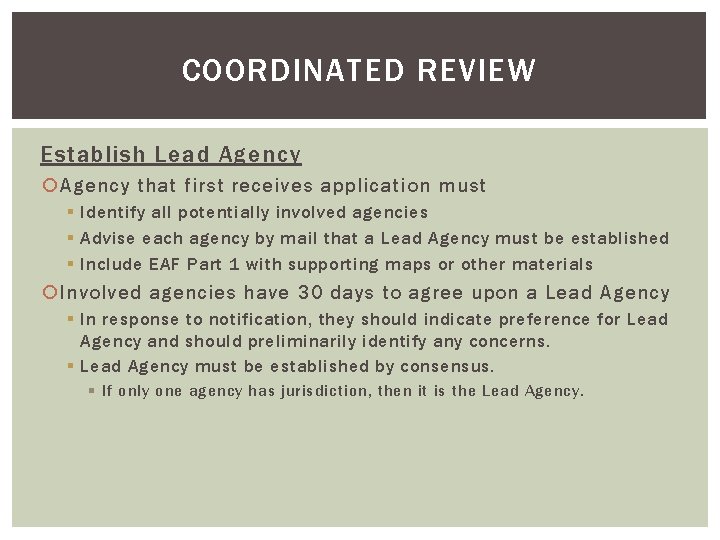
COORDINATED REVIEW Establish Lead Agency that first receives application must § Identify all potentially involved agencies § Advise each agency by mail that a Lead Agency must be established § Include EAF Part 1 with supporting maps or other materials Involved agencies have 30 days to agree upon a Lead Agency § In response to notification, they should indicate preference for Lead Agency and should preliminarily identify any concerns. § Lead Agency must be established by consensus. § If only one agency has jurisdiction, then it is the Lead Agency.
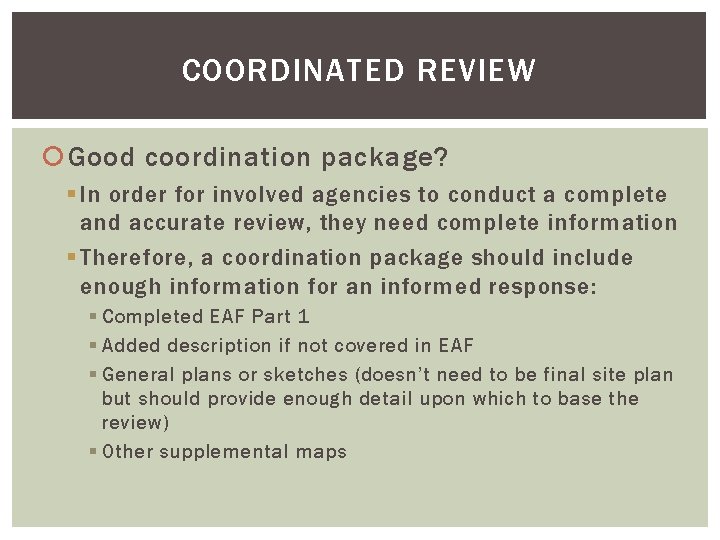
COORDINATED REVIEW Good coordination package? § In order for involved agencies to conduct a complete and accurate review, they need complete information § Therefore, a coordination package should include enough information for an informed response: § Completed EAF Part 1 § Added description if not covered in EAF § General plans or sketches (doesn’t need to be final site plan but should provide enough detail upon which to base the review) § Other supplemental maps
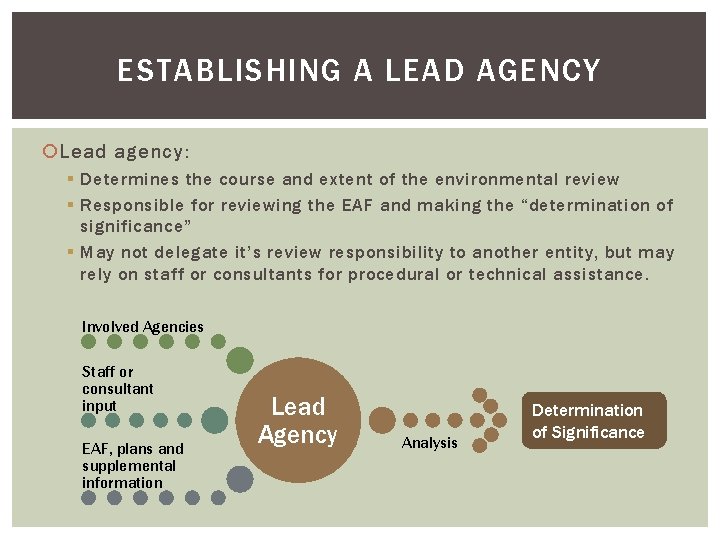
ESTABLISHING A LEAD AGENCY Lead agency: § Determines the course and extent of the environmental review § Responsible for reviewing the EAF and making the “determination of significance” § May not delegate it’s review responsibility to another entity, but may rely on staff or consultants for procedural or technical assistance. Involved Agencies Staff or consultant input EAF, plans and supplemental information Lead Agency Analysis Determination of Significance
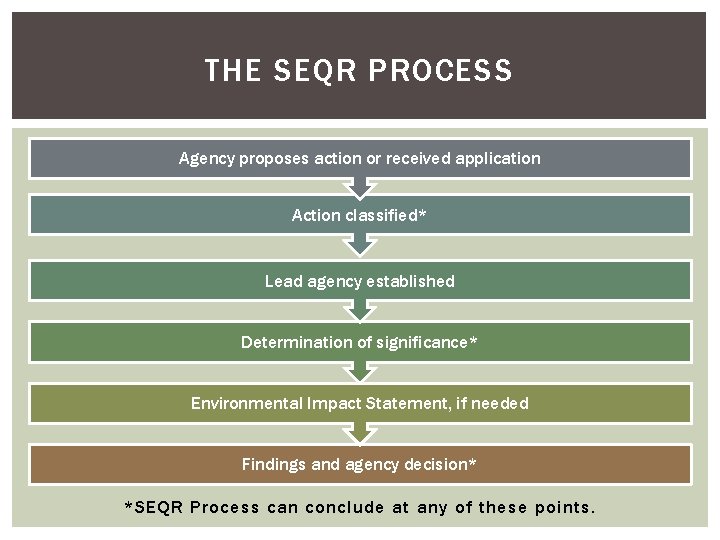
THE SEQR PROCESS Agency proposes action or received application Action classified* Lead agency established Determination of significance* Environmental Impact Statement, if needed Findings and agency decision* *SEQR Process can conclude at any of these points.
DETERMINING OF SIGNIFICANCE “Determination of significance” § The decision whether to require an Environmental Impact Statement to further explore potential impacts of the proposed action as well as options to avoid or mitigate the impacts. § Negative Declaration or Positive Declaration Specific criteria for determining significance: § Indicators of significant adverse impacts on the environment § Reasonably related long-term, short-term, direct, indirect and cumulative impacts § The significance of a likely consequence (i. e. whether it is material, substantial, large or important) Environmental Assessment Form is the main assessment tool to determine significance. Lead agency is responsible for reviewing the EAF and making a determination of significance
ENVIRONMENTAL ASSESSMENT FORM Environmental Assessment Form § Used by an agency to assist in determining environmental significance of actions. § Must contain enough info to describe the proposed action, its location, its purpose and its potential impacts on the environment. Long (Full) EAF § Required for Type I actions, optional for Unlisted actions § Several pages long, organized by environmental features and factors § Use of gateway questions Short EAF § For small, unlisted actions (Long form recommended if sufficient information isn’t provided via short form) Lead agency may require supplemental information be added if necessary to make a determination of significance. Fillable pdf forms can be found on NYSDEC website: http: //www. dec. ny. gov/permits/6191. html
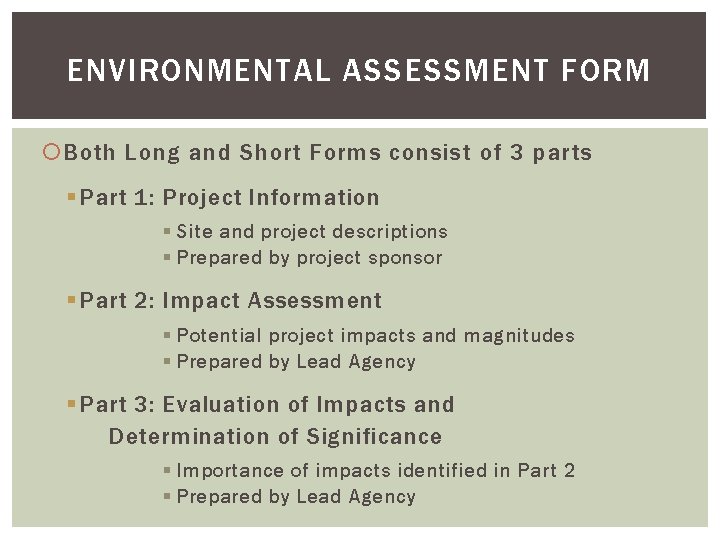
ENVIRONMENTAL ASSESSMENT FORM Both Long and Short Forms consist of 3 parts § Part 1: Project Information § Site and project descriptions § Prepared by project sponsor § Part 2: Impact Assessment § Potential project impacts and magnitudes § Prepared by Lead Agency § Part 3: Evaluation of Impacts and Determination of Significance § Importance of impacts identified in Part 2 § Prepared by Lead Agency
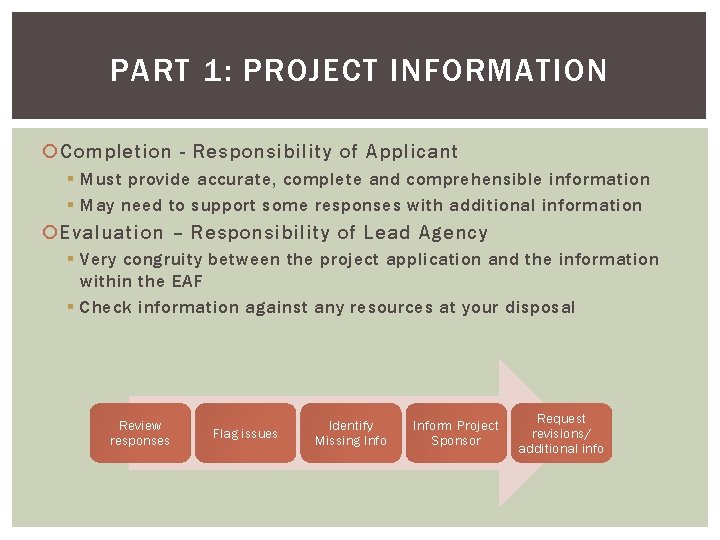
PART 1: PROJECT INFORMATION Completion - Responsibility of Applicant § Must provide accurate, complete and comprehensible information § May need to support some responses with additional information Evaluation – Responsibility of Lead Agency § Very congruity between the project application and the information within the EAF § Check information against any resources at your disposal Review responses Flag issues Identify Missing Inform Project Sponsor Request revisions/ additional info
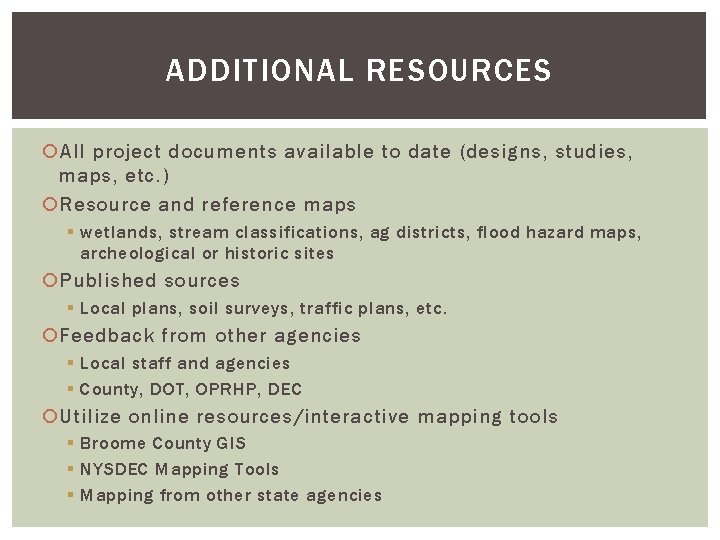
ADDITIONAL RESOURCES All project documents available to date (designs, studies, maps, etc. ) Resource and reference maps § wetlands, stream classifications, ag districts, flood hazard maps, archeological or historic sites Published sources § Local plans, soil surveys, traffic plans, etc. Feedback from other agencies § Local staff and agencies § County, DOT, OPRHP, DEC Utilize online resources/interactive mapping tools § Broome County GIS § NYSDEC Mapping Tools § Mapping from other state agencies
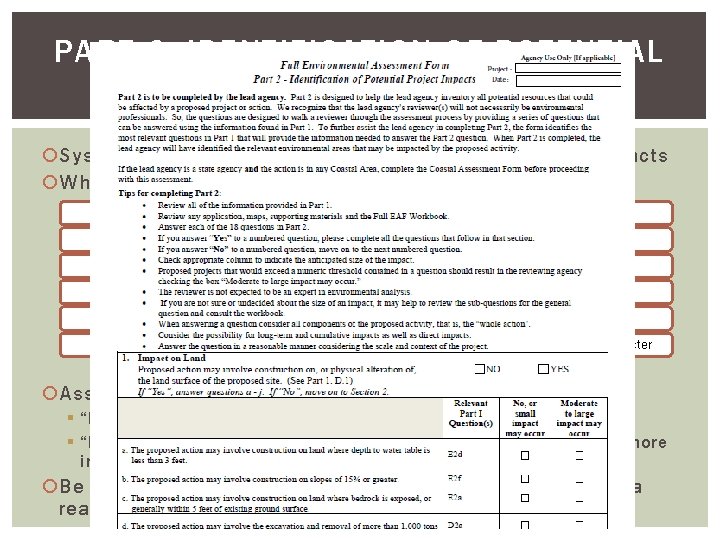
PART 2: IDENTIFICATION OF POTENTIAL PROJECT IMPACTS Systematic analysis by category to identify potential impacts What is affected? Land Geologic Features Surface Water Ground Water Flooding Air Plants and Animals Agriculture Aethetics Historic/Archeological Open Space/Recreation Critical Envir Areas Transportation Energy Noise, Odor, Light Human Health Community Plans/Character Assess Magnitude of Impacts § “No impact or small impact” § “Moderate to Large Impact” =/= Significant, but will warrant a more in-depth assessment Be “reasonable”- Does the information provided give you a reasonable expectation that impacts will be mitigated?
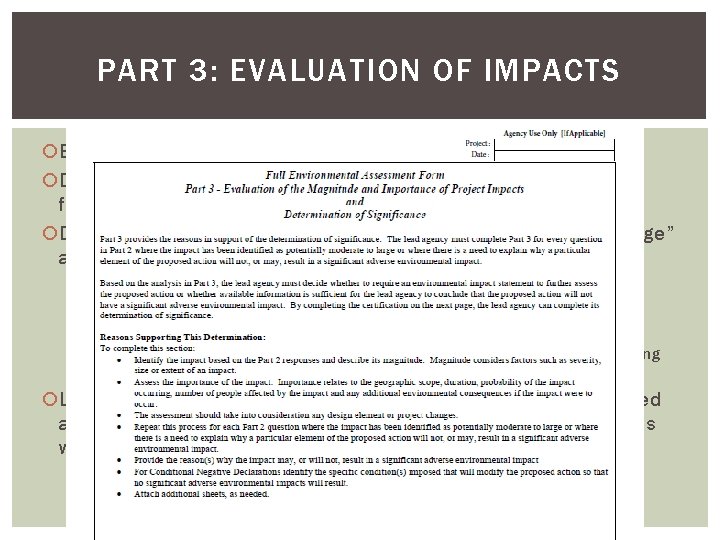
PART 3: EVALUATION OF IMPACTS Evaluate potential impacts and determine significance Describe impacts identified in Part 2 – include design features which avoid or reduce potential impacts Decide if any of the impacts identified as “moderate to large” are important. § Magnitude – size, extent, or severity of a potential impact § Importance – valuation of those impacts § Likelihood, probable duration, nature and quality of resources to be affected, broader impacts beyond project site, consistency with existing plans and ordinances Lead agency must include its assessments of all anticipated adverse impacts, including linking specific project elements with identified potential impacts.
PART 3: DETERMINATION OF SIGNIFICANCE Standard for review established by case law: § Review the “whole action” – all phases, aspects, components or elements, even when separated by time or distance § Identify all relevant impacts – regardless of jurisdiction § Analyze/Take a “hard look” at every impact § Provide a “reasoned elaboration” – explain not only the conclusions, but the process taken to reach those conclusions Be explicit in your “reasoned elaboration” § § State whether impact is likely, significant, or neither Describe mitigation Name sources Explain how sources support conclusions
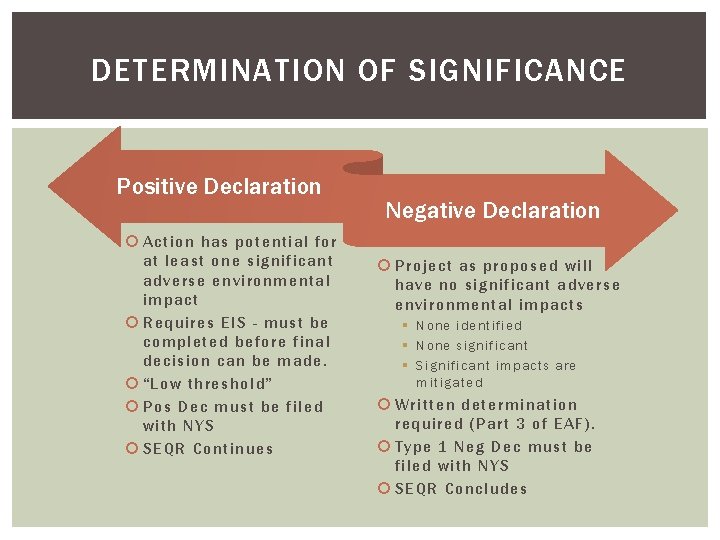
DETERMINATION OF SIGNIFICANCE Positive Declaration Action has potential for at least one significant adverse environmental impact Requires EIS - must be completed before final decision can be made. “Low threshold” Pos Dec must be filed with NYS SEQR Continues Negative Declaration Project as proposed will have no significant adverse environmental impacts § None identified § None significant § Significant impacts are mitigated Written determination required (Part 3 of EAF). Type 1 Neg Dec must be filed with NYS SEQR Concludes
CONDITIONED NEGATIVE DECLARATION (CND) “CND” - Lead agency concludes that an action may have a significant impact that can be eliminated or mitigated by conditions imposed by the lead agency, without the need for additional studies. Allowed for UNLISTED actions only. May not be used where the lead agency is the applicant or Type I actions. Must meet following requirements: § § § § Base on coordinated review Use Full EAF Conditions explicitly set forth Publish notice in the ENB 30+ days for public comment Notice and filing requirements for Type I actions Consider all comments May rescind CND and issue Pos Dec if warranted by comments.
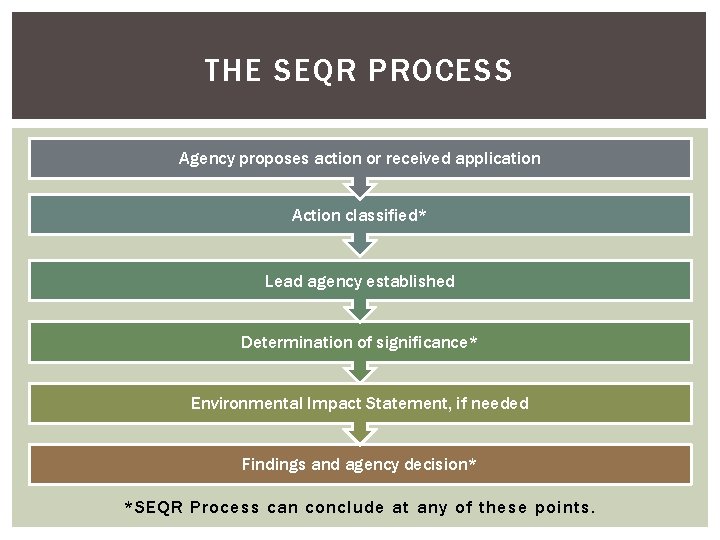
THE SEQR PROCESS Agency proposes action or received application Action classified* Lead agency established Determination of significance* Environmental Impact Statement, if needed Findings and agency decision* *SEQR Process can conclude at any of these points.
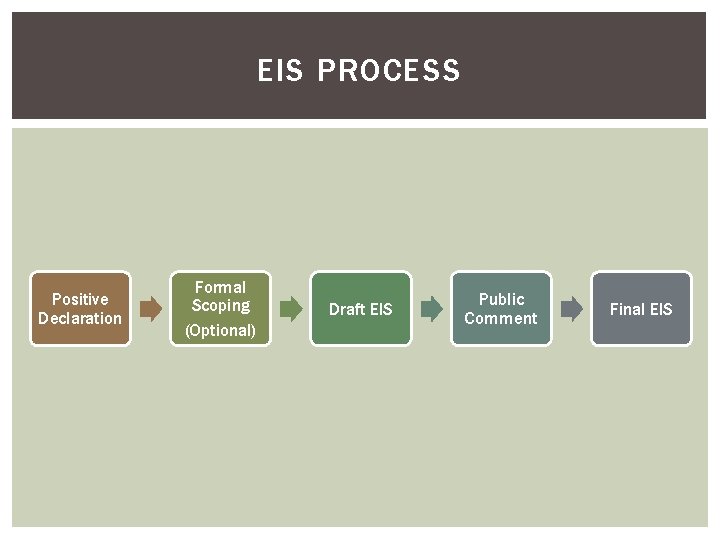
EIS PROCESS Positive Declaration Formal Scoping (Optional) Draft EIS Public Comment Final EIS
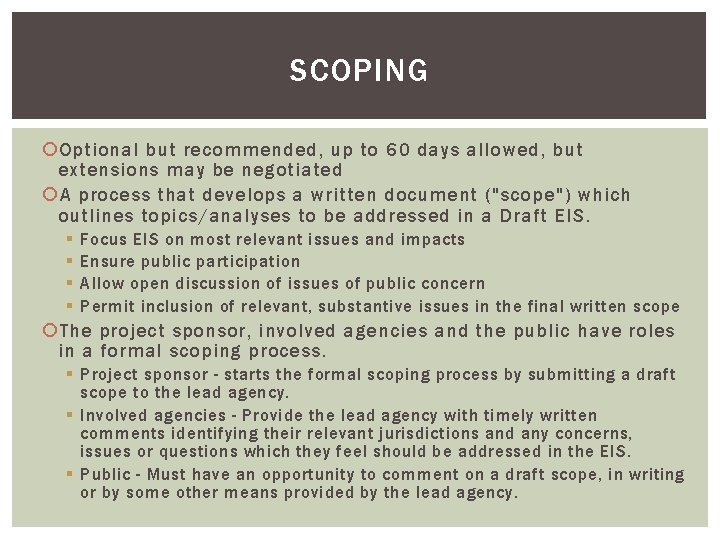
SCOPING Optional but recommended, up to 60 days allowed, but extensions may be negotiated A process that develops a written document ("scope") which outlines topics/analyses to be addressed in a Draft EIS. § § Focus EIS on most relevant issues and impacts Ensure public participation Allow open discussion of issues of public concern Permit inclusion of relevant, substantive issues in the final written scope The project sponsor, involved agencies and the public have roles in a formal scoping process. § Project sponsor - starts the formal scoping process by submitting a draft scope to the lead agency. § Involved agencies - Provide the lead agency with timely written comments identifying their relevant jurisdictions and any concerns, issues or questions which they feel should be addressed in the EIS. § Public - Must have an opportunity to comment on a draft scope, in writing or by some other means provided by the lead agency.
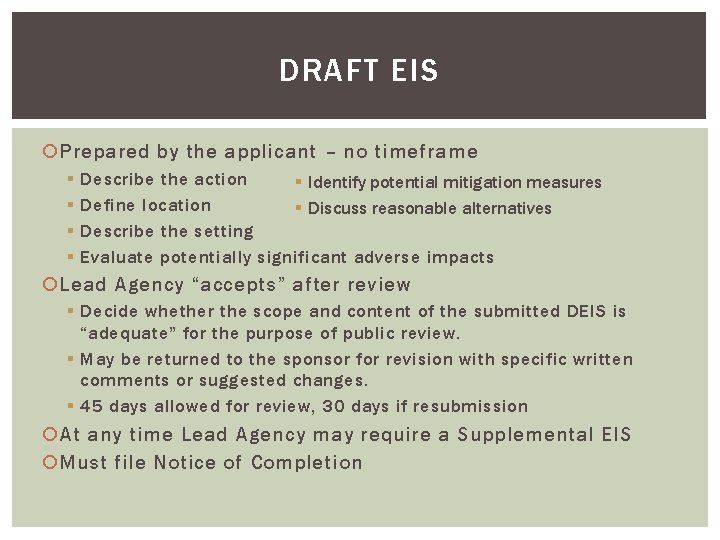
DRAFT EIS Prepared by the applicant – no timeframe § § Describe the action § Identify potential mitigation measures Define location § Discuss reasonable alternatives Describe the setting Evaluate potentially significant adverse impacts Lead Agency “accepts” after review § Decide whether the scope and content of the submitted DEIS is “adequate” for the purpose of public review. § May be returned to the sponsor for revision with specific written comments or suggested changes. § 45 days allowed for review, 30 days if resubmission At any time Lead Agency may require a Supplemental EIS Must file Notice of Completion
PUBLIC COMMENT Minimum 30 day public comment period required after filing. Public Hearing is optional: § May run concurrently with other required hearing for project (but must meet SEQR timeframes) § Minimum of 14 days notice of hearing § Start no less than 15 and no more than 60 days after Notice of Completion filed. Public comment period must continue at least 10 days after hearing closes.
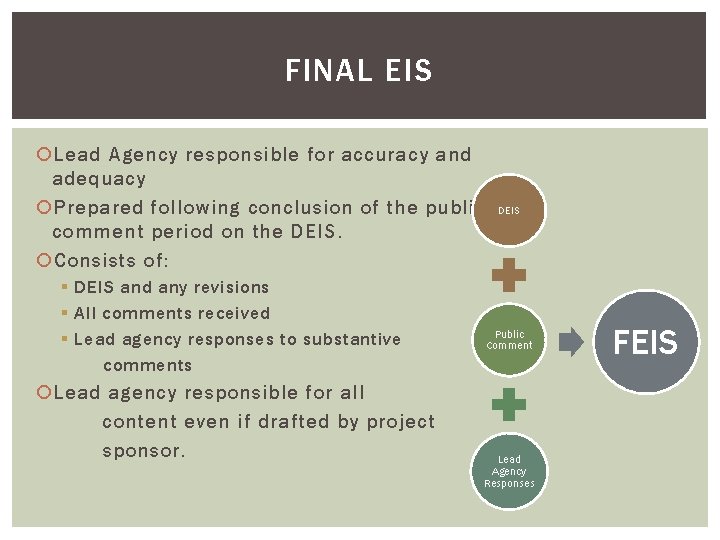
FINAL EIS Lead Agency responsible for accuracy and adequacy Prepared following conclusion of the public comment period on the DEIS. Consists of: § DEIS and any revisions § All comments received § Lead agency responses to substantive comments Lead agency responsible for all content even if drafted by project sponsor. DEIS Public Comment Lead Agency Responses FEIS
FINAL EIS FEIS should be completed: § Within 45 days after public hearing, or § Within 60 days after DEIS Notice of Completion (if no hearing) Lead agency must file Notice of Completion of FEIS § Begins 10 day consideration period § Not an additional round of public comment § Must wait for the end of 10 days to make findings and decisions.
USING THE EIS - FINDINGS The EIS should be linked to Agency decisions regarding the project. Lead Agency and every other involved agency must each issue their own findings and decision(s): § “Findings” - rationale for each agency’s decision within its respective jurisdiction § Comprehensive, reasoned conclusions using information from the FEIS Each agency must: § Certify that alternative or mitigation measures avoid or minimize adverse environmental impacts “to the maximum extent practicable” § If impacts will not be fully avoided or mitigated, explain how it balanced those impacts against economic, social, or public need. Findings Form Available
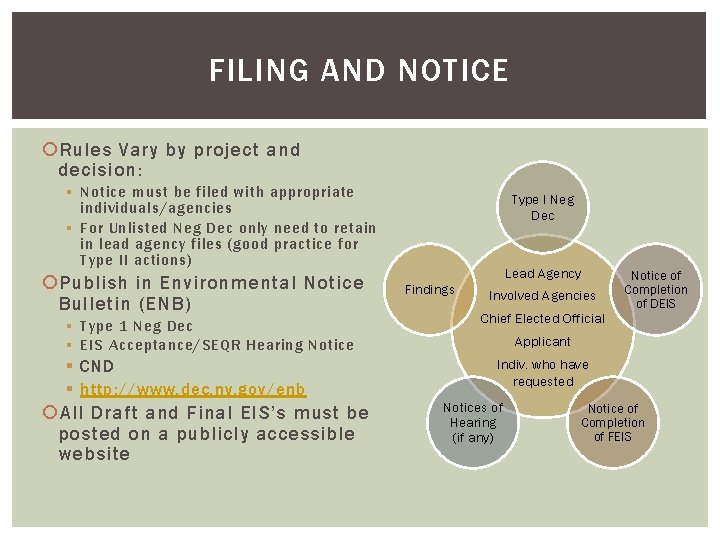
FILING AND NOTICE Rules Vary by project and decision: § Notice must be filed with appropriate individuals/agencies § For Unlisted Neg Dec only need to retain in lead agency files (good practice for Type II actions) Publish in Environmental Notice Bulletin (ENB) § Type 1 Neg Dec § EIS Acceptance/SEQR Hearing Notice § CND § http: //www. dec. ny. gov/enb All Draft and Final EIS’s must be posted on a publicly accessible website Type I Neg Dec Lead Agency Findings Involved Agencies Chief Elected Official Notice of Completion of DEIS Applicant Indiv. who have requested Notices of Hearing (if any) Notice of Completion of FEIS
FINAL DECISIONS AFTER SEQR Findings may be made concurrently with final decision on project Negative Declaration may be made concurrently with final decision on project.
SEQR COMPLIANCE Oversight by citizens and courts § No enforcing entity named in the statute, so SEQR is enforced through the courts Some court standards: § “Substantive” – lead agency must evaluate all potential impacts of a proposed action § “Literal” – Lead agency must follow SEQR’s procedural requirements § Should integrate SEQR with other reviews, but § May not substitute them for SEQR standards
TOOLS AND RESOURCES
GENERAL SEQR GUIDANCE SEQR Main Page, NYSDEC - www. dec. ny. gov/permits/357. html § SEQR Regulations (6 NYCRR Part 617) § Link to “SEQR Publications” (very basic) SEQR Handbook - www. dec. ny. gov/permits/6188. html § Provides a practical reference guide to the procedures prescribed by SEQR and addresses common questions that arise during the process. “SEQR: Guiding the Process” www. dec. ny. gov/docs/permits_ej_operations_pdf/guidfnledits 27409. pdf § Basis for much of this presentation with more detailed notes.
FORMS www. dec. ny. gov/permits/6191. htm § Short and Long Environmental Assessment Form (fillable format) § EAF Mapper § § Notice of Completion for Draft and Final EIS Notice of Completion and Public Hearing for Draft EIS SEQR Findings Form SEQR Environmental Notice Publication Form § For instructions about how to submit to ENB go to http: //www. dec. ny. gov/enb/33200. html
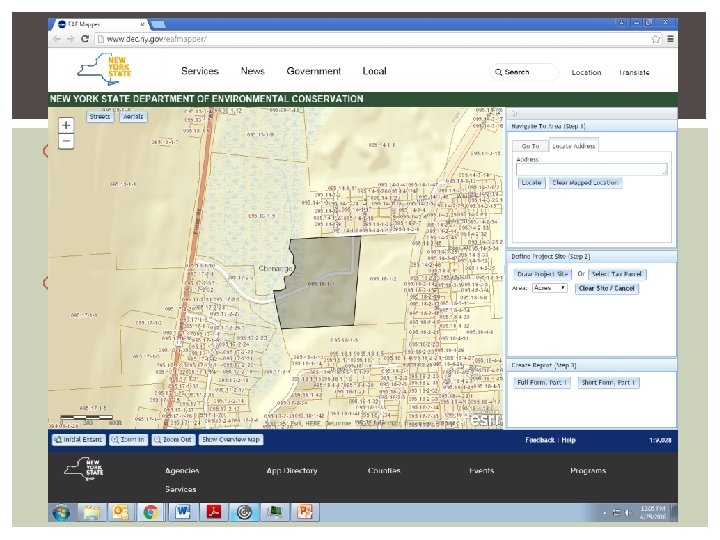
EAF WORKBOOK AND MAPPER EAF Workbook § www. dec. ny. gov/permits/90125. html § Web-based workbooks contain guidance for both the full and short environmental assessment forms § Sidebar contains navigation links. EAF Mapper § www. dec. ny. gov/eafmapper § Finds some of the location-based information needed to complete Part 1 of the EAF from multiple DEC data sources. § Use by applicant for completion but also can be used for verification by lead agency. § Will not complete all components so additional background work is necessary.

OTHER NYSDEC MAPPERS Interactive Online Maps - http: //www. dec. ny. gov/pubs / 42937. html § Environmental Resource Mapper § Freshwater wetlands regulated by the State of New York § Streams, rivers, lakes, and ponds with water quality classifications. § Animals and plants that are rare in New York, including those listed as Endangered or Threatened (generalized locations). § Significant natural communities, such as rare or high-quality forests, wetlands, and other habitat types. § Environmental Facilities Navigator § § § § Superfund sites SPDES discharges Air emission sources Solid waste management facilities Electric generation facilities Mines State recreation lands NYS OPRHP - https: //cris. parks. ny. gov/ § Cultural Resource Information System – Includes mapping tool to find historic and archeologically significant sites
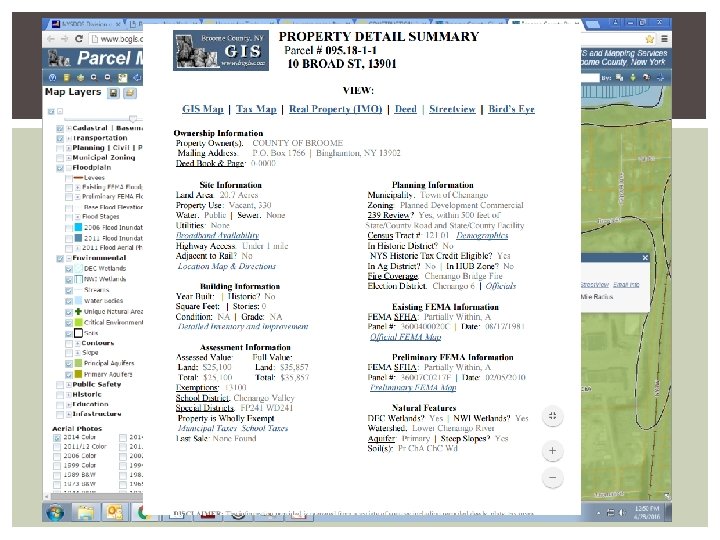
BROOME COUNTY GIS Broome County’s Online Mapping Tool - www. bcgis. com § § § Parcel information Transportation Planning, Civil, Political Municipal Zoning Floodplain Environmental Public Safety Historic Education Infrastructure Aerial Photos
SEQR PRACTITIONERS’ TIPS Be transparent to avoid setback and delays later on § Don’t try to “get around” additional review § Involve the public early § Establish and maintain communication with all parties (sponsors/applicants, other agencies, public) Remember the purpose of SEQR § To balance environmental impacts with other decision-making criteria (economic, social) § Goal is to work together for a project with all around benefits to the community Document and keep records of all discussions and analysis
FOR ASSISTANCE NYS Department of Environmental Conservation § Division of Environmental Permits (518) 402 -9167 deppermitting@dec. ny. gov Broome County Planning and Economic Development § Beth Lucas (607) 778 -2114 x 3 Blucas@co. broome. ny. us
- Slides: 61