
September 2000 Project IEEE P 802 15 Working
September 2000 Project: IEEE P 802. 15 Working Group for Wireless Personal Area Networks (WPANS) Submission Title: [Xtreme. Spectrum Multimedia WPAN PHY] Date Submitted: [July 7, 2000] Source: [Martin Rofheart] Company [Xtreme. Spectrum Inc. ] Address [7501 Greenway Center Drive, Suite 760, Greenbelt, MD 20770 -3514] Voice [(301) 614 -1324], Fax [(301) 614 -1327], E-mail [martin@xtremespectrum. com] Re: [TG 3 Call For Proposals] Abstract: [Multimedia data rate ultrawideband WPAN] Purpose: [for July 2000 plenary] Notice: This document has been prepared to assist the IEEE P 802. 15. It is offered as a basis for discussion and is not binding on the contributing individual or organization. The material in this document is subject to change in form and content after further study. The contributor reserves the right to add, amend or withdraw material contained herein. Release: The contributor acknowledges and accepts that this contribution becomes the property of IEEE and may be made publicly available by P 802. 15. 1 Martin Rofheart, Xtreme. Spectrum
September 2000 doc. : IEEE 802. 15 -00/195 r 7 Xtreme. Spectrum, Inc. An Ultrawideband Technology Company Multimedia WPAN PHY Proposal Presented by: John Mc. Corkle (301) 614 -1325 martin@xtremespectrum. com Submission 2 Martin Rofheart, Xtreme. Spectrum
September 2000 doc. : IEEE 802. 15 -00/195 r 7 Objectives • Describe Xtreme. Spectrum PHY solution • Propose ranging as an important new criteria – Range based authentication – Allows applications to select the closest transceiver as default • More sophisticated applications can be built beyond the default—e. g. everyone around a conference table—better than Ir. DA beaming • Secure algorithms based on range information – Enables multimedia radio abstractions of ‘business card beaming’ used in personal data assistants (PDA’s) – Allows the exchange of digital still images, MP 3 files, digital video clips between two devices without involving other nearby parties – Ir. DA ports can do this because of range and angle limits • But lack data rate & have angle of orientation and line of sight limitations – Narrowband RF is problematic because it propagates everywhere & cannot differentiate between users based on position or range – Allows protocols to transfer digital still images, MP 3 files, digital video clips etc. from one handheld device to another in crowded environments without other parties being involved—either selectively or securely Submission 3 Martin Rofheart, Xtreme. Spectrum
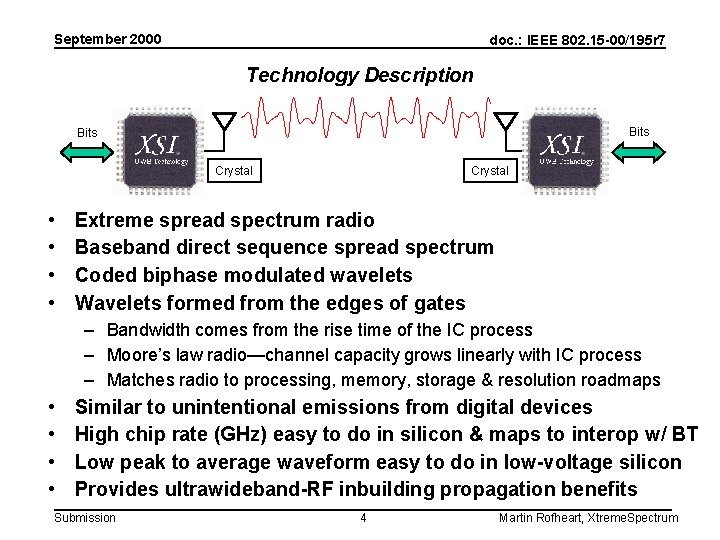
September 2000 doc. : IEEE 802. 15 -00/195 r 7 Technology Description Bits Crystal • • Crystal Extreme spread spectrum radio Baseband direct sequence spread spectrum Coded biphase modulated wavelets Wavelets formed from the edges of gates – Bandwidth comes from the rise time of the IC process – Moore’s law radio—channel capacity grows linearly with IC process – Matches radio to processing, memory, storage & resolution roadmaps • • Similar to unintentional emissions from digital devices High chip rate (GHz) easy to do in silicon & maps to interop w/ BT Low peak to average waveform easy to do in low-voltage silicon Provides ultrawideband-RF inbuilding propagation benefits Submission 4 Martin Rofheart, Xtreme. Spectrum
September 2000 doc. : IEEE 802. 15 -00/195 r 7 Technical Benefits of Biphase Modulated Ultrawideband RF • See our tutorial presented at the March Plenary – Document 00082 r 1 P 802 -15_WG-UWB-Tutorial-1 -Xtreme. Spectrum • Multipath fading immune & best penetration for a given BW – Result of large relative bandwidth (UWB scattering/propagation Physics) • Low order modulation + High Data Rate ==> low cost & power – Result of large absolute bandwidth (Shannon) • Biphase modulation is superior to time-hopping (PPM) – Advantage of 3 -6 d. B depending on optimizations – multipath free chan – Multipath is in-band interference (data modulation) to PPM • Ranging and fine spatial resolution – Result of large absolute bandwidth – Enables positioning and ‘beaming’ in applications Submission 5 Martin Rofheart, Xtreme. Spectrum
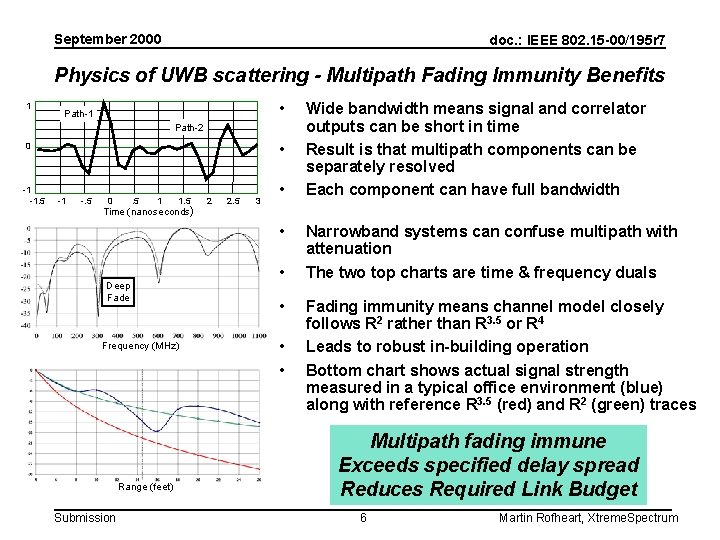
September 2000 doc. : IEEE 802. 15 -00/195 r 7 Physics of UWB scattering - Multipath Fading Immunity Benefits 1 • Path-1 Path-2 • 0 -1 -1. 5 -1 -. 5 0 . 5 1 1. 5 Time (nanoseconds) 2 2. 5 3 • • Deep Fade Frequency (MHz) Range (feet) Submission • • Wide bandwidth means signal and correlator outputs can be short in time Result is that multipath components can be separately resolved Each component can have full bandwidth Narrowband systems can confuse multipath with attenuation The two top charts are time & frequency duals Fading immunity means channel model closely follows R 2 rather than R 3. 5 or R 4 Leads to robust in-building operation Bottom chart shows actual signal strength measured in a typical office environment (blue) along with reference R 3. 5 (red) and R 2 (green) traces Multipath fading immune Exceeds specified delay spread Reduces Required Link Budget 6 Martin Rofheart, Xtreme. Spectrum
September 2000 doc. : IEEE 802. 15 -00/195 r 7 Technical Benefits of Biphase Modulated Ultrawideband RF • See our tutorial presented at the March Plenary – Document 00082 r 1 P 802 -15_WG-UWB-Tutorial-1 -Xtreme. Spectrum • Multipath fading immune & best penetration for a given BW – Result of large relative bandwidth (UWB scattering/propagation Physics) • Low order modulation + High Data Rate ==> low cost & power – Result of large absolute bandwidth (Shannon) • Biphase modulation is superior to time-hopping (PPM) – Advantage of 3 -6 d. B depending on optimizations – multipath free chan – Multipath is in-band interference (data modulation) to PPM • Ranging and fine spatial resolution – Result of large absolute bandwidth – Enables positioning and ‘beaming’ in applications Submission 7 Martin Rofheart, Xtreme. Spectrum
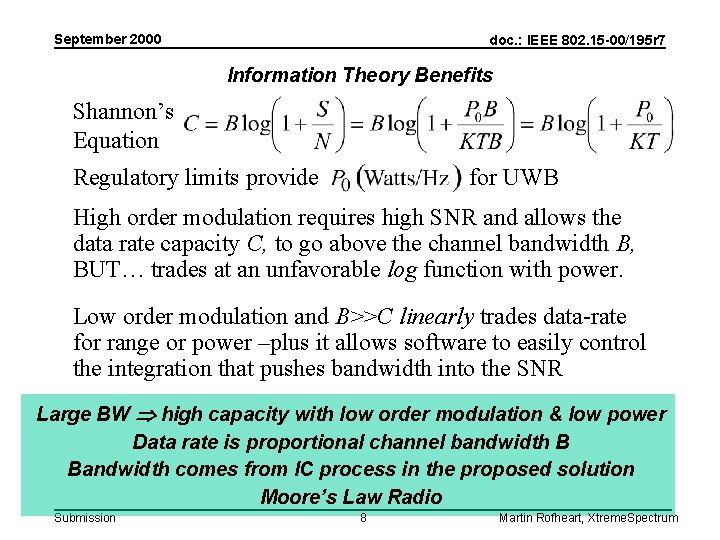
September 2000 doc. : IEEE 802. 15 -00/195 r 7 Information Theory Benefits Shannon’s Equation Regulatory limits provide for UWB High order modulation requires high SNR and allows the data rate capacity C, to go above the channel bandwidth B, BUT… trades at an unfavorable log function with power. Low order modulation and B>>C linearly trades data-rate for range or power –plus it allows software to easily control the integration that pushes bandwidth into the SNR Large BW high capacity with low order modulation & low power Data rate is proportional channel bandwidth B Bandwidth comes from IC process in the proposed solution Moore’s Law Radio Submission 8 Martin Rofheart, Xtreme. Spectrum
September 2000 doc. : IEEE 802. 15 -00/195 r 7 Technical Benefits of Biphase Modulated Ultrawideband RF • See our tutorial presented at the March Plenary – Document 00082 r 1 P 802 -15_WG-UWB-Tutorial-1 -Xtreme. Spectrum • Multipath fading immune & best penetration for a given BW – Result of large relative bandwidth (UWB scattering/propagation Physics) • Low order modulation + High Data Rate ==> low cost & power – Result of large absolute bandwidth (Shannon) • Biphase modulation is superior to time-hopping (PPM) – Advantage of 3 -6 d. B depending on optimizations – multipath free chan – Multipath is in-band interference (data modulation) to PPM • Ranging and fine spatial resolution – Result of large absolute bandwidth – Enables positioning and ‘beaming’ in applications Submission 9 Martin Rofheart, Xtreme. Spectrum
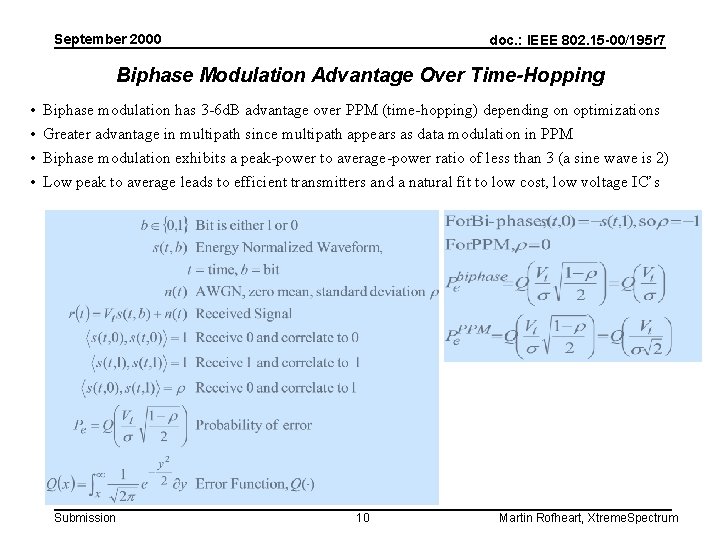
September 2000 doc. : IEEE 802. 15 -00/195 r 7 Biphase Modulation Advantage Over Time-Hopping • • Biphase modulation has 3 -6 d. B advantage over PPM (time-hopping) depending on optimizations Greater advantage in multipath since multipath appears as data modulation in PPM Biphase modulation exhibits a peak-power to average-power ratio of less than 3 (a sine wave is 2) Low peak to average leads to efficient transmitters and a natural fit to low cost, low voltage IC’s Submission 10 Martin Rofheart, Xtreme. Spectrum
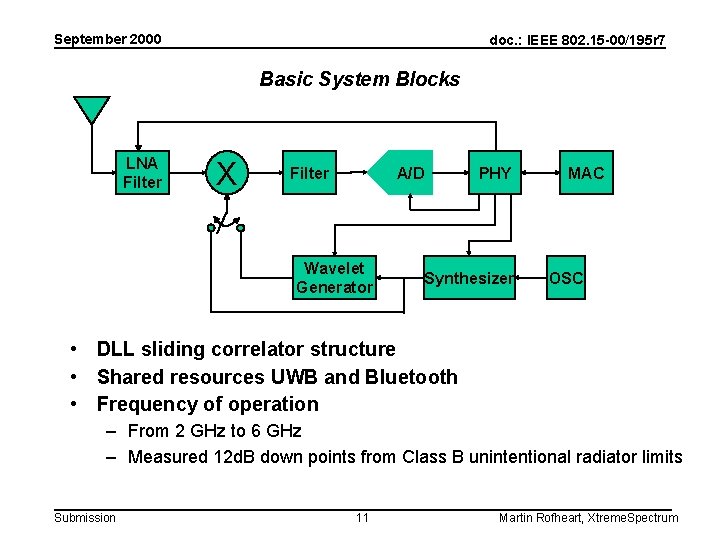
September 2000 doc. : IEEE 802. 15 -00/195 r 7 Basic System Blocks LNA Filter X Filter PHY A/D Wavelet Generator Synthesizer MAC OSC • DLL sliding correlator structure • Shared resources UWB and Bluetooth • Frequency of operation – From 2 GHz to 6 GHz – Measured 12 d. B down points from Class B unintentional radiator limits Submission 11 Martin Rofheart, Xtreme. Spectrum
September 2000 doc. : IEEE 802. 15 -00/195 r 7 Summary of Solution • • • Biphase modulated baseband wavelets (ultrawideband RF) Unit manufacture cost 30 -50% greater than BT 1. 0 standalone Coexistence 20 d. B less interference than BT or 802. 11 b to each other Bluetooth 1. 0 integrated & interoperable solution Data rate scalable 1 -100 Mbps (BER 10 -5 10 m 100 Mbps no FEC) Power consumption roadmap to ~30 m. W (3 Q 02) Jamming resistance current demonstration >60 d. B Multipath fading immune Time to market—samples ICs 2 Q 01, limited qty 3 Q 00, production 4 Q 01 Maturity of solution – Current operational 50 Mbps discrete component system & IC • Form factor smaller than Compact Flash – 2 IC then 1 IC • Ranging enables multimedia beaming and position location Submission 12 Martin Rofheart, Xtreme. Spectrum
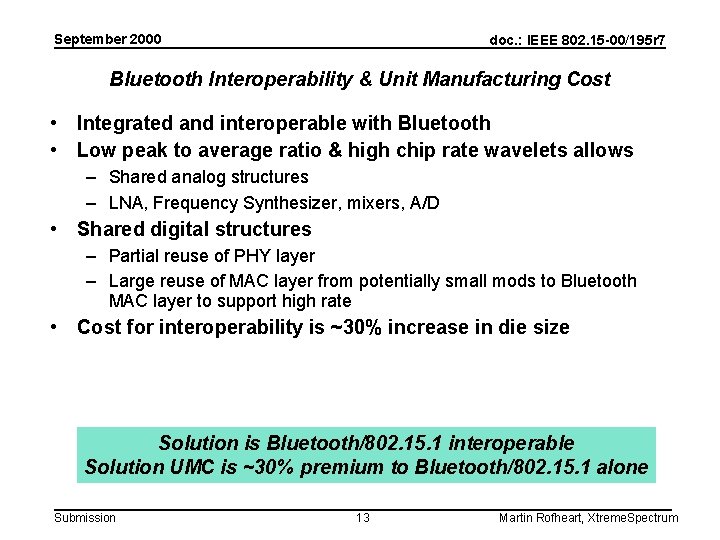
September 2000 doc. : IEEE 802. 15 -00/195 r 7 Bluetooth Interoperability & Unit Manufacturing Cost • Integrated and interoperable with Bluetooth • Low peak to average ratio & high chip rate wavelets allows – Shared analog structures – LNA, Frequency Synthesizer, mixers, A/D • Shared digital structures – Partial reuse of PHY layer – Large reuse of MAC layer from potentially small mods to Bluetooth MAC layer to support high rate • Cost for interoperability is ~30% increase in die size Solution is Bluetooth/802. 15. 1 interoperable Solution UMC is ~30% premium to Bluetooth/802. 15. 1 alone Submission 13 Martin Rofheart, Xtreme. Spectrum
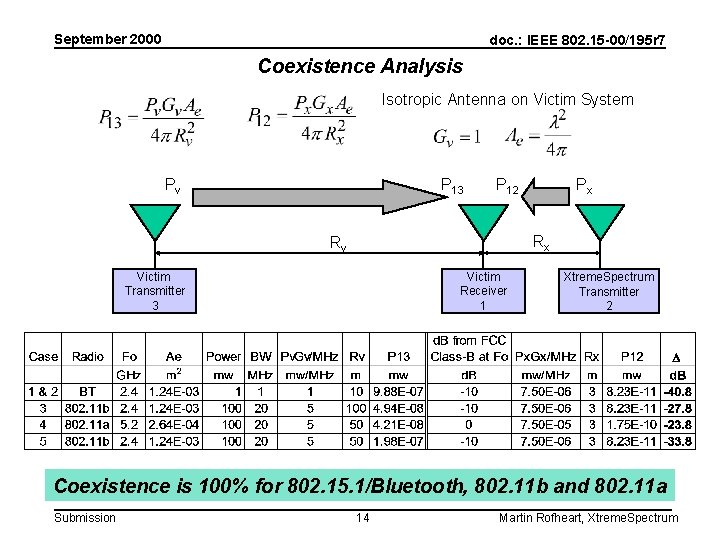
September 2000 doc. : IEEE 802. 15 -00/195 r 7 Coexistence Analysis Isotropic Antenna on Victim System Pv P 13 P 12 Px Rx Rv Victim Transmitter 3 Victim Receiver 1 Xtreme. Spectrum Transmitter 2 Coexistence is 100% for 802. 15. 1/Bluetooth, 802. 11 b and 802. 11 a Submission 14 Martin Rofheart, Xtreme. Spectrum
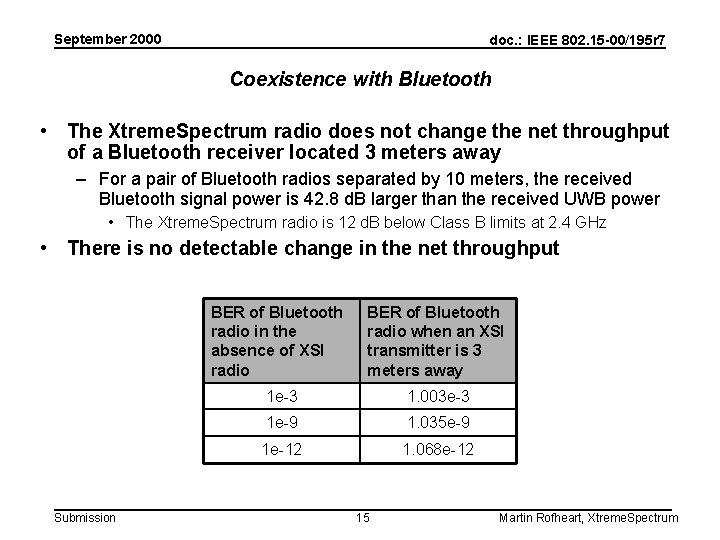
September 2000 doc. : IEEE 802. 15 -00/195 r 7 Coexistence with Bluetooth • The Xtreme. Spectrum radio does not change the net throughput of a Bluetooth receiver located 3 meters away – For a pair of Bluetooth radios separated by 10 meters, the received Bluetooth signal power is 42. 8 d. B larger than the received UWB power • The Xtreme. Spectrum radio is 12 d. B below Class B limits at 2. 4 GHz • There is no detectable change in the net throughput BER of Bluetooth radio in the absence of XSI radio Submission BER of Bluetooth radio when an XSI transmitter is 3 meters away 1 e-3 1. 003 e-3 1 e-9 1. 035 e-9 1 e-12 1. 068 e-12 15 Martin Rofheart, Xtreme. Spectrum
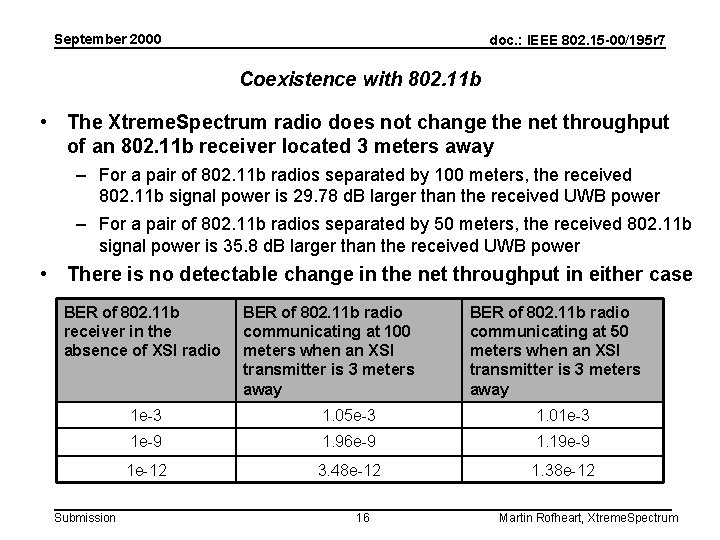
September 2000 doc. : IEEE 802. 15 -00/195 r 7 Coexistence with 802. 11 b • The Xtreme. Spectrum radio does not change the net throughput of an 802. 11 b receiver located 3 meters away – For a pair of 802. 11 b radios separated by 100 meters, the received 802. 11 b signal power is 29. 78 d. B larger than the received UWB power – For a pair of 802. 11 b radios separated by 50 meters, the received 802. 11 b signal power is 35. 8 d. B larger than the received UWB power • There is no detectable change in the net throughput in either case BER of 802. 11 b receiver in the absence of XSI radio Submission BER of 802. 11 b radio communicating at 100 meters when an XSI transmitter is 3 meters away BER of 802. 11 b radio communicating at 50 meters when an XSI transmitter is 3 meters away 1 e-3 1. 05 e-3 1. 01 e-3 1 e-9 1. 96 e-9 1. 19 e-9 1 e-12 3. 48 e-12 1. 38 e-12 16 Martin Rofheart, Xtreme. Spectrum
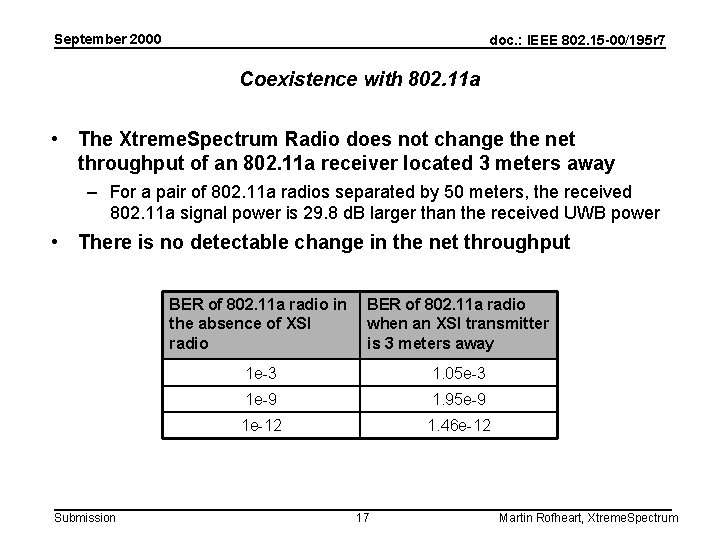
September 2000 doc. : IEEE 802. 15 -00/195 r 7 Coexistence with 802. 11 a • The Xtreme. Spectrum Radio does not change the net throughput of an 802. 11 a receiver located 3 meters away – For a pair of 802. 11 a radios separated by 50 meters, the received 802. 11 a signal power is 29. 8 d. B larger than the received UWB power • There is no detectable change in the net throughput Submission BER of 802. 11 a radio in the absence of XSI radio BER of 802. 11 a radio when an XSI transmitter is 3 meters away 1 e-3 1. 05 e-3 1 e-9 1. 95 e-9 1 e-12 1. 46 e-12 17 Martin Rofheart, Xtreme. Spectrum
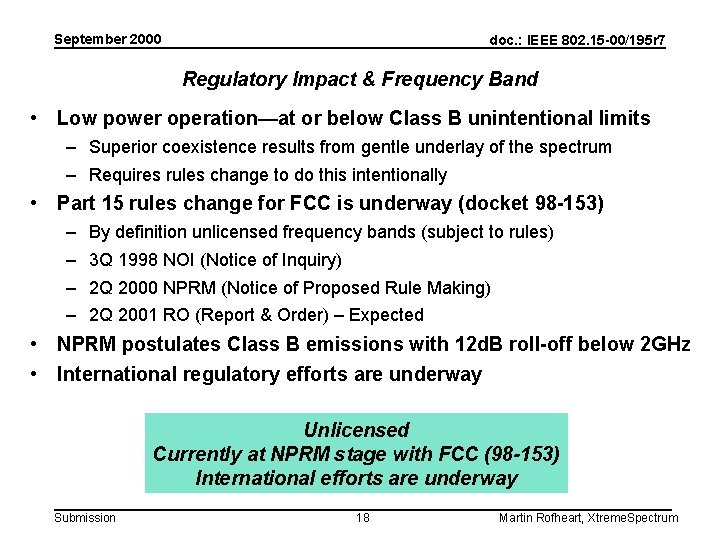
September 2000 doc. : IEEE 802. 15 -00/195 r 7 Regulatory Impact & Frequency Band • Low power operation—at or below Class B unintentional limits – Superior coexistence results from gentle underlay of the spectrum – Requires rules change to do this intentionally • Part 15 rules change for FCC is underway (docket 98 -153) – – By definition unlicensed frequency bands (subject to rules) 3 Q 1998 NOI (Notice of Inquiry) 2 Q 2000 NPRM (Notice of Proposed Rule Making) 2 Q 2001 RO (Report & Order) – Expected • NPRM postulates Class B emissions with 12 d. B roll-off below 2 GHz • International regulatory efforts are underway Unlicensed Currently at NPRM stage with FCC (98 -153) International efforts are underway Submission 18 Martin Rofheart, Xtreme. Spectrum
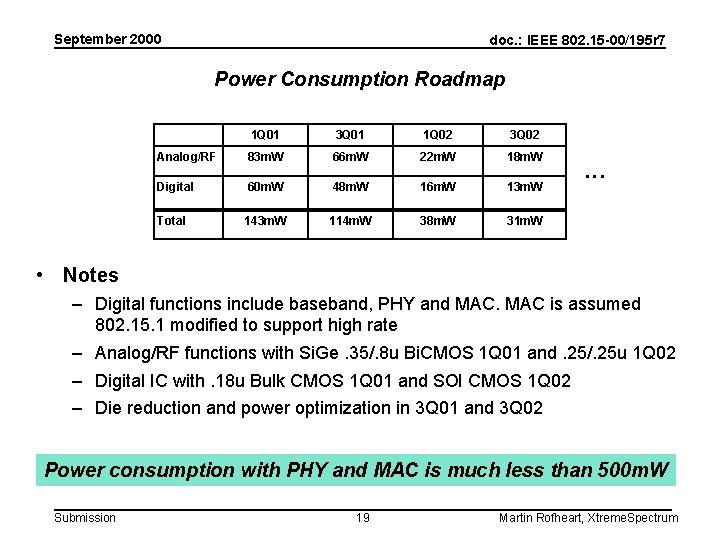
September 2000 doc. : IEEE 802. 15 -00/195 r 7 Power Consumption Roadmap 1 Q 01 3 Q 01 1 Q 02 3 Q 02 Analog/RF 83 m. W 66 m. W 22 m. W 18 m. W Digital 60 m. W 48 m. W 16 m. W 13 m. W Total 143 m. W 114 m. W 38 m. W 31 m. W • • • • Notes – Digital functions include baseband, PHY and MAC is assumed 802. 15. 1 modified to support high rate – Analog/RF functions with Si. Ge. 35/. 8 u Bi. CMOS 1 Q 01 and. 25/. 25 u 1 Q 02 – Digital IC with. 18 u Bulk CMOS 1 Q 01 and SOI CMOS 1 Q 02 – Die reduction and power optimization in 3 Q 01 and 3 Q 02 Power consumption with PHY and MAC is much less than 500 m. W Submission 19 Martin Rofheart, Xtreme. Spectrum
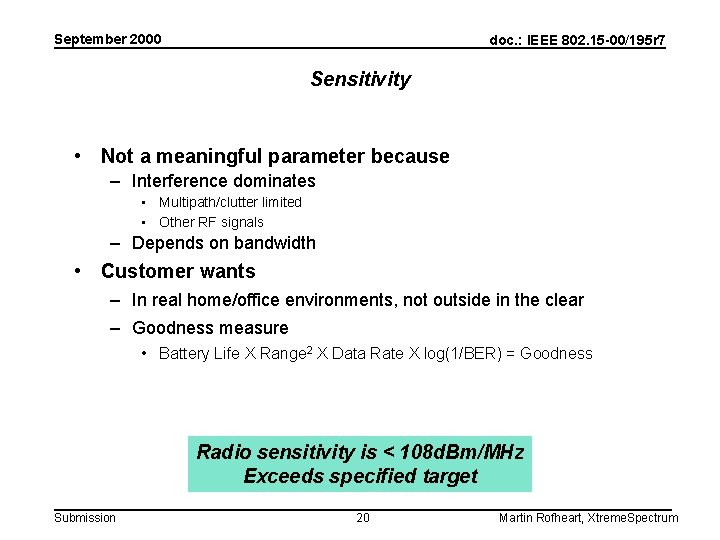
September 2000 doc. : IEEE 802. 15 -00/195 r 7 Sensitivity • Not a meaningful parameter because – Interference dominates • Multipath/clutter limited • Other RF signals – Depends on bandwidth • Customer wants – In real home/office environments, not outside in the clear – Goodness measure • Battery Life X Range 2 X Data Rate X log(1/BER) = Goodness Radio sensitivity is < 108 d. Bm/MHz Exceeds specified target Submission 20 Martin Rofheart, Xtreme. Spectrum
September 2000 doc. : IEEE 802. 15 -00/195 r 7 Data Rate, Range and Scalability of Solution • Data rate scalable 1 -100 Mbps – 2 Decades of bandwidth allow applications unprecedented control of performance envelope (method is increased code length) • Data rate throttles BER, power consumption and range • Range can scale to exceed 10 m – Range=10 m with BER=10 -5 & rate=100 Mbps & margin=10 d. B & no FEC – Range can increase for decreased data rate • Power consumption drops with data rate • Cost can be reduced by reducing bandwidth (frequency band) – Results in decreased range at a given data rate • Functionality can scale – Removing interoperability constraint reduces cost 30% Solution exceeds minimum and maximum throughput specifications Solution scales in data rate, power, range, BW (freq), cost & function Solution exceeds range specification Submission 21 Martin Rofheart, Xtreme. Spectrum
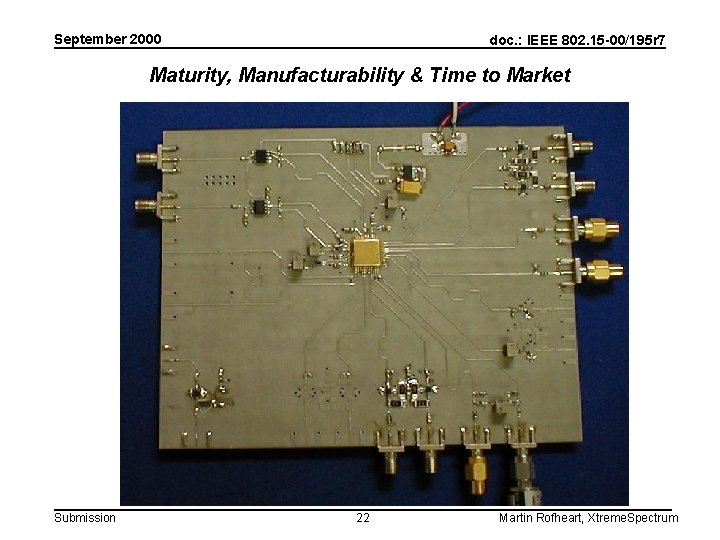
September 2000 doc. : IEEE 802. 15 -00/195 r 7 Maturity, Manufacturability & Time to Market Submission 22 Martin Rofheart, Xtreme. Spectrum
September 2000 doc. : IEEE 802. 15 -00/195 r 7 Maturity, Manufacturability & Time to Market • Maturity of solution – – Though new here, Technology proven in Do. D (see doc # 00082 r 1) Operational discrete component systems Current is 50 Mbps, 10 -5 BER, 45 ft TR sep, link margin 10 d. B, no FEC Measurement environment is office & home, not screen room or chamber • Manufacturability – Key analog/RF IC functions completed and tested – Taped out 1 Q 00, tested 2 Q 00 – Basis of 100 Mbps system due 3 Q 00 • Time to market – Sample chipsets 2 Q 01 – Limited availability 3 Q 01 – Production quantity 4 Q 01 Maturity demonstrated by discrete system Manufacturability demonstrated by analog ICs Time to market is 2001 Submission 23 Martin Rofheart, Xtreme. Spectrum
September 2000 doc. : IEEE 802. 15 -00/195 r 7 Multiple Access & Number of Full Throughput WPANs • Solution uses baseband coded wavelets – Each code operates TDD & TDMA and corresponds to a single piconet • Allows more than 8 active users per piconet each greater 10 Mbps – Between 3 and 6 piconets (codes) can overlap at full throughput • Supports between 300 Mbps and 600 Mbps in a cell • Technique is S-CDMA • Data rate of 100 Mbps allows multiple MPEG 2 streams & async data • Number of simultaneous full throughput (20 Mbps) PANs – Supports 5 simultaneous 20 Mbps users per piconet – Supports 15 -30 simultaneous 20 Mbps users in disjoint overlapping piconets Multiple access exceeds 8 active users & all specified scenarios Number of full throughput (20 Mbps) PANs exceeds 5 Submission 24 Martin Rofheart, Xtreme. Spectrum
September 2000 doc. : IEEE 802. 15 -00/195 r 7 Interference & Susceptibility and Intermodulation Resistance • The Demonstration System Performance 50 MB/s, 45 ft, 10 -5 BER, no FEC, 10 d. B link margin – Measured in a high-rise office building – a high multi-path environment – Measured in Hot RF environment, • Channel 58 TV broadcasts from the roof • Other radio services broadcasting from neighboring office buildings • Operates with 900 MHz and 1. 9 GHz Cellular phones 1 ft (or greater) from the receive antenna – >0 d. Bm into receiver input port • Demonstrates over 60 db rejection of jamming signals – >60 db rejection of the 2. 4 GHz, 802. 11 • Intermodulation resistance – N/A for UWB, not channelized per criteria – Since the bandwidth is 3: 1, the effects of the two fundamental test tones, or the RFI in the real environment, swamp the effects of their intermodulation products. • Interference & Susceptibility: – 10 d. Bm at receiver input – Meets 10^-3 BER before FEC at 10 m and 100 Mbps Interference protection is greater than 60 d. B Intermodulation resistance – 10 d. Bm Submission 25 Martin Rofheart, Xtreme. Spectrum
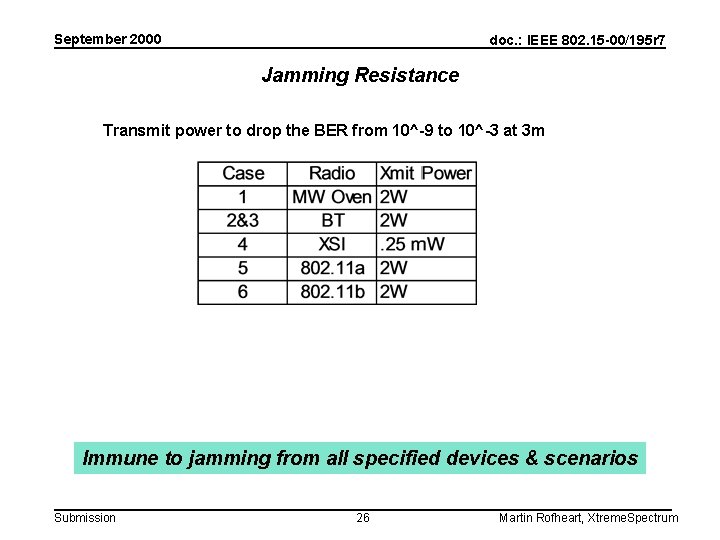
September 2000 doc. : IEEE 802. 15 -00/195 r 7 Jamming Resistance Transmit power to drop the BER from 10^-9 to 10^-3 at 3 m Immune to jamming from all specified devices & scenarios Submission 26 Martin Rofheart, Xtreme. Spectrum
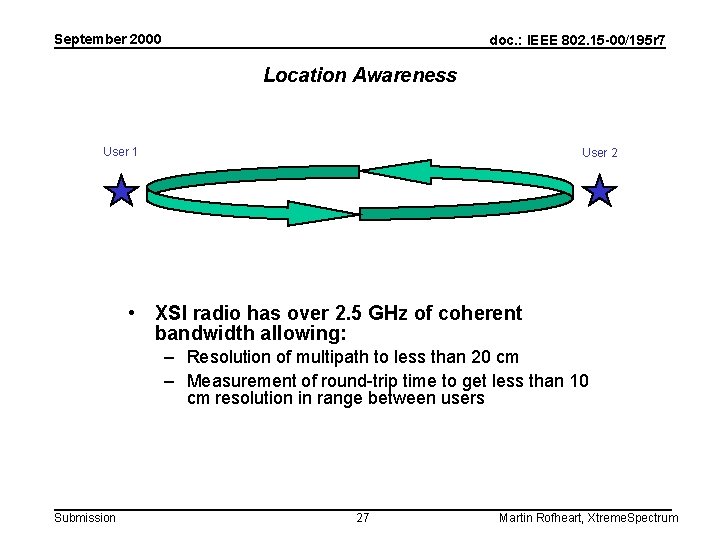
September 2000 doc. : IEEE 802. 15 -00/195 r 7 Location Awareness User 1 User 2 • XSI radio has over 2. 5 GHz of coherent bandwidth allowing: – Resolution of multipath to less than 20 cm – Measurement of round-trip time to get less than 10 cm resolution in range between users Submission 27 Martin Rofheart, Xtreme. Spectrum
September 2000 doc. : IEEE 802. 15 -00/195 r 7 UWB Radio Functionality • Method of backward compatibility with 802. 15. 1 – – Shared LNA for UWB and 802. 15. 1 signals Shared mixers, integrators, and A/D converters Shared clock and clock control networks The block diagram on slide 11 is meant to show generic component reuse and notional system functionality – XSI has RF CMOS expertise and proven RF IC design capability – XSI is in discussions with potential bluetooth partners • Transmit power, power amplifier back-off, and transmit power efficiency – Transmit power is 0. 8 m. W (-1 d. Bm) into a 50% efficient antenna – There is no transmitter backoff (PA runs saturated) – The transmitter is 55% efficient at 0. 8 m. W • Chip area and process technology – Area is < 10 sq. mm on 0. 35 m Si. Ge Bi. CMOS at 3 V Submission 28 Martin Rofheart, Xtreme. Spectrum
September 2000 doc. : IEEE 802. 15 -00/195 r 7 UWB Baseband Functionality Advantages • • • Transmitter needs no D/A converter Receiver A/D converter operates at the bit rate A/D converter is not hi-resolution (only 4 -8 bits) No digital pulse shaping filter is used No equalizer is used Decoder complexity – Low order modulation (BPSK) – FEC - Measured/Actual performance with single piconet of 50 Mbps at 10 e-5 BER at 10 meters with 0. 16 mw is without FEC • CMOS technology - 0. 18 m CMOS at 1. 8 V • CMOS chip area < 12 sq. mm • CMOS gate count -- 200 K gates for the PMD and PLCP Submission 29 Martin Rofheart, Xtreme. Spectrum
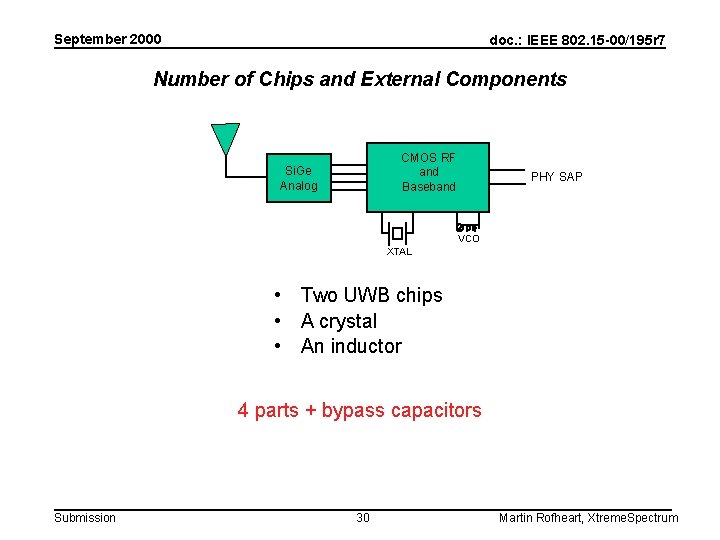
September 2000 doc. : IEEE 802. 15 -00/195 r 7 Number of Chips and External Components CMOS RF and Baseband Si. Ge Analog PHY SAP VCO XTAL • Two UWB chips • A crystal • An inductor 4 parts + bypass capacitors Submission 30 Martin Rofheart, Xtreme. Spectrum
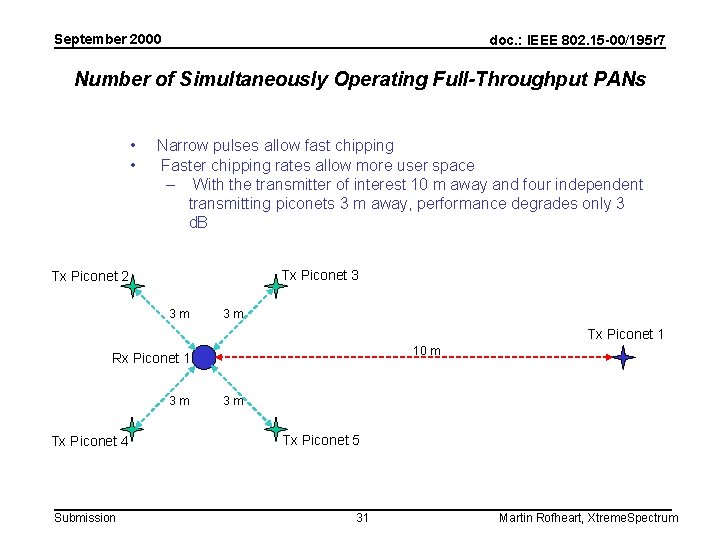
September 2000 doc. : IEEE 802. 15 -00/195 r 7 Number of Simultaneously Operating Full-Throughput PANs • • Narrow pulses allow fast chipping Faster chipping rates allow more user space – With the transmitter of interest 10 m away and four independent transmitting piconets 3 m away, performance degrades only 3 d. B Tx Piconet 3 Tx Piconet 2 3 m 3 m Tx Piconet 1 10 m Rx Piconet 1 3 m Tx Piconet 4 Submission 3 m Tx Piconet 5 31 Martin Rofheart, Xtreme. Spectrum
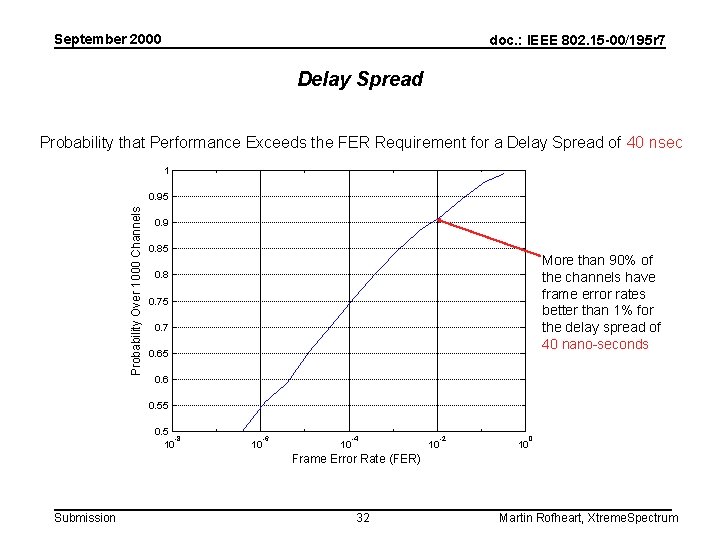
September 2000 doc. : IEEE 802. 15 -00/195 r 7 Delay Spread Probability that Performance Exceeds the FER Requirement for a Delay Spread of 40 nsec 1 Probability Over 1000 Channels 0. 95 0. 9 0. 85 More than 90% of the channels have frame error rates better than 1% for the delay spread of 40 nano-seconds 0. 8 0. 75 0. 7 0. 65 0. 6 0. 55 0. 5 -8 10 10 -6 10 -4 10 -2 10 0 Frame Error Rate (FER) Submission 32 Martin Rofheart, Xtreme. Spectrum
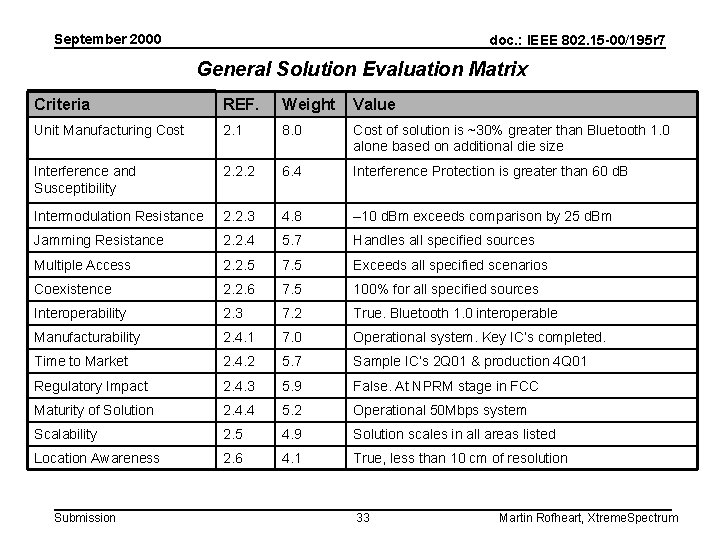
September 2000 doc. : IEEE 802. 15 -00/195 r 7 General Solution Evaluation Matrix Criteria REF. Weight Value Unit Manufacturing Cost 2. 1 8. 0 Cost of solution is ~30% greater than Bluetooth 1. 0 alone based on additional die size Interference and Susceptibility 2. 2. 2 6. 4 Interference Protection is greater than 60 d. B Intermodulation Resistance 2. 2. 3 4. 8 – 10 d. Bm exceeds comparison by 25 d. Bm Jamming Resistance 2. 2. 4 5. 7 Handles all specified sources Multiple Access 2. 2. 5 7. 5 Exceeds all specified scenarios Coexistence 2. 2. 6 7. 5 100% for all specified sources Interoperability 2. 3 7. 2 True. Bluetooth 1. 0 interoperable Manufacturability 2. 4. 1 7. 0 Operational system. Key IC’s completed. Time to Market 2. 4. 2 5. 7 Sample IC’s 2 Q 01 & production 4 Q 01 Regulatory Impact 2. 4. 3 5. 9 False. At NPRM stage in FCC Maturity of Solution 2. 4. 4 5. 2 Operational 50 Mbps system Scalability 2. 5 4. 9 Solution scales in all areas listed Location Awareness 2. 6 4. 1 True, less than 10 cm of resolution Submission 33 Martin Rofheart, Xtreme. Spectrum
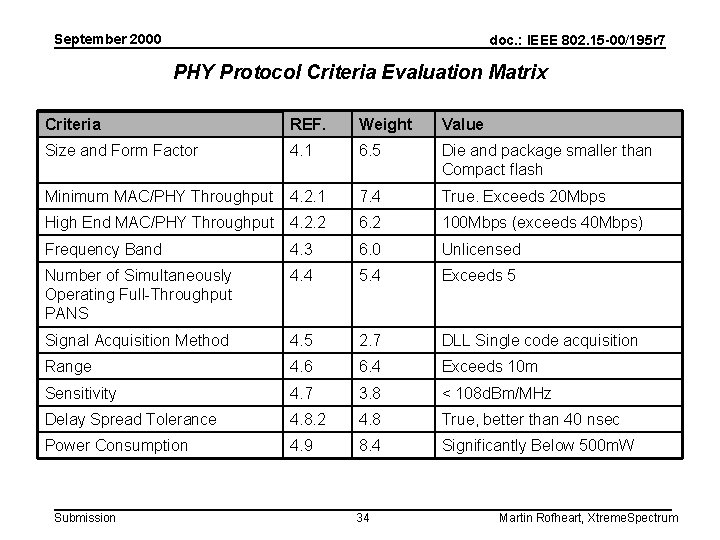
September 2000 doc. : IEEE 802. 15 -00/195 r 7 PHY Protocol Criteria Evaluation Matrix Criteria REF. Weight Value Size and Form Factor 4. 1 6. 5 Die and package smaller than Compact flash Minimum MAC/PHY Throughput 4. 2. 1 7. 4 True. Exceeds 20 Mbps High End MAC/PHY Throughput 4. 2. 2 6. 2 100 Mbps (exceeds 40 Mbps) Frequency Band 4. 3 6. 0 Unlicensed Number of Simultaneously Operating Full-Throughput PANS 4. 4 5. 4 Exceeds 5 Signal Acquisition Method 4. 5 2. 7 DLL Single code acquisition Range 4. 6 6. 4 Exceeds 10 m Sensitivity 4. 7 3. 8 < 108 d. Bm/MHz Delay Spread Tolerance 4. 8. 2 4. 8 True, better than 40 nsec Power Consumption 4. 9 8. 4 Significantly Below 500 m. W Submission 34 Martin Rofheart, Xtreme. Spectrum
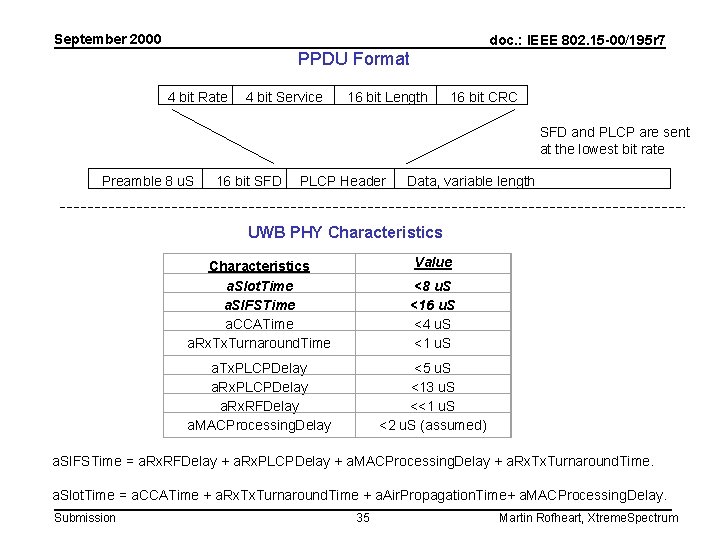
September 2000 doc. : IEEE 802. 15 -00/195 r 7 PPDU Format 4 bit Rate 4 bit Service 16 bit Length 16 bit CRC SFD and PLCP are sent at the lowest bit rate Preamble 8 u. S 16 bit SFD PLCP Header Data, variable length UWB PHY Characteristics Value Characteristics a. Slot. Time a. SIFSTime a. CCATime a. Rx. Turnaround. Time <8 u. S <16 u. S <4 u. S <1 u. S a. Tx. PLCPDelay a. Rx. RFDelay a. MACProcessing. Delay <5 u. S <13 u. S <<1 u. S <2 u. S (assumed) a. SIFSTime = a. Rx. RFDelay + a. Rx. PLCPDelay + a. MACProcessing. Delay + a. Rx. Turnaround. Time. a. Slot. Time = a. CCATime + a. Rx. Turnaround. Time + a. Air. Propagation. Time+ a. MACProcessing. Delay. Submission 35 Martin Rofheart, Xtreme. Spectrum
- Slides: 35