
SEPHY An Ethernet Physical Layer Transceiver for Space

- Slides: 17
SEPHY: An Ethernet Physical Layer Transceiver for Space June 12 -16, 2016 AMICSA & DSP DAY 2016
Agenda Introduction to the project Ethernet in Space: the need for a PHY Options for a Space Ethernet PHY SEPHY goals and current status Page 2 SEPHY – AMICSA & DSP DAY 2016
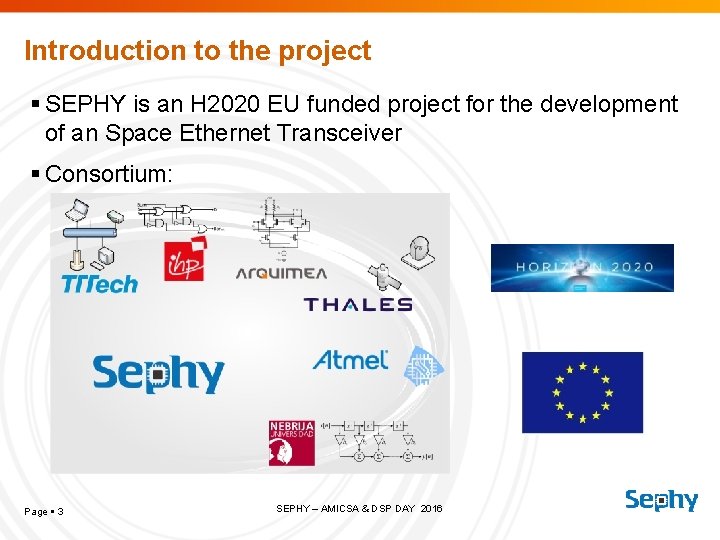
Introduction to the project SEPHY is an H 2020 EU funded project for the development of an Space Ethernet Transceiver Consortium: Page 3 SEPHY – AMICSA & DSP DAY 2016
Consortium roles ARQUIMEA: Coordination, integration, mixed signal design and support to commercialization. THALES ALENIA SPACE ESPAÑA: Testing and user requirements. UNIVERSIDAD ANTONIO DE NEBRIJA: System level verification, signal processing, conformance and standardization. IHP: Digital design. ATMEL: Backend support, digital library supplier, fabrication, packaging and commercialization. TTTECH: Final user requirements, TTEthernet testing, Dissemination and support to commercialization. Page 4 SEPHY – AMICSA & DSP DAY 2016
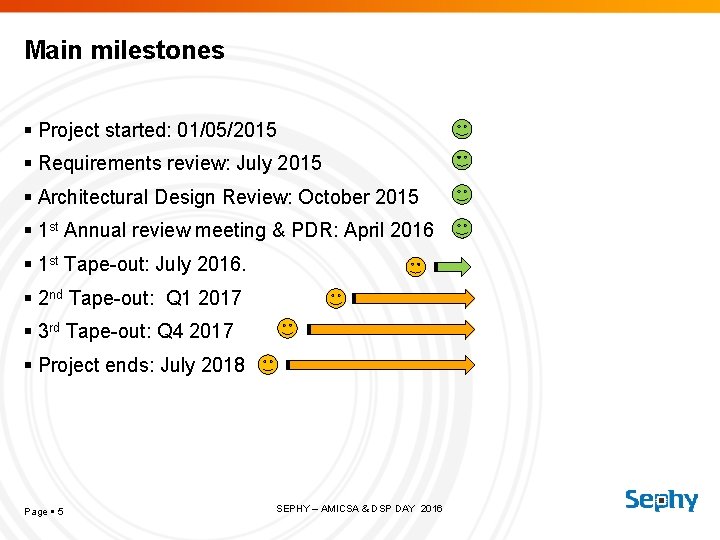
Main milestones Project started: 01/05/2015 Requirements review: July 2015 Architectural Design Review: October 2015 1 st Annual review meeting & PDR: April 2016 1 st Tape-out: July 2016. 2 nd Tape-out: Q 1 2017 3 rd Tape-out: Q 4 2017 Project ends: July 2018 Page 5 SEPHY – AMICSA & DSP DAY 2016
Availability Currently there is no Rad Hard Ethernet PHY. Key to the non dependence for the European industry. SEPHY will be designed by an European Consortium and will be fabricated with Atmel’s ATMX 150 technology, a Silicon On Insulator 150 nm process. Page 6 SEPHY – AMICSA & DSP DAY 2016
Ethernet in Space For critical applications, Ethernet has to be extended to ensure timely and reliable delivery of frames. A number of technologies that can solve the reliability and real time issues have been proposed, for example Time Triggered Ethernet (TTE) Networks are needed for a variety of functions in a space vehicle that range from non-critical sensor data collection and processing to telecommands that are vital for the system operation. Ideally, future space networks can integrate all those functions on a single network thus simplifying the system design and operation The two issues faced by space networks are the integration of different functions on a single network and the evolution to higher speeds and both can be faced by Ethernet has already been used in some missions like NASA´s Orion but without a PHY (which limits the network span and increases the cost). Page 7 SEPHY – AMICSA & DSP DAY 2016
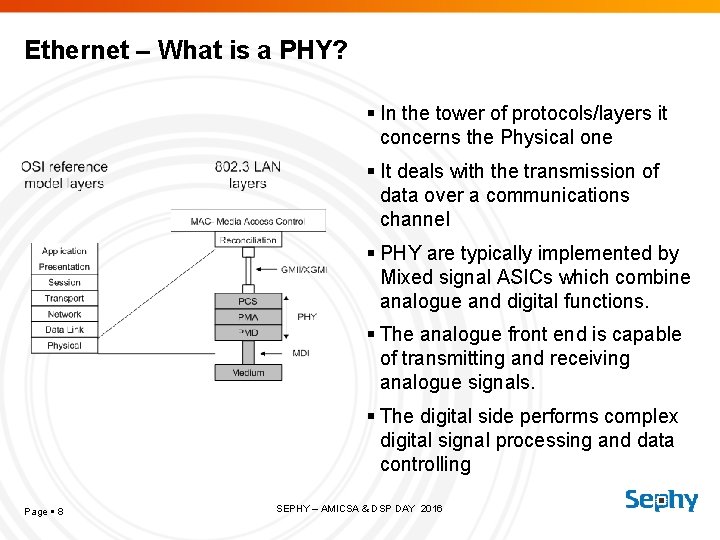
Ethernet – What is a PHY? In the tower of protocols/layers it concerns the Physical one It deals with the transmission of data over a communications channel PHY are typically implemented by Mixed signal ASICs which combine analogue and digital functions. The analogue front end is capable of transmitting and receiving analogue signals. The digital side performs complex digital signal processing and data controlling Page 8 SEPHY – AMICSA & DSP DAY 2016
Options within the IEEE 802. 3 standard defines many PHYs covering different transmission media and speeds. The most commonly used media in Ethernet are Unshielded Twisted Pairs (UTP). Assuming that the PHY will use UTP, the IEEE 802. 3 standard provides several alternatives. o 10 BASE-T defined in IEEE 802. 3 i o 100 BASE-TX defined in IEEE 802. 3 u o 1000 BASE-T defined in IEEE 802. 3 ab o 10 GBASE-T defined in IEEE 802. 3 an. Each of those standards provides a 10 x speed increase over the previous one, starting with the 10 Mb/s of 10 BASE-T. This shows how Ethernet enables the increase in network speed with each new standard Page 9 SEPHY – AMICSA & DSP DAY 2016
What would be the best choice? In terms of performance higher speeds are always preferred… …but as speed goes up so does complexity For instance: 10 GBASE-T PHYs are currently manufactured in 40 or 28 nm technologies and consume several watts. Implementing that PHY on the older nodes qualified for space use will most likely not be feasible. The development cost also increases with speed. This is not a showstopping issue for commercial applications where the cost is spread among millions of devices. However, this is not the case for the space market where volumes are orders of magnitude lower. The selection of the PHY standards to implement the space market needs shall weight both the speed and the cost/complexity. Page 10 SEPHY – AMICSA & DSP DAY 2016
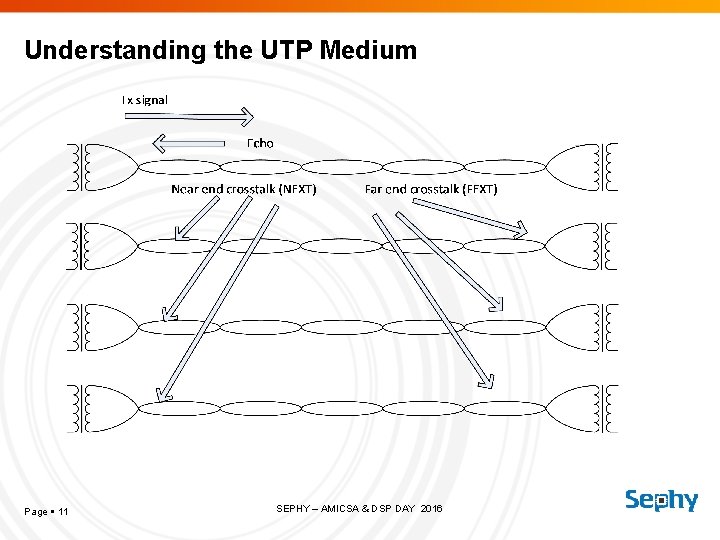
Understanding the UTP Medium Page 11 SEPHY – AMICSA & DSP DAY 2016
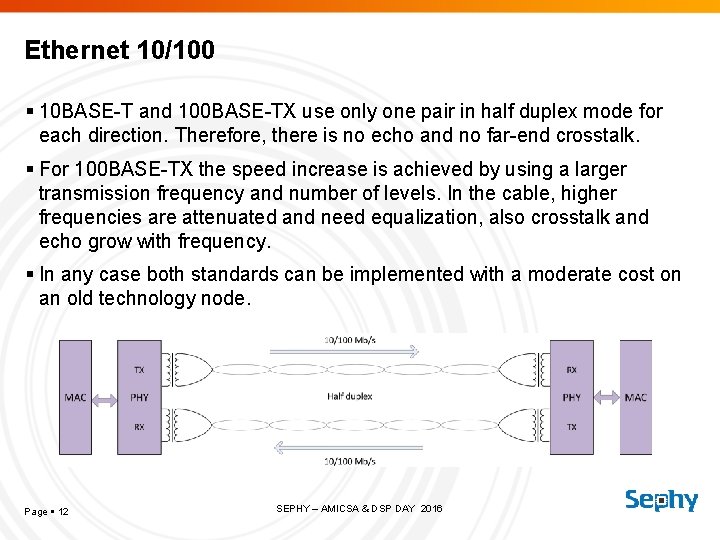
Ethernet 10/100 10 BASE-T and 100 BASE-TX use only one pair in half duplex mode for each direction. Therefore, there is no echo and no far-end crosstalk. For 100 BASE-TX the speed increase is achieved by using a larger transmission frequency and number of levels. In the cable, higher frequencies are attenuated and need equalization, also crosstalk and echo grow with frequency. In any case both standards can be implemented with a moderate cost on an old technology node. Page 12 SEPHY – AMICSA & DSP DAY 2016
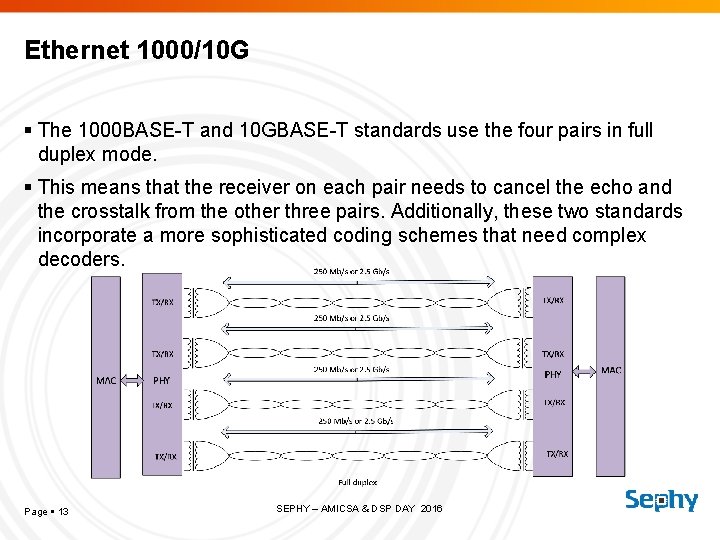
Ethernet 1000/10 G The 1000 BASE-T and 10 GBASE-T standards use the four pairs in full duplex mode. This means that the receiver on each pair needs to cancel the echo and the crosstalk from the other three pairs. Additionally, these two standards incorporate a more sophisticated coding schemes that need complex decoders. Page 13 SEPHY – AMICSA & DSP DAY 2016
SEPHY main goals To produce an European rad-hard 10/100 Ethernet PHY for space applications To produce a roadmap and feasibility study for an European rad-hard 1 G Ethernet PHY for the evolution of SEPHY To increase the presence of the European Industry in the development of Ethernet in Space Page 14 SEPHY – AMICSA & DSP DAY 2016
Acknowledgments This project is founded by Page 15 SEPHY – AMICSA & DSP DAY 2016
Visit us! www. sephy. eu https: //twitter. com/SEPHY_H 2020 Page 16 SEPHY – AMICSA & DSP DAY 2016
dgonzalez@arquimea. com jlopez@arquimea. com arquimea_012 arquimea_026 Page 17 SEPHY – AMICSA & DSP DAY 2016