
Separating Solutions Grade 7 Science Pure Substances and
Separating Solutions Grade 7 Science Pure Substances and Mixtures Ms. Willis

Learning Goals / Success Criteria �I can describe the processes used to separate solutions into their components and identify some industry applications of these processes. �Vocabulary: evaporate, evaporation, distillation
Particles of Solutions �Recall that solutions are mixtures in which the particles of the different components are so completely mixed that the mixture appears to be a single substance. �E. g. : Salt water in the ocean…. .
How can we separate Solutions? � 1. Evaporation � 2. Distillation
Evaporation �Definition: the process by which a sample of matter changes from a liquid to a gas. The solid (or a more concentrated solution) is left behind. �Evaporation is often used to remove the liquid from a solution made of a liquid and a solid.
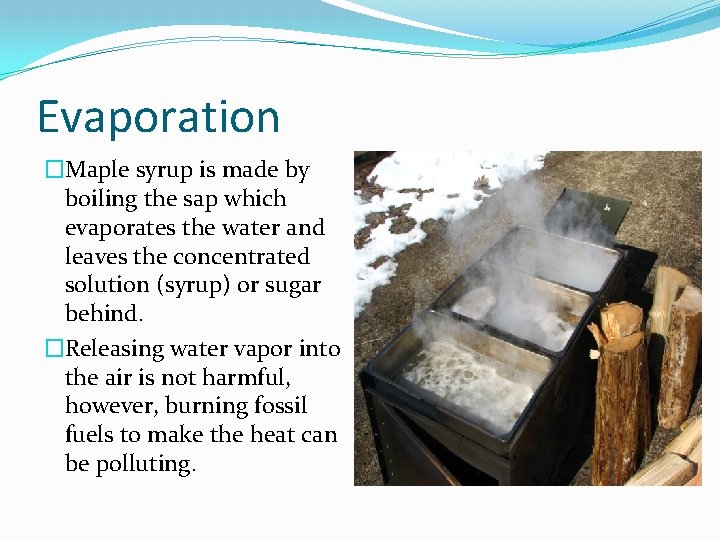
Evaporation �Maple syrup is made by boiling the sap which evaporates the water and leaves the concentrated solution (syrup) or sugar behind. �Releasing water vapor into the air is not harmful, however, burning fossil fuels to make the heat can be polluting.
Distillation �Definition: the process of separating liquids in a solution by heating the solution, trapping and cooling the gas, and collecting the resulting pure liquid. �Short video to illustrate: �https: //www. youtube. com/watch? v=xx. Nf. JLMNS 4 E �If you had a liquid solution with more than two liquid components, you could repeat the distillation process to separate all the liquid parts of the solution and use a different collecting flask for each component.

Distillation

Distillation �Picture of a seawater distillation plant: (Seawater must go through several stages to become drinking water. )
Distillation �New technologies are going beyond simple distillation for “desalinating” water: �A closer look at desalinating seawater: �https: //www. youtube. com/watch? v=aysj 7696 b 0 A
- Slides: 11