
Separating Axis Theorem SAT Build a 2 D
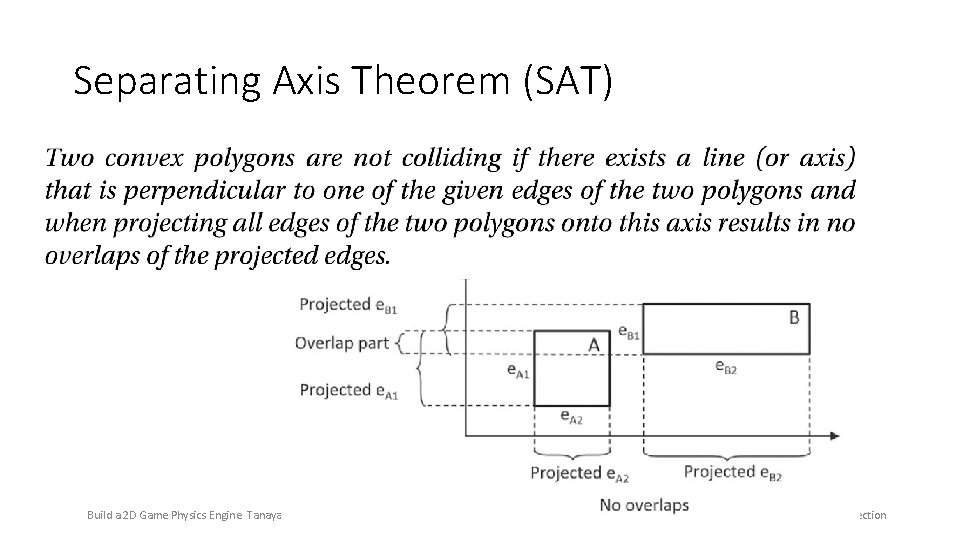
Separating Axis Theorem (SAT) Build a 2 D Game Physics Engine. Tanaya, Chen, Pavleas, Sung, 2017 1 Ch 3: Collision Detection
SAT … • Iterate through ALL face normal • Define a line • Project all edges onto the line • If no overlaps in the projected segements • Conclusion: no collision • Early termination! • If reach the end • Collision Build a 2 D Game Physics Engine. Tanaya, Chen, Pavleas, Sung, 2017 2 Ch 3: Collision Detection
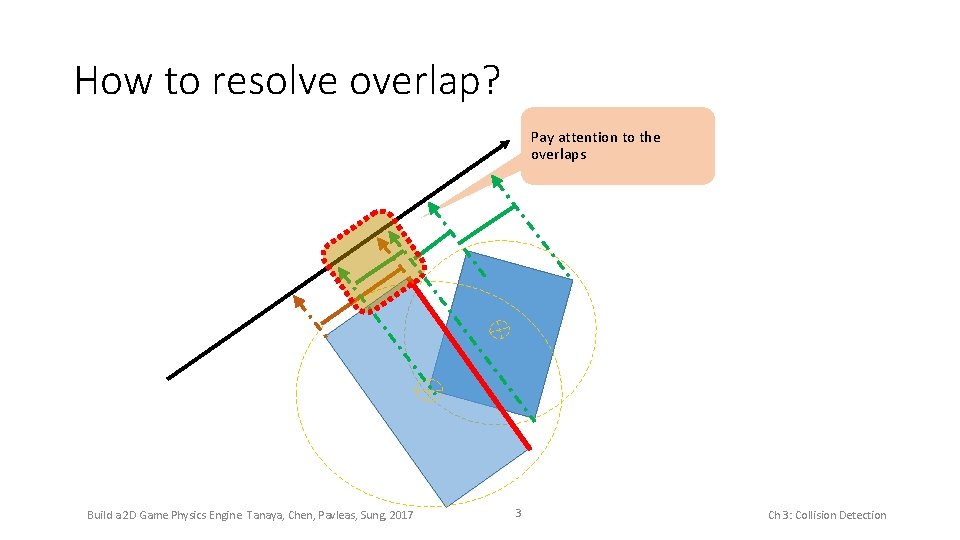
How to resolve overlap? Pay attention to the overlaps Build a 2 D Game Physics Engine. Tanaya, Chen, Pavleas, Sung, 2017 3 Ch 3: Collision Detection
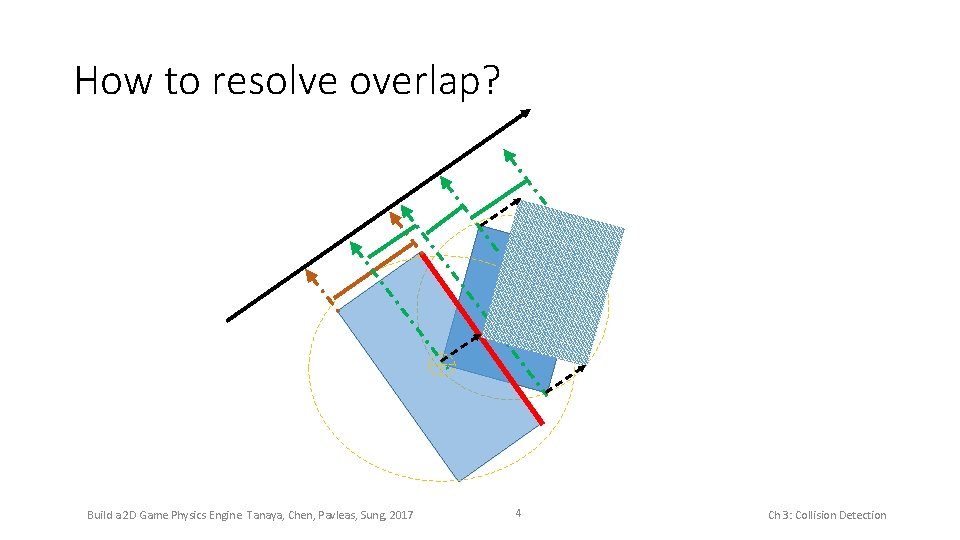
How to resolve overlap? Build a 2 D Game Physics Engine. Tanaya, Chen, Pavleas, Sung, 2017 4 Ch 3: Collision Detection
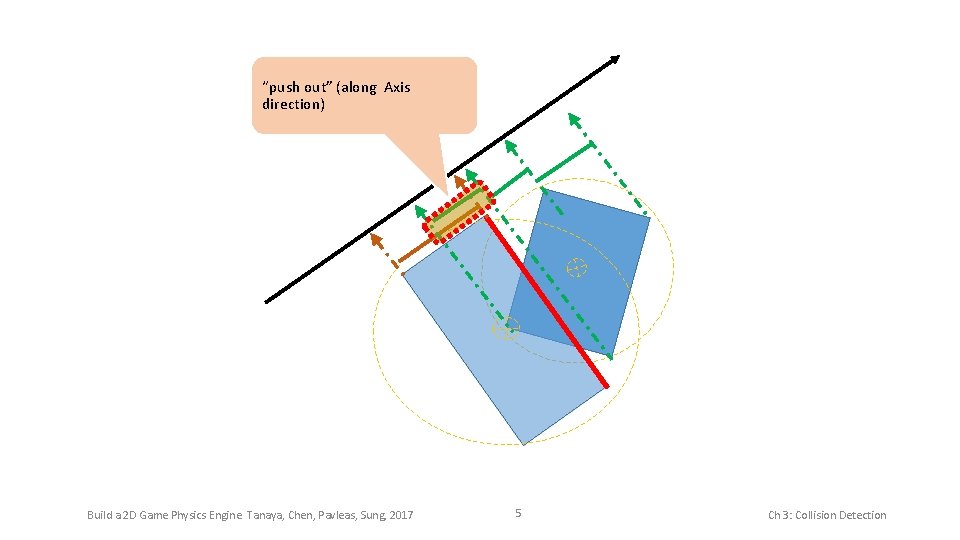
“push out” (along Axis direction) Build a 2 D Game Physics Engine. Tanaya, Chen, Pavleas, Sung, 2017 5 Ch 3: Collision Detection
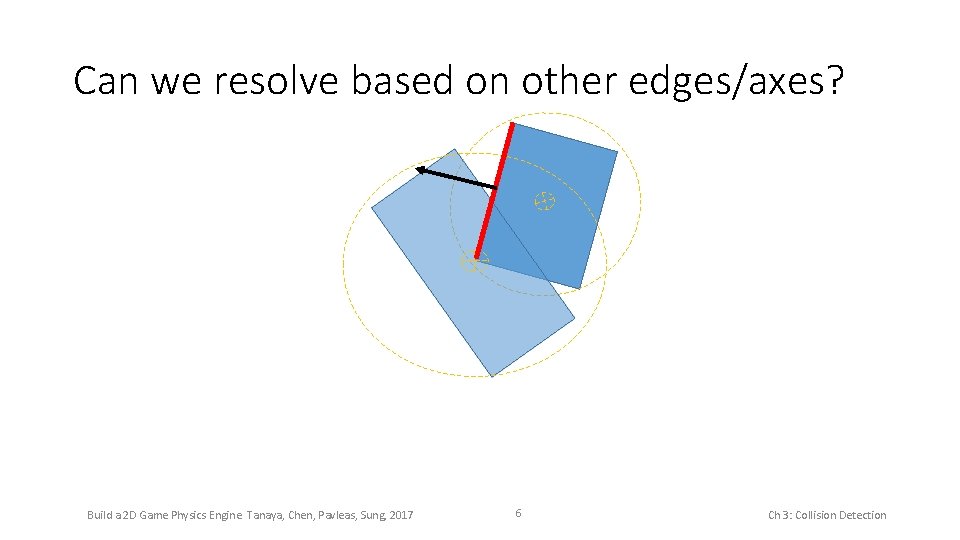
Can we resolve based on other edges/axes? Build a 2 D Game Physics Engine. Tanaya, Chen, Pavleas, Sung, 2017 6 Ch 3: Collision Detection
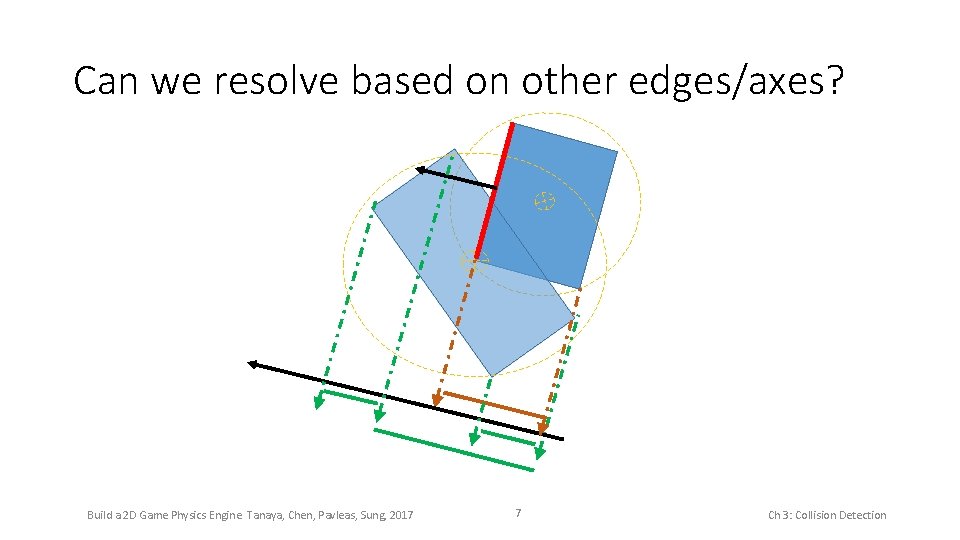
Can we resolve based on other edges/axes? Build a 2 D Game Physics Engine. Tanaya, Chen, Pavleas, Sung, 2017 7 Ch 3: Collision Detection
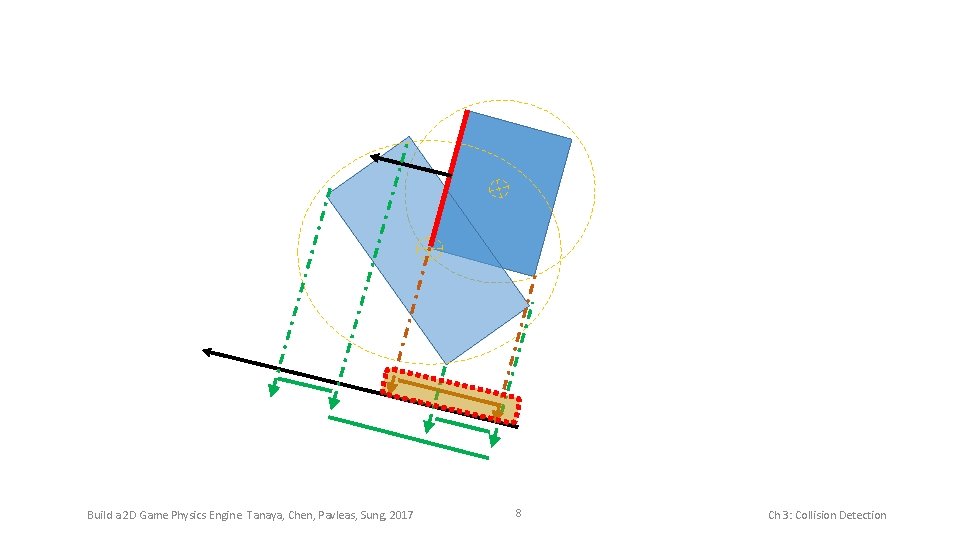
Build a 2 D Game Physics Engine. Tanaya, Chen, Pavleas, Sung, 2017 8 Ch 3: Collision Detection
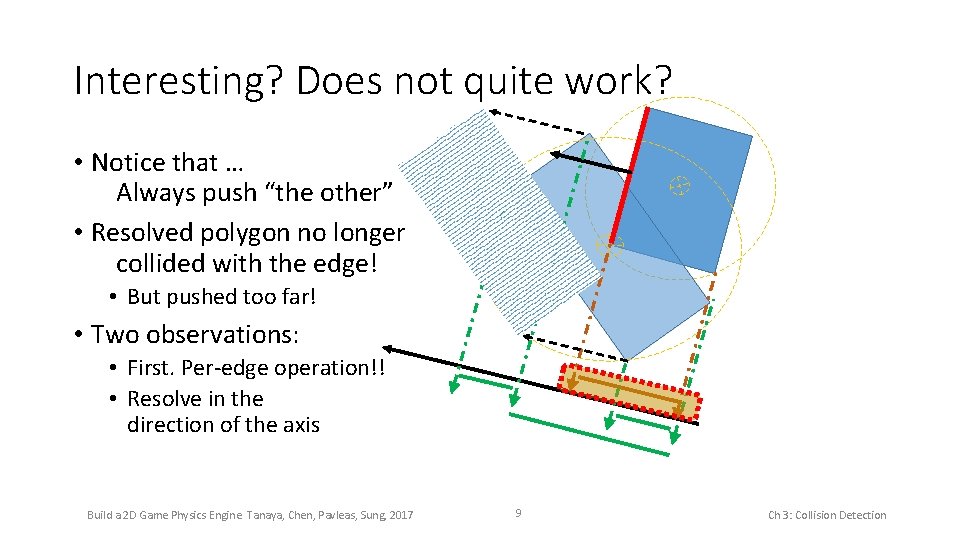
Interesting? Does not quite work? • Notice that … Always push “the other” • Resolved polygon no longer collided with the edge! • But pushed too far! • Two observations: • First. Per-edge operation!! • Resolve in the direction of the axis Build a 2 D Game Physics Engine. Tanaya, Chen, Pavleas, Sung, 2017 9 Ch 3: Collision Detection

Support Point: Efficient SAT Implementation • Given two convex polygons: A and B • Support Point • For an edge on A (will use the edge normal) [face. Normal] • For each Vertex on B • Vertex-i on B is a support point for an edge-e on A when • Vertex-i has the MOST NEGATIVE distance from edge-e • Distance measured along the face normal of edge-e • Associated distance: support point distance • Note: • Support point relationship changes for each frame!! Build a 2 D Game Physics Engine. Tanaya, Chen, Pavleas, Sung, 2017 10 Ch 3: Collision Detection
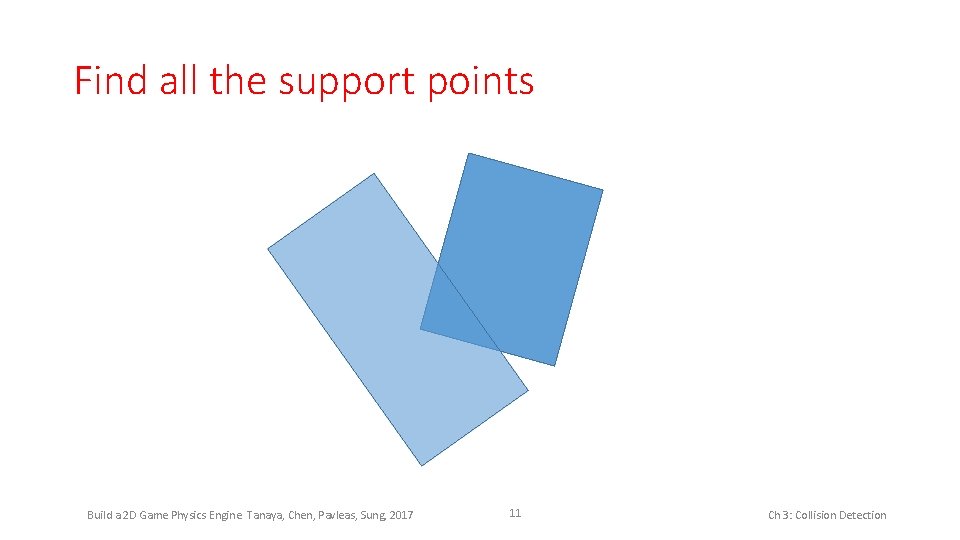
Find all the support points Build a 2 D Game Physics Engine. Tanaya, Chen, Pavleas, Sung, 2017 11 Ch 3: Collision Detection
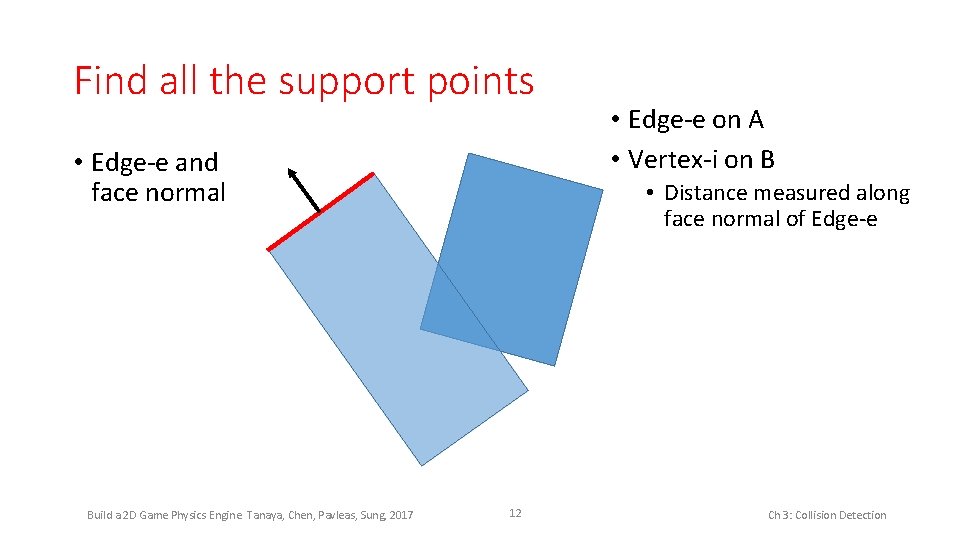
Find all the support points • Edge-e and face normal Build a 2 D Game Physics Engine. Tanaya, Chen, Pavleas, Sung, 2017 • Edge-e on A • Vertex-i on B • Distance measured along face normal of Edge-e 12 Ch 3: Collision Detection
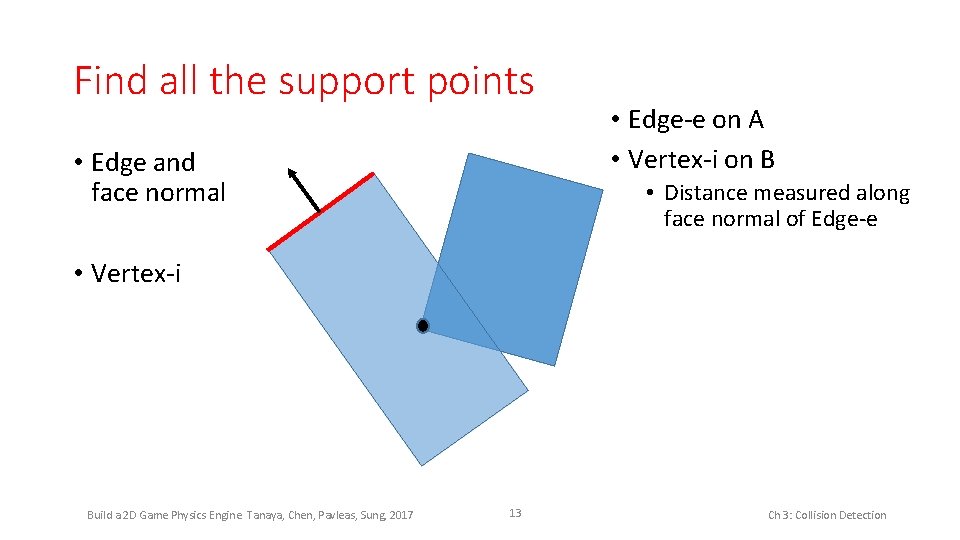
Find all the support points • Edge and face normal • Edge-e on A • Vertex-i on B • Distance measured along face normal of Edge-e • Vertex-i Build a 2 D Game Physics Engine. Tanaya, Chen, Pavleas, Sung, 2017 13 Ch 3: Collision Detection
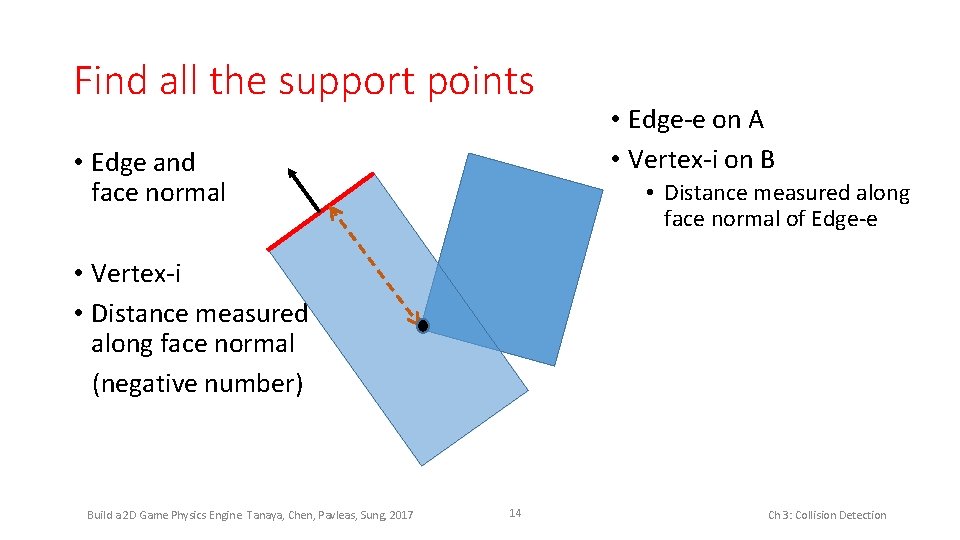
Find all the support points • Edge and face normal • Edge-e on A • Vertex-i on B • Distance measured along face normal of Edge-e • Vertex-i • Distance measured along face normal (negative number) Build a 2 D Game Physics Engine. Tanaya, Chen, Pavleas, Sung, 2017 14 Ch 3: Collision Detection
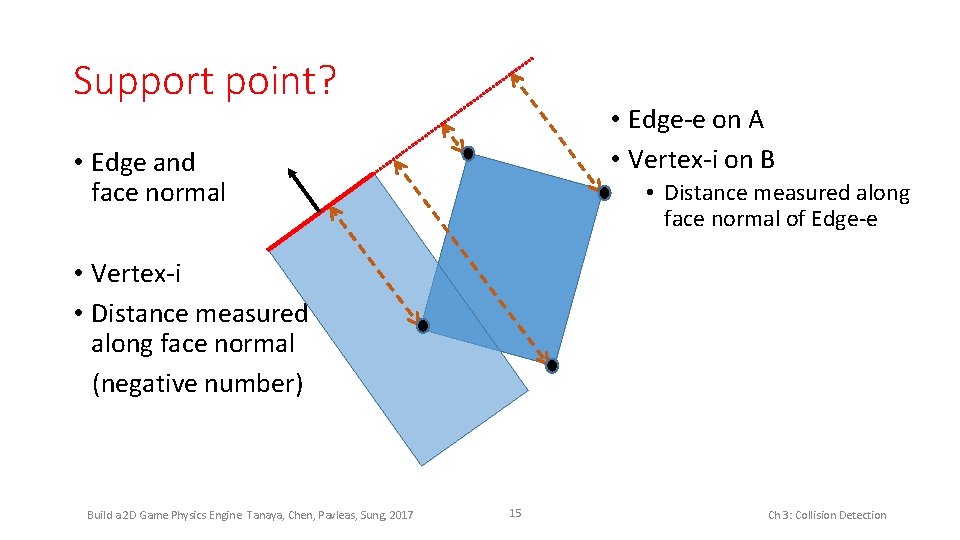
Support point? • Edge-e on A • Vertex-i on B • Edge and face normal • Distance measured along face normal of Edge-e • Vertex-i • Distance measured along face normal (negative number) Build a 2 D Game Physics Engine. Tanaya, Chen, Pavleas, Sung, 2017 15 Ch 3: Collision Detection
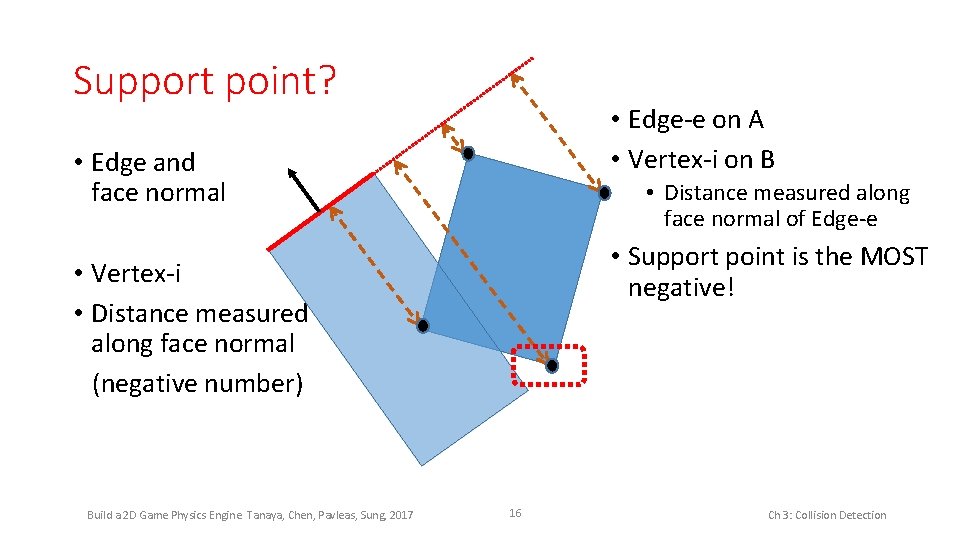
Support point? • Edge-e on A • Vertex-i on B • Edge and face normal • Distance measured along face normal of Edge-e • Support point is the MOST negative! • Vertex-i • Distance measured along face normal (negative number) Build a 2 D Game Physics Engine. Tanaya, Chen, Pavleas, Sung, 2017 16 Ch 3: Collision Detection
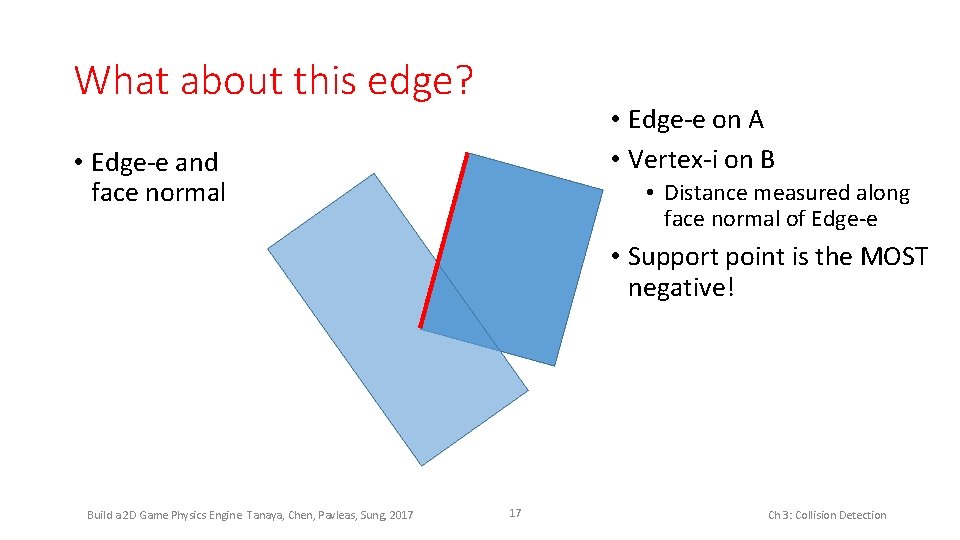
What about this edge? • Edge-e on A • Vertex-i on B • Edge-e and face normal • Distance measured along face normal of Edge-e • Support point is the MOST negative! Build a 2 D Game Physics Engine. Tanaya, Chen, Pavleas, Sung, 2017 17 Ch 3: Collision Detection
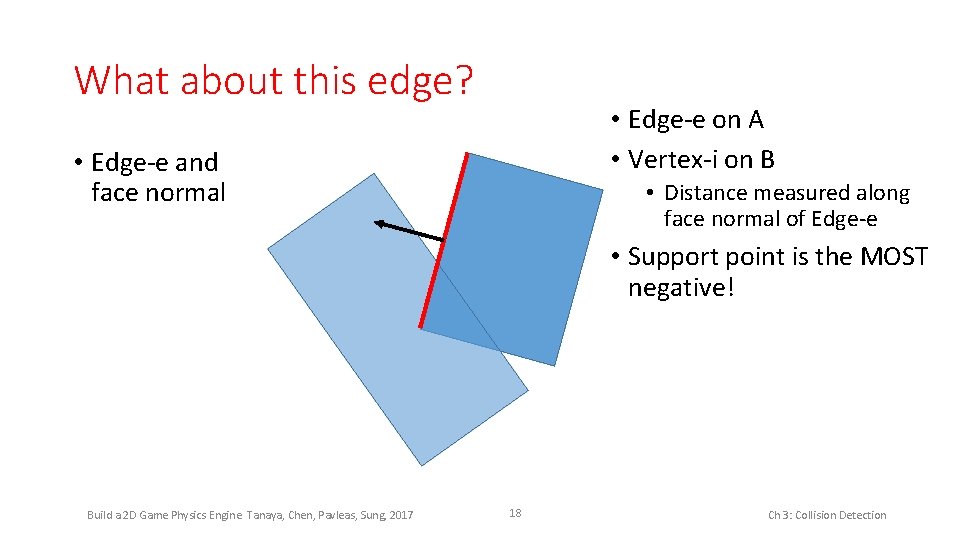
What about this edge? • Edge-e on A • Vertex-i on B • Edge-e and face normal • Distance measured along face normal of Edge-e • Support point is the MOST negative! Build a 2 D Game Physics Engine. Tanaya, Chen, Pavleas, Sung, 2017 18 Ch 3: Collision Detection
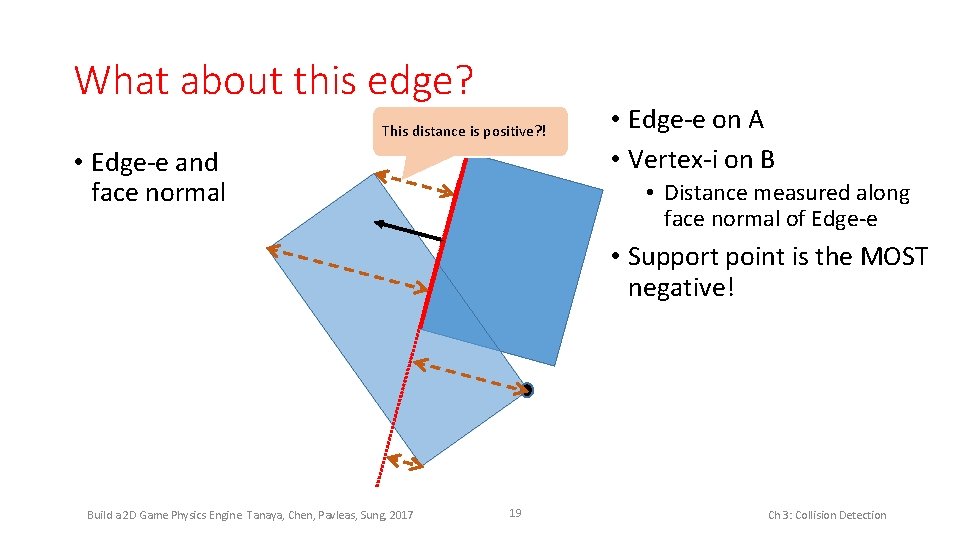
What about this edge? This distance is positive? ! • Edge-e and face normal • Edge-e on A • Vertex-i on B • Distance measured along face normal of Edge-e • Support point is the MOST negative! Build a 2 D Game Physics Engine. Tanaya, Chen, Pavleas, Sung, 2017 19 Ch 3: Collision Detection
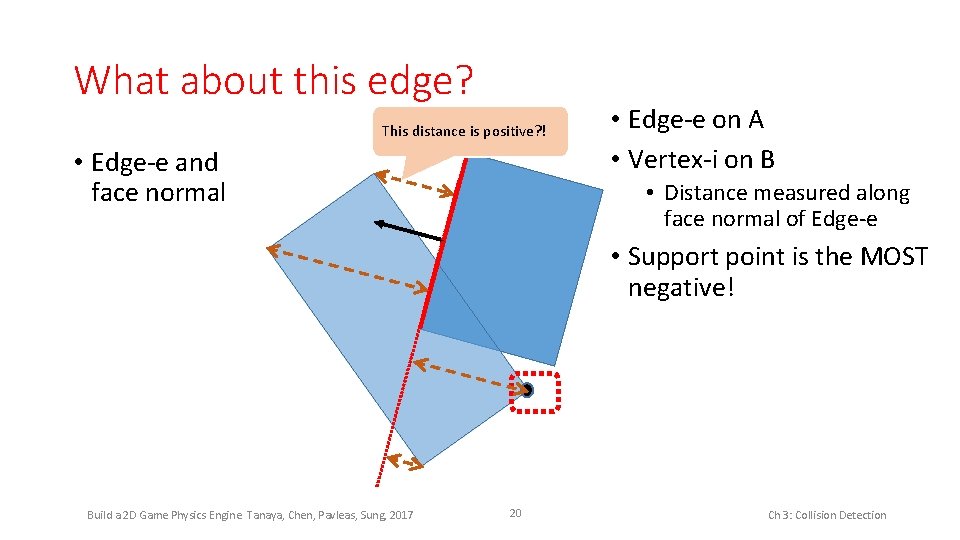
What about this edge? This distance is positive? ! • Edge-e and face normal • Edge-e on A • Vertex-i on B • Distance measured along face normal of Edge-e • Support point is the MOST negative! Build a 2 D Game Physics Engine. Tanaya, Chen, Pavleas, Sung, 2017 20 Ch 3: Collision Detection
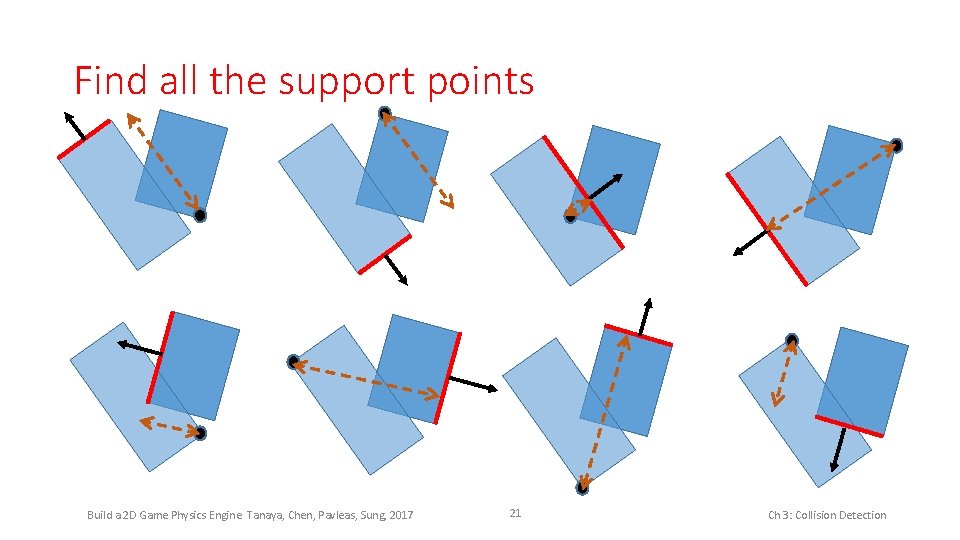
Find all the support points Build a 2 D Game Physics Engine. Tanaya, Chen, Pavleas, Sung, 2017 21 Ch 3: Collision Detection
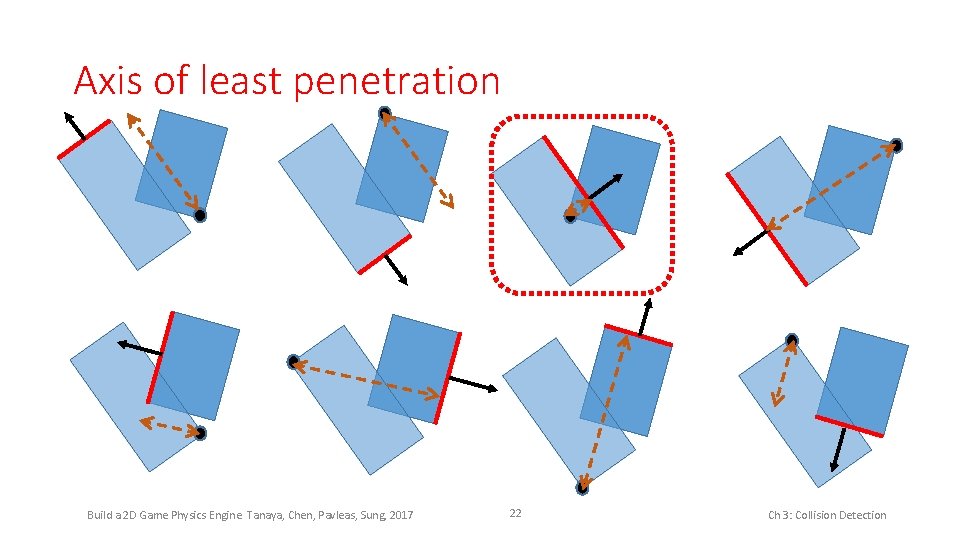
Axis of least penetration Build a 2 D Game Physics Engine. Tanaya, Chen, Pavleas, Sung, 2017 22 Ch 3: Collision Detection
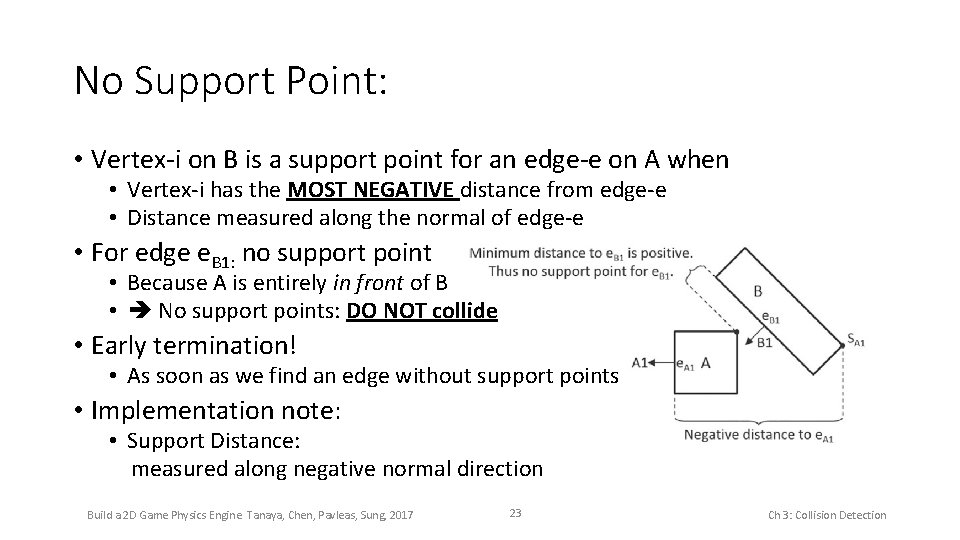
No Support Point: • Vertex-i on B is a support point for an edge-e on A when • Vertex-i has the MOST NEGATIVE distance from edge-e • Distance measured along the normal of edge-e • For edge e. B 1: no support point • Because A is entirely in front of B • No support points: DO NOT collide • Early termination! • As soon as we find an edge without support points • Implementation note: • Support Distance: measured along negative normal direction Build a 2 D Game Physics Engine. Tanaya, Chen, Pavleas, Sung, 2017 23 Ch 3: Collision Detection
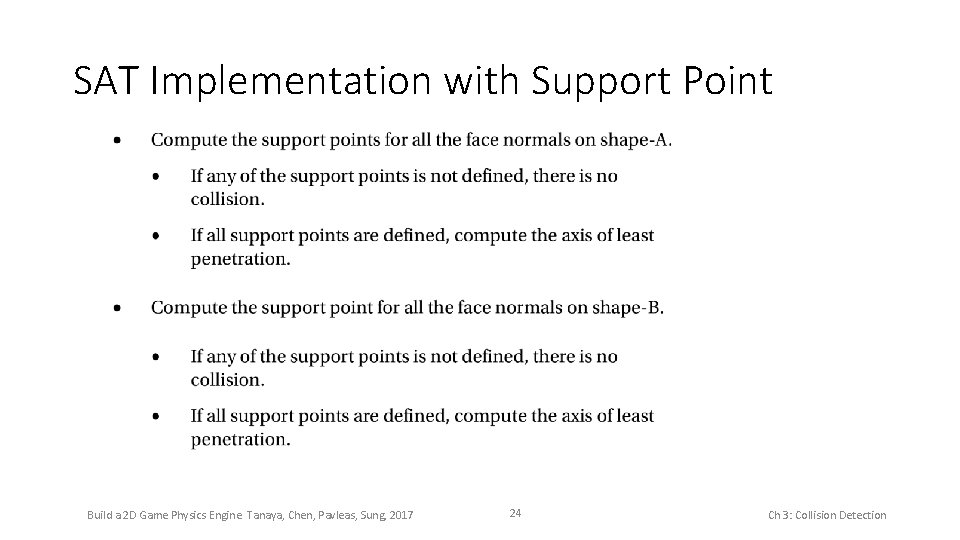
SAT Implementation with Support Point Build a 2 D Game Physics Engine. Tanaya, Chen, Pavleas, Sung, 2017 24 Ch 3: Collision Detection
- Slides: 24