
Separating a Mixture Lab Report Instructions General Information

Separating a Mixture Lab Report Instructions
General Information • Font: Times New Roman • Size: 12 • Skip two lines between each section • Each name of section must have capitalized, underlined and bolded (e. g. PURPOSE) • Make sure to read the rubric as well!
Problem Statement (5 pt) • As Given • Double spaced
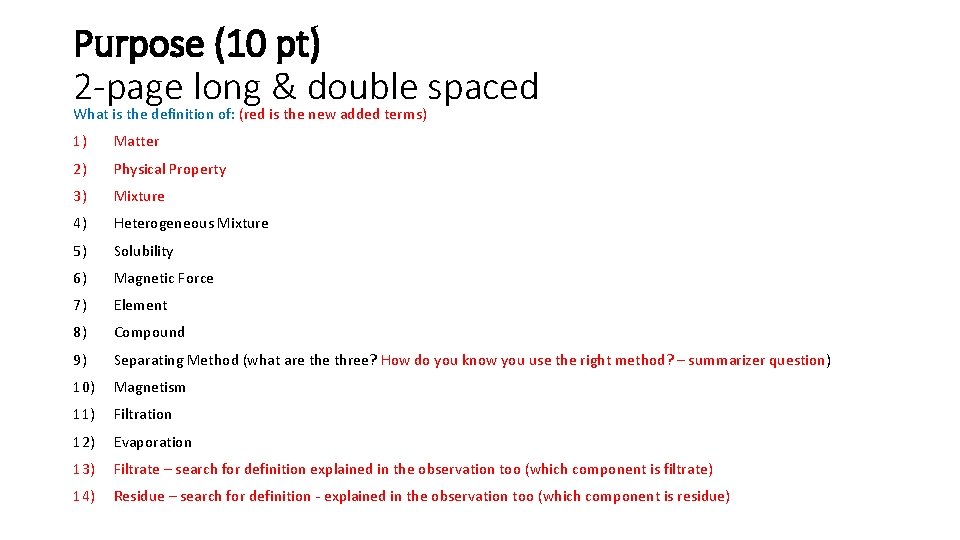
Purpose (10 pt) 2 -page long & double spaced What is the definition of: (red is the new added terms) 1) Matter 2) Physical Property 3) Mixture 4) Heterogeneous Mixture 5) Solubility 6) Magnetic Force 7) Element 8) Compound 9) Separating Method (what are three? How do you know you use the right method? – summarizer question) 10) Magnetism 11) Filtration 12) Evaporation 13) Filtrate – search for definition explained in the observation too (which component is filtrate) 14) Residue – search for definition - explained in the observation too (which component is residue)
Hypothesis (5 pt) • As given • Single-spaced
Variables / Controls (5 pt) • As given • Single-spaced • Add [gram (g) and percentage (%)] at the end of DV • Make sure to include constant (anything you need to keep the same throughout the experiment)
Materials & Equipment (5 pt) • As given • Bullet form • Single-spaced
Experimental Procedure (10 pt) • As given + Add two lab safety concerns • Indicate Day 1 and Day 2 • Numbered • Ignore “must be in own word” • Single-spaced
Data Collection / Presentation (15 pt) • Qualitative Description (5 pts) -- all in one single page -- single-spaced -- At the beginning of each separation method, add the name of the method (e. g. Method 1: Magnetism When I bring the magnet bar to the mixture, I observed that…) -- insert label in the picture with arrows pointing (e. g. iron powder, magnet bar, etc) -- include captions under each picture (e. g. Picture 1 a: iron powder on magnet)
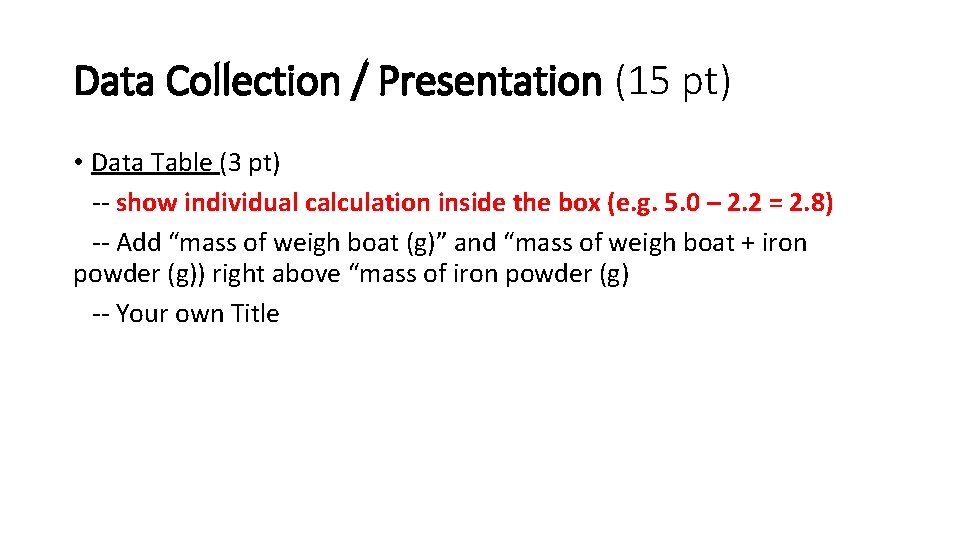
Data Collection / Presentation (15 pt) • Data Table (3 pt) -- show individual calculation inside the box (e. g. 5. 0 – 2. 2 = 2. 8) -- Add “mass of weigh boat (g)” and “mass of weigh boat + iron powder (g)) right above “mass of iron powder (g) -- Your own Title
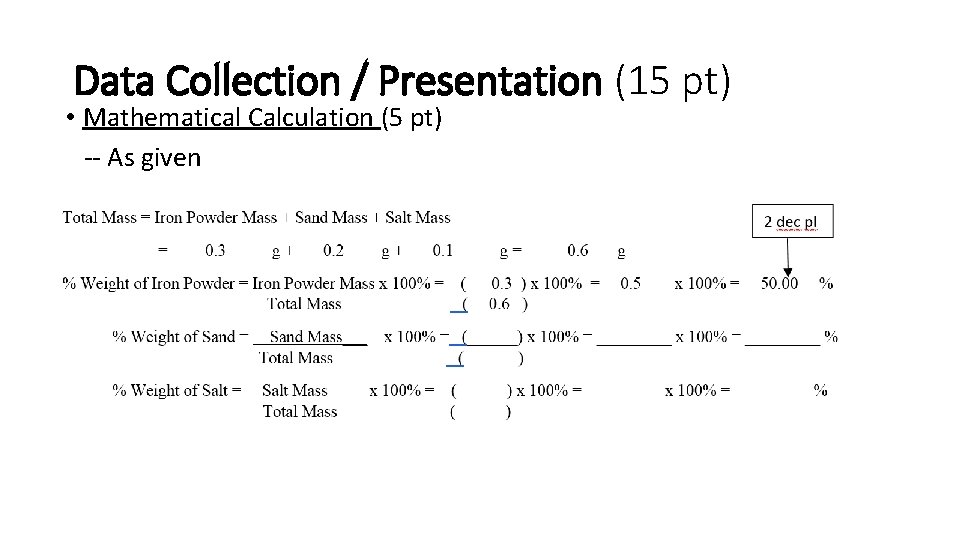
Data Collection / Presentation (15 pt) • Mathematical Calculation (5 pt) -- As given
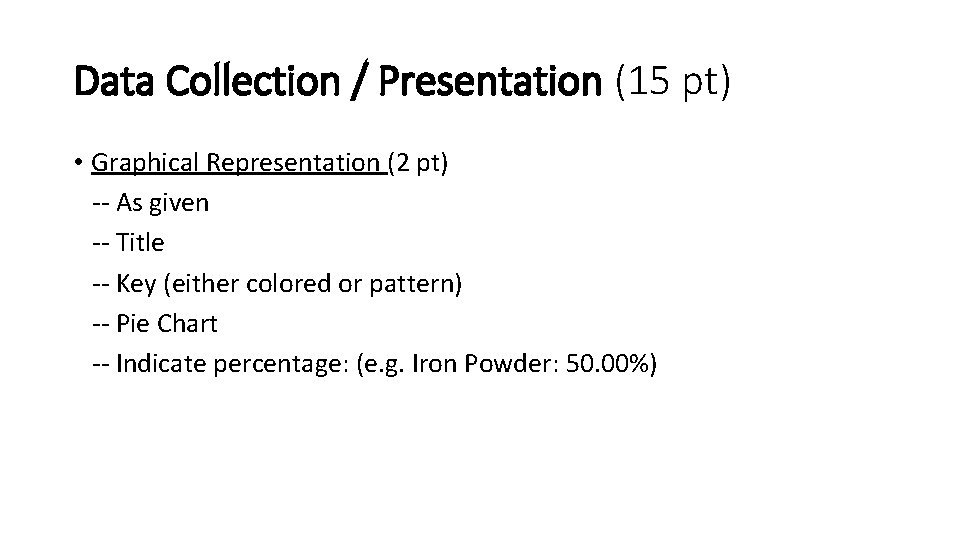
Data Collection / Presentation (15 pt) • Graphical Representation (2 pt) -- As given -- Title -- Key (either colored or pattern) -- Pie Chart -- Indicate percentage: (e. g. Iron Powder: 50. 00%)
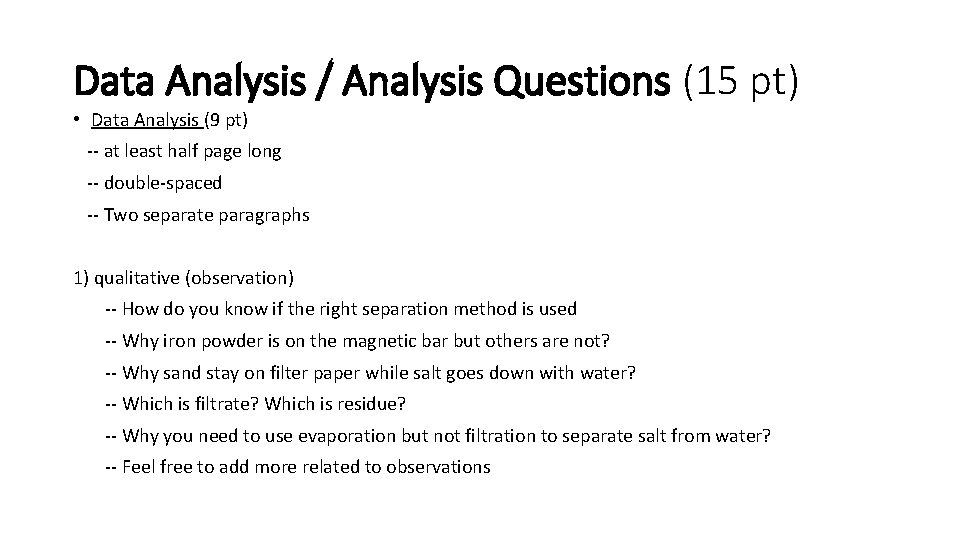
Data Analysis / Analysis Questions (15 pt) • Data Analysis (9 pt) -- at least half page long -- double-spaced -- Two separate paragraphs 1) qualitative (observation) -- How do you know if the right separation method is used -- Why iron powder is on the magnetic bar but others are not? -- Why sand stay on filter paper while salt goes down with water? -- Which is filtrate? Which is residue? -- Why you need to use evaporation but not filtration to separate salt from water? -- Feel free to add more related to observations
Data Analysis / Analysis Questions (15 pt) 2) quantitative (math and graph) -- How to find the individual mass of each component? -- How to find the total mass? -- How to find the individual percentage of each component? -- What can you conclude from the pie chart? Which component has the most amount? The least amount? -- Feel free to add more related to math and/or graph
Data Analysis / Analysis Questions (15 pt) • Analysis Questions (6 pt) -- Numbered (1, 2 a, 2 b, 3) -- Questions (Bolded) and Answer (Italic) -- Single-Spaced -- Skip one line after each question + answer
Conclusion (20 pt) • At least one page long • Double-Spaced • Extended from the guided questions (should write for each point, not just one sentence!) • One single paragraph (not individual sentences)
Experimental Errors (5 pt) • 3 experimental errors • Each is identified with reasons (why there is such error) • Don’t put them in one single paragraph – need separated for each error • Single-spaced • Skip one line between each error 1) 1 st error + 1 st reason 2) 2 nd error + 2 nd reason 3) 3 rd error + 3 rd reason
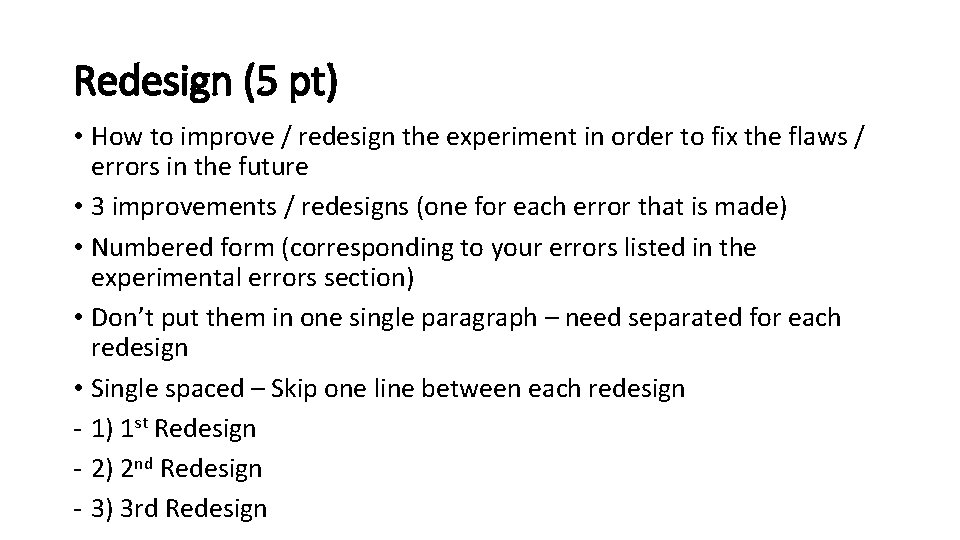
Redesign (5 pt) • How to improve / redesign the experiment in order to fix the flaws / errors in the future • 3 improvements / redesigns (one for each error that is made) • Numbered form (corresponding to your errors listed in the experimental errors section) • Don’t put them in one single paragraph – need separated for each redesign • Single spaced – Skip one line between each redesign - 1) 1 st Redesign - 2) 2 nd Redesign - 3) 3 rd Redesign
- Slides: 18