
Separate Contributions of Kinematic and Kinetic Errors to
Separate Contributions of Kinematic and Kinetic Errors to Trajectory and Grip Force Adaptation When Transporting Novel Hand-Held Loads Frederic Danion, 1* Jonathan S. Diamond, 2* and J. Randall Flanagan 2, 3 1 CNRS and Aix-Marseille University, 2 Centre for Neuroscience Studies and 3 Department of Psychology, Queen’s University The Journal of Neuroscience, January 30, 2013 • 33(5): 2229 – 2236 Motor Control Journal Club May 20, 2013
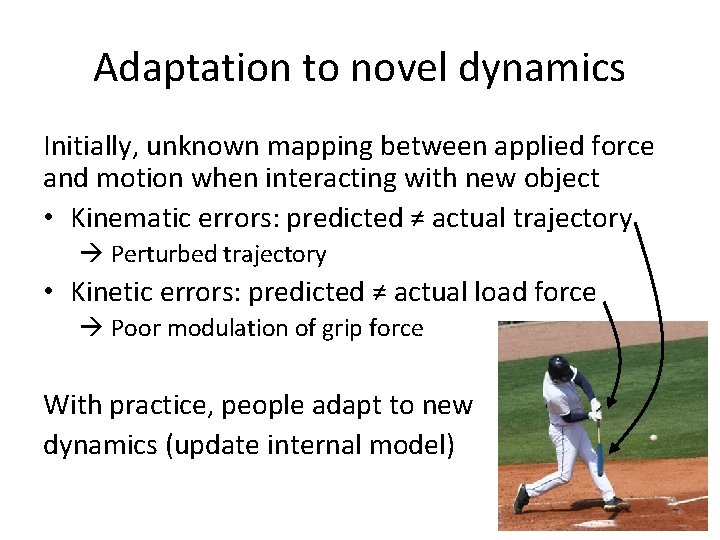
Adaptation to novel dynamics Initially, unknown mapping between applied force and motion when interacting with new object • Kinematic errors: predicted ≠ actual trajectory Perturbed trajectory • Kinetic errors: predicted ≠ actual load force Poor modulation of grip force With practice, people adapt to new dynamics (update internal model)
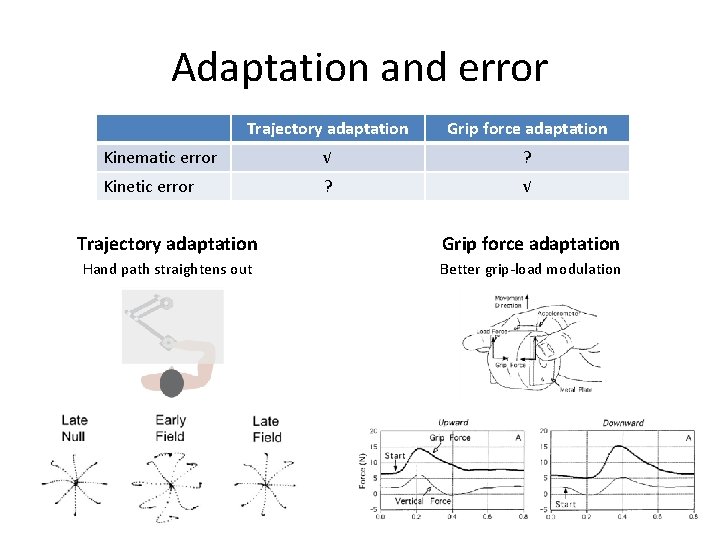
Adaptation and error Trajectory adaptation Grip force adaptation Kinematic error √ ? Kinetic error ? √ Trajectory adaptation Grip force adaptation Hand path straightens out Better grip-load modulation
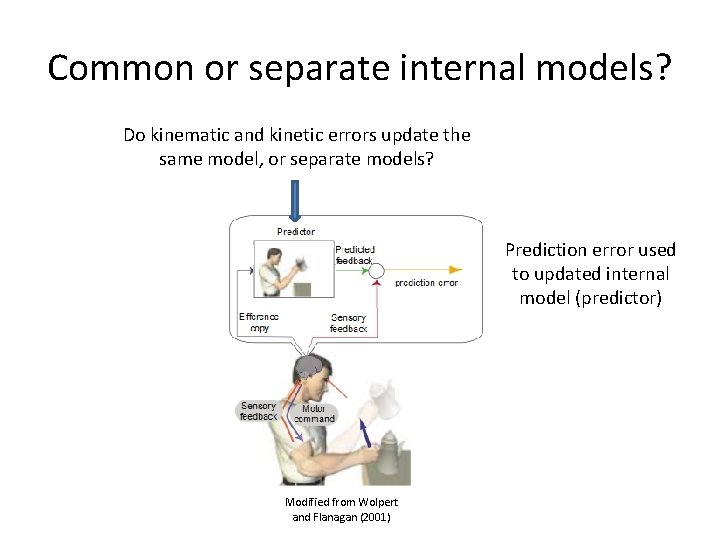
Common or separate internal models? Do kinematic and kinetic errors update the same model, or separate models? Prediction error used to updated internal model (predictor) Modified from Wolpert and Flanagan (2001)
Main ideas of experiment • Compare grip force adaptation with and without kinematic errors • Compare trajectory adaptation with and without prior exposure to kinetic errors
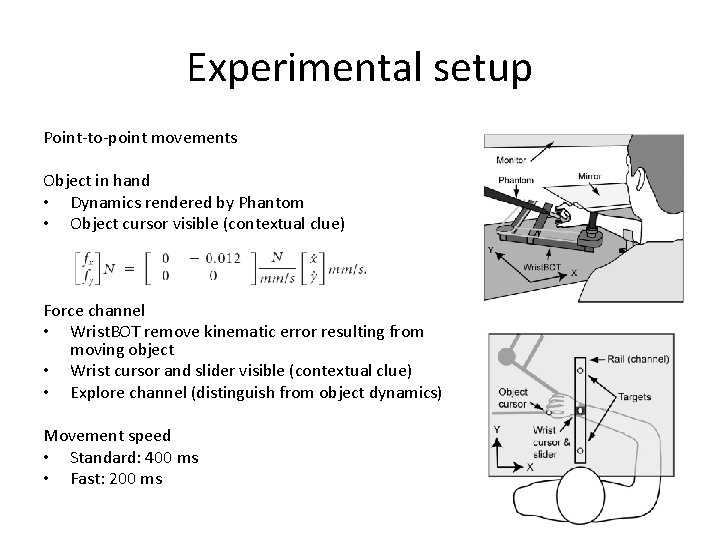
Experimental setup Point-to-point movements Object in hand • Dynamics rendered by Phantom • Object cursor visible (contextual clue) Force channel • Wrist. BOT remove kinematic error resulting from moving object • Wrist cursor and slider visible (contextual clue) • Explore channel (distinguish from object dynamics) Movement speed • Standard: 400 ms • Fast: 200 ms
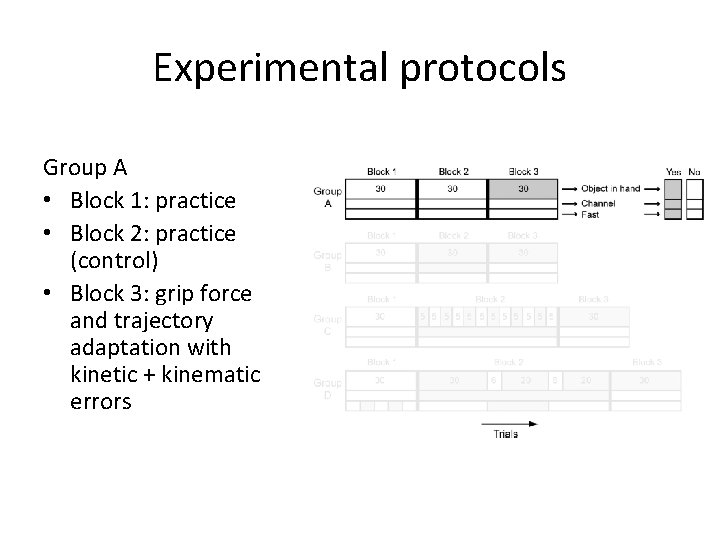
Experimental protocols Group A • Block 1: practice • Block 2: practice (control) • Block 3: grip force and trajectory adaptation with kinetic + kinematic errors
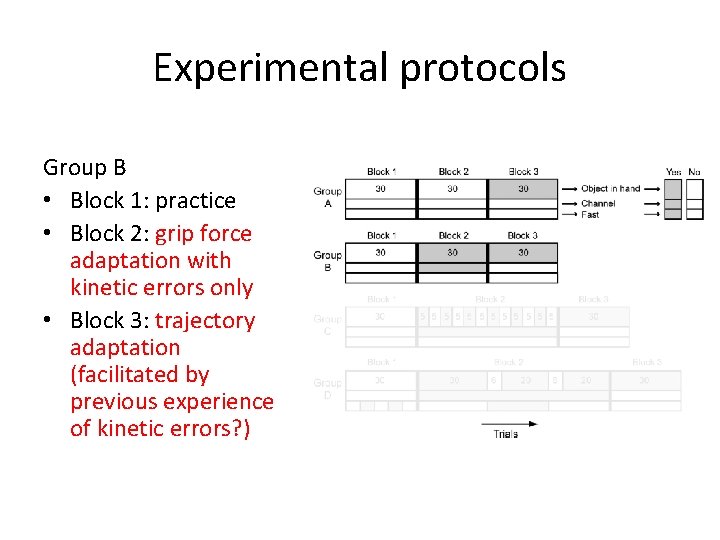
Experimental protocols Group B • Block 1: practice • Block 2: grip force adaptation with kinetic errors only • Block 3: trajectory adaptation (facilitated by previous experience of kinetic errors? )
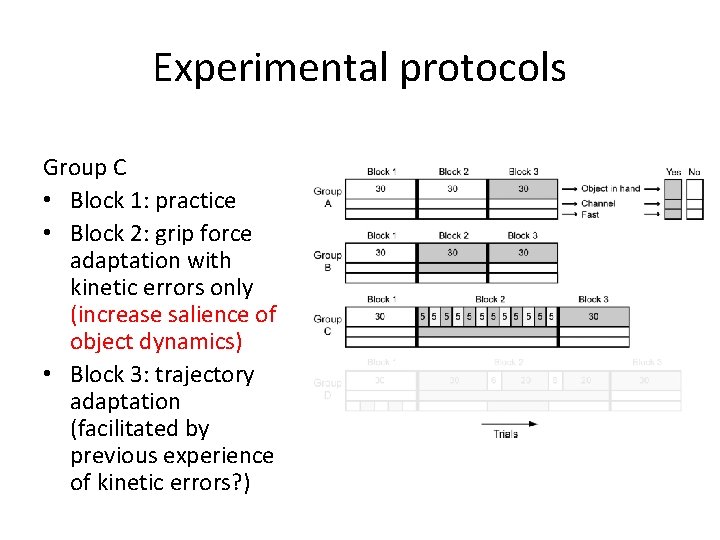
Experimental protocols Group C • Block 1: practice • Block 2: grip force adaptation with kinetic errors only (increase salience of object dynamics) • Block 3: trajectory adaptation (facilitated by previous experience of kinetic errors? )
Data analysis • Grip-load force coupling – Cross-correlation coefficient (at zero lag) • Trajectory perturbation – Peak-to-peak lateral deviation • Adaptation – Fit exponential curve: y = aebx + c
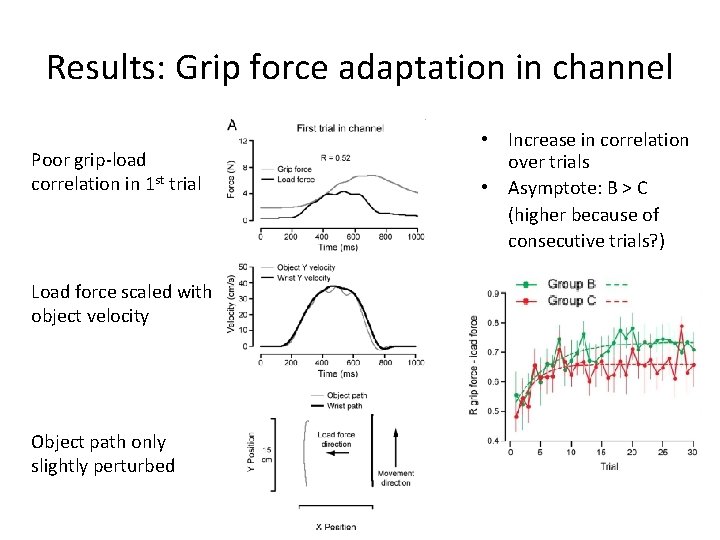
Results: Grip force adaptation in channel Poor grip-load correlation in 1 st trial Load force scaled with object velocity Object path only slightly perturbed • Increase in correlation over trials • Asymptote: B > C (higher because of consecutive trials? )
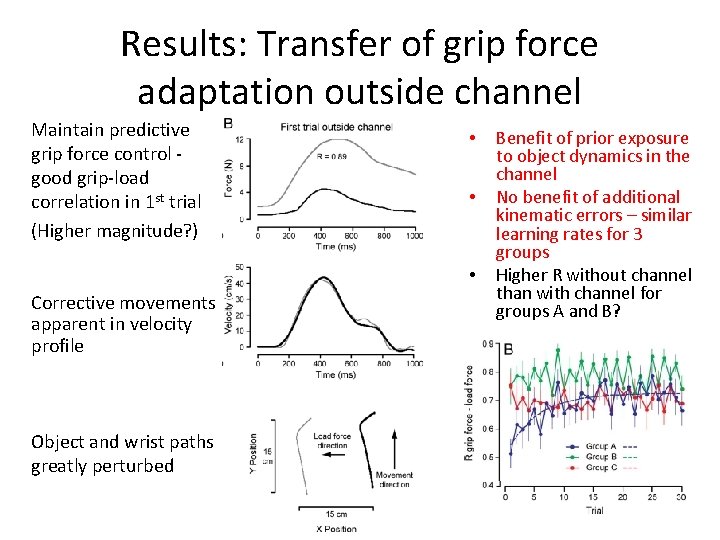
Results: Transfer of grip force adaptation outside channel Maintain predictive grip force control good grip-load correlation in 1 st trial (Higher magnitude? ) • • • Corrective movements apparent in velocity profile Object and wrist paths greatly perturbed Benefit of prior exposure to object dynamics in the channel No benefit of additional kinematic errors – similar learning rates for 3 groups Higher R without channel than with channel for groups A and B?
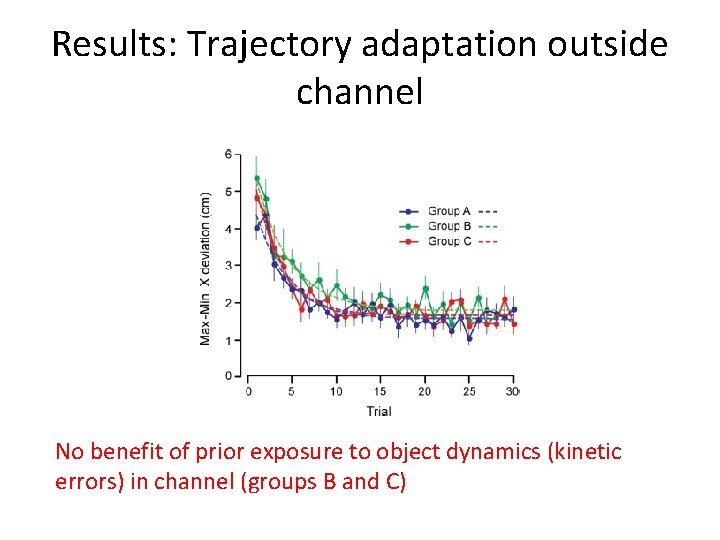
Results: Trajectory adaptation outside channel No benefit of prior exposure to object dynamics (kinetic errors) in channel (groups B and C)
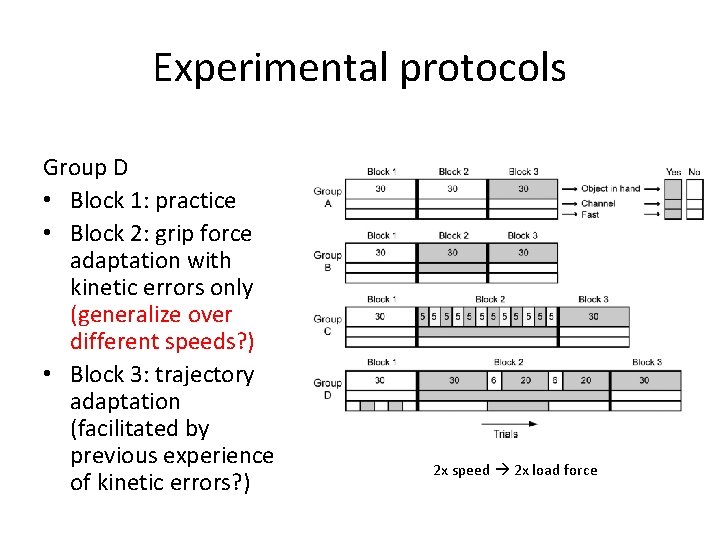
Experimental protocols Group D • Block 1: practice • Block 2: grip force adaptation with kinetic errors only (generalize over different speeds? ) • Block 3: trajectory adaptation (facilitated by previous experience of kinetic errors? ) 2 x speed 2 x load force
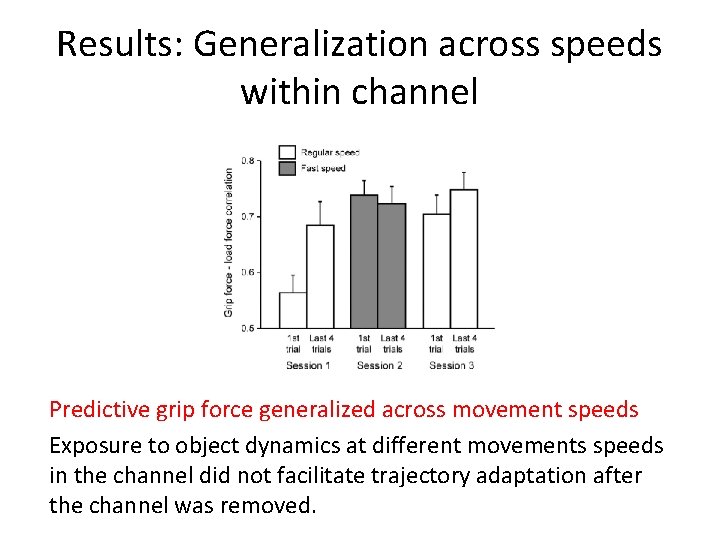
Results: Generalization across speeds within channel Predictive grip force generalized across movement speeds Exposure to object dynamics at different movements speeds in the channel did not facilitate trajectory adaptation after the channel was removed.
Summary of grip force adaptation • Kinetic errors are sufficient to drive grip force adaptation – Equivalent grip force adaptation with channel (kinetic errors) and without channel (kinetic + kinematic errors) – Importance of tactile vs. proprioceptive information • Involves updating of internal model of object dynamics – Generalized over different movement speeds
Summary of trajectory adaptation • Kinematic errors are necessary for arm movement adaptation – Prior experience of moving the object in the channel (kinetic errors) did not benefit trajectory adaptation when moving without the channel • Suggests distinct internal models of object dynamics for grip force and trajectory control
- Slides: 17