
Seoul National University Chapter 4 Bayesian Filtering for
Seoul National University Chapter 4: Bayesian Filtering for State Estimation of the Environment Cognitive Dynamic Systems, S. Haykin Course: Autonomous Machine Learning Nguyen Duc Lam Social and Computer Networks Lab School of Computer Science and Engineering Seoul National University http: //incpaper. snu. ac. kr/ SCONE Lab.
Outline SCONE Lab. o Introduction o Bayesian Filter o Conclusion Seoul National University 9/18/2020 Io. T & SDN 2
Outline SCONE Lab. o Introduction o What is Bayesian ? o Problem Statement o Bayesian Filter o Conclusion Seoul National University 9/18/2020 Io. T & SDN 3
![Introduction [1/3] SCONE Lab. o “In probability theory and statistics, Bayes’ theorem describes the](http://slidetodoc.com/presentation_image/5bb1fdd72599325116fe12e6d1af798d/image-4.jpg "Introduction [1/3] SCONE Lab. o “In probability theory and statistics, Bayes’ theorem describes the")
Introduction [1/3] SCONE Lab. o “In probability theory and statistics, Bayes’ theorem describes the probability of an event, based on conditions that might be related to the event”. Seoul National University 9/18/2020 Io. T & SDN 4
![Introduction [2/3] o Likelihood SCONE Lab. Prior Posterior Evidence Seoul National University 9/18/2020 Io.](http://slidetodoc.com/presentation_image/5bb1fdd72599325116fe12e6d1af798d/image-5.jpg "Introduction [2/3] o Likelihood SCONE Lab. Prior Posterior Evidence Seoul National University 9/18/2020 Io.")
Introduction [2/3] o Likelihood SCONE Lab. Prior Posterior Evidence Seoul National University 9/18/2020 Io. T & SDN 5
![Introduction [3/3] SCONE Lab. o Given a state-space model of the environment o A](http://slidetodoc.com/presentation_image/5bb1fdd72599325116fe12e6d1af798d/image-6.jpg "Introduction [3/3] SCONE Lab. o Given a state-space model of the environment o A")
Introduction [3/3] SCONE Lab. o Given a state-space model of the environment o A system equation o A measurement equation o Practical issues: o The state of the environment is hidden from the observer o Evolution of the state across time and measurements on the environment are both corrupted by the unavoidable presence of physical uncertainties in the environment. o Solutions: o Bayesian Framework o Goal : o Develop algorithms for solving the state-estimation problem. Seoul National University 9/18/2020 Io. T & SDN 6
Outline SCONE Lab. o Introduction o Bayesian Filter o State-Space Model o Sequential o Bayesian Filter o Extended Kalman Filter o Conclusion Seoul National University 9/18/2020 Io. T & SDN 7
![Bayesian Filter [1/8] SCONE Lab. o Seoul National University 9/18/2020 Io. T & SDN](http://slidetodoc.com/presentation_image/5bb1fdd72599325116fe12e6d1af798d/image-8.jpg "Bayesian Filter [1/8] SCONE Lab. o Seoul National University 9/18/2020 Io. T & SDN")
Bayesian Filter [1/8] SCONE Lab. o Seoul National University 9/18/2020 Io. T & SDN 8
![Bayesian Filter [2/8] SCONE Lab. o Generic state-space model of a time-varying, nonlinear dynamic](http://slidetodoc.com/presentation_image/5bb1fdd72599325116fe12e6d1af798d/image-9.jpg "Bayesian Filter [2/8] SCONE Lab. o Generic state-space model of a time-varying, nonlinear dynamic")
Bayesian Filter [2/8] SCONE Lab. o Generic state-space model of a time-varying, nonlinear dynamic system, where Z-1 denotes a block of time-unit delays. Seoul National University 9/18/2020 Io. T & SDN 9
![Bayesian Filter [3/8] SCONE Lab. o Sequential State Estimation problem o The State-estimation problem](http://slidetodoc.com/presentation_image/5bb1fdd72599325116fe12e6d1af798d/image-10.jpg "Bayesian Filter [3/8] SCONE Lab. o Sequential State Estimation problem o The State-estimation problem")
Bayesian Filter [3/8] SCONE Lab. o Sequential State Estimation problem o The State-estimation problem o Prediction : k > n o Filtering : k=n o Smoothing : k <n Seoul National University 9/18/2020 Io. T & SDN 10
![Bayesian Filters [4/8] SCONE Lab. o Framework o Given: o Stream of observations z](http://slidetodoc.com/presentation_image/5bb1fdd72599325116fe12e6d1af798d/image-11.jpg "Bayesian Filters [4/8] SCONE Lab. o Framework o Given: o Stream of observations z")
Bayesian Filters [4/8] SCONE Lab. o Framework o Given: o Stream of observations z and action data u: o Sensor model P(z|x). o Action model P(x|u, x’). o Prior probability of the system state P(x). o Wanted: o Estimate of the state X of a dynamical system. o The posterior of the state is also called Belief: Seoul National University 9/18/2020 Io. T & SDN 11
![Bayesian Filters [5/8] Markov Assumption Underlying Assumptions o Static world o Independent noise o](http://slidetodoc.com/presentation_image/5bb1fdd72599325116fe12e6d1af798d/image-12.jpg "Bayesian Filters [5/8] Markov Assumption Underlying Assumptions o Static world o Independent noise o")
Bayesian Filters [5/8] Markov Assumption Underlying Assumptions o Static world o Independent noise o Perfect model, no approximation errors Seoul National University SCONE Lab.
![Bayesian Filters [6/8] SCONE Lab. z = observation u = action x = state](http://slidetodoc.com/presentation_image/5bb1fdd72599325116fe12e6d1af798d/image-13.jpg "Bayesian Filters [6/8] SCONE Lab. z = observation u = action x = state")
Bayesian Filters [6/8] SCONE Lab. z = observation u = action x = state Bayes Markov Total prob. Markov Seoul National University 9/18/2020 Io. T & SDN 13
![Bayesian Filter [7/8] SCONE Lab. o The Bayesian Filter o Optimal of Bayesian Filter](http://slidetodoc.com/presentation_image/5bb1fdd72599325116fe12e6d1af798d/image-14.jpg "Bayesian Filter [7/8] SCONE Lab. o The Bayesian Filter o Optimal of Bayesian Filter")
Bayesian Filter [7/8] SCONE Lab. o The Bayesian Filter o Optimal of Bayesian Filter Seoul National University 9/18/2020 Io. T & SDN 14
![Bayesian Filter [8/8] SCONE Lab. o Approximation of the Bayesian Filter o Direct numerical](http://slidetodoc.com/presentation_image/5bb1fdd72599325116fe12e6d1af798d/image-15.jpg "Bayesian Filter [8/8] SCONE Lab. o Approximation of the Bayesian Filter o Direct numerical")
Bayesian Filter [8/8] SCONE Lab. o Approximation of the Bayesian Filter o Direct numerical approximation of the posterior o Kalman Filter Theory o Indirect numerical approximation of the posterior o Monte Carlo o Particle filters o Monte Carlo Seoul National University 9/18/2020 Io. T & SDN 15
Outline SCONE Lab. o Introduction o Bayesian Filter o Conclusion Seoul National University 9/18/2020 Io. T & SDN 16
![Conclusion [1/1] SCONE Lab. o Overview of Bayesian Theorem o State-Space Model o Bayesian](http://slidetodoc.com/presentation_image/5bb1fdd72599325116fe12e6d1af798d/image-17.jpg "Conclusion [1/1] SCONE Lab. o Overview of Bayesian Theorem o State-Space Model o Bayesian")
Conclusion [1/1] SCONE Lab. o Overview of Bayesian Theorem o State-Space Model o Bayesian Filter for state estimation Seoul National University 9/18/2020 Io. T & SDN 17
SCONE Lab. THANK YOU Q&a Seoul National University 9/18/2020 Io. T & SDN 18
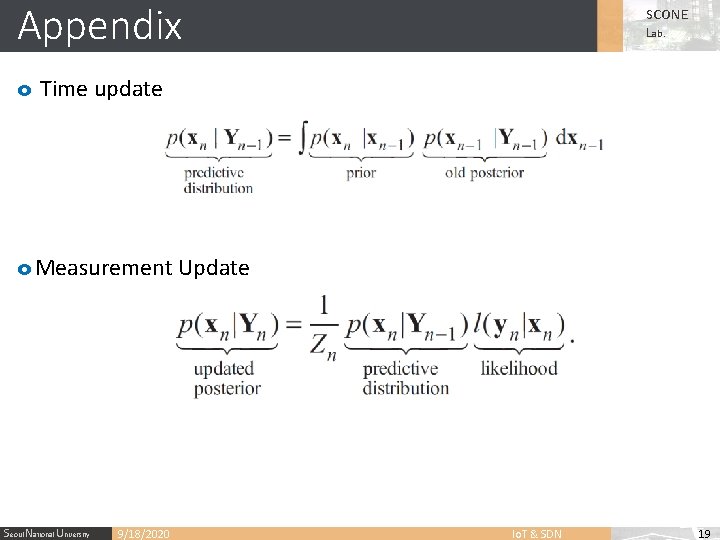
Appendix SCONE Lab. o Time update o Measurement Update Seoul National University 9/18/2020 Io. T & SDN 19
- Slides: 19