
Seoul Accord Where Are We Now Presentation for



- Slides: 30
Seoul Accord: Where Are We Now? Presentation for WCC 2015 by Joe Turner Past Chair, Seoul Accord 1
Some Definitions In this presentation, the following definitions apply: Course: A collection of student learning activities that takes place during a semester or other term. Program: A collection of course requirements that leads to granting of a academic degree or certification by an educational institution. Accreditation: Designation by a recognized organization that a program satisfies the organization’s standards. 2
What is the Seoul Accord? • A mutual recognition agreement among organizations that accredit academic computing programs. • • • Members (called signatories) recognize all designated programs accredited by accord members as producing graduates that are substantially equivalent in preparation to enter a computing profession. Each accord signatory asserts that any recognition for professional preparation given to graduates of its accredited programs also should be extended to the graduates of all programs accredited by any other accord signatory. The scope of the Seoul Accord currently extends only to those accredited baccalaureate-level university programs that prepare graduates for entrylevel positions as computing professionals. 3
Notes • The Seoul Accord does not accredit programs. • The Accord recognizes programs that are accredited by its signatories. • There is no distinction among the recognized programs. • All are deemed substantially equivalent in providing adequate preparation for entry to professional practice in the appropriate field. 4
Relevance to IFIP IP 3 • There is no formal relationship between the Seoul Accord and IFIP IP 3. • (Neither is there any formal relationship between the Seoul Accord and IFIP. ) • Clearly there are issues of mutual interest between the accord and IP 3: • • Preparation and identification of a qualified computing professional workforce on a global level. The appropriate level of cooperation between the accord and IP 3 remains to be determined. • Each must operate independently from the other, but it is important, if not essential, that the standards and requirements of the two be complementary. 5
Engineering Accords (1) • Washington Accord: for baccalaureate-level professional engineering programs (“normally” 4 year programs). • Established in Washington in 1989. • Originally six signatories from native Englishspeaking countries. • Currently 17 signatories, with six provisional (applicant) members, from around the world. 6
Engineering Accords (2) • Sydney Accord: for programs that prepare graduates as engineering technologists (normally 3 -year programs). • Established in Sydney in 2001. • Currently ten signatories. 7
Engineering Accords (3) • Dublin Accord: for programs that prepare graduates as engineering technicians (normally two -year programs). • Established in Dublin in 2002. • Currently eight signatories. 8
• • International Engineering Alliance (IEA) Six members: • Washington, Sydney, and Dublin Accords • Engineers’ Mobility Forum: concerned with professional registration (licensing, etc. ) • APEC Engineer: recognition of substantial equivalency of engineering qualifications among Asia Pacific Economic Cooperation countries. • Engineering Technologist Mobility Forum Cooperative alliance with a common secretariat and a Governing Council. 9
Seoul Accord • History • Current status • Vision • Guiding principles • Procedures • Basis for evaluating membership qualifications. • Current projects/efforts 10
Seoul Accord History Established 6 December 2008, in Seoul • • Formal effort to organize began at a meeting in Seoul during November 2007 • • Meeting was organized by ABEEK (Accreditation Board for Engineering Education Korea) and supported by various South Korean government and industry sponsors Informal discussions for a year or two prior to November 2007 • More formal discussion at IFIP GA in August, 2007 (Addis Ababa) 11
Founding Signatories • Accreditation Board for Engineering Education Korea (ABEEK) • ABET (USA) • Australian Computer Society (ACS) • British Computer Society (BCS) • Canadian Information Processing Society (CIPS) • Japan Accreditation Board for Engineering Education (JABEE) 12
First General Meeting • Held on June 20, 2009 in Kyoto • Admitted two new members: • • Hong Kong Institute of Engineers (HKIE) Institute for Engineering Education of Taiwan (IEET) 13
Current Status • Eight signatories. • Three Provisional Members, admitted in June 2015: • Engineers Ireland (EI) • Institute of IT Professionals New Zealand (IITP) • Philippine Computer Society Information & Computing Accreditation Board (PICAB) • IEET serves as the secretariat. • Website: http: //www. seoulaccord. org/ 14
Vision (informal) • The vision of the Seoul Accord is to be recognized as the reliable authority on international standards for accrediting professionally-oriented tertiary programs in computing. • A goal of the accord is global recognition of adequate professional preparation for graduates of programs recognized by the accord. 15
Guiding Principles (1) The following are the Guiding Principles on which the formation, rules, and procedures of the accord are based: 1. The Accord is based on mutual respect for the autonomy of its signatories. 2. There will be transparency to the accreditation systems of the signatories and to the educational systems to which the accreditation systems are oriented. 3. The signatories will be autonomous and free from governmental or other external influence on the accreditation processes. 16
Guiding Principles (2) 4. The Accord should avoid any perception that it is arbitrary and capricious in its practices and policies, including admitting members and applying rules of membership. 5. The Accord should work to become recognized as the international authority on quality assurance for education in the computing and IT-related professions. 6. The Accord will promote and develop best practices for the improvement of education in computing and IT-related disciplines. 17
Guiding Principles (3) 7. The Accord should continually review its policies and procedures to ensure that they are relevant and reliable indicators of the future of computing and IT-related technologies. 8. The members of the Accord will be accreditation agencies, not countries. 18
Membership Procedures: New Applicants • Applicant submits documents on applicant’s accreditation standards and procedures and nomination from two signatories. • Signatories review documents. • Applicant makes a presentation and answers questions during a meeting of signatories. • Acceptance as Provisional Member requires two-thirds majority approval of all signatories. 19
Membership Procedures: Provisional Members • Provisional Member submits documents on its accreditation standards and procedures. • Review committee of signatory representatives is formed and reviews documents. • Review committee visits provisional member’s office, observes accreditation visits, and observes accreditation action meeting(s). • Review committee submits a report and recommends action to signatories. • Acceptance as a signatory requires the unanimous approval of all signatories. 20
Monitoring Procedures: Signatories • Each signatory is reviewed every six years. • Process is similar to that for member applicants. • Review committee of other signatory representatives reviews documents, observes accreditation visits, and submits report and recommendation. • All other signatories vote on action to continue signatory status. 21
Basis for Admission and Signatory Review Decisions: Graduate Attributes • The accord has established a set of attributes for graduates of accord programs. (See the web site for the list of graduate attributes, contained in the official accord documents. ) • The attributes are essentially expected outcomes for programs recognized by the accord. • • Similar to graduate attributes of IEA accords. The evaluation process determines whether the standards, procedures, practices, infrastructure, and context of an accreditation organization are such that accord-designated programs accredited by the organization are effective in producing graduates having the accord’s graduate attributes. 22
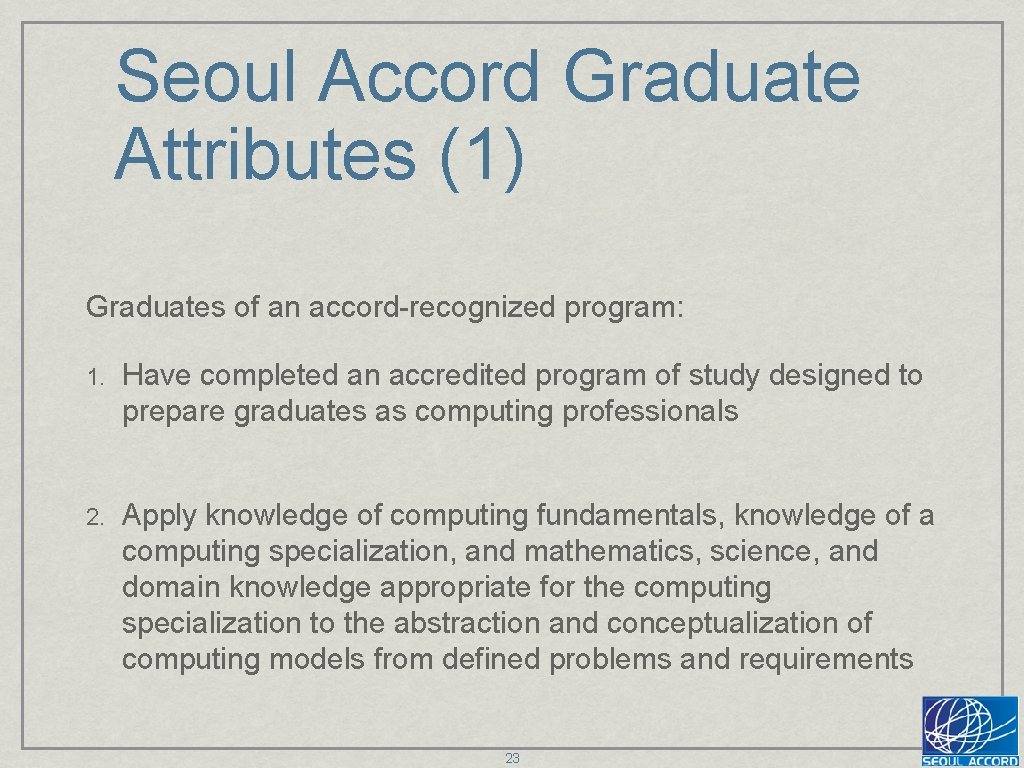
Seoul Accord Graduate Attributes (1) Graduates of an accord-recognized program: 1. Have completed an accredited program of study designed to prepare graduates as computing professionals 2. Apply knowledge of computing fundamentals, knowledge of a computing specialization, and mathematics, science, and domain knowledge appropriate for the computing specialization to the abstraction and conceptualization of computing models from defined problems and requirements 23
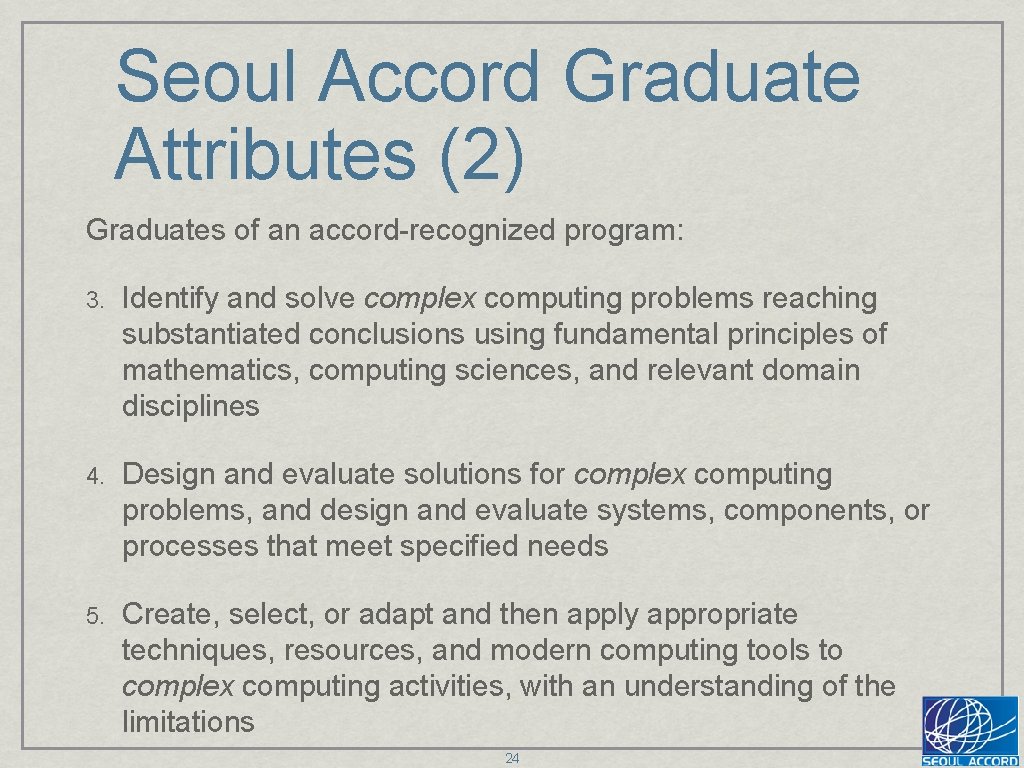
Seoul Accord Graduate Attributes (2) Graduates of an accord-recognized program: 3. Identify and solve complex computing problems reaching substantiated conclusions using fundamental principles of mathematics, computing sciences, and relevant domain disciplines 4. Design and evaluate solutions for complex computing problems, and design and evaluate systems, components, or processes that meet specified needs 5. Create, select, or adapt and then apply appropriate techniques, resources, and modern computing tools to complex computing activities, with an understanding of the limitations 24
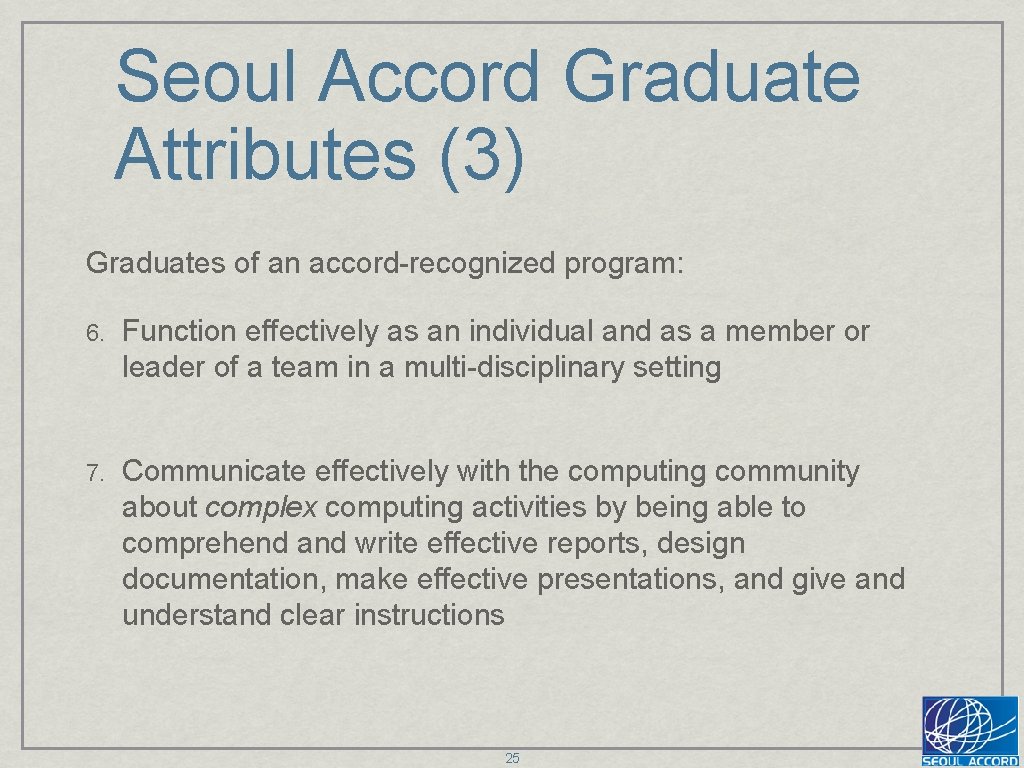
Seoul Accord Graduate Attributes (3) Graduates of an accord-recognized program: 6. Function effectively as an individual and as a member or leader of a team in a multi-disciplinary setting 7. Communicate effectively with the computing community about complex computing activities by being able to comprehend and write effective reports, design documentation, make effective presentations, and give and understand clear instructions 25
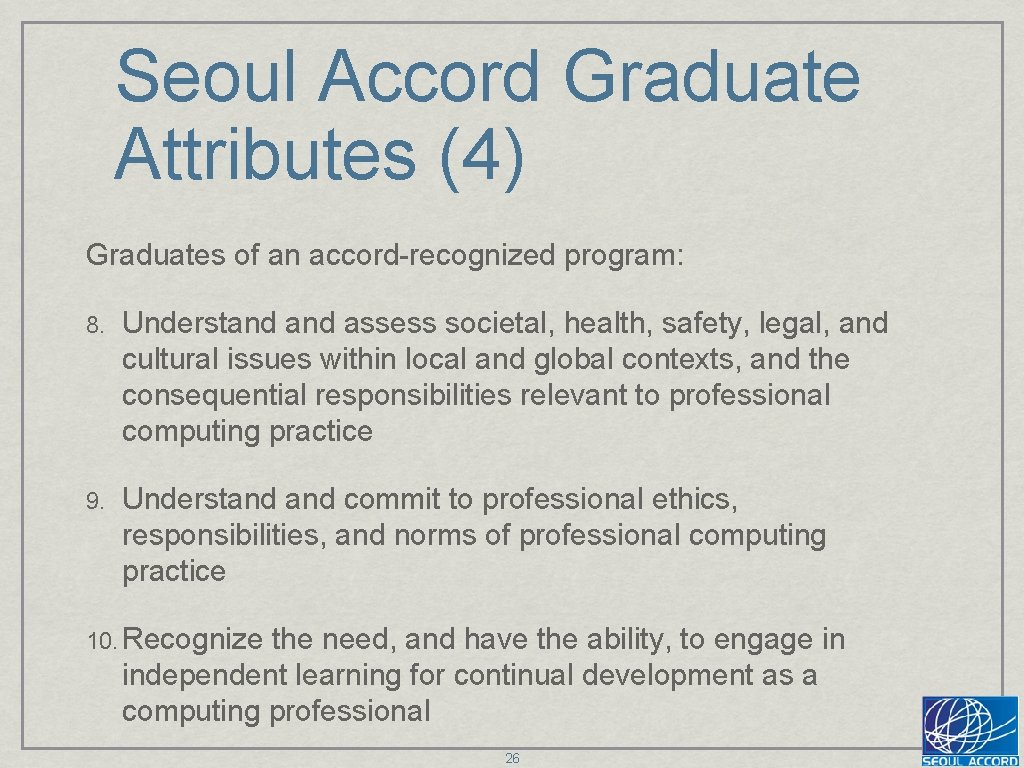
Seoul Accord Graduate Attributes (4) Graduates of an accord-recognized program: 8. Understand assess societal, health, safety, legal, and cultural issues within local and global contexts, and the consequential responsibilities relevant to professional computing practice 9. Understand commit to professional ethics, responsibilities, and norms of professional computing practice 10. Recognize the need, and have the ability, to engage in independent learning for continual development as a computing professional 26
Notes on Accord Requirements • There is no specification or recommendation for the standards or procedures of signatories. • The primary requirement is that the programs accredited by each signatory and recognized under the accord produce graduates that are substantially equivalent to those of the other signatories recognized programs in satisfying the accord’s graduate attributes. • How a signatory achieves this requirement is not specified. 27
Recent Accomplishments • Admitted the first three Provisional Members. • Established procedures for recognizing programs accredited by a signatory outside the signatory’s jurisdiction. • Recognized the first accredited programs that are not in the jurisdiction of any signatory. • Completed the first monitoring reviews (of two signatories). 28
Current Projects/Efforts • Attract additional members. • Encourage the establishment of computing accreditation organizations where appropriate. • Investigate expanding the scope of the accord to include recognition of accredited computing technologist and computing technician programs. • Promote recognition of the accord and its contribution to providing recognition of credentials across country boundaries. • Cooperate as appropriate with the IEA. 29
Thank You! Questions/Comments? 30