
Sentence Structure Why Verbs Matter So much VerbsMost
Sentence Structure Why Verbs Matter So much!

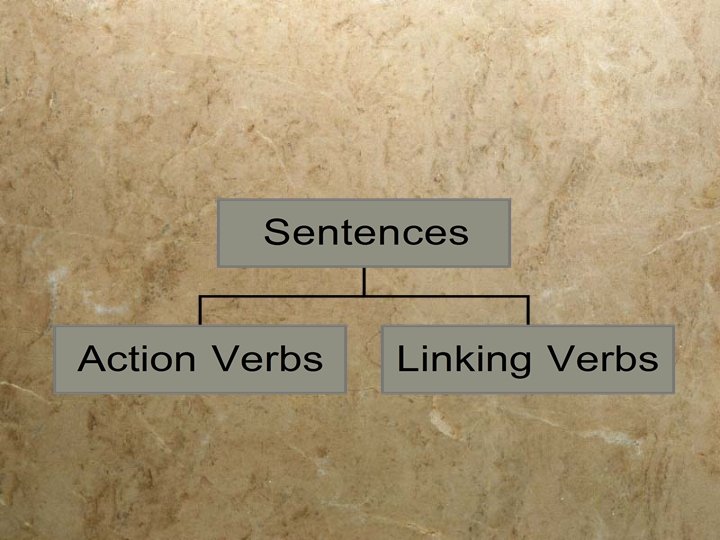
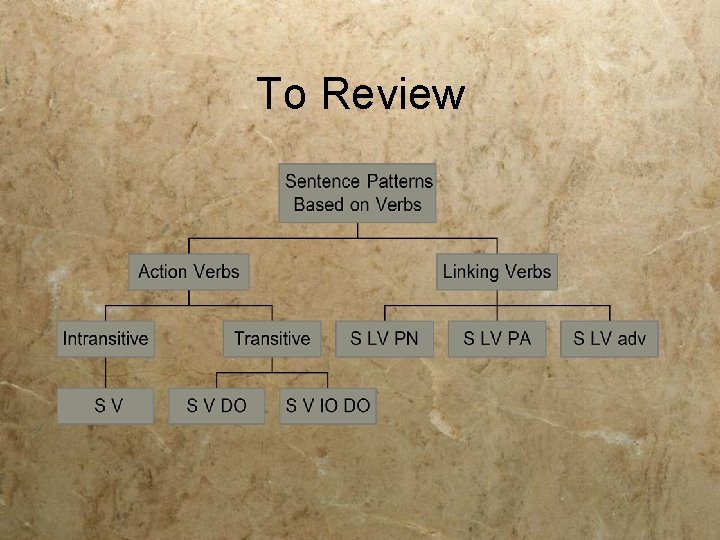
Verbs--Most Important Word in the sentence! § They determine the structure of the sentence § Two kinds of Verbs: Action and Linking
Action Verbs § Show an Action…this is something we could see or do; most verbs (in the infinitive form): To Think to jump To Run to love To Smile to dream To Eat to study To sleep to kick To drive to compute
Linking Verbs § Show a state of being § When A form of the verb “to Be” is the main verb…it’s linking Be Am Is Are Was Were Been Being Also, Become & Seem
Verbs with multiple personalities… § Some verbs can be linking verbs or Action Verbs § appear, feel, grow, look, prove, remain, smell, sound, taste, and turn. § How do you tell the difference?
What do I do Now? § Try to substitute the verb for a form of the verb “to be” like “am, ” “is, ” or “are. ”
Try it § Sylvia tasted the spicy squid eyeball stew……substitute “is” for the verb… § Sylvia is the stew? I don't think so! Tasted, therefore, is an action verb in this sentence, something Sylvia is doing.
Try it § The squid eyeball stew tasted good. § The squid eyeball stew is good? Makes sense…must be linking!
Try it § I smell the delicious aroma of a mushroom and papaya pizza baking in the oven. § The mushroom and papaya pizza smells heavenly.
Note…This won’t work with “to appear” Figure it out…which is an action? The blue Jay appeared happy to see the bird feeder. Or The blue jay suddenly appeared on the branch near the bird feeder. (try to substitute an action verb)
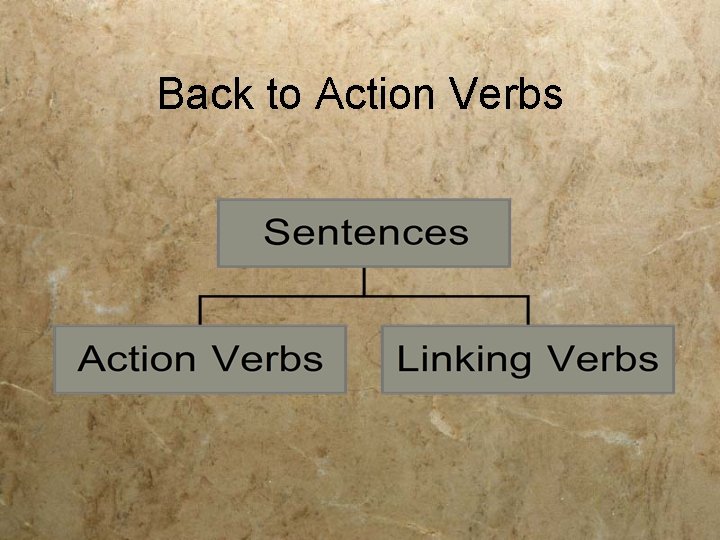
Back to Action Verbs

There are two kinds of action verbs--transitive & intransitive Realize though, that many verbs are both transitive and intransitive
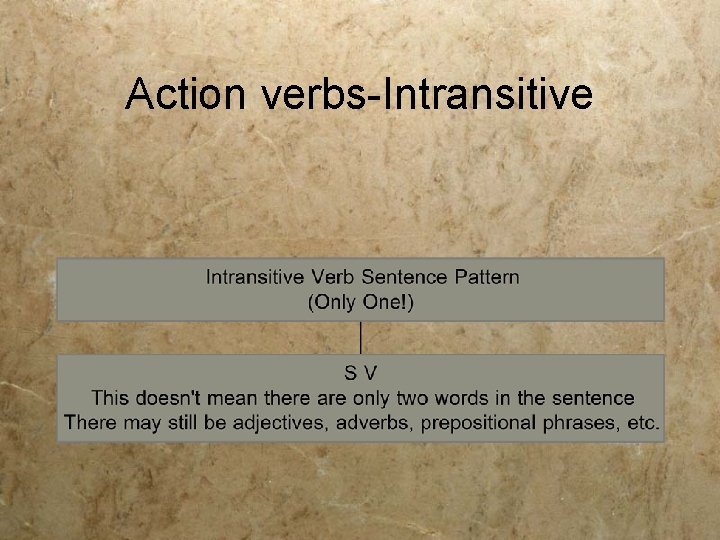
Action verbs-Intransitive

Intransitive Verbs Examples: Huffing and puffing, we arrived at the classroom door with only seven seconds to spare. Or James went to the campus cafe for a steaming bowl of squid eyeball stew.

Action Verbs--Transitive Verbs Again, these subject patterns may have adjectives, adverbs, prepositional phrases, etc. These are the main structural units of the sentence.
S V DO § Everyone loves Raymond. How to find the Direct Object. Find the subject and verb, then ask “Who” or “what” everyone Loves who or what?
S V DO Sylvia kicked Juan under the table. Subject? Verb? Subject Verb who or what?
S V IO DO How to find the indirect object Find the subject and verb Find the direct object, subject and verb who or what Ask “to/for whom” or “to/for what” When someone Gets the direct object, there is an indirect object
S V IO DO Josh built a Sand Castle on the Beach. Vs. Josh built his sister a sand castle on the beach.
Double Checking indirect objects § Can you make the indirect object into a prepositional phrase using “to” or “for” § To explain the broken lamp, we told mom a lie. § What’s the indirect object? § Check, make it into a prepositional Phrase
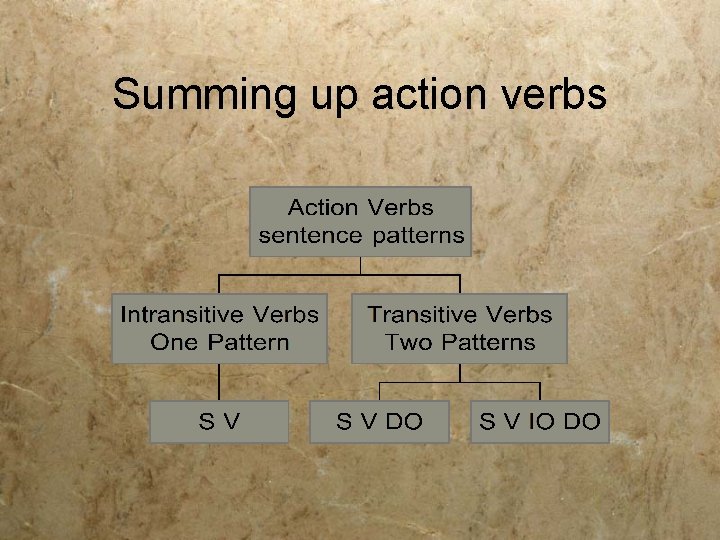
Summing up action verbs
Subject Complement A subject complement is the adjective, noun, or pronoun that follows a linking verb.
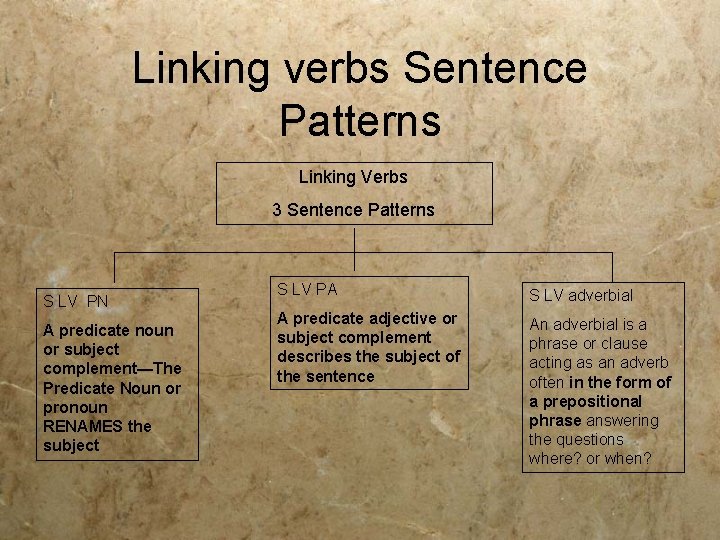
Linking verbs Sentence Patterns Linking Verbs 3 Sentence Patterns S LV PN A predicate noun or subject complement—The Predicate Noun or pronoun RENAMES the subject S LV PA S LV adverbial A predicate adjective or subject complement describes the subject of the sentence An adverbial is a phrase or clause acting as an adverb often in the form of a prepositional phrase answering the questions where? or when?
S LV PN, example A Ferret is a type of Weasel. My mother is a lawyer in providence. Steve is the best student in the class. To double check: use an = Ferret=weasel
S LV PA A ferret is furry and fuzzy. Brandon becomes embarrassed when people compliment his skill. The exchange student was French. Double check, can the adjective be moved in front of the subject? The furry ferret…
S LV adverb My birthday was yesterday. The ferret is in the garage. The ghost is in the attic.
S LV Pronoun When a Pronoun is used as a Subject Complement, you use the Subject Pronouns: I you s/he We they Who
Examples § Don’t get mad at me for pulling your hair. It was he. § Remember the wonderful poet we were talking about. This is she. § Hello, it is I, your wonderful teacher.
To Review
- Slides: 30