
Sentence structure Practice questions National 5 It might




- Slides: 54
Sentence structure Practice questions National 5
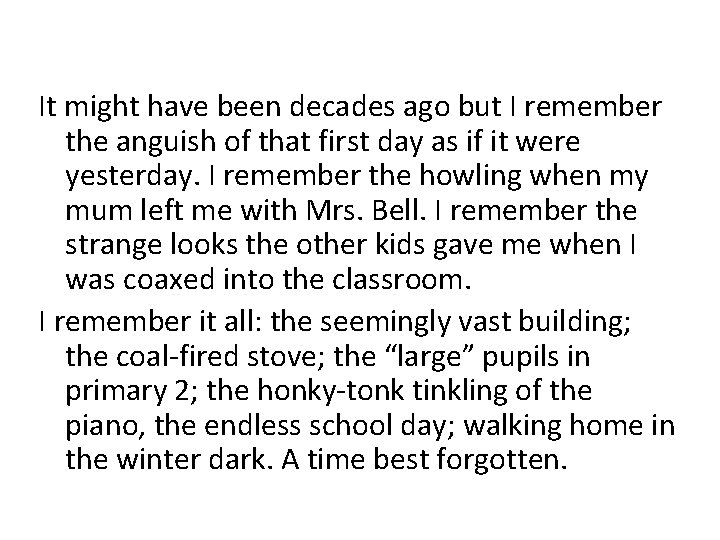
It might have been decades ago but I remember the anguish of that first day as if it were yesterday. I remember the howling when my mum left me with Mrs. Bell. I remember the strange looks the other kids gave me when I was coaxed into the classroom. I remember it all: the seemingly vast building; the coal-fired stove; the “large” pupils in primary 2; the honky-tonk tinkling of the piano, the endless school day; walking home in the winter dark. A time best forgotten.
1. Identify and explain two types of punctuation that have been used in this extract (4).
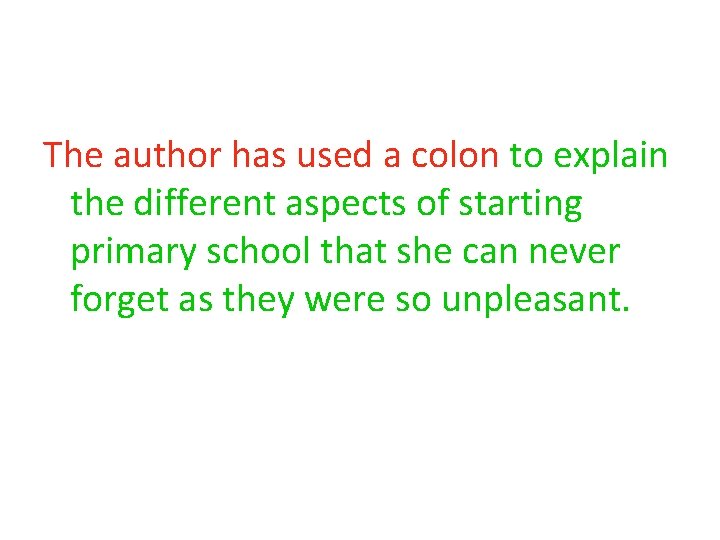
The author has used a colon to explain the different aspects of starting primary school that she can never forget as they were so unpleasant.
The author has used inverted commas around the word “large”. This is used to emphasise that the primary two children were not genuinely big in size, they just appeared to be to her as she was so small.
2. Identify and explain two types of sentence structure (not punctuation) that have been used in this extract (4)
The author uses repetition of the word “remember”. He does this to emphasise his point that there are so many unpleasant things from his first day of primary school that he is unable to forget.
“A time best forgotten” is a short sentence. The author does this to emphasise that there are so many negative things associated with his first day at primary school that he would rather not remember.
Fitness culture is everywhere. Think about how often we run into sweaty bodies in lycra- some decidedly unappealing in this most unforgiving of materials- when trying to negotiate our way home from work. Think of the number of times fit young men and women look out at us from media advertising encouraging us to buy the latest health product. Think of the times we look sadly at our expanding waistlines and begin to wonder if perhaps it is not too late to do something about it.
1. Identify and explain one type of punctuation that has been used in this extract (2).
The author has used parenthesis to give the reader more information about how many people look very unattractive wearing lycra when they are exercising as it is so tight and unflattering.
2. Identify and explain two types of sentence structure (not punctuation) that have been used in this extract (4)
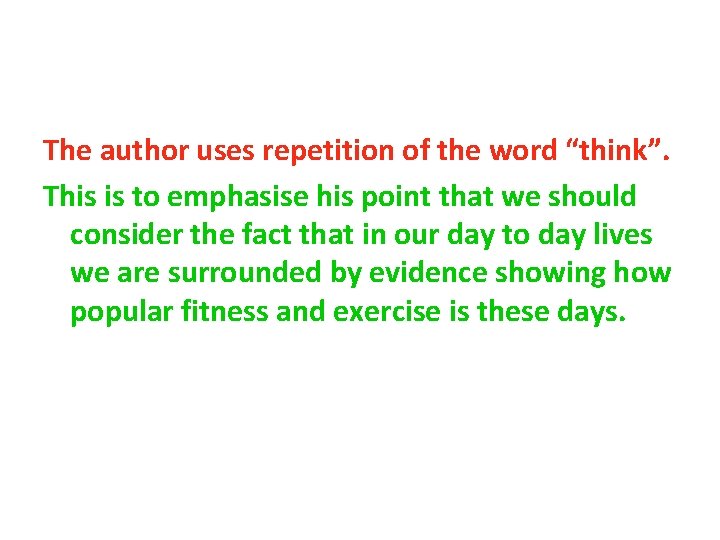
The author uses repetition of the word “think”. This is to emphasise his point that we should consider the fact that in our day to day lives we are surrounded by evidence showing how popular fitness and exercise is these days.
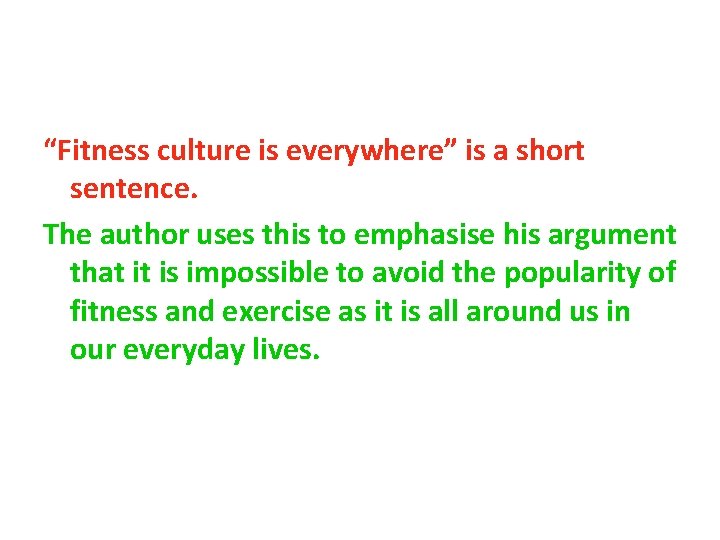
“Fitness culture is everywhere” is a short sentence. The author uses this to emphasise his argument that it is impossible to avoid the popularity of fitness and exercise as it is all around us in our everyday lives.
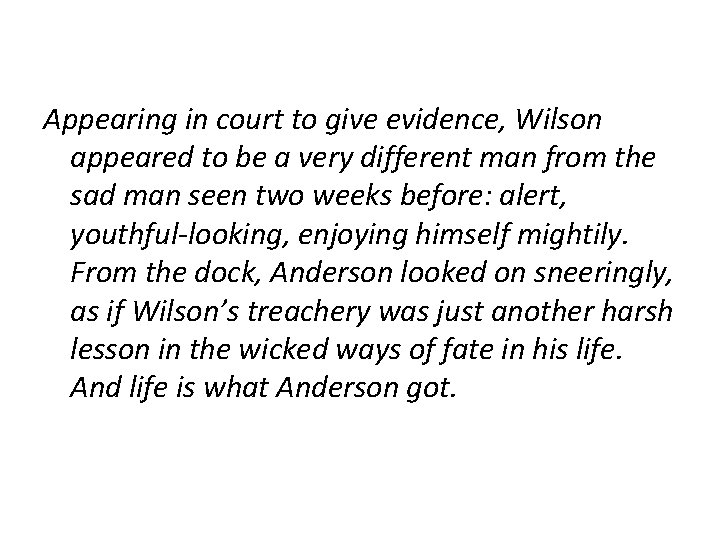
Appearing in court to give evidence, Wilson appeared to be a very different man from the sad man seen two weeks before: alert, youthful-looking, enjoying himself mightily. From the dock, Anderson looked on sneeringly, as if Wilson’s treachery was just another harsh lesson in the wicked ways of fate in his life. And life is what Anderson got.
1. Identify and explain one type of punctuation that has been used in this extract (2).
The author has used a colon to explain the ways in which Wilson’s appearance and behaviour had changed since he was last seen in court.
2. Identify and explain one type of sentence structure (not punctuation) that has been used in this extract (2)
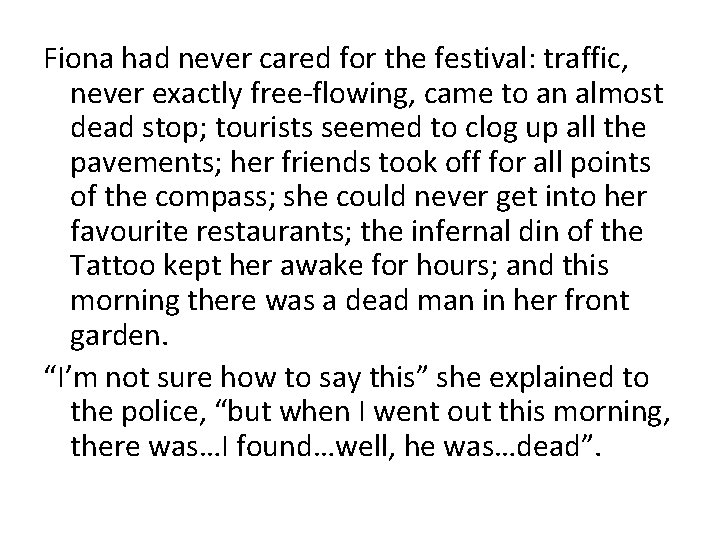
Fiona had never cared for the festival: traffic, never exactly free-flowing, came to an almost dead stop; tourists seemed to clog up all the pavements; her friends took off for all points of the compass; she could never get into her favourite restaurants; the infernal din of the Tattoo kept her awake for hours; and this morning there was a dead man in her front garden. “I’m not sure how to say this” she explained to the police, “but when I went out this morning, there was…I found…well, he was…dead”.
1. Identify and explain two types of punctuation that have been used in this extract (4).
The author has used semi-colons to create a list of all the reasons why she does not like the Edinburgh festival due to its impact on her day to day life.
The author has used ellipsis a number of times in the final sentence. This is used to emphasise that Fiona was uncertain and unsure about how to tell the police that she had found a dead body in her garden. She was hesitating trying to find the right words.
2. Identify and explain one type of sentence structure (not punctuation) that has been used in this extract (2)
The author uses a list to build up to a climax. She does this to emphasise the various ways in which the Edinburgh festival has infringed on her life and to give impact to the fact that on one occasion she even found a corpse lying outside her home.
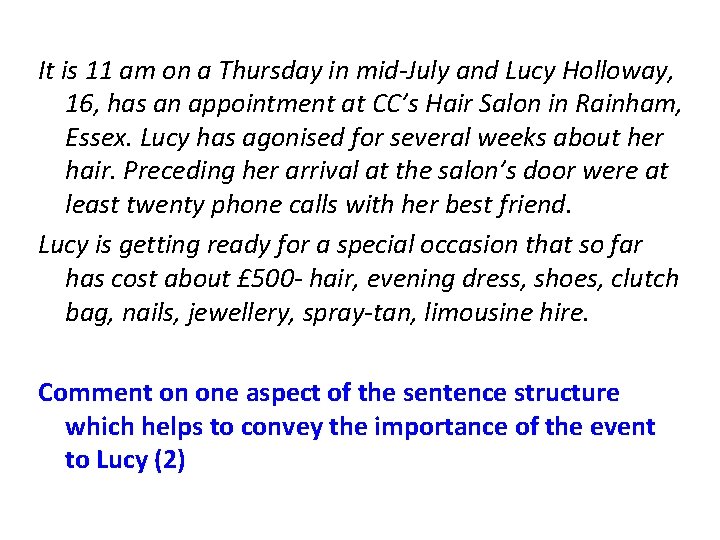
It is 11 am on a Thursday in mid-July and Lucy Holloway, 16, has an appointment at CC’s Hair Salon in Rainham, Essex. Lucy has agonised for several weeks about her hair. Preceding her arrival at the salon’s door were at least twenty phone calls with her best friend. Lucy is getting ready for a special occasion that so far has cost about £ 500 - hair, evening dress, shoes, clutch bag, nails, jewellery, spray-tan, limousine hire. Comment on one aspect of the sentence structure which helps to convey the importance of the event to Lucy (2)
The author has used a single dash to provide a detailed list explaining all the different items that Lucy had spent money on in preparation for her prom.
The author has used a list. “hair…limousine hire” This is to emphasise the sheer number and variety of items that Lucy had to purchase in order to get herself fully prepared for her prom.
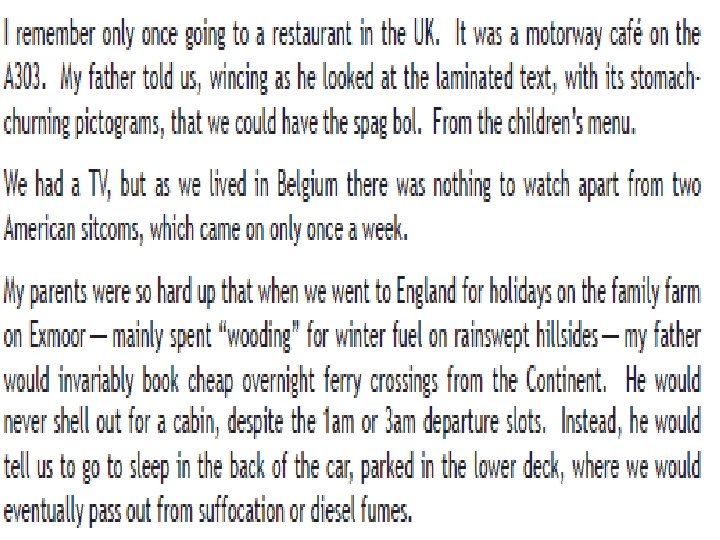
Explain how the writer uses sentence structure to emphasise that her family was not wealthy when she was a child (4)
The author has used parenthesis to give us more information about the types of boring, miserable and cheap activities that he and his family would take part in when they were on holiday in Exmoor.
“From the children’s menu” is a minor sentence. The author has used this to give impact to the statement which demonstrates that her dad was always trying to save money and never splashed out, even for his kids.
And this is almost precisely what superstitions look like in the modern world. Some believe in horoscopes, but few allow them to dictate their behaviour; some like to wear the same lucky shoes to every job interview, but it is not as if wearing a different pair would improve their chances of success; some like to bounce the ball precisely seven times before serving at tennis, but although they are wrong to suppose that this ballbouncing is implicated in their success, it does not harm their prospects.
Explain how the writer uses sentence structure to emphasise his points about superstitions (4)
The author has used semi-colons to provide a detailed list of the different types of superstitious behaviour that people take part in.
The author has used listing to emphasise the number of different types of superstitious behaviour that people take part in.
The love of books that enabled an author dead for more than 100 years to inspire thousands of schoolchildren came mainly from grandmothers who had educated their families orally, then urged them to read widely and learn all that they could. It also came from people such as the activist Steve Biko, whose own mentor, the Brazilian educator Paulo Freire, spent a lifetime working with forest people who had no formal education, teaching them to “name the world their own way”. That is what the youth of Soweto wanted-a future in their own words. And they got it.
Explain how the writer uses sentence structure to convey his ideas (4)
The author has used a single dash to explain what it was that the people of Soweto hoped for and dreamed about, which was to tell their own story.
But it was Oliver that they took to heart: students at one of the country’s leading black colleges, Lovedale, formed a committee to ask for more. Calling it the Board, after Dickens’s Board of Guardians, they asked for more lessons, more food and more and better books. Their reward was to be charged with public violence. All 152 “board” members were expelled from the college and some were jailed.
Explain how the writer uses sentence structure to convey his ideas (4)
The author has used inverted commas around the word “board”. This is to emphasise that the students were not members of a genuine board- it was just a title that they gave themselves in honour of Charles Dickens.
The author has used a colon to elaborate and explain how the students loved Dickens so much that they formally requested that the university buy more of his books for them to read.
But as that new way of living arrives, as we retreat from the wild places, and the fences of national parks go up; as we cease the exploitation of animals, and the cow, the camel, the sheep, the chicken and the pig become items in modern exhibition farms, where schoolchildren see how mankind used to live; as our direct contact with our fellow creatures is restricted to zoos, pets and fish tanks; and as every area of natural beauty is set about with preservation orders and rules to keep human interference to a minimumwill we not be separating ourselves from our planet in order, as we suppose, to look after it better? Will we not be loving nature, but leaving it?
Explain how the writer uses sentence structure to convey his ideas (4)
The original Orient Express service was launched in 1863. Luxury carriages ran the route from Paris to Bucharest via Strasbourg, Vienna and Budapest. In 1921, the route was extended to Istanbul and the trains carried socialites, aristocrats, artists and spies on glamorous journeys across Europe.
The author has used a list. “from Paris…and Budapest” This is to emphasise the number and variety of different destinations that the Orient Express travelled to and from.
Explain how the writer uses sentence structure to convey his/her ideas (2)
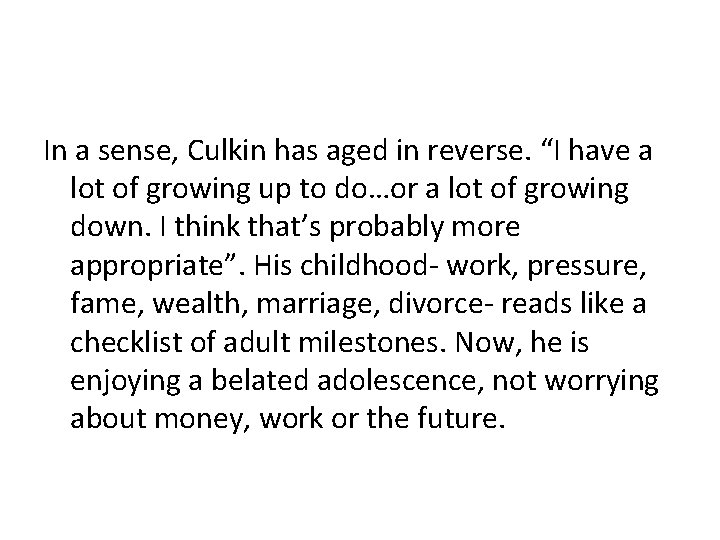
In a sense, Culkin has aged in reverse. “I have a lot of growing up to do…or a lot of growing down. I think that’s probably more appropriate”. His childhood- work, pressure, fame, wealth, marriage, divorce- reads like a checklist of adult milestones. Now, he is enjoying a belated adolescence, not worrying about money, work or the future.
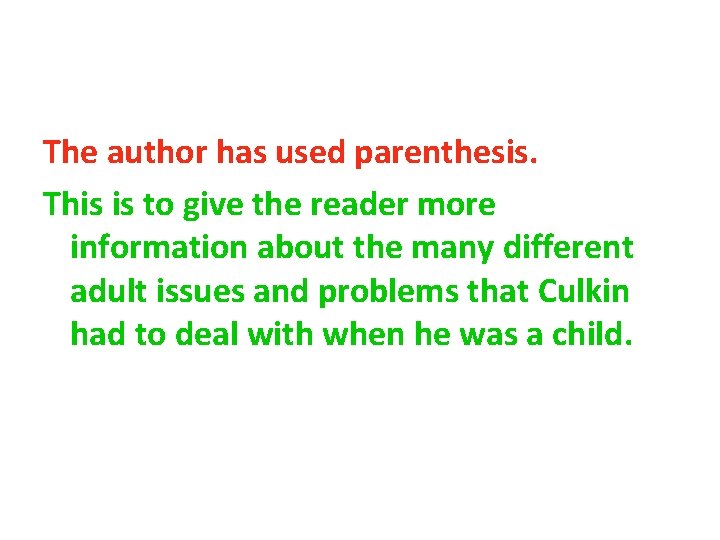
The author has used parenthesis. This is to give the reader more information about the many different adult issues and problems that Culkin had to deal with when he was a child.
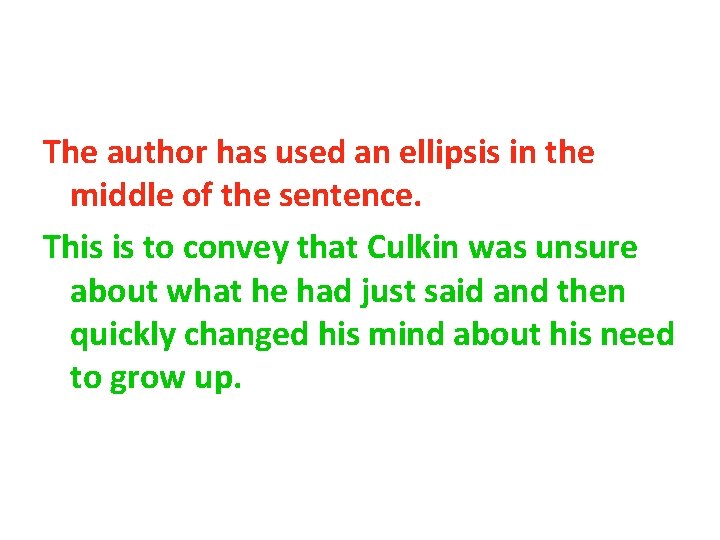
The author has used an ellipsis in the middle of the sentence. This is to convey that Culkin was unsure about what he had just said and then quickly changed his mind about his need to grow up.
Explain how the writer uses sentence structure to convey his/her ideas (2)
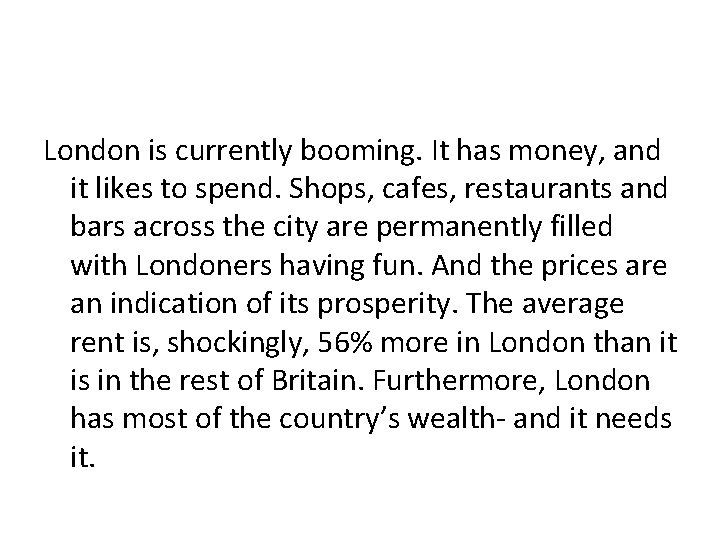
London is currently booming. It has money, and it likes to spend. Shops, cafes, restaurants and bars across the city are permanently filled with Londoners having fun. And the prices are an indication of its prosperity. The average rent is, shockingly, 56% more in London than it is in the rest of Britain. Furthermore, London has most of the country’s wealth- and it needs it.
Explain how the writer uses sentence structure to convey his/her ideas (4)