
SENTENCE STRUCTURE Mrs Harris English 9 Sentence Structures
- Slides: 20
SENTENCE STRUCTURE Mrs. Harris English 9
Sentence Structures � There are many different ways to organize words into sentences � Or, words can be organized into sentences in many different ways. � There are no step by step instructions to putting together sentences
Parts of Speech � Nouns, pronouns, verbs, adjectives, prepositions, conjunctions, articles, and interjections. � Articles: a, an, the � Appear � in front of nouns To know what part of speech a word is, look not only at the word but also at its meaning, position, and use in the sentence
Subject, Verbs, and Objects � Basic parts of speech = Subject + Verb � Sometimes= Subject + Verb + Object � The Subject is usually a noun � Verb= Predicate � Usually follows the subject � Identifies an action or a state of being � An object receives the action and usually follows the verb.
Clause � Clause = a group of words containing a subject and a verb � Two types: Independent and dependent
Independent Clause � An independent clause is a group of words that contains a subject and verb and expresses a complete thought. � An � independent clause is a sentence. Ex: Jim studied in the Sweet Shop for his chemistry quiz.
Dependent Clause � Dependent clauses do not express a complete thought. � Cannot be a sentence � Often a dependent clause is marked by a dependent marker word. � Ex: When Jim studied in the Sweet Shop for his chemistry quiz. . . (What happened when he studied? The thought is incomplete. )
Phrase � Phrase= a group of words not containing both a subject and a verb � Part of a sentence that does not express a complete thought � Ex: "It is always the best policy to speak the truth-unless, of course, you are an exceptionally good liar. “ (Adjective phrase)
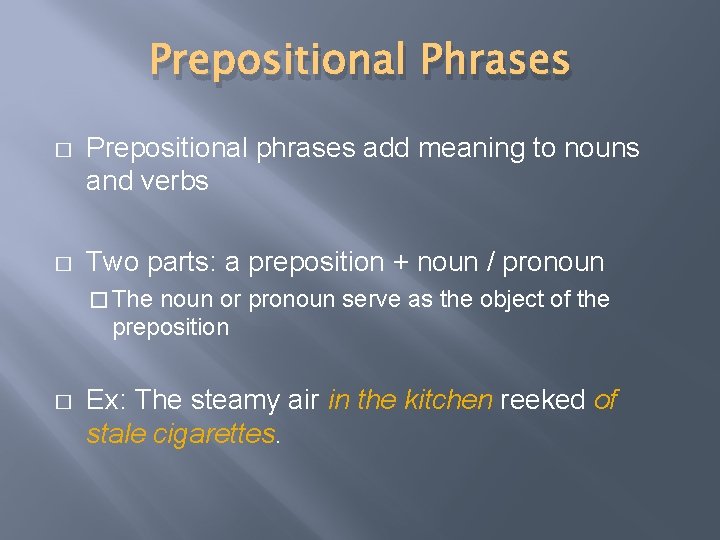
Prepositional Phrases � Prepositional phrases add meaning to nouns and verbs � Two parts: a preposition + noun / pronoun � The noun or pronoun serve as the object of the preposition � Ex: The steamy air in the kitchen reeked of stale cigarettes.
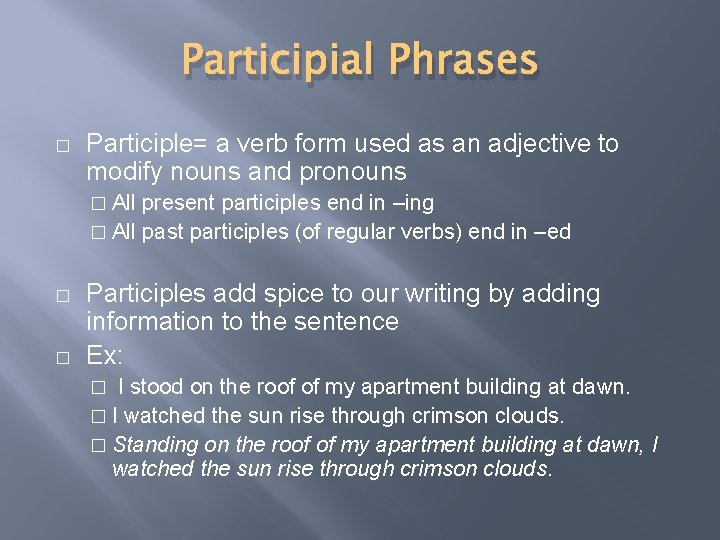
Participial Phrases � Participle= a verb form used as an adjective to modify nouns and pronouns � All present participles end in –ing � All past participles (of regular verbs) end in –ed � � Participles add spice to our writing by adding information to the sentence Ex: I stood on the roof of my apartment building at dawn. � I watched the sun rise through crimson clouds. � Standing on the roof of my apartment building at dawn, I watched the sun rise through crimson clouds. �
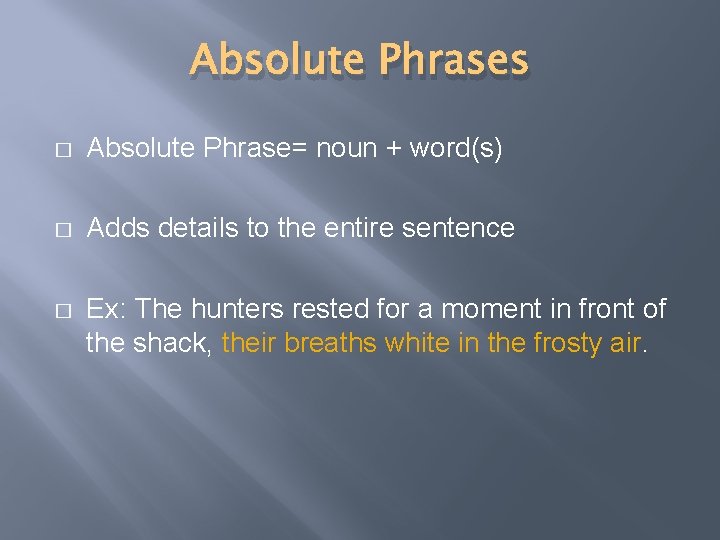
Absolute Phrases � Absolute Phrase= noun + word(s) � Adds details to the entire sentence � Ex: The hunters rested for a moment in front of the shack, their breaths white in the frosty air.
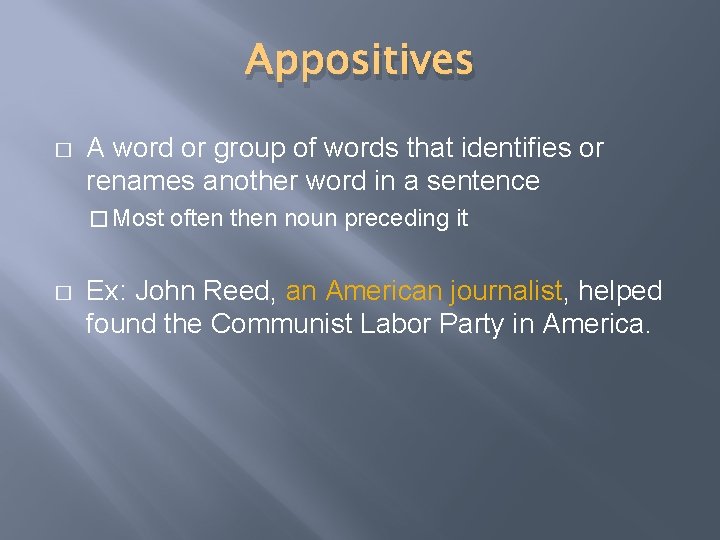
Appositives � A word or group of words that identifies or renames another word in a sentence � Most � often then noun preceding it Ex: John Reed, an American journalist, helped found the Communist Labor Party in America.
Sentence Structures � Simple = A sentence with only one independent clause. � Compound = A sentence containing at least 2 independent clauses � Complex = A sentence containing 1 independent clause and one dependent clause
Sentence Types � Declarative = A statement � Ends � Interrogative = A question � Ends � with a period with a ? Imperative = A Command � Ex: "Go to the edge of the cliff and jump off. Build your own wings on the way down. " (Ray Bradbury)
CHRONOLOGICAL ORDER Mrs. Harris
Signal Words � Events in most stories happen in order � Words like first, then, last, soon, at the same time, and finally signal order
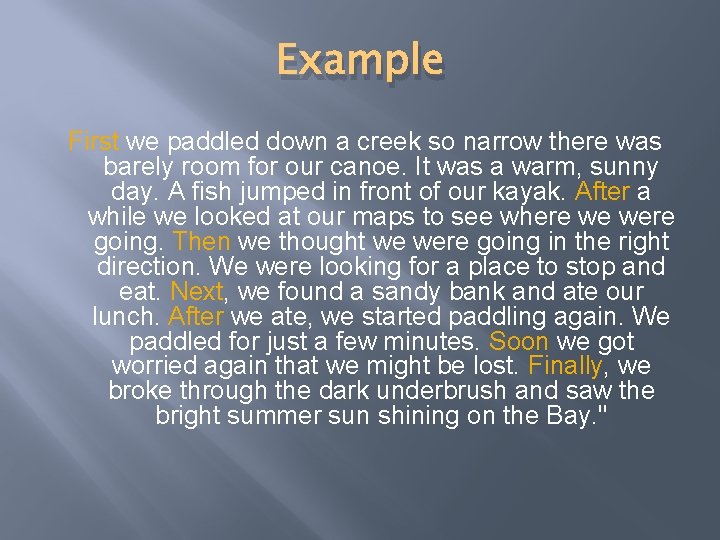
Example First we paddled down a creek so narrow there was barely room for our canoe. It was a warm, sunny day. A fish jumped in front of our kayak. After a while we looked at our maps to see where we were going. Then we thought we were going in the right direction. We were looking for a place to stop and eat. Next, we found a sandy bank and ate our lunch. After we ate, we started paddling again. We paddled for just a few minutes. Soon we got worried again that we might be lost. Finally, we broke through the dark underbrush and saw the bright summer sun shining on the Bay. "
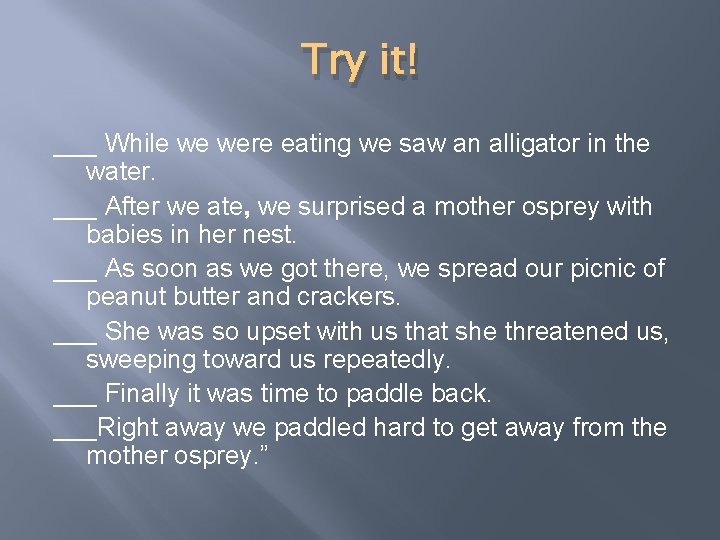
Try it! ___ While we were eating we saw an alligator in the water. ___ After we ate, we surprised a mother osprey with babies in her nest. ___ As soon as we got there, we spread our picnic of peanut butter and crackers. ___ She was so upset with us that she threatened us, sweeping toward us repeatedly. ___ Finally it was time to paddle back. ___Right away we paddled hard to get away from the mother osprey. ”
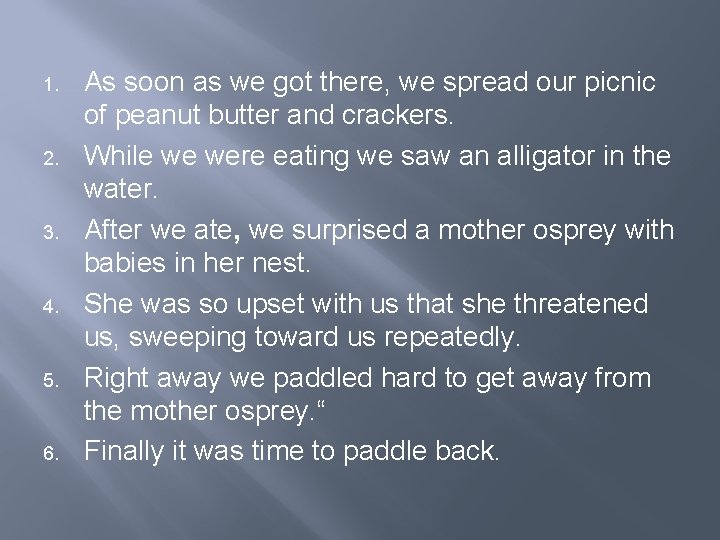
1. 2. 3. 4. 5. 6. As soon as we got there, we spread our picnic of peanut butter and crackers. While we were eating we saw an alligator in the water. After we ate, we surprised a mother osprey with babies in her nest. She was so upset with us that she threatened us, sweeping toward us repeatedly. Right away we paddled hard to get away from the mother osprey. “ Finally it was time to paddle back.
Basic Stories � Exposition � Rising Action � Climax � Resolution