
Sentence Patterns Be verb patterns Be verbs am
Sentence Patterns
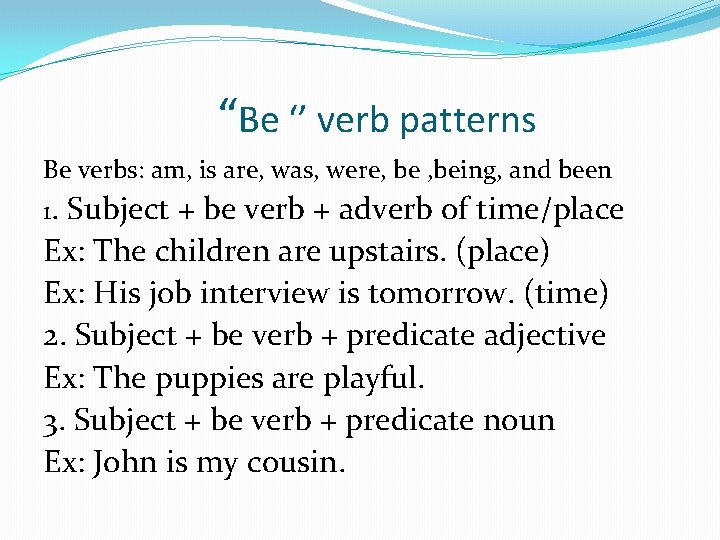
“Be ‘’ verb patterns Be verbs: am, is are, was, were, being, and been 1. Subject + be verb + adverb of time/place Ex: The children are upstairs. (place) Ex: His job interview is tomorrow. (time) 2. Subject + be verb + predicate adjective Ex: The puppies are playful. 3. Subject + be verb + predicate noun Ex: John is my cousin.
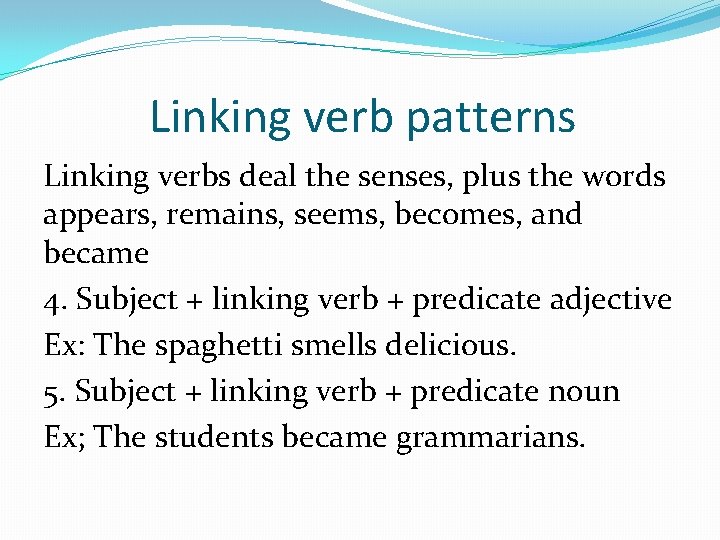
Linking verb patterns Linking verbs deal the senses, plus the words appears, remains, seems, becomes, and became 4. Subject + linking verb + predicate adjective Ex: The spaghetti smells delicious. 5. Subject + linking verb + predicate noun Ex; The students became grammarians.
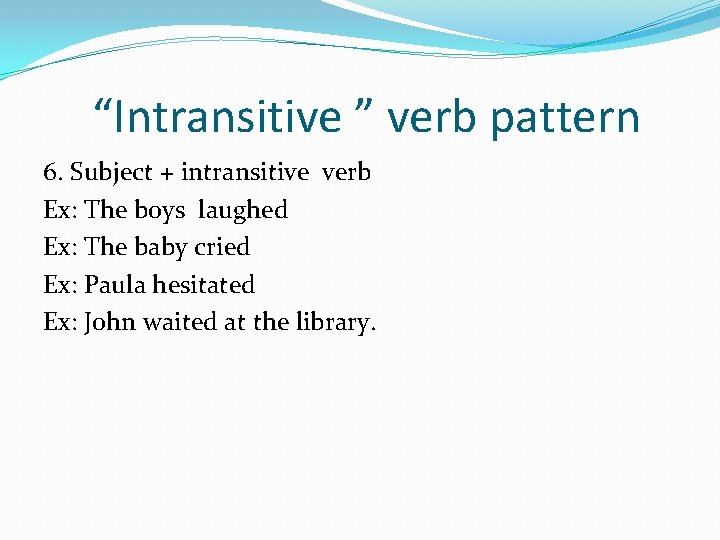
“Intransitive ” verb pattern 6. Subject + intransitive verb Ex: The boys laughed Ex: The baby cried Ex: Paula hesitated Ex: John waited at the library.
“Transitive” verb patterns 7. subject + trans. Verb + direct object Ex: The children ate their lunch. 8. Subject + trans. Verb + Indirect object + direct object Ex: Bob gave Susan a new car. 9. Subject + trans. Verb + D. O. + objective complement adjective Ex: The boys consider her quite attractive. 10. Subject + trans. Verb + obj. comp. noun Ex: The children consider their naps an irritation.
Things to consider when identifying patterns 1. Identify the sentence verb 1 st 2. “a, ” “an, ” and “the” are articles and function as adjectives.
Sentence Types 1. Simple: Is an independent clause, which contains a subject/verb and is a complete thought. Ex: Robert has a new car 2. Compound: Contains 2 independent clauses Ex: Mary likes the Mountains, but Jackie prefers the seashore? 3. Complex: contains at least I independent clause and I or more dependent clauses: Ex: After we left the football game, we went to the Waffle House.
4. Compound/complex: Contains at least 2 independent clauses and I or more dependent clauses. Ex: Because there was very little ran this year, the corn crop was poor, and the cattle had to eat old stores of hay.
- Slides: 8