
Sentence Mistakes Grammar Lesson 3 Composition 101 Mrs
- Slides: 9
Sentence Mistakes Grammar: Lesson 3 Composition 101 Mrs. Hernandez
Refresher: Sentences • A sentence has a subject, verb, and a complete thought. It must have all of these, or it is not a sentence. Standard English is the goal. • The lovely girl met the handsome boy at the coffee shop. • The following are not sentences: • Fragments • Run-ons • Comma Splices
Fragments • Fragments cannot stand alone. They are missing one of the key ingredients for making a sentence. • Fragments can be long or short. People are often confused by long fragments because they look like they “should be a sentence. ” However, a key ingredient (subject, verb, both) may be missing. • Fragments can also be made by trying to create a full sentence but adding a subordinating conjunction at the beginning. Subordinating conjunctions make things dependent, and dependent clauses can never stand alone. If you ever see a dependent clause alone, it is automatically a fragment. • Fragments can also be made by bad punctuation.
Example Fragments • Jennifer at the movies. (This is missing a verb. ) • Waiting for her boyfriend who is away at sea. (Who is waiting? What is she doing while waiting? This is missing a subject and a verb. ) • Since Jennifer went to the movies. (This would be fine, except the “since” makes it dependent. It cannot stand as a sentence. ) • Before Jason went to the movies; he changed his shirt. (This would also be fine, except semicolons (; ) are not used for complex sentences. They show that there is a full sentence on both sides. The first part cannot stand as a sentence alone. )
Fixing Fragments • We fix fragments by adding what is missing, taking out the subordinating conjunction, or changing the incorrect punctuation.
Run-Ons • Run-on sentences may have complete thoughts, subjects, and verbs, but they never stop. They require more punctuation that just isn’t present. • Jamal went to the movies but Amy decided to stay home because she didn’t want to see the same movie Jamal was going to so she read a book about Samurai and ate some bonbons but they weren’t very good and she got bored she ended up going to the movie later and found out it wasn’t half bad. • Just because you have a period at the end doesn’t make it a good sentence.
How to Fix Run-Ons • Run on sentences require punctuation. You must use the correct punctuation in the correct places. Jamal went to the movies, but Amy decided to stay home because she didn’t want to see the same movie he was going to. She read a book about Samurai and ate some bonbons, but they weren’t very good. She eventually got bored, so she went to the movie later and found out it wasn’t half bad.
Comma-Splices • A comma splice is a sort of run-on sentence, but instead of having no punctuation, it has the wrong punctuation. Commas are not strong enough to hold two sentences together. • Jan went to the market, Carl stayed home. • The comma separates two independent clauses. This is incorrect. • I love English, however, I always wondered about teaching history. • “However” is a conjunctive adverb. The first comma should be a semicolon or a period.
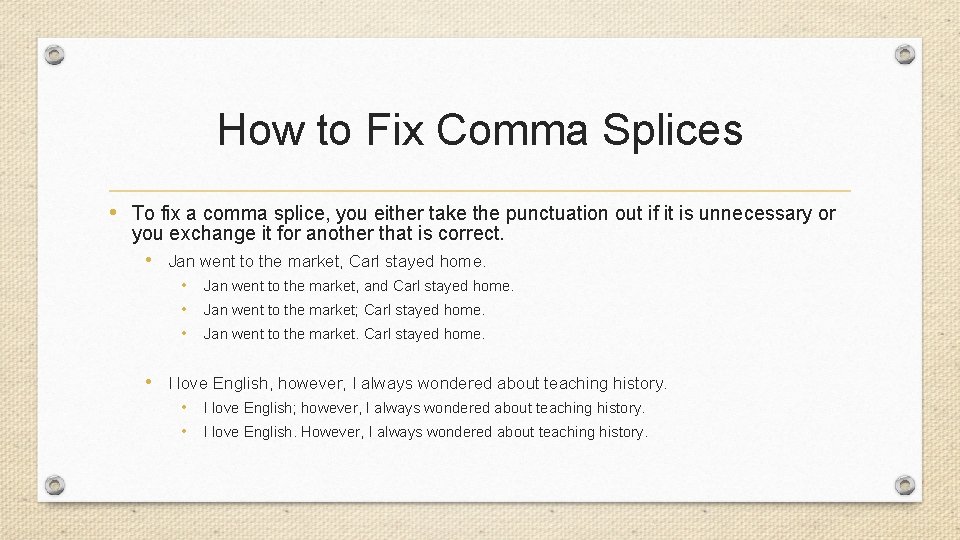
How to Fix Comma Splices • To fix a comma splice, you either take the punctuation out if it is unnecessary or you exchange it for another that is correct. • Jan went to the market, Carl stayed home. • Jan went to the market, and Carl stayed home. • Jan went to the market; Carl stayed home. • Jan went to the market. Carl stayed home. • I love English, however, I always wondered about teaching history. • I love English; however, I always wondered about teaching history. • I love English. However, I always wondered about teaching history.