
Sentence Fluency Language Arts Grade 7 By the
Sentence Fluency Language Arts Grade 7
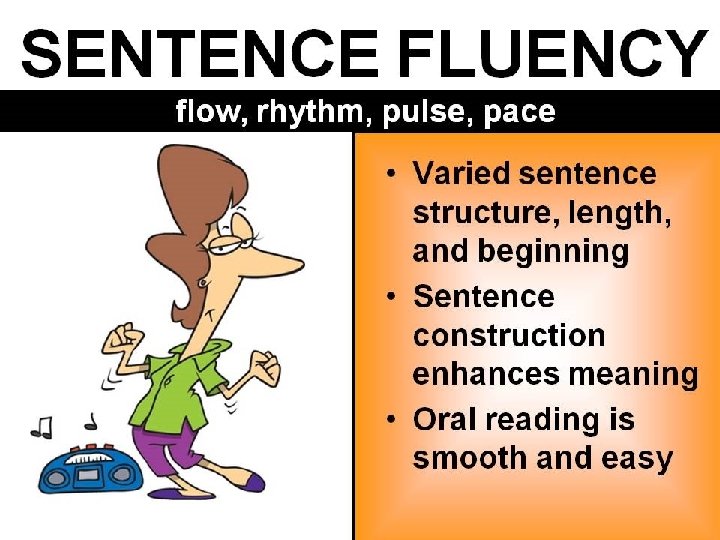
By the end of grade 7… �. . you should be able to include different kinds of sentences, with a variety of complex structures �…you should be able to include a variety of sentence lengths and beginnings to create a natural flow of ideas
Sentences can be categorized by their purposes. Read the following sentences: A properly maintained picnic basket can reduce the chance of hunger or thirst during a hike or outing. � Do you now understand how to assemble a sandwich? � Remove two slices of bread from bag. � Remember, a picnic basket is NOT A TOY! � 1. What is the purpose of each of these sentences? (Hint: What type of punctuation mark is used at the end of each one? ) Statement/Question/Command/Exclamation Purpose
�Clause – A clause is a group of related words that has a subject and a predicate. Every sentence contains at least one clause. An independent clause can stand alone as a complete sentence because it expresses a complete thought. A subordinate clause begins with a word like ‘while’ ‘that’ ‘which’ after’ ‘because’ and cannot stand alone because it does not express a complete thought What is a clause?
�A sentence fragment is an incomplete sentence. Either the subject or the verb (or both) is missing, so the sentence expresses only part of a thought. (complete activities 1 and 2 on page 125 Language & Writing Book) �A run-on sentence occurs when two independent clauses are joined together with proper punctuation or a connecting word. Sentence Length
�An appositive is a word or phrase that renames or explains a noun. (page 75 Language & Writing Book) �Colons are used to introduce a list that follows a complete sentence. (page 100 Language & Writing Book) Enhancing meaning
�Begin some sentences in different ways, for example: with words or phrases that tell what, where or how something happened. Beginnings
�Working on fluenecy using “Literacy” books from page 20, ‘Communication Spy Style’.
- Slides: 10