
Sentence A group of words which makes complete
- Slides: 24
Sentence A group of words which makes complete sense (meaning) is called a sentence. A sentence can express a statement or fact; ask a question; can request /order/instruct somebody/ something or exclaim out of some sudden feelings or emotions.
Basic Parts of a Sentence A sentence has two parts: Subject and Predicate. � 1. Subject: is the person or thing about which we say in a sentence. � 2. Predicate: is whatever we say about the subject in the sentence. Example: God/ is great. India/ is my country. All Indians/ are my brothers and sisters. [The subject of a sentence belongs to any one of the following persons]
Person �There are three persons in grammar. They are: �First Person: The person who is talking. I/we �Second Person: The person to whom the first person is talking. You �Third person: The person/s or the things or the matter about whom or which the first and the second persons are talking.
Four Kinds of Sentences �Assertive sentence �Interrogative sentence �Imperative sentence �Exclamatory sentence
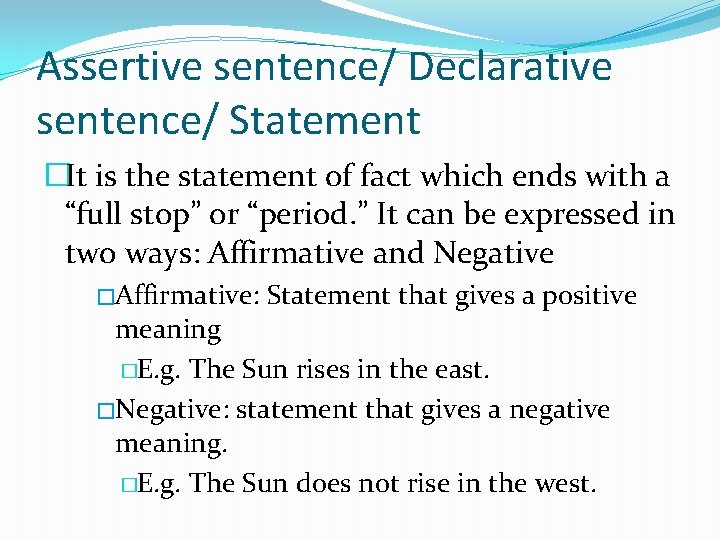
Assertive sentence/ Declarative sentence/ Statement �It is the statement of fact which ends with a “full stop” or “period. ” It can be expressed in two ways: Affirmative and Negative �Affirmative: Statement that gives a positive meaning �E. g. The Sun rises in the east. �Negative: statement that gives a negative meaning. �E. g. The Sun does not rise in the west.
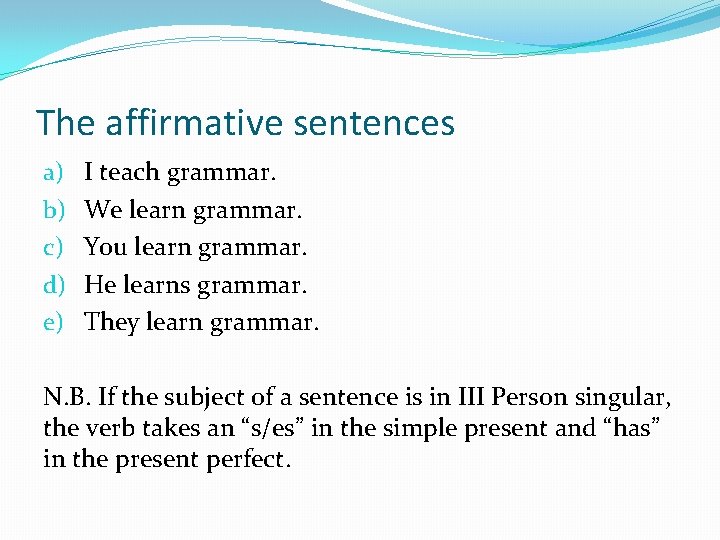
The affirmative sentences a) b) c) d) e) I teach grammar. We learn grammar. You learn grammar. He learns grammar. They learn grammar. N. B. If the subject of a sentence is in III Person singular, the verb takes an “s/es” in the simple present and “has” in the present perfect.
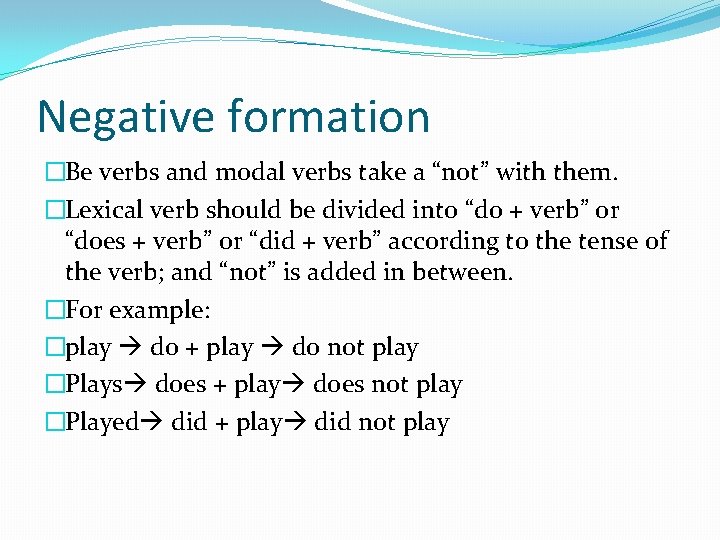
Negative formation �Be verbs and modal verbs take a “not” with them. �Lexical verb should be divided into “do + verb” or “does + verb” or “did + verb” according to the tense of the verb; and “not” is added in between. �For example: �play do + play do not play �Plays does + play does not play �Played did + play did not play
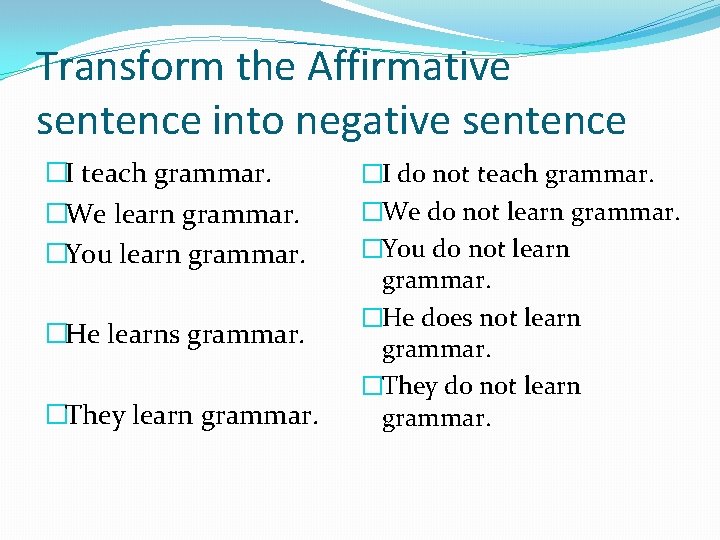
Transform the Affirmative sentence into negative sentence �I teach grammar. �We learn grammar. �You learn grammar. �He learns grammar. �They learn grammar. �I do not teach grammar. �We do not learn grammar. �You do not learn grammar. �He does not learn grammar. �They do not learn grammar.
Interrogative sentence �It is the sentence that asks a question and ends with a question mark “? ” �There are three kinds of question: � 1. Direct question � 2. Alternate question � 3. Tag question.
Direct question: starts with question word �How are you? �Who are you? �What are you? �When did you come? �Where do you live? �Whose book is this? �Whom do you want to meet? �Which is the smallest bird? �Why do you learn?
Alternate question: starts with a verb and gives ‘yes’ or ‘no’ answer. �Are you alright? �Do you understand? �Can you follow me? �May I continue? �Shall we learn? �Do you have a separate notebook? �Will you bring a notebook? �Have you had your breakfast? �Did you sleep well?
Tag question: question tag to stress a statement. �It is raining, isn’t it? �You are not, are you? �I am a teacher, aren’t I? �Sachin is a cricket player, isn’t he? �We like to play, don’t we? �She likes ice cream, doesn’t she? �They have joined the course, haven’t they? �Others do not like to learn, do they?
Formation of question tag �Affirmative statement and negative tag: If the statement is affirmative (gives positive meaning), use a negative tag (verb + n’t). �Negative statement and affirmative tag: If the statement is negative, use an affirmative tag. N. B. For question tags, only the contraction of ‘not’ should be used and ‘not’ should not be used as it is.
Formation of direct questions For framing direct questions: Divide the verb based on its forms: Work do+work Works does+work Worked did+work Use question word and the do verb except the base verb before the subject. Where do you want to go? How did you come to college?
Formation of alternate question �Use the ‘auxiliary’ verbs (be verbs+ have forms + do forms) and ‘modal verbs’ before the subject. (Next) �Are you taking down the notes? �Is she writing? �Have you finished? �Do you understand? �Will you come in time? �Can you speak in English? �May I go home?
Auxiliary verbs �Be verbs: am, is, are, was and were �Have verbs: have, has and had �Do verbs: do, does, did �Modal verbs: shall, should, will, would, can, could, may, might, must, need (to), used to, ought (to), dare (to) �The auxiliaries ‘be, ’ ‘have’ and ‘do’ verbs have nonauxiliary functions too.
Frame questions for the given statements �The sun rises in the east. (Where) �The representative of the student council is Kamala. (Who) �Euclid is the father of Geometry. (Who) �The largest flower is Rafflesia arnouldi. (Which) �Bumblebee bat is the smallest mammal. (Which) �The morning star can be seen before sunrise. (When) �The Haley Comet appears every 72 years. (How often) �Geeta is ten years old. How) �Yak is found in the Himalayas. (Where)
Complete the questions by using question “tags” �English is a language, -----? �Music mesmerizes, ----? �Kangaroo can jump high, ----? �The sea gull dove in the sea, -------? �Sirius is the brightest star, ----? �Mother Theresa helped the poor, -------? �We love our parents, -----? �God loves you, ------?
Imperative sentence �Request �Order/ command/Instructions �Advice/ recommendation/ suggestion �Greetings/ wish
Request �Seeking something in a pleasing manner. �The word ‘please’ can be used for written language. �Tone modulation helps in spoken language. �Please help me. �Will you please lend me your pen? �Will you please accompany me? �Please write the assignment for me. �Please bring your camera.
Order/ command/ instruction �Mostly starts with a �Don’t waste your time. verb. �Submit your record in �Bring the file. time �Get me a bottle of water. �Don’t worry. �Complete the work in �Don’t park here. the morning. �Do not smoke here. �Finish the work and go home. �Do your work.
Advice/ recommendation/ suggestion �You should finish you work in time. �You should maintain silence. �You must submit your record in time. �You should reach the station in time. � You should learn your lessons. �You must not waste your time. �It is better to write competitive examinations. �It is necessary to learn always.
Greetings/ wish �Wish you good luck. �May God bless you. �Many more happy returns of the day. �Live long life. �Wish many more laurels. �Have a wonderful day.
Exclamatory sentence �Expresses sudden feelings or emotions: interjection can be used. Exclamatory mark should be used. �What a lovely scene! �Wow, we have won! �How beautiful you are today! �How nice to see you! �What a horrible sight! �Oh! I can't bear.