
Sensory Theories of Visual Communication Gestalt Theory Gestaltform
- Slides: 20
Sensory Theories of Visual Communication
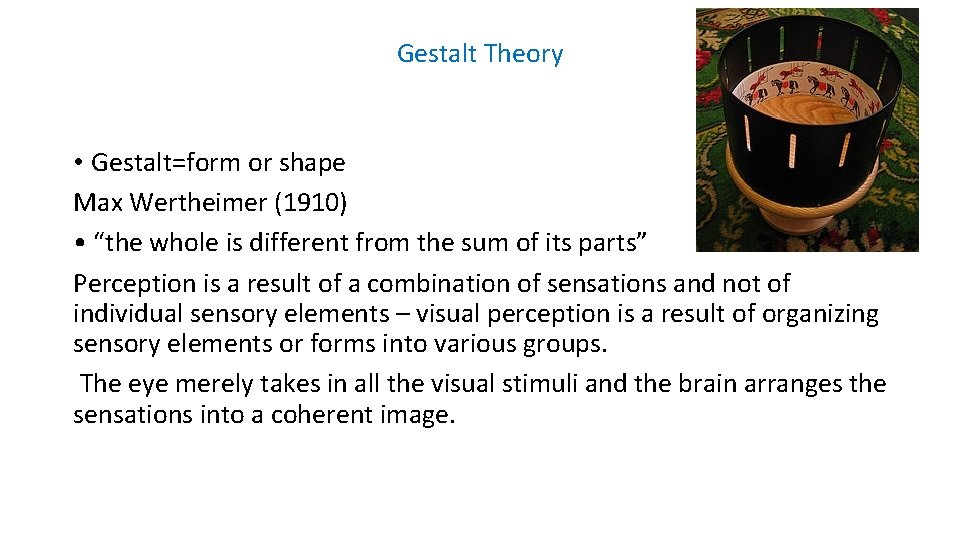
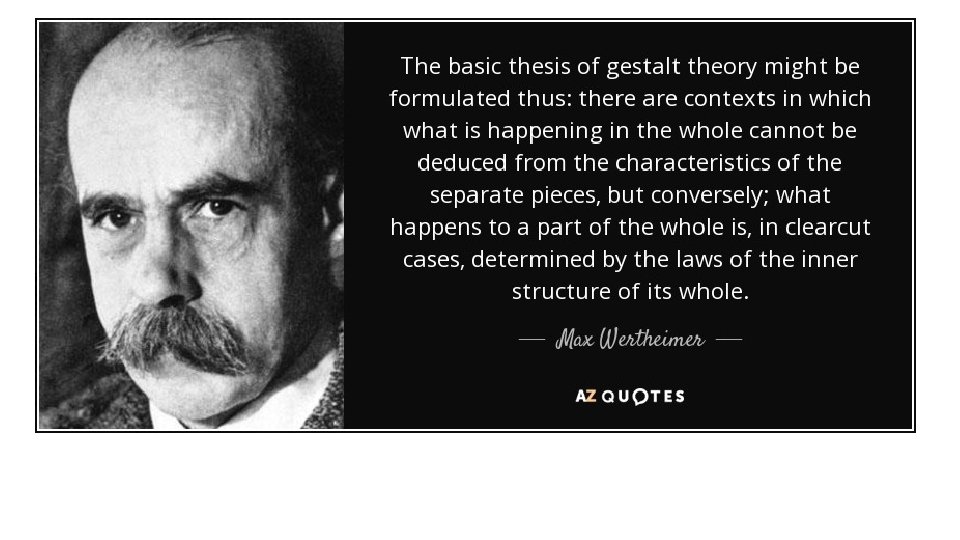
Gestalt Theory • Gestalt=form or shape Max Wertheimer (1910) • “the whole is different from the sum of its parts” Perception is a result of a combination of sensations and not of individual sensory elements – visual perception is a result of organizing sensory elements or forms into various groups. The eye merely takes in all the visual stimuli and the brain arranges the sensations into a coherent image.
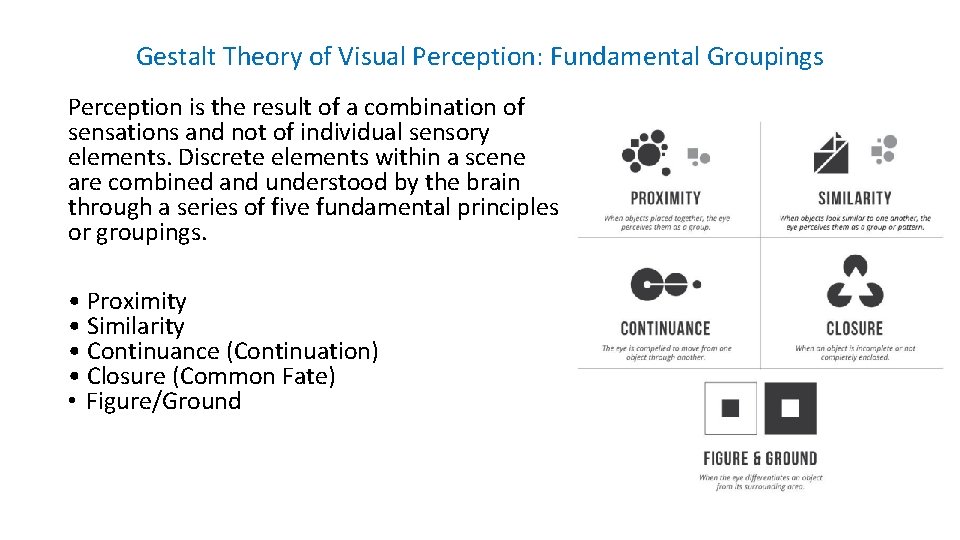
Gestalt Theory of Visual Perception: Fundamental Groupings Perception is the result of a combination of sensations and not of individual sensory elements. Discrete elements within a scene are combined and understood by the brain through a series of five fundamental principles or groupings. • Proximity • Similarity • Continuance (Continuation) • Closure (Common Fate) • Figure/Ground
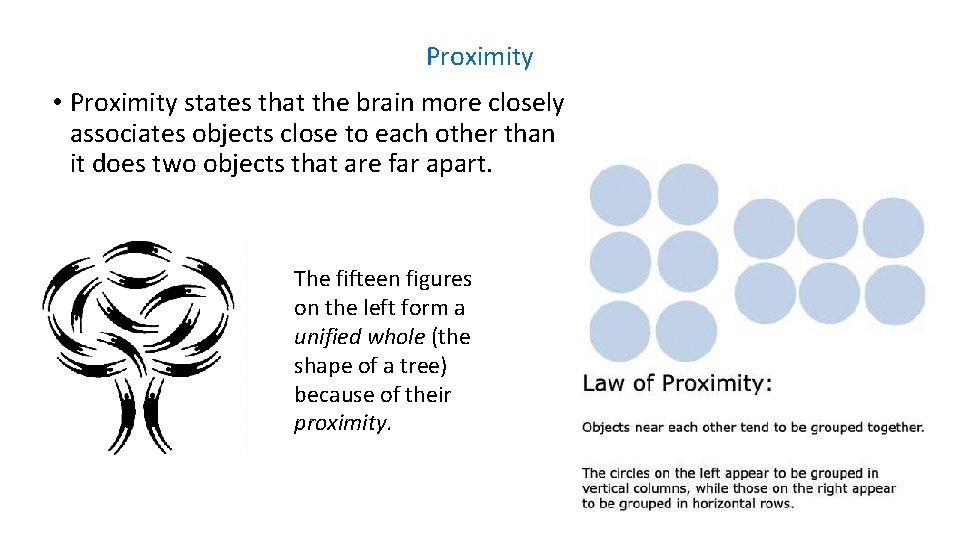
Proximity • Proximity states that the brain more closely associates objects close to each other than it does two objects that are far apart. The fifteen figures on the left form a unified whole (the shape of a tree) because of their proximity.
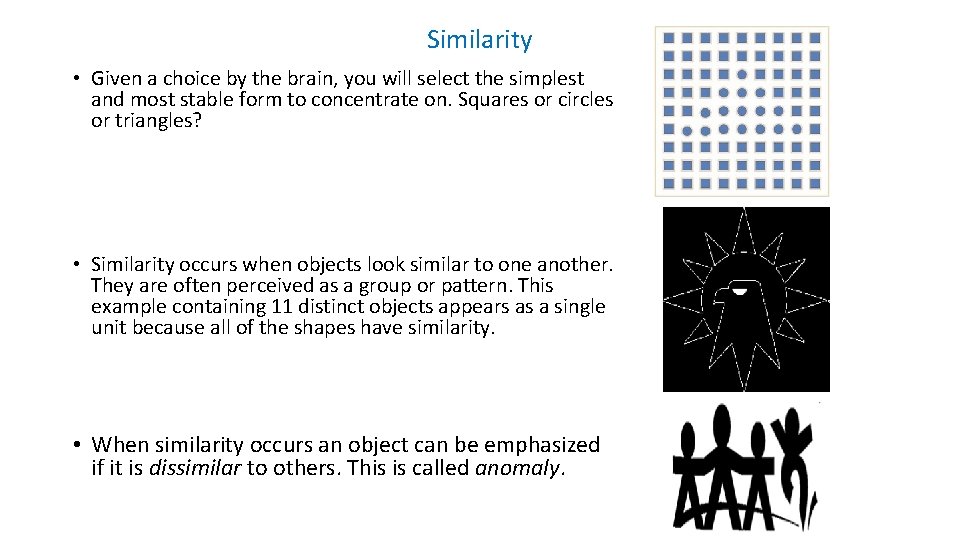
Similarity • Given a choice by the brain, you will select the simplest and most stable form to concentrate on. Squares or circles or triangles? • Similarity occurs when objects look similar to one another. They are often perceived as a group or pattern. This example containing 11 distinct objects appears as a single unit because all of the shapes have similarity. • When similarity occurs an object can be emphasized if it is dissimilar to others. This is called anomaly.
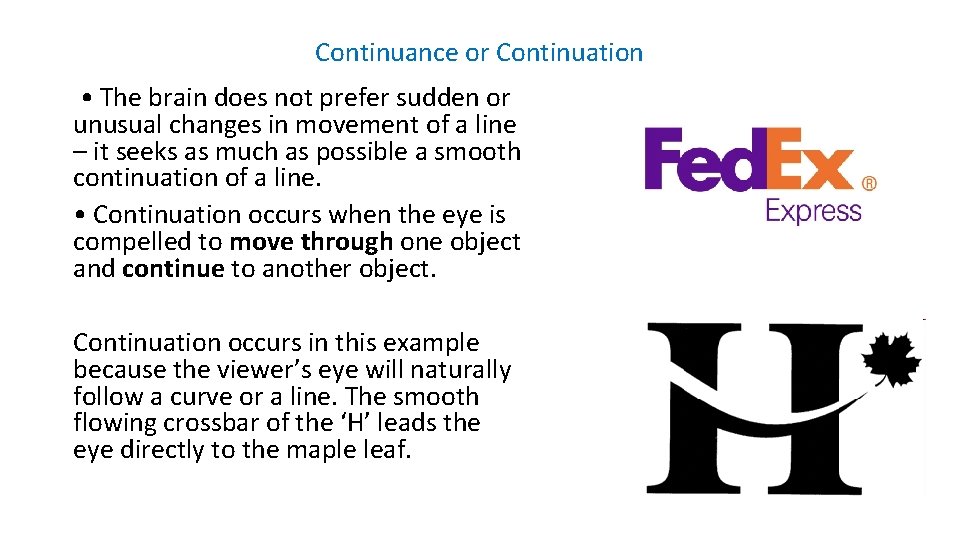
Continuance or Continuation • The brain does not prefer sudden or unusual changes in movement of a line – it seeks as much as possible a smooth continuation of a line. • Continuation occurs when the eye is compelled to move through one object and continue to another object. Continuation occurs in this example because the viewer’s eye will naturally follow a curve or a line. The smooth flowing crossbar of the ‘H’ leads the eye directly to the maple leaf.
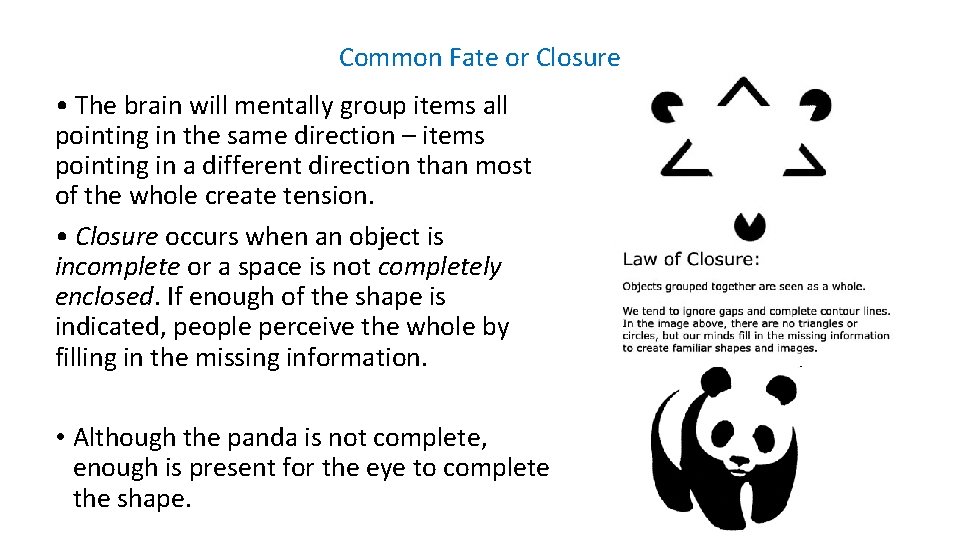
Common Fate or Closure • The brain will mentally group items all pointing in the same direction – items pointing in a different direction than most of the whole create tension. • Closure occurs when an object is incomplete or a space is not completely enclosed. If enough of the shape is indicated, people perceive the whole by filling in the missing information. • Although the panda is not complete, enough is present for the eye to complete the shape.
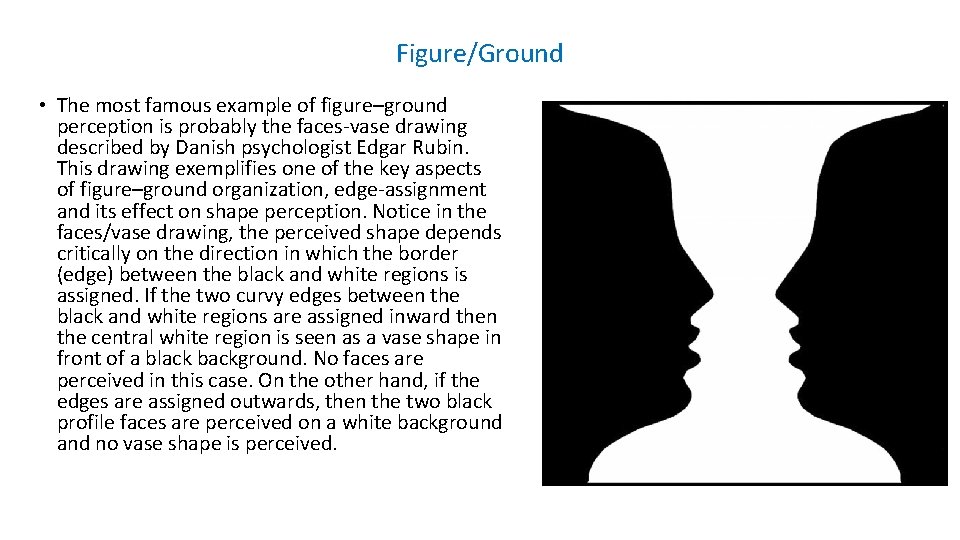
Figure/Ground • The most famous example of figure–ground perception is probably the faces-vase drawing described by Danish psychologist Edgar Rubin. This drawing exemplifies one of the key aspects of figure–ground organization, edge-assignment and its effect on shape perception. Notice in the faces/vase drawing, the perceived shape depends critically on the direction in which the border (edge) between the black and white regions is assigned. If the two curvy edges between the black and white regions are assigned inward then the central white region is seen as a vase shape in front of a black background. No faces are perceived in this case. On the other hand, if the edges are assigned outwards, then the two black profile faces are perceived on a white background and no vase shape is perceived.
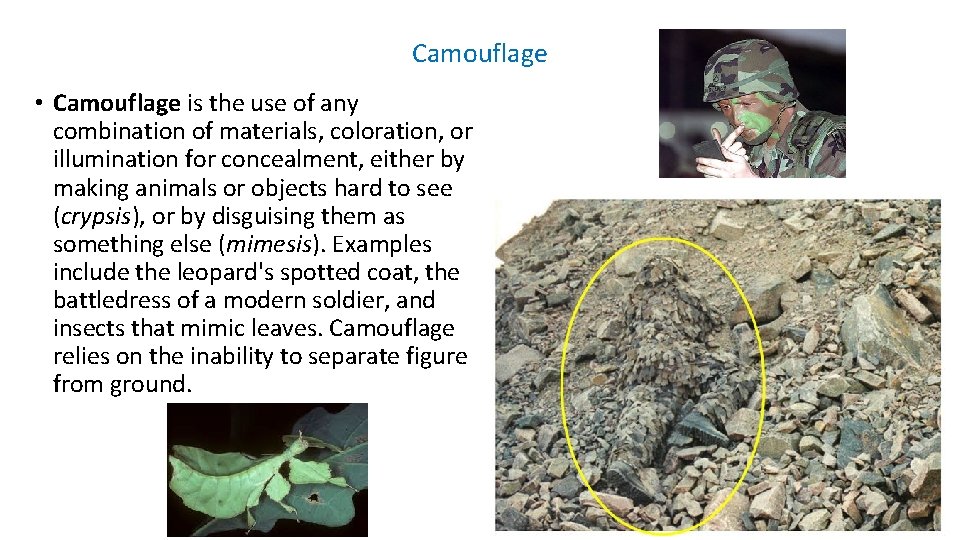
Camouflage • Camouflage is the use of any combination of materials, coloration, or illumination for concealment, either by making animals or objects hard to see (crypsis), or by disguising them as something else (mimesis). Examples include the leopard's spotted coat, the battledress of a modern soldier, and insects that mimic leaves. Camouflage relies on the inability to separate figure from ground.
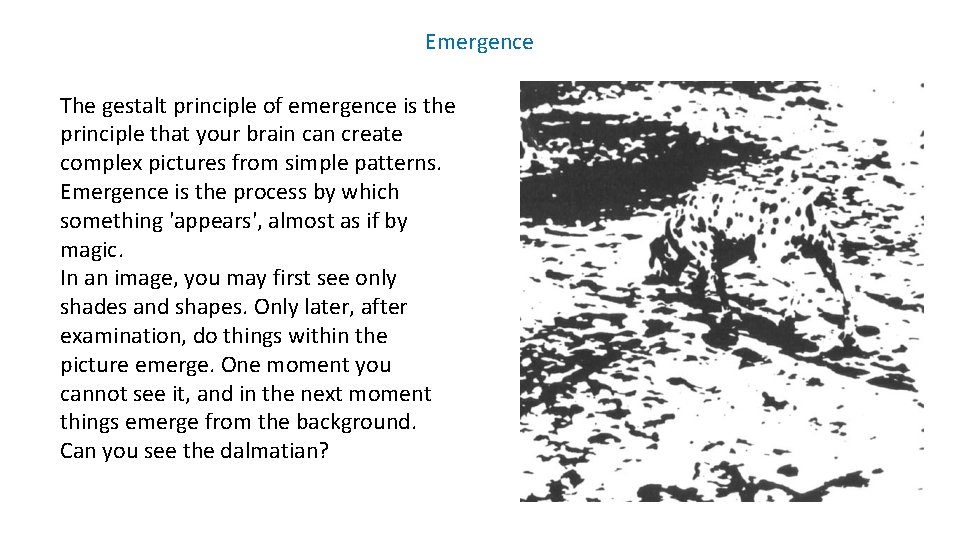
Emergence The gestalt principle of emergence is the principle that your brain can create complex pictures from simple patterns. Emergence is the process by which something 'appears', almost as if by magic. In an image, you may first see only shades and shapes. Only later, after examination, do things within the picture emerge. One moment you cannot see it, and in the next moment things emerge from the background. Can you see the dalmatian?
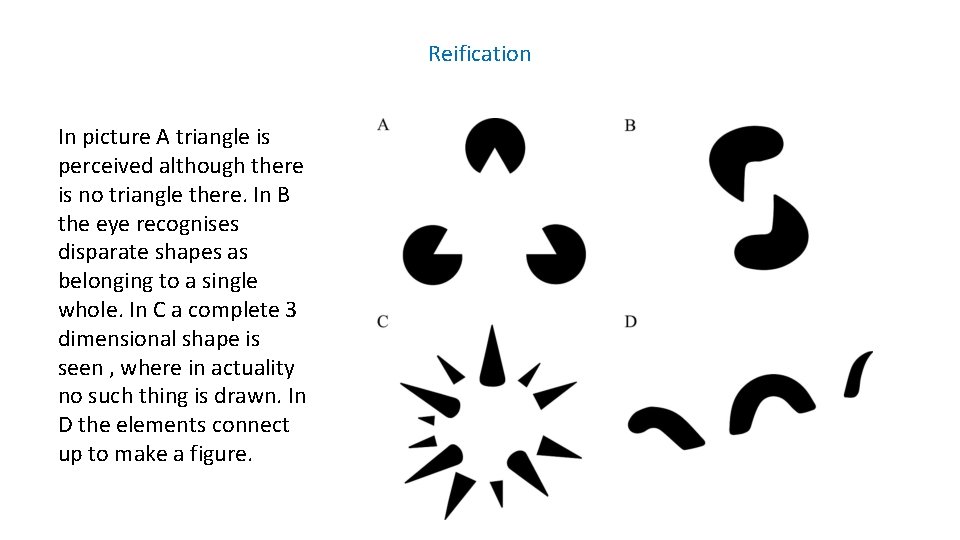
Reification In picture A triangle is perceived although there is no triangle there. In B the eye recognises disparate shapes as belonging to a single whole. In C a complete 3 dimensional shape is seen , where in actuality no such thing is drawn. In D the elements connect up to make a figure.
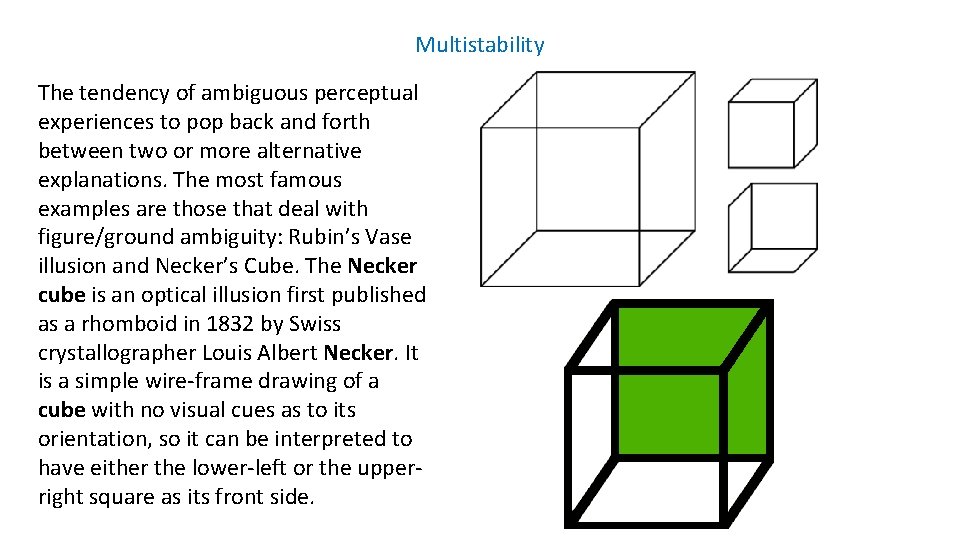
Multistability The tendency of ambiguous perceptual experiences to pop back and forth between two or more alternative explanations. The most famous examples are those that deal with figure/ground ambiguity: Rubin’s Vase illusion and Necker’s Cube. The Necker cube is an optical illusion first published as a rhomboid in 1832 by Swiss crystallographer Louis Albert Necker. It is a simple wire-frame drawing of a cube with no visual cues as to its orientation, so it can be interpreted to have either the lower-left or the upperright square as its front side.
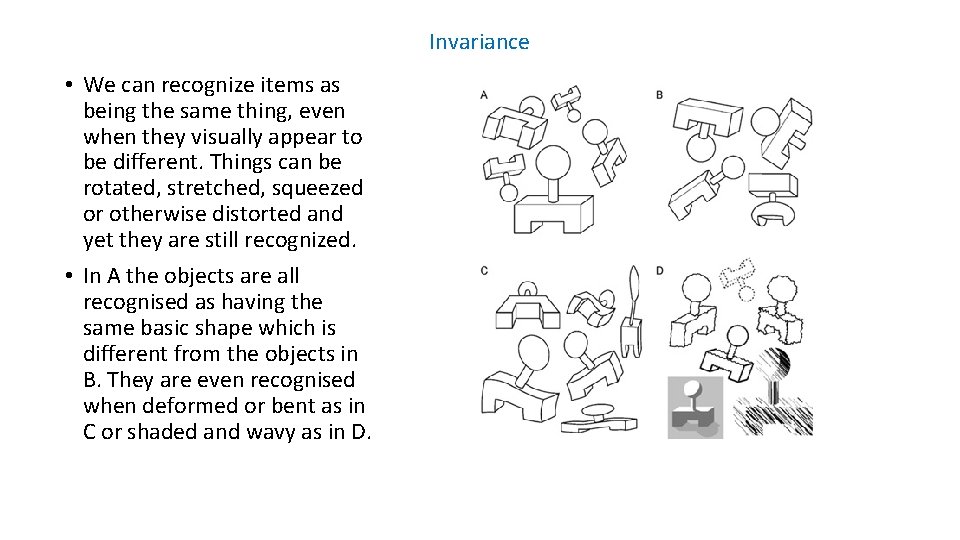
Invariance • We can recognize items as being the same thing, even when they visually appear to be different. Things can be rotated, stretched, squeezed or otherwise distorted and yet they are still recognized. • In A the objects are all recognised as having the same basic shape which is different from the objects in B. They are even recognised when deformed or bent as in C or shaded and wavy as in D.
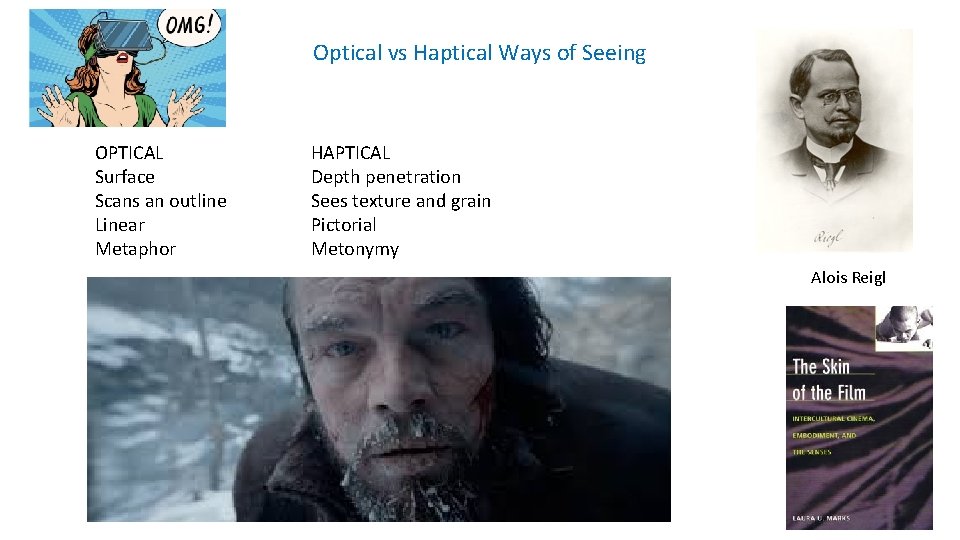
Optical vs Haptical Ways of Seeing OPTICAL Surface Scans an outline Linear Metaphor HAPTICAL Depth penetration Sees texture and grain Pictorial Metonymy Alois Reigl
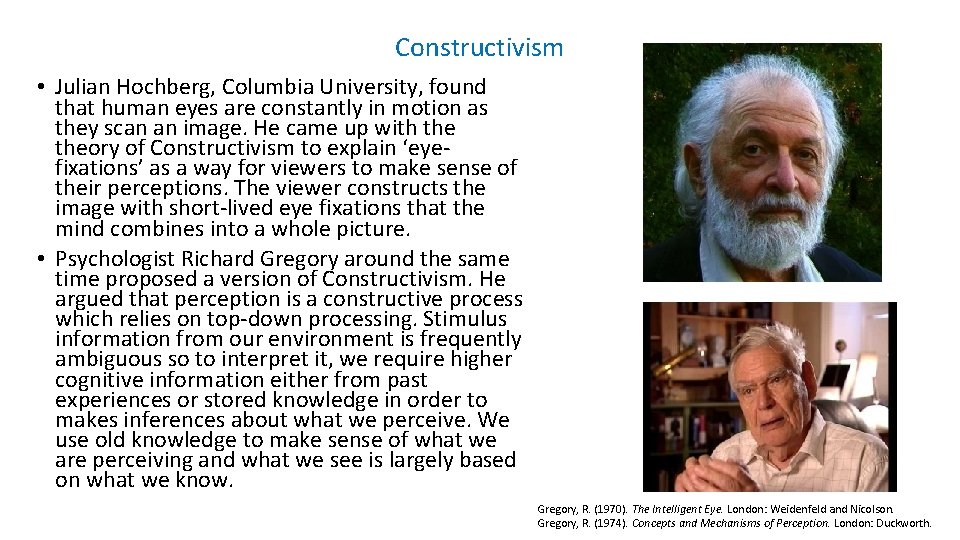
Constructivism • Julian Hochberg, Columbia University, found that human eyes are constantly in motion as they scan an image. He came up with theory of Constructivism to explain ‘eyefixations’ as a way for viewers to make sense of their perceptions. The viewer constructs the image with short-lived eye fixations that the mind combines into a whole picture. • Psychologist Richard Gregory around the same time proposed a version of Constructivism. He argued that perception is a constructive process which relies on top-down processing. Stimulus information from our environment is frequently ambiguous so to interpret it, we require higher cognitive information either from past experiences or stored knowledge in order to makes inferences about what we perceive. We use old knowledge to make sense of what we are perceiving and what we see is largely based on what we know. Gregory, R. (1970). The Intelligent Eye. London: Weidenfeld and Nicolson. Gregory, R. (1974). Concepts and Mechanisms of Perception. London: Duckworth.
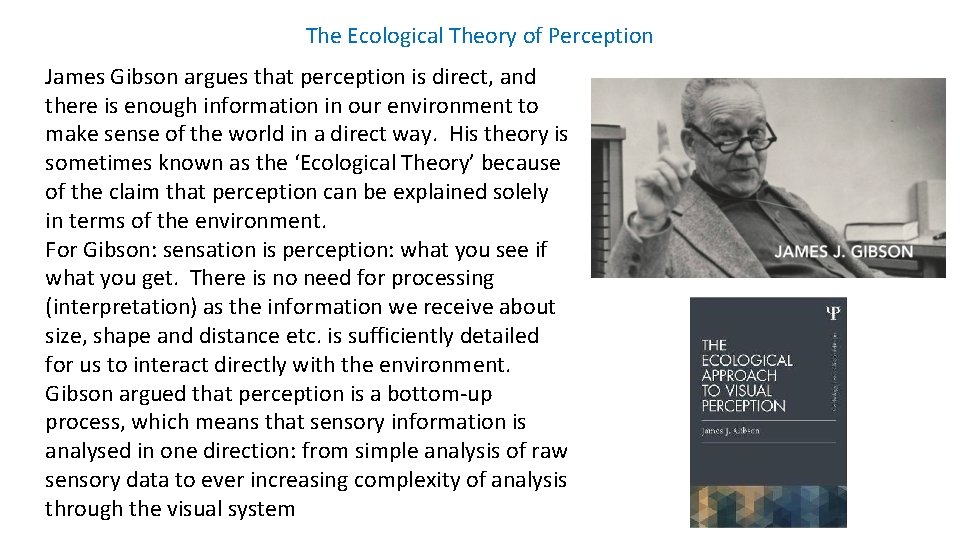
The Ecological Theory of Perception James Gibson argues that perception is direct, and there is enough information in our environment to make sense of the world in a direct way. His theory is sometimes known as the ‘Ecological Theory’ because of the claim that perception can be explained solely in terms of the environment. For Gibson: sensation is perception: what you see if what you get. There is no need for processing (interpretation) as the information we receive about size, shape and distance etc. is sufficiently detailed for us to interact directly with the environment. Gibson argued that perception is a bottom-up process, which means that sensory information is analysed in one direction: from simple analysis of raw sensory data to ever increasing complexity of analysis through the visual system
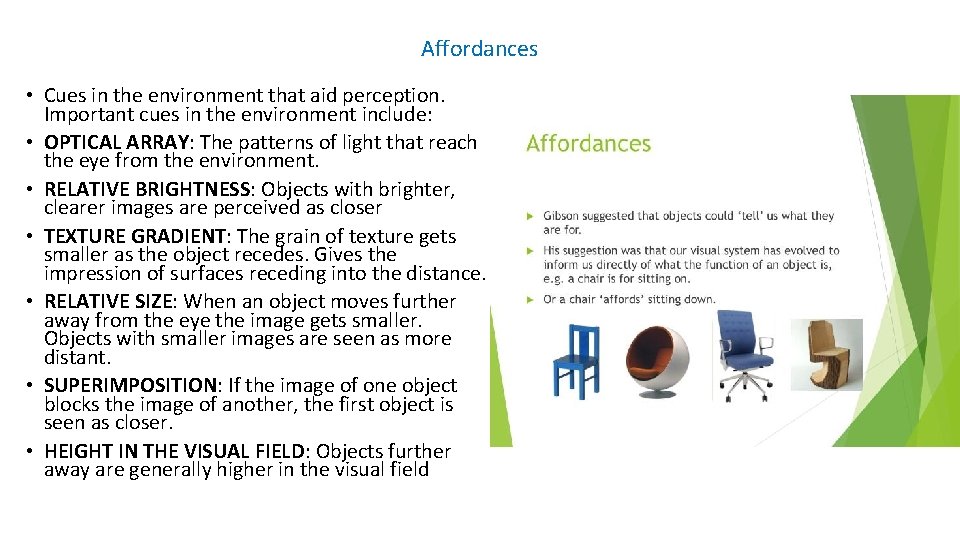
Affordances • Cues in the environment that aid perception. Important cues in the environment include: • OPTICAL ARRAY: The patterns of light that reach the eye from the environment. • RELATIVE BRIGHTNESS: Objects with brighter, clearer images are perceived as closer • TEXTURE GRADIENT: The grain of texture gets smaller as the object recedes. Gives the impression of surfaces receding into the distance. • RELATIVE SIZE: When an object moves further away from the eye the image gets smaller. Objects with smaller images are seen as more distant. • SUPERIMPOSITION: If the image of one object blocks the image of another, the first object is seen as closer. • HEIGHT IN THE VISUAL FIELD: Objects further away are generally higher in the visual field
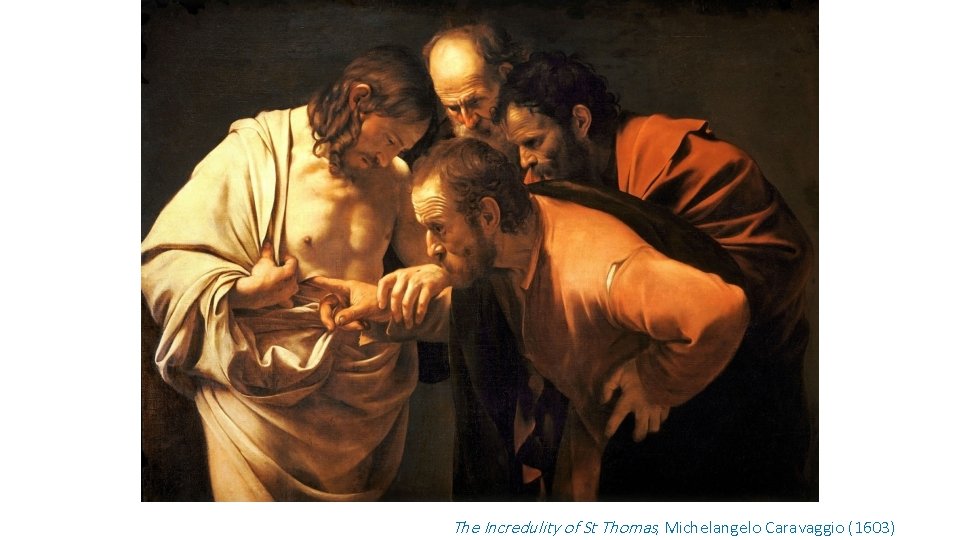
The Incredulity of St Thomas, Michelangelo Caravaggio (1603)
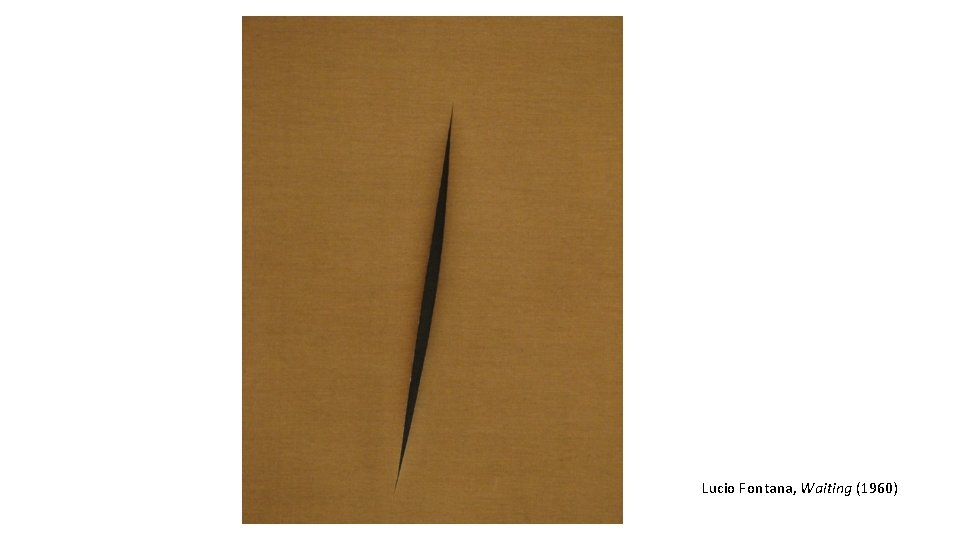
Lucio Fontana, Waiting (1960)