
Sensory System Prof K Sivapalan Receptor Mechanism Receptor
- Slides: 27
Sensory System Prof. K. Sivapalan
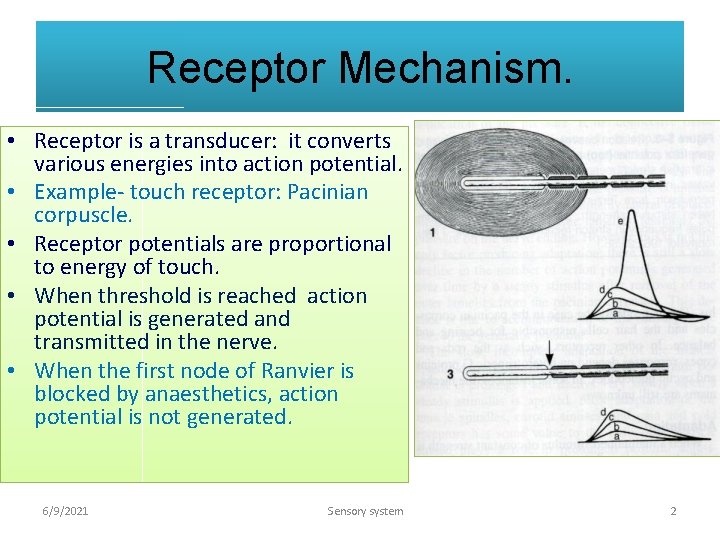
Receptor Mechanism. • Receptor is a transducer: it converts various energies into action potential. • Example- touch receptor: Pacinian corpuscle. • Receptor potentials are proportional to energy of touch. • When threshold is reached action potential is generated and transmitted in the nerve. • When the first node of Ranvier is blocked by anaesthetics, action potential is not generated. 6/9/2021 Sensory system 2
Receptive field • One axon is connected to several receptors. • Receptors of one axon will be spread in the receptive field. Receptive fields of axons can overlap. • The size of the receptive field varies – small in highly sensitive areas and large in less sensitive areas. • Mild stimulus excites few receptors and axons and strong stimulus excites more axons. 6/9/2021 Sensory system 3
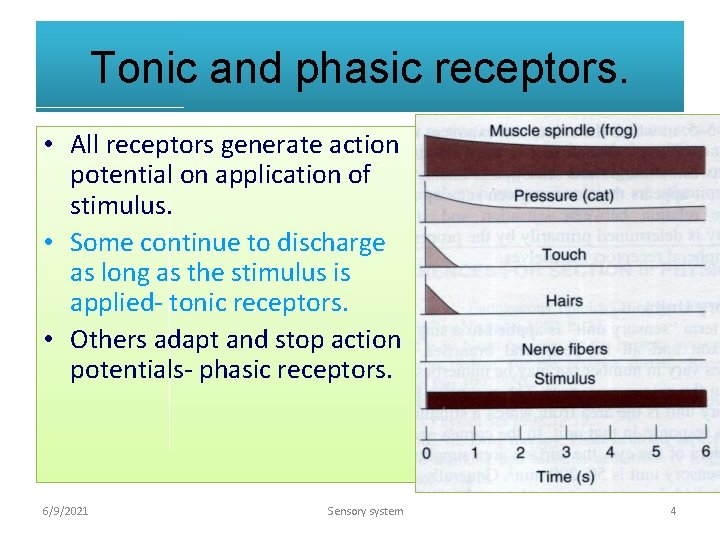
Tonic and phasic receptors. • All receptors generate action potential on application of stimulus. • Some continue to discharge as long as the stimulus is applied- tonic receptors. • Others adapt and stop action potentials- phasic receptors. 6/9/2021 Sensory system 4
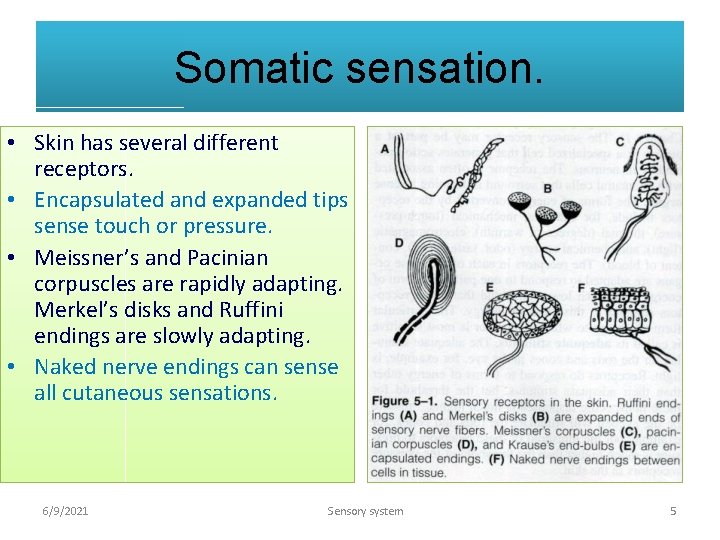
Somatic sensation. • Skin has several different receptors. • Encapsulated and expanded tips sense touch or pressure. • Meissner’s and Pacinian corpuscles are rapidly adapting. Merkel’s disks and Ruffini endings are slowly adapting. • Naked nerve endings can sense all cutaneous sensations. 6/9/2021 Sensory system 5
Sensory modalities. Cutaneous senses are: • Crude touch. • Fine touch. • Pressure. • Cold. • Warmth. • Sharp pain. • Vague pain. 6/9/2021 • Vibration. • Proprioception (sense of position and movement). • Itch and tickle. • Sexual sensation. Sensory system 6
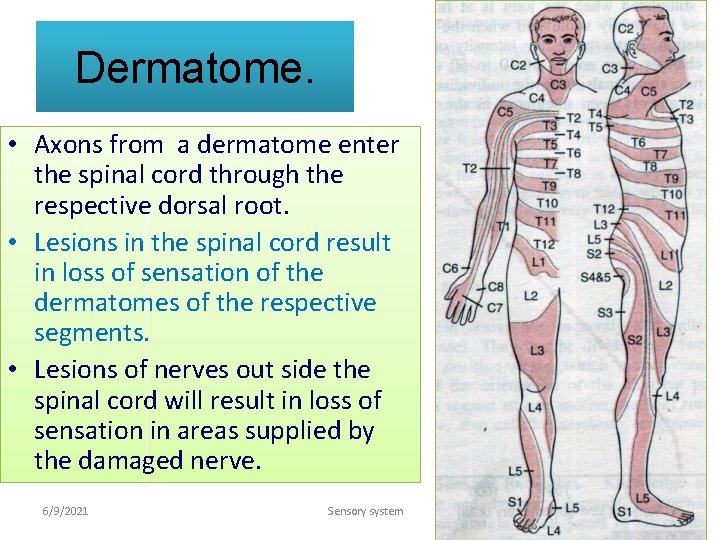
Dermatome. • Axons from a dermatome enter the spinal cord through the respective dorsal root. • Lesions in the spinal cord result in loss of sensation of the dermatomes of the respective segments. • Lesions of nerves out side the spinal cord will result in loss of sensation in areas supplied by the damaged nerve. 6/9/2021 Sensory system 7
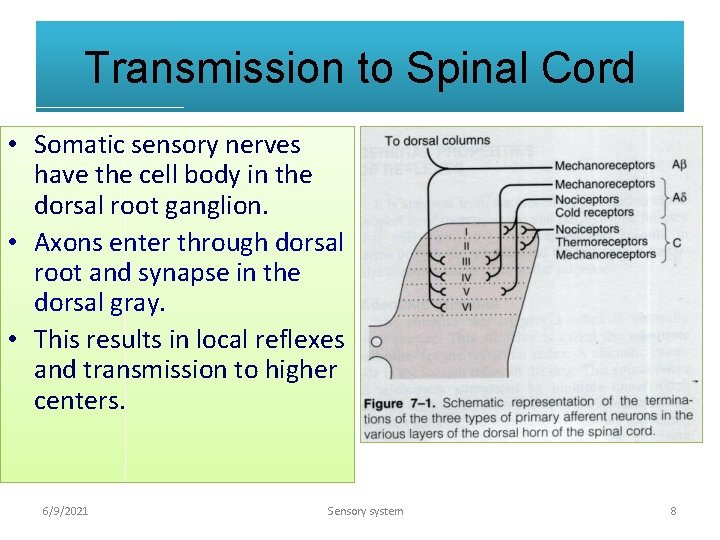
Transmission to Spinal Cord • Somatic sensory nerves have the cell body in the dorsal root ganglion. • Axons enter through dorsal root and synapse in the dorsal gray. • This results in local reflexes and transmission to higher centers. 6/9/2021 Sensory system 8
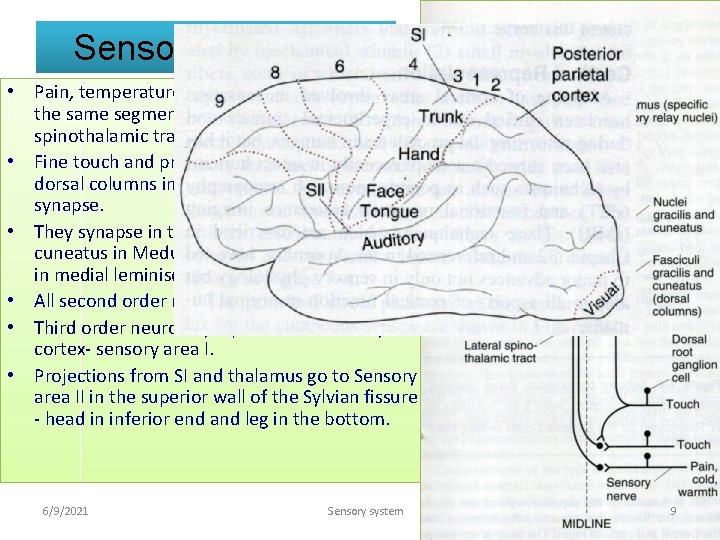
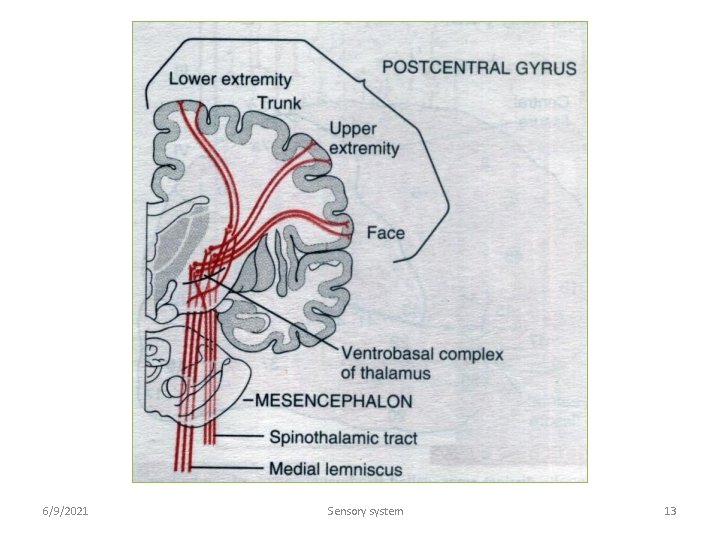
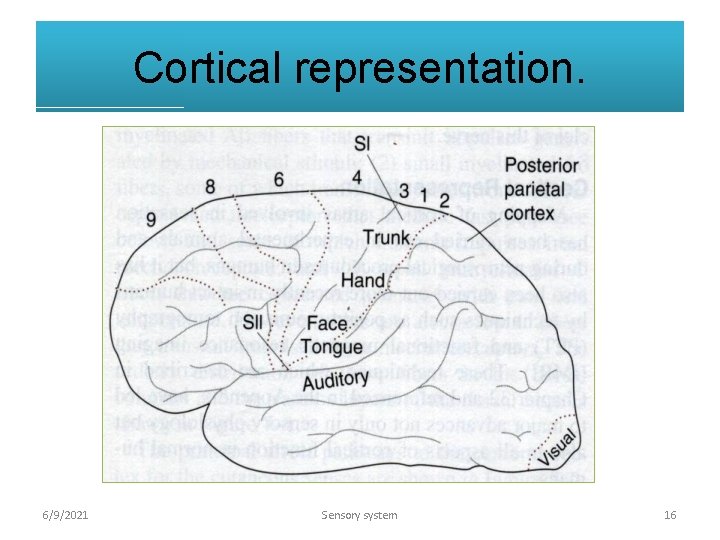
Sensory pathway. • Pain, temperature and crude touch- cross in the same segment and ascend in the spinothalamic tract. • Fine touch and proprioception ascend in the dorsal columns in the same side without synapse. • They synapse in the nuclei gracilis and cuneatus in Medulla and cross over and ascend in medial leminiscus. • All second order neurons synapse in thalamus. • Third order neuron synapses in the sensory cortex- sensory area I. • Projections from SI and thalamus go to Sensory area II in the superior wall of the Sylvian fissure - head in inferior end and leg in the bottom. 6/9/2021 Sensory system 9
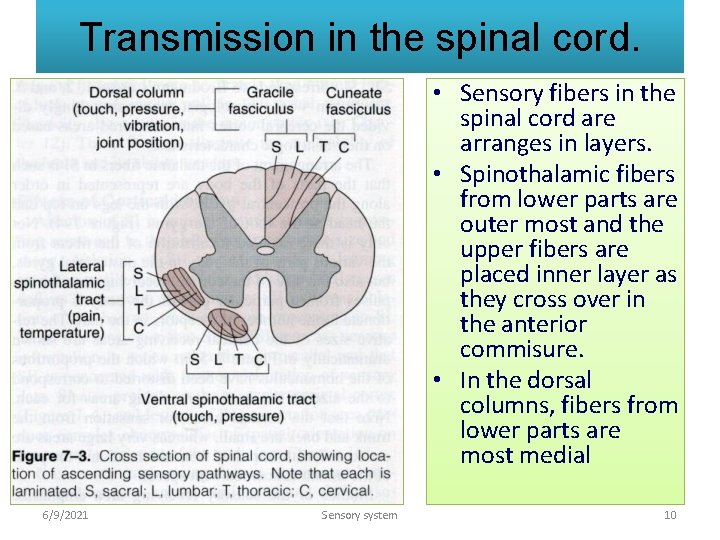
Transmission in the spinal cord. • Sensory fibers in the spinal cord are arranges in layers. • Spinothalamic fibers from lower parts are outer most and the upper fibers are placed inner layer as they cross over in the anterior commisure. • In the dorsal columns, fibers from lower parts are most medial 6/9/2021 Sensory system 10
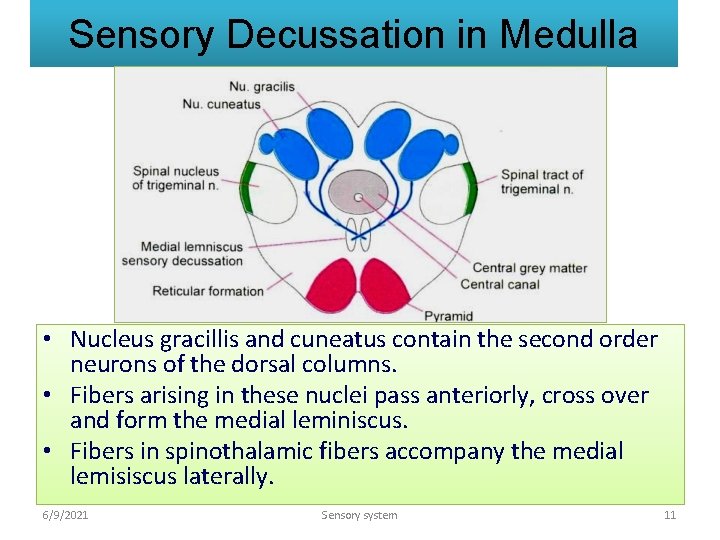
Sensory Decussation in Medulla • Nucleus gracillis and cuneatus contain the second order neurons of the dorsal columns. • Fibers arising in these nuclei pass anteriorly, cross over and form the medial leminiscus. • Fibers in spinothalamic fibers accompany the medial lemisiscus laterally. 6/9/2021 Sensory system 11
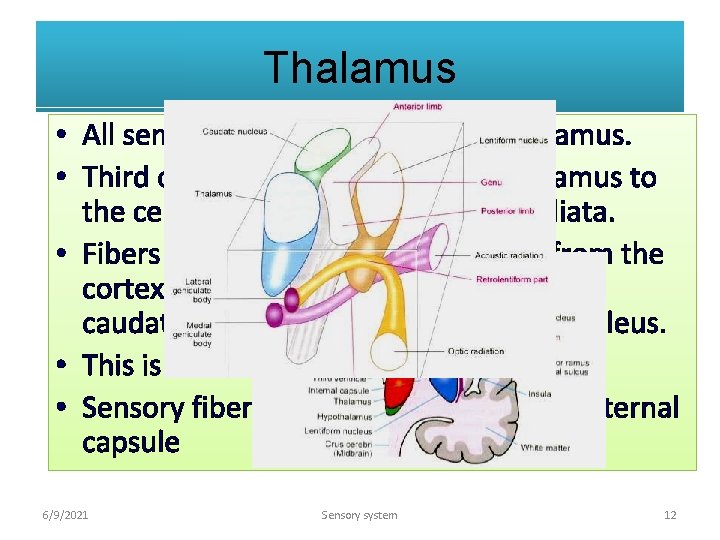
Thalamus • All sensory fibers synapse in the thalamus. • Third order fibers pass from the thalamus to the cerebral cortex in the corona radiata. • Fibers ascending to and descending from the cortex pass lateral to thalamus and the caudate nucleus medial to lentiform nucleus. • This is known as internal capsule. • Sensory fibers occupy the genu of the internal capsule 6/9/2021 Sensory system 12
6/9/2021 Sensory system 13
Cerebrum 6/9/2021 Sensory system 14
Representation in cortex 6/9/2021 Sensory system 15
Cortical representation. 6/9/2021 Sensory system 16
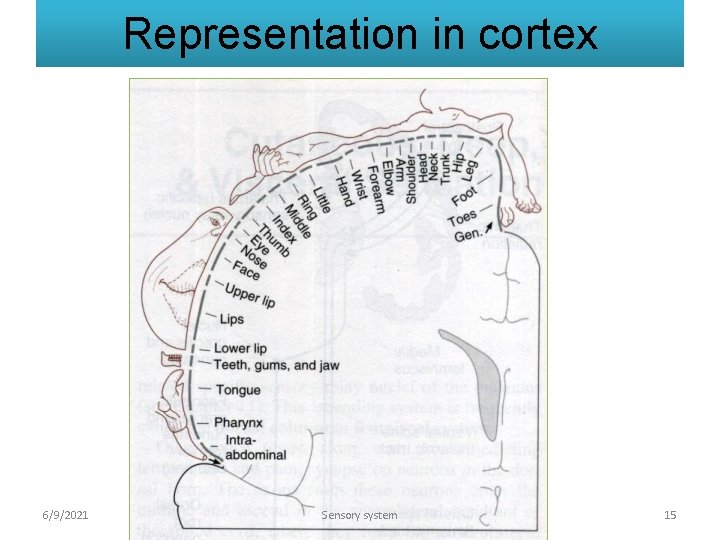
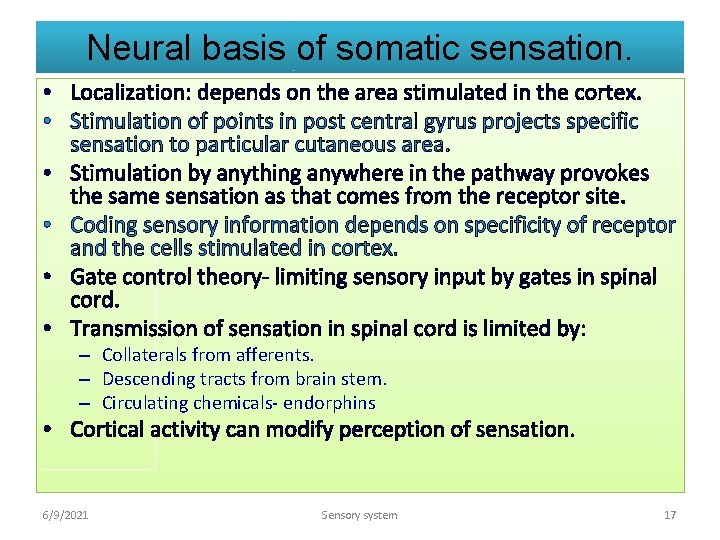
Neural basis of somatic sensation. • Localization: depends on the area stimulated in the cortex. • Stimulation of points in post central gyrus projects specific sensation to particular cutaneous area. • Stimulation by anything anywhere in the pathway provokes the same sensation as that comes from the receptor site. • Coding sensory information depends on specificity of receptor and the cells stimulated in cortex. • Gate control theory- limiting sensory input by gates in spinal cord. • Transmission of sensation in spinal cord is limited by: – Collaterals from afferents. – Descending tracts from brain stem. – Circulating chemicals- endorphins • Cortical activity can modify perception of sensation. 6/9/2021 Sensory system 17
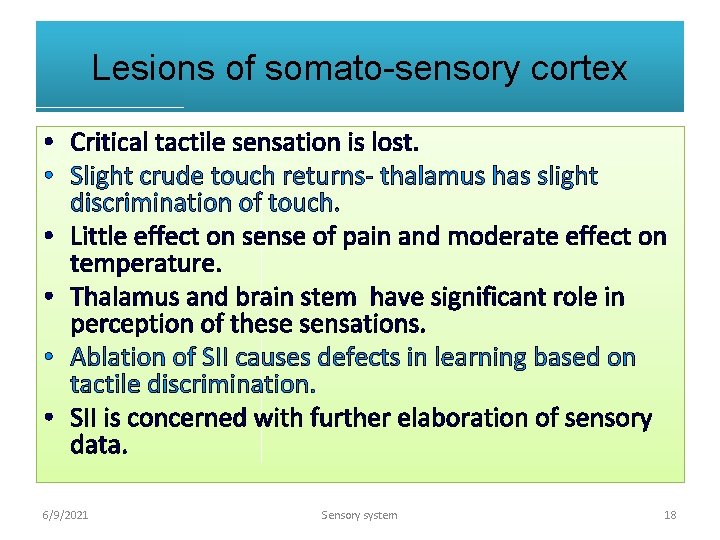
Lesions of somato-sensory cortex • Critical tactile sensation is lost. • Slight crude touch returns- thalamus has slight discrimination of touch. • Little effect on sense of pain and moderate effect on temperature. • Thalamus and brain stem have significant role in perception of these sensations. • Ablation of SII causes defects in learning based on tactile discrimination. • SII is concerned with further elaboration of sensory data. 6/9/2021 Sensory system 18
Pain. • Sensory modalities generate emotional responses in addition to several other functions. • Pain has ‘built-in’ unpleasant effect • But it is important for protective function. • Several different signals are perceived as pain. 6/9/2021 Sensory system 19
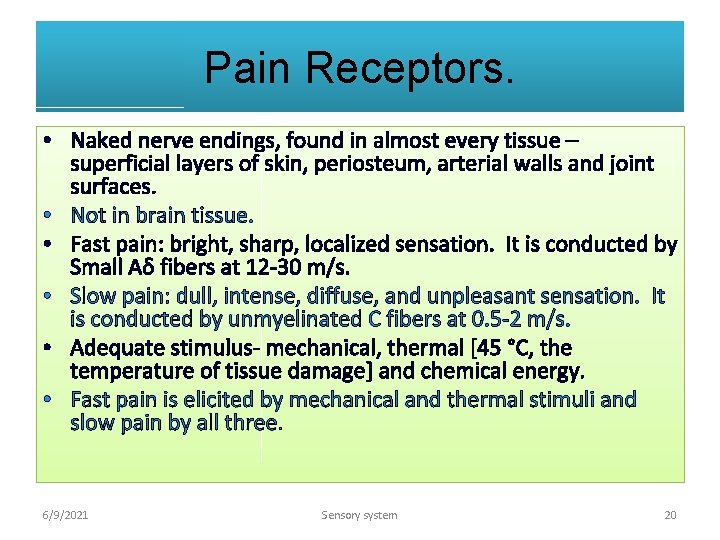
Pain Receptors. • Naked nerve endings, found in almost every tissue – superficial layers of skin, periosteum, arterial walls and joint surfaces. • Not in brain tissue. • Fast pain: bright, sharp, localized sensation. It is conducted by Small Aδ fibers at 12 -30 m/s. • Slow pain: dull, intense, diffuse, and unpleasant sensation. It is conducted by unmyelinated C fibers at 0. 5 -2 m/s. • Adequate stimulus- mechanical, thermal [45 °C, the temperature of tissue damage] and chemical energy. • Fast pain is elicited by mechanical and thermal stimuli and slow pain by all three. 6/9/2021 Sensory system 20
About pain sensation. • Receptors don't adapt- especially for slow pain. • Pain impulses can be inhibited in dorsal horn by collaterals from touch fibers. • Brain’s opiate system – endophin and encephalins inhibit at spinal and central levels. • At the spinal level pain evokes withdrawal and at cortical level avoidance reactions. • Pain also activates mediofrontal cortex, insular cortex, cerebellum, and reticular system in brain stem. • Effects of these are complex- could be emotional and autonomic. 6/9/2021 Sensory system 21
Post injury and neuropathic pain • After moderate or severe injury, pain persists even after the healing of the injury. • Stimuli to injured area that usually cause mild pain evoke severe pain - hyperalgesia. • Other stimuli such as touch can cause pain [alldynia]. • If the nerves to that area are damaged, the pain may persist and may become excruciating- neuropathic pain. 6/9/2021 Sensory system 22
Deep pain. • Poorly localized, nauseating and associated with sweating and changes in blood pressure. • In periosteum, ligaments, muscles, etc. • This initiates reflex contraction of nearby muscles. • Muscle spasm causes ischaemia, pain and more spasm- vicious circle. • Ischaemic pain - caused by substance P in skeletal and cardiac muscles. [uteress] • Colicky pain in intestines, biliary tract and urinary tract is associated with strong contractions. 6/9/2021 Sensory system 23
Visceral Pain. • Poorly localized, unpleasant, associated with nausea and autonomic symptoms and signs. • Viscera has few temperature and touch receptors. Pain fibers are also less than in skin. They reach CNS by autonomic afferents. • In the spinal cord, they travel in spinothalamic tract. • Cortical areas are inter mixed with somatic representational areas. • Stimulation: hollow viscera are sensitive to distension. When inflamed, miner stimuli causes severe pain. • Visceral pain stimulates contraction of nearby skeletal muscle reflexly- rigidity of abdominal wall in peritonitis. 6/9/2021 Sensory system 24
Referred pain: • Pain sensation originating in viscera is felt in somatic structure that may be in considerable distance away. • Such pain is referred to the somatic structure. • Pain seems to spread [radiate] from local to distant site when it is both local and referred. • Visceral pain stimulates contraction of nearby skeletal muscle reflexly- rigidity of abdominal wall in peritonitis. 6/9/2021 Sensory system 25
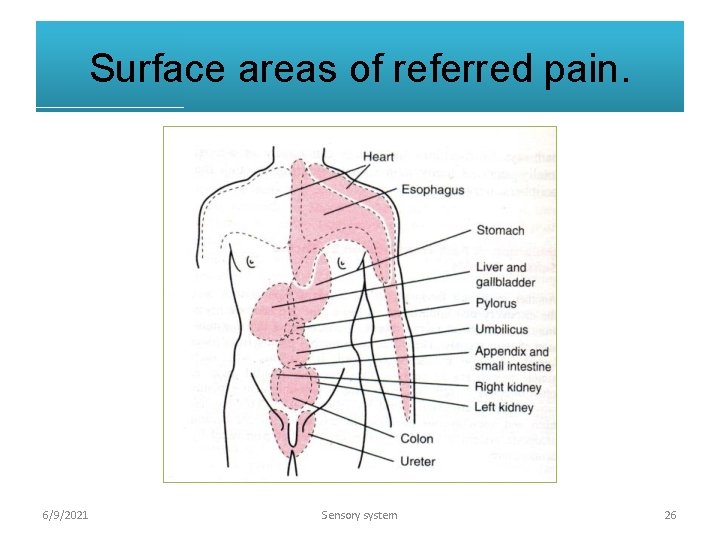
Surface areas of referred pain. 6/9/2021 Sensory system 26
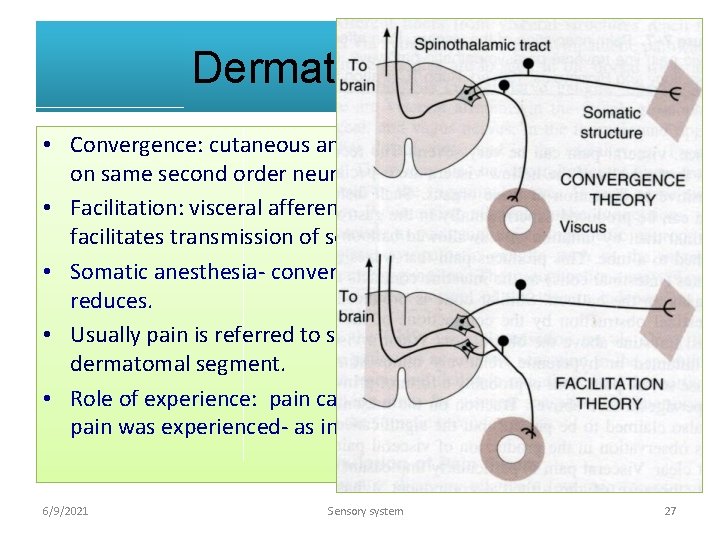
Dermatomal rule. • Convergence: cutaneous and visaral afferents converge on same second order neuron. • Facilitation: visceral afferents send colateral that facilitates transmission of somatic sensation. • Somatic anesthesia- convergence no effect, facilitation reduces. • Usually pain is referred to structures from the same dermatomal segment. • Role of experience: pain can be referred to sits where pain was experienced- as in surgical scars. 6/9/2021 Sensory system 27