
Sensory Profile 2 Presented by Stephanie Skurski Background
Sensory Profile 2 Presented by Stephanie Skurski

Background • Name ▫ Sensory Profile 2 (SP 2) • Author ▫ Winnie Dunn, Ph. D, OTR, FAOTA • Source ▫ Pearson Clinical Assessment (Psych. Corp) • Cost ▫ $270. 00

Theoretical Concepts • • Neuroscience Development Ecology of Human Performance Dunn’s Sensory Processing Framework
Purpose • Family of assessments that examine sensory processing patterns and the influence they have on functional participation • Understand how sensory deficits influence children at home, school, and within the community
Overview • Age ▫ Birth- 14: 11 • Administration options ▫ Paper & pencil; Q-global ▫ Approx. 5 -15 minutes • Completed by ▫ Caregiver and/or teacher • Scoring options ▫ Manual scoring or Q-global
Materials
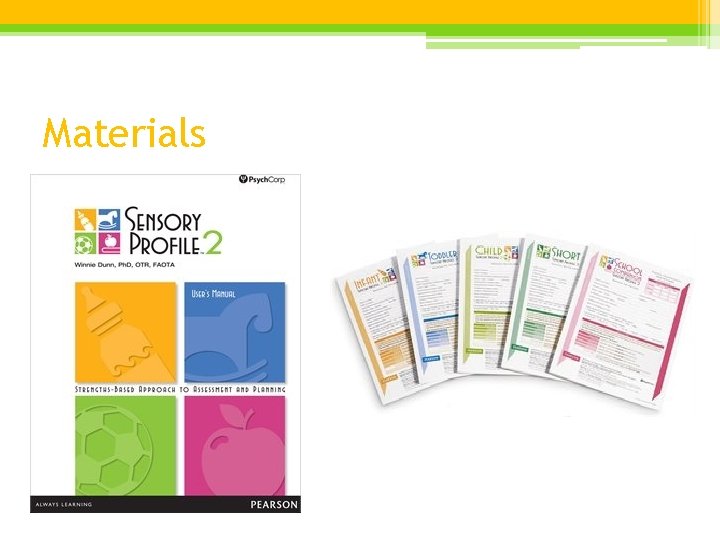
Assessment Breakdown • Infant Sensory Profile 2 ▫ Birth- 6 months • Toddler Sensory Profile 2 ▫ 7 -35 months • Child Sensory Profile 2 ▫ 3 -14 years • Short Sensory Profile 2 ▫ 3 -14 years • School Companion Sensory Profile 2 ▫ 3 -14 years
Sensory Profile 2: What’s New? • Infant, toddler, child, short, and school companion combined in one kit, with one manual • Updated content • Shorter administration time (except Toddler) • Greater consistency between forms • Score summary included on questionnaire • Q-global
Item Development • Sensory Components ▫ ▫ ▫ ▫ General Auditory Visual Touch Movement Body position Oral Sensory processing
Item Development • Behavior ▫ Conduct ▫ Social emotional ▫ Attention • School ▫ ▫ External supports Tolerance Awareness and attention Availability
Scoring • Uses a 5 point Likert Scale ▫ Almost never- Almost always • Write does not apply for behaviors that were not observed • Manual scoring ▫ Approx. 15 minutes
Scoring • Calculate the raw score for each category • Calculate the sensory pattern quadrants and the raw scores • Complete quadrant raw score total grid
Classification • Seeking ▫ Degree to which a child obtains sensory input • Avoiding ▫ Degree to which a child is bothered by sensory input • Sensitivity ▫ Degree to which a child detects sensory input • Registration ▫ Degree to which a child misses sensory input
Reliability • Test-retest reliability ▫ Caregiver assessments ranged from. 83 -. 97 ▫ School Companion SP 2 ranged from. 66 -. 93 • Inter-rater reliability ▫ Caregiver. 70 -. 80 ▫ Teacher. 70 -. 90 • Internal consistency ▫ 57 -. 93 for every section
Case Study • Jacob ▫ 11 years old, 5 th grade • Teacher Concerns ▫ Not available for learning ▫ Gets upset with his group for not understanding him ▫ Frequently leaves the group and refuses to rejoin them ▫ Jacob spends more and more time alone when not required to work on projects
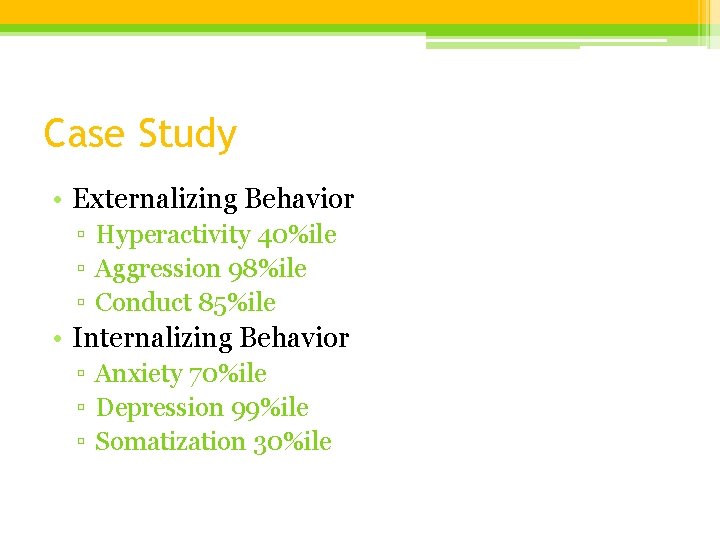
Case Study • Externalizing Behavior ▫ Hyperactivity 40%ile ▫ Aggression 98%ile ▫ Conduct 85%ile • Internalizing Behavior ▫ Anxiety 70%ile ▫ Depression 99%ile ▫ Somatization 30%ile
Case Study: OT Observation • Jacob works well when teacher sends him to the library • Intolerance for small groups, especially when students are enthusiastic about ideas
Case Study: Quadrants • Seeking ▫ Jacob is just as interested in sensory experiences as the majority of students • Avoiding ▫ Jacob is much more likely to be overwhelmed by sensory experiences than other students • Sensitivity ▫ Jacob detects about the same amount of sensory cues as the majority of other students • Registration ▫ Jacob notices sensory cues just like the majority of other students
Case Study • Auditory ▫ Jacob responds much more to sounds than other students • Visual ▫ Jacob responds to sights just like the majority of other students • Touch ▫ Jacob responds to touch just like the majority of other students • Movement ▫ Jacob responds to movement just like the majority of other students • Behavioral ▫ Jacob exhibits behaviors associated with sensory processing much more than other students
Case Study: School Factors • Need for External Supports ▫ Jacob needs the same amount of support as the majority of other students • Awareness and Attention ▫ Jacob is jus as alert and active in the learning environment when compared to the majority of other students • Tolerance ▫ Jacob has many more challenges tolerating changes in he routine than other students • Availability ▫ Jacob is much more detached from learning than oher students
Case Study: Conclusions • Jacob is experiencing sensory _____, linked with _____ and _____, and has challenges tolerating changes and is less available for learning. • Fleeing groups is likely related to an increased number of students in the classroom making more noise as they interact about their projects.
Case Study: Interventions • Focus on decreasing sensory experiences in daily activities and focus on Jacob’s sensory strengths • Limit large group exposure • Use white noise or calming sounds to drown out distracting noises • Limit long unstructured time • Present information visually rather than verbally • Manage depressive and aggressive behaviors
References Asher, E. (Ed. ). (2007). Asher’s Occupational Therapy Assessment Tools (4 th ed. ). American Occupational Therapy Association. Case-Smith, J. (2010). Occupational Therapy for Children (6 th ed. ). Mosby Inc. Pearson Clinical. (2017). Sensory Profile 2. Retrieved from http: //www. pearsonclinical. com/therapy/products/10000 0822/sensory-profile-2. html
- Slides: 23