
Sensory Processing and Learning Disabilities Case Studies of
Sensory Processing and Learning Disabilities: Case Studies of a Neurodevelopmental Approach to Assessment & Successful Treatment in a Pediatric Population Tim Conway, Ph. D* Diana Croom-Atkins, OTD, OTR/L! The Morris Center*! Ocala and Gainesville, FL Neuro-development of Words – NOW!* International The Einstein School* (a free, public charter school for children with dyslexia) University of Florida* Dept. of Clinical and Health Psychology Dept. of Speech, Language and Hearing Sciences
Learning Objectives: - learn a neurodevelopmental model of phonological awareness, spoken language and written language that is based on mutlisensory processing. - discover how multi- and sensory processing aid the development of fine motor skills, occulo-motor skills, oral motor, somatosensory and motor articulatory, postural control, general motor praxis, language skills, and reading and writing - understand the relationship between sensory processing and motor deficits and learning disabilities. - explore how a transdisciplinary team follows neurodevelopmental models during assessment and treatment
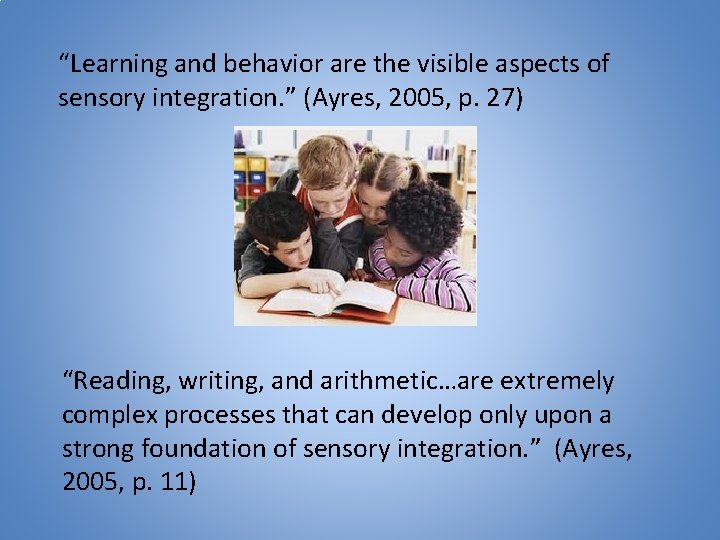
“Learning and behavior are the visible aspects of sensory integration. ” (Ayres, 2005, p. 27) “Reading, writing, and arithmetic…are extremely complex processes that can develop only upon a strong foundation of sensory integration. ” (Ayres, 2005, p. 11)
Promoting Academic Success Attention Sensory, Motor skills & Modulation Learning & Memory skills Spoken & Written Language skills Psychological health – self-esteem, interpersonal skills, regulation of mood or anxiety Behaviors for learning & achievement – - engagement, motivation, compliance Executive Functions – planning, organizing, managing time
What to do? If attention, sensory, motor, visual, language, memory, executive functions and psychosocial skills contribute to academic and life success, then which professions can assess & treat deficits in these systems? Medical providers Speech-Language Pathology Occupational Therapy Neuropsychology/Clinical Psychology A team of providers, but what type of team? Transdisciplinary vs Multidisciplinary
Transdisciplinary Team Building Team is built with: 1. Shared neurodevelopmental models of function 2. Cross-trained in each discipline’s treatments methods and goals 3. Creating an integrated immersion environment for treatment 4. Shared understanding of tenets of neural plasticity Grant, Finocchio et al. , (1995)
Interactive Transdisciplinary Team Transdisciplinary review of assessment data Transdisciplinary diagnoses Transdisciplinary team goals for patient Transdisciplinary members are interdependent for patient’s treatment progress Clinical environment enables collaboration: - weekly transdisciplinary team rehab staffing - daily/hourly hallway consultations - weekly parent education meetings w/ psychologist § Drinka & Clark (2000). § http: //dcahec. gwumc. edu/education/files/session 3/index. html
Interactive Transdisciplinary Team Advantages 1. Integrated care 2. Shared leadership responsibility 3. Solutions to complex problems 4. Solutions with depth & breadth 5. Members are empowered 6. Creative approaches to complexity 7. Understand autonomous practice Disadvantages 1. Initial decisions take more time 2. Members must learn different languages/norms 3. Effort to maintain the team 4. Need time and space to: ‐Clarify values ‐Renegotiate roles ‐Renegotiate leadership ‐Manage and resolve conflicts
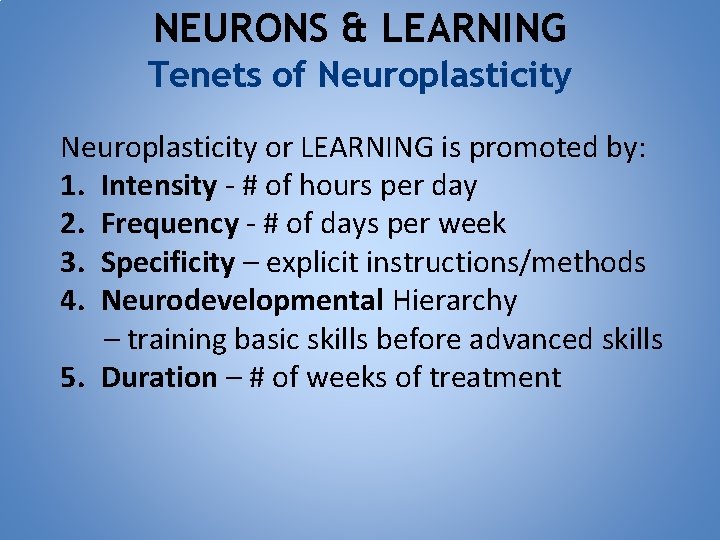
NEURONS & LEARNING Tenets of Neuroplasticity or LEARNING is promoted by: 1. Intensity - # of hours per day 2. Frequency - # of days per week 3. Specificity – explicit instructions/methods 4. Neurodevelopmental Hierarchy – training basic skills before advanced skills 5. Duration – # of weeks of treatment
Shared Neurodevelopmental Models of Function Relative to Treatment Goals
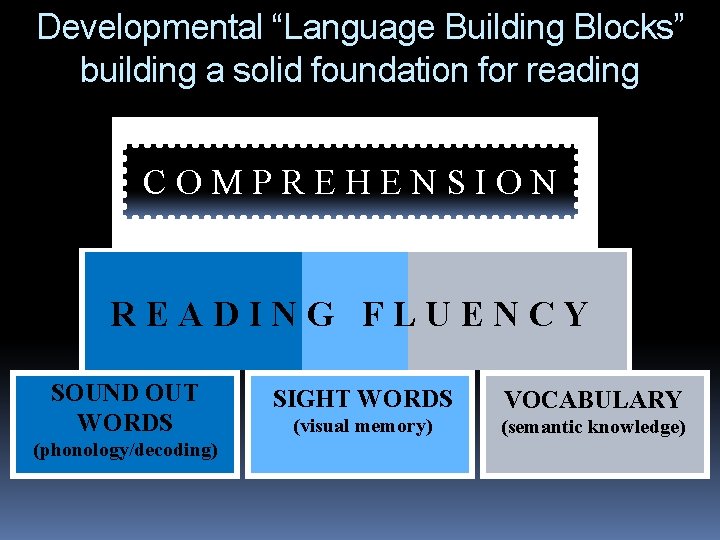
Developmental “Language Building Blocks” building a solid foundation for reading C O M P R E H E N S I O N SYNTAX R E A D I N G F L U E N C Y SOUND OUT WORDS (phonology/decoding) SIGHT WORDS (Visual Memory) (visual memory) VOCABULARY (Semantic Knowledge) (semantic knowledge)
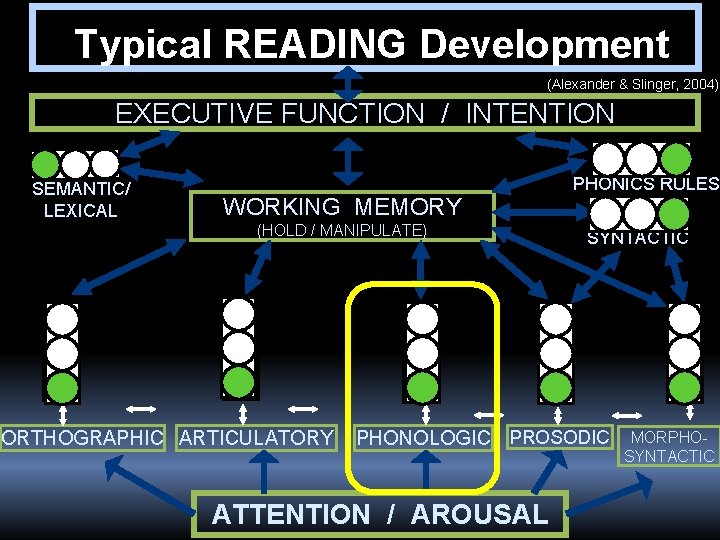
Typical READING Development (Alexander & Slinger, 2004) EXECUTIVE FUNCTION / INTENTION SEMANTIC/ LEXICAL PHONICS RULES WORKING MEMORY (HOLD / MANIPULATE) ORTHOGRAPHIC ARTICULATORY SYNTACTIC PHONOLOGIC PROSODIC ATTENTION / AROUSAL MORPHOSYNTACTIC
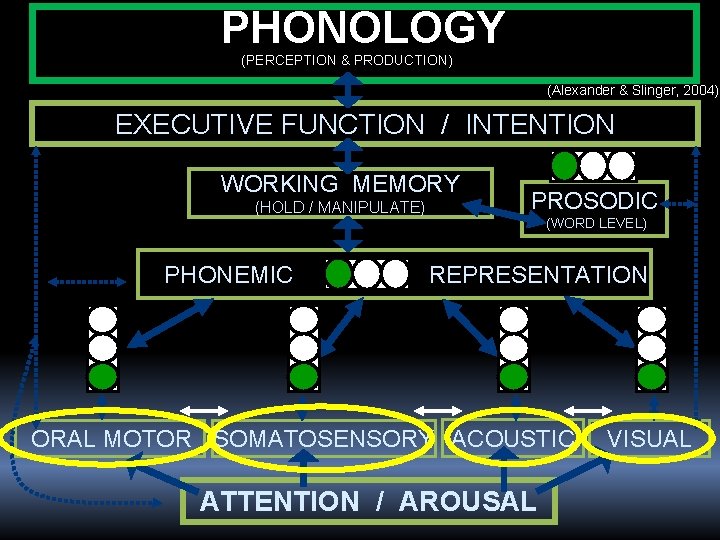
PHONOLOGY (PERCEPTION & PRODUCTION) (Alexander & Slinger, 2004) EXECUTIVE FUNCTION / INTENTION WORKING MEMORY PROSODIC (HOLD / MANIPULATE) (WORD LEVEL) PHONEMIC REPRESENTATION ORAL MOTOR SOMATOSENSORY ACOUSTIC ATTENTION / AROUSAL VISUAL
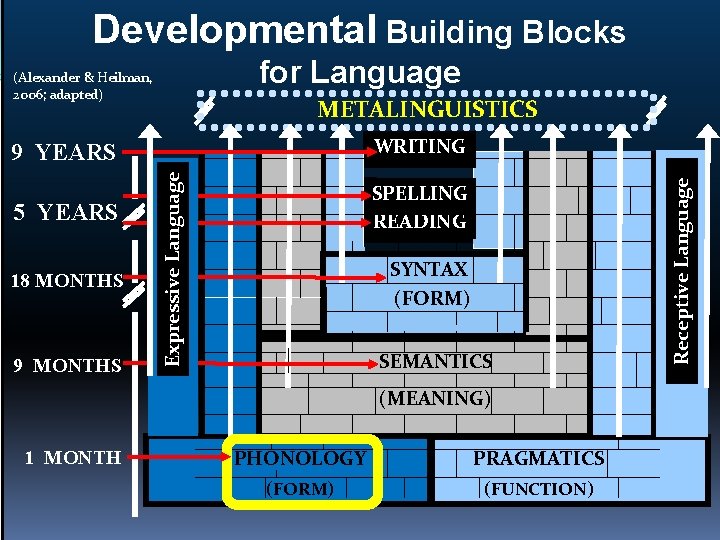
Developmental Building Blocks for Language (Alexander & Heilman, 2006; adapted) METALINGUISTICS 18 MONTHS 9 MONTHS Expressive Language 5 YEARS SPELLING READING SYNTAX (FORM) SEMANTICS (MEANING) 1 MONTH PHONOLOGY PRAGMATICS (FORM) (FUNCTION) Receptive Language WRITING 9 YEARS
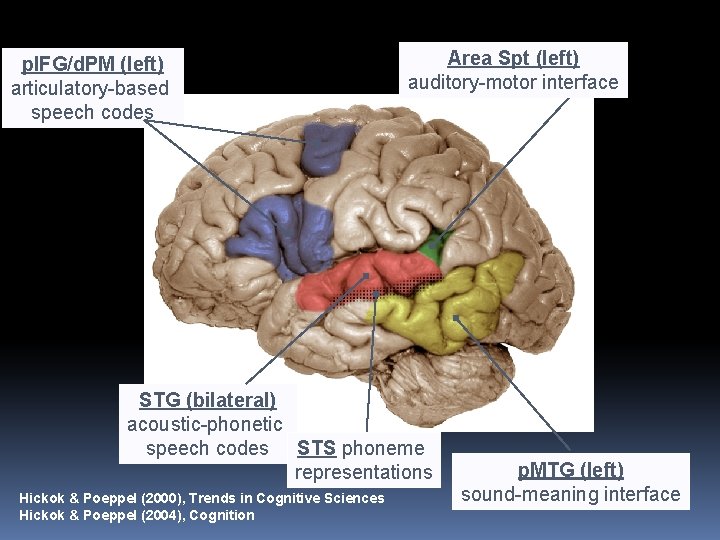
p. IFG/d. PM (left) articulatory-based speech codes Area Spt (left) auditory-motor interface STG (bilateral) acoustic-phonetic speech codes STS phoneme representations Hickok & Poeppel (2000), Trends in Cognitive Sciences Hickok & Poeppel (2004), Cognition p. MTG (left) sound-meaning interface
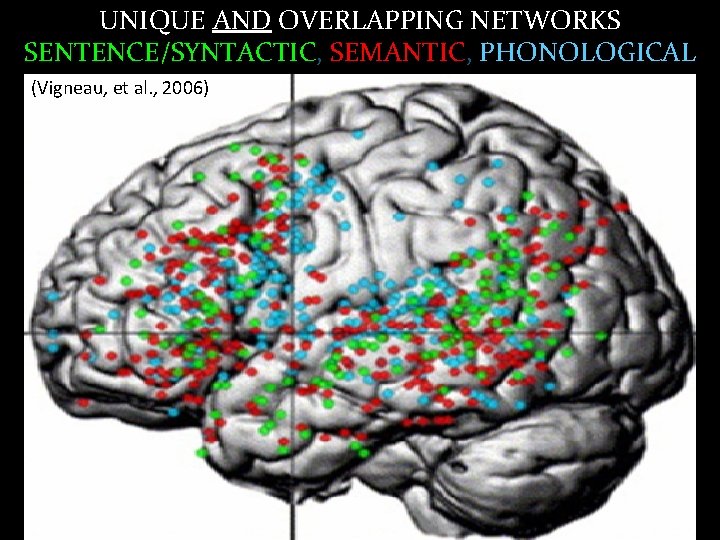
UNIQUE AND OVERLAPPING NETWORKS SENTENCE/SYNTACTIC, SEMANTIC, PHONOLOGICAL (Vigneau, et al. , 2006)
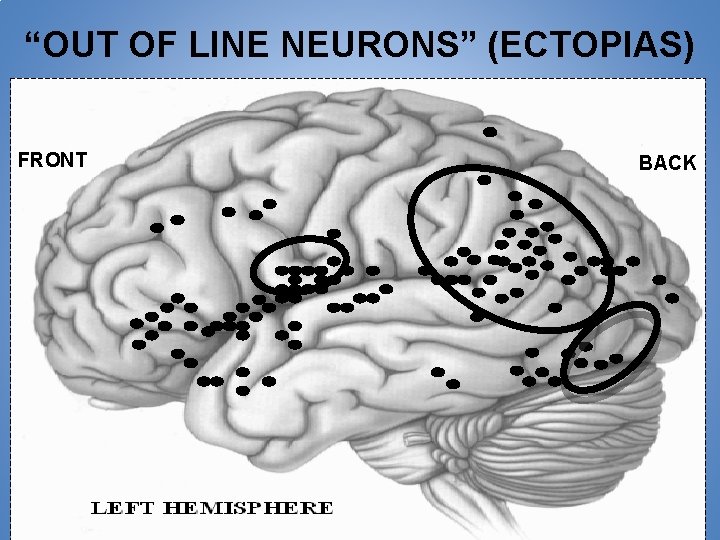
“OUT OF LINE NEURONS” (ECTOPIAS) FRONT BACK
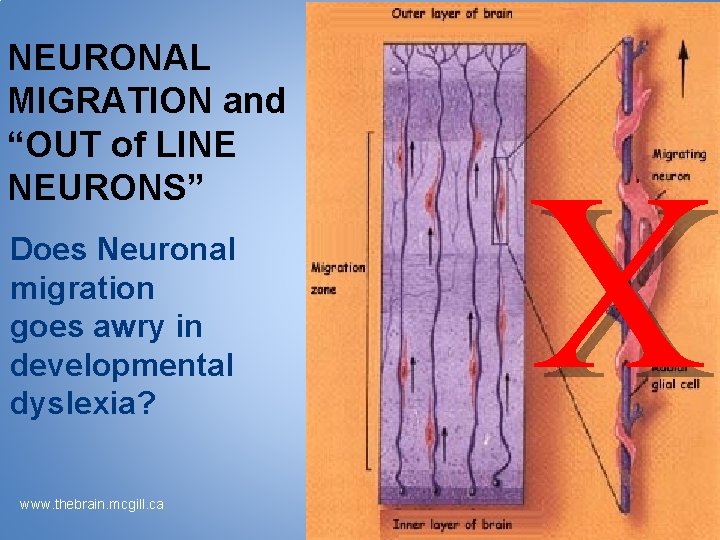
Does Neuronal migration goes awry in developmental dyslexia? www. thebrain. mcgill. ca X NEURONAL MIGRATION and “OUT of LINE NEURONS”
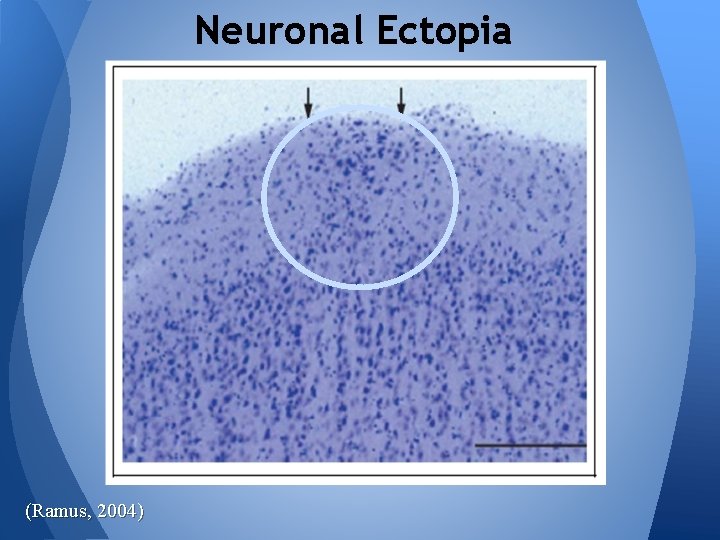
Neuronal Ectopia (Ramus, 2004)
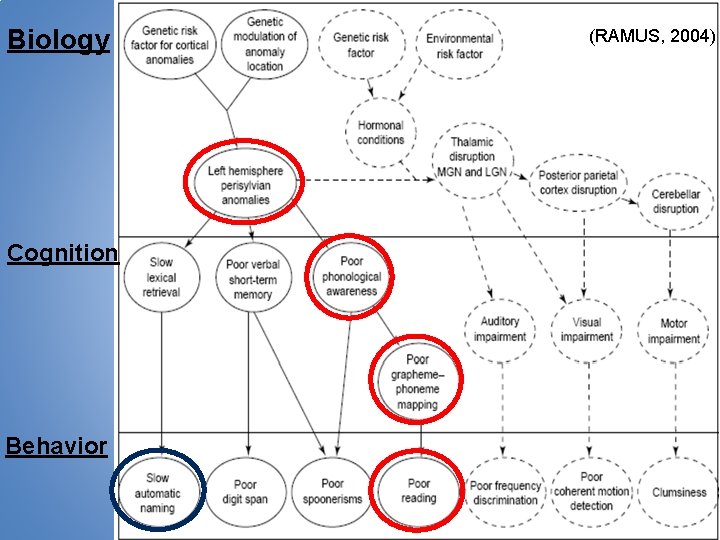
Biology Cognition Behavior (RAMUS, 2004)
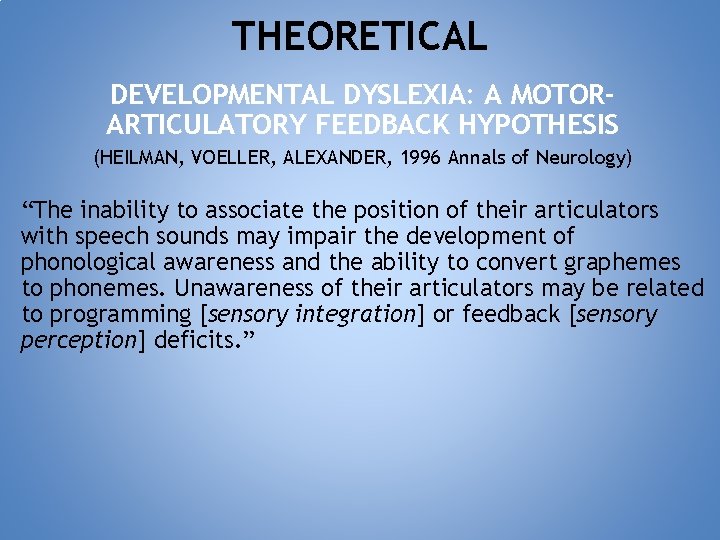
THEORETICAL DEVELOPMENTAL DYSLEXIA: A MOTORARTICULATORY FEEDBACK HYPOTHESIS (HEILMAN, VOELLER, ALEXANDER, 1996 Annals of Neurology) “The inability to associate the position of their articulators with speech sounds may impair the development of phonological awareness and the ability to convert graphemes to phonemes. Unawareness of their articulators may be related to programming [sensory integration] or feedback [sensory perception] deficits. ”
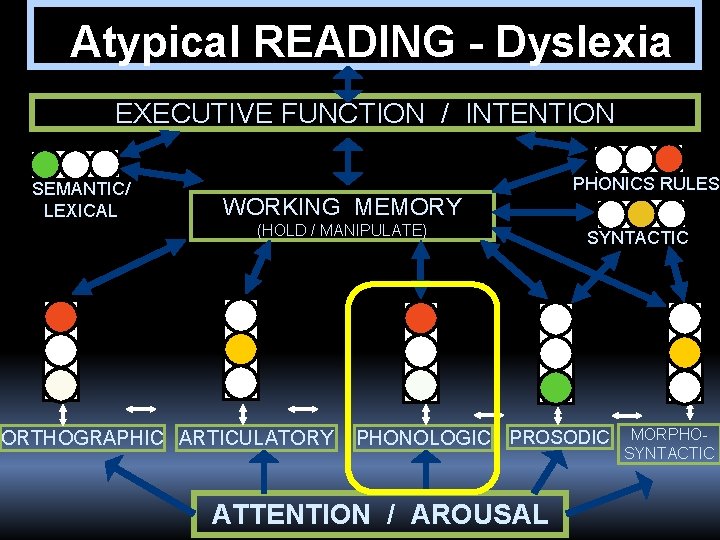
Atypical READING - Dyslexia EXECUTIVE FUNCTION / INTENTION SEMANTIC/ LEXICAL PHONICS RULES WORKING MEMORY (HOLD / MANIPULATE) ORTHOGRAPHIC ARTICULATORY SYNTACTIC PHONOLOGIC PROSODIC ATTENTION / AROUSAL MORPHOSYNTACTIC
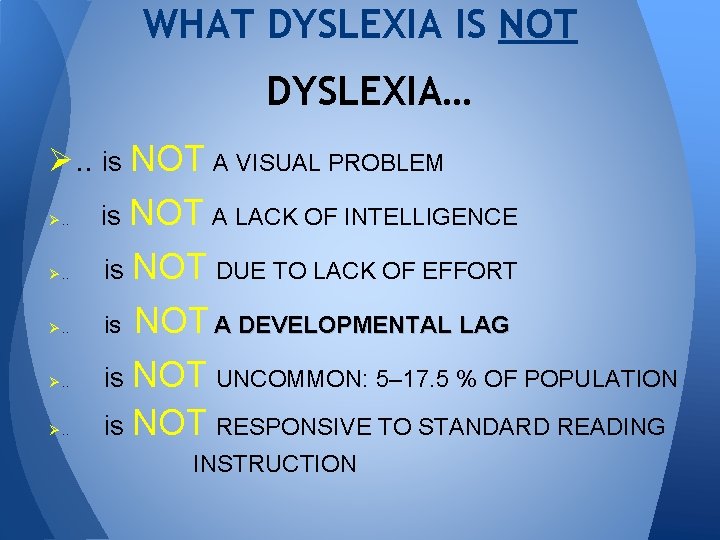
WHAT DYSLEXIA IS NOT DYSLEXIA… Ø. . is NOT A VISUAL PROBLEM Ø. . is NOT A LACK OF INTELLIGENCE is NOT DUE TO LACK OF EFFORT Ø. . is NOT A DEVELOPMENTAL LAG is NOT UNCOMMON: 5– 17. 5 % OF POPULATION Ø. . is NOT RESPONSIVE TO STANDARD READING Ø. . INSTRUCTION
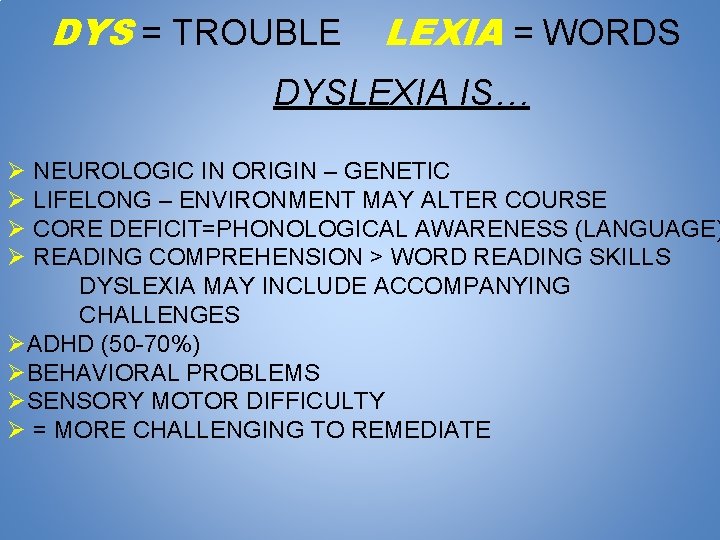
DYS = TROUBLE LEXIA = WORDS DYSLEXIA IS… Ø NEUROLOGIC IN ORIGIN – GENETIC Ø LIFELONG – ENVIRONMENT MAY ALTER COURSE Ø CORE DEFICIT=PHONOLOGICAL AWARENESS (LANGUAGE) Ø READING COMPREHENSION > WORD READING SKILLS DYSLEXIA MAY INCLUDE ACCOMPANYING CHALLENGES ØADHD (50 -70%) ØBEHAVIORAL PROBLEMS ØSENSORY MOTOR DIFFICULTY Ø = MORE CHALLENGING TO REMEDIATE
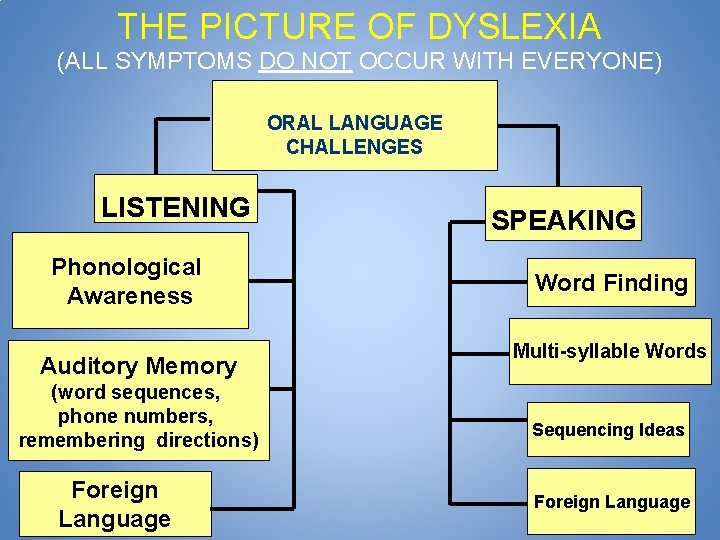
THE PICTURE OF DYSLEXIA (ALL SYMPTOMS DO NOT OCCUR WITH EVERYONE) ORAL LANGUAGE CHALLENGES LISTENING Phonological Awareness Auditory Memory (word sequences, phone numbers, remembering directions) Foreign Language SPEAKING Word Finding Multi-syllable Words Sequencing Ideas Foreign Language
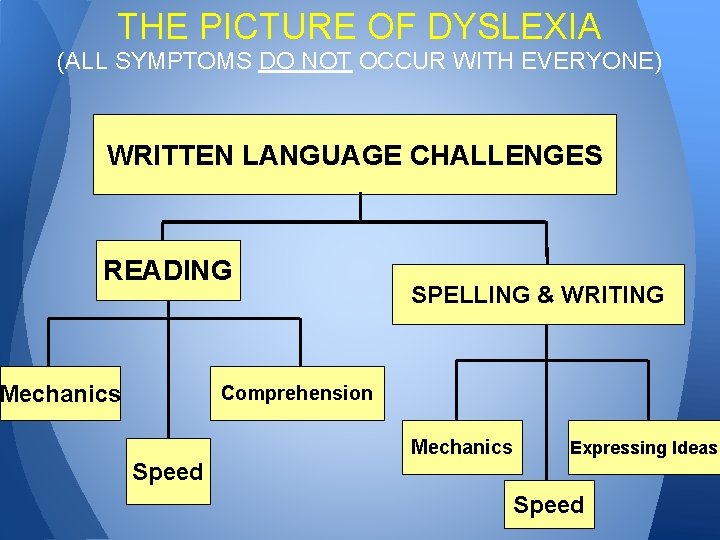
THE PICTURE OF DYSLEXIA (ALL SYMPTOMS DO NOT OCCUR WITH EVERYONE) WRITTEN LANGUAGE CHALLENGES READING Mechanics SPELLING & WRITING Comprehension Speed Mechanics Expressing Ideas Speed
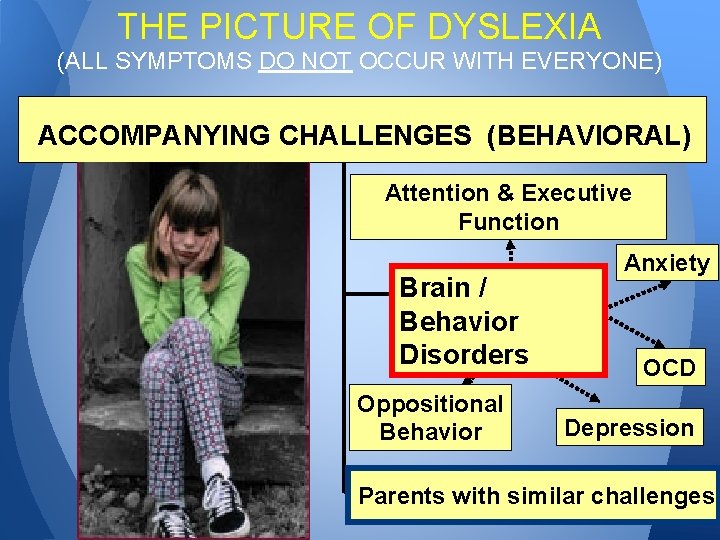
THE PICTURE OF DYSLEXIA (ALL SYMPTOMS DO NOT OCCUR WITH EVERYONE) ACCOMPANYING CHALLENGES (BEHAVIORAL) Attention & Executive Function Brain / Behavior Disorders Oppositional Behavior Anxiety OCD Depression Parents with similar challenges
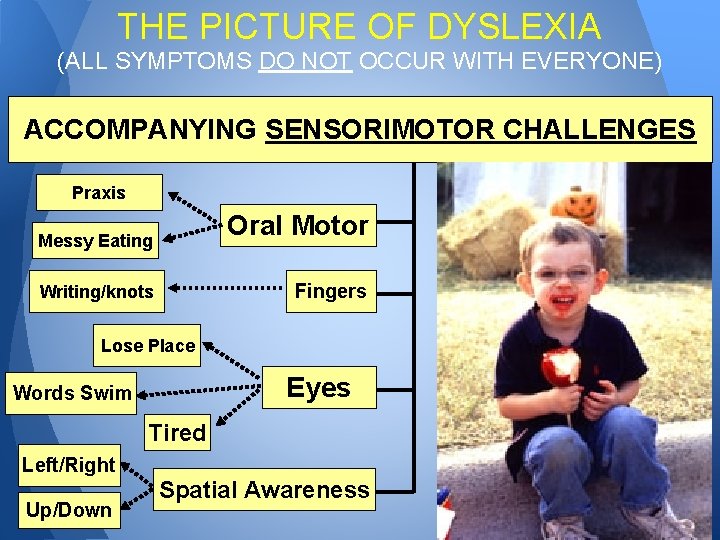
THE PICTURE OF DYSLEXIA (ALL SYMPTOMS DO NOT OCCUR WITH EVERYONE) ACCOMPANYING SENSORIMOTOR CHALLENGES Praxis Oral Motor Messy Eating Fingers Writing/knots Lose Place Eyes Words Swim Tired Left/Right Up/Down Spatial Awareness
Transdisciplinary Team for Assessment & Treatment Disciplines: Neuropsychology Psychiatry Clinical Psychology Occupational Therapy Speech-Language Pathology Education
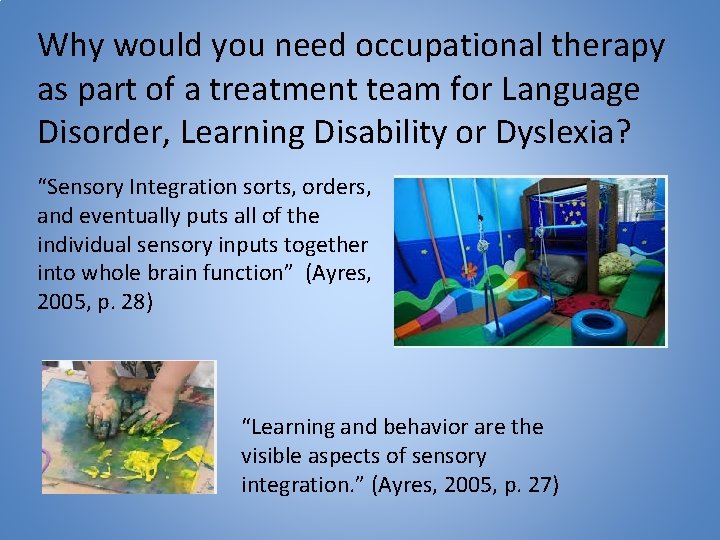
Why would you need occupational therapy as part of a treatment team for Language Disorder, Learning Disability or Dyslexia? “Sensory Integration sorts, orders, and eventually puts all of the individual sensory inputs together into whole brain function” (Ayres, 2005, p. 28) “Learning and behavior are the visible aspects of sensory integration. ” (Ayres, 2005, p. 27)
Occupational Therapy Research shows that more than 50 percent of individuals with learning difficulties may also have sensorimotor difficulties. Occupational Therapists are the experts on the development of sensory and motor skills. These skills are other foundational skills, besides language, that can affect the development of academic skills or interfere with academic performance. The individual who has language and sensorimotor deficits are struggling even harder to develop their skills and perform daily activities. Sensorimotor difficulties may include: • ORAL-MOTOR AND MOTOR PLANNING DIFFICULTY • FINE AND GROSS MOTOR DIFFICULTIES – TROUBLE TYING A SHOE, CUTTING WITH SCISSORS, EATING WITH UTENSILS or JUMPING ROPE • VISUAL PERCEPTUAL DELAYS – POOR DEPTH PERCEPTION or FIGURE GROUND • SOMATOSENSORY DEFICITS – POOR BODY AWARENESS, COORDINATION, or CLUMSINESS • SENSORY HYPERSENSITIVITY – OVERLY SENSITIVE TO SMELLS, TASTES, ETC…
“Society is placing more emphasis on language, academic, and intellectual development, and less on building the sensorimotor foundations for these higher functions. ” (Ayres, 2005, p. 141) § § § 5 to 10 hours of OT per week Transdiciplinary team understands the close relationship between language-based learning & sensorimotor difficulties Therapists confer daily regarding treatment progress OT Goals = improve overall core strength, balance, visual processing, sensory processing and coordination. Strengthening these areas will help improve sensorimotor skills, sensorimotor foundations of language skills, academic skills, build self-confidence and enhance self-esteem.
TMC – Occupational Therapy Objectives Assess, educate, communicate, and plan to: Address the sensory processing, sensorimotor, and arousal state modulation challenges of each client to optimize their learning potential throughout the day Facilitate generalization of these skills into each person’s activities of daily living. Provide sensory-based occupational therapy intervention to: Find the just right challenges to facilitate more functional responses to sensation in active, meaningful, and fun ways so the client is able to develop more appropriate and/efficient adaptive responses/behaviors in academic, social, and self-care activities. Provide recommendations and education for: Accommodations, adaptive equipment, or modification of activities to optimize positioning and provide support as needed to meet each clients’ individual needs as they develop endurance, stamina and skills in dynamic academic, physically active and social settings at TMC and in their daily lives.
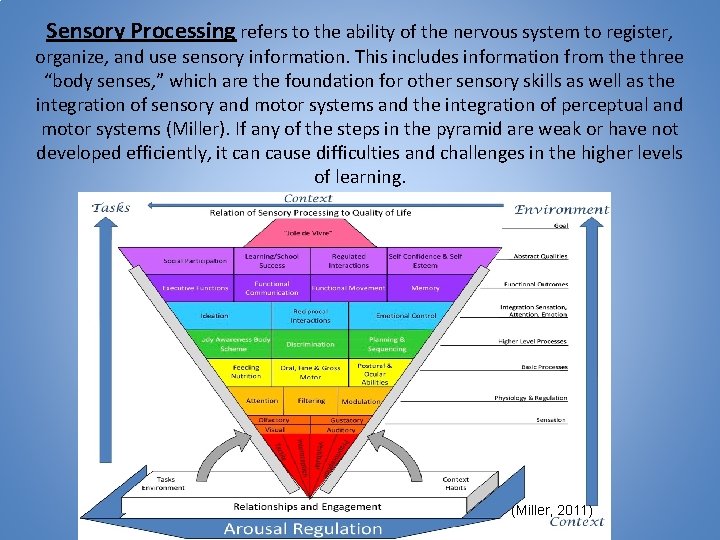
Sensory Processing refers to the ability of the nervous system to register, organize, and use sensory information. This includes information from the three “body senses, ” which are the foundation for other sensory skills as well as the integration of sensory and motor systems and the integration of perceptual and motor systems (Miller). If any of the steps in the pyramid are weak or have not developed efficiently, it can cause difficulties and challenges in the higher levels of learning. (Miller, 2011)
Vestibular system (balance and sense of movement and gravity) is the most powerful and crucial part of the sensory system. Proprioceptive system (position sense) refers to the sensory input and feedback that tells us about our body’s movement and position in space based on information from our muscles, joints, ligaments, tendons, and connective tissues. Tactile system processes information from our environment based on our sense of touch. There are many types of touch receptors including deep pressure/light touch, temperature, and pain receptors. Auditory processing is related to listening and discriminating the differences in sounds. Even though hearing may be normal, when there are difficulties with auditory processing there is a mismatch in the ability to interpret or discriminate sounds. This can impact academic skills including language development, reading, spelling and being able to follow directions.
Visual Perceptual Skills involve the ability to organize and interpret the information that is seen, and give that information meaning. Some examples of visual perceptual skills include those that are important in navigating everyday life and academics: Visual Discrimination – recognizing differences between similar objects Visual Memory – being able to hold the visual image of an object in memory for a brief period of time and choose it from among similar items Spatial Relations – accurately perceiving the position of objects in relation to oneself or other objects Visual Form Constancy – recognizing an object despite changes in size, shape, or orientation Visual Sequencing – being able to remember (the order or sequence) of a series of forms or characters Figure-Ground – finding an object in a complex background Visual Closure – being able to infer what an object is based on by seeing partial information about that object
Reflexes The Moro Reflex occurs in response to loss of support of the head and upper body. A child who has not integrated the Moro reflex efficiently will often be in a high-alert or stressed state. The Moro and the TLR are also closely linked and involved in vestibular (balance) processing. The Tonic Labyrinthine Reflex (TLR) comes in two forms in response to movement of the head (vestibular/proprioceptive processing). When not integrated efficiently, the TLR can impact motor development, muscle tone, postural control and gravitational security. The TLR supports the development of other reflexes into more mature movement patterns including the STNR and the ATNR. The Symmetrical Tonic Neck Reflex (STNR) involves the bending of the elbows when the neck is flexed and knees are bent. This reflex helps prepare babies for learning to crawl on hands and knees. When present in older children, the STNR may interfere with postural control, gross and fine motor movement and ocular motor control. The Asymmetrical Tonic Neck Reflex (ATNR) occurs when the head is turned to the side and the arm on the same side extends outward. This reflex assists an infant when reaching for objects and for learning to roll over. When not integrated efficiently, it may contribute to head-turning during visual motor activities, difficulty with motor planning and praxis with activities off of mid-line as well as rotational activities. When present in older children, the ATNR may interfere with daily performance in movement, activities of daily living and academic activities.
Postural control is the ability of the body to stay upright against the pull of gravity and to adjust one’s posture to keep from falling down. Postural control, joint stability, and strength and endurance are heavily reliant upon respiration efficiency, visual, vestibular, and proprioceptive information. Postural control provides a base of support for the arms and legs to work from and provides the stability for ocular motor and visual perceptual skills to develop in order to perform activities of daily living, movement and coordination activities, as well as academic skills (cutting, drawing, writing, copying from the board or book/paper at a desk). Praxis is the ability of the brain and body to use sensory information in order to perform activities and involves a number of skills and abilities. Motor planning is one of those abilities and involves having an idea, planning the movements, and executing the plan. Once a movement pattern for a new skill becomes proficient, motor planning becomes automatic. Gross motor skills require use of large muscle groups to perform tasks such as walking, balancing, and crawling
Fine motor skills require use of smaller muscle groups to perform tasks that are precise in nature, such as writing and typing. Oculomotor control refers to the ability of the eyes to locate objects in the environment, and maintain focus on a moving object. Deficits with these skills will likely impact visual attention to tasks and activities as well as performance in academics. Graphomotor production refers to the quality of handwriting/drawing/copying. Pencil grip and the pressure used when writing can affect the quality and speed of grapho-motor production. Visual-motor integration refers to the ability to use visual information to motor plan and to execute motor movements. Tracing, copying designs, taking notes from a blackboard and physical education activities are a few of the academic tasks that require solid visual-motor integration skills. Integrating visual information with motor skills often relies heavily upon one’s posture to provide joint stability for the hands to perform intricate movements and sensory processing of vestibular, proprioceptive, tactile, and visual information.
Core Concepts of Sensory Integration…. - provides a foundation for learning and behavior. All sensory systems are important contributors to learning and behavior. The body related senses of tactile, vestibular, and proprioception provide reference points relating to the body and its place in the environment – a critical component to all learning and behavior. - is a developmental process - promotes neuroplasticity. Neuroplasticity is the ability to change in response to environmental input and demands. Lane and Schaaf concluded the literature related to neuroplasticity supports the concept that changes in neural function are possible and that meaningful sensorymotor activities mediate these changes. (Schaaf & Mailloux, 2015)
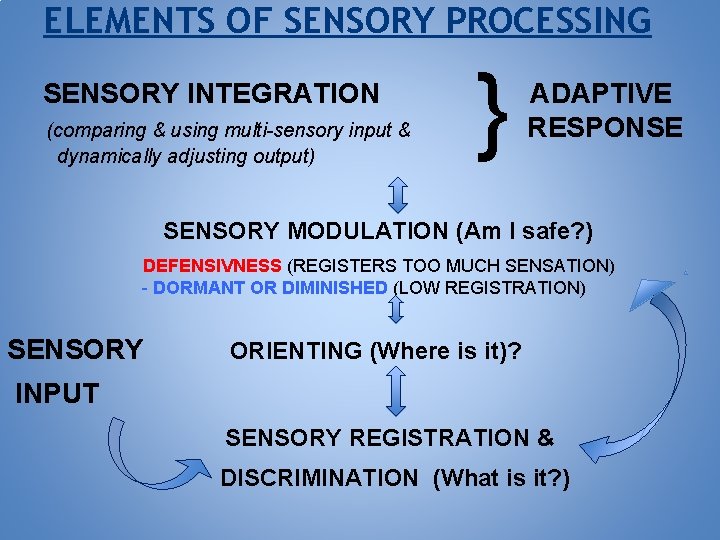
ELEMENTS OF SENSORY PROCESSING } SENSORY INTEGRATION ADAPTIVE (comparing & using multi-sensory input & dynamically adjusting output) RESPONSE SENSORY MODULATION (Am I safe? ) DEFENSIVNESS (REGISTERS TOO MUCH SENSATION) - DORMANT OR DIMINISHED (LOW REGISTRATION) SENSORY ORIENTING (Where is it)? INPUT SENSORY REGISTRATION & DISCRIMINATION (What is it? )
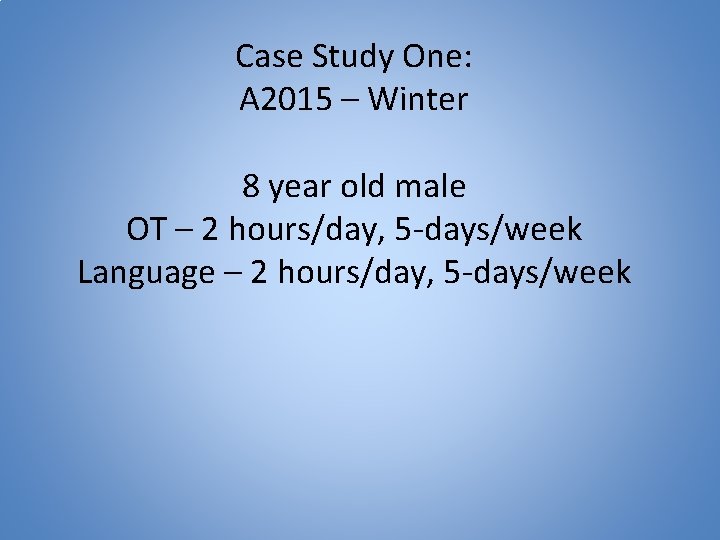
Case Study One: A 2015 – Winter 8 year old male OT – 2 hours/day, 5 -days/week Language – 2 hours/day, 5 -days/week
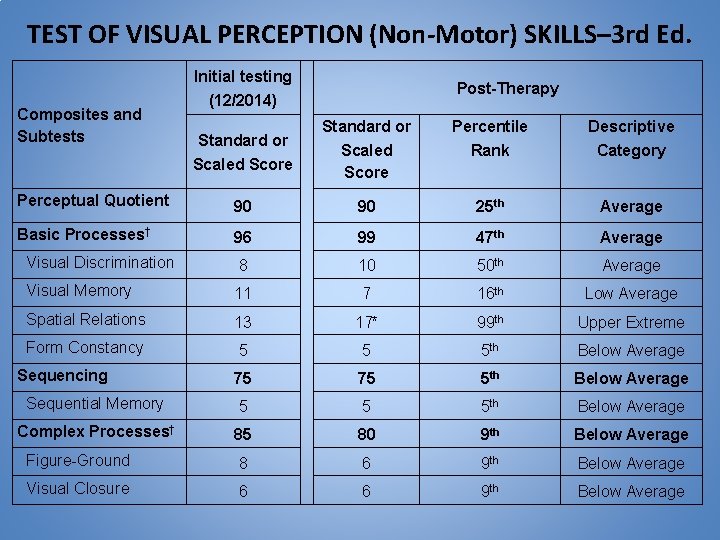
TEST OF VISUAL PERCEPTION (Non-Motor) SKILLS– 3 rd Ed. Initial testing Composites and Subtests Post-Therapy (12/2014) Standard or Percentile Descriptive Scaled Score Rank Category Perceptual Quotient 90 90 25 th Average Basic Processes† 96 99 47 th Average Visual Discrimination 8 10 50 th Average Visual Memory 11 7 16 th Low Average Spatial Relations 13 17* 99 th Upper Extreme Form Constancy 5 5 5 th Below Average 75 75 5 th Below Average Sequential Memory 5 5 5 th Below Average Complex Processes† 85 80 9 th Below Average Figure-Ground 8 6 9 th Below Average Visual Closure 6 6 9 th Below Average Sequencing Standard or
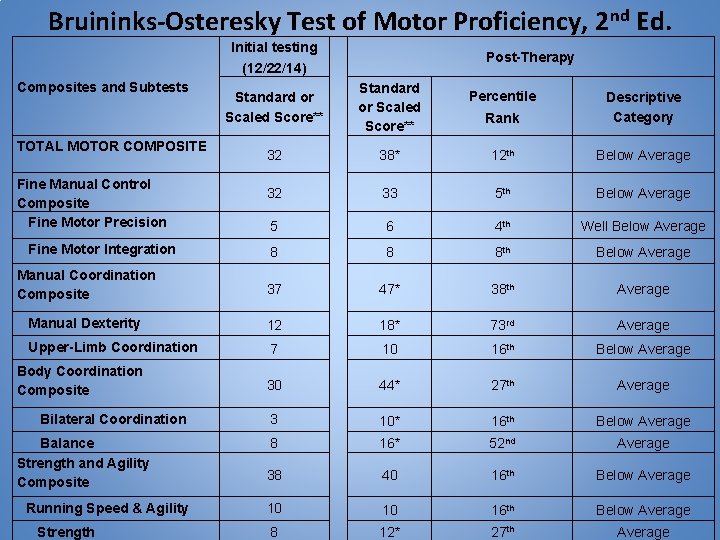
Bruininks-Osteresky Test of Motor Proficiency, 2 nd Ed. Initial testing Post-Therapy (12/22/14) Composites and Subtests Standard or Scaled Score** 32 Percentile Rank Descriptive Category 38* 12 th Below Average 32 33 5 th Below Average 5 6 4 th Well Below Average Fine Motor Integration 8 8 8 th Below Average Manual Coordination Composite 37 47* 38 th Average Manual Dexterity 12 18* 73 rd Average Upper-Limb Coordination 7 10 16 th Below Average Body Coordination Composite 30 44* 27 th Average Bilateral Coordination 3 10* 16 th Below Average Balance Strength and Agility Composite 8 16* 52 nd Average 38 40 16 th Below Average Running Speed & Agility 10 10 16 th Below Average Strength 8 12* 27 th Average TOTAL MOTOR COMPOSITE Fine Manual Control Composite Fine Motor Precision
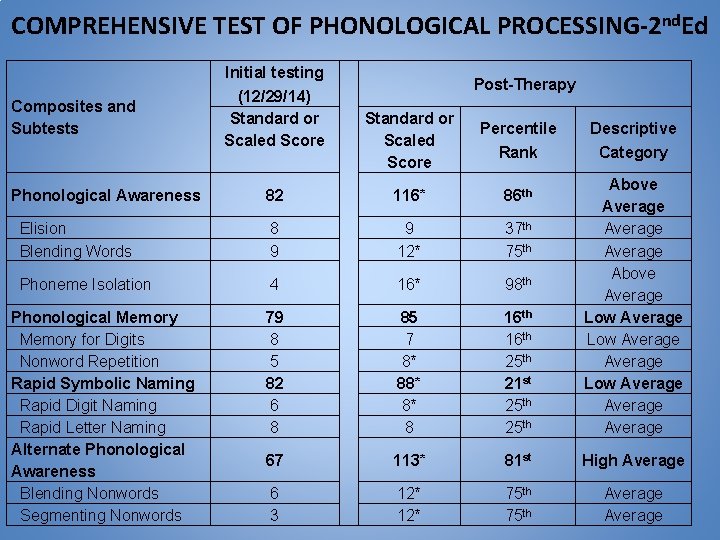
COMPREHENSIVE TEST OF PHONOLOGICAL PROCESSING-2 nd. Ed Initial testing Composites and Subtests (12/29/14) Standard or Scaled Score Post-Therapy Standard or Scaled Score Percentile Descriptive Rank Category 82 116* 86 th Elision Blending Words 8 9 9 12* 37 th 75 th Phoneme Isolation 4 16* 98 th 79 8 5 82 6 8 85 7 8* 8* 8 16 th 25 th 21 st 25 th Above Average Above Average Low Average 67 113* 81 st High Average 6 3 12* 75 th Average Phonological Awareness Phonological Memory for Digits Nonword Repetition Rapid Symbolic Naming Rapid Digit Naming Rapid Letter Naming Alternate Phonological Awareness Blending Nonwords Segmenting Nonwords
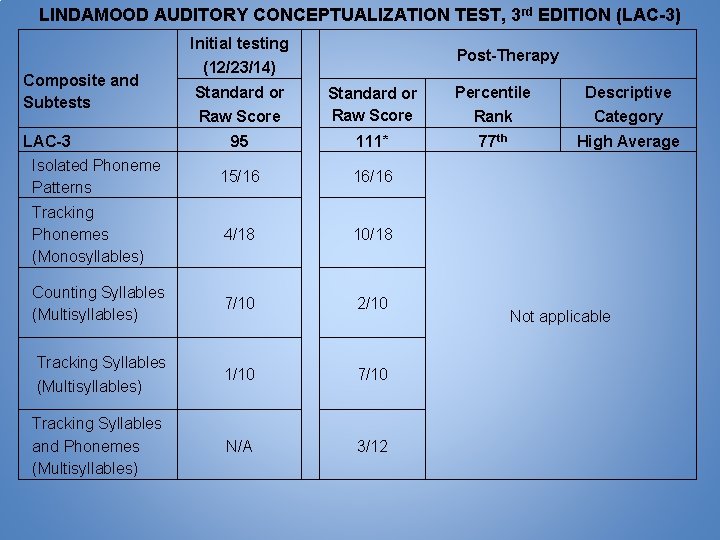
LINDAMOOD AUDITORY CONCEPTUALIZATION TEST, 3 rd EDITION (LAC-3) Composite and Subtests Initial testing Post-Therapy (12/23/14) Percentile Descriptive Raw Score Standard or Raw Score Rank Category 95 111* 77 th High Average Isolated Phoneme Patterns 15/16 16/16 Tracking Phonemes (Monosyllables) 4/18 10/18 Counting Syllables (Multisyllables) 7/10 2/10 1/10 7/10 N/A 3/12 LAC-3 Tracking Syllables (Multisyllables) Tracking Syllables and Phonemes (Multisyllables) Standard or Not applicable
Case Study Two: R 2014 - Fall 13 year old female OT – 1 hour per day, 5 -days/week Language – 4 hours per day, 5 -days/week
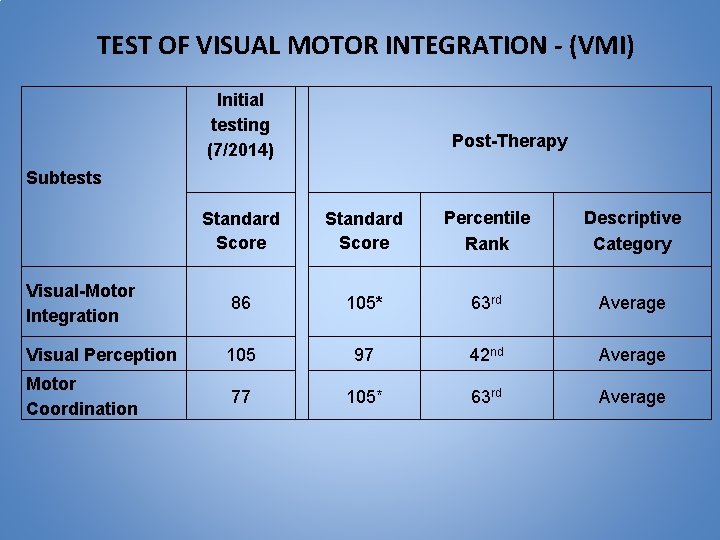
TEST OF VISUAL MOTOR INTEGRATION - (VMI) Initial testing (7/2014) Post-Therapy Subtests Standard Score Percentile Rank Descriptive Category Visual-Motor Integration 86 105* 63 rd Average Visual Perception 105 97 42 nd Average Motor Coordination 77 105* 63 rd Average
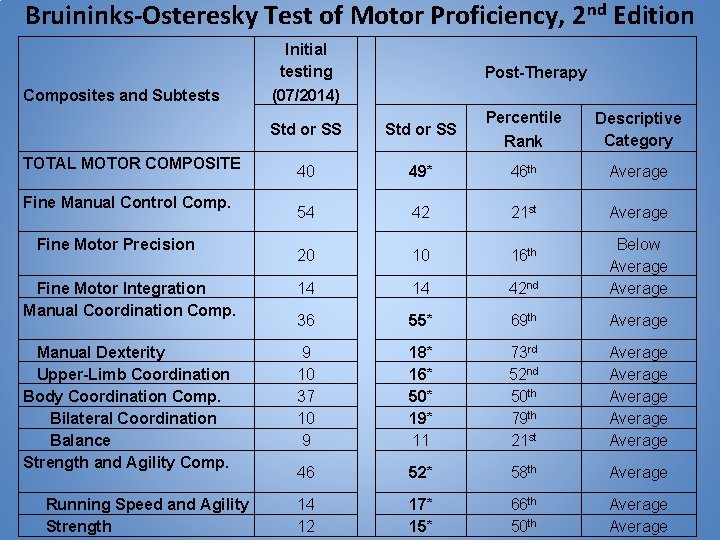
Bruininks-Osteresky Test of Motor Proficiency, 2 nd Edition Initial testing Composites and Subtests Post-Therapy (07/2014) Percentile Rank Descriptive Category 49* 46 th Average 54 42 21 st Average 20 10 16 th Fine Motor Integration Manual Coordination Comp. 14 14 42 nd Below Average 36 55* 69 th Average Manual Dexterity Upper-Limb Coordination Body Coordination Comp. Bilateral Coordination Balance Strength and Agility Comp. 9 10 37 10 9 18* 16* 50* 19* 11 73 rd 52 nd 50 th 79 th 21 st Average Average 46 52* 58 th Average 14 12 17* 15* 66 th 50 th Average TOTAL MOTOR COMPOSITE Fine Manual Control Comp. Fine Motor Precision Running Speed and Agility Strength Std or SS 40
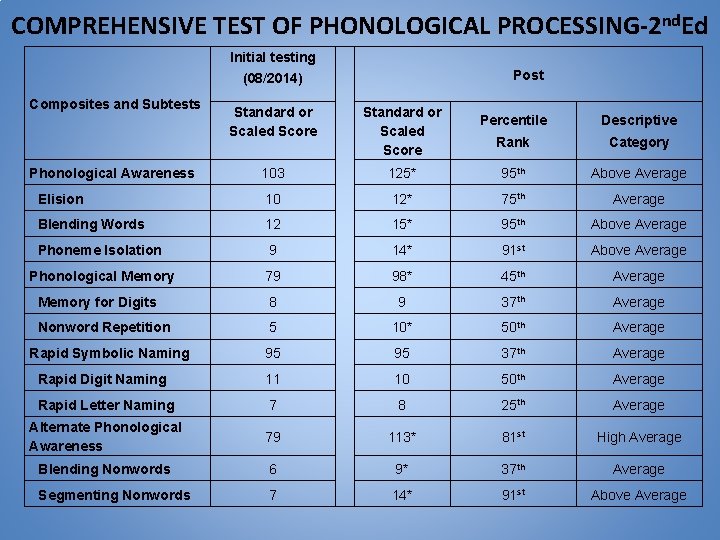
COMPREHENSIVE TEST OF PHONOLOGICAL PROCESSING-2 nd. Ed Initial testing Post (08/2014) Composites and Subtests Standard or Scaled Score 103 Elision Percentile Descriptive Rank Category 125* 95 th Above Average 10 12* 75 th Average Blending Words 12 15* 95 th Above Average Phoneme Isolation 9 14* 91 st Above Average Phonological Memory 79 98* 45 th Average Memory for Digits 8 9 37 th Average Nonword Repetition 5 10* 50 th Average 95 95 37 th Average Rapid Digit Naming 11 10 50 th Average Rapid Letter Naming 7 8 25 th Average Alternate Phonological Awareness 79 113* 81 st High Average Blending Nonwords 6 9* 37 th Average Segmenting Nonwords 7 14* 91 st Above Average Phonological Awareness Rapid Symbolic Naming
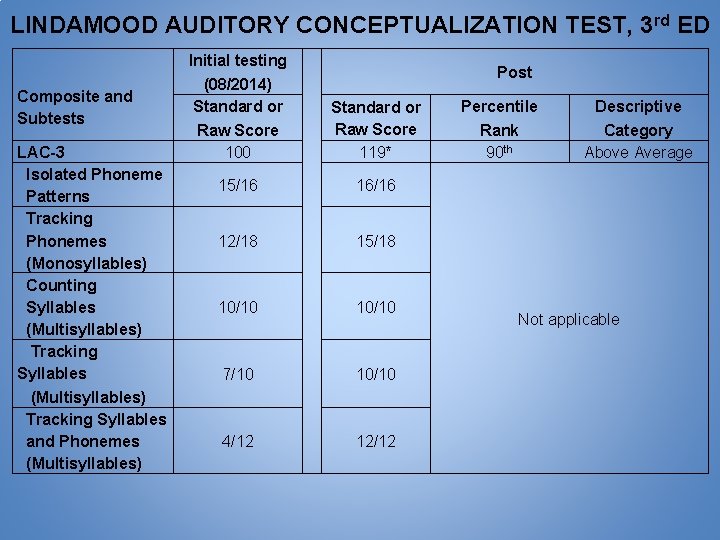
LINDAMOOD AUDITORY CONCEPTUALIZATION TEST, 3 rd ED Composite and Subtests LAC-3 Isolated Phoneme Patterns Tracking Phonemes (Monosyllables) Counting Syllables (Multisyllables) Tracking Syllables (Multisyllables) Tracking Syllables and Phonemes (Multisyllables) Initial testing (08/2014) Standard or Post Raw Score 100 Standard or Raw Score 119* 15/16 16/16 12/18 15/18 10/10 7/10 10/10 4/12 12/12 Percentile Descriptive Rank 90 th Category Above Average Not applicable
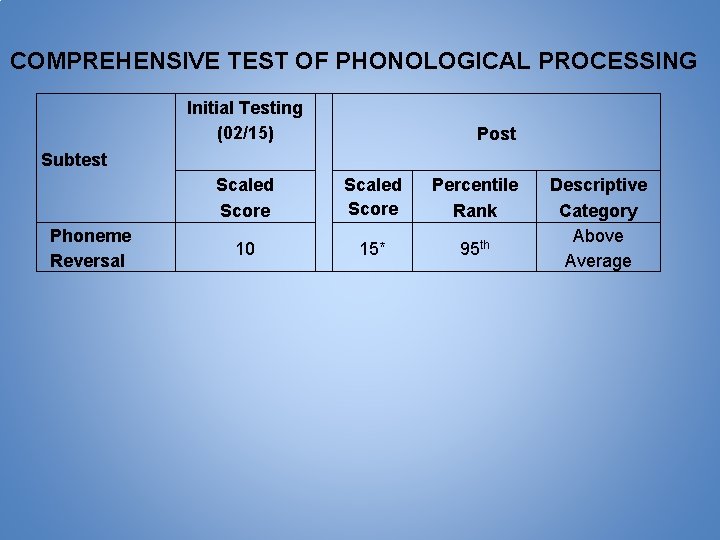
COMPREHENSIVE TEST OF PHONOLOGICAL PROCESSING Initial Testing (02/15) Post Subtest Phoneme Reversal Scaled Score Percentile Rank 10 15* 95 th Descriptive Category Above Average
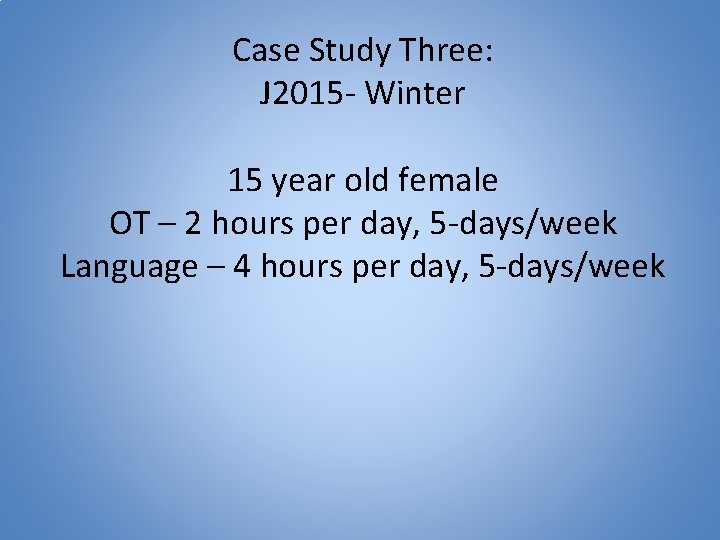
Case Study Three: J 2015 - Winter 15 year old female OT – 2 hours per day, 5 -days/week Language – 4 hours per day, 5 -days/week
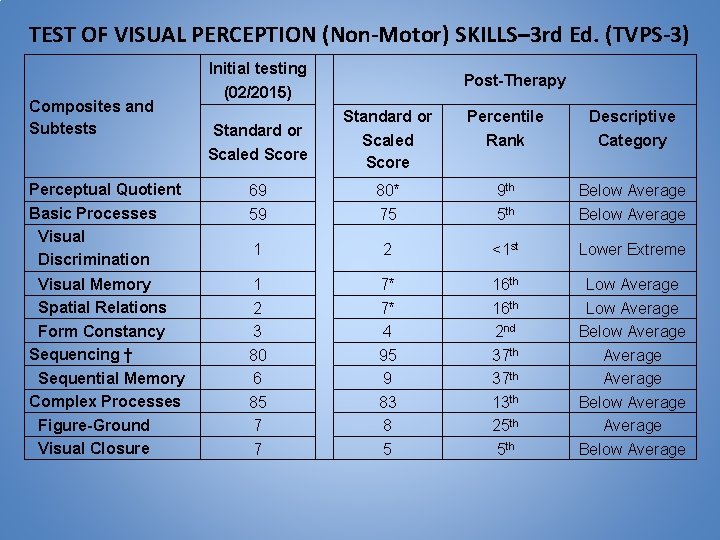
TEST OF VISUAL PERCEPTION (Non-Motor) SKILLS– 3 rd Ed. (TVPS-3) Initial testing Composites and Subtests Post-Therapy (02/2015) Standard or Percentile Descriptive Scaled Score Rank Category Perceptual Quotient Basic Processes Visual Discrimination 69 59 80* 75 9 th 5 th Below Average 1 2 <1 st Lower Extreme Visual Memory Spatial Relations Form Constancy Sequencing † Sequential Memory Complex Processes Figure-Ground Visual Closure 1 2 3 80 6 85 7 7 7* 7* 4 95 9 83 8 5 16 th 2 nd 37 th 13 th 25 th Low Average Below Average Standard or
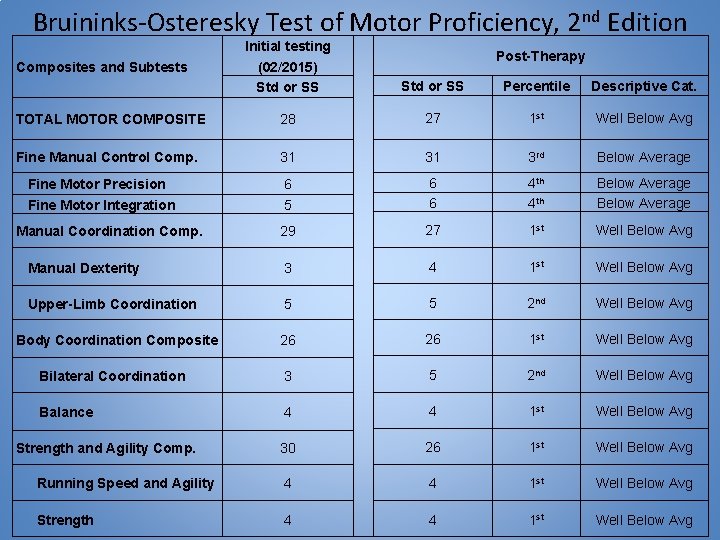
Bruininks-Osteresky Test of Motor Proficiency, 2 nd Edition Initial testing Composites and Subtests Post-Therapy (02/2015) Std or SS Percentile Descriptive Cat. TOTAL MOTOR COMPOSITE 28 27 1 st Well Below Avg Fine Manual Control Comp. 31 31 3 rd Below Average Fine Motor Precision Fine Motor Integration 6 5 6 6 4 th Below Average Manual Coordination Comp. 29 27 1 st Well Below Avg Manual Dexterity 3 4 1 st Well Below Avg Upper-Limb Coordination 5 5 2 nd Well Below Avg Body Coordination Composite 26 26 1 st Well Below Avg Bilateral Coordination 3 5 2 nd Well Below Avg Balance 4 4 1 st Well Below Avg Strength and Agility Comp. 30 26 1 st Well Below Avg Running Speed and Agility 4 4 1 st Well Below Avg Strength 4 4 1 st Well Below Avg
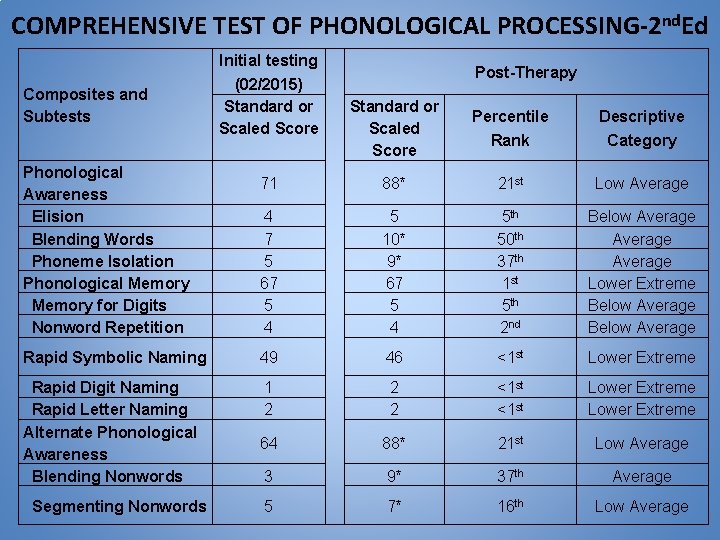
COMPREHENSIVE TEST OF PHONOLOGICAL PROCESSING-2 nd. Ed Initial testing Composites and Subtests Phonological Awareness Elision Blending Words Phoneme Isolation Phonological Memory for Digits Nonword Repetition (02/2015) Standard or Scaled Score Post-Therapy Standard or Scaled Score Percentile Descriptive Rank Category 71 88* 21 st Low Average 4 7 5 67 5 4 5 10* 9* 67 5 4 5 th 50 th 37 th 1 st 5 th 2 nd Below Average Lower Extreme Below Average Rapid Symbolic Naming 49 46 <1 st Lower Extreme Rapid Digit Naming Rapid Letter Naming Alternate Phonological Awareness Blending Nonwords 1 2 2 2 <1 st Lower Extreme 64 88* 21 st Low Average 3 9* 37 th Average 5 7* 16 th Low Average Segmenting Nonwords
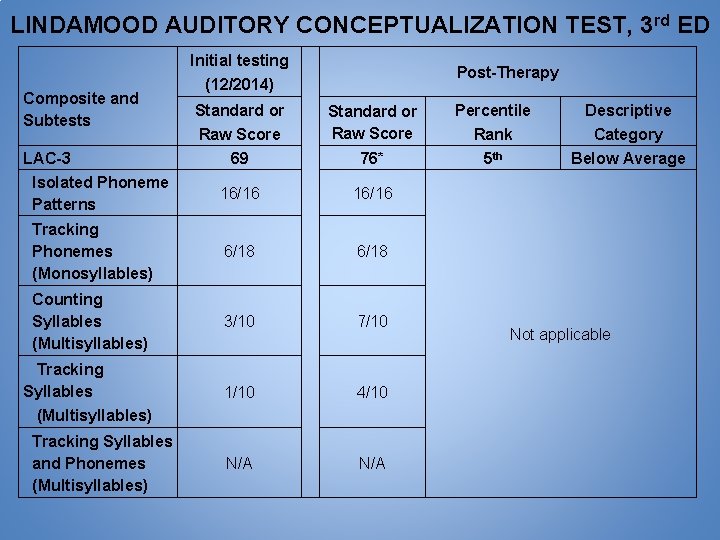
LINDAMOOD AUDITORY CONCEPTUALIZATION TEST, 3 rd ED Composite and Subtests Initial testing Post-Therapy (12/2014) Percentile Descriptive Raw Score Standard or Raw Score Rank Category 69 76* 5 th Below Average Isolated Phoneme Patterns 16/16 Tracking Phonemes (Monosyllables) 6/18 Counting Syllables (Multisyllables) 3/10 7/10 1/10 4/10 N/A LAC-3 Tracking Syllables Standard or (Multisyllables) Tracking Syllables and Phonemes (Multisyllables) Not applicable
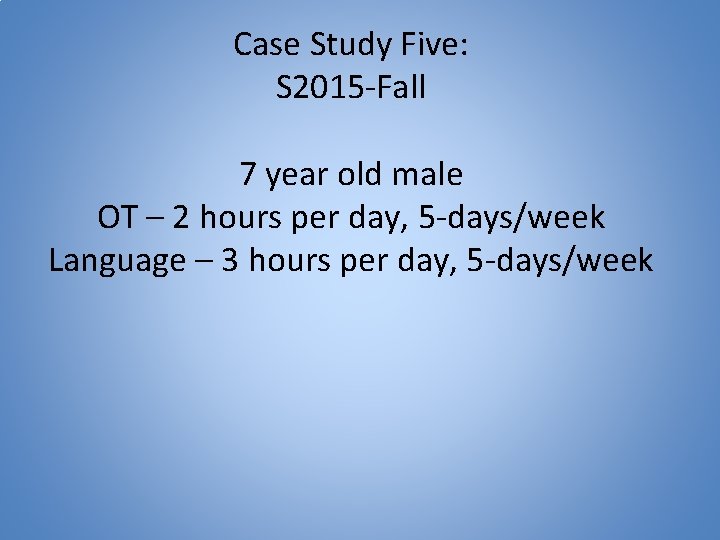
Case Study Five: S 2015 -Fall 7 year old male OT – 2 hours per day, 5 -days/week Language – 3 hours per day, 5 -days/week
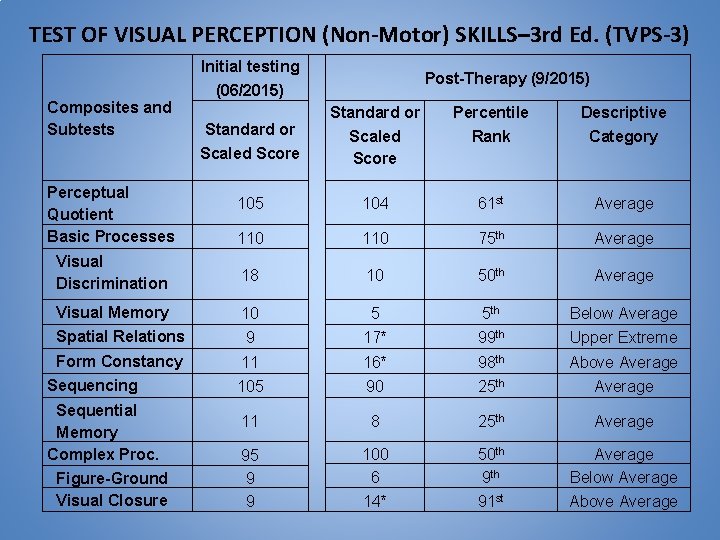
TEST OF VISUAL PERCEPTION (Non-Motor) SKILLS– 3 rd Ed. (TVPS-3) Initial testing Composites and Subtests Post-Therapy (9/2015) (06/2015) Standard or Percentile Descriptive Scaled Score Rank Category 105 104 61 st Average 110 75 th Average Visual Discrimination 18 10 50 th Average Visual Memory 10 5 5 th Below Average Spatial Relations 9 17* 99 th Upper Extreme Form Constancy 11 16* 98 th Above Average 105 90 25 th Average 11 8 25 th Average 95 9 9 100 6 14* 50 th 91 st Average Below Average Above Average Perceptual Quotient Basic Processes Sequencing Sequential Memory Complex Proc. Figure-Ground Visual Closure Standard or
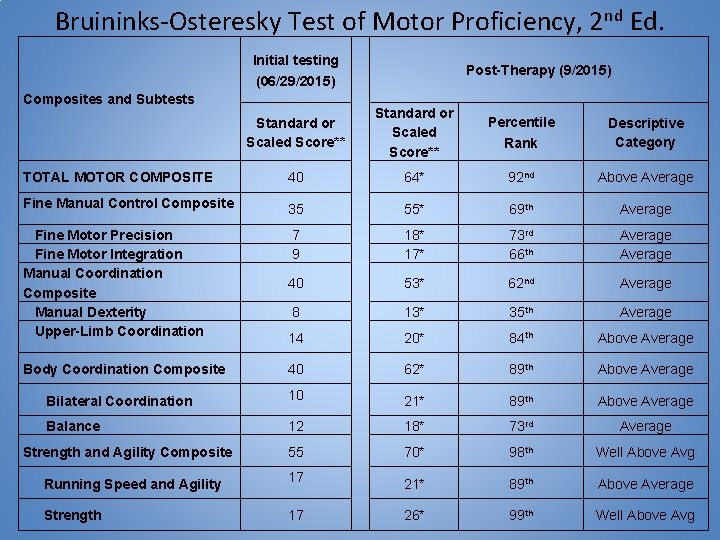
Bruininks-Osteresky Test of Motor Proficiency, 2 nd Ed. Initial testing Post-Therapy (9/2015) (06/29/2015) Composites and Subtests Standard or Scaled Score** TOTAL MOTOR COMPOSITE 40 Fine Manual Control Composite Fine Motor Precision Fine Motor Integration Manual Coordination Composite Manual Dexterity Upper-Limb Coordination Percentile Rank Descriptive Category 64* 92 nd Above Average 35 55* 69 th Average 7 9 18* 17* 73 rd 66 th Average 40 53* 62 nd Average 8 13* 35 th Average 14 20* 84 th Above Average Body Coordination Composite 40 62* 89 th Above Average Bilateral Coordination 10 21* 89 th Above Average Balance 12 18* 73 rd Average Strength and Agility Composite 55 70* 98 th Well Above Avg Running Speed and Agility 17 21* 89 th Above Average Strength 17 26* 99 th Well Above Avg
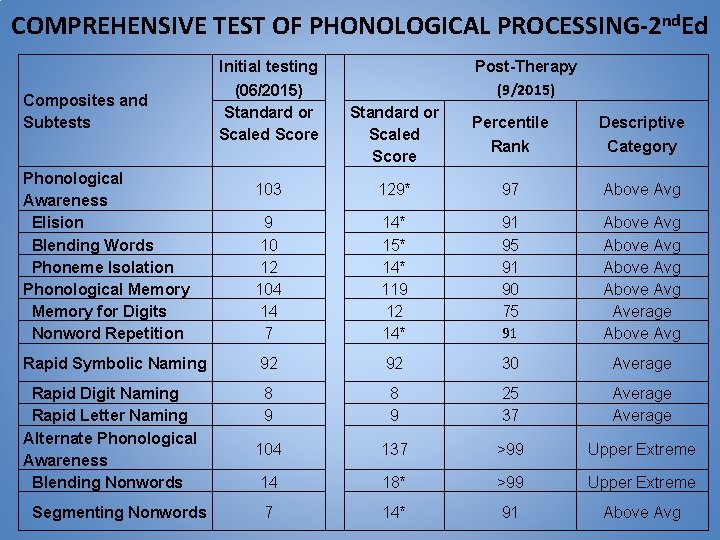
COMPREHENSIVE TEST OF PHONOLOGICAL PROCESSING-2 nd. Ed Initial testing Composites and Subtests Phonological Awareness Elision Blending Words Phoneme Isolation Phonological Memory for Digits Nonword Repetition (06/2015) Standard or Scaled Score Post-Therapy (9/2015) Standard or Scaled Score Percentile Descriptive Rank Category 103 129* 97 Above Avg 9 10 12 104 14 7 14* 15* 14* 119 12 14* 91 95 91 90 75 91 Above Avg Average Above Avg Rapid Symbolic Naming 92 92 30 Average Rapid Digit Naming Rapid Letter Naming Alternate Phonological Awareness Blending Nonwords 8 9 25 37 Average 104 137 >99 Upper Extreme 14 18* >99 Upper Extreme 7 14* 91 Above Avg Segmenting Nonwords
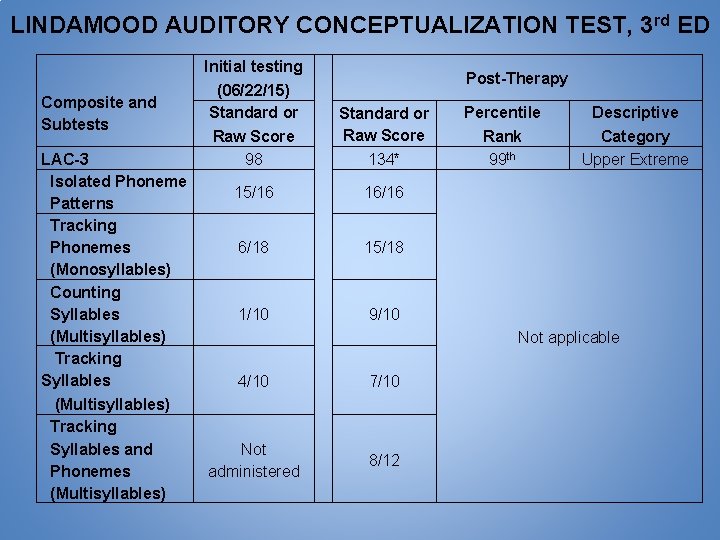
LINDAMOOD AUDITORY CONCEPTUALIZATION TEST, 3 rd ED Composite and Subtests LAC-3 Isolated Phoneme Patterns Tracking Phonemes (Monosyllables) Counting Syllables (Multisyllables) Tracking Syllables (Multisyllables) Tracking Syllables and Phonemes (Multisyllables) Initial testing (06/22/15) Standard or Post-Therapy Raw Score 98 Standard or Raw Score 134* 15/16 16/16 6/18 15/18 1/10 9/10 Percentile Descriptive Rank 99 th Category Upper Extreme Not applicable 4/10 7/10 Not administered 8/12
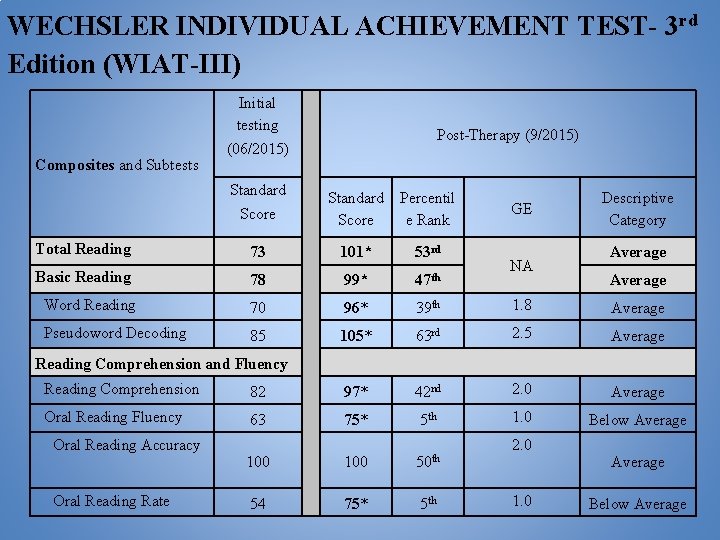
WECHSLER INDIVIDUAL ACHIEVEMENT TEST- 3 rd Edition (WIAT-III) Initial testing Composites and Subtests Post-Therapy (9/2015) (06/2015) Standard Score Standard Percentil Score e Rank GE Descriptive Category Total Reading 73 101* 53 rd Basic Reading 78 99* 47 th Word Reading 70 96* 39 th 1. 8 Average Pseudoword Decoding 85 105* 63 rd 2. 5 Average Reading Comprehension and Fluency NA Average Reading Comprehension 82 97* 42 nd 2. 0 Average Oral Reading Fluency 63 75* 5 th 1. 0 Below Average 100 50 th 54 75* 5 th Oral Reading Accuracy Oral Reading Rate 2. 0 1. 0 Average Below Average
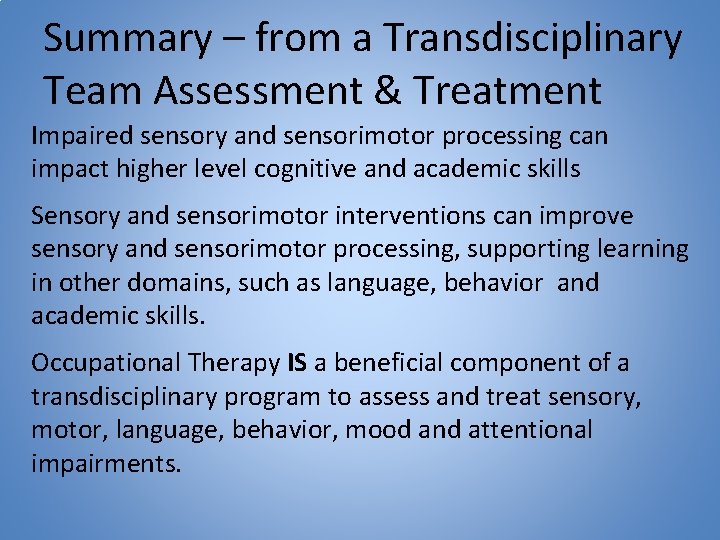
Summary – from a Transdisciplinary Team Assessment & Treatment Impaired sensory and sensorimotor processing can impact higher level cognitive and academic skills Sensory and sensorimotor interventions can improve sensory and sensorimotor processing, supporting learning in other domains, such as language, behavior and academic skills. Occupational Therapy IS a beneficial component of a transdisciplinary program to assess and treat sensory, motor, language, behavior, mood and attentional impairments.
References Alexander, A. W. (2007). Developmental dyslexia. In E. Tridas (Ed. ) From ABC to ADHD (pp. 57 -101). Baltimore, MD: International Dyslexia Association. Alexander, A. W. , & Heilman, K. M. (2006). Treatment of developmental language disorders. Neurological Therapeutics: Principles and Practice. J. H. Noseworthy. Oxon, England, Informa Healthcare. 2: 3061 -3080. Ayres, A. J. (1972). Sensory Integration and learning disorders. Los Angelos, CA: Western Psychological Services. Ayres, A. J. (1979). Sensory Integration and the child. Los Angelos, CA: Western Psychological Services. Dunn, W. , Bennett, D. (2002). Patterns of sensory processing in children with attention deficit hyperactivity disorder. Occupational Therapy Journal of Research, 22, 4 -15. Ghanizadeh, A. (2011) Parent reported oral sensory sensitivity processing and food preferences in ADHD. Journal of Psychiatric Mental Health Nursing, Oct 6 [Epub ahead of print] Gritter, M. (1999). Clinical forum: sensory integration therapy. Is sensory integration effective for children with language-learning disorders? : a critical review of the evidence. Language, Speech, and Hearing Services in Schools, 30, 393 -400. Miller, L. J. (2011). Designing Spaces to Maximize Therapeutic Benefits. Presentation at the Sensory Processing Disorders Foundation conference, Fort Lauderdale, FL, October 20, 2011. Williams, S. , & Shellenberg, S. (1994). How does your engine run? A leader’s guide to the Alert program for self regulation. Albuquerque, NM: Therapy Works, Inc.

QUESTIONS? www. The. Morris. Center. com www. NOWprograms. com www. einsteinschool. us email: info@Morris. Centers. com info@NOWprograms. com
- Slides: 68