
SENSORY MOTOR SKILLS TRADITIONAL HUMAN INFORMATION PROCESSING MODEL



- Slides: 33
SENSORY MOTOR SKILLS
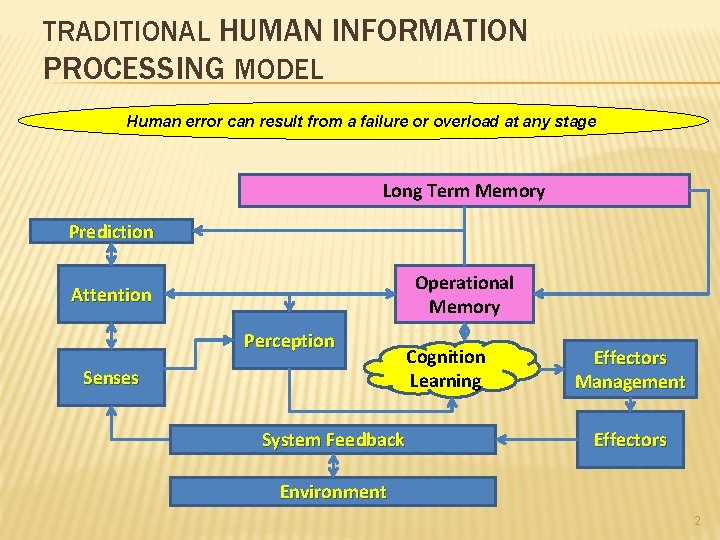
TRADITIONAL HUMAN INFORMATION PROCESSING MODEL Human error can result from a failure or overload at any stage Long Term Memory Prediction Operational Memory Attention Perception Senses System Feedback Cognition Learning Effectors Management Effectors Environment 2
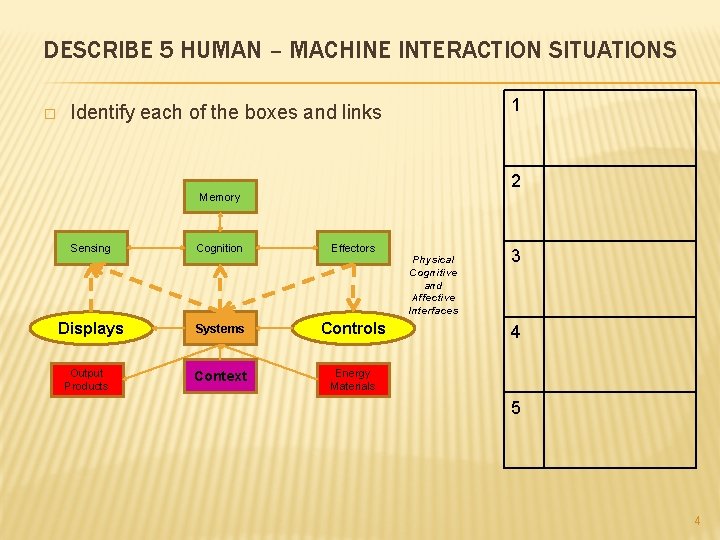
HUMAN MACHINE SYSTEM MODEL INTERFACES This model shows the addition of controls and displays to enhance human performance Memory Sensing Cognition Effectors Displays Systems Controls Context Energy Materials Output Products Physical Cognitive and Affective Interfaces 3
DESCRIBE 5 HUMAN – MACHINE INTERACTION SITUATIONS � 1 Identify each of the boxes and links 2 Memory Sensing Cognition Effectors Displays Systems Controls Context Energy Materials Output Products Physical Cognitive and Affective Interfaces 3 4 5 4
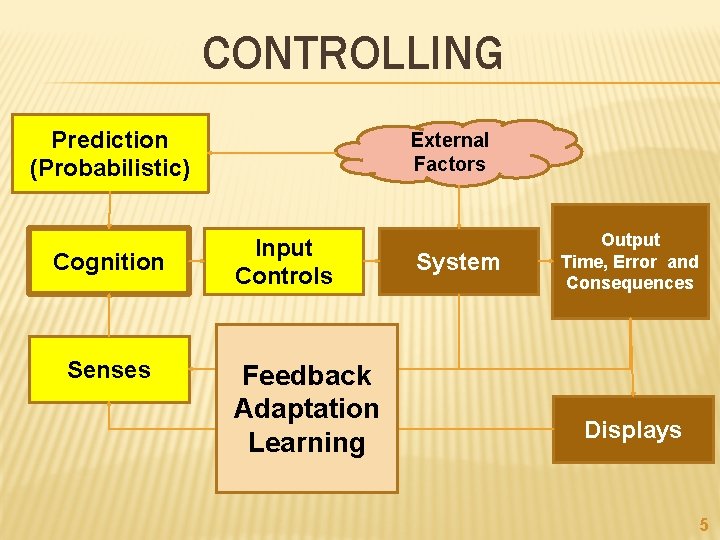
CONTROLLING Prediction (Probabilistic) Cognition Senses External Factors Input Controls Feedback Adaptation Learning System Output Time, Error and Consequences Displays 5
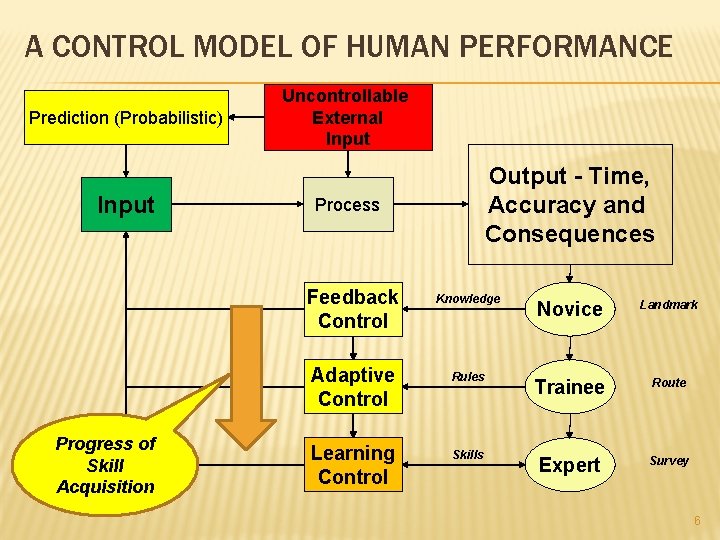
A CONTROL MODEL OF HUMAN PERFORMANCE Prediction (Probabilistic) Input Uncontrollable External Input Process Feedback Control Adaptive Control Progress of Skill Acquisition Output - Time, Accuracy and Consequences Learning Control Knowledge Novice Landmark Rules Trainee Route Skills Expert Survey 6
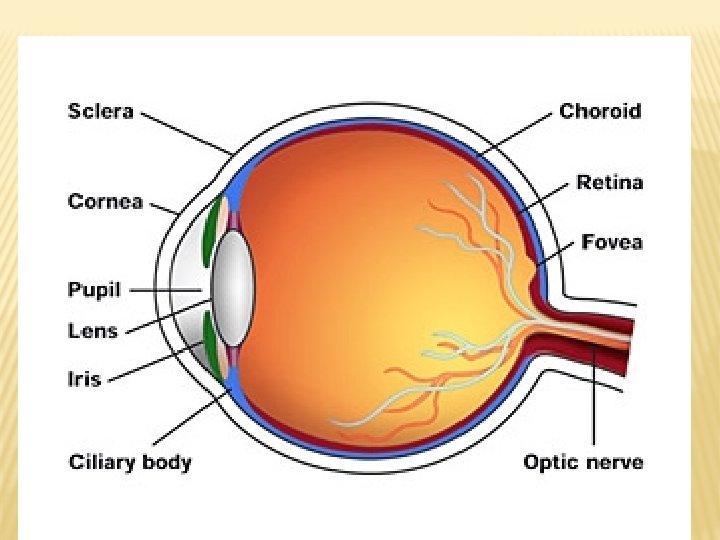
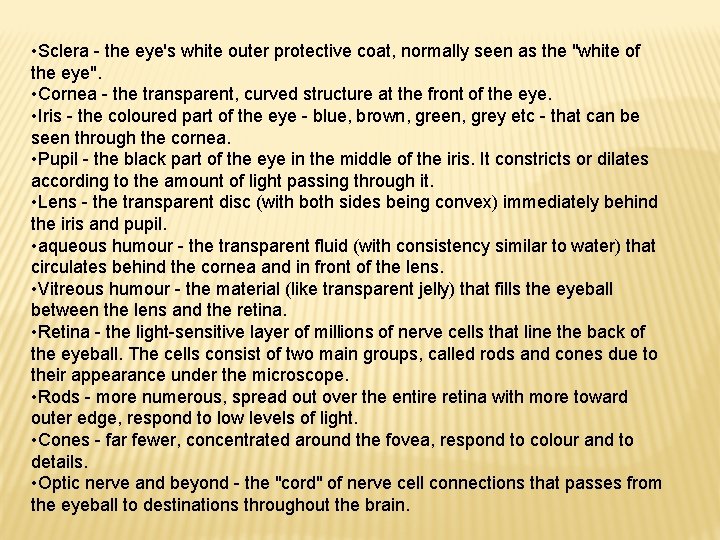
• Sclera - the eye's white outer protective coat, normally seen as the "white of the eye". • Cornea - the transparent, curved structure at the front of the eye. • Iris - the coloured part of the eye - blue, brown, green, grey etc - that can be seen through the cornea. • Pupil - the black part of the eye in the middle of the iris. It constricts or dilates according to the amount of light passing through it. • Lens - the transparent disc (with both sides being convex) immediately behind the iris and pupil. • aqueous humour - the transparent fluid (with consistency similar to water) that circulates behind the cornea and in front of the lens. • Vitreous humour - the material (like transparent jelly) that fills the eyeball between the lens and the retina. • Retina - the light-sensitive layer of millions of nerve cells that line the back of the eyeball. The cells consist of two main groups, called rods and cones due to their appearance under the microscope. • Rods - more numerous, spread out over the entire retina with more toward outer edge, respond to low levels of light. • Cones - far fewer, concentrated around the fovea, respond to colour and to details. • Optic nerve and beyond - the "cord" of nerve cell connections that passes from the eyeball to destinations throughout the brain.
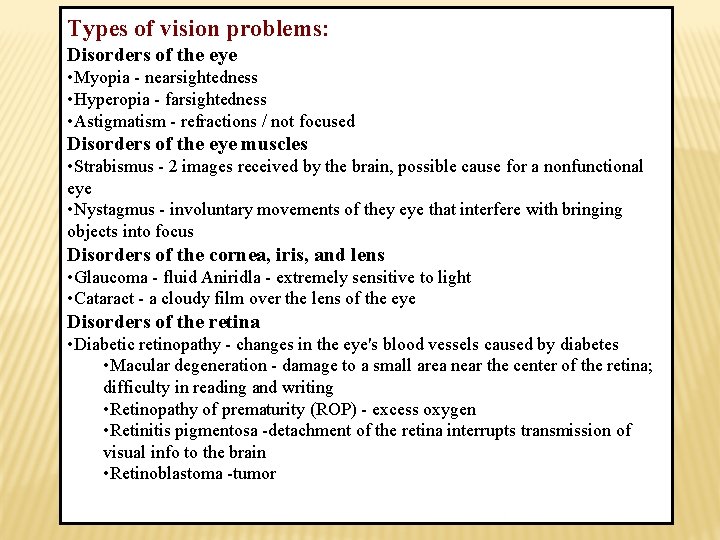
Types of vision problems: Disorders of the eye • Myopia - nearsightedness • Hyperopia - farsightedness • Astigmatism - refractions / not focused Disorders of the eye muscles • Strabismus - 2 images received by the brain, possible cause for a nonfunctional eye • Nystagmus - involuntary movements of they eye that interfere with bringing objects into focus Disorders of the cornea, iris, and lens • Glaucoma - fluid Aniridla - extremely sensitive to light • Cataract - a cloudy film over the lens of the eye Disorders of the retina • Diabetic retinopathy - changes in the eye's blood vessels caused by diabetes • Macular degeneration - damage to a small area near the center of the retina; difficulty in reading and writing • Retinopathy of prematurity (ROP) - excess oxygen • Retinitis pigmentosa -detachment of the retina interrupts transmission of visual info to the brain • Retinoblastoma -tumor
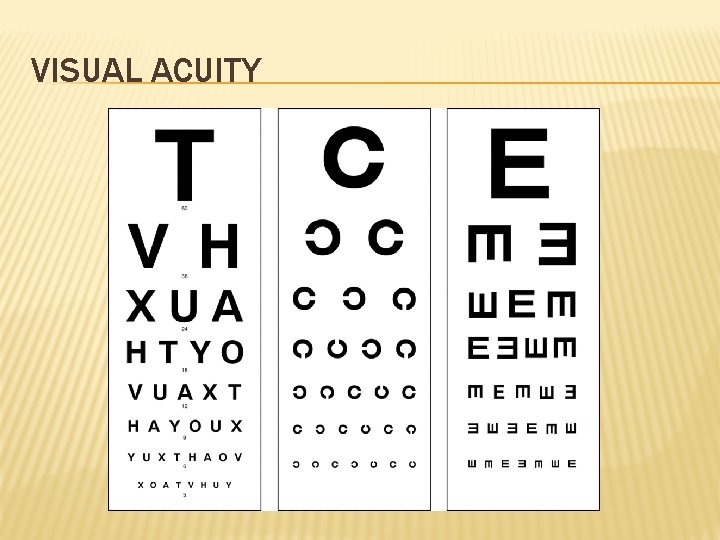
VISUAL ACUITY
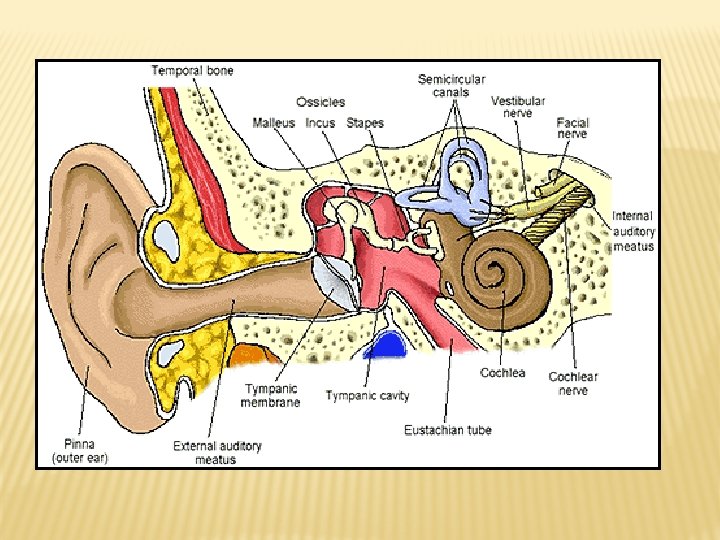
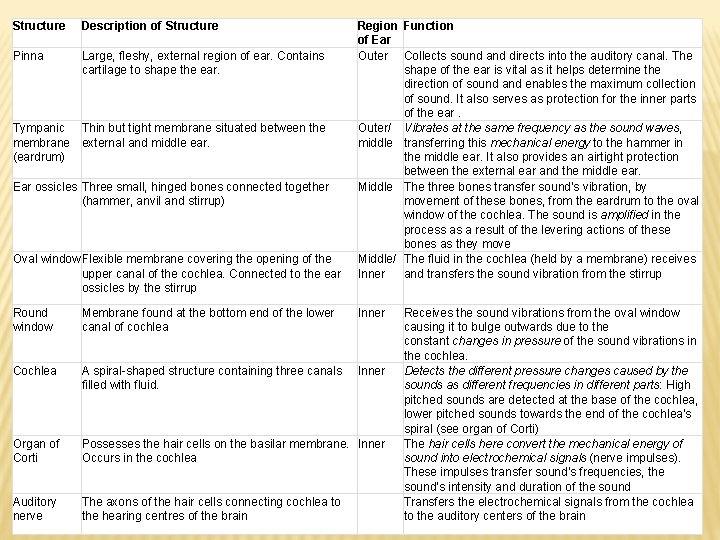
Structure Description of Structure Pinna Large, fleshy, external region of ear. Contains cartilage to shape the ear. Tympanic Thin but tight membrane situated between the membrane external and middle ear. (eardrum) Ear ossicles Three small, hinged bones connected together (hammer, anvil and stirrup) Oval window. Flexible membrane covering the opening of the upper canal of the cochlea. Connected to the ear ossicles by the stirrup Region Function of Ear Outer Collects sound and directs into the auditory canal. The shape of the ear is vital as it helps determine the direction of sound and enables the maximum collection of sound. It also serves as protection for the inner parts of the ear. Outer/ Vibrates at the same frequency as the sound waves, middle transferring this mechanical energy to the hammer in the middle ear. It also provides an airtight protection between the external ear and the middle ear. Middle The three bones transfer sound's vibration, by movement of these bones, from the eardrum to the oval window of the cochlea. The sound is amplified in the process as a result of the levering actions of these bones as they move Middle/ The fluid in the cochlea (held by a membrane) receives Inner and transfers the sound vibration from the stirrup Round window Membrane found at the bottom end of the lower canal of cochlea Inner Cochlea A spiral-shaped structure containing three canals filled with fluid. Inner Organ of Corti Possesses the hair cells on the basilar membrane. Inner Occurs in the cochlea Auditory nerve The axons of the hair cells connecting cochlea to the hearing centres of the brain Receives the sound vibrations from the oval window causing it to bulge outwards due to the constant changes in pressure of the sound vibrations in the cochlea. Detects the different pressure changes caused by the sounds as different frequencies in different parts: High pitched sounds are detected at the base of the cochlea, lower pitched sounds towards the end of the cochlea's spiral (see organ of Corti) The hair cells here convert the mechanical energy of sound into electrochemical signals (nerve impulses). These impulses transfer sound's frequencies, the sound's intensity and duration of the sound Transfers the electrochemical signals from the cochlea to the auditory centers of the brain
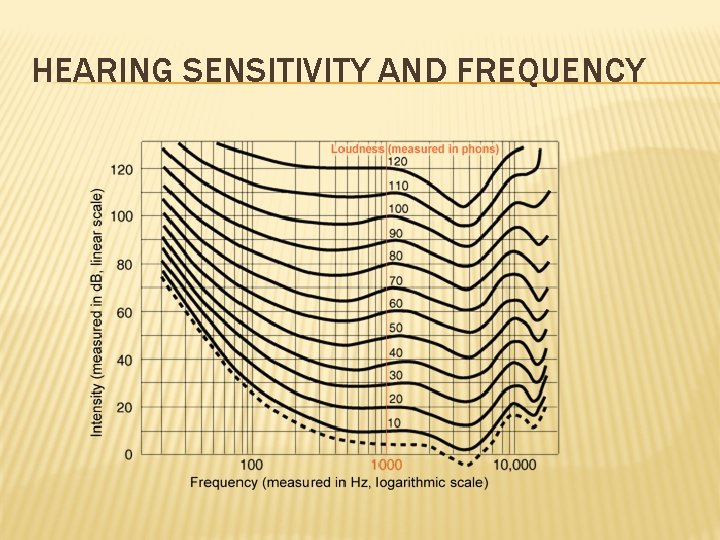
HEARING SENSITIVITY AND FREQUENCY
Tight Targets Take Time
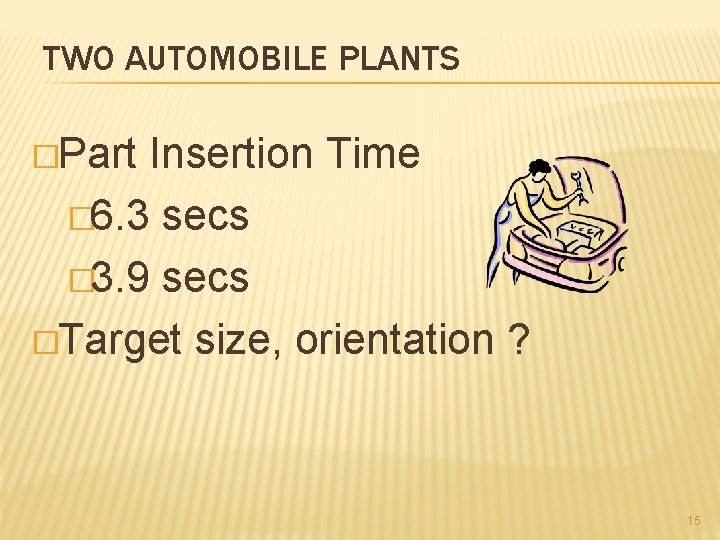
TWO AUTOMOBILE PLANTS �Part Insertion Time � 6. 3 secs � 3. 9 secs �Target size, orientation ? 15
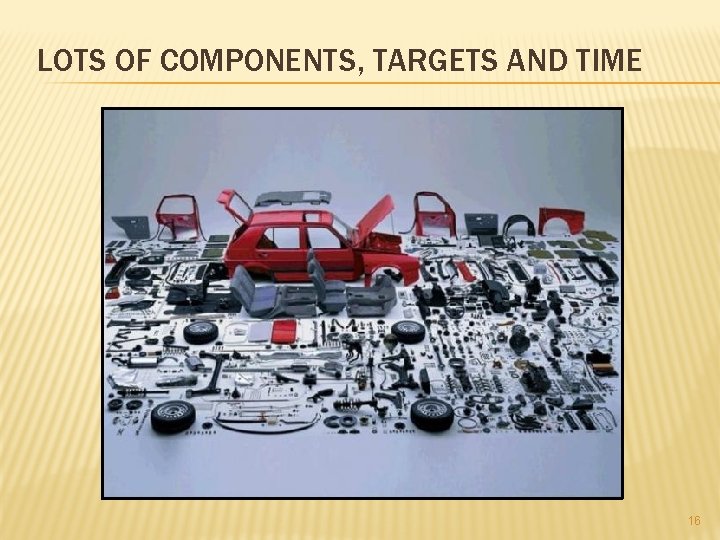
LOTS OF COMPONENTS, TARGETS AND TIME 16
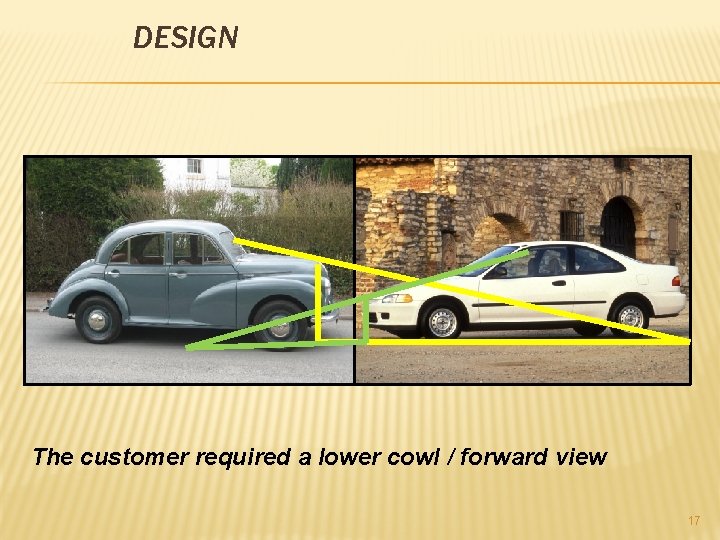
DESIGN The customer required a lower cowl / forward view 17
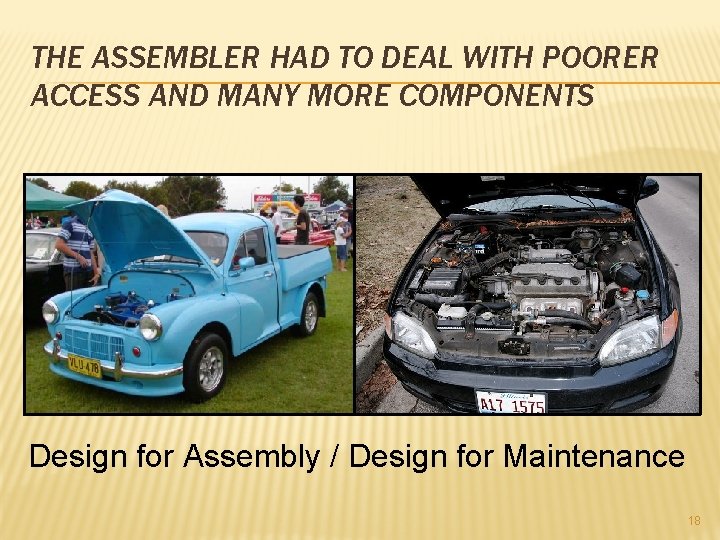
THE ASSEMBLER HAD TO DEAL WITH POORER ACCESS AND MANY MORE COMPONENTS Design for Assembly / Design for Maintenance 18
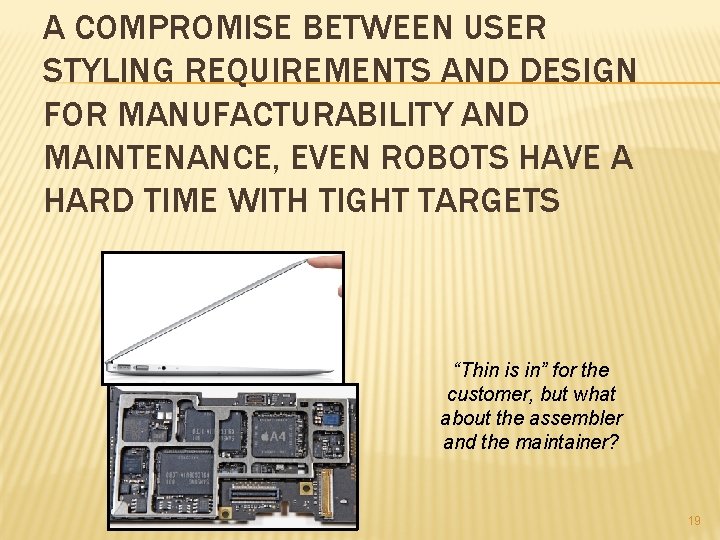
A COMPROMISE BETWEEN USER STYLING REQUIREMENTS AND DESIGN FOR MANUFACTURABILITY AND MAINTENANCE, EVEN ROBOTS HAVE A HARD TIME WITH TIGHT TARGETS “Thin is in” for the customer, but what about the assembler and the maintainer? 19
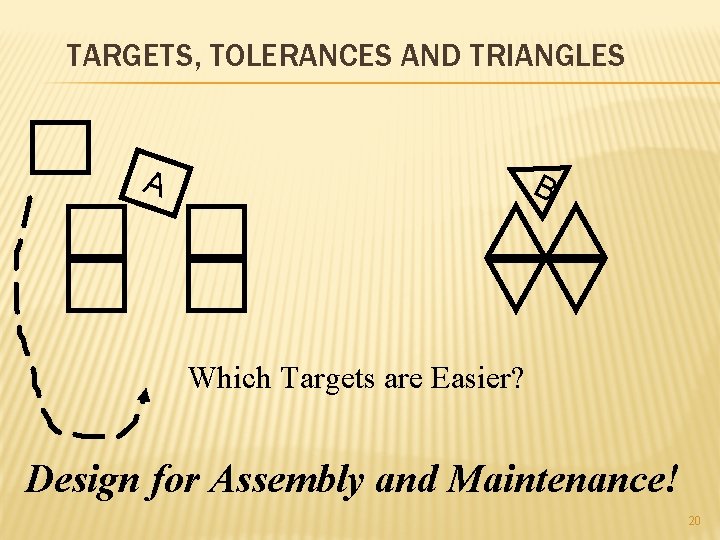
TARGETS, TOLERANCES AND TRIANGLES A B Which Targets are Easier? Design for Assembly and Maintenance! 20
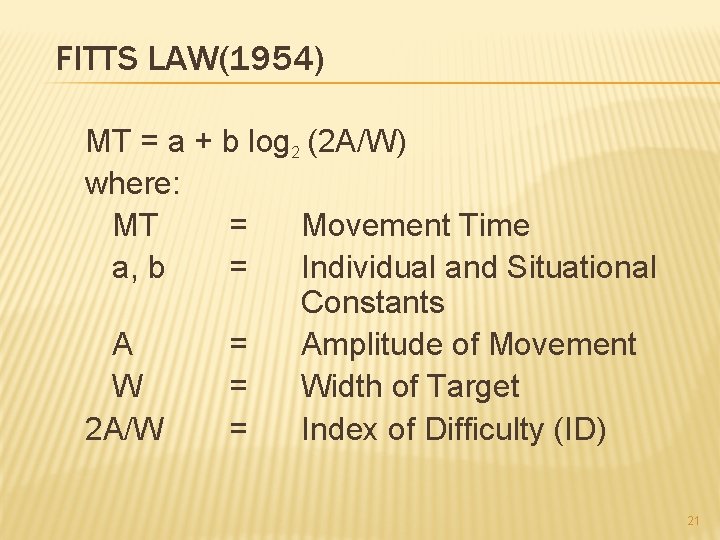
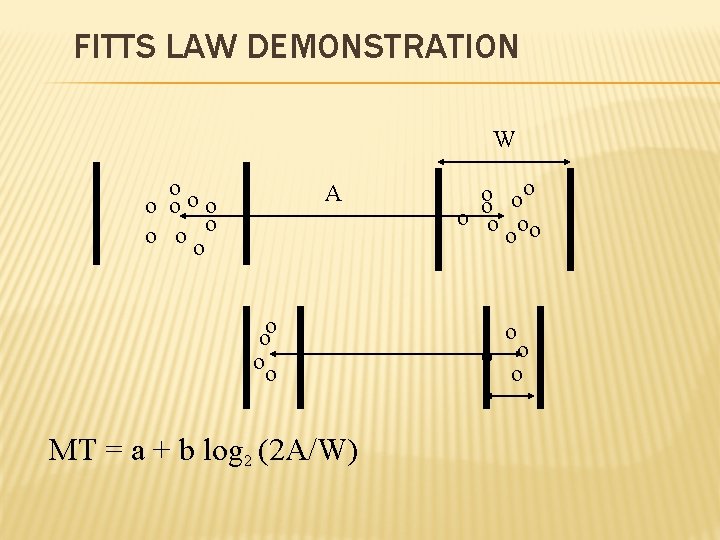
FITTS LAW(1954) MT = a + b log 2 (2 A/W) where: MT = Movement Time a, b = Individual and Situational Constants A = Amplitude of Movement W = Width of Target 2 A/W = Index of Difficulty (ID) 21
CASE STUDY BARBIE DOLLS � � � How long does it take to assemble and pack a set of clothes for a Barbie Doll? How many assemblies per day? How many workers are needed? TARGETS!!! 22
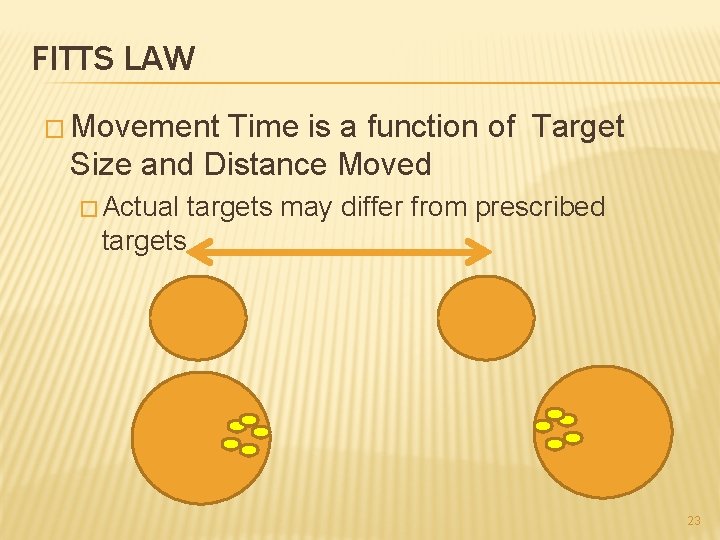
FITTS LAW � Movement Time is a function of Target Size and Distance Moved � Actual targets may differ from prescribed targets 23
FITTS LAW DEMONSTRATION W oo o o oo A oo oo MT = a + b log 2 (2 A/W) oo oo o o o
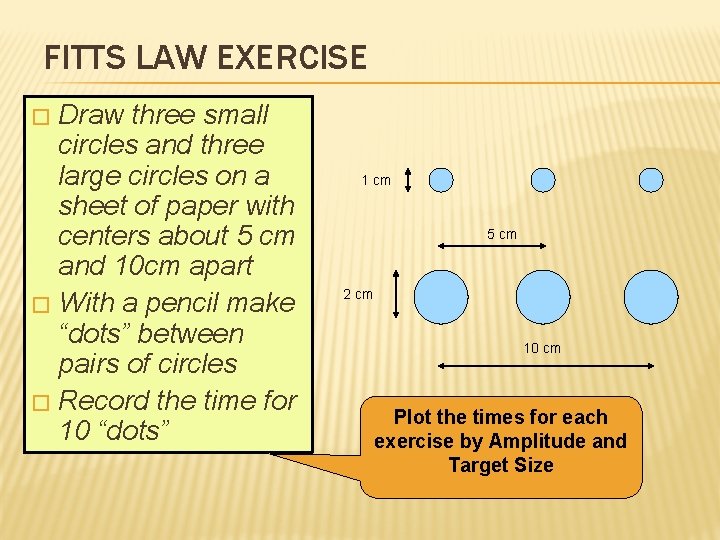
FITTS LAW EXERCISE Draw three small circles and three large circles on a sheet of paper with centers about 5 cm and 10 cm apart � With a pencil make “dots” between pairs of circles � Record the time for 10 “dots” � 1 cm 5 cm 2 cm 10 cm Plot the times for each exercise by Amplitude and Target Size
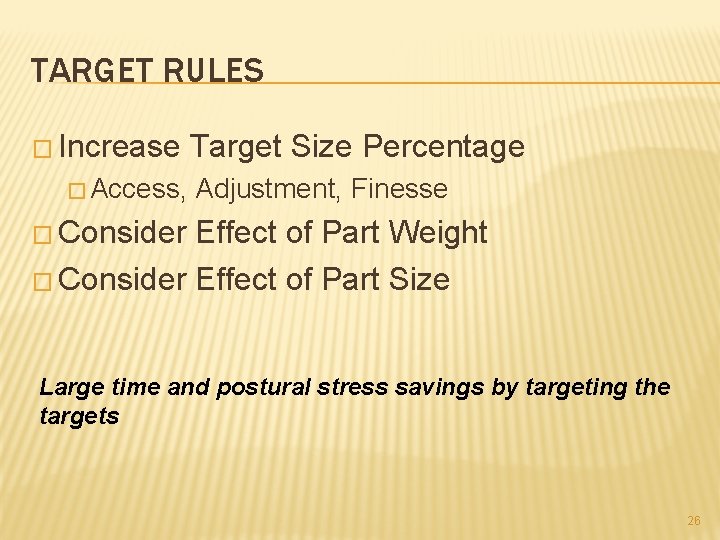
TARGET RULES � Increase � Access, Target Size Percentage Adjustment, Finesse � Consider Effect of Part Weight � Consider Effect of Part Size Large time and postural stress savings by targeting the targets 26
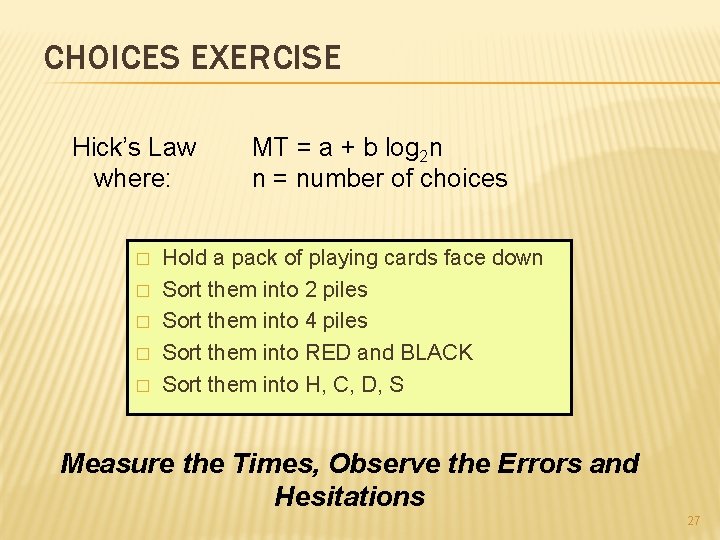
CHOICES EXERCISE Hick’s Law where: � � � MT = a + b log 2 n n = number of choices Hold a pack of playing cards face down Sort them into 2 piles Sort them into 4 piles Sort them into RED and BLACK Sort them into H, C, D, S Measure the Times, Observe the Errors and Hesitations 27
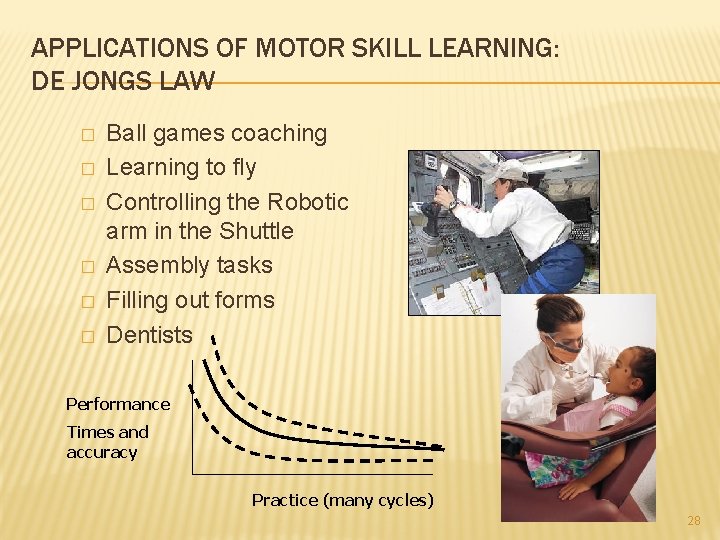
APPLICATIONS OF MOTOR SKILL LEARNING: DE JONGS LAW � � � Ball games coaching Learning to fly Controlling the Robotic arm in the Shuttle Assembly tasks Filling out forms Dentists Performance Times and accuracy Practice (many cycles) 28
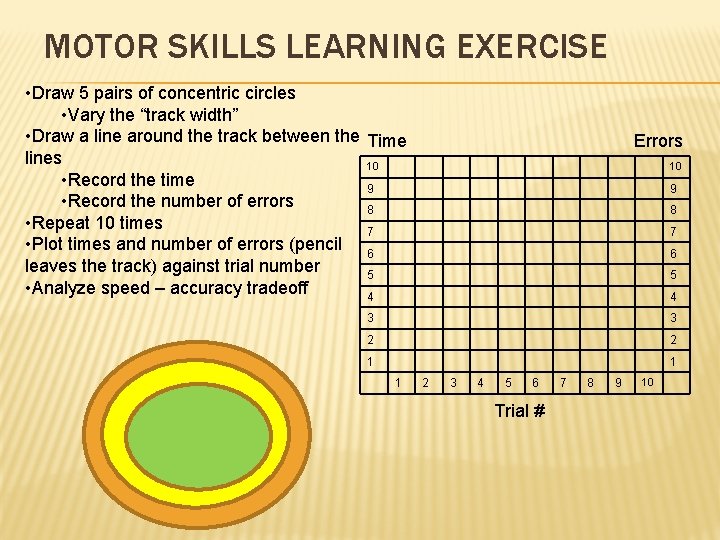
MOTOR SKILLS LEARNING EXERCISE • Draw 5 pairs of concentric circles • Vary the “track width” • Draw a line around the track between the Time lines 10 • Record the time 9 • Record the number of errors 8 • Repeat 10 times 7 • Plot times and number of errors (pencil 6 leaves the track) against trial number 5 • Analyze speed – accuracy tradeoff 4 Errors 10 9 8 7 6 5 4 3 3 2 2 1 1 1 2 3 4 5 6 Trial # 7 8 9 10
1. Repeat with different diameters and track widths 2. Analyze time / error against diameter / track width 3. Develop Latin Square experiment (Subject / Target Width / Trial) 1 2 5 3 1 2 3 4 5 1 2 4 5 1 2 3 5 5 1 2 3 4 5 4
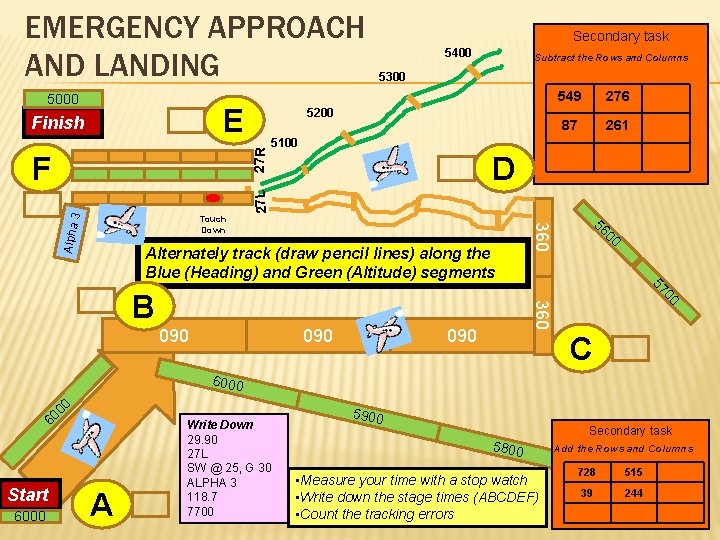
EMERGENCY APPROACH AND LANDING 5000 E Subtract the Rows and Columns 5300 3 5000 276 87 261 D Alternately track (draw pencil lines) along the Blue (Heading) and Green (Altitude) segments 090 56 0 0 57 00 360 B 360 Touch Down Alpha 549 5100 27 L F 5400 5200 27 R Finish Secondary task 090 C 60 00 6000 Start 6000 A Write Down 29. 90 27 L SW @ 25, G 30 ALPHA 3 118. 7 7700 5900 Secondary task 5800 • Measure your time with a stop watch • Write down the stage times (ABCDEF) • Count the tracking errors Add the Rows and Columns 728 515 39 244 31
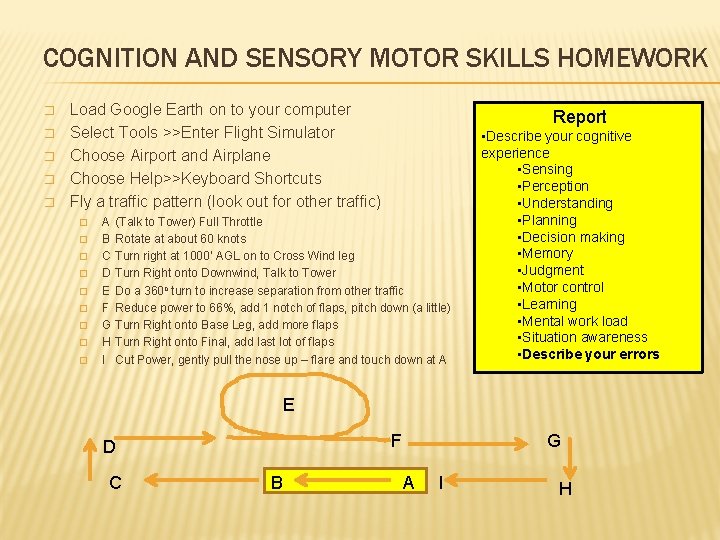
COGNITION AND SENSORY MOTOR SKILLS HOMEWORK � � � Load Google Earth on to your computer Select Tools >>Enter Flight Simulator Choose Airport and Airplane Choose Help>>Keyboard Shortcuts Fly a traffic pattern (look out for other traffic) � � � � � A B C D E F G H I Report (Talk to Tower) Full Throttle Rotate at about 60 knots Turn right at 1000’ AGL on to Cross Wind leg Turn Right onto Downwind, Talk to Tower Do a 360 o turn to increase separation from other traffic Reduce power to 66%, add 1 notch of flaps, pitch down (a little) Turn Right onto Base Leg, add more flaps Turn Right onto Final, add last lot of flaps Cut Power, gently pull the nose up – flare and touch down at A • Describe your cognitive experience • Sensing • Perception • Understanding • Planning • Decision making • Memory • Judgment • Motor control • Learning • Mental work load • Situation awareness • Describe your errors E F D C B G A I H
DESIGN FOR SENSORY MOTOR PERFORMANCE: OPERATIONS, MANUFACTURING AND MAINTENANCE TARGET THE TARGETS REDUCE THE CHOICES PROVIDE PRACTICE 33