
Sensory Integration Overview and strategies Alive Awake Alert

- Slides: 24
Sensory Integration Overview and strategies
Alive, Awake, Alert, Enthusiastic (Sing to tune of “If You’re Happy & You Know IT”) I’m alive, awake, alert, enthusiastic I’m Alive, Awake, Alert, Enthusiastic I’m Alive, Awake, Alert, I’m Alert, Awake, Alive, I’m Alive, Awake, Alert, Enthusiastic (Bend, Hips, Shoulders, Reach) Repeat, increase speed with repetition!
“Over 80% of the nervous system is involved in processing or organizing sensory input, & thus the brain is primarily a sensory processing machine” ~A. Jean Ayres � Sensory integration (SI) was identified in 1972 by A. Jean Ayres as a neurological process that takes place naturally in a normally developing child � 5 functions of the brain: SI, Thinking/learning/language/perception, motor (fine/gross/speaking), Emotional & behavioral control, vital functions � Sensory processing activities: Reception, Detection, integration, modulation, discrimination, postural responses, praxis
Sensory Processing Disorder � Basic definition: The brain mutes or magnifies sensory messages inappropriately. � 6 factors indicative of worst case SPD (Dr. John F. Taylor, ph. D. , clinical psychologist): › › › Fussy/picky eater Digestive anomalies/problems Allergies Sweat at night Adequate sleep (9 hours is optimal) Teeth grinding
Sensory Integration Dysfunction � SI dysfunction results in an inability to organize & integrate sensory input. � To the individual with SI dysfunction, sensory experiences are unpredictable, lack meaning, & affect the person differently from one time to the next. Inconsistency places the individual in a high stress or anxiety mode. � Dysfunction may occur at various levels: registration, integration/organization, modulation, sensory processing
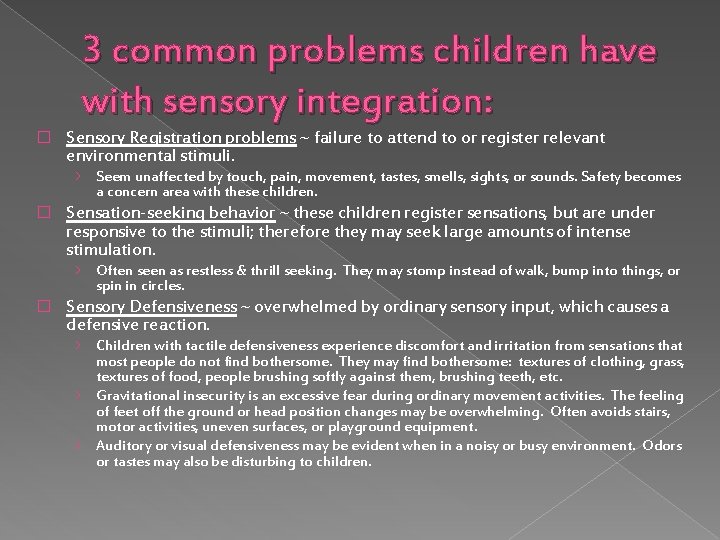
3 common problems children have with sensory integration: � Sensory Registration problems ~ failure to attend to or register relevant environmental stimuli. › Seem unaffected by touch, pain, movement, tastes, smells, sights, or sounds. Safety becomes a concern area with these children. � Sensation-seeking behavior ~ these children register sensations, but are under responsive to the stimuli; therefore they may seek large amounts of intense stimulation. › Often seen as restless & thrill seeking. They may stomp instead of walk, bump into things, or spin in circles. � Sensory Defensiveness ~ overwhelmed by ordinary sensory input, which causes a defensive reaction. › Children with tactile defensiveness experience discomfort and irritation from sensations that most people do not find bothersome. They may find bothersome: textures of clothing, grass, textures of food, people brushing softly against them, brushing teeth, etc. › Gravitational insecurity is an excessive fear during ordinary movement activities. The feeling of feet off the ground or head position changes may be overwhelming. Often avoids stairs, motor activities, uneven surfaces, or playground equipment. › Auditory or visual defensiveness may be evident when in a noisy or busy environment. Odors or tastes may also be disturbing to children.
Sensory Integration Therapy Involves the use of specific techniques requiring a complex understanding of this approach. Therapeutic intervention should always be administered by a professional with SI training. � Although not intended to be a substitute for therapy, several techniques/tools may be utilized in the classroom to improve student’s overall learning experience. � In a clinical therapy setting, SI works toward changing the child’s Sensory systems. In other environments (school/home) the focus is on making the world accessible for the child. �
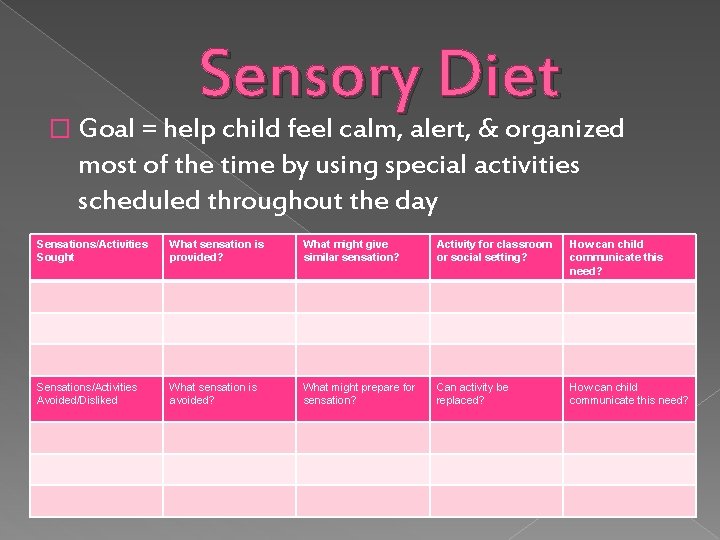
Sensory Diet � Goal = help child feel calm, alert, & organized most of the time by using special activities scheduled throughout the day Sensations/Activities Sought What sensation is provided? What might give similar sensation? Activity for classroom or social setting? How can child communicate this need? Sensations/Activities Avoided/Disliked What sensation is avoided? What might prepare for sensation? Can activity be replaced? How can child communicate this need?
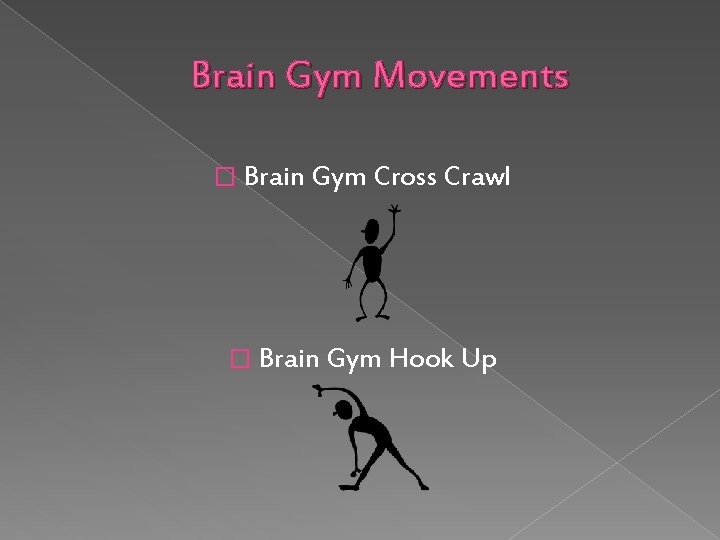
Brain Gym Movements � Brain Gym Cross Crawl � Brain Gym Hook Up
Sensory Systems � Vestibular system (movement) � Proprioceptive system (body awareness) � Tactile system (touch) � Auditory System � Visual System � Olfactory System
Vestibular System � Provides unconscious information from the inner ear about one’s equilibrium (state of balance) & head/body movements away from & to, the center of gravity. � Observations indicating problems with this system might include: falls off chair, clumsy/awkward/uncoordinated movements, craves movement, does not get dizzy, intolerant of movement, gets car sick.
Proprioceptive System � Provides unconscious information from muscles and joints & gives info about movement/change of position in space related to the pressure/stretch of muscles/joints. Provides body scheme/awareness ~ “internal eyes” � Observations that may indicate challenges with this system: knocks things off desk, stiff &/or uncoordinated movements, difficulty with clothing management, cannot do things without looking, holds objects too hard/soft.
Tactile System Receptors on skin/inside the mouth, which allow interpretation of light touch, pain, temperature, & pressure. Tactile input is ongoing with 2 functions: exploration – learning - discrimination and defense. � Observations that might indicate challenges with the tactile system include: high tolerance for pain, cannot discriminate objects by feel, aversion to being touched, avoids messy activities, difficulty standing in line, fussy about clothing, touching others/objects excessively. �
Auditory System � Hearing sense that allows for interpretation of environmental sounds: closely associated with the vestibular system. Aside from normal hearing acuity, child must be able to attend, process, remember, & interpret sounds. � Observations that may indicate concerns with auditory stimulation: distress with loud/sudden noises; distress with sounds that typically do not bothers (such as the toilet flushing, fans running, etc).
Visual System � Process that enables a person to make sense of what is seen. � Observations indicative of visual system challenges include: turn/tilt head while reading, difficulty tracking a moving object, rub eyes or blink/squint excessively, fatigue during visual concentration on school work.
Olfactory System � Receptors located in the nose allow for the sense of smell. � Notable observations may include: obsessive smelling or extreme aversive reactions to substances. Olfactory sensitivities may result in any environment feeling overpowering.
Alerting for learning � Stretchy Bands
Identifying sensory challenges � Requires observations across various settings. Often accomplished via direct observations, interviews/checklists, standardized testing to compile a profile of sensory strengths/challenges. � Ongoing process as child grows & develops and/or to identify typical behaviors not due to special influences (fatigue, med changes, time factors, etc).
The Environment � Make environment predictable & comfortable to improve focus, learning, and interactions. � People bring a great deal of potentially disrupting sensory stimuli in the form of voice, odors, eye contact, touch, etc. � Environmental modifications are simple & have been found to be extremely effective in treatment. Notice factors that increase or decrease arousal.
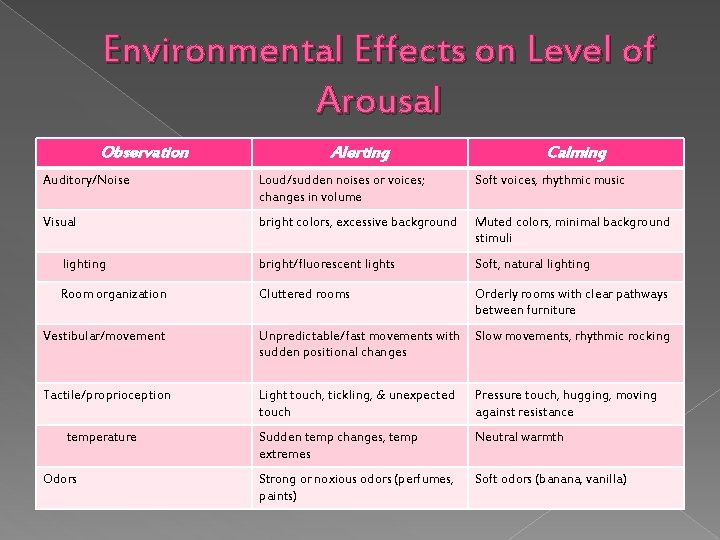
Environmental Effects on Level of Arousal Observation Alerting Calming Auditory/Noise Loud/sudden noises or voices; changes in volume Soft voices, rhythmic music Visual bright colors, excessive background Muted colors, minimal background stimuli lighting bright/fluorescent lights Soft, natural lighting Room organization Cluttered rooms Orderly rooms with clear pathways between furniture Vestibular/movement Unpredictable/fast movements with sudden positional changes Slow movements, rhythmic rocking Tactile/proprioception Light touch, tickling, & unexpected touch Pressure touch, hugging, moving against resistance Sudden temp changes, temp extremes Neutral warmth Strong or noxious odors (perfumes, paints) Soft odors (banana, vanilla) temperature Odors
Environmental Strategies � Reduce sound distractions � Reduce visual distractions � Manage vestibular input & movement � Manage tactile & proprioceptive input � Control temperature & odors � Provide a quiet corner � Alternative seating � Observe positioning of materials � Provide environmental visual supports
Just a few classroom ideas… � � � � � Fidgets ~ stress ball, chew toys, paperclip, pen cap, masking tape… Weighted input ~ heavy blanket across legs or over shoulders, push heavy cart/furniture, ankle/wrist weights Seat cushion ~ bean bag or air filled Tie co-ban around the legs of the chair foot fidget Reduced lighting, calming music Tape lines on the floor ~ to identify boundaries; midline crossing games. Chair push-ups, body stretches, Brain Gym Hard candies, ‘thinking’ gum, cold water Avoid very light touch; approach child from the front Use visual cues such as timers, schedules, etc.
References/Resources � � � � The Sensory Connection: An OT and SLP Team Approach by Nancy Kashman & Janet Mora Answers to Questions Teachers Ask about Sensory Integration by Carol Kranowitz & Stacey Szklut Inclusive Programming for Elementary Students with Autism by Sheila Wagner The Out-of-Sync Child by Carol Stock Kranowitz The out-of-Sync Child Has Fun by Carol Stock Kranowitz Dr. John F. Taylor’s website: www. ADD-Plus. com. Sensory Defensiveness in Children Aged 2 – 12 by Patricia Wilbarger & Julia Leigh Wilbarger
Thank You!